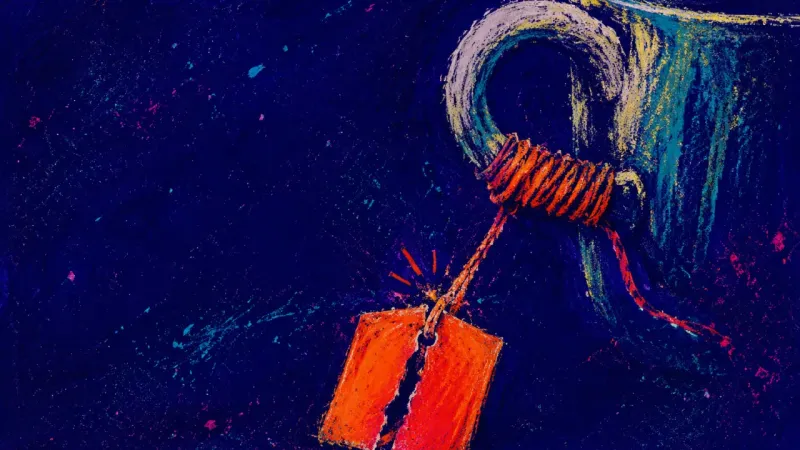
Finding Clarity in the 8:47 p.m. Streetcar Spiral
If you're a late-20s city creative who can present a Figma deck just fine but goes blank when a friend texts 'you're my best friend,' I usually know the shape of the knot before I even lay down a card. Jordan, a 27-year-old junior product designer in Toronto, joined my evening session from a tiny condo kitchen lit by one unforgiving overhead bulb. The fridge hummed behind them. Their hands still looked damp from dish soap. Their phone sat face-down on the table like it had said something too intimate to look at directly.
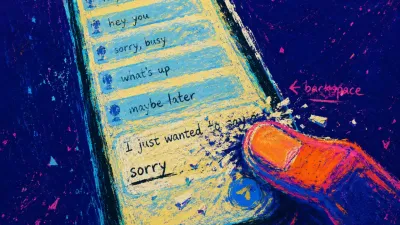
'It happened on the 504 King,' they told me. 'Tuesday. 8:47. I was heading east, the brakes were doing that awful screech, and my friend texted, "you're my best friend." I read it, typed something warm, deleted it, opened Instagram Stories for like twenty minutes, and told myself I'd answer when I could sound normal.'
I watched them give a short laugh that didn't make it all the way into a smile. Jordan wanted the closeness. That part was never the mystery. The mystery was why the second the closeness got spoken aloud, their chest tightened, their face went hot, and some private exit sign lit up inside them. They described it as feeling like being handed a fragile glass object on a moving streetcar: flattering for half a second, then instantly terrifying. By the time they booked with me, they had already searched some version of best friend anxiety, fear of intimacy in friendship, and why do I pull away when people get close.
I nodded and said what I needed them to hear first: the panic isn't proof you don't care; it's proof the moment feels high-stakes in your body. The sweetest text can still hit like an alarm. I told Jordan I wasn't interested in shaming the silence or forcing a perfect emotional script. I wanted to help them map the exact moment where affection turned into pressure, and then find one honest path through it. 'Let's draw a map through the fog,' I said. 'Not a grand solution. Just real clarity, and a next step you can actually use.'
Choosing the Map: A Four-Card Tarot Spread for Friendship Anxiety
I asked Jordan to put both feet on the floor and rest one hand on the mug beside them. I shuffled slowly at my desk while they took one long breath in and a longer breath out. I treat the opening of a reading the way I treat the opening of a fragrance formula: not as theater, but as a way to bring scattered material into focus.
For this session, I chose a spread called the Situation-Obstacle-Advice-Outcome · Context Edition. If you've ever wondered how tarot works with something as specific as freeze response texting, this is one of the clearest ways I know to use it. I wasn't trying to predict whether Jordan's friend was sincere, or whether the friendship would survive. The real knot lived inside Jordan's response the moment closeness became explicit. So I needed a compact, diagnostic arc: what happens on the surface, what hidden fear locks it in place, what energy interrupts the reflex, and what the next grounded expression of connection can look like.
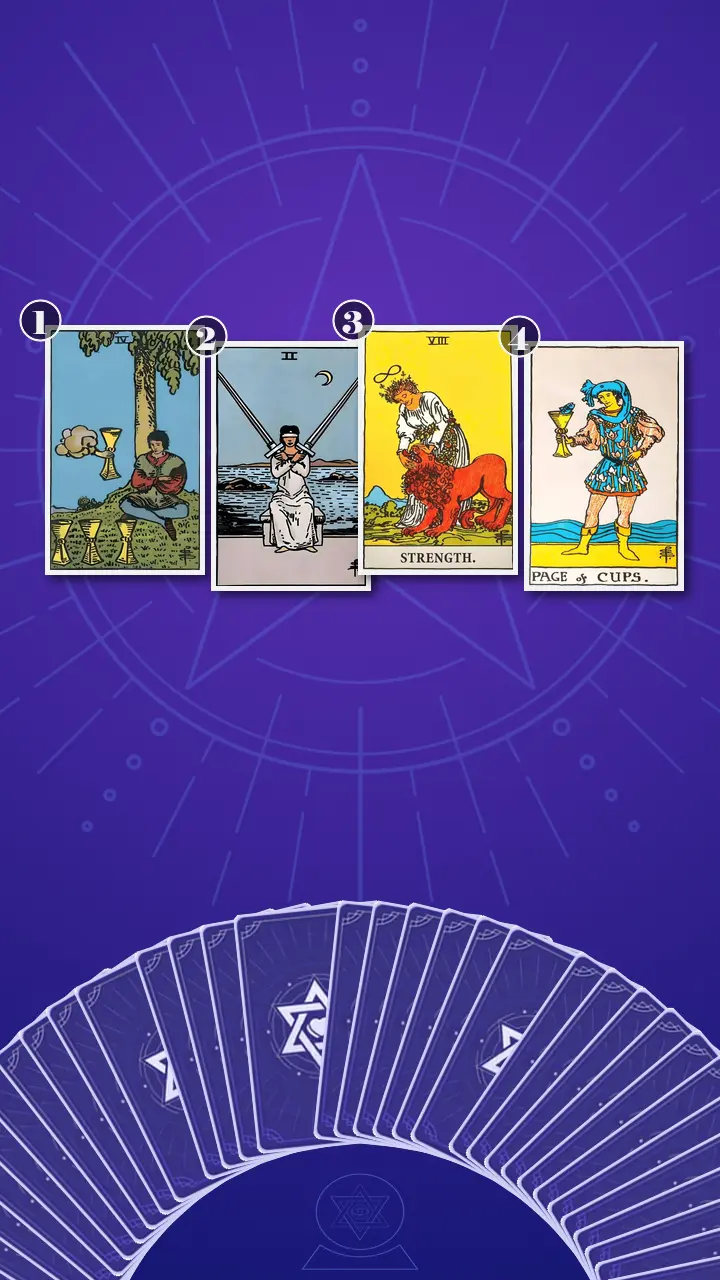
I laid the four cards in a straight line from left to right, like stepping-stones across a threshold. The first would show the visible shutdown reflex. The second would reveal the fear underneath it—what makes being called important feel so emotionally high-stakes. The third, which I already suspected would be the bridge, would show the corrective stance Jordan needed in the exact moment their system wanted to vanish. And the fourth would show me what friendship could look like if it stopped feeling like a spotlight and started feeling like a shared space again.
The Cup Left on Read
The Message That Felt Heavier Than It Looked
I turned the first card. 'This one sits in the position of the visible symptom,' I said, 'the immediate shutdown or withdrawal that appears when closeness is named.' The card was the Four of Cups, upright.
I smiled softly, because the image was almost too precise. In modern life, this is the commute-home message you absolutely wanted to receive until it actually arrives: the glowing iMessage bubble, the phone going face-down in your palm, the reflexive switch to Instagram Stories because receiving the closeness in real time suddenly feels heavier than wanting it from a distance. The Four of Cups is stagnant Water. Feeling is present, but reception is blocked. The offered cup is there. The care is real. But your system folds its arms and turns away before your heart has even had time to say yes.
'This is not indifference,' I told Jordan. 'It's overwhelm.' Wanting to disappear doesn't cancel the fact that you care. The problem is not a cold heart. It's that the body closes before the mind can explain why.' Jordan let out one short, bitter laugh and rubbed a thumb across the side of the mug. 'Wow,' they said. 'That's so accurate it's kind of rude.' Their shoulders, which had been pitched up almost to their ears, stayed high—but something in their face softened. Recognition had landed.
The Drafts Folder Armor
I turned the second card. 'This one shows the hidden fear and defensive logic underneath the shutdown,' I said. 'Why does being called “best friend” suddenly feel like a role you could fail?' The card was the Two of Swords, upright.
This was Jordan with three drafts open between Notes and iMessage: one too intense, one too casual, one too fake. Send none. Stay unreadable. Freeze both options—lean in or back away—so nobody can judge you in real time. The Two of Swords is Air turned rigid. Too much mental calibration, not enough permission to feel. The blindfold is tone uncertainty. The crossed swords over the chest are the exact inner guard you raise where tenderness is trying to move.
This is where I used the lens I call Social Pattern Analysis. I always listen for the moment a relationship stops feeling mutual and starts feeling like an invisible role assignment. Jordan didn't hear 'you're my best friend' as affection alone. They heard a job description: always available, always emotionally fluent, always certain. Closeness became a spotlight the second it was named. And because I spent years training my nose in perfume labs, I had a flash of a lesson I learned there too: if I kept stripping a formula of every risky note, I could make it technically safe—and completely lifeless. Looking at those crossed swords over the heart, I felt the same problem. Jordan had been editing themselves for safety until the connection could barely breathe.
Jordan went still, then looked away from the camera toward the dark window over the sink. First came the physical tell: a tiny pause in their breathing. Then the cognitive hit: their eyes unfocused, clearly replaying old message threads. Then the feeling surfaced. 'Ouch,' they said quietly. 'I'm not actually trying to avoid people. I'm trying not to fail them.' I nodded. That sentence, more than any search phrase, was the lock clicking open.
When Strength Put a Hand on the Lion
The Bridge Between Panic and Presence
When I turned the third card, the air changed. Even the fridge hum on Jordan's end seemed louder, as if the room itself knew we had arrived at the hinge of the reading. 'This card sits in the position of guidance,' I said, 'the quality that can interrupt the reflex to disappear.' The card was Strength, upright.
I loved seeing it there. In real life, Strength is not dramatic vulnerability. It's the moment the exposure spike hits and you do one grounding action before obeying it: both feet on the floor, one breath, one hand on your chest or around a mug, and then one honest sentence goes out while you're still a little shaky. This is balanced Fire—regulated courage, not force. I told Jordan, 'You do not have to become calm before you become honest. And you do not need a perfect reply to give a real one.'
Presence Has Sillage
Because fragrance is one of my native languages, I explained the card the way I understand presence. In perfumery, sillage is the trail a scent leaves behind it. People often think presence has to work in extremes: either project hard enough to fill the room, or disappear completely. But the most trustworthy formulas don't do that. A good woody base gives the whole composition structure without shouting. Strength felt exactly like that to me—first impression calibration through sillage control. Jordan did not need to spray the whole bottle of their feelings to prove they cared. They only needed enough honest presence for the other person to feel them there. Breathable, skin-close, real.
Then I slowed down and gave the card its full weight. 'Picture that streetcar again,' I said. 'The screen lights up with something genuinely sweet, and within seconds you're toggling between drafts and Instagram because your chest got tight before your brain had time to say, “I actually wanted this.” You're caught in the idea that being important means you now have to answer perfectly.'
You do not have to bolt the moment affection feels intense; place a steady hand on the lion of your nervous system and answer from presence instead of panic.
Jordan froze so completely I could hear the silence between us. First came the body: their inhale stopped halfway, their thumb hovered over the dark screen beside them, and the muscles around their mouth pulled tight as if bracing for impact. Then came the mind catching up. Their gaze went soft and far away, replaying a Tuesday streetcar, a Monday dinner text, three unsent drafts, the whole relief-now-guilt-later loop. When the emotion finally surfaced, it wasn't neat relief first. It was resistance. 'But doesn't that mean I've been making this way harder than it had to be?' they asked, voice suddenly sharper. 'Like... people think I'm distant when I'm actually panicking because they matter?' I let that sting stay in the room for a beat. Then I said, 'Yes. And it also means the pattern was protection, not proof that you're incapable of closeness. It made sense to your nervous system. It just costs more now than it gives.' Their shoulders dropped a full inch. One hand moved to the center of their chest. A shaky laugh escaped them, and right behind it came the wet shine in their eyes—the strange dizziness that comes when the burden shifts and you're left standing in new responsibility. I asked gently, 'Now, with this new view, think about last week. Was there a moment when this would have changed the feeling?' Jordan swallowed and nodded. 'The dinner text,' they said. 'I could've just said I got weird after our vulnerable hang and still wanted to see them.' That was the bridge: from intimacy panic and performance pressure to steady, imperfect closeness.
The Honest Beta Version
A Reply That Sounded Like a Person
I turned the final card. 'This one sits in the position of the integrated next step,' I said. 'Not a fixed prediction—more like the shape connection can take when the old defense loosens.' The card was the Page of Cups, upright.
I almost laughed with relief. The Page of Cups is small sincerity. A slightly awkward but warm text. A 20-second voice note. A reschedule paired with genuine care. Not a polished speech, not a lifetime promise, not customer-support language disguised as intimacy. Fresh Water, not stagnant Water. Feeling that can move again. For Jordan, who designs prototypes for a living, I translated the card in terms they could feel immediately: this is shipping the honest v1 instead of waiting for an impossible final release.
'So I don't need a perfect statement,' Jordan said, finally smiling for real. 'I need a human one.' Exactly. The fish rising unexpectedly from the cup is that surprising line that slips out when you stop editing yourself to death: 'That means a lot to me.' 'I get shy with sweet texts.' 'I care about you too.' Small, sincere, unfinished—and enough to keep the friendship breathing. Jordan's whole posture looked different by then. Not loose, exactly. But less armored. Less like they were auditioning for the role of ideal best friend, and more like they were allowed to simply participate.
From Spotlight to Shared Space
Once all four cards were down, the story was clean. First, the Four of Cups showed me the visible reflex: care arrives, and the body shuts the door before the heart can receive it. Then the Two of Swords showed me the hidden lock: affection becomes a calibration exercise, and silence starts masquerading as carefulness. Strength broke that closed architecture not by demanding fearless openness, but by teaching Jordan how to stay in the room with their own nervous system. And the Page of Cups gave the new relational style: no grand performance, just one modest honest reply that lets connection remain human.
I told Jordan their biggest blind spot was this: they had been treating closeness as a role they needed to perform perfectly, rather than a bond they could co-create imperfectly. That is why friendship had started feeling like pressure instead of comfort. The transformation direction was simple, but not shallow—move from spotlight to shared space; from performance to participation; from disappearing urges to steadier closeness. Friendship can be co-created, not flawlessly performed.
- The Hand-on-Phone Citrus ResetThe next time a heartfelt text lands—on the TTC, at your desk after Slack goes quiet, or alone in your kitchen—keep the chat open, put both feet on the floor, and take one slow exhale before deciding what the message means. If scent helps you regulate, use one light citrus spray or even the smell of orange peel as a reset for 30 seconds.If your brain says this is dramatic, assume the freeze cycle is talking. The goal is not full calm; it's slightly more presence.
- The Two-Sentence Beta ReplyPin this in Notes and use it within 15 minutes when possible: 'That means a lot to me.' Plus one true qualifier: 'I get a little awkward with sweet texts, but I care about you too.' If typing feels too exposed, record a 20- to 30-second voice note draft first.Lower the bar on purpose. Honest beta version beats elegant silence every time.
- The Same-Message RepairIf you need to reschedule or clarify with this friend this week, pair it with one concrete repair move in the same message: a new day, a check-in time, or one expectation reset such as 'I'm not always the fastest texter, but I do come back.' Keep it to one topic only.Clarity creates less pressure than silence. You do not have to explain your whole personality—just one useful truth.
Because Jordan responds strongly to atmosphere, I added one more sensory note from my own toolkit: before an in-person hang that feels emotionally loaded, wear something skin-close and woody—cedar, vetiver, or a quiet sandalwood. Not as armor. As structure. In my world, a grounded base note helps the heart notes behave. In human terms, it can remind the body that presence does not have to be loud to be steady.

A Week Later, the Quiet Proof
Five days later, Jordan messaged me from a coffee shop in the west end. They had used the two-sentence reply after their friend sent another sweet check-in: 'That means a lot to me. I get weirdly shy with sweet texts, but I care about you too.' Later, when they had to move dinner, they added, 'I'm still in—can we do Thursday instead?' They told me they stared at the sent message for three full minutes afterward, half relieved and half nauseous. The next morning, their first thought was still, 'What if that was cringe?'—but this time they laughed, made coffee, and didn't delete themselves from the friendship in their head.
That is what a real Journey to Clarity looks like to me. Not becoming instantly fearless. Not transforming into the world's most emotionally fluent texter overnight. Just moving, one card at a time, from intimacy panic and performance pressure toward steady, imperfect closeness. This little Situation-Obstacle-Advice-Outcome spread did exactly what good tarot should do: it turned a shame spiral into a pattern, and a pattern into actionable next steps.
Sometimes the sweetest words can make your chest lock up, because being loved out loud feels less like comfort and more like being handed a role you're scared you won't be able to hold.
If closeness did not require a perfect version of you, what small, breathable line of truth could you let into the room tonight—no full performance, just enough honest sillage to say, 'I'm here'?
This story is adapted from psychological research, written so that those in a similar struggle can see their own pattern in it — and find their next step clearly.These insights are not a substitute for professional psychological, medical, legal, or financial advice.
Learn more about our Journey to Clarity.
How did this insight land for you?
🫂 This Resonates Deeply
🌀 Living This Story
✨ Now I See Clearly
🌱 Seeing New Possibilities
🧰 Useful Framework
🔮 The Confirmation I Needed
💪 Feeling Empowered
🚀 Ready for My Next Step
Author Profile
 AI
AI“As a perfumer for fifteen years, I’ve learned to perceive human boundaries through the delicate metaphor of scent. Relationships need the right amount of space to breathe, and I've seen too many kind souls exhaust themselves trying to please everyone. I’m here with warmth and understanding—not to teach you to be guarded, but to help you gently clear the air and rediscover the comforting, safe boundaries that are rightfully yours.”
In this Friendship Tarot Reading :
Core Expertise
- Boundary Permeability Diagnosis: Identifying friends whose lack of limits is metaphorically 'bleeding into your space' and causing emotional suffocation.
- Vibe Contamination Auditing: Recognizing when a highly sensitive or negative friend is unconsciously polluting your personal psychological atmosphere.
Service Features
- The Space Calibration Ritual: A behavioral directive to implement specific 'digital and physical blank spaces', preventing enmeshment and restoring breathable boundaries.
Also specializes in :
Explore Related Patterns:
Emotional Self-CensorshipJordan's warm reply being typed, deleted, rewritten, and withheld shows the honest feeling getting edited out before it can reach the friend. The issue is not a lack of care; it is the belief that care must pass a tone-safety test before it can be spoken. That is Emotional Self-Censorship. You protect the bond by becoming unreadable, hoping that if nothing vulnerable leaves your mouth or your phone, nothing can be judged, misunderstood, or used as proof that you are too much or not enough. The defense lowers immediate exposure while quietly starving the relationship of real signals. The later two-sentence reply matters because it names what censorship had been hiding: 'I get weirdly shy with sweet texts, but I care about you too.' That line does not overexplain or perform. It lets one useful truth into the room, which is exactly where the old pattern had been cutting off the connection.
Fearful-Avoidant AttachmentJordan wanting the closeness and then feeling an internal exit sign light up the second it is named shows a push-pull response around attachment. The bond is desired, but the explicit declaration makes the body act as if closeness has suddenly become unsafe. That is the mechanism behind Fearful-Avoidant Attachment in this story. Your system can crave connection and defend against it at the same time, especially when being important to someone feels like being handed something fragile you might drop. The fear is not just losing the person; it is being seen, needed, and evaluated inside the bond. The streetcar image makes the pattern concrete: flattering for half a second, then terrifying. You are not moving away because the friendship means nothing. You are moving away because it matters enough to activate a protective strategy that confuses intimacy with pressure and presence with danger.
Freeze ResponseJordan's phone going face-down, the deleted warm reply, and the twenty minutes on Instagram show a body-level shutdown before the mind can build a clean explanation. The text is sweet, but the nervous system treats it like a sudden demand for exposure. That is the logic of a Freeze Response. Instead of moving toward or away with a clear choice, your system suspends action: draft, delete, scroll, wait, go blank. The pause is trying to protect you from the intensity of being seen in real time, but it also turns a simple moment of care into a longer shame-and-delay loop. The pattern is especially visible because it repeats around different points of closeness: the streetcar text, the vulnerable hang, the dinner text, and the later sweet check-in. You wanted contact, but the first reflex was to immobilize until you could sound normal. That is not indifference; it is protective shutdown with a high social cost.
Relationship Performance AnxietyJordan's three unsent drafts after the 'you're my best friend' text show affection getting converted into an invisible performance review. The message was not rejected as unwanted; it was recoded as a role with hidden standards: be warm enough, not too intense, emotionally fluent, available, and certain. That is the mechanism of Relationship Performance Anxiety. When closeness starts to feel like a job description, your defensive system tries to prevent a relational mistake before anyone has actually asked for perfection. Silence then masquerades as carefulness because not replying feels safer than sending a human sentence that could be judged. The disappearing urge makes sense inside that logic. You are not failing to care; you are treating care as something you must execute flawlessly before you are allowed to show up. The audit point is where friendship stopped feeling co-created and started feeling like a spotlight you had to survive.
Secure VulnerabilityJordan's coffee-shop reply, 'That means a lot to me. I get weirdly shy with sweet texts, but I care about you too,' shows vulnerability becoming small enough to be usable. The message is not polished, dramatic, or overexplained; it is honest and breathable. That is Secure Vulnerability. You do not wait until your body feels perfectly calm before letting care be visible. You regulate just enough to stay present, then offer a true sentence that respects both the bond and your own capacity. The shift is subtle but structurally important: Jordan still feels relieved and nauseous afterward, and the thought 'What if that was cringe?' still appears. The difference is that the discomfort no longer deletes the friendship from their mind. Vulnerability becomes something you can practice inside connection, not a performance you have to master before connection is allowed.
Explore Related Struggles:
Real-Time Care BindThe message is not theoretical affection; it is live, glowing, and waiting for a response while Jordan is still on the streetcar. That timing matters because the care does not stay safely in the background. It arrives in real time and asks to be received. You can handle the idea of closeness from a distance, then feel cornered when closeness becomes a present-tense event. The body reads the sweet text as a demand for immediate emotional accuracy, so even a wanted message starts to feel like an obligation you could mishandle. Real-Time Care Bind captures the pressure point where being cared for and having to respond become fused into one high-stakes moment. The work is not to care more; the story already shows that care is there. The work is to separate the warmth of the message from the imagined emergency of answering it perfectly right now.
Visibility-Connection SplitThe friendship becomes most difficult at the moment Jordan is named and seen. A sweet text that should widen the bond instead sharpens the spotlight, and their thumb hovers over the phone while the body braces before the mind has caught up. You are not only deciding what to text back; you are being made visible as someone who matters. That visibility can feel strangely exposing when connection has to be answered from inside the moment rather than managed from a safe distance. Visibility-Connection Split captures the fracture between being seen and staying connected. The story keeps returning to that pressure point: the more clearly the friend names the bond, the more Jordan feels the urge to disappear from the very connection they want to keep.
Self-Editing ExhaustionJordan keeps three versions of the reply in circulation: too intense, too casual, too fake. The message is not ignored because it means nothing; it is held in an editing room so long that the friendship receives silence instead of care. The friction is that every revision is supposed to make the response safer, but the loop keeps moving the response further away from the person waiting for it. You try to protect the connection by making your words impossible to misread, and the cost is that your actual presence never arrives. Self-Editing Exhaustion names the depletion created by that safety calibration. The struggle is not simply overthinking a text; it is the way constant tonal control drains the living exchange until connection can barely breathe.
Explore Related Emotions:
Conditional Belonging FearJordan did not hear 'you're my best friend' as affection alone. They heard a job description: always available, always emotionally fluent, always certain, always able to respond in the right tone at the right time. Conditional Belonging Fear sits underneath that translation. The bond starts to feel like something you can lose access to by failing the role, even when the other person has only offered care. The clearest line in the session was, 'I'm not actually trying to avoid people. I'm trying not to fail them.' That is not a lack of love; it is the fear that love has suddenly come with a standard you may not be able to maintain.
Guarded LongingJordan wanted the closeness. That part was never the mystery. The contradiction was that the phone still ended up face-down, the warm draft still got deleted, and the body still moved away from the very contact it wanted. Guarded Longing names that split: the inner reach toward connection paired with an immediate protective turn away. The longing is not absent, but it has to pass through armor before it can become visible. This is why the story does not read as coldness. It reads as care held behind glass, close enough to ache, not yet close enough to move freely.
Intimacy ClaustrophobiaThe 8:47 streetcar text said 'you're my best friend,' and the phone immediately became something too intimate to look at directly. You wanted the closeness, but once it was named, your chest tightened, your face heated, and an inner exit sign came on before any reply could form. Intimacy Claustrophobia fits because the bond itself is not unwanted; the sudden explicitness of it makes the relationship feel spatially smaller. A friendship that could have felt mutual starts to feel like a room with the door closing, where every breath carries the question of whether you can hold the role. The useful clarity is that the disappearing urge is not proof of indifference. It is the body trying to create space when closeness arrives faster than your sense of agency can organize it.
Micro-Performance Shame'I'll answer when I can sound normal' carries the whole emotional knot in one sentence. Even after Jordan finally sent a kind, honest reply, the next morning brought the thought: 'What if that was cringe?' Micro-Performance Shame is the sting that appears when tiny acts of warmth feel inspectable. A text, a qualifier, a reschedule, or a 20-second voice note can start to feel like evidence of whether you are too much, too distant, too fake, or not emotionally fluent enough. This label points to the small scale of the exposure. You are not trying to perform a grand identity; you are trying to survive the embarrassment of being sincere in one ordinary line.
Performance FreezeJordan did not ignore the text because nothing was happening inside them. They typed something warm, deleted it, opened Instagram Stories for twenty minutes, and told themself they would answer when they could sound normal. Performance Freeze fits the exact mechanics of that shutdown. The reply stops being a reply and becomes a test of tone, timing, sincerity, and emotional fluency, with every draft failing a different invisible standard. Inside that freeze, the body is trying to avoid being evaluated in real time. You are not empty; you are over-edited, caught between the need to show care and the fear that any visible version of care will come out wrong.
Tenderness OverwhelmThe message was gentle, but Jordan described it like being handed a fragile glass object on a moving streetcar. The sweetness did not land as simple comfort; it arrived with brakes screeching, a hot face, a tight chest, and the sudden sense that one wrong movement could break something. Tenderness Overwhelm names the moment when care is real and still too much to receive all at once. The problem is not the friend's warmth, and it is not a lack of caring on your side. It is the intensity of being reached directly before your body has enough time to make room for it. That distinction matters because it turns the reaction from a moral failure into a capacity issue. You can want the cup and still need a steadier hand before you can take it.
Visibility PressureCloseness became a spotlight the second it was named. Before the text, the friendship could live in gestures, dinners, check-ins, and ordinary warmth; after the phrase 'best friend,' Jordan felt watched by the meaning of the role. Visibility Pressure captures the feeling of being seen as important and suddenly having to manage the image of what that importance should look like. The issue is not attention in general; it is relational attention that seems to ask for a flawless response. When that pressure rises, disappearing can feel like the only way to stop being inspectable. Naming it gives you a different option: reduce the performance frame instead of leaving the relationship.
Cautious VulnerabilityFive days later, Jordan sent the honest beta version: 'That means a lot to me. I get weirdly shy with sweet texts, but I care about you too.' Later, when dinner had to move, they added, 'I'm still in, can we do Thursday instead?' Cautious Vulnerability is the feeling of opening a door without throwing it wide open. The message is not polished, dramatic, or fully self-explaining; it is just sincere enough to let the other person feel you there. The caution matters as much as the vulnerability. You are not forcing yourself into a bigger exposure than you can hold. You are letting one breathable truth into the room and allowing the friendship to keep moving.
Regulated CourageThe corrective moment was small: both feet on the floor, one longer breath, one hand on the mug, and then one honest sentence sent while the body was still a little shaky. Jordan did not have to become perfectly calm before becoming real. Regulated Courage names that middle state between bolting and oversharing. It is not dramatic bravery, and it is not total ease. It is the choice to stay present for one manageable action when the old reflex wants to vanish. That is why Strength landed as the bridge in the session. It gave Jordan a way to answer from presence instead of from the demand to perform presence perfectly.
Clarity Relief'I'm not actually trying to avoid people. I'm trying not to fail them' was the lock clicking open. Jordan's shoulders dropped when the response stopped looking like a personal defect and started looking like a protective pattern with a cost. Clarity Relief is the release that comes when fog becomes shape. The situation is still tender, and the next text can still feel exposed, but the old story of 'something is wrong with me' loses some of its grip. That relief shows up quietly a week later. Jordan still wondered if the reply was cringe, but they laughed, made coffee, and did not delete themselves from the friendship in their head.
Explore Related Contexts:
Friendship Spotlight TestThe friend’s text does not arrive as a casual compliment in Jordan’s world; it lands on the 504 King streetcar as a public declaration of closeness that suddenly makes Jordan’s role visible. They read the words, start to answer warmly, delete the reply, and move to Instagram instead, which shows the friendship shifting from private connection into an exposed social test. The structural pressure comes from the way the label “best friend” turns a mutual bond into a spotlight. Jordan is not rejecting the friend’s care; they are facing a named position that seems to require immediate proof, perfect warmth, and a version of themselves that never mishandles intimacy. That is why Friendship Spotlight Test fits the story so tightly. You are watching a friendship moment become high-stakes because affection is no longer implicit; it has been spoken out loud, and Jordan now has to locate a way to stay present without treating the role as an audition.
Praise as Performance ContractJordan does not process “you’re my best friend” as affection alone. The story spells out the conversion: they hear a job description inside the praise, one that says they must be always available, always emotionally fluent, and always certain. That hidden contract is what makes the message feel heavier than it looks. The external event is simple, but the social demand attached to it becomes complex: answer warmly, answer correctly, prove the bond, and do not disappoint the person who has just named you as important. Praise as Performance Contract captures the exact pressure point because the text functions like approval with obligations attached. You can want the closeness and still get trapped by the implied performance standard, especially when the relationship starts to feel less like co-created care and more like a role that must be maintained without visible error.