The Northern Line Goal Tracker, Then a 45-Minute Life-Drawing Test

The Borrowed Scoreboard on the Northern Line
"You finish the thing you said you wanted, then open a new goal tracker before the congratulations have even settled." I let the sentence rest between us before I asked what it brought up.
I met Jordan, a 29-year-old project coordinator at a fast-moving London tech company, on an afternoon when rain had darkened the shoulders of their coat. Their career looked coherent from the outside: respectable role, visible responsibility, carefully planned next moves. Yet I could see how tightly they held their takeaway cup, as if even sitting still required an explanation.
When I asked for the most recent example, Jordan took me to 8:47 p.m. on the Northern line. I pictured their phone warming their palm while LinkedIn served up promotions, rooftop drinks, engagements, and house keys beneath the carriage lights' electric buzz. Their chest had pressed restlessly against their shirt while their limbs sank into the seat, but instead of looking into the dark window, they had opened a new goal tracker.
"I keep getting what I said I wanted and feeling like I'm still waiting to arrive," Jordan said. "I can explain why the next milestone matters. I just can't describe what it changes about a normal Tuesday."
I heard the core contradiction clearly. Jordan was not short of ambition, discipline, or options. They were torn between chasing milestones and living a life that felt like theirs. The alienation seemed to sit in their body like a smart work laptop carried long after the battery had died: polished, expensive, and increasingly heavy, with nothing on the screen that felt alive.
"You can be proud of the progress and still question the life it is building," I said. "I won't ask the cards to issue a verdict on your career. Let's use them to map the distance between visible progress and lived meaning. Our journey to clarity is about finding where your own direction has gone quiet, then giving it one practical way to speak."

Choosing Four Rungs Out of the Loop
I invited Jordan to take one unforced breath and hold a single question in mind: "What has the next milestone been asked to provide?" I shuffled slowly. I use this preparation as a transition from habitual problem-solving into focused observation, not as a performance of certainty.
I chose the Four-Layer Insight Ladder · Context Edition, a four-card tarot spread for self-exploration. I want readers to understand why, because how tarot works in my practice matters: the cards provide an organised set of images and questions through which I can examine a pattern. They do not predict a fixed future or remove the querent's authority.
I did not use a Past-Present-Future spread because Jordan had not asked for a timeline. I also avoided the broader Celtic Cross because its many external and outcome-oriented positions would have added noise to a compact identity loop. The Four-Layer Insight Ladder gives me the smallest useful sequence: visible symptom, underlying attachment, transforming inner quality, and embodied experiment. It lets card meanings in context build an argument without pretending to decide what Jordan should do next.
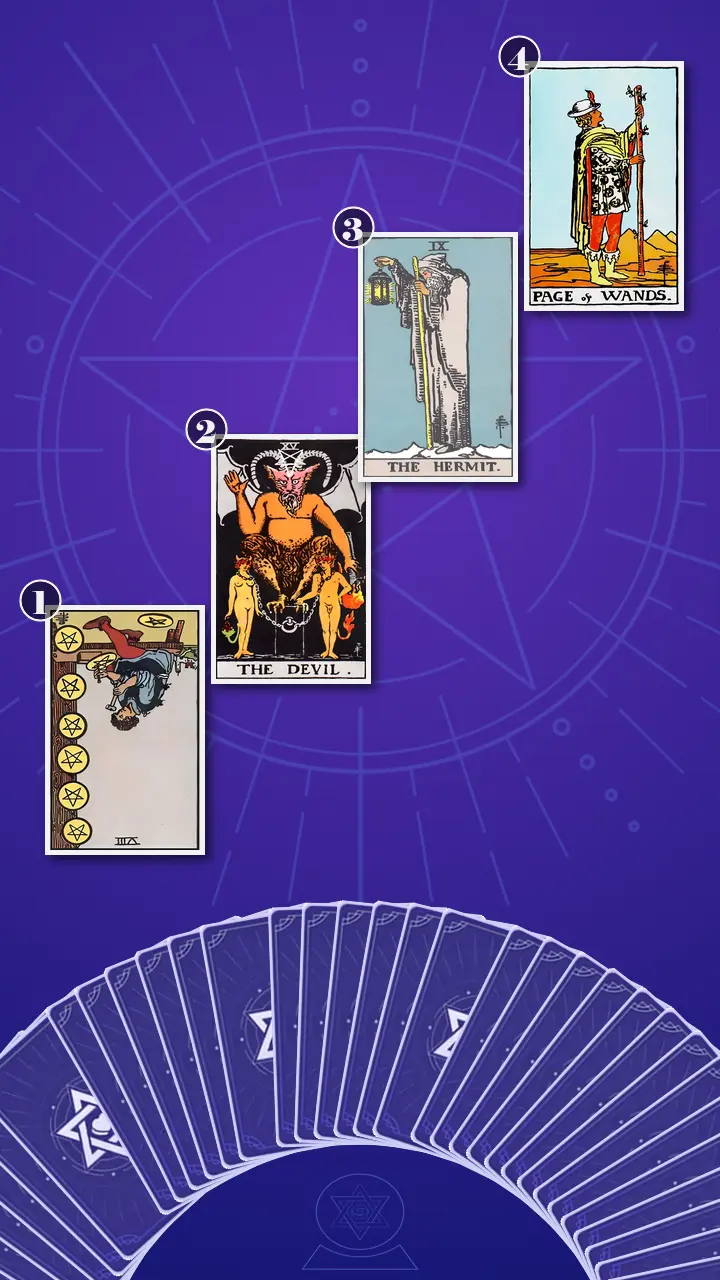
I placed four cards in an ascending diagonal line. The lower-left card would reveal how the milestone chase appeared in observable behaviour. The next would uncover the attachment beneath it, especially the fear that pausing might threaten Jordan's worth or direction. The third would act as the bridge back to self-trust. The upper-right card would turn that insight into a small, reversible test. On the cloth, the spread looked like a stairway leading away from a treadmill whose finish line kept moving.
The Workbench and the Loose Chain
Position One: The Task That Never Feels Finished
"Now I'm turning over the card for the presenting symptom," I said. "This position shows how the repeated milestone chase appears in observable behaviour and where effort has become disconnected from lived meaning."
I revealed The Eight of Pentacles, in reversed position.
I pointed to the craftsperson bent over the workbench and to the completed pentacles displayed in a row. In Jordan's life, this was the moment after submitting a successful project or finishing a qualification and immediately opening a blank Q3 goals document. It was revising an adequate presentation, CV, or productivity system because repetitive improvement felt safer than asking whether the finished work had changed an actual Tuesday.
I read the reversal as both Excess and Blockage. There was an excess of refinement, monitoring, and productive repetition, but the relationship between effort and purpose had become blocked. The card did not tell Jordan to abandon discipline. It asked discipline to serve something more personal than the production of further evidence.
"Your calendar can colour-code every objective," I said, "while leaving the most important field blank: what does this make possible in the life I actually live? A quarterly roadmap that automatically creates another sprint may look efficient, but it never asks whether the product is useful."
Jordan gave a short, bitter laugh. "That's so on the nose it feels a bit rude." Their breath caught first; then their eyes drifted towards the cards as if replaying several late-night planning sessions; finally, they exhaled and rubbed the tight place beneath their collarbone.
I did not soften the recognition by turning it into criticism. "The card is describing a strategy that has worked," I said. "Planning gives you temporary control. The question is whether a useful strategy has been promoted into an identity."
Position Two: The Bargain Beneath the Progress
"Now I'm turning over the card for the underlying root," I said. "This position looks beneath the chase for the attachment that says stopping or choosing differently could threaten your worth and direction."
I revealed The Devil, upright.
I kept my voice level. I never treat The Devil as a warning that something terrible is coming. I read the image as a study of attachment, consent, and the temporary security offered by a pattern. The chains around the figures are loose, which matters. They suggest a relationship maintained partly through habit and belief, not an inescapable sentence.
In Jordan's London tech career, the chain looked like a title, salary number, promotion, move, or polished LinkedIn update being used as the condition for feeling legitimate. Another demanding target provided quick relief from the fear of being directionless. Rent security, professional skill, and recognition were real needs; the problem appeared when visible proof quietly decided which parts of each day were allowed to count.
I read this upright energy as Excess in external validation and Blockage in freely chosen direction. The borrowed scoreboard offered orientation, but every time Jordan consulted it, their own preferences became harder to hear.
I placed the first two cards closer together. "The workbench and the chain are one mechanism," I said. "You revise the deck after it is already useful, update the colour-coded tracker, and then feel unable to close the laptop because the next target is the quickest way to feel oriented. What you want is a life that feels inhabited. What you think you should want is another visible proof point."
I asked Jordan to complete a sentence without polishing it: "If I stop now, I will have to admit..."
They looked at the loose chains and answered quietly, "That I don't know what any of this was for. And maybe that there is nothing underneath the goals that makes me worth taking seriously."
I nodded, but I did not treat the statement as an objective truth or a diagnosis. "That is the bargain the card helps us see," I said. "A goal can be useful without becoming evidence that you are worth something. Awareness is not the same as ripping up every commitment. It is the first moment in which you can ask whether the chain still has your consent."
When the Hermit's Lantern Outranked the Finish Line
Position Three: One Honest Patch of Ground
The rain against the window thinned to a soft hiss as I reached for the third card. The room seemed to grow larger around the small pool of light from my desk lamp, as if the environment had decided to make space for what the next image required.
"Now I'm turning over the card for the key transformation," I said. "This position reveals the inner quality that can interrupt external scorekeeping and restore contact with personally chosen values."
I revealed The Hermit, upright.
I showed Jordan the lantern held close to the solitary figure. It did not flood the mountain with light. It illuminated only a limited radius. In ordinary life, I read that as one evening with career notifications turned off, the next research tab left unopened, and a few lines written about which activities make the week feel inhabited rather than merely impressive.
I read The Hermit's energy as a move towards Balance: enough solitude to hear a private preference, enough discernment to examine it, and enough humility to accept that self-trust does not require a complete five-year plan. Solitude here was an information-gathering space, not a verdict against ambition, responsibility, or community.
This was where I used what I call Cognitive Stratigraphy. On an archaeological site, I do not mistake the first object in the soil for the whole history of the place. I treat it as a surface artefact and ask what layers made its presence possible. Jordan's newly opened goal tracker was the surface artefact. Beneath it lay comparison, praise, and the temporary safety of measurable progress. Deeper still was an older rule: "If I am not visibly progressing, I may have no direction, and without direction I may have no worth."
I felt a restrained flash of recognition from my years at Cambridge and on excavations: a cracked layer does not prove that a settlement had no value. It tells me where one structure stopped carrying the weight placed upon it. The Hermit's lantern did not demand that Jordan demolish their career. It illuminated the obsolete belief underneath the career's current burden.
I asked Jordan to picture 8:47 p.m. on the Northern line again: the warm phone, the buzzing carriage lights, and the new goal tracker opened after the last target was finally reached. I named the familiar promise: the next marker will make this life feel like mine.
A milestone can measure movement; it cannot decide whether the life being moved toward is yours.
I left a brief silence before giving them the central message of the reading.
Stop treating the next finish line as your identity; let the Hermit's lantern illuminate one value you can live today, even when no one applauds it.
I watched Jordan's breathing stop. Their fingers, which had been pressing a thumbnail into the table edge, froze; their pupils widened and the line between their brows held. Then their gaze moved beyond the card, unfocused, as if the Northern line scene were replaying behind their eyes. Anger arrived before relief. "But doesn't that mean I've built the whole thing wrong?" they asked, their voice sharper than before. I did not hurry to convert that resistance into a neat breakthrough. "No," I said. "It means the scoreboard may have been asked to do a job it cannot do. Your skills, security, and effort remain real." Their jaw stayed tight for another beat; their eyes shone, but no tears fell. Then their fist opened, one finger at a time. A breath came from low in their chest, their shoulders dropped, and a small "Oh" escaped. Relief did not make them triumphant. It left them briefly blank, almost dizzy, because a clearer path also returned responsibility to them.
I asked immediately, "Now, with this new perspective, think back to last week. Was there a moment when this insight could have made you feel different?"
Jordan returned to the Sunday evening when a peer's promotion and house keys had sent them to a salary calculator. "Nothing had been wrong with my day before I opened LinkedIn," they said. "I wanted my evening back. I could have noticed that before deciding I needed a more impressive life."
I set a blank page beside The Hermit and offered a bounded exercise rather than a demand for revelation. "Set a ten-minute timer and write two sentences: 'This goal was meant to support...' and 'On an ordinary Tuesday, that would look like...' You do not have to choose a new direction today. If it feels too exposing, stop, switch to something neutral, or leave the page unfinished."
I named the crossing I had just witnessed: this was one small movement from achievement-driven urgency and borrowed external validation towards self-trust, values-based discernment, and grounded curiosity. It was not certainty. It was a quieter authority beginning to return.
I also brought in Ruins Restoration Thinking. I told Jordan that feeling fragmented after success did not necessarily mean their identity had collapsed. It could mark a transition in which an old structure had become visible enough to assess. Restoration does not erase every earlier layer; it preserves what remains useful and stops asking cracked foundations to carry the whole future.
A Green Shoot Without a Five-Year Plan
Position Four: Curiosity in Real Conditions
"Now I'm turning over the card for the embodied next step," I said. "This position translates the insight into a small, open-ended action that can test what a personally meaningful life feels like in practice."
I revealed The Page of Wands, upright.
I drew Jordan's attention to the Page looking directly at the sprouting wand. The image did not show a completed monument or public announcement. It showed interest while it was still alive, small, and unproven.
In Jordan's life, this could be one beginner class, creative practice, conversation, or change to the route home tried because it felt quietly enlivening. It did not need to become a career pivot, a side hustle, a personal brand, or content for a LinkedIn post. The useful evidence would be attention, energy, resistance, and fit with an ordinary week.
I read the Page as Fire moving towards Balance: curiosity providing enough energy to begin without being forced to guarantee an outcome. I also named the risk of Excess. Jordan could easily turn one interesting hour into a new dashboard, qualification plan, or identity project. The Page's medicine would disappear if the sprout were required to become a forest by Monday.
"Treat it like a beta test," I said. "One feature, tried in real conditions, before you rebuild the whole product. You are allowed to try this because it feels interesting; you do not need it to prove that you have finally discovered your purpose."
Jordan smiled with recognition and then winced. "My first instinct is already to make an evaluation spreadsheet."
"Then the spreadsheet gets three fields only," I replied. "One moment of engagement, one moment of resistance, and whether the activity fitted the shape of your week. No score, no public launch, and no conclusion about who you now have to become."
I heard Jordan mention a drop-in life-drawing session they had bookmarked and repeatedly dismissed as "not useful enough." As they spoke, their posture changed in three small stages: their chin lifted from the cards, their eyes sharpened with cautious interest, and their hand moved towards their phone before they caught themselves and laughed. The curiosity was real; so was the reflex to convert it into proof.
The Normal Tuesday Test
I read the four cards as one coherent history rather than four isolated meanings. Jordan had learned that organisation, responsiveness, and visible delivery produced safety and recognition. In the present, the reversed Eight of Pentacles showed that useful work continuing past its meaningful stopping point. The Devil revealed why: measurable targets had become a borrowed scoreboard for worth and direction. The Hermit restored a private source of discernment, while the Page of Wands offered a way to gather evidence through lived experience.
I also noted the absence of Cups. I did not read that absence as doom or emotional deficiency. I read it as a practical reminder that emotional nourishment would not automatically arrive through more Earth-based production. Jordan would need to consult felt meaning deliberately instead of assuming that achievement would manufacture it after the fact.
The cognitive blind spot was not ambition. It was the habit of treating what could be measured as though it were automatically meaningful, then interpreting post-achievement flatness as proof that the target had been too small. The shift was precise: before accepting or setting another milestone, Jordan would name the daily experience or chosen value it was meant to support.
I gave Jordan two next steps. I wanted the actionable advice to be small enough to begin without becoming another performance.
- The Ten-Minute Lantern and Trigger ExcavationOn one evening this week, sit somewhere familiar in your flat, place your phone face down, and set a ten-minute timer. Complete "A normal Tuesday would feel more like mine if it included..." with one observable experience, then note the first response in your chest, jaw, shoulders, or breathing. If a disproportionately sharp fear appears, use my Trigger Excavation Exercise: write the surface trigger, the safety or status it promises, the earliest "epoch" when that rule felt necessary, and one sentence separating then from now.Start with two minutes if ten feels intrusive. You may stop at any point, leave the question unanswered, and return to your ordinary plans.
- The One-Hour, Unbranded Beta TestBefore the end of the week, schedule one reversible trial of no more than sixty minutes, such as the bookmarked life-drawing session, a different walk home, a creative practice, or a conversation. Afterwards, record one moment of engagement, one moment of resistance, and whether the experience fitted an ordinary week.Do not post it, monetise it, add it to a five-year plan, or call it a new identity. The minimum version is showing up long enough to gather one honest piece of information.
I made the boundary explicit: Jordan could keep goals, structure, financial plans, and professional ambition. The purpose was to change their function. Progress could support a meaningful life without being forced to prove that the life was valid.
"The cards have not chosen your direction," I told them. "They have shown you where your attention has been captured and what kind of experiment might return it. You remain the person who decides what to preserve, what to question, and what to try."

Six Days Later: The Quiet Proof
Six days later, I received a message. Jordan had tried a 45-minute life-drawing session, left it off LinkedIn, and slept through the night. Their first thought on waking was, "What if this means nothing?" Then they wrote, "I smiled. It was allowed to mean one good Tuesday."
I did not take that message as proof that Jordan had solved their life. I took it as the first grounded evidence of the real transformation: urgency had loosened enough for curiosity to exist without immediately becoming an identity project.
For me, that was the purpose of this Journey to Clarity. The Hermit's lantern had not revealed a perfect destination. It had shown one honest patch of ground, and Jordan had chosen to step onto it under their own authority.
I know how much it can hurt when the congratulations arrive but your chest still feels restless and your limbs turn heavy. Visible progress may have been carrying the burden of proving your worth while your actual days remained strangely unfamiliar. Simply noticing that burden means the borrowed scoreboard is no longer the only voice in the room.
If you let the Hermit's small lantern illuminate one quiet value before you turn it into a new identity, what low-stakes experiment would you be curious to notice on your next ordinary Tuesday?