Permission-Seeking Paralysis: Turning One Unsent Draft Into Evidence
Permission-Seeking Paralysis at 9:40 p.m.
If you are the late-twenties city worker who can coordinate everyone else's deadlines but cannot submit your own application without a group-chat verdict, career pivot anxiety may look less like panic and more like one permanently open draft. I recognized that pattern as soon as Jordan appeared on my screen.
It was 9:40 on a wet Tuesday night in their shared Toronto apartment. Jordan shared their laptop screen with me: a polished cover letter sat beside a job listing they had refreshed all week, while three unread replies waited in the group chat where they had asked, again, whether applying was sensible. Through the microphone, I heard the radiator click and a streetcar grind along the road below. Jordan rubbed one wrist where it rested against the warm laptop, reread the requirements, and moved the cursor away from Submit.
“I know I want something different,” they said. “I just don't know who gets to say I'm ready. I keep preparing for a decision I never actually make.”
I heard the real conflict immediately: Jordan wanted to change their life on their own terms, but they were waiting for someone else to make the beginning feel legitimate. Each self-directed choice seemed to turn their body into a coat soaked with freezing rain: their chest drew tight, their limbs became heavy, and even a small movement suddenly felt expensive.
“We don't have to pretend Toronto rent isn't real, or that every risk is secretly easy,” I told them. “I'm also not here to issue the permission you're waiting for. Let's use the cards to map what happens between wanting change and postponing it. Then we'll look for one responsible movement that still belongs to you.”

Choosing the Switchback Map
I asked Jordan to close the group chat, put both feet on the floor, and take one unforced breath while holding the question: “Why do I keep waiting for permission to change my life?” I shuffled slowly. The purpose was focus, not theatre; the small ritual marked the transition from cycling through opinions to observing the pattern itself.
I chose the Transformation Path Grid · Context Edition, a six-card tarot spread arranged like a switchback path. The top row diagnoses the lock: present behaviour, immediate blockage, and the deeper belief keeping it in place. The lower row turns back toward movement: catalyst, experiment, and integration.
For readers wondering how tarot works in a situation like this, the spread was useful because Jordan did not need a broad prediction about their future. They needed a clear model of the reassurance-delay-relief loop. A larger spread could have added possibilities, but more possibilities were already part of the problem. These six positions let me examine how preparation reduced short-term discomfort, how that relief reinforced waiting, and where a testable action could interrupt the system.
The most important positions would be the second, which examined the habit of giving other people veto power; the fourth, which identified an agency trigger; and the sixth, which showed how self-direction could become repeatable. The card meanings in context would matter more than any isolated definition. I was not asking the deck to decide whether Jordan should take the job. I was asking it to make their decision process visible.
I laid the first three cards from left to right, dropped to the lower-right corner for the fourth, and then moved back across the table toward the sixth. The shape resembled a waiting-room corridor that reached a dead end, turned, and returned with a chosen direction.
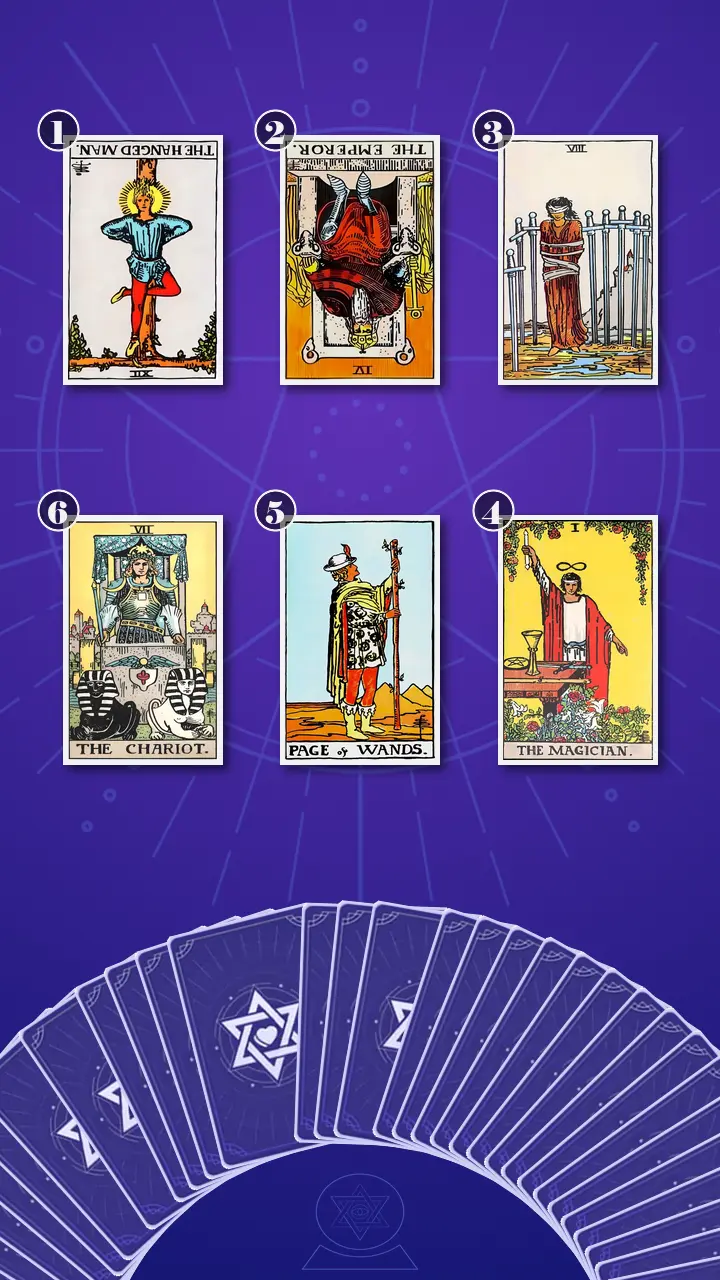
The Corridor of Borrowed Permission
Position One: Tomorrow as a Holding Folder
I turned over the card representing the observable stagnation: repeated research, preparation, and waiting. It was The Hanged Man, reversed.
In the Rider-Waite-Smith image, the figure hangs by one foot while a halo surrounds the still head. Upright, the card can describe a useful pause that changes perspective. Reversed here, the pause had become a Blockage: Jordan was still waiting, but the waiting was no longer producing insight. The free leg remained bent behind the bound one, a quiet visual reminder that total immobility and chosen stillness are not the same thing.
The modern scene was already open on Jordan's screen. At 9:40 p.m., the cover letter was adequate, the job listing had been reread, and tomorrow had become a holding folder for a decision that was ready to be tested. The inner script sounded responsible: “I'm not avoiding it; I'm just making sure.” The concrete fact was less comforting: the latest review had added no new information.
“You keep calling it preparation because ‘waiting for permission’ feels harder to admit,” I said. “That doesn't make the pause foolish. It means the pause once protected you from the risk of being wrong, and now we need to ask whether it still serves you.”
I asked Jordan which plan they had reopened at least three times in the previous two weeks, and what genuinely new information the most recent review had produced.
Their fingers stopped circling the edge of the trackpad. Then they let out a short, bitter laugh. “That's so accurate it's almost cruel.”
“I can see why it lands sharply,” I replied. “But accuracy isn't an accusation. This card isn't calling you lazy or weak. It's helping us separate reflection from protective repetition. You get to keep every pause that is still useful, and you get to end the ones that have stopped teaching you anything.”
Position Two: The Unofficial Board Meeting
I turned over the card representing the immediate permission barrier: assigning authority to other people, institutions, and ideal conditions. It was The Emperor, reversed.
The stone throne, hidden armour, and severe mountains usually present authority as structured and immovable. Reversed in this position, the Emperor showed a Deficiency of trusted inner authority paired with an Excess of borrowed authority. Jordan could make responsible decisions; they simply treated their own considered judgment as the least legitimate voice in the room.
I contrasted two scenes. At work, Jordan could coordinate vendors, calendars, approvals, and other people's deadlines without collapsing under every possible objection. At home, they sent the same career question to friends, a former mentor, and sometimes Reddit, then treated one cautious response as a veto. Their imaginary panel included a manager's vague feedback, LinkedIn success stories, Toronto cost-of-living threads, and the ideal future circumstance in which everyone agreed.
“I can decide once someone credible says this makes sense,” I said, giving the loop its familiar voice. “But mixed feedback isn't a ruling. Advice is information; it becomes a cage when you treat it as authorization.”
Jordan's jaw tightened. Their eyes shifted toward the three unread replies, but they did not open them. “I keep saying I want input,” they said. “What I actually want is for everyone to agree so I won't have to own it.”
I nodded. “Ownership doesn't mean ignoring expertise. For housing, health, legal status, safety, or major financial risk, qualified information matters. The question is narrower: after the necessary facts are gathered, who has been given the power to make a reversible personal step count as legitimate?”
Position Three: The Gap Between the Swords
I turned over the card representing the learned root of the lock: the belief that independent effort is unlikely to matter and that a wrong move would expose a lack of control. It was the Eight of Swords, upright.
The blindfold showed attention captured by predicted danger. The cloth around the figure's torso looked restrictive but not tightly knotted, and the planted swords left visible gaps. The energy here was an Excess of air-like forecasting: so much thought was devoted to preventing failure that the mind began presenting uncertainty as total prohibition.
Jordan told me about seeing a saved job on the TTC and noticing one preferred qualification they lacked. Their mind translated “preferred” into “not allowed.” The swords became the open tabs, conflicting opinions, rent calculations, remembered warnings, and job requirements that appeared to form a complete fence. Some constraints were real. Needing income was real. A costly move could be difficult to reverse. But applying without resigning, asking a recruiter one factual question, or booking a refundable conversation remained visible between the blades.
“A closed feeling is not always a closed door,” I said. “I would never use this card to claim that every barrier is imaginary. I would use it to ask what is physically, financially, legally, or contractually impossible, and what smaller action is merely uncomfortable.”
Jordan's breath became shallow. Their gaze settled on the gap between two of the swords. “Quitting without another job would be risky,” they said slowly. “Submitting an application isn't quitting. I've been treating them as the same decision.”
I watched that distinction reach them. Their shoulders remained tense, but one hand opened on the desk. The cards had not removed Toronto rent or guaranteed an offer. They had restored the scale of the actual choice.
When the Magician Put the Pen Back in Jordan's Hand
Position Four: One Tool, Used on Purpose
I reached the lower-right corner of the grid and turned over the card representing the agency trigger: using one existing resource to interrupt learned powerlessness and create direct evidence. It was The Magician, upright.
The atmosphere changed. On Jordan's side of the call, the radiator stopped clicking, and the laptop fan became the clearest sound in the room. On my table, the Magician stood with one hand raised and the other directed toward the ground. The cup, sword, wand, and pentacle were already arranged within reach. Nothing in the image was waiting to be delivered later.
In Jordan's life, the Magician's table was remarkably ordinary: one adequate cover letter, one email address, one calendar slot, one modest budget, and several transferable skills. The card carried Balanced agency. It did not demand a dramatic leap or promise that confidence would arrive on command. It asked Jordan to connect one available tool to one concrete behaviour.
As an artist, I thought of sitting in an edit suite after too many rounds of notes. A scene can become technically tidier while losing its pulse; eventually, another edit is not refinement but fear wearing professional clothes. The work only reveals what it needs next when someone allows a version to leave the timeline.
I use a lens called Hero's Journey Alignment for moments like this. Jordan was not failing their story; they were standing in the classic Refusal of the Call. That refusal was not cowardice. It was the scene where the protagonist asks the threshold to provide a guarantee before crossing it. The Magician did not shame that hesitation. The card showed that the next character evolution began when Jordan used what was already in the scene.
Through Vision Actualization, I rewrote the limiting line “I am not ready for a new life” into a smaller and more truthful direction: “I am ready to test one thing and let reality answer.” Jordan did not need a new personality. They needed to deploy one resource instead of collecting five more.
At 9:40 p.m., the cover letter was ready, three friends' replies were unread, and Jordan's finger hovered over Submit while the laptop fan hummed. They called one more review responsible even as their chest tightened around the prospect of another deferred night.
I said, “You do not need permission as proof that change will work; you need one self-chosen action that can give you evidence your waiting never could.”
You are not waiting because you lack every necessary tool; choose one tool already on the Magician's table and turn borrowed permission into direct evidence.
I let the sentence remain between us without rushing to explain it away.
I watched Jordan go still. Their inhale stopped; one hand froze above the trackpad. Then their gaze slipped off the card and became unfocused, as though the previous week were replaying behind the screen. Their pupils widened. The corners of their mouth tightened, and their eyes shone before they blinked hard. “But doesn't that mean I've been wrong this whole time?” they asked, anger sharpening a voice that had been quiet. “No,” I said. “It means waiting was a protection strategy. It reduced the risk of being wrong, and it also prevented new evidence. We can respect why it formed without letting it direct the next scene.” Their fingers curled once, then slowly opened. Their shoulders dropped. A breath left from deep in their chest, almost a laugh and almost grief. The relief made them look briefly unsteady, as if a locked door had opened onto a path they would now have to choose. I asked, “Now, using this new perspective, think back to last week. Was there a moment when this insight could have made you feel different?”
Jordan named a refundable introductory course session they had watched expire. “I could have booked it,” they said, their voice trembling, “without making it my whole future.”
That was the reading's decisive movement: from powerless stagnation and borrowed permission to cautious curiosity and grounded confidence built through direct evidence. It was only a first crossing. Jordan still felt exposed because greater clarity also meant accepting responsibility for the next small choice. But the discomfort now belonged to authorship, not helplessness.
I made one point explicit: the Magician was not granting Jordan power, and I was not transferring power to them through the reading. The card was reflecting capacities Jordan had already demonstrated at work and could choose to use on their own behalf. Tarot had provided an objective mirror. Jordan remained the person holding the pen.
The Road After the Turn
Position Five: An Experiment, Not a New Identity
I turned over the card representing the self-authorized experiment: one small, reversible action that produces information without requiring advance certainty. It was the Page of Wands, upright.
The Page studied a sprouting wand in an open landscape. The energy was emerging fire held in Balance: enough curiosity to make contact with a possibility, without demanding a lifelong commitment. Beginner status was not the same as incapacity.
In context, the card looked like Jordan sending one concrete question to a recruiter, submitting one application without promising to accept an offer, or booking a refundable introductory session and noting the cancellation date. A confirmation email would not settle their identity. It would simply create information that another evening of browsing could not provide.
“You do not have to choose your whole life; you can choose the next experiment,” I said. “An application can be a request for information from reality, not a declaration of destiny.”
I asked what Jordan would try if the action only had to teach them one thing. Their shoulders lowered another fraction. They looked at the cover letter rather than the group chat. “I could submit this one,” they said. “That doesn't mean I have to take a job I haven't even been offered.”
“Exactly. Exploration preserves your right to say yes, no, not yet, or not this. Agency includes revision.”
Position Six: Steering With Both Voices in the Chariot
I turned over the final card, representing the integration of self-direction: choosing, reviewing evidence, and adjusting without returning every uncertain moment to an external authority. It was The Chariot, upright.
The black and white sphinxes embodied Jordan's simultaneous voices: “I want out,” and “I cannot risk destabilizing everything.” The charioteer held no visible reins. Direction came through conscious coordination, not through forcing every internal conflict to disappear. The card's energy was Integration: fear could identify genuine risks, desire could identify meaningful movement, and neither voice needed automatic control.
I translated the card into a one-month direction rather than a final verdict. Jordan could make one self-directed commitment each week, record what factually happened, and adjust the next checkpoint. They could still seek qualified advice when the stakes required it. What would change was the job assigned to that advice: information would support the decision instead of replacing the decision-maker.
“Both can be true,” I said. “You can want change and protect your housing stability. You can feel uncertain and still choose the next responsible checkpoint. The Chariot isn't control over the destination; it is the practiced ability to steer.”
Jordan opened their calendar. I saw them add a ten-minute Sunday note rather than another sprawling research block. “Action, Evidence, Adjustment,” they read aloud. “That feels less like asking for a verdict.”
“Because it is a review process,” I said. “You are no longer putting your entire life back on trial each week.”
Finding Clarity in the Next Forty-Eight Hours
I drew the six cards into one story. Jordan's workdays had made approval chains and other people's priorities familiar territory. The Hanged Man reversed showed how a useful pause had become indefinite preparation. The Emperor reversed revealed the central blockage: personal authority had been outsourced to an imaginary panel. The Eight of Swords showed how real constraints and learned predictions had fused into one closed feeling. Then the Magician restored the missing function, the Page made it experimental, and the Chariot made it repeatable.
The reassurance-delay-relief loop explained why nothing seemed to change. A possibility appeared. Jordan predicted that an independent choice would fail. They sought reassurance and postponed the first step. The postponement briefly removed the risk of being wrong, but it also prevented any new evidence of agency. Another unfinished plan then appeared to prove that their choices did not matter.
The cognitive blind spot was not simply “I need more confidence.” It was the assumption that discomfort, mixed opinions, or an uncertain outcome meant Jordan lacked legitimate authority to begin. The transformation direction was more practical: complete one small, reversible, self-chosen experiment within forty-eight hours, then evaluate the evidence afterward. Advice could remain part of the process without functioning as permission.
The Character Bible Directive
To turn insight into actionable advice, I introduced my Character Bible Directive. In film production, a character bible specifies how someone behaves under pressure so that each scene remains coherent. I asked Jordan to write the behavioural specs of the future self they wanted to begin embodying now, not after a personality transplant or perfect burst of confidence.
We wrote three lines: “Future Jordan gets qualified input for material risk. Future Jordan uses one existing tool before polling people about a reversible choice. Future Jordan records facts before turning a result into a verdict.” These were not affirmations about guaranteed success. They were stage directions Jordan could actually perform.
- Run the eight-minute One-Tool Agency Test.On the next weekday evening, open one plan that has been paused for at least two weeks. Put an eight-minute timer beside it. Choose one resource already available, such as the cover letter, a contact, a calendar slot, a portfolio sample, or a small discretionary budget. Make no more than one factual check, then submit the application or send the single missing factual question before the timer ends. Do not open the group-chat replies first.Keep the action reversible and informational. For housing, immigration, health, safety, legal matters, or substantial financial risk, gather information and consult an appropriate professional instead of making an irreversible move.
- Keep a forty-eight-hour Direct Evidence note.Immediately after the experiment, write two lines in a notes app: “What I chose” and “What happened next.” Pause additional opinion polling for forty-eight hours unless new information affects safety, legality, or material risk. At the ten-minute Sunday checkpoint, separate observable facts from forecasts and choose one reversible adjustment.“No reply yet” is a complete fact; “They must think I'm underqualified” is a forecast. The exercise succeeds when the evidence is recorded, not only when the external outcome is positive.
Jordan looked at the two steps and frowned. “Eight minutes sounds almost too small to count.”
“That is the old plotline protecting its scale,” I said. “It wants the next action to be large enough to prove your entire future, because then waiting feels responsible again. Eight minutes is not meant to solve your life. It is meant to produce one piece of evidence that your action can affect what happens next.”

A Confirmation Email, Not a Finished Life
Three days later, I received a message from Jordan with a screenshot. They had set the timer, checked one factual requirement, and submitted the application at 9:47 p.m. without reading the group-chat replies. Their message said, “I felt slightly sick, but I did it. No reply yet. Still counts.”
In the screenshot, I saw the confirmation email timed at 9:48. Jordan told me they had sat alone at the kitchen table, relieved and strangely exposed. Their first thought had been, “What if this goes nowhere?” Then they entered “No reply yet” under Evidence and closed the laptop.
Nothing cinematic had happened in the external world. Jordan had not resigned, solved their career crossroads, or become permanently fearless. They had simply stopped asking one application to prove their whole future. The following morning still contained doubt, but doubt no longer had admin access to the calendar.
I thought back to the waiting-room corridor formed by the spread. The cards had not called Jordan's name or opened the exit for them. They had shown where the corridor turned. Jordan chose to walk the first few steps.
That was the quiet proof at the end of this Journey to Clarity: not certainty, but authorship. Tarot made the permission loop visible; Jordan created the evidence. Their grounded confidence would be built through repeated choices, not bestowed by a card, a manager, a friend, or me.
When your chest tightens over a choice that is finally yours, it can feel safer to keep preparing than to discover whether your own judgment can carry weight. If that is where your story is paused, noticing the difference between information and authorization already changes the scene.
If this choice did not have to prove anything about your whole future, which one tool on your own Magician's table would you use for an eight-minute, reversible experiment before the imaginary board meeting begins?