Saturday Review Tabs Gave Way to a Thirty-Minute Ceramics Trial

When Self-Monitoring Puts a Free Saturday on Trial
You can defend every design decision in a London product review, yet a free Saturday can still trigger decision paralysis the moment someone asks, “What do you actually feel like doing?” I had that sentence in mind when Maya (name changed for privacy), a 28-year-old product designer, appeared on my screen from her shared South London flat.
It was 11:20 on a wet Saturday morning. Behind her, rain ticked against a cracked window and buses hissed along the road. Three cafe menus, a film listing, a ceramics class, and Google Maps crowded her laptop. Her coffee had gone lukewarm. Her jaw was set, her shoulders were almost level with her ears, and one hand kept drifting toward the work inbox.
“I felt interested in the class for about five seconds,” she told me. “Then I checked the reviews, the journey, the weather, whether it was worth the money, whether I was only choosing it because it looked good online. I can explain every option and still have no idea which one I want.”
Then she gave me the question beneath all those tabs: “Why do I monitor every move until I can't tell what I want?”
I could see the physical shape of her disorientation. It was like trying to hear one quiet voice while an imaginary review panel scraped its chairs across the floor. The moment she liked something, she started checking whether she should, until the original preference became unreadable.
“Nothing here suggests that you have no wants,” I said. “It may mean they are being inspected too quickly. Let us give the pattern a visible structure and see where your own signal disappears. We are not asking the cards to choose for you. We are using them to draw a map through the noise.”

Choosing the Four-Layer Insight Ladder
I invited Maya to put both feet on the floor, take one unforced breath, and hold her question without trying to improve its wording. I shuffled slowly. The pause was not a mystical performance; it was a way to move from automatic analysis into deliberate attention.
I chose the Four-Layer Insight Ladder tarot spread. For anyone curious about how tarot works in a reflective consultation, I choose the smallest spread that can examine the whole mechanism without creating more decision fatigue. A ten-card Celtic Cross would have introduced unnecessary branches. These four positions let me read observable behavior, its hidden root, the resource that interrupts it, and a practical next step.
The bottom card would show how self-monitoring appeared in ordinary life. The second would expose why suspended choice felt safer. The third, at the center of the spread, would reveal the transformative insight. The final card would turn that insight into a reversible experiment. Read upward, the arrangement resembled a short ladder out of mental contraction.
This is where card meanings in context matter. A tarot card is not a verdict floating above someone's life. I treat it as an external image against which a person can test patterns, reactions, and possibilities that are otherwise difficult to see from inside the loop.
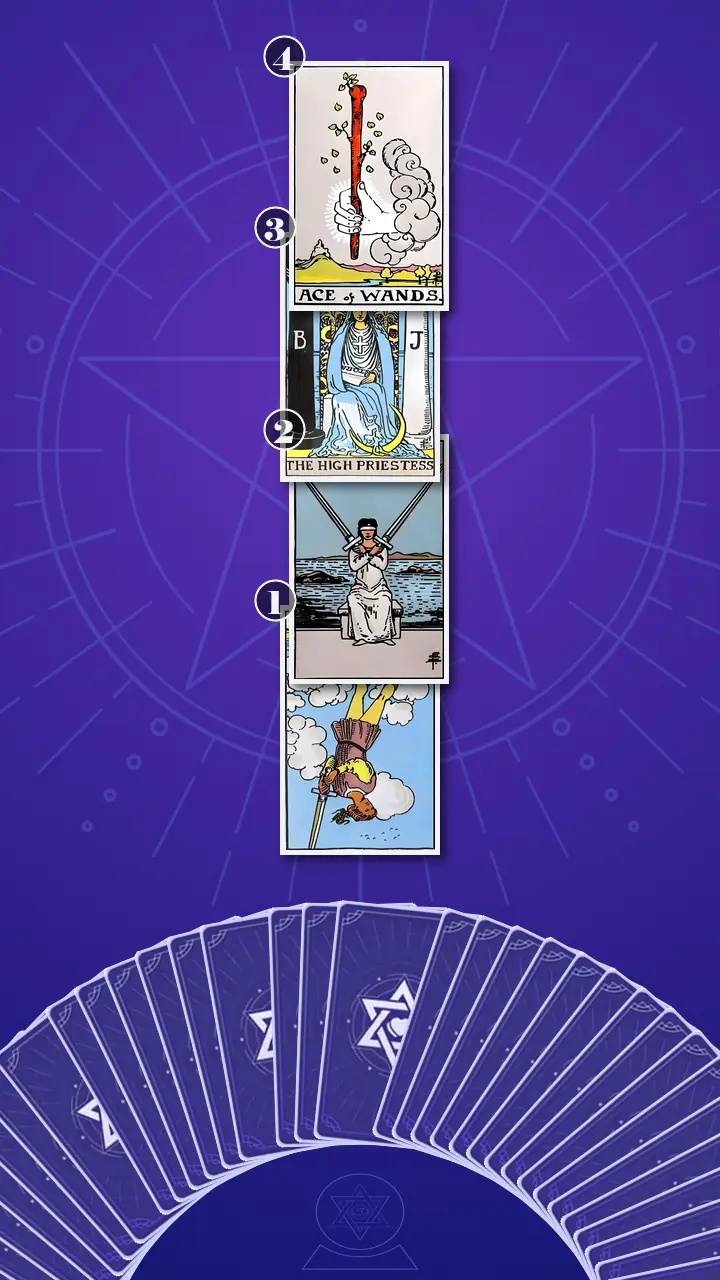
The Lower Rungs of the Self-Surveillance Loop
Position One: The Page Watching Herself
The first card occupied the position of the observable symptoms of hypervigilant self-monitoring: repeated editing, option switching, and watching the self instead of participating. I turned over the Page of Swords, reversed.
I pointed to the Page's sideways glance and the sword held ready in both hands. Upright, the Page's alertness can be useful: quick perception, careful communication, a willingness to investigate. Reversed, that Air energy had moved into excess and blockage. Maya's perceptiveness was no longer gathering useful information. It had become an internal monitoring system.
I brought the card into her Tuesday afternoon at the office. At 4:46, she had written a clear two-line Slack reply to her manager, then reread it as the manager, a senior designer, and an imaginary hostile reviewer. “I was going to write, 'I can update the flow tomorrow,' but what if that sounds passive? So maybe, 'My recommendation is...' But what if that sounds defensive?” The useful response window narrowed while she ran an endless usability test on herself.
“You are not only making the choice,” I said. “You are watching yourself make it. Attention has stopped serving communication and started serving imagined evaluation.”
Maya let out a short laugh that carried no amusement. “That is so accurate it is almost cruel.” Her fingers closed around the cold coffee mug, then loosened. I told her the accuracy was not an accusation. The Page showed a skill that had become overextended, not a defect in her character.
Position Two: The Grid with No Exit
The next card represented the root of her drift: the inner conflict and fear of losing control that made suspended choice feel temporarily safer. I turned over the Two of Swords, upright.
The blindfolded figure held two equal blades across her chest while uneven water waited behind her. Maya immediately recognized her Saturday comparison grid: film, ceramics class, and cafes divided into columns for price, travel, weather, reviews, and social value. Each new criterion created another tie. From outside, choosing nothing could look calm. Her raised shoulders and cold coffee showed the effort required to maintain it.
The Two's Air was not absent; it was locked in a closed circuit. Thought argued with thought while feeling and lived evidence remained outside the frame. The temporary reward was relief: if every option had a case against it, staying home was the only choice for which she could not be blamed. The cost was that postponement erased the information she needed.
“Delay can feel like control while quietly erasing the information you need,” I said. “When you freeze between two harmless options, what conclusion about your judgment are you trying not to face?”
Her jaw tightened before she answered. Her gaze dropped to the crossed swords, went unfocused for several seconds, and returned with a small exhale. “That if I choose something just because I want it, and it turns out badly, I will have proved I cannot trust myself.”
I did not tell her simply to be decisive. The stalemate had been protecting something. We needed to respect that protective logic while testing whether it still belonged in every cafe choice, group chat, and free evening.
When the High Priestess Let One Preference Stand
Position Three: Preference Before Proof
The rain softened until I could hear the quiet electrical hum of my laptop. At the visual center of the ladder, I turned the card representing the transformative insight that could restore access to preference before evaluation. It was The High Priestess, upright.
She sat still between black and white pillars, holding both without forcing either to win. Her scroll was only partly visible. I explained that this was balanced, receptive energy: useful personal information may arrive before a complete argument does. Unlike the Two of Swords, her stillness did not exclude feeling. It made room to notice it.
In Maya's life, the card was the instant before another review tab opened. The cursor hovered, the room went quiet, and one option already felt slightly more alive. She could put the phone face down for ninety seconds and write, “My first lean is the class,” without booking it, defending it, or declaring herself a ceramics person. A preference could be information without becoming an infallible command.
I call this way of reading a trigger Cognitive Stratigraphy. The open tabs, clenched jaw, and requests for reassurance were surface artifacts. Beneath them, we uncovered the older rule holding the structure together: “An unvetted preference could prove that I am careless and out of control.” The High Priestess did not supply a better external authority. She revealed the space in which that obsolete rule could stop speaking first.
For a moment, I remembered a Cambridge excavation where rubble initially mistaken for simple collapse turned out to contain evidence of later rebuilding. Maya's apparent lack of desire looked similar to me. Her preferences were not absent. They were buried beneath a protective structure erected over time. Ruins Restoration Thinking asks me to see such fragmentation as a transition with history, not a permanent fate.
I asked her to return to Saturday morning: three promising tabs open, reviews multiplying, jaw tightening, and a small spark toward the class disappearing beneath transit checks, rankings, and pressure to choose correctly. She had been trying to make the preference defensible before allowing herself to feel it.
You do not need to interrogate every impulse into certainty; let one quiet preference stand, as The High Priestess sits between opposing pillars without forcing either one to win.
I left a few seconds of silence around the sentence.
“A preference does not become trustworthy by surviving an interrogation; it becomes readable when you let it exist, try it gently, and notice what happens.”
Her breath stopped first, and her fingertips remained suspended above the trackpad. Her eyes widened, then shifted toward the rain-streaked glass as if last week's group chat were replaying there. Her mouth tightened. “But doesn't that mean I've been doing it wrong all this time?” she asked, the words sharper than anything she had said before.
I let the resistance have its place. “No. It means close monitoring probably helped you feel prepared in environments where every design choice needed a rationale. A strategy can be intelligent and still become outdated when it follows you home.”
Her eyes reddened slightly. Then her shoulders lowered, her hands opened on the table, and a long breath left her chest. Relief arrived, but it was followed by a moment of blankness. Without the review panel, she would have to risk meeting her own unfinished answer. That responsibility seemed to make the cleared space feel both lighter and strangely exposed.
“Now, with this new perspective, can you think of a moment last week when this insight might have made you feel different?” I asked.
“A friend asked where I wanted to eat,” she said. “I knew immediately. Vietnamese. Then I deleted it and sent three alternatives. I could have let Vietnamese be my first lean without making everyone go there.”
That distinction was the first crossing from hypervigilant self-scrutiny toward receptive self-trust. She was not promising to obey every impulse. She was allowing herself to hear one before evaluation began.
I gave her a five-minute version to test. She would put her phone face down, write one low-stakes question, and complete only: “Before I explain it, my first lean is...” She could circle the answer without acting. If the tension became too strong, noticing where her eyes returned first would count as the entire exercise.
The Wand That Asked for Thirty Minutes
Position Four: A Trial, Not an Identity
The final position held the low-stakes behavioral experiment that could turn a provisional desire into lived evidence without demanding a permanent identity decision. I turned over the Ace of Wands, upright.
A hand extended a living wand from a cloud, fresh leaves emerging while the distant landscape remained open. The card did not offer a complete map. It offered a beginning whose meaning could develop through contact.
I translated it into a specific London afternoon: Maya could book the pay-as-you-go ceramics class that had produced the first flicker of interest and give it thirty minutes. She could leave if she disliked it. She did not need to determine whether she was creative enough, whether the class was optimal, or whether this would become part of her identity. Her inner sentence could be simple: “This does not define me; it only gives me data.”
The Ace brought healthy Fire into a spread dominated by Air. It moved the reading from analysis into participation. Yet no Pentacles had appeared, so I knew we had to supply Earth deliberately through a timer, an exit option, and a short note about what actually happened. Without those limits, even experimentation could become another performance metric.
“Which option would you be curious enough to try if changing your mind afterward counted as information rather than failure?” I asked.
Maya looked at the ceramics tab. Her cursor moved toward it, stopped, and moved again. Then she smiled with visible uncertainty. “The class. Thirty minutes feels possible. Forever did not.”
“Exactly,” I said. “Let the experience answer what analysis cannot.”
Restoring First-Person Choice
Read as one story, the ladder was coherent. A professional strength had followed Maya out of the design studio: the Page of Swords reversed showed alertness turning into self-surveillance. The Two of Swords showed why the pattern persisted: postponement protected her from a feared verdict about her judgment. The High Priestess restored the quieter signal that existed before explanation. The Ace of Wands converted that signal into an experiment small enough to produce evidence.
Her cognitive blind spot was the belief that a genuine preference should arrive fully reasoned and impossible to challenge. In reality, defensibility and authenticity are different qualities. Her direction would not emerge from inspecting every corridor of the maze. Like Ariadne's thread, one provisional preference could guide a few steps without pretending to be the whole map.
This was also where I used The Trigger Excavation Exercise. When a small choice produced a disproportionately strong reaction, Maya would separate the layers: the visible trigger, the older rule it activated, and the evidence available in the present. The exercise was not meant to blame the past or produce a dramatic origin story. Its purpose was to stop an older epoch from automatically governing a harmless decision today.
Three Small Tests for the Next Seven Days
- The Preference-Before-Proof PauseBefore opening restaurant reviews or asking a friend for advice, put the phone face down for ninety seconds. Write, “My first lean is...” and name one harmless option without explaining it.Keep it reversible. If ninety seconds feels loaded, take ten seconds and notice only which option draws your eyes back first.
- The Thirty-Minute Evidence LoopChoose one cafe, film, walk, or drop-in class that creates a flicker of interest. Try it for thirty minutes this week, with explicit permission to leave, stop, or revise.Define success as obtaining information, including “I did not enjoy this.” Do not turn the experiment into a verdict on your identity.
- The Single-Review SendAt work, choose one routine Slack message, reread it once, and send it. After the real response arrives, spend three minutes noting the surface trigger, the older rule it activated, and what actually happened.Use only one message and three short lines. A detailed tracker would become another place to monitor yourself.
I reminded Maya that none of these steps applied to medical, legal, financial, safety-critical, or consent-related decisions. They were deliberately modest tests for everyday analysis paralysis. She retained full permission to revise, decline, or stop.
The cards had not instructed her to choose ceramics. They had made the sequence of her own mind visible enough for her to intervene. That distinction mattered: tarot offered the map, but Maya remained the person deciding where, whether, and how far to walk.

A Week Later, the Quiet Proof
A week later, I received a message from Maya. She had used the five-minute timer, written “My first lean is the class,” and booked the pay-as-you-go session before reopening the reviews. She promised herself thirty minutes and stayed for the full hour.
She did not report a cinematic transformation. She disliked the playlist, made a lopsided bowl, and loved the physical weight of the clay. For once, those mixed observations did not need to be reconciled into a score. They were simply lived information.
She told me that on the bus home she still thought, “What if I used the day badly?” Then she noticed clay beneath her thumbnail and smiled. The question had not vanished; it simply no longer held the steering wheel.
For me, that was the journey to clarity in its most honest form: not complete certainty, but a first-person experience strong enough to sit beside the imagined evaluator. Maya had moved from auditing desire to gathering evidence through participation. The proof belonged to her, not to the cards.
When every small want makes your breath catch and your mind convene an imaginary review panel, control can feel close even as your own preference slips below the surface. Noticing that buried signal is already the first careful brushstroke of restoration.
If one quiet preference could stand between the High Priestess's pillars as provisional information, what tiny, reversible experience would you feel curious enough to try first?