The Half-Open Door at 11:38 PM
I recognized the London communications professional who could read a room in three seconds but reread one vague WhatsApp reply for hidden warmth after work. Maya arrived with that particular stillness I often see when someone has spent the whole day making other people's words sound clearer than their own.
At 11:38 PM on a Tuesday in her small shared flat bedroom, she had lain under a half-folded duvet, scrolling back to an affectionate voice note after a vulnerable date conversation. Rain had ticked against the window, the fridge had hummed through the wall, and her phone had felt warm in her palm. Her thumb had stopped at the unanswered question beneath his promise that they should talk soon.
She told me, I want emotional closeness, but I keep treating their distance as something I can solve. Why do I keep wanting partners who cannot meet me emotionally? They were warm enough to keep hope alive, but distant enough to keep her checking. Her longing felt like a notification light inside her chest: bright for one second, then impossible to stop watching for.
I said, You are not confused because you want too much; you are trying to build certainty from an exchange that keeps changing shape. I did not want to turn her pain into a diagnosis or a prediction about someone else. I wanted us to make the pattern visible, so we could begin our Journey to Clarity with her choices, her needs, and her agency still in the centre.

Choosing a Map for Mixed Signals
I invited Maya to put both feet on the floor, take one slow breath, and hold the question without trying to answer it in advance. Then I shuffled slowly. For me, this is not a mystical performance; it is a practical transition from collecting explanations to noticing what is actually present.
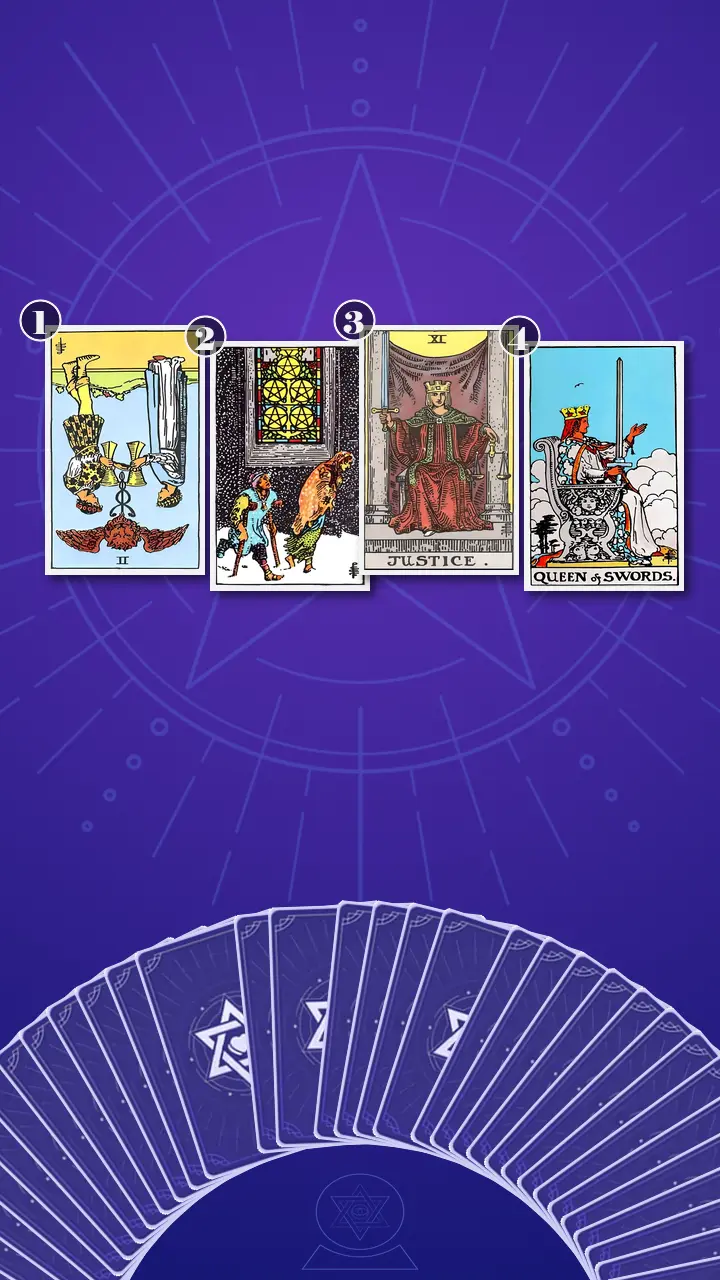
I told her I was using The Shadow Spread, a four-card tarot reflection for emotionally unavailable relationship patterns. I chose it because her question was an inner excavation, not a request to predict a particular partner's behaviour. The structure follows a narrow bridge: visible repetition, hidden belonging fear, the disowned standard that can interrupt the pattern, and one direct practice that returns the decision to her.
For anyone trying to understand how tarot works in a relationship reading, the useful part is the sequence. The first position shows the surface pattern and presenting problem. The second reveals the fear beneath it. The third acts as the hinge, asking what fair reciprocity has been treated as too demanding. The fourth turns that insight into a question, boundary, or observable next step.
What the Raised Cups Could Not Promise
Position 1: The Warm Message and the Missing Follow-Through
Now I turn the card that represents the surface pattern and presenting problem: Two of Cups, in reversed position.
Upright, the Two of Cups shows mutual attraction, emotional partnership, and an exchange that moves in both directions. Reversed, its Water is blocked. This is the moment after Maya sends a vulnerable WhatsApp voice note and receives just enough warmth to keep the relationship emotionally alive: an affectionate reply, a promise to talk, or a late-night confession. Then she carries the next vulnerable conversation, waits through the silence, and treats the occasional tenderness as proof that the fuller exchange is still coming.
The two cups are raised, but the emotional handoff is not reliably happening. The deficiency is not Maya's capacity to love. The blockage is that one person keeps supplying the emotional opening while the other offers intermittent access. It can feel like a dating algorithm that gives one perfectly relevant recommendation after ten irrelevant ones, keeping her scrolling because the next hit might finally be the one.
I asked, What has this person consistently shown you, separate from what you imagine could happen? Maya's thumb froze above the screen. Her eyes went unfocused as if the voice note were playing again, and then she gave a short, bitter laugh.
That is too accurate, she said. Almost cruel.
I let the silence stay ordinary. A reversed Two of Cups is not a verdict about your worth or a command to end anything instantly, I said. It is a prompt to notice whether two people are actually participating in the same exchange. You can name a need, observe a pattern, and still leave room for an imperfect human response.
The Lit Window and the Empty Calendar
Position 2: The Fear Beneath the Waiting
Now I turn the card that represents the underlying fear and emotional root: Five of Pentacles, in upright position.
The Five of Pentacles brings us into contracted Earth: exclusion, insecurity, and the fear of being outside warmth or support. I connected it to the Sunday afternoon scene Maya had described. Friends were posting anniversary photos and moving-in pictures while she remained attached to a vague romantic chat, waiting to find out whether she would see him that week. A pinned conversation could begin to look like a lit window in a cold London evening.
I said, This may not be only about missing this person. It may also be about imagining the first empty evening after stepping away: the unanswered phone, the open calendar, and the fear that no one else will choose you. Her financial independence did not cancel that emotional fear. A Monzo rent notification could prove she was capable of managing her life while the possibility of being alone still landed as a heavy drop beneath her ribs.
Longing can tell you that you care; it cannot, by itself, tell you that you are being met. I asked whether the fear of having no relationship had started to masquerade as evidence that this particular relationship was right. Maya lowered her gaze, pressed her fingers together, and slowly released them.
I keep calling him guarded because unavailable feels too final, she said. If I stop explaining him, I have to admit I might be waiting for something that is not coming.
I nodded. That admission can hurt without being a punishment. It is information becoming available.
When Justice Put the Story on the Scales
Position 3: The Standard I Had Been Calling Too Much
The room became quieter as I turned the central card, the visual hinge of the spread: Justice, in upright position.
Justice brings Air into a reading that has been dominated by blocked Water and contracted Earth. Its balanced scales ask for fair accounting, while its upright sword separates present behaviour from the story built around it. This is Maya opening the Notes app after another vague reply and making two headings: What I receive consistently and What I keep explaining away.
On one side might be two affectionate conversations and one thoughtful check-in. On the other might be missed plans, unanswered questions, and the fact that she initiates every conversation about feelings. The scales are not a prosecution. They are a way to let the observable exchange count as much as chemistry, hope, and potential.
This is where I use one of my signature lenses, Daily Friction Deconstruction. I strip away dramatic accusations and locate the ordinary mechanical breakdown: who follows through, who repairs distance, who asks a second question, and who keeps carrying the conversation. Then I use Emotional Clutter Sorting to separate genuine incompatibility from a busy week, fatigue, different pacing, or external pressure. That distinction protects Maya from turning one imperfect response into a character verdict, while also protecting her from explaining away a repeated pattern.
She was still caught in the old question of how to become easier to choose. The new question was more uncomfortable and more useful: what can this person consistently offer now, without Maya doing the emotional project management for both of them?
She was not being asked to decide whether the connection was good or bad, I said. She was being asked to let the present exchange have a fair vote.
Do not treat emotional distance as a test you must pass; weigh present reciprocity with Justice's scales and speak from what you actually need.
Maya's breath caught first. Her face stayed still, but her eyes widened slightly and fixed on the card, as though a familiar explanation had stopped loading. Then I saw the memory move through her: the voice note, the three-day silence, the draft messages she had deleted. Her shoulders rose toward her ears and held there before lowering by degrees. One hand had been closed tightly around the edge of her sleeve; it opened finger by finger. When she finally spoke, her voice was quiet and uneven. So I have been trying to win access to something I should have been observing. A long breath left her chest, followed by a small, almost startled laugh. There was relief in it, but also the brief dizziness of having a clear path where an old story had been. I asked, Now, use this new view to think back to last week. Was there a moment when this insight could have made you feel different?
She looked toward the rain-streaked window. The grinder in the cafe next door stopped, and for one clean second the city seemed to hold its breath with us. When he said he was not good at emotional conversations, I started planning how to make them easier for him, she said. I could have heard that as information.
That was the first crossing from longing-driven hypervigilance and idealized potential toward self-trusting discernment grounded in observable reciprocity. It did not erase her desire for closeness. It changed what closeness would be allowed to mean.
The Sentence That Gives the Door a Handle
Position 4: The Boundary-Setting Witness
Now I turn the card that represents the conscious response and next practice: Queen of Swords, in upright position.
Her upright sword and direct gaze translate Justice into language. The Queen does not ask Maya to become colder, flawless, or suspicious. She asks her to make one emotional need visible early enough that reciprocity can be assessed before fantasy fills every gap.
I wrote a sentence with her: I am looking for emotional consistency, which for me means being able to talk openly and follow through on plans. Then I added one question: Is that something you are able and interested in building right now?
This is the difference between a boundary and a silent test. A boundary gives the other person a real chance to answer and gives Maya permission to let the answer include what happens next. As I told her, Ask once, watch the pattern, and let the answer include what happens next. I compared it to checking the live arrival time for a delayed Tube train instead of building a hopeful route around one that arrived brilliantly once.
Maya typed the sentence into her phone, read it twice, and placed the device face down. Her jaw tightened, then softened. I want an answer, she said. But I also want to avoid what the answer may show me.
Both can be true, I said. You choose whether to send it, when to send it, and what you do with the response. Clear language does not control the outcome; it makes your participation honest.
From Decoding to Finding Clarity
The spread told one coherent story. The reversed Two of Cups showed the visible loop: Maya carried the vulnerable exchange and treated intermittent warmth as evidence that mutuality was forming. The Five of Pentacles showed why the loop held: stepping away felt like standing outside belonging, so limited warmth seemed safer than an honest empty evening. Justice introduced a fair measure, and the Queen of Swords gave that measure a voice.
The cognitive blind spot was treating the intensity of waiting as evidence of emotional depth. Maya had been asking how to make a distant person open up, when the more grounded question was whether the current relationship already offered enough openness to participate in. Their distance may be a fact about their capacity, not a challenge designed to measure her patience.
The transformation direction is small but decisive: move from interpreting emotional distance as a challenge to earn closeness toward naming one need early and assessing the partner's consistent, observable response for reciprocity. This four-card Shadow Spread tarot reflection does not decide for Maya. It gives her a clearer surface on which she can decide for herself.
A Practical Reciprocity Reality Check
I offered Maya three low-pressure next steps. None required a dramatic breakup, a perfect speech, or certainty about the entire future.
- The Reciprocity Reality CheckOn Wednesday evening, open the Notes app for ten minutes and make two columns: What I receive consistently and What I keep explaining away. Use only the last two weeks of observable replies, plans, follow-through, emotional conversations, and repair after distance. Circle one repeated behaviour in each column.Keep the wording factual rather than prosecutorial. They cancelled twice and did not reschedule is enough. You do not have to send the list or make a decision immediately.
- The One-Sentence Need PracticeChoose one current or future connection and write: I am looking for emotional consistency, which for me means being able to talk openly and follow through on plans. Add: Is that something you are able and interested in building right now? Keep the draft for twenty-four hours, then choose whether to say it in person or send it.Prepare a full version and a two-sentence version. Asking once is enough. Observe directness, curiosity, follow-through, and whether the other person returns to the conversation without you carrying it.
- The 24-Hour Micro-Boundary ResetFor the next twenty-four hours, set one non-negotiable time boundary in your shared London flat: after 9:30 PM, mute the chat, place your phone across the room, and do not check their activity or draft another explanation until morning. Use the pause to name the feeling before the story arrives.This is not a punishment or a test. If the pause increases distress, make tea, call a trusted friend, or return to an ordinary grounding task. The boundary is information, not a rule about what you must ultimately choose.

A Week Later, the Quiet Proof
Six days after our reading, I received a voice note from Maya while I was pouring coffee. She had made the two columns, written the need sentence, and asked the question. His reply had been kind but clear: he was not able to build the kind of emotional consistency she wanted right now. She thanked him instead of negotiating with the answer, then archived the chat.
That evening, she sat alone in a cafe with her coffee growing cold, not celebrating exactly. She still missed him, but the empty chat no longer looked like a lit window with her name on it. I still wanted him, she told me, but I stopped using wanting as evidence.
I consider that a real beginning. The cards did not remove uncertainty, choose a partner, or promise that a clearer question would never hurt. They helped Maya move from decoding to discernment, from earning closeness to observing availability, and from treating a mismatch as proof of personal failure to treating it as usable information.
When a text thread goes quiet and your chest tightens around the hope that one more explanation might bring the person closer, it can feel safer to keep earning a half-open door than to risk discovering whether you were ever being met. You are allowed to want the door open. You are also allowed to look at whether someone is opening it with you.
If you let emotional availability be something you observe rather than something you earn, what is one small need you might allow yourself to name in your next real conversation?
This story is adapted from psychological research, written so that those in a similar struggle can see their own pattern in it — and find their next step clearly.These insights are not a substitute for professional psychological, medical, legal, or financial advice.
Learn more about our Journey to Clarity.
How did this insight land for you?
🫂 This Resonates Deeply
🌀 Living This Story
✨ Now I See Clearly
🌱 Seeing New Possibilities
🧰 Useful Framework
🔮 The Confirmation I Needed
💪 Feeling Empowered
🚀 Ready for My Next Step
Author Profile
 AI
AI“For twenty years, I’ve listened to stories unfold over the warm aroma of coffee. I don’t believe life’s complexities always require grand theories to be solved; often, we just need a safe place to tidy up our reality. I don’t offer high-minded preaching—just grounded, heartfelt insights to help you regain your sense of control amidst the clutter of daily life.”
In this Love Tarot Reading :
Core Expertise
- Daily Friction Deconstruction: Stripping away dramatic accusations to locate the mundane, mechanical breakdowns in your shared daily routine.
- Emotional Clutter Sorting: Separating actual relationship incompatibility from the stress of household chores, fatigue, or external life pressure.
Service Features
- The 24-Hour Micro-Boundary Reset: A highly pragmatic exercise to establish one non-negotiable physical or time boundary in your shared space to instantly reduce friction.
Also specializes in :
Explore Related Patterns:
Anxious AttachmentMaya rereads a vague WhatsApp reply for hidden warmth, monitors the unanswered question, and imagines the empty calendar that might follow if she steps away. The relationship's uncertainty activates more searching and pursuit precisely when reliable closeness is least available. When you fear that releasing partial access could leave you entirely unchosen, small signals can take on the role of emotional security. Anxious Attachment describes this hyperactivating strategy rather than a defect in your capacity to love: ambiguity increases the urge to restore contact, even when the contact does not consistently meet the need that activated the urge.
Defensive OverfunctioningWhen Maya hears that he is not good at emotional conversations, she immediately starts planning how to make them easier for him. She initiates the discussions, carries the next vulnerable exchange, and supplies the structure that would allow closeness to appear possible. When you respond to another person's limited capacity by increasing your own labor, action can protect you from the helplessness of simply observing the mismatch. Defensive Overfunctioning keeps hope active through effort, but it also obscures the central evidence: what the other person can initiate, sustain, and repair without you managing both sides.
Intermittent ReinforcementMaya receives affectionate replies, promises to talk, and occasional confessions, followed by unanswered questions, silence, and missing follow-through. Because warmth returns unpredictably, each tender moment can feel unusually significant and renew the expectation that mutual closeness is about to stabilize. When care arrives on an irregular schedule, your attention can become more persistent than it would under a consistently unavailable exchange. Intermittent Reinforcement explains why the half-open door is difficult to leave alone: the next warm moment remains possible, so checking and waiting feel temporarily more compelling than evaluating the overall pattern.
Pursuer DistancerMaya repeatedly initiates conversations about feelings, carries the next vulnerable exchange, and moves toward the connection after periods of silence. The other person offers enough access to keep the exchange alive but does not reliably match her movement toward openness and repair. When you increase pursuit in response to distance, the relationship can become organized around the pursuit itself rather than around mutual closeness. The Pursuer Distancer cycle explains how both positions remain stable over time: your extra movement fills the relational gap, so the other person's independent willingness and capacity are never tested cleanly.
Self-AbandonmentMaya has been calling fair reciprocity 'too much' and asking how to become easier to choose. When he names his difficulty with emotional conversations, her first move is to redesign the conversation around his limitation rather than let her own requirement remain central. When you preserve connection by repeatedly demoting your needs, accommodation becomes a form of Self-Abandonment. The pattern does not lie in caring about another person's limits; it appears when their limits are treated as fixed reality while your need for consistency is treated as the variable that must keep shrinking.
Emotional ReasoningMaya has been treating the intensity of waiting as evidence of emotional depth and the fear of losing the relationship as evidence that it must be important to preserve. Her later statement, 'I still wanted him, but I stopped using wanting as evidence,' identifies the precise shift in her appraisal. When you use the strength of a feeling to judge the quality of a relationship, longing can appear to confirm compatibility even when observable reciprocity is weak. Emotional Reasoning does not mean the feeling is false; it means the feeling is being asked to prove something it cannot establish about another person's capacity or the exchange between you.
Potential ProjectionMaya treats occasional tenderness as evidence that a fuller exchange is forming and uses 'guarded' where 'unavailable' feels too final. The imagined future partner, the one who eventually follows through and becomes emotionally open, begins to compete with the person participating in the relationship now. When you project potential into the gaps of an inconsistent exchange, possibility can feel almost as persuasive as evidence. Potential Projection preserves hope by turning isolated warmth into a forecast, which makes it harder to ask whether the current version of the relationship is already sufficient for your actual needs.
Scarcity MindsetMaya imagines the unanswered phone, open calendar, and fear that no one else will choose her, while friends' anniversary and moving-in posts sharpen the contrast. Against that imagined absence, even a vague pinned conversation can resemble proof that she still has access to belonging. When you perceive connection as scarce, partial warmth can feel more valuable than its actual consistency would justify. Scarcity Mindset narrows the choice to 'this connection or no connection,' making it harder to recognize that leaving an unmet need visible is not the same as giving up the possibility of being met elsewhere.
Boundary DiscernmentMaya replaces the half-open door of implication with one stated need, one direct question, and attention to what follows. She also separates an ordinary imperfect response from the repeated pattern of missed plans, unanswered questions, and emotional conversations she has to carry. When you practice Boundary Discernment, you define what you need without making the other person responsible for agreeing. You leave their choice with them while reclaiming your choice about continued participation, so a boundary becomes a decision guide rather than a silent test or threat.
Reality TestingMaya's two-column Notes audit and her decision to hear 'I am not good at emotional conversations' as information move the relationship out of the realm of hidden meanings. Missed plans, direct answers, follow-through, and repair become observable evidence rather than details that chemistry can overrule. When you compare what is consistently happening with what you hope might happen, you interrupt the mind's attempt to manufacture certainty from ambiguity. Reality Testing does not require you to dismiss affection or assume the worst; it allows present behavior to carry a fair vote in your decisions.
Assertive CommunicationMaya names emotional consistency in concrete terms, asks whether he can and wants to build it, and later receives his answer without negotiating against it. Her language turns a private hope into a visible standard that another person can respond to honestly. When you state a need directly, you stop using extra effort, silence, or hints to make the relationship reveal itself. Assertive Communication cannot control whether someone is available, but it makes your participation clear and prevents their capacity from being confused with your ability to phrase the request perfectly.
Explore Related Struggles:
Availability-Worth FusionOn Sunday, anniversary and moving-in posts surround a pinned romantic chat while you wait to learn whether you will see him that week. The prospect of an empty evening gives intermittent warmth a larger place than its consistency deserves, and being chosen starts to carry the weight of belonging itself. Availability-Worth Fusion describes the point where access to a person's attention becomes entangled with what their choice seems to say about your place in the world. You do not need to argue yourself out of wanting him. You can separate wanting to be chosen from evidence that he is able to choose the kind of emotional presence you need.
Earned Love BindThe phrase I keep calling him guarded because unavailable feels too final shows how waiting becomes a project. You reread, explain, and plan how to make emotional conversations easier, as though enough precision or patience could win access to what the other person has not consistently offered. Earned Love Bind names the closed loop between effort and closeness: the more uncertain the access, the more your work can feel like proof that the connection is still worth pursuing. You can ask once, watch what happens next, and allow the answer to be information rather than a challenge to solve. Your ability to make a conversation easier is not the same as the other person's ability or willingness to participate.
Idealization-Reality SplitWhen he says he is not good at emotional conversations, you start planning how to make those conversations easier for him. The affectionate voice note, the promise to talk soon, and the possibility of a fuller bond pull against missed plans, unanswered questions, and the fact that you initiate feeling conversations. Idealization-Reality Split captures the friction between the person who appears in intermittent moments and the relationship their consistent behavior can actually support. You can leave room for fatigue, different pacing, or an imperfect response without asking potential to overrule a repeated pattern. Letting present capacity count does not make your desire excessive; it gives your desire a reality it can stand on.
Reciprocity DeficitAt 11:38 PM, you are rereading an affectionate voice note while the question beneath his promise to talk remains unanswered. You keep the emotional opening alive, but the next vulnerable exchange and the waiting are carried mainly by you, so warmth arrives as a signal without becoming a dependable handoff. That arrangement makes longing do the work that mutual participation would normally do. Reciprocity Deficit names the structural bind in which you can receive tenderness and still not receive a relationship that consistently meets your emotional needs. You are allowed to count the affectionate moments, the missed plans, the unanswered questions, and who returns to the conversation as equal parts of the evidence.
Explore Related Emotions:
Borrowed Warmth AcheRain taps Maya's window while the phone feels warm in her palm and an affectionate voice note sits above an unanswered question. The warmth is real in the moment, but it belongs to a fragment of contact rather than a consistently shared relationship. You can keep returning to limited tenderness because it briefly softens the surrounding absence. Borrowed Warmth Ache describes the pain of receiving enough contact to remember what closeness could feel like, while never being able to rest inside it as something reliably available.
Certainty HungerMaya can read a room in seconds, yet she rereads one vague message for hidden warmth and searches earlier voice notes for a stable answer. The exchange offers too little consistency to resolve the question, so every detail acquires more interpretive weight. Your mind may work harder when the available evidence cannot support the certainty you need from it. Certainty Hunger names the consuming wish for one definitive sign that will make an unstable connection coherent, even as repeated decoding keeps you inside the uncertainty.
Conditional Belonging FearFriends post anniversary and moving-in photos while Maya waits to learn whether she will see him that week. The pinned conversation begins to function like a lit window, making an inconsistent connection appear safer than the unanswered phone and open calendar she imagines after leaving. When one person's limited attention becomes evidence that you still belong somewhere, stepping away can feel larger than ending a mismatch. Conditional Belonging Fear names the deeper concern that refusing partial access may leave you entirely unchosen, even when the current exchange is not meeting you.
Counterfactual LongingMaya hears that her partner is not good at emotional conversations and immediately begins planning how to make those conversations easier for him. Occasional tenderness is then asked to stand in for the fuller reciprocity she keeps imagining could develop. Your longing can become attached to a relationship that exists mainly in the conditional future, where one more explanation or patient wait might finally unlock consistent closeness. Counterfactual Longing names the ache for what could be, especially when that imagined possibility carries more emotional weight than what is being offered now.
Finality DreadMaya admits that she keeps calling him guarded because unavailable feels too final. She wants a direct answer, yet she also wants to avoid the possibility that the answer will confirm she has been waiting for something that is not coming. You may keep a softer explanation alive when a clearer conclusion would close the imagined route to future closeness. Finality Dread is the weight that gathers around accepting a present limit, particularly when ambiguity still leaves a narrow opening for possibility.
Mixed Signal DreadAn affectionate reply, a promise to talk, or a late-night confession keeps the exchange alive, but unanswered questions and missed follow-through arrive behind it. Maya cannot settle into either mutual closeness or a clean ending because the relationship keeps changing shape. Your inner world can remain suspended when warmth repeatedly appears without becoming reliable. Mixed Signal Dread is the heavy anticipation produced by never knowing whether the latest opening marks genuine movement or another brief interruption in the distance.
Mutuality HungerMaya sends the vulnerable voice note, carries the next difficult conversation, waits through the silence, and initiates every discussion about feelings. The connection repeatedly depends on her supplying the opening while the other person offers only intermittent participation. Your desire is not merely for contact; it is for another person to meet, continue, and repair the exchange with you. Mutuality Hunger names the persistent inner need for closeness that moves in both directions, especially when you have been surviving on responses that acknowledge the need without actually sharing its weight.
Bittersweet ReleaseSix days later, Maya receives a kind answer that he cannot build the emotional consistency she wants, thanks him, and archives the chat. She still misses him in the cafe afterward, but the empty thread no longer looks like a promise waiting to be recovered. You can release a connection without erasing the part of you that wanted it. Bittersweet Release holds both realities at once: the attachment still has tenderness and weight, while your decision no longer requires longing to function as evidence that you were being met.
Cautious Self-TrustMaya writes one clear definition of emotional consistency, asks whether the partner can build it now, and later receives a kind but limiting answer. She thanks him instead of negotiating, allowing his stated capacity and subsequent behavior to count. Self-trust develops here through a sequence of small, observable choices rather than absolute confidence. Cautious Self-Trust is the tentative steadiness of letting your need remain valid even when naming it risks disappointment, then allowing the answer to inform you without turning it into a verdict on your worth.
Clarity ShockMaya's breath catches, her eyes widen, and her hand opens finger by finger when she recognizes that she has been trying to win access to something she could have been observing. Memories of the voice note, the three-day silence, and the deleted drafts reorganize around that distinction. Clarity can reach you as a bodily jolt before it becomes calm understanding. Clarity Shock names the disorienting instant when an old explanation stops working and a more accurate account suddenly becomes available, returning your choices to view while the emotional impact is still landing.
Hypervigilant AnxietyMaya rereads a vague WhatsApp reply, returns to an affectionate voice note, and freezes with her thumb above the unanswered question. Her body remains braced while her attention treats every word, silence, and change in tone as potentially decisive. When your access to closeness is intermittent, monitoring can begin to feel necessary because the next small signal might restore the connection. Hypervigilant Anxiety names the inner strain of staying continuously alert for warmth that never becomes dependable enough to let your attention stand down.
Solitary ClarityMaya sits alone in a cafe with her coffee growing cold after archiving the chat. She still wants him, but the empty conversation no longer resembles a lit window with her name on it, and she stops treating wanting as proof. Your time alone can become a clear vantage point rather than evidence that you have failed to secure belonging. Solitary Clarity describes the quiet, unsentimental recognition that an open calendar may hurt while still giving you more room than a half-open connection that requires constant interpretation.
Explore Related Contexts:
Mixed Signal LimboAn affectionate voice note sits above Maya's unanswered question, while the promise to talk soon never becomes a dependable conversation or plan. Tender exchanges keep the connection active, but silence, missed plans, and vague timing prevent her from locating where the relationship actually stands. Mixed signals create a practical limbo in which each warm moment appears to reopen a path that subsequent behavior does not sustain. You can regain clarity by treating repeated follow-through as stronger evidence than the most emotionally vivid message, allowing the observable pattern to define the available relationship rather than an indefinitely postponed possibility.
Emotional Labor ImbalanceMaya initiates every conversation about feelings, carries the next vulnerable exchange, and begins planning how to make emotional dialogue easier after he says he is not good at it. The work of creating clarity, repairing distance, and sustaining emotional contact is therefore concentrated on one side of the relationship. When you are doing the emotional project management for two people, increased effort can keep an unequal exchange functioning without making it mutual. Recognizing the labor distribution gives you a concrete question to examine: after you make one clear opening, does the other person independently return, ask, repair, and follow through, or does the connection still require you to supply its entire emotional infrastructure?