The 8:47 p.m. Line 1 Scroll
I met Jordan after a committee meeting had followed them all the way onto the TTC. At 8:47 p.m., heading north on Line 1, they had reopened a Slack thread they had promised themself not to check. The carriage smelled faintly of wet coats. Fluorescent lights buzzed overhead. Their phone had grown warm in their palm from being held too tightly.
Someone had called a new accessibility proposal unrealistic. Jordan had drafted a point-by-point reply while the speaker was still talking, then deleted it, then made it longer and sharper. Their jaw had locked. Their shoulders had stayed lifted nearly to their ears. By the time they reached the subway, the argument was playing on repeat between Yonge and St. George.
“If I stay calm, people will think I have nothing to say,” Jordan told me. Then, quieter: “But I do not want to become the thing I am fighting.”
I recognized the particular weight of that contradiction. Jordan wanted to reject the old guard's values, but under pressure they reached for the old guard's method: speed, certainty, and a voice sharpened until it could not be ignored. The anger was real, and so was the value beneath it. The pain came from hearing an inherited authority voice come through their own mouth afterward, as though they were trying to read a road sign in a storm while gripping the wheel too hard to steer.
“You can reject the old guard's values and still have learned its volume,” I said. “That does not make you a fraud. It gives us something precise to examine. Let us make a map of the moment before your reply takes over.”
Choosing a Compass in a Crosscurrent
I asked Jordan to place both feet on the floor, take one unhurried breath, and hold the question without trying to solve it. I shuffled slowly, not as a performance of mystery, but as a way to give the nervous system a clear transition: the meeting was over; the pattern could now be observed.
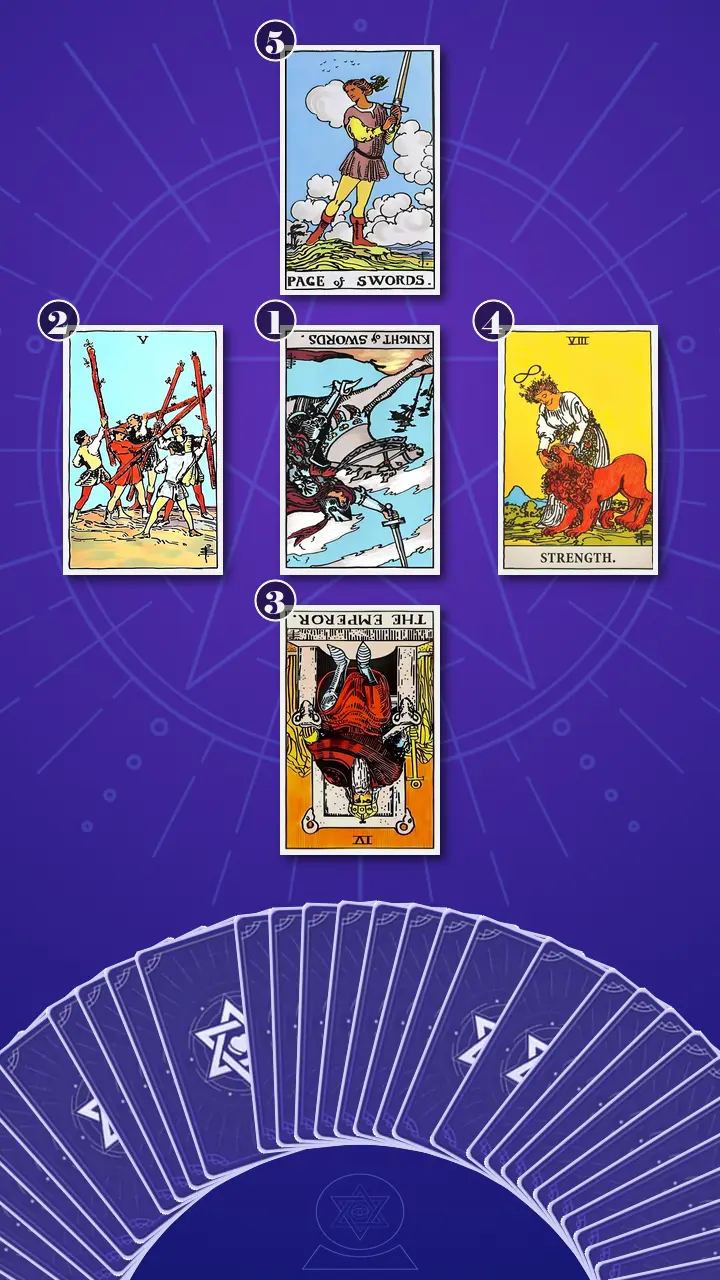
I chose The Shadow Spread, a five-card tarot spread for inherited anger, authority patterns, and conflict communication. It is useful when a problem cannot honestly be reduced to “speak up” or “stay quiet.” Its cross-shaped structure follows the actual chain: the visible reaction at the center, the trigger to its left, the inherited root below, the transforming capacity to the right, and a practical communication habit above.
For Jordan, I explained, the central card would show the sharp reply that arrives before reflection. The card beneath it would examine the learned belief that leadership requires control. The card to the right would point toward a form of authority that protects a boundary without reproducing hostility. This is how tarot works at its most useful: not as a verdict about who someone is, but as a structured way to see a pattern clearly enough to choose differently.
Reading the Map of Inherited Anger
The Reply Already in Motion
Now I turned the card representing the visible reactive pattern: the specific way Jordan adopts sharp, fast anger while trying to distinguish themself from the old guard. It was the Knight of Swords, reversed.
I pointed to the raised sword, the charging white horse, and the wind-tossed landscape. “This is the Slack reply opened before the other person has finished speaking,” I said. “Your intelligence and conviction are not the issue. Reversed, the Knight shows mental speed turning into an urgent verbal charge. The body gets ahead of understanding. The goal quietly shifts from clarifying the issue to proving you cannot be dismissed.”
In the card's modern language, the raised sword was Jordan's phone hovering over Send; the horse was their mind racing through every inconsistency in the other person's argument. The energy was blocked, not because Jordan lacked a point, but because unchosen urgency had turned a legitimate concern into a message built to win.
“If I do not answer now, I will disappear,” Jordan said, repeating the thought that always seemed to arrive with the heat in their face.
Jordan did not nod in agreement. They gave a brief, bitter laugh and looked down at the table. “That is so accurate it is almost cruel,” they said. Their fingers pressed flat against the edge of the chair, then eased away. I let the recognition stand without turning it into a judgment. A reactive pattern is a pressure point, not a character flaw.
“The question is not whether you are allowed to care,” I told them. “It is whether speed is serving the value, or only protecting you from the feeling of being ignored.”
Five Voices, One Microphone
Now I turned the card representing the conflict trigger: the kinds of competitive or dismissive group exchanges that make Jordan feel they must fight to be heard. It was the Five of Wands, upright.
Five people raised crossing staffs on uneven ground. I saw the Toronto planning calls Jordan had described: several voices talking at once, contradictory comments multiplying in a shared Google Doc, no agreement about the actual question, and an older colleague saying, “We have tried this before.”
“This card is friction,” I said, “but it does not say every disagreement is an attack or that one person must win. Its fire is active and scattered. When the process is unclear, volume can impersonate leadership. That is the trigger: not just opposition, but the sense that influence is being handed to whoever speaks most forcefully.”
The Five of Wands showed energy in excess: too many agendas colliding without enough structure. Jordan's stomach tightened as they remembered the last meeting. They had responded to the loudest tone instead of the actual question. I asked them to consider whether a future tense exchange contained a real boundary violation, or whether a chaotic group pattern had made every disagreement feel like a contest for the floor.
The Stone Throne Under the Argument
Now I turned the card representing the inherited authority script: the learned equation of leadership with control, rigidity, and force that keeps the anger pattern in place. It was The Emperor, reversed.
The stone throne, ram heads, armor, and barren mountains gave the pattern its deeper shape. I said, “This is the internal rule that says someone must seize control or the room becomes unsafe. You are resisting that model outside yourself, but when you feel dismissed, you borrow it inside yourself. Certainty becomes armor. Force starts to feel like the only proof that you belong at the table.”
For a moment, my mind returned to the trading floor where I had spent years before becoming a reader. I remembered how quickly a room could mistake the loudest certainty for the soundest position. In practice, the strongest leverage was rarely the person making the most noise; it was the person who understood the decision, the constraints, and the actual point of pressure.
“The Emperor reversed does not ask you to respect a rigid process just because it is old,” I told Jordan. “It asks you to separate a structure that needs a boundary from an inherited belief that every experienced voice is the enemy. The issue is not whether you control the room. It is whether the process can become more equitable.”
Jordan's gaze moved from the card to the rain-darkened window. Their shoulders remained tense, but the rigid set of their mouth had softened. They were beginning to see that their fear was not simply anger at an older colleague. It was the lonely belief that, without force, they would have no influence at all.
When Strength Put a Hand on the Lion
The Authority Jordan Could Choose
The room grew quieter before I turned the next card. Now I turned the card representing the transformative capacity: the form of strength that lets Jordan protect a value without reproducing the old guard's hostility. It was Strength, upright.
I showed Jordan the woman in white with her gentle hands at the lion's mouth, the infinity symbol above her head, and the flowering landscape behind them. This was not conquest. It was regulated power: anger held close enough to hear its message, but not handed the microphone.
Jordan was still caught in the old calculation: if their words did not land hard, would anyone hear the issue at all? They had been treating a raised temperature as evidence that the concern mattered. I could see the familiar conflict moving through them, the one between wanting to build a different kind of workplace and fearing that a calmer voice would make them disappear.
You do not have to use the old guard's raised voice to be effective; hold your values with Strength's gentle hand on the lion.
I left space after the sentence. Jordan's breath paused halfway in. Their thumb, which had been rubbing the rim of their water glass, stopped. Their eyes lost focus for a second, as if the Line 1 carriage and the unsent Slack draft had replayed behind them. Then their pupils widened and their face tightened with something more complicated than relief.
“But does that mean I was wrong before?” they asked. There was anger in the question, then grief under it. Their fingers curled once into the fabric of their sleeve. “I was right about the accessibility issue. I just... I hated how I sounded.”
“You were not wrong to protect the issue,” I said. “The anger may be yours; the delivery may be inherited. Strength does not ask you to erase either your clarity or your boundary. It asks you to choose who gets to deliver it.”
I used my own Power Dynamic Deconstruction here. I asked Jordan to distinguish the surface heat from their actual leverage: Who owned the agenda? What decision was being made? Whose experience had been excluded? What specific process change could alter that? A cutting reply might create a brief sense of force, but it was not the same as influence. Naming the decision, the affected people, and the request was leverage Jordan could use without becoming the next person everyone had to defend against.
I returned to the meeting-room scene. Instead of reaching for the phone under the table, Jordan could place both feet on the floor, take one breath, and say: “This comment does not work for me because it shuts out the people this process is meant to serve.” That was directness without hostility. It was firm compassion, not compliance.
Jordan exhaled through a small tremble, and their shoulders finally lowered. The release left them briefly unsteady, the way a body can feel lightheaded after putting down something it has held for too long. “I can keep the concern without using the temperature of my voice as evidence,” they said.
“Now, with this new perspective, think back over last week,” I said. “Was there a moment when this could have helped you feel different?”
They named the senior-led agenda meeting. The card marked a real shift: not from reactive anger to perfect calm, but from post-conflict self-disgust toward calm courage, chosen authority, and grounded self-respect. Being direct does not require becoming difficult to survive.
A Sword Held Upright
Now I turned the card representing the grounded next step: a practical communication habit that channels Jordan's alert mind into inquiry rather than attack. It was the Page of Swords, upright.
The Page stood on uneven ground, holding an upright sword with both hands while looking back into the wind. I saw the contrast immediately: the Knight had swung the sword while charging ahead; the Page held it steady long enough to see the wider situation.
“This is you entering a difficult meeting with one factual question and one boundary sentence in Notes,” I said. “The Page does not give up discernment. The energy is balanced: alert, truthful, and curious. It turns your sharp mind into an instrument of investigation instead of a closing argument.”
Jordan could ask, “What concern is this rule trying to address, and who is currently paying the cost of it?” That question did not declare the other person innocent. It made the power problem visible. A question can hold a boundary without swinging a sword.
The practical sequence was small enough to be believable: feet on the floor, one breath, one value sentence, then one factual question. Jordan looked at the Page and nodded once, slowly. The next meeting would not become easy on command. But they could arrive without a prewritten verdict and still be ready to name what mattered.
From Heat to Chosen Authority
I gathered the reading into one story. The reversed Knight of Swords showed the rushed rebuttal: a real concern converted into a verbal charge. The Five of Wands showed why group conflict felt like a fight for the microphone. The reversed Emperor revealed the inherited rule beneath it all: that credibility must be secured through control. Strength offered a different kind of authority, and the Page of Swords gave it a daily form.
The cognitive blind spot was understandable: Jordan had been measuring influence by whether they could control the room. The reading offered another metric. Did their response name the value? Did it make a clear request? Did it move the decision or process closer to the future they wanted to build?
“You do not have to soften the value,” I said. “You can choose the delivery.” I adapted my Leverage Mapping Protocol into two small experiments, designed for a real committee meeting rather than an ideal one.
- The Value-First PauseBefore the next committee meeting, Jordan will open Notes and write one sentence beginning, “The value I am protecting is...” using six words or fewer. When a dismissive comment lands, they will put both feet on the floor, take one full breath, state one boundary sentence, and make one process request such as, “Can we hear newer staff concerns before we close this agenda item?”Start with the three-second version. One breath is not surrender. If the exchange becomes personally hostile, pause, leave the thread, or ask for facilitation support.
- The One-Question RebuttalBefore one meeting that week, Jordan will save one factual question in Google Docs: “What concern is this rule trying to address?” They will ask it before presenting their full case, listen without drafting a reply at the same time, and afterward note whether the answer clarified the issue, exposed a real boundary problem, or showed that the conversation needed better structure.Keep the question narrow. One question is an experiment, not a promise to trust the speaker, accept the rule, or solve the entire issue in one meeting.

A Week Later, a Different First Sentence
A week later, I received a message from Jordan after another planning meeting. They had felt the heat rise when someone questioned whether newer staff needed more agenda time. They had written six words in Notes: “Access to the process shapes outcomes.” Then they had said one boundary sentence and asked what operational concern the current agenda rule was meant to solve.
The room had not transformed into a perfect collaboration. One colleague had still sounded defensive. But Jordan had not spent the ride home rebuilding the argument in their head. They had slept through the night; at breakfast, the first thought was still, “What if I handled that wrong?” This time, they noticed it, smiled slightly, and went on with their morning.
I did not read that as a magical ending. I read it as evidence. Jordan had not surrendered their values, silenced their anger, or handed their agency to a deck of cards. They had made a small, observable choice between trigger and response. That was their Journey to Clarity: not certainty, but ownership of their own voice.
When a meeting goes quiet after someone dismisses the point you came to protect, your jaw may lock and your reply may get hotter, not because you want their power, but because part of you fears that calm will make you disappear. If you could keep the value that makes you speak up and let Strength's gentle hand guide the volume in your next difficult conversation, what might your first sentence sound like?
This story is adapted from psychological research, written so that those in a similar struggle can see their own pattern in it — and find their next step clearly.These insights are not a substitute for professional psychological, medical, legal, or financial advice.
Learn more about our Journey to Clarity.
How did this insight land for you?
🫂 This Resonates Deeply
🌀 Living This Story
✨ Now I See Clearly
🌱 Seeing New Possibilities
🧰 Useful Framework
🔮 The Confirmation I Needed
💪 Feeling Empowered
🚀 Ready for My Next Step
Author Profile
 AI
AI“I spent years in the intense, high-stakes world of Wall Street. I know exactly how isolating and heavy the weight of uncertainty can feel in the dead of night. I use strategic, commercial logic not to be cold, but to protect you from unnecessary friction. Think of me as a fellow traveler who has walked the same rocky path—offering sharp but deeply supportive wisdom to help you clear the fog and confidently win your narrative back.”
In this Career Tarot Reading :
Core Expertise
- Power Dynamic Deconstruction: Decrypting hidden agendas and leverage points in upward management and cross-departmental negotiations.
- Transferable Asset Pricing: Objectively auditing and pricing your core skills for cross-industry pivots, stripping away corporate gaslighting.
Service Features
- The Leverage Mapping Protocol: A tactical breakdown to identify your true bargaining chips before your next performance review or salary negotiation.
Also specializes in :
Explore Related Patterns:
Control CopingThe crossing voices, contradictory comments, and dismissive reference to what has been tried before make the committee room feel structurally unsafe to Jordan. In response, certainty becomes armour, and controlling the tone or direction of the exchange starts to feel like proof that they still have influence. Control Coping appears when you use command, certainty, or force to reduce the vulnerability of not knowing whether you will be heard. The short-term reward is a sense of leverage, but the strategy quietly changes the task from protecting access to controlling the room. That is why the method can resemble the old guard even when the value being defended is different. The useful audit is whether your response changes the decision or merely reduces the immediate fear of powerlessness. Naming the affected people, the decision, and the requested process change preserves authority without requiring total control of the interaction.
Shadow IntegrationJordan identifies two different truths inside the same reaction: the anger protects a real accessibility concern, while the sharpened delivery was learned from the authority style they oppose. Instead of declaring the entire reaction right or wrong, Jordan separates the value, the emotion, and the inherited method. Shadow Integration allows you to acknowledge that a rejected trait has entered your behaviour without making it your identity. The aim is not to suppress anger or prove that you are completely unlike the old guard. It is to understand what the borrowed force has been trying to accomplish and choose a form of authority that better serves your own values. Jordan's later boundary sentence makes that integration observable. The concern remains firm, but the delivery is chosen, which turns self-recognition into ownership of voice rather than another cycle of shame and denial.
Cognitive DissonanceJordan states the contradiction directly: they do not want to become the thing they are fighting, yet the old guard's speed, certainty, and hostility appear in their own reply. The accessibility position still feels right, while the delivery feels incompatible with the kind of workplace Jordan wants to create. Cognitive Dissonance develops when your behaviour and your stated values cannot be made to fit the same self-understanding. The bitter recognition afterward is not evidence that the value was false or that you are a fraud. It is the mind detecting a real mismatch between the future you want and the method used under pressure. That mismatch becomes useful when it is treated as information rather than a reason for self-condemnation. You can preserve the concern, examine the learned delivery, and bring your behaviour into closer alignment without rewriting the original disagreement as a mistake.
Zero-Sum ThinkingSeveral voices collide in the planning meeting, and Jordan begins to experience the exchange as a fight for one microphone. The internal options narrow quickly: either speak with enough force to control the room or become irrelevant to the decision. Zero-Sum Thinking converts shared influence into a scarce resource that one side must take from the other. When you read disagreement through that filter, another person's certainty can seem to erase your position, and matching their force can feel like the only defence. The frame reproduces the old guard's method because it accepts their assumption that authority belongs to whoever dominates the exchange. A factual question and a process request open a third option. You can challenge the rule, protect excluded voices, and alter how the decision is made without treating every moment of influence as something only one person can possess.
Assertive CommunicationJordan replaces the sharpened Slack rebuttal with a boundary sentence and a narrow operational question. They name how the dismissive comment affects the people the process is meant to serve, then ask what concern the current rule is designed to address. Assertive Communication lets you protect a position without attacking the other person's legitimacy or abandoning your own. The factual question does not promise trust, agreement, or compliance. It creates enough space to test the stated rationale while keeping the boundary and requested process change visible. This matters because directness and hostility are no longer treated as the same thing. Jordan can be difficult to dismiss without becoming difficult to engage, preserving both the accessibility value and their ability to influence the decision.
Emotional RegulationWhen the heat rises in the next planning meeting, Jordan places both feet on the floor, uses the value written in Notes, and asks one factual question before presenting the full case. The activation is still present, but it no longer determines the first sentence automatically. Emotional Regulation means keeping enough contact with anger to understand its message while retaining choice over the behaviour that follows. When you regulate the response, calm is not evidence that the issue matters less. It is the capacity to stop vocal temperature from becoming the measure of conviction. The quieter ride home shows the practical result. Jordan has not eliminated disagreement or forced the room to become collaborative; they have reduced the amount of control the trigger holds over their body, attention, and later mental replay.
Urgency BiasJordan starts drafting while the other person is still speaking, then deletes the reply only to make it longer and sharper. The thought that arrives with the physical heat is explicit: if the answer does not happen now, Jordan will disappear from the conversation. Urgency Bias turns speed into false evidence that a response is necessary, credible, or powerful. When you experience a pause as surrender, the body can move ahead of comprehension and the first available rebuttal can feel more important than the actual decision. The concern remains legitimate, but unchosen urgency begins directing how it is expressed. The one-breath pause works because it tests the hidden equation between immediacy and influence. You are not abandoning the issue; you are checking whether speed serves the value or only relieves the fear of being ignored.
Post-Event RuminationThe committee meeting follows Jordan onto Line 1 through the reopened Slack thread, the warm phone in their hand, and the argument repeating between stations. Although the external exchange has ended, Jordan's attention remains occupied with rebuilding the rebuttal and reviewing every inconsistency. Post-Event Rumination keeps a completed conflict psychologically active in an attempt to obtain certainty, vindication, or the perfect response after the fact. When you replay the exchange this way, the mind treats further analysis as preparation, but the repeated review can preserve the same bodily activation that produced the sharp reply. Jordan's later commute provides a concrete contrast: the meeting is still imperfect, but the argument no longer has to be reconstructed all the way home. That change shows that processing an event and repeatedly reopening it are not the same psychological task.
Explore Related Struggles:
Anger-Ownership SplitYou draft the accessibility reply before the speaker has finished, delete it, and then make it longer and sharper, even while saying you do not want to become the thing you are fighting. The scene keeps two elements distinct: the anger and value are yours, while the speed, certainty, and sharpened delivery were learned from the old guard. That split leaves you carrying a legitimate objection through a borrowed instrument. When calm feels like disappearance, the reply has to prove both that the issue matters and that you cannot be dismissed, so protecting the value becomes entangled with disowning the voice carrying it. Seeing the anger as yours without treating its inherited delivery as your identity gives you a precise place to choose. You can keep the boundary and change the sentence that delivers it.
Oppositional Identity LockAfter the committee meeting, you can name a clear difference between the future you want and the old guard's values, yet pressure sends you back to its speed, certainty, and volume. The standard you oppose becomes the internal rule you use to secure a place at the table. Because force has been made to feel like proof of leadership, resisting control can still reproduce control at the moment your influence feels threatened. Your identity is asked to stay separate by using the very method that defines what it rejects, so the line between being different and being louder keeps collapsing. Your later questions about agenda ownership, excluded experience, and process change show a different basis for authority. It can be measured by what your intervention makes possible, rather than by how closely its force resembles the authority you are trying to replace.
Voice-Visibility LockYou tell yourself that staying calm will make people think you have nothing to say, then hold your phone over Send while the argument keeps running between Yonge and St. George. A calm delivery is not being treated as a communication choice; it is being made to carry the threat of vanishing from the room. That makes the loudest tone feel like the safest evidence of influence. The reply can start by protecting accessibility and end by trying to establish that you cannot be ignored, while the actual decision, agenda, and cost to excluded people remain less visible. Your one-breath, one-boundary, one-question sequence gives your voice another way to remain present. It preserves directness without making heat the admission price for being heard.
Explore Related Emotions:
Anger ShameJordan drafts the reply while the other person is still speaking, deletes it, makes it longer and sharper, then gives a bitter laugh and says, "I hated how I sounded." The physical tension and the later self-disgust show how quickly a legitimate concern becomes a judgment about the kind of person you were in the room. You are left auditing the temperature of your voice more harshly than the substance of your point. That shame is not evidence that the accessibility concern was misplaced. It is the recoil that follows when your method resembles the authority style you meant to reject, and it can make the next moment of disagreement feel even more urgent.
Authority ClaustrophobiaIn the planning calls Jordan described, several voices talk at once, comments multiply, and an older colleague says, "We have tried this before." Under that pressure, the learned rule that someone must seize control makes the room feel smaller. Whoever speaks most forcefully appears to receive the microphone, while every other response feels like surrendering position. You are resisting the old guard's values, but the inherited equation of leadership with control still restricts your choices when you feel dismissed. The task is not to accept a rigid process or make yourself smaller. It is to distinguish a real boundary that needs protection from the inner pressure that says only domination can secure a place at the table.
Protective AngerSomeone calls the accessibility proposal unrealistic, and Jordan's response is rooted in who the process is meant to serve. The anger has a protective direction because it points toward excluded experience and a concrete change in how the decision is made, rather than toward winning for its own sake. You do not need to disown that force to become different from the old guard. You can keep the value, name the boundary, and ask for a process change while allowing the concern to remain connected to the people it protects. The distinction is not between caring and staying calm. It is between using heat as evidence of importance and using clarity to carry the importance forward.
Self-Betrayal AcheJordan says, "I do not want to become the thing I am fighting," and later admits, "The anger may be yours; the delivery may be inherited." You are not only reacting to an older colleague in those moments. You are hearing a borrowed authority voice come through your own mouth while trying to build a different kind of workplace. That recognition creates a specific ache because the concern itself remains valid. You can be right about the accessibility issue and still feel wounded by the way you carried it. Naming the split between value and delivery lets you examine the learned method without treating the whole of your voice as contaminated by it.
Voice Erasure DreadJordan tells you, "If I stay calm, people will think I have nothing to say," and later names the thought that arrives with the heat in their face, "If I do not answer now, I will disappear." The fast reply is therefore doing more than presenting an argument. It is trying to prevent the experience of being erased from the room. When you measure influence by how forcefully you respond, the old guard's volume can look like protection even while it pulls you away from your own values. The fear is not proof that you are the old guard. It is a precise signal that being heard has become entangled with urgency, giving you something concrete to separate before the next reply takes over.
Grounded AgencyYou are given specific questions that return influence to the parts of the situation you can actually examine. Who owns the agenda, what decision is being made, whose experience has been excluded, and what process change would alter the outcome all give your concern a location beyond the contest for the microphone. A week later Jordan writes, "Access to the process shapes outcomes," asks what operational concern the agenda rule is meant to solve, and does not spend the ride home rebuilding the argument. The room does not become perfect. Agency appears in the observable choice between the trigger and the response, where your values can shape the next move without requiring control of everyone else.
Explore Related Contexts:
Competitive Meeting CultureOn the Toronto planning calls, several people talk at once, contradictory comments multiply in a shared Google Doc, and no one has settled the actual question. Jordan's rapid Slack draft emerges inside a meeting culture where the loudest tone can masquerade as leadership. The later meeting still includes a defensive colleague, yet Jordan is able to bring a value statement, a boundary, and one factual question into the same public process. You can treat the friction as evidence that the forum needs clearer decision rules and room for specific requests, giving your concern a route beyond a contest for the microphone.
Access as Proof PressureSomeone calls the new accessibility proposal unrealistic, and the following meeting raises the question of whether newer staff should receive more agenda time. Access is therefore not treated as a settled condition of the committee's process; it is made to justify its own feasibility before it can shape the decision. That structure turns a substantive concern into a repeated test of whether it is allowed onto the agenda at all. You can locate the pressure in the rule, the decision owner, and the people excluded by the current arrangement, then make the process request visible without reducing the issue to the force of your delivery.