Closing the Course Tab, Then Testing One Meaningful Path in Private

The 10:45 p.m. Course Tab
If you are the operations person who can untangle everyone else's broken workflow but still has the same course application open at 10:45 p.m., the competence trap may look a lot like being “responsible.”
Casey (name changed for privacy) joined my video call from her Toronto apartment with a mug cupped between both hands. She told me that, two nights earlier, blue-white laptop light had been stinging her eyes while a course application glowed beside a Slack message asking her to rescue another routine project. The radiator ticked; her tea cooled untouched. She answered the work message in six minutes, felt her chest loosen with the familiar relief of being useful, and then closed the application because it was too late to “do it properly.”
“I keep waiting for the meaningful option to feel as safe as the familiar one,” she said. “I know how to be useful here, but I'm not sure this role fits me anymore.” As she spoke, her jaw tightened and her shoulders rose. The apprehension looked like a subway brake locked beneath her ribs: a real pull toward movement meeting an equally real resistance.
I told her I did not hear ingratitude or recklessness. I heard a person trying to protect rent, credibility, and control while privately noticing that competence no longer felt like alignment. “Being good at a role is evidence of skill, not proof that the role still fits,” I said.
I also made our purpose clear. I was not going to use tarot to issue a verdict about whether she should quit. I wanted us to build a map of the fog: what the familiar role genuinely protected, what it prevented, and what small piece of the meaningful path she could test without gambling her stability.

Choosing a Compass for the Career Crossroads
I invited Casey to place both feet on the floor, take one slow breath, and hold a single question in mind: “What keeps me choosing a familiar role over a meaningful path?” I shuffled slowly and placed the cards beneath the camera. The pause was not a mystical performance. It was a way to interrupt the tab-switching reflex and give her attention somewhere deliberate to land.
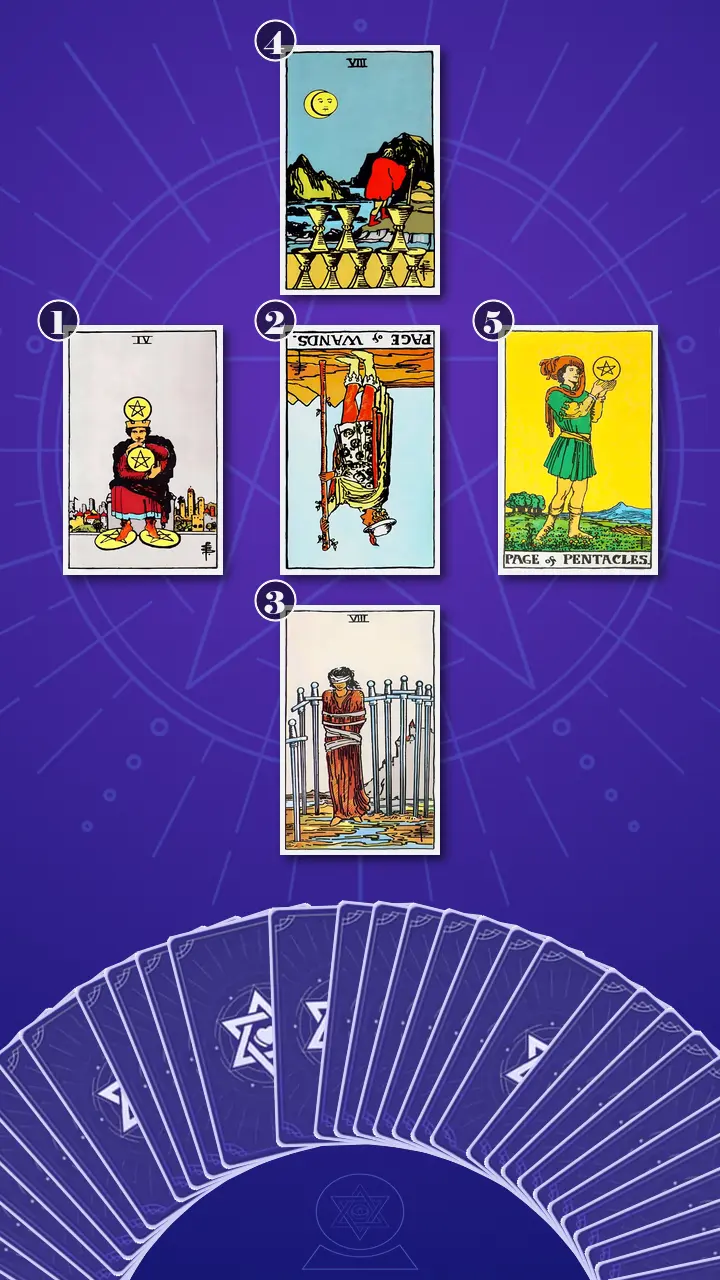
I chose a five-card layout called The Shadow Spread. In my practice, this is how tarot works best for a question about a repeated career pattern: it externalizes the decision architecture so we can examine it without treating every thought as a fact. Card meanings in context become prompts for observation, not commands from an outside authority.
The horizontal line of the spread would move from Casey's visible identity, through the beginner energy she had pushed out of view, toward a practical method of integration. The card below the center would expose the root belief maintaining the pattern. The card above it would reveal the hidden gift and turning point. The layout resembled a crossroads with a stairwell through its center: one axis showed where Casey kept going, while the other showed what had to be understood before movement could feel possible.
I chose this structure because her question was not really, “Which job will win?” It was, “Why do I keep reproducing the same choice?” Five positions let me separate practical security, blocked curiosity, fear of losing control, the need for meaning, and an actionable next step. That separation mattered. When every concern is compressed into one giant career decision, decision fatigue can make staying still look like the only responsible answer.
Reading the Grip, the Spark, and the Cage
Position One: The Coin Held Against the Chest
I began with the position representing Casey's observable pattern: repeatedly choosing responsibilities that confirmed the familiar role while meaningful experiments remained unfinished. I turned over the Four of Pentacles, upright.
I pointed to the figure pressing one pentacle against his chest while pinning two more beneath his feet. “This card is not saying security is bad,” I told her. “Your income, professional credibility, and workplace structure protect real things. But the same grip that guards the chest also immobilizes the feet.”
In Casey's life, the card was the 10:45 p.m. tab switch. One hand answered the familiar rescue request while the other closed the course application. The work assignment provided measurable value and immediate relief. It also took calendar space away from the direction she claimed mattered. Her internal bargain sounded like this: “At least I know I can do this well, but every yes here removes time from the thing I say matters.”
The Four of Pentacles showed Earth energy in excess. Its protective function had hardened into control. Stability was no longer simply supporting Casey; it was assigning her the reliable-fixer role by default, like an old software permission that kept granting the same access because nobody had reviewed whether the setting still served its user.
Casey gave a short laugh, but there was no humor in her eyes. “That's so accurate it's kind of rude,” she said. Her fingers tightened around the mug before loosening again.
“Then let's make it precise rather than punitive,” I replied. “We are not putting your salary and your identity in the same column. The role may genuinely protect your finances. That does not mean every urgent request deserves automatic access to your future.” Her exhale sharpened, the first sign that responsibility and avoidance were beginning to separate.
Position Two: The Draft That Never Reached Version 0.1
I moved to the position representing the disowned beginner and exploratory energy Casey suppressed whenever the meaningful path could make her inexperience visible. The card was the Page of Wands, reversed.
In the upright image, the Page studies a budding wand in an open landscape. Reversed, the exploratory Fire was not absent; it was blocked and turned inward. Casey had ideas, sparks, and moments of genuine interest. What she withheld was permission for those sparks to become imperfect action.
When I asked for a recent example, she described sitting in a Queen West cafe on Saturday with twenty-seven minutes before meeting a friend. She had opened a purpose-led project and written two rough lines while espresso hissed behind the counter and a streetcar vibrated the table. Then she searched the portfolios of people already doing similar work. Their polished launches made her beginning look embarrassingly small, so she deleted the lines and spent the remaining time redesigning her comparison table.
“I wanted to try it,” she said, looking away from the camera, “but I didn't want anyone to see how new I was.”
“That is the reversed Page exactly,” I said. “You judged a private first attempt by public-performance standards. You compared someone else's finished career-pivot reel with your own version 0.1.” Research feels productive because it creates information without creating exposure. It can be valuable, but once it repeatedly replaces contact with the work, it becomes protection dressed as preparation.
I watched Casey rub the edge of her thumbnail. Her mouth tightened with recognition, then softened. I reminded her that the Page was not asking for a launch, a LinkedIn announcement, or a heroic reinvention. A first attempt could remain private. The Fire only needed a safe container in which to move.
Position Three: The Search Filter With Only Two Results
I turned the card in the position of the root belief beneath the pattern: the fear that leaving familiar competence would mean losing control and discovering that every alternative was unsafe. It was the Eight of Swords, upright.
I centered the loosely bound figure and the visible gaps between the swords. The woman in the image experiences real restriction, but the enclosure is not structurally complete. Her blindfold narrows the field more thoroughly than the swords do.
In Casey's decision process, this looked like a job-search filter set so narrowly that it returned only two results: “stay exactly where you are” or “quit without a plan.” A short course, a twenty-minute informational conversation, a volunteer micro-task, a sample lesson, and a protected private prototype had all disappeared from the interface. If she could not guarantee the landing, she did not allow herself to move.
The card showed Air energy in blockage and excess at the same time. Discernment had become recursive analysis. Her mind kept generating comparisons, but those comparisons all inherited the same untested premise: a meaningful path had to offer the income, polish, and certainty of a role she had spent years learning before she was permitted to approach it.
“Toronto rent is not a mindset issue,” Casey said, her tone firm.
“Agreed,” I replied immediately. “I would never ask you to call a material constraint imaginary. Rent is real. Your need for income is real. The question is whether those facts prohibit a forty-five-minute private trial, or whether your mind has bundled that trial together with resignation, tuition, and a total identity change.”
Her breath paused. Her eyes lost focus for a moment, as if she were mentally replaying the tabs she had closed on Sunday night. Then her jaw eased. “A sample lesson doesn't threaten my rent,” she said slowly. “It threatens the story that I should already know whether I'm good at it.”
That distinction was the first visible gap between the swords. I was not asking Casey to deny risk. I was asking her to measure the risk of the actual next action rather than the imagined risk of an entire five-year future.
When the Eight of Cups Left Everything Intact
Position Four: A Respectable Role Can Still Be Insufficient
The radiator on Casey's side of the call stopped ticking, and the sudden quiet seemed to widen the space between us. I turned the card representing the developmental gift inside her shadow: the recurring lack of fulfillment as valid information, and the possibility of moving deliberately without complete certainty. The card was the Eight of Cups, upright.
I showed her the cloaked figure walking toward uneven mountains beneath a watchful moon. The eight cups remained standing. Nothing had been smashed, disowned, or declared worthless. The card's Water energy was moving in balance, restoring emotional truth to a decision that had been dominated by control and analysis.
Casey told me about her last performance review. Her manager had praised her as the person everyone trusted when a project went sideways, then offered her a larger version of the same rescue work. The recognition warmed her for a moment. Her stomach dropped immediately afterward. She smiled, accepted the praise, and privately thought, “I cannot keep building my life around this.” By lunch, she had relabeled that information as ingratitude.
“A respectable role can still be insufficient,” I said. “The cups can be intact and still no longer sustain the journey. Gratitude describes what the role has given you. It does not create an obligation to give that role every future version of you.”
The image triggered a restrained flashback from my years on Wall Street. On a trading floor, the cleanest risk decisions began by separating capital already committed from the opportunity cost of the next commitment. A position did not become wiser simply because more time or money had already gone into it. Human decisions deserve more care than trades, but the structural lesson still applies.
I call this Sunk Cost Neutralization. I asked Casey to place her past investment in one mental column: years of skill, income, relationships, emotional effort, and a professional identity she had earned honestly. In a separate column, I placed the future opportunity cost of staying automatically available to the same work. Neutralizing sunk cost did not mean condemning the past or leaving the job. It meant refusing to treat past value as a debt her future self had to keep paying.
At 10:45 p.m., Casey had been caught inside the demand to make the whole meaningful path safe before she could touch it. The familiar Slack request offered proof of competence in six minutes. The course tab offered no guaranteed identity, only the exposure of becoming a learner again.
Staying familiar is not the same as staying true; choose one honest step toward meaning, like the cloaked figure leaving intact cups that can no longer sustain the journey.
I let the sentence remain in the quiet before adding the second part.
You do not need proof that the whole path is safe. You need one reversible experience that tells you whether it feels more true than the role you already know.
For three seconds Casey did not move. Her breath stopped halfway in, and her fingers remained suspended above the mug. Then her gaze drifted beyond the screen. I watched her pupils widen slightly as the course tab, the cafe draft, and the performance-review praise seemed to replay behind her eyes. Her brow pulled tight. “But doesn't that mean I got the last six years wrong?” she asked, with a sudden edge of anger beneath the hurt. I told her no. Those years had produced skills, income, friendships, resilience, and accurate evidence about what she could do. New information did not retroactively turn a useful chapter into a mistake. Her fist slowly opened. Her shoulders dropped, her eyes reddened, and a long breath left her chest with a faint tremor. Then relief gave way to a more vulnerable expression. “If I don't need a verdict,” she said, “then I actually have to try something.” The clarity had removed a burden, but it had also returned responsibility to her hands.
“Now, with this new perspective, think back to last week,” I said. “Was there a moment when this insight might have made you feel different?”
Casey returned to the performance review. “I could have let the disappointment be information,” she said. “I didn't have to turn it into evidence that I was spoiled. I could have thought: this role gave me something real, and that does not mean it must receive every future version of me.”
I invited her to open one saved course page while we were still together. I asked her to set a ten-minute timer and write one question that only direct experience could answer. She typed: “Do I enjoy doing the beginner version of this work when nobody is grading my identity?” Beneath it, she defined the smallest private test: one introductory exercise, no submission, no purchase, and no career decision. I told her to stop when the timer ended. If even that felt exposing, she could reduce the test to one sentence naming what she wanted to learn.
I named the crossing we had just witnessed. This was not certainty replacing uncertainty. It was the first movement from contracted apprehension and identity-based safety toward grounded self-trust built through lived evidence. The Eight of Cups acted as a bridge: emotional honesty had made a practical experiment possible.
Position Five: One Pentacle, One Experiment
I turned the final card in the integration position, where the reading translated insight into everyday practice. It was the Page of Pentacles, upright.
The Page held one pentacle at eye level while standing in a landscape that could be cultivated. Casey did not need to manage an entire new career at once. She needed one bounded object of study: one course module, one short project, or one structured conversation with a clear time limit, modest cost ceiling, and tangible output.
Earth had returned, but its function had changed. In the Four of Pentacles, Earth was fixed around possession and control. Here, Earth was balanced. It provided a field in which beginner curiosity could become evidence. Stability can be a container for exploration, not a veto against it.
I used a second lens from my former career, Asymmetric Risk-Benefit Analysis. The downside of Casey's proposed test could be strictly capped: forty-five minutes, complete privacy, no spending, and no commitment to repeat it. The information upside was larger. One direct encounter could tell her whether the work held her attention, depleted her, or generated a more intelligent question. Structurally, she did not need guaranteed success for the experiment to be worthwhile. Even choosing to stop would produce evidence about fit, timing, or format.
“So the assignment isn't to prove my next career,” Casey said.
“Exactly. It is to collect one piece of lived evidence.”
Her shoulders lowered another fraction. I watched her open her calendar and create a block titled “Private test: 45 minutes.” For the first time in the reading, the meaningful path was no longer a glowing tab demanding a permanent verdict. It was an appointment with one manageable question.
The Third Path Hidden Inside the Binary
I drew the five cards together into one coherent sequence. Casey's years as the reliable fixer had created real competence and practical security. Praise reinforced that identity, so familiar work received immediate calendar access. Meanwhile, the Page of Wands held her curiosity below the threshold of visible action. The Eight of Swords then translated beginner exposure into an all-or-nothing risk story. Because she gathered no direct evidence, the familiar role kept appearing to be the only controlled option. The Eight of Cups restored fulfillment as valid data, and the Page of Pentacles turned that data into a bounded learning process.
The pattern reminded me of gripping a well-known stair railing after realizing the staircase might lead to the wrong floor. Casey's grip was not foolish; it had kept her steady. Her cognitive blind spot was assuming that releasing one finger meant throwing herself over the edge. She had overlooked the landing, the side door, and the possibility of taking one step while keeping the railing within reach.
I stated the transformation direction plainly. Casey did not need to shift from caution to impulsiveness. She needed to shift from demanding proof that the meaningful path would work to completing one time-boxed, low-stakes experiment that could produce direct evidence. Familiarity could remain one source of information. It no longer had to function as a command.
I gave her two concrete next steps. I kept them small because actionable advice should reduce friction, not turn finding clarity into another optimization project.
- The 10-Minute Protection Ledger:On one evening this week, open a private note titled “What this role protects / What this role prevents.” Write no more than three concrete items in each column. When the next familiar rescue request arrives, wait five minutes before replying and check whether accepting it would displace protected exploration time.Tip: Keep both truths visible. If ten minutes feels heavy, write one sentence under each heading. Nothing has to be shared, and naming insufficiency does not require condemning the role.
- The 3rd-Option Leverage Test:Within the next 72 hours, map Option A as “continue by default” and Option B as “make an abrupt exit.” Then create Option C: stay employed while running one private forty-five-minute test from a saved course, role, or project. Use one question, one tangible output such as 200 rough words or one introductory exercise, a clear cost ceiling, and a fixed stopping time. Afterward, record what held your attention, what drained it, and what question became more specific.Tip: Cap the test at zero cost unless another amount genuinely fits your budget. On a low-energy day, use the ten-minute version. Do not post, submit, purchase, resign, or promise a second session. Stopping is also usable evidence.
I call the second exercise a leverage test because it breaks the false zero-sum contest between meaning and stability. The hidden third path uses the current role as financial runway for a capped experiment. It does not assume the experiment will confirm a career pivot. It gives Casey a way to encounter reality before asking reality for a five-year guarantee.
I also returned ownership of the process to her. The cards had helped us see the pattern, but they had not selected a course, predicted an outcome, or overruled her financial limits. Casey would decide what remained private, what deserved another test, and whether any direction went further. Tarot had supplied a clearer decision matrix. The decision-maker was still Casey.

A Week Later: The Quiet Proof
Six days later, I received a message from Casey. She had completed the introductory exercise during the calendar block and stopped at forty-five minutes, even though her optimization reflex wanted to turn it into a three-hour research session. She had produced 312 rough words and written three observations beneath them.
Her message read: “I still don't know if this is my next job. But I forgot to check Slack for thirty-eight minutes, and I wanted to keep going. That's more useful than another comparison table.”
She had also paused before accepting a new rescue assignment. She still took the work because the deadline bonus and visibility were useful, but she negotiated the timeline so it did not consume her next private trial. That distinction mattered. She was not performing a dramatic rejection of her old identity. She was deciding when to use a familiar skill instead of allowing that skill to use her entire calendar.
Casey added that she had slept through the night after the experiment. Her first thought in the morning was still, “What if I'm wrong?” She smiled at it, made coffee, and kept the next calendar block. Clarity had not eliminated uncertainty; it had changed uncertainty from a verdict into a question she could test.
That was the real Journey to Clarity I witnessed. The five-card Shadow Spread did not reveal a predetermined destination. It helped Casey distinguish protection from restriction, curiosity from performance, and material risk from untested fear. Her emotional transformation began when she replaced speculation with one piece of lived evidence, then chose what that evidence meant.
I know how persuasive the relief of familiar competence can feel, especially when rent is due and other people trust the identity you are questioning. When a role lets your jaw unclench because it pays the bills but leaves your shoulders heavy because it no longer fits, both reactions deserve a place in the analysis. Simply noticing that double truth means you are no longer standing at the exact beginning.
If your next experiment did not have to justify an entire career change, which meaningful tab would you let stay open for forty-five private minutes, and what single question would you ask it to answer through experience?