A Failing Test, Ten Quiet Minutes, and the Owner's Next Revision

Finding Clarity in the 5:42 PM Pull Request
I know the competence trap by its most familiar move: a software engineer opens a teammate's GitHub pull request to leave one comment and ends up rewriting the whole function before the deadline.
Jordan, a 29-year-old software engineer in Toronto, joined our video session at 5:42 PM on a Thursday. The fluorescent lights of their downtown office buzzed through the microphone, their laptop fan pushed warm air over one wrist, and a VS Code split diff remained open beside our call. I watched their cursor leave the comment box and drift toward another person's file.
“If I can see the bug, how can I leave it there?” they asked. Then, after a pause: “Why do I keep fixing everyone's code instead of letting them own it?”
They wanted reliable code and clear standards. They also wanted teammates to carry their own revisions. But the sight of an imperfect implementation sent apprehension through their body like a production alert wired directly into their jaw and fingertips: the jaw locked, the hands moved, and waiting began to feel morally equivalent to carelessness.
“I am helping,” Jordan said, looking at the rewritten function, “but I am also keeping the whole thing on my plate.”
I asked them to close the diff for the length of our session. “Caring about quality is not the same as owning every implementation,” I said. “I am not going to ask you to lower your standards. I want us to map the moment when a standard becomes a takeover, then find a way for your expertise and someone else's ownership to exist at the same time.”

Choosing a Map for the Rescue Loop
I invited Jordan to place both feet on the floor and take one unforced breath before I shuffled. I use this small transition to focus attention, not to create mystique. The point is to move from reacting inside a problem to observing its structure.
I chose The Shadow Spread · Context Edition, a five-card tarot spread for workplace over-responsibility and shared ownership. A Celtic Cross would have added more territory than this focused question needed. This spread follows one repeated loop from visible behaviour to hidden driver, protective payoff, transformation hinge, and integrated action.
This is how tarot works in my practice: the cards do not issue a verdict or predict what a coworker will do. They provide an external set of symbols against which we can test assumptions, notice power dynamics, and examine card meanings in context. Jordan remained the source of the facts and the authority over every next step.
I placed five cards in a shallow line, like a work queue. The first would show the observable move from review to intervention. The second would identify the fear beneath it. The third would reveal why rescuing feels rewarding in the short term. The fourth would act as a handbrake in the loop, and the fifth would turn that interruption into a repeatable ownership boundary.
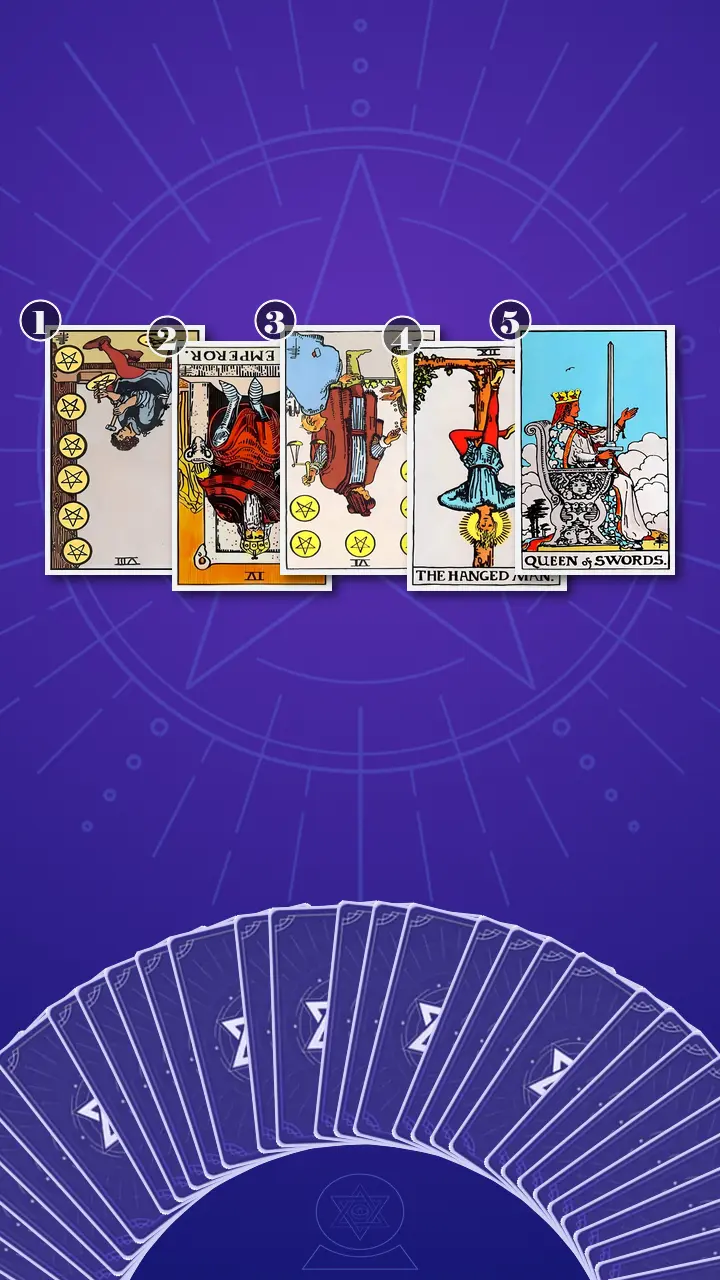
Three Cards Inside the Competence Trap
Position 1: The Workbench That Belonged to Everyone
I turned over the card representing the presenting shadow: the observable pattern of opening, rewriting, or taking over someone else's code when discomfort appears. It was the Eight of Pentacles, reversed.
The traditional craftsperson sat at a bench beneath a row of completed pentacles. I connected that scene to Jordan's actual screen: every pull request had become their personal workbench. They would enter a teammate's diff intending to leave one useful comment, notice unclear naming or a slower query, and polish the implementation until the finished branch displayed Jordan's craft more clearly than the original author's thinking.
I read the reversed earth energy as excess turning into blockage. Jordan did not lack discipline or technical skill. Their craft had crossed the ownership boundary and become compulsive correction. Every rescued branch proved that Jordan could fix the work, while removing one more opportunity for its owner to diagnose, choose, and practise.
“When you opened the last pull request intending to leave one comment, what did you actually do next?” I asked.
Jordan gave a short, bitter laugh rather than nodding. “I changed the function, renamed everything, added two tests, and stayed late to clean up the handoff. That is painfully accurate. Almost rude, honestly.” Their humour landed first, but their fingers had stopped moving toward the keyboard.
“The card is not criticising your craftsmanship,” I said. “It is helping us price its cost. A cleaner diff can prove that you were faster at taking the work back. It does not automatically prove reliable teamwork.”
Position 2: The Private Command Centre
I turned over the card representing the underlying driver: the fear that imperfect code left untouched would expose Jordan as unreliable and place quality outside their control. It was The Emperor, reversed.
The Emperor's stone throne, armoured legs, and rigid posture resembled the body Jordan had shown me at the review screen. A teammate's approach could pass the agreed tests and still differ from Jordan's preferred architecture. At that point, the review queue became a private command centre, and a personal method began masquerading as a team requirement.
In energy terms, this was blocked authority expressed as excess control. The healthy Emperor builds structures that everyone can understand and use. Reversed, structure depends on one person's private approval. Jordan had become a human branch-protection rule: nothing felt genuinely safe until their hands had shaped it.
The stone throne took me back to Wall Street deal rooms where one person could quietly control the definition of acceptable risk simply by controlling the final document. I learned there that authority becomes difficult to challenge when standards remain unwritten. The same dynamic can appear in a pull request, even when the person enforcing it has good intentions.
“Suppose the code passes the agreed checks but uses a method you would not choose,” I said. “What specific consequence are you afraid of if you leave it with the owner?”
Jordan's shoulders set. Their eyes scanned the open diff faster, and they rubbed the hinge of their jaw. “That someone will ask why I saw it and let it through. If I do not catch it, everyone will notice.”
I let the sentence settle. The irritation they usually directed toward slower methods now had a fear beneath it: not merely that the code might fail, but that another person's visible mistake might be entered into evidence against Jordan's reliability.
“That distinction matters,” I said. “A review comment can protect a standard without stealing the work. We need to separate an agreed reliability risk from the urge to make uncertainty disappear through personal command.”
Position 3: The Help That Never Returned the Keyboard
I turned over the card representing the protective payoff: the immediate relief, usefulness, and control Jordan received from fixing the code, along with the unequal ownership created by that help. It was the Six of Pentacles, reversed.
The card showed a giver holding scales while distributing coins to people below. I translated the image into Jordan's team channel: Jordan fixed a failing test, received a grateful Slack message, and then picked up the next unfinished task. Relief and recognition flowed toward them, but the branch, the standard, and the next decision stayed in the same hands.
The reversed energy showed imbalance, not a lack of generosity. Jordan was giving real help, but the help included so much labour and authority that the other person remained a recipient instead of an owner. A pairing session became a live demo because Jordan kept the keyboard. Three useful review comments became ten corrections. The finished code looked stronger while the working relationship became less reciprocal.
“What do you receive in the first few minutes after you rescue the work?” I asked. “And what are you carrying by the next morning?”
Jordan looked down at their hands. “For about three minutes, I get proof that I am useful. Then I am tired and annoyed that they still need me.” Their fingers tightened around a pen, held there, and slowly loosened as they heard their own answer.
“Immediate control feels like reliability until the whole team learns to wait for you,” I said. “That does not make you manipulative, and it does not make your teammates incapable. It shows us the short-term reward maintaining the rescue loop: a visible flaw triggers fear, takeover lowers the tension, reduced ownership creates more work, and that extra work appears to prove that only you can keep things reliable.”
When the Hanged Man Became a Keyboard Handbrake
The office ventilation clicked off as I reached for the fourth card. Without that low mechanical sound, the fluorescent buzz grew strangely distinct, and the room on Jordan's side of the screen seemed to hold still with us.
Position 4: The Information Hidden Inside a Pause
I turned over the card representing the transformation hinge: the pause and perspective shift required to separate genuine risk from discomfort with another person's method. It was The Hanged Man, upright.
The suspended figure hung by one foot from a living tree, face calm, halo bright. I did not read that stillness as helplessness. Upright, the card held the balanced and available energy of voluntary suspension: choosing not to perform the usual action long enough for a different kind of information to appear.
I asked Jordan to picture 8:47 PM on the TTC Line 1, their phone warm in their hand while the train brakes squealed and a red GitHub Actions check glowed on the screen. The old reflex said reliability meant touching the code. The new angle asked what its owner might notice if Jordan waited.
I used one of my core analytical tools, Power Dynamic Deconstruction, to make the hidden structure visible. In Jordan's usual review loop, one person controlled three leverage points at once: who defined the risk, who touched the implementation, and who made the final decision. That concentration felt efficient, but it left the code owner with almost no meaningful authority. A pause would not erase Jordan's expertise. It would preserve their ability to name and escalate a real risk while returning implementation and revision leverage to the person responsible for the branch.
“The inner line I want you to test is simple,” I said. “I can feel the urgency without obeying it.”
You do not need to suspend standards; you need to stop treating every imperfect implementation as your responsibility to own. Reliability can look like naming a real risk, leaving a preference optional, and returning the next revision to the person who wrote the code.
Stop equating immediate intervention with reliability; pause like the Hanged Man, change your angle, and let the owner carry the next revision.
First, Jordan stopped breathing. Their fingers stayed curled above the laptop, and their pupils widened as if the TTC scene had replaced our video call. Then their gaze slipped past the cards, replaying every late-night rescue; the corners of their mouth tightened, and colour rose beneath their eyes.
Instead of relaxing, they pushed back. “But doesn't that mean I've been doing it wrong this whole time?” Their voice was sharper than before.
“It means the strategy protected you from uncertainty, and now its cost is visible,” I said. “That is information, not a verdict.”
Their fist opened one finger at a time. Their shoulders lowered, their eyes reddened, and a shaky breath left their chest. Relief arrived with a brief, almost dizzy blankness. “Then I have to let them make a choice I wouldn't make,” they said quietly.
I leaned closer to the screen. “Now, using this new perspective, think back to last week. Was there a moment when this insight could have made the situation feel different?”
Jordan remembered a teammate posting their own diagnosis in Slack seconds before Jordan pushed a replacement fix. “I did not even wait long enough to read the second message,” they said. “They were already carrying it. I just could not see that because I was moving too fast.”
That recognition marked the first crossing from immediate control and automatic correction toward precise boundaries, shared ownership, and steadier confidence. The pause was uncomfortable, but Jordan could now distinguish discomfort from danger. The pause is not abandonment; it is where ownership becomes visible.
The Sword, the Open Hand, and the Returned Revision
Position 5: Clarity Without Custody
I turned over the card representing the integrated action: a clear, bounded way to communicate standards and return the next revision to its owner. It was the Queen of Swords, upright.
Her sword rose in a clean vertical line while her other hand remained open. I read the upright air energy as balanced discernment: precise enough to identify a concrete failure case, open enough to leave another person responsible for the implementation.
In Jordan's workday, the Queen of Swords looked like one exact review comment naming a real risk, one optional note about preference, and one sentence returning the next revision to its author. The standard stayed visible. The branch stayed with its owner. Expertise travelled through language instead of silent edits.
I offered an example: “I see a possible failure when two requests update this record at the same time. Can you add a test for that case? The next revision is yours; tag me if the risk itself is unclear.”
Jordan read the sentence twice. Their head tilted, and their expression held both relief and a trace of grief for all the evenings when they had believed the only alternatives were takeover or neglect. “That is still direct,” they said. “It does not pretend the bug is fine.”
“Exactly. The Queen does not ask you to become vague, endlessly patient, or less competent. She asks you to make the boundary as clear as the concern. Her sword names the failure case. Her open hand releases the implementation.”
I watched Jordan type a draft into their notes app: “Blocking risk: possible race condition. Preference: I would structure the helper differently. Owner action: add coverage and choose the implementation.” For the first time in our session, their hands looked deliberate rather than restless.
The Owner-First Review Protocol
Why the Rescue Loop Kept Recompiling
I drew the five cards back into one coherent story. Jordan's history of catching edge cases had earned trust and made rapid intervention feel like proof of value. The Eight of Pentacles reversed showed that strength crossing into repetitive rescue. The Emperor reversed exposed the fear underneath: if an imperfect implementation became visible, Jordan expected its consequences to reflect on them. The Six of Pentacles reversed explained the reinforcement: taking over produced immediate relief and appreciation, then dependency, overload, and resentment. The Hanged Man introduced a chosen pause, and the Queen of Swords converted that pause into clear standards, bounded help, and a returned decision.
The core contradiction was never quality versus laziness. It was the desire to keep everyone's code reliable versus the fear of letting other people own mistakes and consequences. Jordan had become like a mechanic reaching under every hood before the driver could learn the controls. Each repair reduced immediate risk, but it also prevented the evidence Jordan needed most: proof that another person could diagnose, revise, and recover.
I named the cognitive blind spot directly. Jordan had been treating a cleaner diff as evidence of reliable teamwork and treating personal custody as evidence of competence. The spread showed that a clean result can conceal a broken ownership process. It also showed that Jordan's value did not disappear when their hands left the keyboard.
Through my Transferable Asset Pricing lens, I separated Jordan's premium asset from the labour surrounding it. Their highest-value contribution was not typing every correction. It was the ability to detect edge cases, define meaningful standards, ask high-signal questions, and communicate risk early. Those assets became more valuable when transferred into tests, documentation, and shared review language. Silent rescue kept valuable judgment trapped inside one person's availability.
I then adapted The Leverage Mapping Protocol, which I often use before performance reviews and salary negotiations. Here, leverage did not mean dominance. It meant identifying what actually protected quality before Jordan spent time or took ownership: the evidence for the risk, the agreed standard, the branch owner, the smallest useful support container, and the person responsible for the next decision.
Three Bounded Experiments for the Next Review
- Separate the blocker from the preference.Before commenting on the next three pull requests, make a private two-line note: “Blocking risk” and “Personal preference.” Put only a reliability, security, or agreed-requirement issue in the first line. Name that risk in one precise comment, label the preference as optional, and leave the branch unchanged.Start with the smallest version: one risk, one preference, and no direct edit. If the standard is unclear, ask the team to define it instead of enforcing it privately.
- Use the ten-minute keyboard handbrake.On the next non-urgent pull request that triggers the urge to edit, leave exactly one clear question and one concrete test suggestion. Set a ten-minute timer, close the diff, and let the owner respond before choosing any further support.Use this only for non-urgent work. A two-minute pause still counts, and a genuine production incident should follow the team's normal incident process.
- Put help inside a fixed container.When a teammate asks in Slack, reply: “Do you want a question, a 15-minute pairing session, or a second set of eyes?” If they choose pairing, let them keep the keyboard. Cap a first review round at three comments, then say, “You own the next revision; tag me if the specific risk is still unclear.”Keep the time and comment limit even if the urge to continue appears. If a deadline requires a real takeover, name the ownership change explicitly and record who receives the follow-up.
Jordan raised the practical objection I expected. “What if I genuinely cannot spare ten minutes because the release is going out?”
“Then do not turn a reflection exercise into a safety hazard,” I said. “Use the incident process and intervene. The skill is not waiting in every situation. It is deciding consciously whether you are facing an actual incident, an agreed blocker, or discomfort with a method you would not have chosen.”
I asked Jordan to end each experiment with one sentence in their notes app: “I noticed urgency, paused, and left the next revision with the owner.” The note was not a scorecard. It was a small record that competence could include restraint, clear language, and an explicit handoff.
Ten Quiet Minutes of Shared Ownership
Six days later, I received a message from Jordan. A teammate had opened a pull request with a failing edge-case test. Jordan wrote one question, suggested one concurrency test, and closed the diff for ten minutes. The owner replied with a diagnosis, changed the implementation, and pushed the next revision without Jordan touching the branch.
“I checked twice, not six times,” Jordan wrote. “I still wanted to take over. But I could see what they were carrying once I stopped carrying it first.”
That night, Jordan slept through until morning. Their first thought was still, “What if the branch is wrong?” They checked once after breakfast, smiled at the owner's green build, and left the laptop closed.
I did not treat that green check as a prophecy fulfilled or a promise that every future pause would end neatly. One teammate's response did not solve an entire team culture, and Jordan's keyboard reflex had not vanished. The meaningful change was smaller and more durable: they had experienced apprehension without automatically converting it into custody.
That was Jordan's Journey to Clarity. The cards supplied a map of the rescue loop, but Jordan created the evidence by choosing a pause, naming the risk, and returning the revision. Tarot did not make them the master of their fate. It helped them notice that they already were.
If your jaw tightens when you spot a flaw, I want you to remember that two protective impulses may be speaking at once: one part of you cares deeply about the work, while another fears that leaving the flaw visible will turn someone else's mistake into evidence against your reliability. Noticing both parts means control is no longer your only available answer.
Clarity may not arrive as total certainty. It may arrive as one precise comment, an open hand, and a screen left untouched long enough for another person's ownership to become visible.
When the next non-urgent pull request lights up red, if you name the real risk and let its owner carry the next revision, what might you notice in the ten quiet minutes before your hand reaches for the keyboard?