Familiarity Was History, Not Proof: Measuring What Fits You Now

The Hidden Album at 11:47 p.m.
If you are a late-twenties hybrid creative in London who can handle a packed client workshop but not the quiet after a merely decent date, I may already know the dating-comparison loop: your coat is still on, yet the hidden photo album is open.
Maya, a 29-year-old UX designer, brought that exact scene into my consultation room. She told me that at 11:47 on a rainy Tuesday night, she had returned to her shared Zone 2 flat after a pleasant Soho date. She sat on the edge of her bed without unbuttoning her coat. The radiator clicked behind her; rain hissed against the window; her phone grew warm in her palm as tonight's unanswered message disappeared beneath years of photographs.
Her thumb paused on a holiday picture in which she and her former partner were laughing at something no one else would understand. Then it accelerated past a screenshot of one of the recurring conflicts that helped end the relationship. I watched her press two fingers to the centre of her chest as she described the hollow pull there, followed by a fizzing restlessness in her hands, as if her body had become a room with one window open and no way to close it.
“I know why it ended,” she said. “But I remember why it mattered more. New people feel fine, and fine feels like failure. I keep comparing their first chapter with our entire book.”
I heard the real tension beneath her question. Maya wanted a relationship that fit the person she was now, but looking at the old relationship without its flattering crop could make the loss feel frighteningly final. Keeping it nearly perfect preserved a familiar form of belonging, even while it made every unfamiliar present connection look inadequate.
“I can't tell whether I miss the person or the certainty,” she said.
“You do not have to invalidate what mattered in order to examine what fit,” I told her. “I am not going to use tarot to tell you to move on, predict a reconciliation, or decide whether another person deserves a chance. We can use the cards as an objective reflection tool. Let's give this fog a structure and find out what your own evidence has been trying to say.”
Choosing the Compass: The Five-Card Shadow Spread
I asked Maya to place both feet on the floor, take one unforced breath, and hold one question in mind: “Why does the past become my benchmark whenever the present feels uncertain?” I shuffled slowly, using the small physical ritual as a transition from replaying the story to observing it.
I chose the five-card Shadow Spread because this was not a choice between two people. It was an inner pattern involving breakup nostalgia, projection, a fear of losing belonging, and the possibility of clearer discernment. For anyone wondering how tarot works in a grounded consultation, this is the important distinction: the spread does not supply supernatural certainty. It places different parts of a problem where we can inspect their relationship to one another.
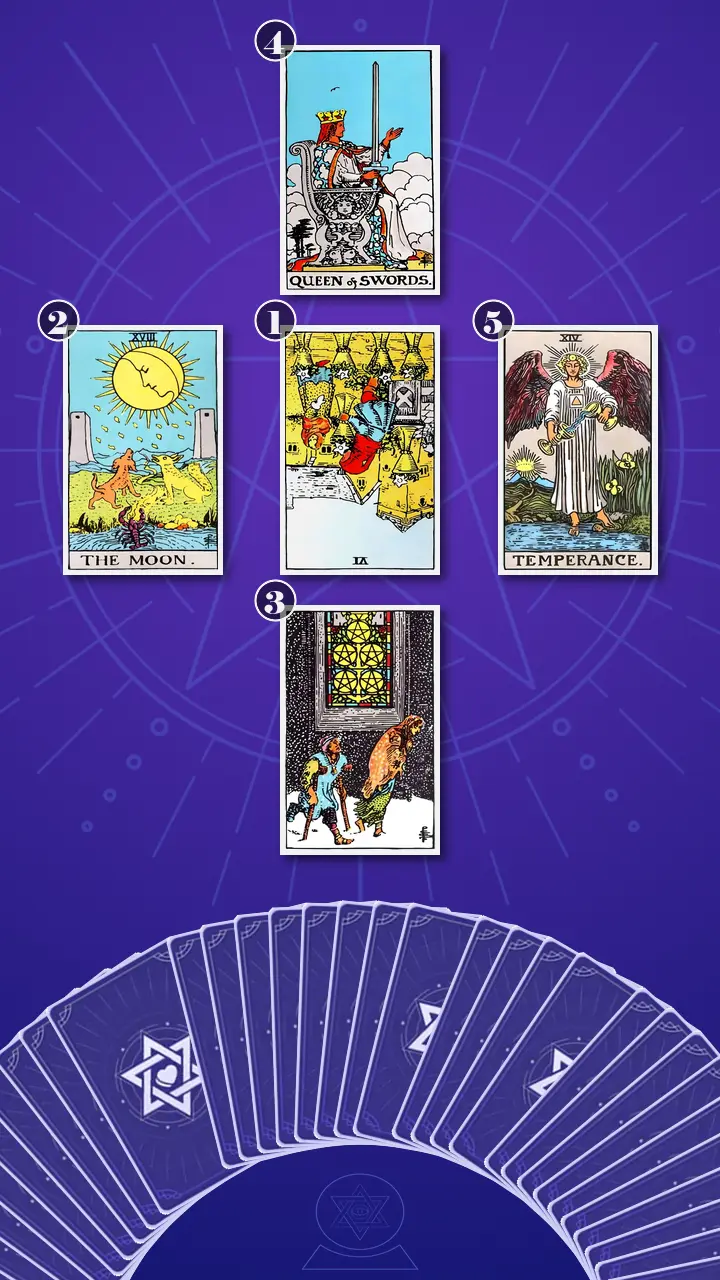
The centre position would show Maya's observable habit: revisiting selected memories and using them to judge present-day fit. The card to the left would reveal the interpretation hidden beneath that habit. The lower card would take us to the root fear. Above the centre, we would look for the capacity capable of interrupting the cycle. The final card, placed to the right, would turn insight into a repeatable way of evaluating compatibility.
The layout resembled a compass. I saw the lower point as the buried emotional south, the upper point as a clear northern reference, and the right-hand card as movement into present behaviour. That focus was why I used the Shadow Spread rather than a larger future-oriented layout: Maya needed a map of the pattern, not a forecast about future love.
The Archive That Edited Itself
Position 1: The Loop That Looked Like Evidence
The card I turned first occupied the position representing Maya's observable habit: reopening selected memories and using them as the benchmark for current relationship fit. It was the Six of Cups, reversed.
I pointed to the flower-filled cups and the enclosed village. Upright, the image can carry tenderness, familiarity, and the emotional inheritance of the past. Reversed in this position, that tenderness had become sealed inside an archive. The Water energy was blocked in a closed circuit: memory supplied temporary warmth, the present looked flatter by comparison, and that flatness sent Maya back to the same memories for more warmth.
“This is your 11:47 p.m. ritual,” I said. “You come home from a pleasant date, sit on the bed with your coat still buttoned, and open the hidden album. You pause on holidays and private jokes. You skip the evidence of repeated mismatch. Then a curated set of moments from a relationship that had years to develop gets to judge someone you have known for two hours.”
I gave voice to the comparison I had heard beneath her story: “The date was fine, but fine did not feel like us, so maybe us was the real thing.”
Maya let out one short laugh, but no amusement reached her eyes. Her thumb rubbed the edge of her phone case, stopped, and then pressed hard into the silicone. “That is painfully accurate,” she said. “Almost rude, honestly.”
“I can understand why it stings,” I replied. “The card is not mocking the attachment. It is showing us that the comparison has unequal editing rules. The past gets its most cinematic Saturday night; the present gets one ordinary Tuesday.”
I asked which part of the old relationship usually stayed outside the frame. Maya looked toward the rain-streaked window before answering. She said she remembered the ease of being known, but called the repeated day-to-day mismatch a timing problem. She had been trying to preserve the affection by softening the incompatibility.
“Familiarity is evidence of history, not proof of fit,” I said. “You are not comparing two relationships. You are comparing a first chapter with an edited archive.”
Position 2: The Message Beneath Uneven Light
The next card occupied the position representing the blind spot beneath Maya's idealisation: present uncertainty being interpreted through projection, emotional intensity, and incomplete information. It was The Moon, upright.
I traced the winding path between the two towers. The path offers enough visibility for one careful step, but not enough for a final verdict. In Maya's pattern, the Moon's reflective Water was abundant while clarifying Air was deficient. Her feeling was real; the first explanation attached to that feeling remained untested.
Maya had already given me a precise modern version of the card. At 8:42 one morning on the Victoria line, she had received a courteous message from a new date: “Had a lovely time. Hope your week goes well.” As the brakes squealed and stale coffee hung in the carriage, she studied the absence of a follow-up question. Before Oxford Circus, she had decided the connection was flat and searched an old WhatsApp thread for five affectionate messages her former partner had once sent in a row.
“The inner sentence is, 'I feel unsettled, therefore this must mean the past was more authentic,'” I said. “The Moon asks us to interrupt the sentence. Is the feeling naming incompatibility, or could it be naming unfamiliarity, loneliness, pace, disappointment, or a need that has not yet been expressed?”
I compared the pattern to a recommendation algorithm treating one late-night click as a permanent preference. Each return to the archive trained the emotional feed to show Maya more of the same material until repetition began to resemble proof.
Her shoulders rose, then lowered by a fraction. She looked from The Moon to the Six of Cups and said, “So I might be right that I do not like someone. I just might be deciding what the feeling means too quickly.”
“Exactly,” I said. “Discernment does not require you to suppress intuition or continue dating anyone. It asks you to separate the signal from the story long enough to see what each one contains.”
The Lit Window Outside the Crop
Position 3: The Fear Beneath the Highlight Reel
The third card occupied the position representing the root fear: that releasing the idealised bond might feel like losing access to belonging itself. It was the Five of Pentacles, upright.
I showed Maya the two figures crossing the snow beneath an illuminated stained-glass window. The card's Earth energy had contracted around scarcity. Her attention kept returning to the door that had closed, while available warmth sat just beyond the narrow crop of her focus.
“I think this is the Sunday-evening version of the pattern,” I said. “Your flatmate is out. The takeaway has gone cold. The television is murmuring, and an anniversary memory turns your phone into the brightest object in the room. The thought beneath the scrolling is not only, 'I miss my ex.' It is, 'If I stop calling that relationship uniquely right, what proves I will ever be known like that again?'”
Maya's breath paused. Her fingers curled around the cuff of her jumper; her eyes lost focus as if she were replaying a private sequence; then she released the fabric and exhaled from low in her chest.
“That is the part I do not say to my friends anymore,” she said. “I feel embarrassed. They have heard it all. But if I admit it did not fit, I feel like I am saying I imagined the whole connection.”
“You are allowed to name one lost form of belonging without declaring belonging itself extinct,” I said. “Your friends, your present values, and your capacity to build new forms of intimacy do not replace the relationship. They simply remain inside the wider field. Grief does not need a perfect relationship to justify itself.”
The rain struck the glass more softly then. I watched Maya look at the illuminated window in the card for several seconds. I did not rush to fill the silence. The task was not to reassure her that someone better was guaranteed to arrive. It was to let her recognise how fear of scarcity had been editing the evidence.
When the Queen Raised Her Sword
Position 4: A Clean Line Between Memory and Evidence
The room seemed to narrow around the next card. Even the radiator, which had clicked through most of the reading, fell quiet. I turned the position representing the capacity that could interrupt Maya's cycle: clear criteria, honest boundaries, and equal scrutiny of past and present evidence.
It was the Queen of Swords, upright, the catalyst of the spread.
I saw balanced Air in the Queen's vertical sword, direct gaze, and extended open hand. Her clarity did not erase emotion. She could separate two categories while remaining receptive to both. In Maya's daily life, that meant opening a clean Notes page called “Fits Me Now,” naming three current relationship needs, and reviewing both the former relationship and a new connection by the same observable standards.
Looking at the raised sword, I thought of my fifteen years at a perfumer's bench. A fragrance can have a dazzling opening and still reveal a different structure in the dry-down. I would never evaluate an entire composition from its brightest top note, nor would I call that first impression false. It is true and incomplete.
I used what I call my Boundary Permeability Assessment. The blurred boundary was not simply between Maya and her former partner. It ran between the old relationship's emotional atmosphere and Maya's present-day decision-making. The remembered bond had diffused beyond its proper container, like a fragrance saturating a room until every new scent seemed faint before it had space to develop. The Queen's sword did not build a wall around Maya's heart. It marked where memory ended, where current needs began, and where new information deserved uncontaminated air.
Up to that point, I had watched Maya treat the problem as a demand to determine whether her past relationship had been right or wrong. At 11:47 p.m., that impossible verdict had seemed easier than tolerating grief, incomplete information, and responsibility for naming what she needed now.
The past is not more compatible simply because it feels vivid; name what fits now, and let the Queen's raised sword separate memory from evidence.
I left a beat of silence around the sentence. Then I gave her the distinction in its simplest form: A memory can be emotionally true without being complete evidence. Familiarity proves that a bond had history; it does not prove that the bond still fits who you are now.
I watched her inhale and then stop. Her fingers hovered above the table as if an invisible screen had frozen beneath them. Her pupils widened; her gaze slipped past the cards, and I could almost see the Victoria line, the hidden album, and fourteen months of comparisons replaying behind her eyes. Then heat rose across her cheeks.
“But doesn't that mean I've been wrong for fourteen months?” she asked. The words came out sharper than anything she had said so far. Beneath the anger, her voice shook.
“No,” I said. “It means the strategy made sense when finality felt unbearable. You used vivid memories to keep the meaning of the relationship safe. We are only noticing that the same strategy now makes it harder to perceive what fits you.”
Her jaw unclenched first. Then her shoulders dropped. Her fist opened slowly on the tabletop, relief arriving alongside a brief, almost dizzy blankness. I recognised the vulnerability in that moment: if the archive could no longer make the decision, Maya would have to trust herself to gather new evidence.
“Now, using this new perspective, think back to last week,” I invited her. “Was there a moment when this insight could have made the experience feel different?”
She returned to the restrained WhatsApp message on the Victoria line. “I could have said, 'My chest feels hollow,' without immediately adding, 'because nobody will feel like my ex.' I could have waited to see whether the person followed up later.”
I asked her to open Notes and set a timer for no more than eight minutes. She made two headings: “What this memory tells me I value” and “What the relationship did not consistently provide.” She wrote one private line beneath each, then stopped without reopening a message thread or forcing a verdict. I reminded her that if the exercise became too activating, she could close the note, name one current need, or leave it for another day.
I named the shift I had just witnessed. This was not a leap from missing someone to being finished with them. It was one grounded step from longing sustained by selective certainty toward openness to present-day compatibility. Maya could hold affection and incompatibility in the same hand without asking either one to disappear.
Temperance Pours the Water Forward
Position 5: Compatibility as a Living System
The final card occupied the position representing conscious integration: assessing present-day fit gradually through balanced needs, reciprocal behaviour, boundaries, and lived evidence. It was Temperance, upright.
I placed it to the right of the Six of Cups and pointed out the visual conversation between them. The opening card held preserved flowers inside stationary vessels. Temperance moved water actively between two cups. The first image protected a memory at its most beautiful; the second described a relationship as something responsive, reciprocal, and continually adjusted through participation.
Temperance brought the spread's energy into balance. One foot rested on solid land while the other remained in water. Maya did not need to become less emotional, and she did not need to turn dating into a clinical audit. She needed feeling and observation to work together.
“In daily life, this means that when you freely choose to continue seeing someone, you can observe two or three interactions rather than demanding instant familiarity,” I said. “You notice whether attraction, communication, mutual effort, personal boundaries, and ordinary ease begin to coexist. Think of it as a live product tested across normal use, not a launch trailer judged at peak excitement.”
“So fine isn't automatically failure,” Maya said.
“Correct. Fine may become warmth, or it may stay flat. You do not owe anyone more dates to find out. Disrespect, pressure, a crossed boundary, clear disinterest, or simply not wanting to continue is enough reason to stop. Temperance offers an observation window only when safety, mutual interest, and genuine curiosity are already present.”
I watched her shoulders soften as she studied the moving water. “I don't need to know everything tonight,” she said. “I can notice whether things work together.”
“Present-day fit appears in patterns, not in one perfect spark,” I replied.
The Fits-Me-Now Filter
I gathered the five cards into one coherent story. The Six of Cups reversed showed the visible archive ritual, inherited from a bond with real affection and years of shorthand. The Moon revealed how present uncertainty became a premature conclusion. The Five of Pentacles exposed the deeper fear that seeing the relationship clearly would leave Maya outside belonging. The Queen of Swords supplied the missing boundary between emotional vividness and compatibility evidence. Temperance turned that clarity into patient, embodied observation.
The core image moved from preserved flowers to flowing water, from preservation to participation. Maya did not need to destroy the archive or deny what had been beautiful. She needed to stop using its best-lit images as the full specification for a functioning relationship.
I named the cognitive blind spot directly: she had been granting the past generous exceptions while holding the present to an impossible test. Immediate intensity counted as evidence for the ex; ordinary uncertainty counted as evidence against everyone new. The transformation was not “move on” or “give someone a chance.” It was to assess past and present through the same current needs, boundaries, and observed behaviour.
When I introduced the practical plan, Maya frowned. “But the album is what gets me through the quiet after a date. I don't know if I can just not open it.”
“Then we do not turn this into a ban,” I said. “In perfumery, I step into neutral air between evaluations because saturation can make the next composition difficult to perceive. My Blank Space Protocol creates that same oxygen. It is not erasure, punishment, or a dating game. It is a short, chosen space in which the present experience gets to have its own scent before the old one fills the room.”
- Create the Three-Item Fits-Me-Now List During one lunch break this week, Maya would open Notes and write three observable relationship needs, such as consistent communication, room for independence, and willingness to address conflict. She would use the same three criteria when reflecting on the former relationship and any new connection. Keep it under eight minutes and exclude anything that requires mind-reading. The minimum version is one sentence: “I feel most like myself in a relationship when...”
- Use the Memory-and-Evidence Pair When a comforting memory arose naturally, Maya would write one line under “What this shows I value” and one under “What the relationship did not consistently provide.” She would not search the archive for material or use the exercise to reach a final verdict. Stop when the eight-minute timer ends. If the exercise feels too activating, close the note, name one present need only, or return another day.
- Try the Blank Space Protocol After One Date After her next date, Maya would wait until she was home and settled before evaluating it. For one reversible overnight window, she would leave the old archive unopened and use a three-minute timer to answer: “Was I more or less myself?” “Was interest reciprocal?” and “Did my boundaries feel easy to keep?” This observation window never creates an obligation to continue dating. A crossed boundary, pressure, clear lack of interest, or a simple wish to stop is sufficient information.
I told Maya that these were experiments, not commandments. Tarot had clarified the pattern and offered actionable advice, but only she could decide which boundary felt useful, which connection deserved her curiosity, and when an exercise needed to stop.
A Week Later: The Quiet Proof
Six days later, I received a message from Maya. She had used the Blank Space Protocol after another low-key date. Her observed fact was: “I felt calm, and they asked thoughtful questions.” Her interpretation was: “Calm means boring because it doesn't feel like the past.”
She had not forced the calm into chemistry, and she had not dismissed it as failure. She chose a second coffee because she was curious. More importantly, she told me she had made that choice without opening the hidden album first.
That night, she slept through. In the morning, her first thought was still, “What if I'm wrong?” She smiled, made coffee, and left the question unanswered.
I did not read her message as a solved love life. I read it as a small, credible shift from selective certainty toward grounded openness. The cards had not given Maya agency; they had made the comparison visible enough for her to reclaim the agency she already possessed.
When a merely okay date leaves your chest hollow and your hand reaching for old photos, I know it can feel safer to protect the past than to risk discovering that belonging may look unfamiliar now. Noticing that tug does not erase the bond. It simply means the hidden album is no longer making every decision unnoticed.
So I will turn the Queen's question toward you: if one current need, rather than one remembered emotional peak, became your next small measure of fit, what might you become curious enough to notice in the blank space before the archive opens?