Planning to Move In Too Soon: Letting Compatibility Catch Up

The Six Tabs After a Good Weekend
The morning after an intensely close weekend, I watched Alex, a 28-year-old non-binary UX designer renting in Toronto, begin building a shared home before the relationship had reached its first ordinary Tuesday. By 8:47 PM on Sunday, six Rentals.ca tabs glowed across their laptop, the Notes app held two colour-coded commute routes, and a half-drafted message about the Junction waited beside a mug gone cold.
I could hear the radiator clicking behind us and the soft fan of the laptop warming Alex's fingertips. Their shoulders kept climbing towards their ears. Each new rental detail briefly loosened the pressure in their chest, even though no listing could tell either of us how the couple handled anger, chores, privacy, money, or three hours of needed silence.
Alex pressed both hands flat against the table. I can picture our apartment before I can explain how we handle a disagreement, they said. Then they gave a small, embarrassed shrug. Planning it makes the relationship feel real. I know I am skipping steps, but waiting feels like losing momentum.
I could see the core contradiction without needing to dramatise it: Alex wanted the closeness and security of sharing a home, while fearing that taking enough time to know a partner might leave the future uncertain and leave them without a secure place to belong. The anxious longing in their body felt like trying to nail a floor plan to fog while the fog pressed back against their ribs and sent their fingers hunting for one more practical task.
My name is Juniper Wilde. I do not use tarot to declare whether someone should move in, stay apart, or predict what a partner will do. I use the cards as a reflective map. I told Alex that I did not hear foolishness in the rental tabs; I heard a clever planning system trying to make an undefined relationship feel settled. I wanted us to notice the moment planning became an emotional shortcut, then hand the pen back to Alex. Our Journey to Clarity would begin by asking what was known, what was imagined, and what still needed to be lived.

Choosing the Compass: The Shadow Spread for Moving-In Anxiety
I asked Alex to put both feet on the floor, breathe once without trying to solve anything, and hold the question in mind exactly as it was: Why do I keep planning to move in before I know my partner? I shuffled slowly. The small ritual was not a supernatural test. It gave the body a clean transition from reacting to observing.
I chose a five-card cross called the Shadow Spread. I explained to Alex, and to anyone following the reading, that the repeated word keep and the question why made this an inner-excavation problem, even though it appeared inside a relationship. This spread was compact enough to trace the behaviour without inventing a story about the partner's motives.
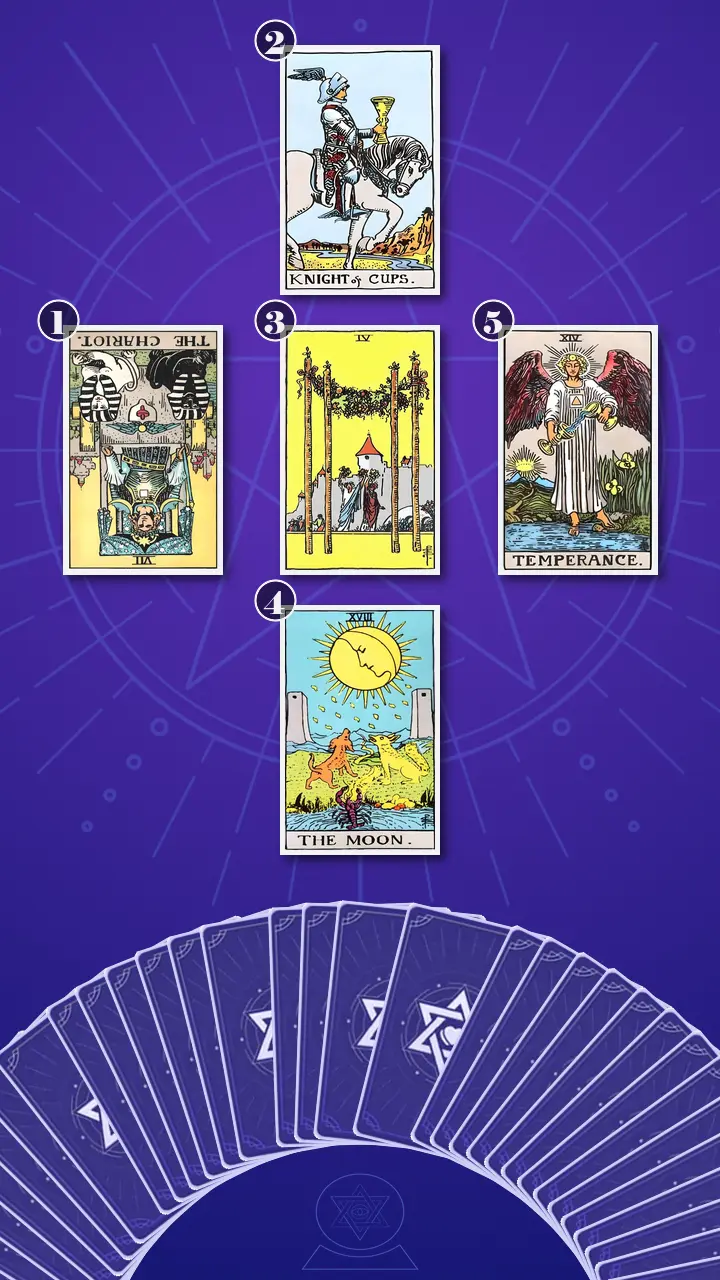
In the cross, the first position would show the observable shadow pattern: the listings, budgets, and moving timeline. The second would reveal the romantic signal that activated it. The centre would protect the legitimate need beneath the behaviour, the desire for belonging and home. The fourth would bring incomplete information and projection into view. The final position would translate all of that into a conscious practice rather than a prediction.
I placed the first card to the left of the centre and the final card to the right. The romantic trigger went above the centre; the uncertainty that needed acknowledgement went below it. The arrangement looked less like a verdict than a compass around a protected need. I wanted the reading to show a direction Alex could choose, not a future the cards had already decided.
Reading the Map Without Fast-Forwarding
The Chariot Reversed: When Movement Pretends to Be Alignment
Now I turned the first card. This position shows Alex's observable pattern of opening rental listings, estimating shared logistics, and creating a cohabitation timeline before enough compatibility has been observed. The card was The Chariot, reversed.
In the Rider-Waite-Smith image, the charioteer sits above two differently oriented sphinxes and holds no visible reins. I saw Alex's six Toronto listings in that image: a destination carefully entered into Google Maps before both travellers had agreed where they were going. The forward motion was real, but the direction was not yet mutually negotiated.
Reversed, The Chariot showed overdriven will and deficient alignment. Alex was not simply making a useful housing plan. After a beautiful date, they were trying to use a controllable destination to outrun the discomfort of not knowing. The short-term relief was genuine. Once a commute, rent split, or possible moving month appeared on the screen, the chest softened. But the plan then received more attention than the questions it was meant to avoid.
I said, If I keep this moving, I will not have to feel how much I still do not know. I compared the six tabs to starting a Jira sprint before the requirements interview, then mistaking completed tasks for a validated product direction. The issue was not that Alex was good at planning. The issue was that planning could make a relationship feel settled before the relationship had a chance to become known.
Alex's thumb froze above the Rentals.ca tab. Their breath paused first, as if their body had hit a red light. Then their eyes went unfocused and travelled across the saved commute times, replaying the Sunday evening sequence. Finally, they gave a brief laugh with a bitter edge. That is too accurate. Almost rude.
I smiled gently. I am not taking the planning skill away from you. I am helping you notice what it is being asked to carry. A housing tool cannot answer a relational question, but it can briefly make the question feel less exposed. Alex's shoulders lowered by a fraction. The first opening in the pattern was not a decision. It was recognition.
The Knight of Cups: When Someday Sounds Like Start Now
Now I turned the second card. This position identifies the early romantic signal or moment of closeness that activates Alex's urge to convert possibility into a shared-home plan. The card was the Knight of Cups, upright.
The knight extends a cup while the white horse takes a measured step. Nothing in the image makes the offering false or trivial. I connected it to the Monday morning scene Alex described: on the TTC leaving Ossington, their partner had written, I can really imagine a future with you. The message was tender and meaningful. Alex had read it, smiled, and opened Rentals.ca before replying.
I said, They said someday; your nervous system heard start now. The Knight of Cups carries sincere emotional possibility, but the cup is not a lease, a tested household routine, or proof that two people have compatible ways of handling money, mess, guests, conflict, sleep, or solitude.
The energy here was not blocked. It was an honest invitation being overextended. Alex could receive the feeling at the scale it was offered, as a reason to learn more, instead of enlarging it into a completed promise. Romantic openness could remain romantic openness without being forced to perform as domestic readiness.
Alex smiled in recognition, then glanced down at their phone. I hate how fast it happens, they said. One warm message, and suddenly I am calculating whether my desk would fit near their window. I watched their smile hold both delight and a little unease. The feeling did not need to be shamed. It needed to be separated from the evidence it had started claiming.
The Four of Wands: The Home Beneath the Housing Plan
Now I turned the centre card. This position reveals the need for secure belonging, stability, and a tangible sense of home that the planning behaviour is attempting to protect. The card was the Four of Wands, upright.
The four garlanded wands formed a welcoming threshold. I asked Alex to describe the first image that arrived when they imagined moving in. They talked about a bright apartment listing with two mugs on the counter, a dining table beside the window, enough room for both coats, and friends dropping by without anyone needing to explain why the relationship was serious.
I told Alex, Wanting a home is not the problem; asking an address to prove you belong is. The Four of Wands validated the wish beneath the spreadsheet: celebration, legitimacy, stability, and the quiet relief of being able to say our place without wondering whether the future would hold them.
The danger was not the milestone itself. It was asking the milestone to carry every unanswered question. A shared address could become a public sign of being chosen, a financial solution, and a promise that the relationship would not drift. That was too much symbolic weight for any apartment to hold. The actual supporting beams would have to be built through fairness, repair, respect, boundaries, and repeated ordinary behaviour.
Alex exhaled, long and low. Their hands moved from the table to their lap, and the tension around their mouth softened. That makes me feel less ridiculous, they said. I do not only want cheaper rent or a nicer kitchen. I want somewhere our relationship is visibly real. I let the room stay quiet long enough for the valid need to remain visible without allowing it to control the pace.
The Moon: The Blank Space That Imagination Fills
Now I turned the fourth card. This position brings Alex's discomfort with not yet knowing the partner into awareness and distinguishes observed facts from hopeful projection. The card was the Moon, upright.
The winding path between the two towers showed a route that was real but only partly visible. The dog and wolf responded beneath the moon, one familiar and one less familiar, while the crayfish rose from the dark pool. I did not read this as evidence that Alex's partner was deceptive. I read it as an information gap that imagination had been filling with the most reassuring available version.
I compared the relationship to a product screen still showing blank states. When the data has not loaded, a designer may auto-fill the interface with a plausible placeholder. The placeholder can look polished and still not be evidence. Alex had seen the couple on carefully planned dates and affectionate weekends. They had not yet seen enough of each other after a bad workday, a money disagreement, an untidy kitchen, competing deadlines, or several hours of needed silence.
Alex looked again at the card. I have seen us at our best, they said slowly. I have not seen us after a missed payment, a serious disagreement, or three hours when one of us needs the door closed. I keep saying we can work out the difficult bits later.
I asked what happened in the body when the future became undefined. Alex's palms began to move against one another. Their jaw tightened, then released. The blank feels like I am already losing something, they said. I heard curiosity beginning where accusation might have appeared. The Moon was not asking them to become suspicious. It was giving them permission to say, I do not know this yet, without turning the blank into either an idealised answer or a fearful one.
I named the missing balance plainly. No Swords appeared in this spread, so direct questions and clear language would need to be added deliberately. No Pentacles appeared, so ordinary routines and practical evidence would need to be gathered rather than assumed. The feeling and the dream were not wrong. They were simply moving faster than communication and observation.
When Temperance Made Pacing Feel Like Progress
Temperance Upright: The Bridge Between Two Distinct Lives
The room changed when I reached for the final card. The radiator clicked once and then went quiet, leaving only the low traffic hiss beyond the Toronto window. On Sunday night, six Toronto rental tabs sat beside a cooling mug while Alex drafted a neighbourhood text. The plan briefly settled their chest, even though they still did not know how the two of them handled money, mess, disagreement, or a closed door.
Now I turned the fifth card. This position translates insight into paced relational discovery through direct conversations, ordinary shared experiences, and commitments proportionate to what is actually known. The card was Temperance, upright.
The angel poured a careful stream between two cups, one foot on land and one in water. I saw an active practice, not passive waiting. Feeling could remain welcome while practical reality, separate identities, boundaries, and mutual adjustment received equal weight. Temperance did not ask Alex to extinguish the wish for a home. It asked them to stop using speed to manufacture certainty.
Alex stared at the two cups. Their face tightened with a different kind of resistance. But does this mean I was wrong before? they asked. Does it mean every time I imagined living together, I was making something up?
No, I said. It means a strategy that protected your longing for belonging sometimes moved ahead of the evidence. Your hope can be real without becoming proof. Your planning can be useful without being in charge.
On my desk, I used the diagnostic tool I call Dialogue Loop Auditing. I wrote three short lines: what was said, what Alex heard, and what Alex did next. The partner said, I can imagine a future with you. Alex heard, We need to secure that future now. Alex opened rental apps, drafted a timeline, and began solving a household that had not yet been mutually designed. The triggering phrase was not the whole problem; the silent translation that followed it was the loop.
I also used my Toxic Script Identification lens with care. I was not calling Alex, their partner, or the relationship toxic. I was identifying an automatic role pattern: Alex became the Future-Builder, while the imagined partner was quietly assigned the role of Reassurer who had to make belonging feel certain. Neither person had consented to those parts. Seeing the script made it possible to interrupt it without blaming either actor.
You do not need to secure love by fast-forwarding; let intimacy become liveable through repeated, measured blending, like Temperance pouring between two cups.
A shared address cannot create the trust its floor plan assumes. Let the home become evidence of trust already lived, not a shortcut around what remains unknown.
Alex first went completely still. Their fingers hovered above the edge of the phone, and their breath stopped halfway in. Then their gaze slipped past me towards the dark window, as if the sentence had opened a reel of recent memories: the saved listings, the colour-coded commutes, the moment a warm text had become a moving month. Their eyes grew bright. When they finally breathed out, it came with a small, unsteady laugh. Their shoulders dropped, their hands unclenched, and the relief carried a brief dizziness, as though setting down a heavy box had left the body unsure where to stand. I can let this matter without making it final today, they whispered. I asked, Now, with this new perspective, can you look back at last week and find one moment when this insight might have made you feel different?
Alex nodded, then stopped. Last Wednesday, they said. They needed a quiet hour after work. I started talking about how a two-bedroom would solve the space issue. I could have asked what quiet meant instead. The distinction was small but decisive. This was the first movement from anxious future-scripting towards patient discernment, not a promise that cohabitation would happen and not a demand that it never happen.
I set a seven-minute timer on Alex's phone. I asked them to divide a private note into three headings: Known, Imagined, and Unasked. Under the first, they wrote one observed fact. Under the second, they placed one detail from the apartment fantasy. Under the third, they wrote one question about alone time. I reminded them that they did not need to send the note, make a decision, or turn it into a secret scorecard. The smallest useful version was one known fact and one unanswered question.
The Known, Imagined, and Unasked Map
When I read the five cards together, I saw a clear sequence. The Knight of Cups brought genuine feeling. The Four of Wands revealed the valid dream of belonging. The Chariot reversed tried to drive that feeling straight towards an address before both people had agreed on the route. The Moon exposed the blank spaces that had been filled with a reassuring household rendering. Temperance offered a different kind of progress: two distinct lives blending gradually, with both lives still visible.
The central blind spot was simple and powerful: Alex had been treating detail as data. A budget sheet, furniture board, commute calculation, and imagined weekday could make the future look validated even when the relationship had not yet produced enough evidence about conflict, privacy, chores, finances, solitude, repair, or ordinary responsibility.
I returned to the metaphor I use often as an artist: a life can be a film still in production, and sometimes the feeling of being stuck comes from staying in a painful scene for too long. Alex had been furnishing a room before checking its foundations. The next scene did not require a dramatic ending. It required a change in the way the next line was written.
The transformation I named was a shift from treating cohabitation plans as proof of closeness to checking how the relationship actually handles boundaries, disagreement, money, personal space, and ordinary routines over time. Pacing was not the absence of progress. It was how two realities got a vote.
I gave Alex three small next steps. Each one separated housing maths from relationship readiness while keeping affection intact.
- Run the Known-Imagined-Unasked CheckThe next time a listing urge appears, Alex will pause before opening Rentals.ca, set a seven-minute timer at the kitchen table, and write one known fact, one imagined household detail, and one unanswered question. Alex will wait twenty-four hours before bringing the listing into the relationship.If seven minutes feels too exposing, Alex can write one sentence beginning, What I actually know is... The note can stay private and does not need to become a verdict about the partner.
- Use the Pattern Interruption ScriptBefore discussing a neighbourhood or moving month, Alex will replace the old line, We should see what we can afford together, with: I feel the pull to make this concrete. Would you be open to talking for ten minutes about how each of us uses alone time, with no housing decision attached? Alex will ask whether the partner has the capacity to talk now, later, or not yet.A pause or partial answer is information, not a verdict. The lower-effort version is to write the new sentence privately and read it aloud once before deciding whether to share it.
- Collect Ordinary Tuesday EvidenceOnce this week, Alex and their partner will spend one low-stakes weekday evening grocery shopping, cooking, or tidying without treating it as a cohabitation audition. Alex will note one observed behaviour, such as asking before changing a plan, rather than making a conclusion about whether they would live well together.No one needs to create stress or pass a hidden test. The minimum version is one uncurated hour together while tired, followed by a private note about what felt easy, unclear, or worth discussing.
I told Alex that these were not commandments and not a universal moving-in timeline. They were small ways to add the missing Air of direct language and the missing Earth of repeated practical evidence. The cards could help Alex notice a pattern, but Alex remained the person who would choose the pace, the questions, the boundaries, and the eventual meaning of any shared address.

A Week Later, the Quiet Proof of Finding Clarity
Six days later, I received a message from Alex while I was making coffee. I saw a two-bedroom listing after a good call, they wrote. I did not send it. I waited twenty-four hours, wrote Known, Imagined, and Unasked, and realised the second bedroom was carrying the promise of privacy. I asked whether we could talk about alone time this weekend instead.
They told me that the conversation had not solved the future. Their partner needed time to think, and Alex still felt the familiar flutter in their chest. But they spent one ordinary Wednesday cooking together, noticed a changed plan, and asked about it instead of drawing a floor plan around it.
That night, Alex slept a full night, but woke with the thought, What if I am wrong? They smiled at it instead of opening a rental app. The doubt remained; it simply no longer held the steering wheel.
I think of that as a real Tarot reading outcome: not certainty, not a promised relationship, and not a magical answer about when two people should share a home. It was a small piece of lived evidence that Alex could stay connected to hope without handing hope the controls.
In our Journey to Clarity, the cards did not decide Alex's destiny. They helped Alex see the difference between a future that felt real because it was detailed and a relationship that could become trustworthy because its patterns were lived, discussed, repaired, and chosen. The authority returned to the person whose life the plan would actually shape.
When a promising weekend makes your hands reach for rental tabs, the pressure in your chest can hold both sides of the same fear: wanting a place to belong, and fearing that taking time might reveal you do not have one yet.
If you let possibility stay possible for one more week, what small piece of real life would you be curious to notice before giving the future another line in the plan?