The TTC Spotlight Text: A Self-Worth Spiral in One Question
You’re a 20-something/early-30s city person with a hybrid job, and the second a dating app match asks “What are you looking for?”, your stomach drops like you’ve just been put on the spot in a meeting—instant Sunday Scaries, but make it romance.
Taylor sat across from me with their phone face-down on the little table between us, as if it might buzz and expose them at any moment. They’re 29, a marketing specialist in Toronto, the kind of person who can ship a deck, track performance, and hit a deadline—then completely freeze over one sentence in a chat thread.
They described Tuesday, 8:47 PM on Line 1 southbound: fluorescent lights buzzing overhead, winter coats brushing shoulders, the screen glow too bright against the window’s black reflection. Their phone had gone warm from being open so long. A simple message—“So… what are you looking for?”—and suddenly their throat tightened like a drawstring. Stomach dropped. Face went hot. Thumb hovered. Then: Notes app. Draft. Delete. Draft. Change one word, change it back. Lock the phone like closing a laptop in a meeting when you realize you’ve been caught off-guard.
“The second I have to define it,” Taylor said, voice low, “I feel like I’m failing a test.”
I didn’t call it anxiety. I didn’t call it insecurity. I called it what it felt like in their body: like trying to speak while standing on thin ice—every syllable a crack that might prove you don’t belong on the surface at all.
“That makes so much sense,” I told them. “If your nervous system thinks this is an evaluation, it will try to protect you with perfection. Today, let’s do something different. Let’s make a map through the fog—so you can find clarity without turning your worth into a negotiation.”

Choosing the Compass: The Four-Layer Insight Ladder
I invited Taylor to take one slow inhale, then a longer exhale—nothing mystical, just a signal to the body that we were stepping out of the chat thread and into a wider view. I shuffled slowly, listening the way I listen to weather: not for drama, but for patterns.
“Today,” I said, “we’ll use a spread I designed for moments exactly like this: the Four-Layer Insight Ladder · Context Edition.”
For anyone reading who’s ever googled how tarot works because you don’t want vague predictions—you want something usable—this is why I like this spread for a self-worth spiral after a dating-intentions question. It’s not about forecasting whether this person will text back. It’s about decoding what happens inside you when the question lands, so you can change the next step.
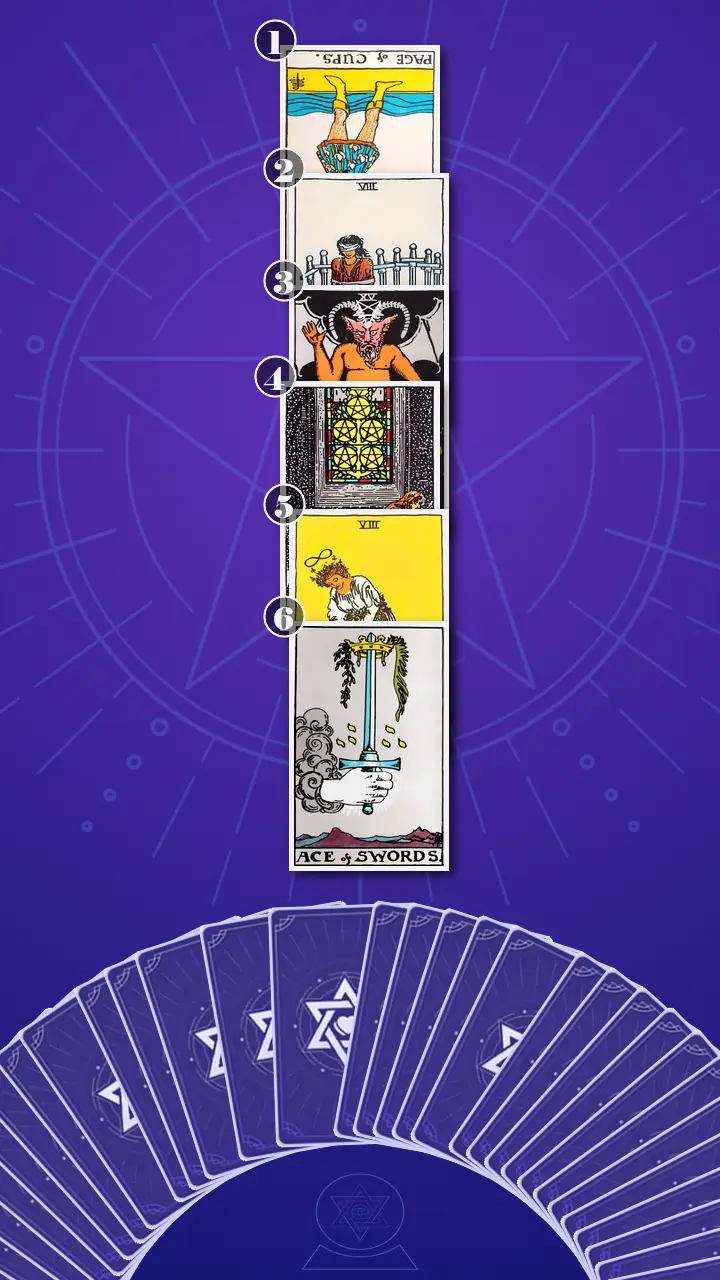
The ladder is linear—six cards read straight down like walking down a stairwell from noise to clarity. Card 1 shows the first ten seconds (the trigger). Card 2 shows the visible spiral behavior (editing, delaying). Cards 3 and 4 name the deeper drivers (attachment, belonging wound). Card 5 is the turning point. Card 6 is your one-week action—low-drama, repeatable, practical.
Reading Down the Stairwell: From Trigger to Root
Position 1 — The first 10 seconds: The immediate trigger response
“Now turning over,” I said, “is the card that represents the immediate trigger response—what the question activates in your emotional system in the first 10 seconds.”
The Page of Cups, reversed.
I showed Taylor the image: the Page holding a cup, the surprise fish rising up—something alive where you expected something simple. “This,” I said, “is the moment a normal question becomes suddenly… loaded.”
In modern life, it looks like this: You see “What are you looking for?” and your nervous system treats it like you’ve been cornered into defining yourself on the spot. You start trying to sound perfectly balanced—chill but serious, confident but not ‘too much’—and you lose access to your real voice.
“They asked X,” I said gently, keeping my voice plain. “Your brain heard Y. So you did Z.”
“They asked: What are you looking for? Your brain heard: Prove you deserve to be here. So you did: Notes app. Editing. Tone control. Not connection.”
Reversed, the Page’s water-energy is blocked—too tender to flow outward. It turns inward into self-consciousness. That’s not a character flaw. That’s a protective reflex.
Taylor let out a quick laugh that sounded like it had bumped into a bruise. “That’s… so accurate it’s kind of mean.” Their fingers pinched the edge of their sleeve, then released. Throat tight, even as they smiled.
Position 2 — The default loop: The observable spiral pattern
“Now turning over,” I said, “is the card that represents the observable spiral pattern—the concrete behaviors you default to once triggered.”
The Eight of Swords, upright.
“This is the Notes app as a prison cell,” I told them. “Not because you’re trapped. Because the trap is built out of assumptions.”
The modern-life translation is almost painfully specific: Your draft becomes a maze: you keep rewriting to prevent misinterpretation, but the rewriting is what freezes you. You can’t hit send until you’ve predicted every possible reaction.
The Eight of Swords is Air-energy in excess and blockage at the same time—thoughts multiplying, breath getting shallow, options narrowing. The blindfold isn’t punishment; it’s tunnel vision. The ropes are loose, but when you’re bracing for judgment, “loose” still feels like “locked.”
I watched Taylor’s shoulders creep up toward their ears as if they were cold. “If I just tweak this one word,” they murmured, almost embarrassed, “then I’ll be safe.”
“Your nervous system wants certainty,” I said. “Your life needs honesty.”
Taylor nodded, slow and heavy, the way you nod when you recognize a pattern and can’t unsee it.
Position 3 — The hidden bargain: The attachment you’re trying to secure
“Now turning over,” I said, “is the card that represents the hidden attachment—what you believe you must secure to feel okay in dating conversations.”
The Devil, upright.
Toronto winter had pressed itself against the window in a dull gray sheet, and for a moment the card’s chains felt like they belonged to the season: the way the city can make you hunch, rush, grip your phone like it’s the only warm thing you’ve got.
The Devil’s modern translation is blunt: Under the draft is a deal you didn’t agree to out loud: “If I say this perfectly, I’ll be chosen.” You check response times, read tone into punctuation, and treat compatibility as a verdict on your desirability.
This is attachment-as-safety. It’s the compulsion to optimize—like refreshing a feed for the one update that will finally let you unclench. You’re not chasing love. You’re chasing a guarantee.
I spoke the sentence I knew Taylor needed to hear, clean as a snapped twig: “A perfect line can’t buy belonging.”
Their reaction came in a split-screen, just like the card wanted. First: they glanced down at their phone, like they could see the “seen” status floating there even with the screen dark. Second: their eyes unfocused, like they were replaying every time a typing bubble vanished and their chest read it like a stock price drop. Third: a sharp little breath—“Oh.” Not a sigh. A realization.
“It’s not actually about the wording,” Taylor said, quieter now. “It’s about… what it means if they don’t like the answer.”
Position 4 — The wound underneath: The fear you’re protecting
“Now turning over,” I said, “is the card that represents the core fear under the attachment—the belonging wound that makes the stakes feel life-or-death.”
The Five of Pentacles, upright.
On the card, two figures move through snow past a warm stained-glass window. “This is the cold-street feeling,” I said. “The part of you that assumes everyone else has a warm room called ‘secure love’—and you’re outside trying to earn the password.”
In modern life, it’s exactly this: After you stall, you see couples content—moving-in updates, engagement posts—and it hits like a cold draft through your ribs. You start to feel like you’re outside looking in.
Earth-energy here shows up as scarcity: there isn’t enough love, enough time, enough chances, enough ‘right answers.’ When shame takes the wheel, you don’t just fear rejection—you fear exile.
Taylor’s jaw worked once, like they were swallowing a sentence they didn’t want to say. Their eyes reddened, but they didn’t cry. They just went very still, and I could feel how practiced they were at keeping themselves upright.
“If they walk,” they said, “it proves I’m not someone people choose.”
“That’s the wound talking,” I said softly. “Not the truth.”
When Strength Put Its Hand on the Lion
Position 5 — The unlock: The key inner shift
I let a beat of silence settle. The room felt quieter, as if even the radiator had decided to listen.
“Now turning over,” I said, “is the card that represents the key inner shift—the quality that unlocks the pattern and changes how you relate to the question.”
Strength, upright.
Here’s the setup as it lives in real time: you’re on the TTC home, phone warm in your hand, re-opening the same chat thread. A clean question—“What are you looking for?”—hits like a spotlight. You open Notes, start drafting, and suddenly your chest tightens like you’re defending a thesis on your own worth.
Stop trying to ‘say it right’ to earn safety—hold your desire with gentle strength, like calming the lion, and let clarity be a mutual filter instead of a self-worth test.
When I said it, Taylor’s body answered before their mind did—three small movements, like a season changing by a degree. First, a freeze: their breath paused and their hands stopped fidgeting, fingers suspended above the table. Then the thought landed: their gaze drifted past me, unfocused, as if replaying the last time they wrote “just to clarify…” and felt their stomach drop the moment it sent. Then the release: a slow exhale, shoulders lowering a fraction, jaw unclenching like they’d been grinding their teeth through half their dating life.
“But if I don’t perfect it,” they said, and there was a flash of irritation—at themselves, at the whole system, at the idea that something so human could feel so scored—“then I’m just… exposed.”
“Yes,” I said, steady. “Exposed in the way a real person is exposed. Not in the way a product pitch is exposed.”
This is where my own work—what I call Relationship Pattern Recognition—matters. I don’t look for a ‘good’ or ‘bad’ dater. I look for recurring scripts. And Taylor’s script was clear: interview mode. A question arrives, and their whole system switches to performance: craft, calibrate, anticipate, prevent. Strength is the interrupt. It says: you can be nervous and still be honest. You can feel the lion—tight chest, hot face—and still keep your hands gentle.
“This,” I told them, “is a move from shame-driven performance and mind-reading to grounded self-respect and mutual clarity. It’s not about becoming unbothered. It’s about staying on your own side.”
I leaned in slightly. “Now, with this new lens—can you remember a moment last week when you were about to rewrite the message again? A moment when ‘gentle strength’ could’ve been one honest sentence instead?”
Taylor’s eyes flicked down, then back up. “Thursday,” they said. “I had it written. I just… couldn’t send.”
“That’s the lion,” I said. “Not a verdict.”
The Ace of Swords: A Two-Line Exit From the Loop
Position 6 — The one-week action: Practical integration
“Now turning over,” I said, “is the card that represents the one-week action—how to answer differently in a concrete, low-drama way.”
The Ace of Swords, upright.
This card is the antidote to the three-paragraph “just to clarify” message. The modern-life scenario is simple and almost shocking in its normalness: You use a script you trust and keep it short enough that it can’t spiral: “I’m looking for something intentional, and I’m open to taking it one step at a time. What about you?”
Ace of Swords is Air-energy returned to balance: clean, direct, self-respecting. Not sharp like a weapon—sharp like a clear title on a calendar invite. Not a 12-paragraph agenda. Just: “Here’s what this is.”
Taylor made a small sound—half relief, half disbelief. “I want to screenshot that,” they said, almost laughing again, but this time without the bruise. “Like… I can do two lines.”
“You’re not answering a test,” I reminded them. “You’re starting a two-way clarity check.”
From Insight to Action: The Worth-Not-On-The-Table Reply
I gathered the six cards into one story, the way you’d gather scattered groceries into one bag. The Page of Cups reversed showed the first sting—where a curious question gets misread as evaluation. The Eight of Swords showed the coping loop—drafting, rewriting, delaying until the connection cools. The Devil named the bargain underneath: “If I say it perfectly, I’ll be chosen.” The Five of Pentacles revealed the fuel—fear of being outside, left out, walking alone. Then Strength arrived as the turning point: staying with yourself while you speak. And the Ace of Swords turned that inner steadiness into one clean sentence.
The cognitive blind spot here is sneaky: you think the problem is not knowing what you want, when the deeper problem is believing you must define it perfectly to deserve belonging. The transformation direction is clear: from performing the “right” answer to offering one honest sentence—and asking what they want back.
Here are your next steps—small enough to start, concrete enough to work, and designed for anyone who’s ever thought, How do I stop overthinking my dating app replies?
- Build a “Two-Line Intent” Notes template (10 minutes)Create a Note titled Two-Line Intent with three versions: (A) “intentional relationship,” (B) “open-to-exploring with consistency,” (C) “not sure yet, but I do want kindness/effort.” Keep each version to 25 words max, and end each with one question back (e.g., “What are you looking for?”).Expect the thought “this is too blunt.” If that hits, just write the drafts and save them—still counts. You don’t owe a stranger your relational autobiography.
- Do the 20-second body check + 3 slow exhalesBefore you reply, pause and ask: “Where do I feel this question—throat, stomach, face?” Name it once (“tight throat”), then take 3 slow exhales before typing. This is Strength in real life: calm hands on the lion.If it spikes too high, use “pause without punishment”: step away without ghosting yourself. Come back later the same day with the same two-line template.
- Send within 15 minutes, then do the “No Re-Open for 30” ruleNext time you’re asked “What are you looking for?”, pick one template, personalize one word, and send within 15 minutes. Then put your phone face-down and do not reopen the chat for 30 minutes.If you feel pulled to check, redirect your hands: refill water, wash one dish, step onto the balcony for 3 minutes. Your worth is not a live scoreboard.
If you want one extra layer—optional, not required—I sometimes suggest a gentle scheduling trick from my own practice: choose a time when your body is resourced for “important talks.” In my family we’ve long used moon cycles as reminders (new moon for intentions, full moon for clarity), but you can translate that into modern terms: don’t have the conversation at your emotional midnight. Choose a moment when you can actually breathe.

A Week Later: The Quiet Proof
Eight days later, Taylor messaged me. “I did it,” they wrote. “Two lines. Sent in under 10 minutes. Phone face-down. I walked to get groceries like a normal person.”
The bittersweet part was there too, honest and human: they said they slept through the night for the first time in a while—then woke up and their first thought was still, What if I said it wrong? Only this time, they noticed the thought, exhaled, and didn’t reopen the chat like it was a courtroom.
That’s what I call a Journey to Clarity: not certainty, not control—just a steadier self-respect you can feel in your jaw, your breath, your thumbs hovering over the keyboard. The question didn’t disappear. The self-worth spiral loosened.
When someone asks a normal question and your throat tightens like you’re about to be graded, it’s not that you don’t know what you want—it’s that you’re trying to protect yourself from the feeling of not being chosen.
If you didn’t have to earn safety with the perfect wording, what would your one honest sentence be—and what would you be curious to ask them back?
This story is adapted from psychological research, written so that those in a similar struggle can see their own pattern in it — and find their next step clearly.These insights are not a substitute for professional psychological, medical, legal, or financial advice.
Learn more about our Journey to Clarity.
How did this insight land for you?
🫂 This Resonates Deeply
🌀 Living This Story
✨ Now I See Clearly
🌱 Seeing New Possibilities
🧰 Useful Framework
🔮 The Confirmation I Needed
💪 Feeling Empowered
🚀 Ready for My Next Step
Author Profile
 AI
AI“As the seventh generation of a Highland healing family, I see modern anxieties as a simple, temporary disconnection from nature's rhythm. I bring 67 years of lived seasons not to instruct you, but to hold space for you. Using tarot as a mirror, I want to gently guide you out of the chaos, helping you breathe deeply and rediscover the organic, steady heartbeat of your own life.”
In this Love Tarot Reading :
Core Expertise
Service Features
Also specializes in :
Explore Related Patterns:
Anxious AttachmentUnder Taylor's draft is the bargain the story names directly: 'If I say this perfectly, I'll be chosen.' The phone becomes a regulator for belonging, with response times, punctuation, and typing bubbles carrying more emotional weight than the actual compatibility question. The attachment strategy is to reduce uncertainty by securing a guarantee. Taylor tries to earn safety through the right wording, then monitors the other person's signals for proof that the connection is still available. This makes the match's response feel like emotional oxygen instead of information. Anxious Attachment fits because the pattern is not only about wanting a relationship; it is about using the other person's reaction to stabilize self-worth. You start chasing reassurance inside the chat thread, and the question 'What are you looking for?' becomes a test of whether closeness is about to be granted or withdrawn.
Assertive CommunicationTaylor's turning point is the two-line reply: 'I'm looking for something intentional, and I'm open to taking it one step at a time. What about you?' The sentence is short, direct, and mutual, which matters because it does not try to defend Taylor's worth before stating a preference. The mechanism here is not bluntness; it is boundary-based clarity. Taylor stops treating the answer as a product pitch and starts treating it as a compatibility filter. That changes the relational field from performance to exchange. Assertive Communication fits because the new behavior lets desire exist without overexplaining it. You can be nervous and still answer clearly, then ask what the other person wants back, which keeps the conversation two-way instead of turning your self-worth into the only thing on trial.
Certainty SeekingTaylor keeps returning to the same reply as if one more edit could make the outcome controllable. The message is no longer just a sentence; it becomes a risk-management tool designed to predict and neutralize every possible reaction. The cognitive mechanism is certainty seeking. When the stakes feel tied to worth, the mind tries to replace relational uncertainty with analysis, prediction, and control. But dating does not provide courtroom-level proof before you speak, so the search for certainty keeps generating more doubt. Certainty Seeking fits because Taylor's freeze is powered by the need to know how the answer will land before they send it. You spiral because your system is asking for a guarantee that the conversation cannot provide, and the attempt to secure that guarantee keeps you stuck in the draft.
Mind ReadingThe match asks, 'What are you looking for?' and Taylor's brain hears, 'Prove you deserve to be here.' Later, response times, punctuation, and a vanished typing bubble start to feel loaded, as if the other person's tiny digital signals can reveal a final truth about Taylor's desirability. That is a cognitive distortion built around threat interpretation. Instead of staying with what is actually known, the mind fills in the unknown with imagined judgment. The nervous system then reacts to the imagined verdict as if it has already happened. Mind Reading fits because Taylor is not only answering a message; they are trying to decode an invisible court of opinion behind the message. You spiral because the blank spaces in the other person's response get treated as evidence, and your worth starts reacting to meanings that have not actually been confirmed.
Perfectionism-Driven AvoidanceTaylor's Notes app becomes the visible loop: draft, delete, rewrite, change one word, change it back, then lock the phone as if closing a laptop after being caught off guard. The intention is protection, but the protection takes the form of endless refinement. The defense mechanism is perfection as avoidance. By trying to prevent every possible misread, Taylor postpones the vulnerable act of sending a real answer. The more exact the wording has to be, the less access they have to their actual voice. Perfectionism-Driven Avoidance fits because the story shows perfectionism functioning as a delay tactic, not a high standard. You are trying to make the sentence flawless enough to guarantee belonging, but the editing loop quietly keeps you away from the only thing that could create clarity: a direct, imperfect, mutual exchange.
Rejection SensitivityTaylor's reaction starts before any rejection happens: stomach dropping, throat tightening, face going hot, thumb frozen above the screen. The question itself is neutral, but Taylor's system receives it as a possible exclusion notice. The core cognitive link is that mismatch gets converted into identity evidence. 'If they walk' becomes 'I'm not someone people choose.' That turns ordinary dating uncertainty into a self-worth alarm, because the outcome is no longer just about fit; it feels like proof of belonging or exile. Rejection Sensitivity fits because Taylor's nervous system is bracing for disconfirmation before the other person has actually made a judgment. You are not overreacting to nothing; you are reacting to a learned internal equation where not being chosen can feel like being outside the warm room entirely.
Relationship Performance AnxietyTaylor's body treats the dating app question like being put on the spot in a meeting: stomach dropping, throat tightening, thumb hovering, and the phone suddenly feeling like it might expose them. The behavior is not random nervousness; it is a performance system switching on the moment connection starts to feel evaluative. That system tries to manage worth through presentation. Taylor drafts, deletes, changes one word, changes it back, and searches for the version that sounds chill but serious, confident but not too much. The psychological mechanism is performance-based safety: if the answer can be optimized, then maybe rejection can be prevented. Relationship Performance Anxiety fits because the story keeps translating intimacy into interview mode. You are not simply deciding what to say; you are trying to pass an imagined assessment of desirability. The spiral begins because the question stops being a mutual clarity check and becomes a stage where your self-worth feels scored in real time.
Explore Related Struggles:
Belonging-Authenticity SplitTaylor tries to sound perfectly balanced: chill but serious, confident but not too much. Every edit is an attempt to stay acceptable, but each adjustment pulls the message further from the real voice that wants to answer simply. Belonging-Authenticity Split lives in that friction. If you answer honestly, you risk being too much, too clear, too uncertain, or too exposed; if you answer performatively, you may protect the connection for a moment while losing contact with yourself. The spiral loosens when the message stops being a bid for universal approval. One honest sentence gives the other person something real to meet, and it gives you a way to stay present without bargaining away your own voice.
Chosen-Worth BindThe match asks, "What are you looking for?" and Taylor's system hears, "Prove you deserve to be here." A normal compatibility question stops being a two-way filter and becomes a verdict waiting to happen. Chosen-Worth Bind is the deeper knot underneath the self-worth spiral. If the other person likes the answer, you get a temporary sense of being safe; if they do not, the rejection feels like evidence that you are not someone people choose. That is why the stakes feel so disproportionate to the message. You are not only answering a dating prompt; you are trying to prevent one stranger's reaction from becoming the final word on your desirability.
Clarity-Exposure SplitThe second Taylor has to define what they want, the body reacts before the sentence can form: throat tight, stomach dropping, face hot, thumb hovering over the screen. The chat is casual on the outside, but inside it feels like stepping into a spotlight. Clarity-Exposure Split fits because clarity should make dating cleaner, yet here it feels like removing cover. Saying what you want would help both people understand the match, but it also makes your desire visible before you know how it will be received. You are caught at the threshold between being clear and being seen. The way through is not to hide your desire inside perfect wording, but to let clarity become a mutual filter instead of a moment where your whole self feels on display.
Performance-Worth FusionTaylor can ship decks, track performance, and hit deadlines, yet one line in a dating chat turns the phone into a stage. The reply moves out of the conversation and into Notes: draft, delete, adjust the tone, try to sound chill but serious, confident but not too much. Performance-Worth Fusion shows up because the message is no longer just information. It becomes a performance that has to prove you are desirable, balanced, low-drama, and worth choosing before the other person has even answered back. You are not stuck because you lack a clever enough line. You are stuck because the act of wording the line has been asked to carry your whole sense of value, and no two-sentence dating reply can hold that much weight without turning into a test.
Read Receipt Worth LockTaylor looks at the dark phone and can still almost see the "seen" status floating there. A vanished typing bubble, a delayed reply, a shift in punctuation, or the urge to reopen the chat starts to feel like data about whether they are wanted. Read Receipt Worth Lock captures the way the app's smallest signals become a live scoreboard. The phone is not only delivering messages; it is holding the imagined verdict, and your body keeps checking it as if certainty might appear in the next notification. The one-week action matters because putting the phone face-down is not just a productivity trick. It creates a boundary between your worth and the app's feedback cycle, so a delayed response can return to being a dating signal instead of a measurement of you.
Explore Related Emotions:
Cautious Self-TrustEight days later, Taylor sends two lines in under ten minutes, puts the phone face-down, and walks to get groceries. The old worry still appears the next morning, but it no longer gets full control of their hands. Cautious Self-Trust names that fragile but real shift. Taylor is not suddenly fearless; they are beginning to let one honest sentence be enough for the moment it is meant to serve. The emotion is upright because the story shows trust becoming embodied through a repeatable action. You can feel Taylor keeping their worth off the table, letting the answer be a mutual clarity check instead of a personal trial.
Clarity ReliefThe final reply is almost ordinary: one clean sentence about what Taylor is looking for, followed by one question back. Its power comes from how little it asks the message to prove. Clarity Relief appears when the fog of over-editing thins enough for Taylor to act. The answer does not guarantee an outcome; it simply restores the shape of the conversation, making room for both people to name what they want. That relief is visible a week later when Taylor notices the old thought and does not reopen the chat like a courtroom. You can feel the system loosening because clarity has become practical, not performative.
Conditional Belonging FearUnder Taylor's draft is the quiet bargain that a perfect line might secure being chosen. The story makes that bargain visible through the warm-room image: everyone else seems to have access to secure love, while Taylor feels outside trying to earn the password. Conditional Belonging Fear is the inner weather created when acceptance feels available only after flawless presentation. The dating question becomes loaded because it asks Taylor to reveal desire before they feel sure that desire will not cost them connection. This is why the fear feels larger than the message itself. You are seeing someone treat belonging as something that can be lost through one wrong tone, one unclear phrase, or one answer that does not meet the imagined standard.
Exposure DreadTaylor keeps the phone face-down as if the device itself could reveal them, then moves the answer out of the chat and into a private draft zone. Later, they say the core fear plainly: if they do not perfect it, they are just exposed. Exposure Dread names the fear of being visible before the self has been polished into safety. It is not only fear of saying the wrong thing; it is fear of being seen in the raw middle of wanting something. The story shows how quickly directness starts to feel unprotected. You can feel Taylor trying to put a layer between their desire and the other person's eyes, because an honest sentence seems to carry too much personal risk.
Grounded AgencyTaylor's new answer ends with a question back: "What about you?" That small return of curiosity changes the whole emotional posture of the exchange. Grounded Agency fits because Taylor stops submitting themselves for approval and begins participating in the conversation as an equal person. Putting the phone face-down after sending creates enough space for the reply to exist without constant monitoring. The story's movement is not toward control over the match. It is toward Taylor reclaiming their side of the interaction: their pace, their clarity, their right to ask for information too.
Not-Enough PanicTaylor's stomach drops, throat tightens, and face goes hot before any reply has even been sent. The body reacts as if the question has already uncovered a possible flaw. Not-Enough Panic fits because the fear moves faster than thought. Taylor is not simply unsure how to phrase a dating intention; they are bracing against the sudden sensation that an imperfect answer could confirm some hidden insufficiency. The story keeps returning to that pressure point: failing a test, earning the password, proving they are someone people choose. You can feel the panic compressing a mutual dating check into a single urgent question of personal adequacy.
Performance FreezeTaylor can ship decks, track performance, and hit deadlines, yet one sentence in a chat thread locks their body into hover mode. The phone is warm from being open too long, the thumb does not commit, and the answer gets moved into Notes where it can be rehearsed without being seen. Performance Freeze captures the moment skill turns into paralysis because the task has become self-presentation. Taylor is not unable to answer because they lack thoughts; they freeze because the answer feels like it must be optimized before it is allowed to exist. The emotional logic is direct: when connection starts to feel like a performance review, movement stops. You can feel the body trying to buy safety through delay, but the delay keeps Taylor suspended between wanting to connect and fearing what directness might expose.
Self-Audit AnxietyTaylor's first move after seeing the question is not to check in with what they want; it is to inspect how they might be perceived. Draft, delete, soften, clarify, recalibrate: the whole reply becomes an internal review process. Self-Audit Anxiety fits the way the story turns self-reflection into self-surveillance. Taylor is trying to catch every possible flaw in tone before the other person can see it, which makes their inner world feel like a performance dashboard. This emotion is tightly linked to the consulting question because the self-worth spiral starts when Taylor audits themselves instead of evaluating the fit. You can feel the agency narrowing as the focus shifts from mutual clarity to whether their answer will pass.
Shame SpiralTaylor opens a simple dating-app message and immediately turns it into Notes app drafts, deleted words, tone control, and a frozen thumb over the keyboard. The question is not being processed as curiosity from another person; it is being absorbed as a live review of whether their answer will make them acceptable. That is why Shame Spiral fits the story so precisely. The spiral begins when Taylor stops asking, "What do I honestly want?" and starts asking, "How do I phrase this so I do not become too much, too vague, too intense, or too wrong?" Every revision seems practical on the surface, but underneath it pulls their attention deeper into self-monitoring. The emotional center is the moment worth becomes negotiable through wording. You can see Taylor trying to protect themselves with perfection, but the protection turns inward and starts scoring them before anyone else has even responded. The shame is not loud; it is procedural, hidden inside each tiny edit.
Verdict DreadTaylor hears "What are you looking for?" and their body reacts as if a spotlight has snapped on. Their throat tightens, their face goes hot, and the chat begins to feel less like a conversation than a test they were not ready to take. Verdict Dread names the specific fear that the other person's response will not just reveal compatibility, but deliver a ruling on Taylor's desirability. The story shows this clearly when Taylor says that if the person walks away, it proves they are not someone people choose. This emotion matters because the dread is attached to evaluation, not simply rejection. You are watching Taylor's nervous system turn a normal dating question into a courtroom, where one honest answer feels like it could be used as evidence against their worth.
Certainty HungerTaylor keeps rewriting because the message is being asked to do impossible work. It has to be honest, chill, serious, not too much, not too little, and somehow capable of preventing every bad reaction. Certainty Hunger captures the ache underneath that impossible assignment. Taylor wants the reply to create a guarantee before they risk being seen, so the sentence becomes loaded with a promise no sentence can actually make. The story shows this hunger in the urge to predict every possible reaction before pressing send. You are watching uncertainty become intolerable enough that Taylor tries to solve dating through control, even though the real exchange requires another person's freedom too.
Hard-Won ComposureTaylor's body does not skip straight into ease. The breath pauses, the hands stop fidgeting, the jaw has to unclench, and even after sending the message the old thought still arrives in the morning. Hard-Won Composure names the steadiness that has to be practiced while the alarm is still present. It is not a glossy version of calm; it is the ability to notice the spike without letting it drag the whole self-worth spiral back online. That makes the emotion valuable in this story because the ending is deliberately human. The question does not disappear, but Taylor can stay with themselves long enough for the spiral to loosen.
Rejection ChillAfter Taylor stalls, couples content and engagement posts hit like a cold draft through the ribs. The comparison is not framed as envy alone; it feels like watching other people stand inside a warm room while Taylor remains outside. Rejection Chill names the coldness that arrives when possible mismatch starts to feel like exclusion. The emotional temperature drops because the story links one person's response to a wider fear of being left out of secure love altogether. You can hear it in Taylor's sentence: if they walk, it proves I am not someone people choose. The chill comes from that leap, where rejection stops being one relational outcome and becomes a felt exile from being wanted.
Relational AnxietyTaylor reads response times, punctuation, seen status, and vanished typing bubbles as if each small digital cue contains the future of the connection. The match's possible reaction becomes something to monitor before it has even happened. Relational Anxiety belongs here because the uncertainty is interpersonal and immediate. Taylor's system starts scanning for signs of safety, interest, or withdrawal, turning tiny app behaviors into emotional evidence. This feeling does not sit at the edge of the story; it drives the editing loop. You can see Taylor trying to predict every possible reaction so the connection will not surprise them, but that prediction effort keeps the whole exchange charged and fragile.
Explore Related Contexts:
Commitment Criteria Black BoxTaylor tries to answer one question, but the draft turns into a maze because the expected standard is invisible. They are not only deciding what they want; they are trying to guess what the other person will count as too intense, too vague, too casual, or too much. That hidden rubric is what makes this a Commitment Criteria Black Box. The dating app prompt asks for clarity, but the social rules around early dating often reward ambiguity, coolness, and careful pacing. Taylor is forced to navigate commitment language without knowing which version of honesty will be received as attractive, acceptable, or disqualifying. For You, this context explains why the spiral can start before anything bad happens. When the criteria are opaque, the mind tries to build a perfect answer to a test it cannot see. A clearer path begins when the question is treated as a shared filter, not a secret exam.
Conditional Belonging PressureTaylor says the problem is not really the wording; it is what the answer would mean if the match does not like it. That sentence makes the social contract visible: acceptance feels conditional on producing a version of desire that another person will approve. The story keeps showing belonging as something located just outside the window. Couples content, moving-in updates, engagement posts, and the image of everyone else having a warm room called secure love all create a social field where one dating reply seems to carry the weight of being chosen or left out. The pressure is external because the dating culture around Taylor keeps making romantic legitimacy look like something that must be earned through the right signals. For You, this label points to the structure underneath the spiral. A compatibility question becomes dangerous when the surrounding script says that one imperfect answer can move You from desirable to disposable. Naming the pressure gives You room to separate mutual fit from personal worth.
Dating App Performance LoopTaylor receives a simple dating app question on the TTC and immediately moves into a polished-response workflow: Notes app open, one word changed and changed back, phone locked like a laptop in a meeting. The behavior is not random hesitation; it is the visible shape of a dating environment where the reply feels like a public performance with hidden scoring criteria. The app turns desire into copywriting. Taylor tries to sound balanced, calm, intentional, and not too intense all at once, as if the right tone could prevent rejection before the other person has even responded. That is why this context fits: the external stage is not just dating, but dating under performance pressure, where connection gets replaced by calibration. For You, the useful audit point is that the pressure lives in the setup of the exchange as much as in the feelings it triggers. The moment the question becomes an audition, the chat stops being a mutual clarity check and starts operating like a one-person brand presentation.
Direct Communication TrialTaylor’s one-week action is deliberately small: choose a two-line intent, personalize one word, send within a short window, and ask the question back. Eight days later, they do exactly that, sending in under 10 minutes and then walking to get groceries. This is a trial because the new behavior is not yet effortless or settled. The old pressure still appears as the thought "What if I said it wrong?" but the external structure has changed: the reply is short, reciprocal, and grounded in what Taylor can actually state. The dating question becomes a two-way clarity check instead of a stage for self-editing. For You, this context is the usable exit ramp from the spiral. Directness is not presented as a personality makeover; it is a repeatable social move that protects agency while still allowing connection to happen.
Relationship Readiness CheckThe same sentence that first freezes Taylor is later reframed as a mutual check: "I’m looking for something intentional, and I’m open to taking it one step at a time. What about you?" The wording matters because it makes space for both direction and pacing. This context is not about proving readiness to a match. It is about using the question to identify whether both people can participate in a clear, respectful exchange about intent. The answer stops being a performance of certainty and becomes a simple way to test alignment. For You, the shift is structural. A readiness check asks whether the connection can hold honesty from both sides, rather than asking whether You can produce the perfect version of wanting. That gives the question a job without giving it control over your worth.
Social Clock PressureAfter Taylor stalls, the story cuts to couples content: moving-in updates, engagement posts, and the cold feeling of being outside a warm room called secure love. Those images matter because they turn a single app reply into part of a wider timeline of romantic milestones. The pressure is social, not just personal. In a late-20s city dating context, visible couple progress can make every ambiguous interaction feel like it is happening against a clock: enough time, enough chances, enough right answers, enough proof that You are not falling behind. Taylor is not simply answering a match; they are answering inside a public culture of milestones. For You, this context helps explain why the question can feel bigger than the chat. When dating content and peer milestones crowd the background, "What are you looking for?" can start sounding like "Where are You on the timeline?" Separating the actual person from the social clock makes the next answer less loaded.
Strategic Dating BoundaryTaylor’s new structure has hard edges: 25 words max, one question back, send within 15 minutes, then no reopening the chat for 30. Those limits are not about being cold; they keep the dating exchange from expanding into an unpaid emotional project. The boundary is strategic because it protects the space where mutuality can be tested. Taylor gives enough information to be honest, then returns the question so the other person also has to participate. The phone rule prevents the interface from turning the next half hour into a surveillance period. For You, this label captures the practical social design of the solution. A dating boundary does not have to be dramatic to be real; sometimes it is a short message, a reciprocal question, and a refusal to keep auditing the chat after You have already shown up clearly.