Three Deleted Replies After a Fight, Then a Pause with a Return Time

When Cooling Off Became Open-Ended Silence at 10:47 p.m.
I had barely set the deck between us when I reflected Jordan, a 28-year-old UX researcher, back to them: “You can spend all day asking careful questions at work, but after a fight in your Toronto apartment, one ‘Can we talk?’ notification can trigger a full post-conflict shutdown.” They gave me the small, exhausted nod of someone hearing their private browser history read aloud.
They told me about 10:47 the previous night. Jordan had sat on the edge of the bed with their partner’s message open, the phone warm against their palm while streetcar brakes scraped against the wet road outside. They typed three replies, deleted each one, turned on Do Not Disturb, and placed the phone face down. Their jaw stayed locked even after the screen went dark.
“I asked for thirty minutes because I needed the conversation to stop long enough for me to think,” they said. “But then I thought, if I reply before I’m fully calm, I’ll say it wrong. By bedtime, I still hadn’t answered. I keep waiting for the perfect moment to reconnect, and then the silence becomes its own problem.”
I watched their shoulders rise toward their ears as they spoke. The feeling in their body seemed less like a single emotion and more like a rush-hour intersection where every direction had been given a green light: defend the original point, explain the silence, reassure their partner, avoid restarting the fight, and somehow sound completely composed while doing all four.
Jordan had already searched “taking space after a fight vs silent treatment” and “cooling off period vs stonewalling,” only to feel reduced to a label by every result. I told them I was not interested in diagnosing them or assigning a cruel motive to a behaviour they were using to regain control.
“Your need for space is real,” I said. “I’m not going to ask you to stay inside a heated exchange. I want us to find the exact point where useful solitude loses its return route. Let’s give this fog a map—and then hand the pen back to you.”

Choosing the Compass: The Five-Card Shadow Spread
I invited Jordan to place both feet on the floor and take one unforced breath. I shuffled slowly while they held one precise question in mind: “Why does cooling off after our fights become shutting my partner out?” The pause was not a mystical performance. It was a way to move their attention from the latest argument into observable patterns.
This is how tarot works in my practice: I do not use the cards to predict whether a relationship will survive, decide who is right, or replace direct consent and communication. I use them as an objective recognition tool—a set of symbolic prompts that can separate a trigger, a protective strategy, its cost, and a possible next move. Card meanings become useful when I place them in the context of someone’s actual Tuesday night, lock screen, body language, and choices.
I chose the five-card Shadow Spread because Jordan’s question was about the internal mechanics of their own shutdown, not speculation about their partner’s thoughts. A Relationship Spread would have pulled us toward comparing two people, while a Celtic Cross would have added future and environmental layers we did not need. This smaller trigger-protection-cost-integration tarot spread could stay close to the present repair process.
I placed the first card at the centre for the visible shadow behaviour. The second went to the left for the moment inside a fight that activates it. The third went to the right for the fear and protective purpose beneath the silence. Below the centre, the fourth would show the relational cost. Above it, the fifth would offer an integration path. The cross looked like a closed door, but its vertical line also suggested a threshold: consequence below, a visible route back above.
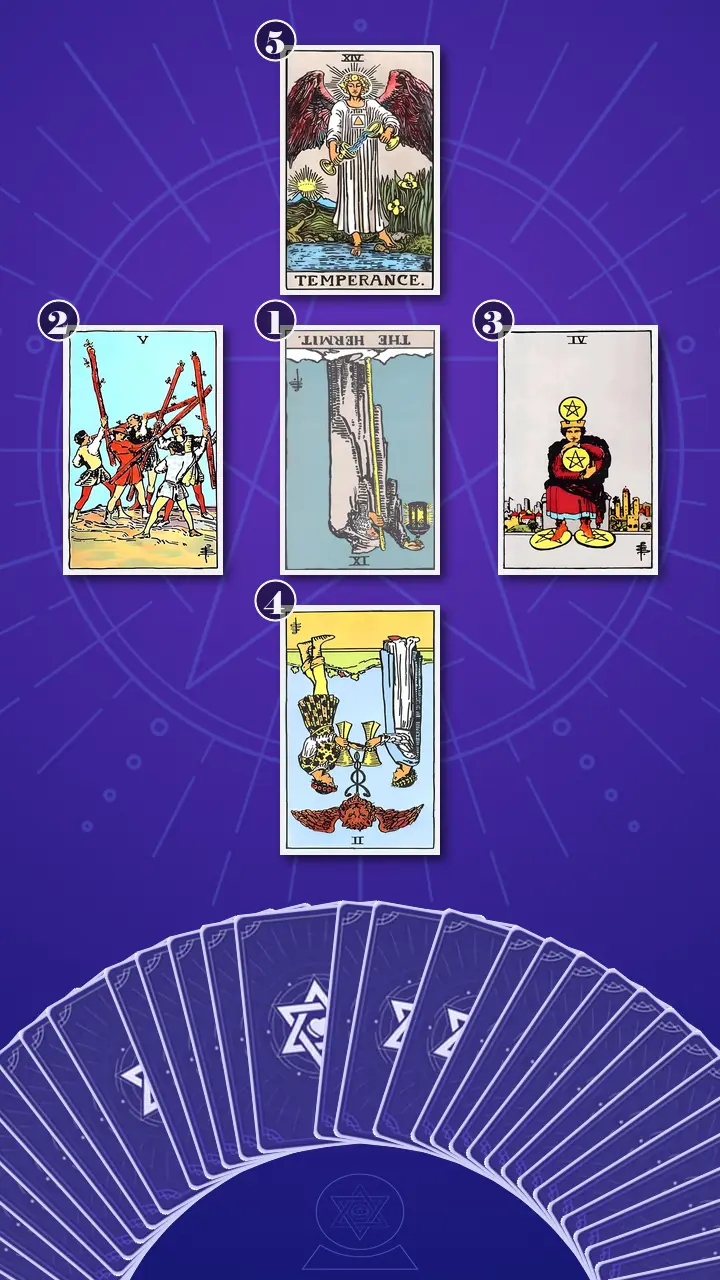
Reading the Map: Four Ways a Pause Loses Its Edges
Position 1: The Hermit Reversed and the Door with No Return Time
Now I turned over the card representing the observable shadow behaviour: a cooling-off period that expands into unannounced isolation. It was The Hermit, in the reversed position.
I pointed to the solitary figure on the snowy summit. The Hermit’s lantern illuminates only a small area, which is enough for the person holding it but not enough to show someone at the bottom of the mountain where the path will reopen. In Jordan’s life, that was the 10:47 p.m. move from the shared living room to the bedroom: phone face down, every draft kept in Notes, no return time sent.
“The first quiet genuinely helps,” I said. “You are not leaving the relationship in your own mind. You are leaving the conversation. But each hour without a signal raises the emotional cost of the first message, so the retreat that was meant to create clarity becomes the isolation that makes re-entry harder.”
I read the reversal as an excess of retreat and a blockage in return. Solitude itself was not the problem. The energy became distorted when Jordan waited to produce a perfectly calm, logically complete explanation before allowing any light to travel back across the closed door.
I asked, “The last time you left the room, when did the immediate intensity begin to drop—and what stopped you from naming a return time after that?”
Jordan let out a short laugh, but there was no humour in it. “That’s too accurate. Almost cruel.” Their fingers tightened around the edge of their sleeve before releasing it.
“Let’s keep the sting and remove the shame,” I replied. “The card is not calling your need for quiet wrong. It is showing the missing structure around that need. Space is a boundary; disappearance is an unanswered question. We’re here to turn the unanswered question into information you can actually choose to give.”
Position 2: Five of Wands and the Argument with Five Open Threads
Now I turned over the card representing the conflict dynamics and exact moments that trigger Jordan’s impulse to disengage. It was the Five of Wands, upright.
Five figures raised their staffs in different directions, with no shared target and no clear sequence. I translated the image into the exchange Jordan had described: their partner raised one concern, Jordan heard criticism in the tone, remembered an earlier disagreement, noticed their own defensiveness, and began constructing a rebuttal—all within a few seconds.
“The internal monologue sounds like this,” I said. “‘I am still processing the first point, but now I also have to answer the tone, the old example, what you think my silence means, and the fact that I’m getting upset.’ One disagreement starts behaving like five group-chat threads demanding simultaneous replies.”
Jordan nodded more slowly this time. They worked in Figma every day, so I compared the moment to a file where comments stack across the same screen faster than anyone can resolve the first one. It also carried the energy of an overlapping kitchen argument in The Bear: several urgent reactions arriving at full volume, with no agreed order in which to hear them.
I read the card as excess fire. The desire to understand had not disappeared; it was being crowded out by the pressure to defend. Withdrawal became the only stop button Jordan could see because the conversation no longer felt like one navigable disagreement.
“What is the exact phrase that changes the scene?” I asked. “Not the whole argument. The sentence or tone shift that makes the room suddenly feel too crowded to stay in?”
Jordan looked past the cards as though replaying a recent exchange. “Usually it’s ‘Can we talk now?’ or ‘Are you ignoring me?’ I know those can be real questions, but my body hears, ‘You’re not allowed to stop.’ Then I say, ‘I can’t do this,’ and leave.”
I used one of my core tools, Dialogue Loop Auditing. On a small pad, I wrote the incoming phrase, Jordan’s automatic translation, their protective reply, and the next likely escalation. “Can we talk now?” became “Your boundary is being refused.” Jordan’s “I can’t do this” could then be received as “Your hurt does not matter.” That impact could produce another follow-up question, which Jordan experienced as proof that contact was uncontrollable.
I was careful not to declare either interpretation objectively true. The audit was an X-ray of the loop, not a verdict about either person’s intent. Jordan’s breathing slowed as they saw the phrases separated on paper. The argument was no longer one enormous emotional weather system; it had a discernible ignition point.
Position 3: Four of Pentacles and the Perfectly Defensible Reply
Now I turned over the card representing the core fear and protective purpose beneath the silence, especially Jordan’s attempt to preserve control over emotional intensity, wording, and timing. It was the Four of Pentacles, upright.
The figure pressed one pentacle against the chest, balanced another above the head, and pinned two beneath the feet. Nothing could be dropped, offered, or allowed to move. I saw Jordan’s Notes app immediately: the reply held outside the actual conversation, affection compartmentalised, practical logistics permitted, and the return time withheld because releasing even one sentence felt capable of restarting everything.
“The private rule is, ‘If I release one piece of access, the entire argument might start moving again,’” I said. “So you hold the reply, the tenderness, the timing, and the imperfect emotion all at once.”
The Four of Pentacles carried useful earth—the wish for containment and stability—but that energy had hardened into excessive control. It created short-term safety by freezing every channel. The same freeze then prevented reassurance and new information from moving, which meant Jordan’s body never received evidence that a conversation could pause and return without becoming unmanageable.
My artist’s mind caught the scene as if it were a film stuck in post-production. Jordan was trying to edit every line until the performance contained no visible uncertainty. But real relational dialogue is not released like a polished campaign video; it arrives with breaths, pauses, revisions, and occasional sentences that are clear without being flawless.
I introduced another diagnostic lens I call Toxic Script Identification—not because either person was toxic, but because the automatic script was toxic to repair. In this version, one role became the Urgent Reconnector, seeking immediate certainty that contact still existed. The other became the Perfect-Answer Editor, withholding contact until nothing could be misunderstood. More urgency produced more editing; more silence produced more urgency. Each role accidentally fed the other.
“What if you did not release the whole argument?” I asked. “What is the smallest piece of information you could offer that would preserve your boundary without reopening the discussion?”
Jordan’s breathing paused. Their hand hovered over the table, their eyes lost focus as though scrolling through old nights, and then their palm flattened beside the card. “A time,” they said quietly. “I could give a time without giving my whole defence.” The answer seemed to loosen something under their ribs, although their jaw still carried the old reflex to brace.
Position 4: Two of Cups Reversed in the Next-Morning Kitchen
Now I turned over the card representing the long-term relational cost of the defence strategy: interrupted reciprocity and a second conflict about disconnection. It was the Two of Cups, in the reversed position.
I showed Jordan the two figures offering cups at equal height. Upright, the exchange is visible. Reversed, one cup has effectively left the meeting without communicating whether or when it will return. The card did not question Jordan’s private affection. It asked what part of that affection had become observable during the pause.
Jordan described the following morning at 7:38. In their narrow kitchen, the espresso machine hissed and a spoon clicked against ceramic while they and their partner discussed coffee, keys, the bathroom, and the commute. Jordan still cared deeply and intended to repair the argument, but they could not make eye contact or show softness until the conflict felt resolved. Their partner received logistics, not a check-in.
I read the reversal as a deficiency of visible reciprocity and a blockage in relational water. The relationship remained emotionally important to Jordan, but no reassurance, return point, or agreed extension carried that care across the silence. By the time Jordan returned with a detailed explanation of why the withdrawal had been necessary, the new conflict could already be about the absence itself.
“Intent lives inside you,” I said. “A return signal is what the relationship can actually receive.”
Jordan winced. “That makes it sound like I’m doing something to them when I’m just trying not to make things worse.”
“I hear that,” I said. “Impact is not proof of malicious intent, and accountability does not require self-condemnation. Two things can be true: you are using silence to prevent escalation, and the lack of a return signal can create uncertainty for someone outside that silence. The cards are not asking you to surrender your boundary. They are asking whether private care can have one visible form.”
Their expression softened, then briefly tightened again. I could see the bittersweet edge of the insight: relief at being understood, followed by the ache of recognising a cost they had never meant to create.
When Temperance Kept the Water Moving
Position 5: The Bridge Between Space and Contact
The room went quiet enough for me to hear the radiator click. As I lifted the final card, a streetcar bell sounded once below the window—a single clear note after the scraping brakes that had accompanied Jordan’s story.
Now I turned over the card representing integration: a time-bounded pause with reassurance, a return time, and accountable follow-through. It was Temperance, upright, the strategic bridge of the reading.
I pointed to the water moving continuously between two cups. One foot rested on solid land and the other touched water. I read that as balanced regulation: enough earth to hold a practical boundary, enough water to preserve emotional participation, and enough measured movement that separation did not have to become severance.
At 10:47 p.m., the phone was warm in Jordan’s hand, three careful replies had been typed and deleted, and the apartment had gone painfully quiet. They had wanted thirty minutes to settle; now they were waiting to become unshakeable before returning.
I let that impossible standard sit between us before I spoke.
A pause protects connection when it names both the boundary and the way back; calm does not have to be perfect before contact can be clear.
Then I translated the card’s central image into the sentence I wanted Jordan to carry home:
Cooling off does not require disappearance; make the pause a bridge back to contact, like Temperance's water moving visibly between two cups.
Jordan’s breath stopped first. Their fingers remained suspended above the table as if they had been about to reach for the card and forgotten how. Their pupils widened, then their gaze slipped past me, replaying some private sequence of closed doors, unsent drafts, and next-morning coffee. Their eyebrows drew together. “But doesn’t that mean I’ve been doing it wrong?” they asked, the words sharper than anything they had said so far. “Doesn’t it mean I’ve been hurting them while telling myself I was preventing harm?” The anger lasted only a moment before their voice thinned at the edges. Their shoulders dropped, their clenched hand slowly opened, and a shaky breath left their chest. Relief arrived, but it brought a brief, almost dizzy blankness with it: if the pattern was changeable, Jordan now had a choice to make inside the next difficult scene. Their eyes reddened slightly. “I thought the options were stay and explode, or leave until nothing emotional was left,” they said. “I didn’t know the pause could still contain contact.”
I did not rush to turn their anger into gratitude. “Your old strategy was not pointless,” I said. “It performed one necessary job: it stopped the immediate overload. It was simply missing its second edge. Learning that does not make every previous choice a moral failure. It gives you more authorship over the next one.”
I asked, “Now, with this new perspective, think back to last week. Was there a moment when this insight could have made you feel different?”
Jordan remembered a Saturday walk along Queen’s Quay. They had planned to take twenty minutes, but icy air against their cheeks and wet traffic underfoot carried them into a second hour. “At the forty-minute mark, I knew I wasn’t leaving the relationship,” they said. “I just couldn’t face the whole conversation. I could have sent one line then. The walk might have stayed a walk instead of starting to feel like an exit.”
That was where I brought in my Pattern Interruption Script. I use it like a rewritten stage direction at the exact moment an old role is about to take over. The trigger remained the same: a fight, a follow-up notification, Jordan’s chest compressing. The old direction was: leave, silence every channel, draft until perfect, return only when no vulnerability remains. The new direction was not “keep talking.” It was: mark the interval.
I asked Jordan to open their Notes app for two minutes and type: “I care about us and want to return to this. I need 40 minutes without messages, and I will come back at 8:30.” The sentence carried four things between Temperance’s cups: care, boundary, duration, and a return point.
Jordan’s thumbs hesitated after the first sentence. I reminded them they did not have to send the draft that day. If their body tightened further, they could stop or keep only the minimum version: “I need 30 minutes, and I will check in at 8:15.” A clearly stated no-messaging boundary was still a real boundary; reassurance did not turn it into an invitation to continue debating.
The Pattern Interruption Script could not control their partner’s reaction, and I did not present it as a magic fix. Its purpose was to change the role Jordan automatically played. Instead of becoming the Perfect-Answer Editor, they could become the person who named a limit and kept one visible waypoint.
“You do not need a perfect explanation to send a clear waypoint,” I said. “The shift here is from overwhelmed, control-driven silence to measured self-regulation and accountable reconnection. That is not the same as being fully calm. It is the first act of trusting that you can pause and still return.”
Giving the Pause Two Edges
When I drew the five cards back into one story, the mechanism was remarkably coherent. The Five of Wands showed the noisy entry: too many emotional and verbal threads arriving at once. The Hermit reversed showed Jordan exiting that crowded field for valid relief, then losing the route back. The Four of Pentacles revealed why the silence hardened: holding words, affection, timing, and access created a temporary sense of control. The Two of Cups reversed showed the cost when private care had no observable exchange. Temperance restored movement without removing the boundary.
I also noticed what the spread did not contain: there were no Swords. Fire appeared as conflict, earth as containment, and water as relationship, but the air function of plain language was missing. Jordan did not need a longer explanation. They needed one simple sentence to tell the other person where the boundary ended and the next contact point began.
The cognitive blind spot was the belief that any contact meant consenting to resume the entire fight. That belief made perfect composure seem like the admission price for one text. The transformation was more practical: a check-in could remain limited; returning could mean ten minutes rather than total resolution; an extension could be communicated without counting as failure.
Jordan raised an immediate obstacle. “But if I send the message, what if it invites more messages? I’ll see the notification and feel like we’re back in it.”
“Then the no-contact limit belongs inside the script,” I said. “You can turn off notification previews after sending it. The point is not unrestricted availability. The point is that the boundary has a visible end or a promised update.”
- Save the Two-Sentence Temperance Script.During a neutral five-minute window at home this week, open Notes and write one reusable message containing care, a no-messaging boundary, and an exact check-in time: “I care about us and want to return to this. I need 40 minutes without messages, and I will come back at 8:30.” Show the draft to your partner later and ask whether it clearly communicates a pause rather than an invitation to continue immediately.Choose wording you can say while activated. If two sentences feel impossible, save the minimum version: “I need 30 minutes, and I will check in at 8:15.”
- Set the Return Alarm Before Do Not Disturb.At the next ordinary disagreement, choose a realistic pause—20, 40, or 90 minutes—send or say the return point before leaving the room, and set a labelled phone alarm for that exact time. If more time is genuinely needed, send one saved update when the alarm sounds: “I’m not ready to continue yet. I need another 30 minutes and will check in again at 9.”Treat the first return time as a commitment to check in, not a promise to be completely calm. Keep notification previews off during the break if they reactivate the argument, but leave the return alarm on.
- Use a Ten-Minute Re-entry.At the named time, return to the agreed room or call, even if the first line is simply, “I’m here, and I’m still a bit activated.” Set a ten-minute timer and begin with one point you heard: “I heard that the sudden silence left you unsure whether I was coming back.” When the timer ends, decide together whether to continue, take another named pause, or schedule a specific later window.Re-entry is not the same as immediate resolution. Avoid using the first ten minutes only to defend why you withdrew; the smallest success is arriving, acknowledging one impact, and choosing the next interval clearly.
I made the safety boundary explicit: these practices are for ordinary conflict where contact is voluntary. If direct engagement feels unsafe, coercive, or likely to expose someone to harm, distance and trusted support take priority over any return script. No tarot card creates an obligation to make oneself available.
“The goal is not to stay in the fight,” I told Jordan. “It is to make the pause lead somewhere. You decide the length, the wording, whether an extension is needed, and whether the situation is safe enough for contact. The cards can reveal the structure; they cannot take that authorship from you.”

Six Days Later: The Alarm That Meant “Return”
Six days later, I saw Jordan’s name appear on my screen. Their message read: “I used it. I said I needed forty minutes and set the alarm. At 8:30 I was still shaky, so I sent the extension instead of disappearing. I came back at 9 and started with what I’d heard. We didn’t solve everything, but we didn’t have the second fight about whether I was coming back.”
There was nothing cinematic about the outcome, which was exactly why I trusted it. Jordan had not become perfectly regulated in a week. Their partner had not been turned into a predictable character. One disagreement still contained disappointment, defensiveness, and sentences that needed revision. But the pause had acquired two edges: the moment contact stopped and the moment it visibly began again.
That night Jordan slept through, then woke with the thought, “What if I still get this wrong?” They noticed the alarm labelled RETURN and smiled anyway.
I think of that as the honest end of a Journey to Clarity: not certainty, but a small piece of evidence that the old scene is editable. Temperance did not send the message, keep the return time, or reopen the conversation. Jordan did. The card offered an image; they chose what to write with it.
When your chest tightens and every notification feels like the fight starting over, disappearing can feel like the only way to keep control, even while another part of you is already carrying guilt about the growing distance. If that is your scene tonight, noticing the missing return signal means you are no longer standing in its opening frame.
If your next pause could leave the Hermit’s lantern visible at the door, what words—and what honest return time—would keep that small light on without asking you to be fully calm first?