Moving-In Anxiety at 11:30 p.m.: The Apartment Was Beautiful, but Tuesday Was Missing
If your hybrid-work calendar has a detailed plan for where the sofa will go but no agreement about who handles groceries during a deadline week, this may be moving-in anxiety rather than a lack of love. Jordan, a 29-year-old product designer in Toronto, came to me carrying exactly that question.
It was 11:30 p.m. when Jordan joined our video session from their small desk. A floor-plan app glowed beside a half-finished cup of tea; their laptop fan kept whirring as they dragged a virtual sofa toward a bright window. Their phone looked warm in their hand from forty minutes of saved listings. Then they opened the shared planning document, reached the sections marked rent, cleaning, guests, quiet hours, and alone time, and closed it again.
“I can picture the home more clearly than I can picture the Tuesday chores,” they said. “I keep thinking love should make the logistics obvious. If we need this many conversations, are we actually ready?”
I watched their shoulders rise as they spoke. The apprehension was physical, like a subway train halted in a tunnel while the body still expected forward motion: pressure across the chest, a restless drop through the stomach, nowhere for the momentum to go. Jordan wanted moving in to confirm the relationship's closeness, yet every concrete question suggested that readiness would require uncomfortable preparation.
“A beautiful apartment is not the same thing as a workable Tuesday,” I told them. “I am not going to ask the cards to decide whether you should sign a lease. Let us use them to separate affection, projection, practical evidence, and fear. We are drawing a map through the fog, but you remain the person choosing the route.”

Choosing the Bridge: A Seven-Card Relationship Spread
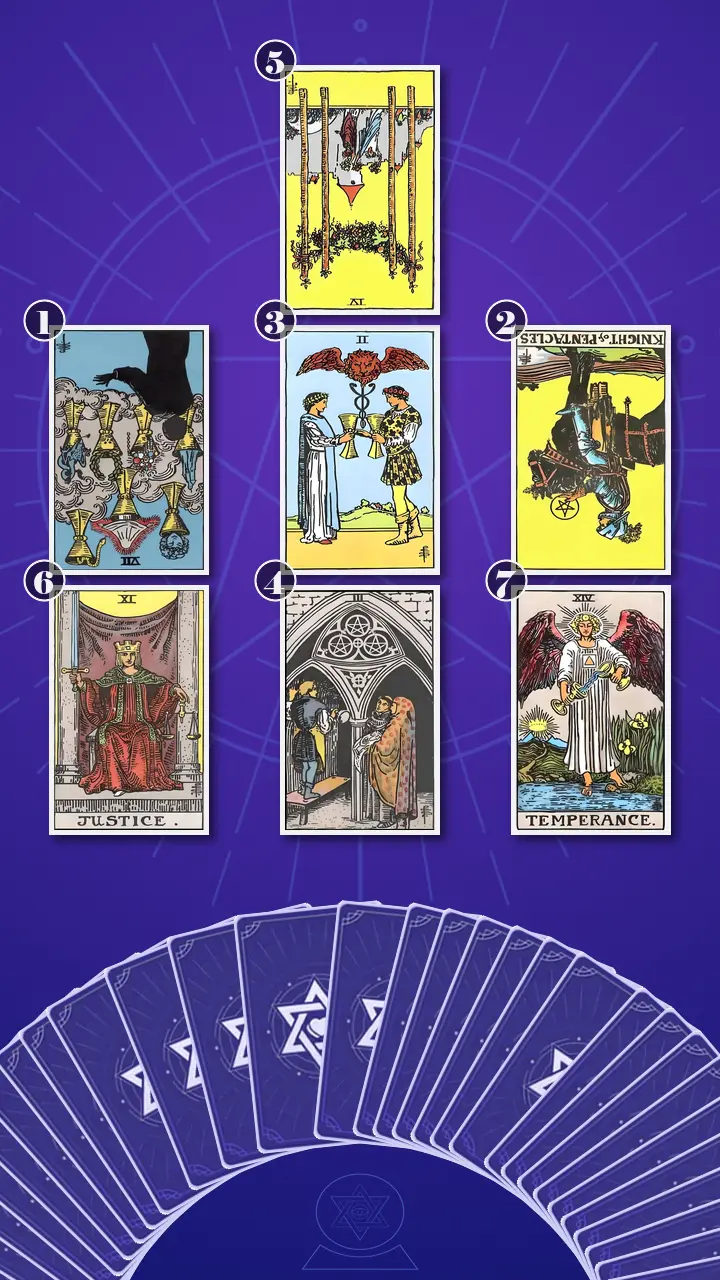
I asked Jordan to place their phone face down, take one slow breath, and hold a single question in mind: “Why does moving in keep exposing a gap between fantasy and readiness?” The shuffle was not a supernatural performance. It gave their attention somewhere to settle while the emotional noise softened enough for us to examine the pattern.
I chose a seven-card Relationship Spread for this cohabitation readiness reading. For anyone wondering how tarot works in my practice, I use the spread as a structured psychological mirror. It does not reveal a partner's secret motives or issue a fixed prediction. It separates parts of a complicated situation so that intuition can be tested against observable reality.
This was the smallest spread that could hold the full relationship dynamic without turning a focused moving-in question into a sprawling life forecast. The first two positions would distinguish Jordan's stance from their partner's observable contribution. The centre would show the bond beneath the proposed move. Above and below that bond, we would examine the main pressure and the collaborative resource. The final two cards would offer guidance and a possible path of integration.
I arranged the cards like a bridge: two people facing one another, the relationship between them, pressure above the central span, support beneath it, and two grounded steps completing the crossing. The shape mattered because Jordan was trying to leap from love directly into home. The spread would let us inspect what had to carry the weight in between.
The Dream Meets the Working Week
Position One: Seven of Cups Reversed and the Untouched Floor Plan
The card I turned for Jordan's current stance, expectations, and contribution to the pattern was the Seven of Cups, reversed.
Seven cups floated above a shadowed figure, each containing an alluring but incompatible possibility. In Jordan's life, those cups were easy to recognise: the Toronto neighbourhood with the good coffee shop, the financial relief of splitting rent, the perfect natural light, slow Sunday mornings, emotional security, matching shelves, and the hope that domestic life would feel effortless. They could choose the sofa, lighting, and mood, but the shared document closed as soon as it asked how rent, cleaning, sleep schedules, guests, and private workspace would function.
The reversed orientation showed an Excess of image-making meeting a Blockage in discernment. Imagination was not the enemy. The problem was using a vivid picture as evidence that one workable version had already been chosen. When ordinary friction appeared, Jordan overcorrected and demanded complete certainty, as if an imperfect plan must mean there should be no plan at all.
“When you close the document,” I asked, “which question are you protecting the dream from, and what are you afraid its answer might reveal?”
Jordan gave a small, bitter laugh instead of nodding. Their thumb pressed hard against the edge of the tea mug. “That is a little too accurate. Honestly, kind of brutal. I think I am afraid the answer will be, ‘We should wait,’ and that waiting will mean I misunderstood how secure we are.”
“That fear makes sense,” I said. “The card is not criticising you for wanting the home. It is showing the distance between admiring a future and handling the routines inside it. We do not have to collapse that distance tonight. We only have to make it visible.”
Position Two: The Knight of Pentacles Reversed and the Task With No Owner
Next, I turned the card examining the other person's observable consistency and practical follow-through. It was the Knight of Pentacles, reversed.
The horse was saddled, the pentacle carefully held, and the cultivated field ready for continued work, but nothing was moving. I kept the interpretation tied to behaviour rather than imagined motives. Jordan's partner had said moving in sounded right and had agreed that a budget was necessary. Yet the utility section remained blank, no review time had been booked, and no one had claimed ownership of recurring chores.
This was a Deficiency of grounded Pentacles energy: intention without a repeatable next step. It did not prove indifference, avoidance, or lack of love. It did show that verbal enthusiasm had not yet become reliable evidence. The practical risk was equally clear: Jordan might silently complete every unfinished task, become the household project manager before there was a household, and then interpret the resulting resentment as proof that cohabitation itself was unsafe.
“Over the last month,” I asked, “what did your partner actually complete, schedule, or revisit when a readiness task needed an owner?”
Jordan looked away from the cards. Their jaw shifted once before they answered. “They keep saying, ‘Of course we can figure it out.’ But I am the one who reopens the spreadsheet. Then I fill things in because I cannot stand watching it sit there.”
I told them the Knight was asking for evidence, not a prosecution. One unfinished spreadsheet was not a complete portrait of a person, but repeatedly stalled follow-through was still information. Jordan did not need to excuse it, catastrophise it, or rescue it before an agreed deadline. They could observe what happened when ownership was made explicit.
Position Three: Two of Cups and the Love That Was Already Real
The card I turned for the genuine emotional foundation beneath the moving-in fantasy was the Two of Cups, upright.
Two figures met at equal height and exchanged their cups freely. I saw Balance here: mutual recognition, reciprocal affection, and the experience of being emotionally chosen. Jordan described weekends when conversation came easily, moments when their partner noticed they were overstimulated before they had to explain, and a tenderness that did not feel invented.
The card mattered because it separated two questions Jordan had fused together. A relationship can contain real love and still have underdeveloped domestic systems. Practical uncertainty does not retroactively make affection false. At the same time, affection does not automatically answer questions about rent, chores, privacy, guests, or the mental load.
“Love can choose the address,” I said. “Agreements keep the week livable. Which part of your bond feels genuinely mutual, and which part of an exhausted working week have you simply not tested yet?”
Jordan's grip on the mug loosened. They named the emotional steadiness first, then admitted that most of their time together happened on planned weekends. They had rarely tested back-to-back design reviews, grocery runs after work, competing needs for quiet, laundry on the floor, or the moment when both people were too depleted to be generous.
Position Four: Three of Pentacles and the Unfinished Arch
The card I turned for the collaborative resource available within the relationship was the Three of Pentacles, upright.
A craftsperson stood beneath an unfinished stone arch while two collaborators consulted an architectural plan. This was practical Earth energy in Balance: visible contribution, complementary skills, feedback, and revision. In modern terms, it was Jordan and their partner opening the same Google Doc, comparing hybrid-work schedules, assigning one readiness task each, defining what “done” meant, and returning at an agreed time to review the result.
I framed the home as a joint design problem because that language belonged naturally to Jordan's world. They had been choosing the cover image for a project before confirming the requirements, owners, and test conditions. The Three of Pentacles offered a different thought: “We are not proving whether we are perfect; we are learning what this task requires from both of us.”
“If you opened one document together tonight,” I asked, “which single household issue could become a shared design problem instead of a referendum on your compatibility?”
Jordan's eyes returned to the spread. Their fingers tightened around the mug, paused, and then released it altogether. After a long exhale, they said, “Utilities. It is boring enough that I might not turn it into a statement about our entire future.”
That answer was small, which was exactly why it had value. The card was not promising that collaboration would happen automatically. It was identifying the capacity that could be tested. One person could bring utility estimates; the other could propose how payments would be tracked. An owner, a deadline, and permission to revise would reveal more than another hour of comparing listings.
Position Five: Four of Wands Reversed and the Housewarming Before the House
The card I turned for the central blockage was the Four of Wands, reversed.
The garland, raised bouquets, distant buildings, and promise of homecoming looked almost exactly like the fantasy Jordan had been protecting. I brought them back to a bright Toronto rental they had viewed on Saturday: keys in hand, two desks near the window, friends arriving for a soft-launch housewarming, winter boots finally sharing the same doorway. Then I placed one ordinary point of friction inside the picture. Their partner wanted guests to stay over spontaneously; Jordan needed predictable quiet before a Monday design review.
The reversed card showed an Excess of celebratory Fire placed on top of a Blockage in the structure beneath it. Signing a lease, sharing keys, or posting the move was being asked to manufacture security. When a small disagreement interrupted that image, Jordan's mind jumped to: “I thought moving in would make us feel secure, so why is this tiny question making me panic?”
“If the home has to prove the relationship, every chore starts to feel like a verdict,” I said.
Jordan's breathing became shallow. Their gaze drifted past the screen as if replaying the apartment viewing; then their eyebrows lifted with recognition and their shoulders dropped by a fraction. “That is what I do. We disagree about one guest, and five minutes later I am mentally cancelling the lease and wondering whether we are fundamentally incompatible.”
I asked what practical condition they would want to observe if signing a lease no longer had to prove that the relationship was secure. After a silence, Jordan said they wanted a protected quiet-work boundary that their partner could discuss without treating it as rejection. The answer was not glamorous, but it finally named the support hidden beneath the garland.
When Justice Made Readiness Visible
Position Six: Justice and the Shared Document That Stayed Open
The room changed as I reached the guidance position. Jordan's laptop fan stopped, leaving a clean pocket of silence; somewhere outside their window, a streetcar bell sounded once, sharp enough to echo the upright sword on the next card. I turned Justice, upright.
Justice held balanced scales at eye level and sat between symmetrical pillars. The card's energy was Balance through clear language, fair standards, reciprocal accountability, and consequences that both people could see. In Jordan's life, the scales became a shared Google Doc listing rent, utilities, cleaning, groceries, quiet workspace, guests, alone time, shared purchases, and conflict repair. The sword became one testable sentence: “Who owns this, what does done look like, and when do we revisit it?”
Justice was not a courtroom and I was not there to pronounce either person guilty or ready. A fair arrangement did not have to be perfectly fifty-fifty in every category. It did have to be visible, freely accepted, experienced as mutual, and supported by behaviour from both people.
This was where I used my Attachment Loop Diagnosis, a lens for mapping relationship friction without turning an attachment pattern into a permanent identity. I traced the sequence aloud. A practical question appeared. Jordan's attachment alarm translated it into, “A pause might mean my place in this relationship is less secure.” They protected themselves by returning to mood boards, asking friends for reassurance, taking over unfinished work, or questioning the entire move. The practical issue remained unresolved, so the next conversation arrived with even more pressure.
I was careful about the distinction. The available evidence did not justify labelling Jordan's partner as avoidant. Their stalled follow-through was real data, but a blank spreadsheet could not reveal a private motive. What I could identify was a belonging-sensitive insecurity loop interacting with inconsistent practical action. Justice kept those facts beside each other without allowing either projection or reassurance to erase what had actually happened.
“I hear the thought underneath this,” I told Jordan. “‘If I write this down, I might discover that we are not ready, or that I am asking for more than my partner wants to give.’ But if you never write it down, you are asking the address to decide for you.”
Jordan was still caught in the thought that there had to be one correct move-in decision, reached by feeling completely certain. The sofa, neighbourhood, and slow Sunday mornings looked vivid; the working week remained untested, and writing it down felt like inviting disappointment.
Stop treating a shared address as proof that everything will balance itself; name the responsibilities and limits now, and let Justice's scales show whether the arrangement is genuinely mutual.
I let the sentence sit between us.
For one beat, Jordan stopped breathing. Their right index finger froze above the trackpad, and their eyes widened before losing focus, as if several old conversations had begun replaying at once. Then their brow tightened and colour rose along their cheeks. “But doesn't that mean I have been doing all of this wrong?” they asked, the words sharper than anything they had said so far. I did not rush to flatten the anger into reassurance. I told them the fantasy had protected something tender: the fear that preparation might expose insecure belonging. Protection was not failure; it was simply no longer giving them useful information. Their eyes shone. Their clasped hands opened slowly, and their shoulders descended as a long, uneven breath left their chest. Relief arrived, followed by a brief, almost dizzy blankness. The clearer path also returned responsibility to them. “Oh,” they said quietly. “So I have to know what I need, not just whether we feel ready.”
I asked, “Now, with this new perspective, think back to last week. Was there a moment when this insight could have made the situation feel different?”
Jordan remembered the Sunday conversation about groceries during deadline-heavy weeks. They had heard their partner's uncertainty as evidence against the entire relationship and had said, “Maybe we should not move in at all.” With Justice on the table, they could see another possibility: stay with the grocery question, ask who would own what, and notice whether the answer was mutual without forcing that one routine to judge the bond.
A shared address can reveal closeness, but it cannot manufacture readiness. Readiness becomes visible when both people can name the work, accept fair limits, complete what they own, and revise the arrangement after an ordinary week. For Jordan, that was the first step from using a shared address as proof of closeness and waiting for complete certainty to trusting fair, revisable evidence gathered through shared problem-solving.
Position Seven: Temperance and the Domestic Beta Test
The final card I turned represented the integrative direction available if the current dynamic was engaged consciously. It was Temperance, upright.
The figure poured water continuously between two cups, with one foot on solid land and the other in water. The energy was Balance through pacing, feedback, and adjustment. The aim was not for one person's rhythm to erase the other's. Jordan could need quiet while their partner wanted connection; both needs could belong in the same discussion, provided the arrangement remained reciprocal and revisable.
I translated Temperance into Jordan's product language: a paced domestic beta test, not a dramatic full launch. Several ordinary weeknights could reveal how work fatigue, solitude, groceries, sleep, and a household reset actually felt. One frustrating evening would be information about a routine, not proof that the relationship had failed. One easy evening would not solve every future problem either.
“You do not need a perfect plan,” I said. “You need a plan both people can actually see and change.”
Jordan hesitated. “Three nights sounds like a lot. I have a release sprint next week, and that is exactly when I get weird about interruptions.”
“Then start with one evening and breakfast,” I replied. “Temperance is not impressed by the size of the experiment. It asks whether the pace lets both people participate honestly. You can stop, revise, or decide to pause. That is still clarity.”
Jordan nodded slowly. The potential shown by Temperance was not a guaranteed move or a guaranteed happy ending. It was the possibility of treating affection, privacy, practical responsibility, and different rhythms as variables that could be observed together, rather than forcing them into one final feeling of certainty.
Fairness Before Furniture
Looking across the full spread, I could see one coherent story. Jordan had been furnishing the imagined flat before checking its floor plan. The Seven of Cups reversed showed the future image carrying more detail than the working week. The reversed Knight of Pentacles showed that practical follow-through from their partner was not yet consistent enough to support reassurance. The Two of Cups protected an important truth: the affection itself could still be genuine. The Three of Pentacles showed that shared work was the bridge Jordan kept trying to skip, while the reversed Four of Wands revealed why every gap felt so dangerous. The home milestone had been asked to confirm belonging before its daily supports had been built. Justice made the requirements visible, and Temperance allowed the couple to test them without turning the experiment into a verdict.
The cognitive blind spot was simple but costly: Jordan had been treating the discomfort of preparation as evidence that something was wrong with the relationship. In reality, money, chores, quiet time, guests, and conflict repair were not interruptions to readiness. They were where readiness became observable.
The transformation direction was equally clear. Jordan did not need to move from uncertainty to perfect confidence. They needed to move from milestone-as-proof to one explicit, reciprocal agreement at a time. Grounded readiness and a clear decision to pause were both valid outcomes. The purpose of the next steps was to gather fair evidence, not to force a lease.
Before we ended, I adapted my Projection Detachment Exercise for the conversations ahead. This Jungian journaling practice separates a partner's actual behaviour from the story activated by an old fear. It does not dismiss intuition. It prevents the psyche from using a blank space as a projection screen and then mistaking the projected image for confirmed reality.
- The Projection Detachment and One-Topic Justice CheckBefore speaking with a partner, take five minutes alone and write three lines: the observable fact without adjectives, the triggered internal narrative, and one testable request. For example: “The utility section was blank by our agreed date. My mind says I will carry the whole household and a pause means our bond is fragile. My request is that you add your estimate by Thursday and review it with me Friday.” Then schedule one 25-minute conversation this week about only rent and utilities, chores, privacy, guests, or conflict repair. In one shared document, use the columns “What I expect” and “What we are agreeing to test.” Finish with one observable agreement, one owner, and one review date.Start with the least emotionally loaded topic and use a timer so the conversation has a clear exit. If either person feels pressured or overwhelmed, pause and reschedule. Discomfort is information, not a command to sign the lease or abandon the relationship.
- The Temperance-Paced Domestic Beta TestBefore setting a final move-in date, rehearse three ordinary weeknights together: one workday, one evening with separate plans, and one shared household reset. After each trial, both people privately note what felt easy, what created friction, and what agreement might make the next attempt more workable. After the third night, hold one 15-minute review and change only one routine, such as quiet hours, groceries, guests, or bedtime expectations.Call it an experiment, not a pass-or-fail audition. If three nights feel too intense, begin with one evening and a shared breakfast. The smallest honest sample is more useful than a grand plan neither person can sustain.

A Week Later, the Document Stayed Open
Six days later, I received a message from Jordan. They and their partner had chosen utilities because it felt boring enough to survive without becoming symbolic. The conversation lasted twenty-two minutes. Jordan wrote their expectation before speaking, and their partner completed a utility estimate instead of offering another general promise. They recorded an owner and booked a review for the following Friday.
They had not signed a lease. One disagreement about quiet hours was still unresolved, and the numbers suggested they might need to reconsider the August target. The difference was that Jordan had not rushed to fill every blank or asked three friends to interpret the delay. They had left the question where it belonged: between the two people considering the home.
Jordan slept through the night. Their first thought in the morning was still, “What if we are wrong?” This time, they smiled, opened the document, and checked the review date.
I did not read that message as proof that tarot had fixed the relationship. The cards had made a hidden sequence visible; Jordan chose to interrupt it, and their partner's response became real evidence. That was the Journey to Clarity: not certainty delivered from outside, but a move from protecting the dream to trusting their capacity to examine the life inside it.
When a question about rent, dishes, guests, or alone time tightens your chest because ordinary friction might expose a fragile place in the relationship, I know it can feel safer to protect the beautiful apartment in your mind than to test the Tuesday living inside it. Simply noticing that the dream has been carrying the burden of proof means you are no longer standing at the beginning.
If the home did not have to prove how much you belong to each other, what is one small Tuesday agreement you might let yourself test, at your own pace, before asking the address to answer for you?
This story is adapted from psychological research, written so that those in a similar struggle can see their own pattern in it — and find their next step clearly.These insights are not a substitute for professional psychological, medical, legal, or financial advice.
Learn more about our Journey to Clarity.
How did this insight land for you?
🫂 This Resonates Deeply
🌀 Living This Story
✨ Now I See Clearly
🌱 Seeing New Possibilities
🧰 Useful Framework
🔮 The Confirmation I Needed
💪 Feeling Empowered
🚀 Ready for My Next Step
Author Profile
 AI
AI“Having traveled across cultures... I've learned that what we often lack isn't a simple answer, but a moment of being truly understood. I use a Jungian psychological lens to help you deconstruct your subconscious patterns—not to prove anything, but to be the gentle companion who helps you unravel your knots, free of judgment, so you can reconnect with your inner wisdom.”
In this Love Tarot Reading :
Core Expertise
- Attachment Loop Diagnosis: Logically decoding whether your relationship friction is driven by an anxious-avoidant trap or deep-seated insecurity.
- Shadow Projection Analysis: Identifying the unacknowledged fears or unmet childhood needs you are unconsciously projecting onto your partner.
Service Features
- The Projection Detachment Exercise: A structured psychological journaling prompt to separate your partner's actual behavior from your triggered internal narrative.
Also specializes in :
Explore Related Patterns:
Anxious AttachmentJordan hears the possibility of waiting as a sign that they may have misunderstood how secure the relationship is. When chores or groceries remain uncertain, the response expands beyond planning into reassurance from friends, taking over tasks, or questioning the whole move. When you experience practical ambiguity as a threat to belonging, you may try to restore security before establishing what the other person will actually do. Anxious Attachment describes this loop without turning it into a permanent identity. The shared address becomes a route to reassurance, while every delay in reaching it feels more relationally charged than the observable facts alone justify.
Boundary DiscernmentJordan identifies a need for predictable quiet before design reviews while acknowledging that their partner may want connection or spontaneous guests. They also leave the partner's utility task with the partner instead of automatically completing it. Boundary Discernment allows you to distinguish a personal need from a rejection of the other person, and shared responsibility from responsibility you have silently absorbed. The goal is not rigid separation. It is enough differentiation for both preferences and both contributions to remain visible, which makes mutual readiness easier to assess.
Certainty SeekingJordan keeps searching for one correct move-in decision that should arrive with complete emotional certainty, even though the ordinary working week has not been tested. Writing down requirements feels dangerous because clearer information could produce a pause rather than the desired lease. When you require certainty before gathering evidence, uncertainty stops being a normal condition of decision-making and becomes a reason to delay the very actions that could reduce it. Certainty Seeking keeps Jordan oscillating between a vivid future and global doubt because no untested relationship can provide the absolute assurance being demanded.
Emotional ReasoningJordan feels apprehension when the conversation reaches guests, groceries, and quiet time, then treats that apprehension as evidence that the relationship itself may be wrong. The physical intensity of the moment gives a routine disagreement the authority of a compatibility verdict. When you use the strength of a feeling to judge the truth of a conclusion, discomfort can erase the distinction between emotional activation and practical evidence. Emotional Reasoning makes preparation appear threatening because feeling unsettled is interpreted as proof of unreadiness, even though the unsettled feeling may simply mark an important conversation that has not happened yet.
Milestone IdealizationJordan imagines shared keys, matching desks, winter boots in one doorway, and friends arriving for a housewarming before the couple has settled groceries, guests, quiet hours, or recurring chores. The move is carrying more than a housing decision because Jordan wants the address to confirm closeness and make belonging feel secure. When you ask a milestone to prove the relationship, every practical gap can feel like a threat to the milestone's meaning. Milestone Idealization turns signing the lease into emotional evidence that daily life has not yet supplied. The fantasy-readiness gap persists because the symbolic achievement is expected to create the security that only reciprocal behaviour can demonstrate.
Reality TestingJordan writes the observable fact, the activated story, and one testable request as three separate lines. The utility estimate, named owner, and review date then produce information that a general promise or imagined motive could not provide. When you practise Reality Testing, neither optimism nor fear gets to decide the case alone. You compare interpretation with behaviour under ordinary conditions and remain willing to revise the conclusion. Readiness becomes visible through completed tasks, respected limits, and repeatable follow-through rather than through the intensity of the apartment fantasy.
Reflective DistanceA week later, Jordan still wakes with the thought, “What if we are wrong?” but opens the document and checks the review date instead of mentally retrying the entire relationship decision. Earlier, they also learn to treat one frustrating evening as information about a routine rather than proof of failure. Reflective Distance does not require you to eliminate uncertainty before acting. It lets you notice a thought, recognise the fear it carries, and choose whether the thought deserves behavioural authority. That space interrupts the old loop between activation and global judgment, allowing Jordan to return to the next agreed source of evidence.
Perfectionism-Driven AvoidanceJordan closes the document precisely when the plan becomes incomplete, negotiable, and capable of producing an uncomfortable answer. The internal standard is not simply to prepare well; it is to reach a plan that feels fully reassuring before continuing. When you treat imperfection as evidence that the whole plan may be wrong, avoidance protects you from discovering limits but also prevents readiness from becoming measurable. Perfectionism-Driven Avoidance is operating here because the demand for a flawless answer blocks the ordinary conversations through which a workable answer would actually be built.
ProjectionThe blank utility section becomes a story that Jordan will carry the entire household, while uncertainty about groceries becomes evidence that the bond may be fragile. Those conclusions contain possible concerns, but they go beyond what the unfinished document can establish on its own. When evidence is missing, projection can place an activated internal narrative into the blank space and make that narrative feel externally confirmed. You regain clarity by separating what the partner actually completed from what the delay made you fear. That distinction preserves intuition while preventing an old belonging concern from impersonating present-day evidence.
Timing DiscernmentThe numbers suggest that Jordan and their partner may need to reconsider the August target, and the proposed domestic test can shrink from three nights to one evening and breakfast. Neither adjustment is treated as proof that the relationship lacks love. Timing Discernment lets you choose a pace according to participation, capacity, and observable evidence rather than using speed as a measure of commitment. You can move forward, revise the experiment, or pause without asking delay to carry a rejection narrative. The timeline becomes part of the evidence-gathering process instead of a test of belonging.
CatastrophizingOne disagreement about a guest becomes mental lease cancellation, and one uncertain grocery conversation produces, “Maybe we should not move in at all.” The mind moves from a bounded household problem to the largest possible relational conclusion before the original task has an owner or test. When you catastrophize, escalation creates the feeling that you must solve the entire future immediately. That urgency prevents you from staying with the smaller question long enough to learn whether it is negotiable. Here, Catastrophizing repeatedly transforms ordinary cohabitation friction into a forecast of incompatibility, making each unresolved detail heavier the next time it appears.
Defensive OverfunctioningJordan repeatedly reopens the spreadsheet and fills unfinished sections because watching them remain blank feels intolerable. That action gets the document moving, but it also prevents the partner's follow-through from being observed under clear ownership and a real deadline. When you overfunction defensively, taking control reduces uncertainty in the short term while quietly increasing your workload and resentment. Defensive Overfunctioning explains how Jordan can become the household project manager before the household exists. The coping strategy produces activity, but it removes the reciprocal evidence Jordan most needs in order to judge readiness.
Secure VulnerabilityJordan names the need for protected quiet and leaves the shared document open even though clearer answers could reveal that the August move should be delayed. The utility conversation succeeds, while the quiet-hours disagreement remains unresolved without becoming an immediate breakup or lease verdict. When you practise Secure Vulnerability, you allow a real need to be visible without controlling the other person's response or guaranteeing the outcome in advance. The risk is that honest evidence may change the plan. The gain is that closeness no longer depends on hiding the very limits and preferences that a shared home would eventually expose.
Explore Related Struggles:
Clarity-Exposure SplitJordan opens the planning document, reaches the sections on money, chores, guests, quiet, and private space, and closes it again. They later name what the document might reveal: perhaps the couple should wait, and perhaps waiting would change what the relationship's security seems to mean. The same information that could guide the decision also exposes the possibility of disappointment, unequal effort, or a boundary the imagined home cannot absorb. You are pulled toward clarity because you need evidence and away from it because the answer may interrupt a future that already feels emotionally real. Keeping one bounded question open lets clarity become information rather than a verdict. You can learn whether a specific agreement is workable without requiring that discovery to define the entire bond.
Milestone-Foundation SplitJordan wants the shared address to confirm the relationship's closeness before the couple has established ownership of utilities, chores, quiet hours, guests, or conflict repair. Keys, desks by the window, and the imagined housewarming are carrying symbolic weight that the unfinished household structure cannot yet support. When the milestone must certify belonging, each practical disagreement becomes more than a practical disagreement. You have to assess whether a routine works while simultaneously defending what the entire move is supposed to say about the relationship. A foundation can be incomplete without making the affection false. Separating those layers allows the lease to follow demonstrated agreements rather than being asked to create the security those agreements have not yet shown.
Perfect Readiness TrapJordan keeps searching for one correct move-in decision reached through complete certainty. An imperfect plan can quickly become a reason to abandon the plan, while writing down a condition feels dangerous because it may reveal that the couple is not ready yet. Readiness for a shared home cannot be fully felt in advance because the decisive evidence lives inside ordinary routines that have not happened. You become locked between needing certainty before testing the arrangement and needing to test the arrangement before certainty can have any factual basis. A small, reversible trial changes the role of uncertainty. It lets you ask whether both people can participate, adjust, and keep an agreement without demanding that one evening produce a final answer about the entire future.
Unspoken Expectation LoadJordan says love should make the logistics obvious, yet the shared document closes around rent, cleaning, groceries, guests, quiet hours, and alone time. The relationship is therefore carrying expectations that neither person has fully converted into visible agreements. When care is expected to generate the same household assumptions in two different people, every necessary conversation can feel like evidence that something is missing. You are left trying to infer what should happen while also wondering whether the need to ask has already weakened the meaning of the move. Naming an expectation does not make the bond less intuitive. It gives both people a fair chance to accept it, revise it, or show through action whether it can become part of a workable home.
All-or-Nothing BelongingJordan hears uncertainty about groceries and responds with the possibility that they should not move in at all. A disagreement about one overnight guest becomes mental lease cancellation and a question about whether the couple is fundamentally incompatible. A bounded household issue is being forced to answer an unbounded belonging question. You lose the middle ground where two people can love each other, disagree about a routine, revise a target date, or discover that one arrangement is unworkable without turning that result into a judgment on the whole relationship. Keeping the grocery question at the level of groceries protects both clarity and connection. It lets each piece of evidence inform the decision at its actual size, so a pause can remain a pacing choice rather than proof that you misunderstood the bond.
Reciprocity DeficitJordan's partner says they can figure the move out, but the utility section stays blank, no review is booked, and recurring chores have no owner. Jordan then reopens the spreadsheet and fills the gaps, turning a task meant to test shared contribution into another task completed alone. You can receive genuine affection while still lacking reciprocal practical effort. The friction comes from having to decide whether verbal enthusiasm should count as readiness when your own labour is supplying most of the evidence. Leaving a clearly assigned task with the other person makes mutuality observable. It allows you to evaluate contribution without prosecuting, rescuing, or treating affection as a substitute for follow-through.
Explore Related Emotions:
Cautious ReadinessThe utilities conversation lasts twenty-two minutes and ends with an estimate, an owner, and a review date. You have not signed a lease, quiet hours remain unresolved, and the August target may need to change, but the document stays open. Cautious Readiness feels provisional because it grows from repeatable participation rather than a dramatic inner yes. You can move, revise, or pause as new evidence arrives, allowing readiness to become a lived capacity instead of a promise that no friction will occur.
Conditional Belonging FearWhen waiting to move begins to sound like proof that you misunderstood how secure the relationship is, the lease stops being only a housing decision. Every blank section and unresolved routine starts testing whether you are fully chosen. Conditional Belonging Fear makes closeness feel dependent on reaching the milestone without interruption. Naming that fear separates your need to belong from the timing of the move, leaving room for preparation or a pause without automatically turning either into rejection.
Evidence AnxietyYou can place the virtual sofa beside the bright window and scroll through listings for forty minutes, yet the shared document closes as soon as rent, cleaning, guests, quiet hours, and alone time appear. Your body braces because those practical details could produce an answer that the imagined apartment has allowed you to postpone. Evidence Anxiety takes hold when information feels less like guidance and more like a possible verdict on the relationship. Keeping the document open lets observable facts inform your choice without requiring any single fact to decide whether the love is real.
Hollow FantasyThe natural light, matching shelves, slow Sundays, and soft-launch housewarming are vivid enough to feel almost inhabited, but Tuesday has no groceries plan, quiet-hours agreement, or task owner. The future image contains atmosphere without yet containing a workable week. Hollow Fantasy appears when the beautiful picture is asked to prove security that only lived reciprocity can support. Seeing the gap does not invalidate your desire for the home; it frees the image to inspire you without using it as substitute evidence.
Mutuality HungerYour partner says moving in sounds right, but the review is unscheduled, the utility section is blank, and you are the one who keeps returning to the document. Verbal agreement offers closeness without yet showing how the work will move between two people. Mutuality Hunger is the longing to feel that the future is being built with you rather than merely approved by someone else. A completed estimate, an accepted owner, or a respected limit gives that longing observable substance while preserving your freedom to evaluate what follows.
Relational Catastrophe DreadOne disagreement about an overnight guest becomes a cancelled lease in your mind, and uncertainty about groceries turns into a question about whether the relationship can work at all. The practical issue disappears beneath the speed and scale of the conclusion. Relational Catastrophe Dread makes ordinary friction feel capable of exposing a total incompatibility that was waiting underneath. Staying with the specific guest or grocery question allows you to assess that routine on its own evidence instead of forcing it to judge the entire bond.
Certainty HungerJordan keeps searching for one correct move-in decision that should feel completely certain before the working week has been tested. The sofa and neighbourhood are easy to choose because they offer a finished image, while revisable agreements leave the future visibly open. Certainty Hunger asks for emotional finality before practical evidence can exist. You regain room to choose when readiness is allowed to mean enough reciprocal information for the next step, rather than the permanent disappearance of doubt.
Invisible Labor DreadThe utilities section stays blank, your partner says it can be figured out, and you reopen the spreadsheet because watching it remain unfinished is unbearable. Each rescue places you one step closer to becoming the person who notices, assigns, tracks, and completes the household work. Invisible Labor Dread is the felt weight of a future in which partnership quietly turns into project management. Explicit ownership gives you a way to observe whether responsibility can remain shared before you take on work that was never mutually agreed.
Reciprocal WarmthYour partner notices when you are overstimulated before you have to explain, weekend conversations move easily, and the tenderness does not feel invented. These moments provide direct evidence that affection and emotional recognition already pass between you. Reciprocal Warmth allows the love to remain real without demanding that it solve rent, chores, privacy, or mental load. Holding that warmth separately protects the bond from being erased by unfinished logistics while leaving those logistics fully available for honest review.
Cautious Self-TrustYour first morning thought still asks whether the two of you might be wrong, but you smile, open the document, and check the review date. You also leave unresolved questions between both partners instead of filling every blank or asking friends to interpret the delay. Cautious Self-Trust does not require confidence that the move will work. It rests in your capacity to know what you need, request observable participation, and change course when the evidence calls for it.
Clarity ReliefYour clasped hands open and your shoulders descend when one grocery question no longer has to determine whether the whole relationship is viable. Later, a utility estimate, an owner, and a review date give the uncertainty somewhere concrete to rest. Clarity Relief comes from reducing the scale of what each conversation must answer. You still do not know whether the lease will be signed, but you no longer have to manufacture immediate certainty because the next piece of evidence has a visible place and time.
Clarity ShockYour finger freezes above the trackpad when the shared address is separated from proof of security. Anger rises, old conversations replay, and a brief blankness follows because the interpretation exposes several previously fused questions at once. Clarity Shock arrives when a hidden sequence becomes visible faster than your self-understanding can reorganise around it. The impact carries useful information because it reveals where the move had been answering for belonging, responsibility, and choice, all of which you can now examine separately.
Explore Related Contexts:
Planning Labor ImbalanceJordan's partner repeatedly says, "Of course we can figure it out," while the utility section remains blank, no review time is booked, and no one claims the recurring chores. Jordan then reopens the spreadsheet and fills the gaps because leaving them unfinished has become difficult to tolerate. That sequence assigns Jordan the monitoring, prompting, documenting, and completion work before the household even exists. For you, the readiness gap becomes concrete when one person's reassurance depends on the other person supplying the entire planning infrastructure; the unequal workload is observable in who notices, follows up, and finishes each task.
Premature Cohabitation PressureJordan spends forty minutes saving listings and can position the sofa, desks, and housewarming inside a bright Toronto rental, yet closes the shared document when it reaches rent, cleaning, guests, quiet hours, and alone time. The imagined address is advancing faster than the ordinary systems that would have to support it. The move has therefore acquired responsibilities beyond housing: it is being asked to confirm closeness and settle uncertainty before domestic roles are defined. You face Premature Cohabitation Pressure when the milestone starts setting the pace even though the working week has not supplied enough practical evidence to carry that commitment.
Readiness Mismatch CycleOver the previous month, Jordan's partner agreed that moving in sounded right and that a budget was necessary, but did not complete the utility section, schedule a review, or claim recurring chores. Each general promise allowed the move to remain verbally active while its practical foundation stayed incomplete. This produces a repeating mismatch between declared commitment and demonstrated readiness. You are left evaluating two valid but unequal forms of evidence: enthusiasm about the future and observable participation in the work required to build it. The cycle persists whenever another promise temporarily carries the decision forward without resolving the stalled task underneath it.
Unspoken Expectations GapThe shared document contains sections for rent, cleaning, guests, quiet hours, and alone time, but those sections repeatedly remain unresolved. A specific collision is already visible: Jordan needs predictable quiet before a Monday design review, while their partner wants the freedom to host overnight guests spontaneously. Without agreed ownership and boundaries, each person can enter the proposed home with a different operating model while believing the arrangement should be obvious. You encounter the gap through ordinary questions that have no shared rule yet, so groceries or one guest can suddenly become a referendum on the entire relationship rather than a bounded household negotiation.
Domestic Exposure PressureJordan and their partner have mainly shared planned weekends; they have rarely tested back-to-back design reviews, groceries after work, competing needs for quiet, laundry on the floor, or evenings when both people have little capacity left. The proposed apartment would place all of those demands inside the same limited space and schedule. Cohabitation would therefore expose forms of coordination that affection during curated time cannot demonstrate. For you, the pressure comes from making work rhythms, privacy, guest access, household maintenance, and depleted capacity continuously visible to both people, with fewer natural exits from unresolved friction.