Deleting the Draft, Naming the Need: From Self-Silencing to Asking

The 11:40 p.m. Voice Note
If you can ask a room of research participants thoughtful follow-up questions all day but answer “good” when a friend asks how you are after work, you may recognise the emotional labour in friendships that nobody sees. Alex, a 27-year-old junior UX researcher in Toronto, recognised it immediately.
At 11:40 p.m., on the edge of their bed, Alex listened to a friend's seven-minute voice note through the phone speaker. The warm screen was the only light in the room. The radiator clicked behind them, and the blanket felt rough beneath their legs as they drafted two sentences about their own difficult day. Their throat tightened. They deleted both sentences and typed, “Anyway, are you feeling any better now?”
“I know how to make space for everyone except myself,” Alex told me during our session. “I want people to know me, obviously. But I don't want to turn a normal conversation into a whole thing.”
I heard the central contradiction before I touched the deck: Alex wanted reciprocal closeness and room to be heard, yet opening up threatened the secure role in which they were calm, useful, and difficult to reject. Their loneliness had the physical shape of standing behind soundproof glass in a crowded group chat: every notification lit up, everyone was technically present, and still no one could hear what was happening on Alex's side.
I watched them swallow as they added, “People think I'm private, but half the time I'm editing myself in real time.”
“You are not impossible to know,” I said. “You have become very good at editing yourself. That skill probably protected something important, so we are not going to attack it. We are going to notice when it serves you and when it quietly removes you from the friendship.”
I let that distinction settle before continuing. “Listening is a gift. It should not be the only way you are allowed to belong. Let's use the cards to draw a map of this pattern, then find one opening that does not require you to disclose more than you choose.”

Choosing the Cross at the Locked Intersection
I invited Alex to place both feet on the floor, take one unforced breath, and hold the question in plain language: “Why am I always the friend who listens but never opens up?” I shuffled slowly, using the movement as a transition from rehearsing answers to observing the pattern.
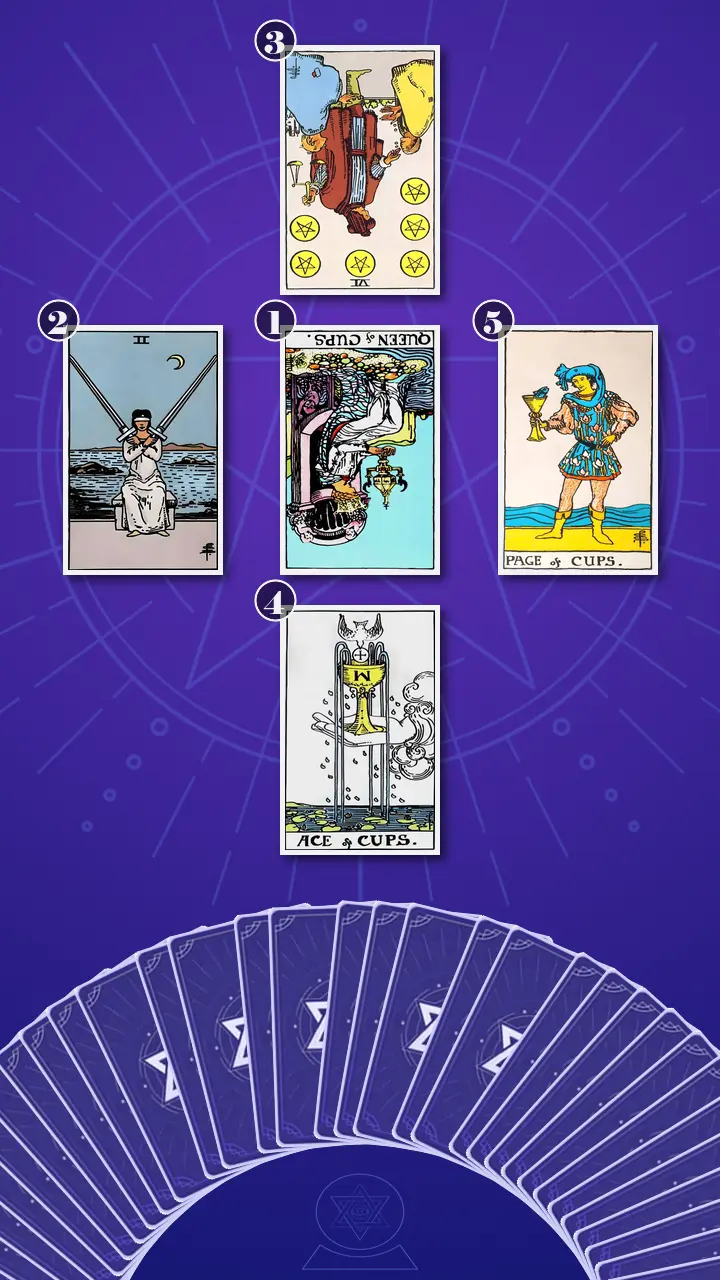
I chose The Shadow Spread · Context Edition, a five-card spread arranged as a cross. I use this form when a repeated relationship problem is asking for self-understanding rather than a prediction about what another person will do.
For anyone wondering how tarot works in a reading like this, the spread gives us an external surface on which to examine a sequence. It does not diagnose Alex, expose secret motives, or guarantee that every friend will respond well. It helps separate five things that can otherwise blur together: the visible habit, the fear beneath it, the behaviour that maintains it, the resource hidden inside it, and a conscious next step.
The first card would sit at the centre and reveal Alex's presenting shadow: the exact habit of offering sustained emotional attention while concealing their own feelings. The card to the left would identify the root belief that makes openness feel dangerous. Above the centre, a third card would show how self-protection becomes an unequal exchange. Below it, a fourth would reveal the unmet need and usable capacity beneath the silence. The final card, placed to the right, would offer an exit through action.
Seen together, the cards would resemble a locked intersection with a possible route opening to the right. That structure mattered. Alex did not need a verdict about whether they were “too closed off.” They needed to see where choice disappeared from the conversational sequence and where it could return.
Reading the Sealed, Guarded, Uneven Map
Position One: The Sealed Cup
I turned the card representing the presenting shadow in Alex's concrete habit of caring for others while concealing their own feelings. It was the Queen of Cups, reversed.
In the Rider-Waite-Smith image, the Queen sits at the water's edge, studying an ornate cup held between both hands. The cup is elaborate, emotionally meaningful, and enclosed. Reversed, it mirrored Alex's 11:40 p.m. routine with uncomfortable precision: they could hear the smallest change in a friend's voice, remember every detail, and compose a warm, exact response while their own difficult experience remained sealed in the draft box.
I described the energy as an excess of emotional attention directed outward and a deficiency of receptivity directed inward. Alex did not lack emotional intelligence. Their sensitivity had become so specialised around other people's needs that it could function as a hiding place. The moment listening stopped being a free choice and became the price of belonging, compassion tipped toward self-erasure.
“This is the Fleabag reflex without the camera,” I said. “Something real nearly reaches the surface, then a joke or a clever redirect creates distance before anyone can stay with it.”
I also named what I call Somatic Shadow Sensing. Before Alex's mind produced the polished line “I'm fine,” their body had already registered the unsaid feeling. The throat became a gate. The jaw acted like a brace. The shoulders lifted as though they were trying to hold the conversation safely above the heart. Those sensations were not proof that disclosure was wrong. They were early signals that attention had turned inward and the familiar defence was preparing to redirect it.
“When a friend finishes sharing and asks how you are,” I asked, “what happens in the next ten seconds?”
Alex gave one short, bitter laugh and looked down at the card. “That is so accurate it feels a bit brutal. I say I'm fine, make a joke, and ask another question. Every time.”
I let the reaction have room. “Accuracy is not an indictment. The Queen is not saying your care is fake. She is showing where care stops being a choice and becomes a way to disappear. Once we can see that threshold, you can decide whether you want to cross it.”
Position Two: The Message That Had to Pass Every Test
I turned the card representing the core fear and limiting belief that made openness feel more dangerous than remaining useful. It was the Two of Swords, upright.
The blindfolded figure held two blades crossed directly over the chest, while moonlit water waited behind her. I saw Alex's Notes app in that image. At 8:23 p.m. after work, they might draft five versions of “I had a hard day,” compare each one for possible failure, and delete them all because no version could guarantee a safe response.
The inner sequence sounded like this: “If I say it this way, they might think I'm too much. If I say it that way, I might change the mood. If I cannot predict how they will respond, I should say nothing.”
This was defensive Air in blockage. Thought, which could have clarified what Alex wanted, had been recruited to guard the heart. An ordinary two-sentence text became a product launch requiring every possible user reaction to be tested before release. Yet a friendship conversation is not a controlled UX environment. The response data does not exist until something real enters the exchange.
I asked Alex to notice the contradiction without forcing it away. They wanted to be known, but they had created a private rule that disclosure must already be safe before it could begin. No relationship can provide that guarantee in advance.
Alex's fingertips stopped rubbing the edge of their sleeve. Their eyes drifted from the crossed swords to the dark window behind their screen, as though they were replaying several deleted messages at once. Then their shoulders dropped by a fraction.
“I call it being careful,” they said quietly. “But I think I am running a full risk assessment on saying one normal thing.”
“Yes,” I said. “Carefulness protects privacy when you choose it. This version keeps postponing the very closeness you want. The question is not whether you should lower both swords for everyone. It is whether you could lower one of them for one small conversation with someone who has already shown care.”
Position Three: The Emotional Help Desk With No Return Route
I turned the card representing the observable protection strategy through which Alex redirected attention and maintained a one-way emotional exchange. It was the Six of Pentacles, reversed.
The traditional image shows a standing figure distributing coins while holding scales above two kneeling people. Reversed, it made the structure of Alex's emotional labour visible. On a Thursday evening, Alex could spend an hour listening to a friend's crisis, validating every feeling and helping to make a plan. When the friend eventually asked how Alex had been, Alex would say “all good” and ask one more question about the crisis.
The imbalance was not proof that the friend refused to care. It showed an exchange in which support flowed outward because Alex made the return route difficult to find. An hour of attention went one way; a request for ten minutes of listening was deleted before it could go the other.
I described this as Earth energy in imbalance. Usefulness had given Alex a stable position in the friendship, but that stability came with hidden control. By giving while restricting receiving, Alex avoided the uncertainty of needing someone. The short-term reward was safety and competence. The longer-term result was a heavy chest after the call, quiet resentment, and guilt for keeping a score no one else knew existed.
“A friendship cannot respond to a need it has never been allowed to see,” I said. “That does not mean friends are excused from checking in, and it does not mean every friend will be capable of reciprocity. It means their willingness cannot be tested by a need that remains disguised as a joke or deleted draft.”
Alex pressed their lips together, then released them. “So I keep waiting for people to notice. But I also make sure there is almost nothing to notice.”
“That is the blind spot,” I said. “Not because you caused every imbalance, but because invisibility has felt safer than receiving an uncertain answer. The cards are showing the part of the exchange that is actually within your agency.”
Position Four: One Window in the Stuffy Room
I turned the card representing the unmet need for emotional receptivity and the inner capacity that could loosen Alex's self-silencing. It was the Ace of Cups, upright.
An open hand supported a cup without gripping it, and five streams of water poured into the pool below. I thought of a Highland stream after winter: water can look absent while it is frozen, but the current has not been destroyed. It is waiting for enough warmth and space to move.
The Ace did not predict rescue, a perfect friendship, or a sudden emotional breakthrough. It revealed Alex's existing ability to receive their own experience before editing it for someone else's comfort. In ordinary life, that might happen on a Sunday afternoon when they pause before saying “fine,” rest one hand on the kitchen counter, notice the hollow place in their chest, and name the feeling as lonely rather than merely tired.
The five streams suggested different volumes of openness: naming what happened, naming a feeling, asking for listening, asking for advice, or asking for company. Alex did not need to open all five. One stream was enough.
I described the Ace as Water moving toward balance. Where the reversed Queen held the cup sealed, the Ace allowed support without a demand for total control. It was like opening one window in a stuffy apartment rather than knocking down the wall.
“You do not need a perfect disclosure; you need one honest sentence,” I said. “The sentence does not have to contain the whole backstory, and sharing it does not cancel your right to privacy. The inner permission is simply: I do not have to pour everything out; I can let one thing move.”
Alex inhaled, paused, and released a longer breath than any I had heard from them during the session. Their hand flattened on their thigh, no longer gripping the fabric. “One thing sounds possible,” they said. “Everything sounds impossible. But one thing, maybe.”
When the Page Let the Feeling Speak
Position Five: The Beginner's Cup
The radiator clicked once and fell quiet as I moved to the card on the right, representing integration through one named feeling, one manageable request, and one response Alex would not control in advance. This was the bridge card and the heart of the reading: the Page of Cups, upright.
The Page looked directly at a fish rising unexpectedly from his cup. He did not have a prepared explanation for it. He did not hide it because its arrival was awkward or poorly timed. He met it with curiosity.
In Alex's life, the Page could be a short message to a trusted friend: “This week felt heavier than I expected. I feel lonely and a little wrung out. Do you have ten minutes to listen tonight, or would tomorrow be easier?” The message would not explain everything or demand a perfect response. It would simply give the friendship something real to meet.
I described the Page as upright Water finding a communicative form. This was not an excess of disclosure or a deficiency of caution. It was balance through beginner-minded vulnerability: enough sincerity to be visible, enough containment to preserve choice, and enough curiosity to let the response be information rather than a verdict.
I call this diagnostic shift Ecosystem Bandwidth Restoration. In nature, a stream clouded by runoff does not become clear because someone orders the water to behave. Clarity returns through movement, settling, and a reduction in what the system must carry at once. Alex's relational bandwidth had been consumed by tracking other people's moods, rehearsing every outcome, and keeping their own signal permanently muted. One honest feeling and one bounded request would not flood the system. It would reopen a channel.
Until that moment, Alex had been trying to become safe enough, articulate enough, and undemanding enough to deserve a response. The Page offered a less polished position: they could be unsure and still be sincere, and they could discover what a friend did with the truth instead of predicting it from behind crossed swords.
You do not have to earn connection by remaining the silent listener; offer one honest feeling and meet it with the Page's curious, open cup.
For a few seconds, neither of us spoke. Rain touched the window in three soft taps, and the cursor in Alex's open Notes app kept blinking beside the words they had typed during the reading.
I watched their breath stop first. Their thumb hovered above the phone without touching the screen, and their eyes widened as though the sentence had interrupted a familiar internal script. Then their gaze lost focus. I could almost see the replay: the Thursday crisis call, the unsent request for company, the group-chat update replaced by a reaction GIF. Their eyebrows drew together, and a flash of frustration crossed their face before their eyes became wet. Finally, their fist loosened against their leg. Their shoulders descended, but the release did not look triumphant. It looked slightly disorienting, like setting down a heavy bag and discovering that the hand still remembers its weight.
“But doesn't that mean I helped make this happen?” Alex asked. Their voice was sharper than before. “That I kept saying nobody sees me while making sure they couldn't?”
“It means you participated in a protective pattern,” I replied. “Participation is not the same as blame. You developed a reliable way to reduce the risk of rejection, and it worked in the short term. Now you can see its cost. That is not a verdict on your past self. It is evidence that your present self has more choices.”
I waited until their breathing had steadied. “Now, using this new perspective, think back to last week. Was there a moment when this insight could have made you feel different?”
Alex looked at the Page again. “After that Thursday call. I wanted to ask if they could stay on for ten minutes. I didn't need advice. I just didn't want to be alone yet.”
“That is the bridge,” I said. “Not a flawless confession. Not a promise that the answer will always be yes. Just a need becoming specific enough for another person to recognise.”
I named the movement the whole spread had revealed: from being emotionally useful but personally unseen to visible participation in reciprocal friendship support. It was a first crossing from private loneliness toward cautious relief, curiosity, and self-respect. The Page did not ask Alex to stop being caring or become radically open. It asked them to remain in the conversation for one sentence longer.
The One Honest Sentence Path
I drew the five cards together as one story. The Queen showed empathy becoming a sealed identity. The Two of Swords revealed the rule beneath it: no disclosure until safety could be guaranteed. The reversed Six turned that private rule into an observable friendship economy in which care travelled outward but had no clear route back. The Ace restored permission to feel without flooding the room, and the Page translated that permission into an ordinary message.
The elemental movement mattered too. Reversed Water had become defensive Air, then an unequal Earth structure, before returning to upright Water through the Ace and Page. There was no Fire in the spread. I took that absence seriously. Alex did not need a dramatic confrontation, an impulsive reveal, or a new personality. Repeated, emotionally honest experiments were more aligned with the cards than one intense disclosure.
The cognitive blind spot was the belief that perfect self-editing protected connection without affecting it. In practice, it also prevented friends from receiving the information they needed to offer care. The transformation was therefore specific: instead of waiting to feel completely safe, Alex could share one feeling and one manageable request with a trusted friend, then allow the response to reveal something about that moment and that relationship.
“The goal is not to stop being the listener,” I told them. “It is to become visible in the conversation too. You still choose the person, the timing, the level of detail, and whether to continue. Tarot is the mirror here. You are the person making the decision.”
Three Small Ways to Reopen the Channel
- The Ninety-Second Grounding Transmutation RitualBefore replying to one emotionally intense voice note this week, set a ninety-second timer. Put both feet on the floor. If a houseplant is nearby, rest two fingertips lightly on the soil; otherwise, press your heels down and notice the floor holding your weight. Exhale slowly, then write three words in your phone: feeling, energy, request. For example: lonely, low, listening.Treat the image of mental static draining into the ground as an attention cue, not a demand to make the feeling disappear. Stop when the timer rings. You may reply, delay, set a boundary, or keep the words private.
- The Beginner's Cup MessageChoose one trusted friend who has previously shown care. Send three short lines: what happened, what feeling is present, and what kind of support would help. Ask for something bounded, such as ten minutes of listening, a short walk, or company over text. Example: “Work was heavier than I expected today. I feel lonely and wrung out. Do you have ten minutes to listen tonight, or would tomorrow suit you better?”Use one event, one feeling word, and one request. A friend's unavailability gives information about that moment; it does not determine your worth, and it does not obligate you to explain more.
- The Reciprocity Beta TestAfter listening to one friend's concern, say: “I want to be here with you, and I also have something small from my day to share.” If your energy is limited, name a ten-minute boundary before continuing. Afterward, notice whether the conversation contained even one true piece of information about your inner life.Start with a small update rather than the most painful subject available. The experiment is to create a visible return route for care, not to force intimacy or turn every conversation into a major disclosure.
I asked Alex to choose only one practice for the week. They chose the Beginner's Cup Message. Keeping the experiment small mattered because their old pattern would happily turn even vulnerability into another task to perform perfectly.
“And if I write it and can't send it?” they asked.
“Then you will still have interrupted the automatic sequence,” I said. “You will have noticed the body cue, named the feeling, and allowed an honest sentence to exist. Sending is your choice. The cards do not outrank your boundaries.”

A Week Later, the Cursor Kept Moving
Six days later, I received a message from Alex. They had paused before answering a friend's voice note, put both feet on the kitchen floor, and written three words: “lonely, tired, listening.” Then they sent the three-line message without replacing it with a meme.
The friend replied, “I can call at eight. Do you want me to listen, help you think it through, or just keep you company?” Alex answered with one word: “Listen.”
That night, they slept through until morning. Their first thought was still, “Was that too much?” This time, they noticed the thought, smiled faintly, and left the message undeleted.
I did not take that response as proof that every future disclosure would go well. I took it as a quiet piece of evidence: Alex had made one need visible, another person had been given a real chance to respond, and Alex had survived the uncertainty without retreating into the listener role. The cards had not created the change. Alex had.
That was the first living proof of their Journey to Clarity: not certainty, not total openness, but visible participation. They could remain thoughtful, private, and deeply caring while allowing an unfinished part of their own life to belong in the room.
If your throat tightens when a friend asks how you are, I understand why usefulness may feel safer than discovering whether your ordinary needs still have a place. But noticing the moment your cup seals, your swords cross, or your honest sentence moves toward the delete key means you are no longer entirely inside the old pattern.
If you let one unfinished feeling remain visible without turning it into a perfect explanation, what small sentence would you want one trusted friend to hear this week?