Finding Clarity in the 8:47 p.m. Kitchen Spiral
When Taylor sat across from me, I recognized the exact pattern I hear from so many late-20s city clients: high-functioning at work, funny in the group chat, and weirdly unable to unpack a gym bag, answer one thread, or pay one fee without spiraling.
She was twenty-seven, an account coordinator at a creative agency in Toronto, and the scene she described was so specific it almost felt storyboarded. It was 8:47 p.m. in her small downtown kitchen. Half-heated leftovers were going cold on the counter. One AirPod was still in. The microwave fan was loud. Her phone felt warm in her hand. She opened her banking app, remembered the internet bill, tapped into Messages to reply after that, saw the Notes app checklist she had started the night before, and within two minutes her jaw had locked and her shoulders were buzzing as if her body had mistaken Tuesday night for an emergency drill.
'I am busy all the time,' she said, looking at the cards rather than at me, 'so why does nothing feel done? It is never just one text or one bill. It becomes a whole spiral.'
What she wanted was simple and deeply human: for life to feel handled, steady, unremarkable in the best way. What she feared was that one more unread text, one more late fee, one more small missed task would prove she was not really on top of things after all. The overwhelm in her voice was not abstract. It felt like living with twenty-three browser tabs open and none of them was the one with the music, so every click came with a tiny shot of dread.
I watched the way she held her neck—slightly braced, right shoulder a little higher than the left—and my body-based reading clicked into place. In my work, that pattern usually means responsibility overload has already moved into the muscles before the mind has finished making sense of it. This was not laziness. This was screen-induced exhaustion fused with shame, the kind that makes a harmless ping land like a verdict. 'You are not lazy,' I told her gently. 'You are overloaded and over-signified. Let’s make a map of this fog. That is what our journey to clarity is for.'

Choosing the Compass: A Five-Card Cross Tarot Spread for Catch-Up Mode
I asked her to put both feet on the floor and take one slow breath before she touched the deck. I never use this moment as theatre. For me, it is a threshold. A breath, a pause, a hand on the cards—those things tell the nervous system that we are stepping out of the scroll, the ping, the accidental tab-switch. We are paying attention now.
For a question like hers—why small tasks feel impossible even when she is trying, and how to stop procrastinating on life admin without needing a total life reset—I chose the Five-Card Cross · Context Edition. It is one of my favorite tools when someone is stuck in catch-up mode, because it gives me the shortest honest chain from symptom to root to next step. A full Celtic Cross would have been more cards than this moment needed. A three-card line would have been too blunt. Five cards let me see the visible pattern, the pressure crossing it, the fear underneath it, the key reframe, and the grounded next step.
I explained the structure as I laid it out. The center card would show the catch-up pattern itself: what her evenings actually looked like when everything stayed half-open. The crossing card would show what kept simple tasks from staying simple. The card beneath would reveal the underlying fear and limiting belief giving all of this extra emotional weight. The card above would name the inner reorientation that could interrupt the shame-based backlog loop. And the card to the right would show the embodied rhythm that change would need in real life—not a fantasy makeover, but something usable on an ordinary Wednesday after work.
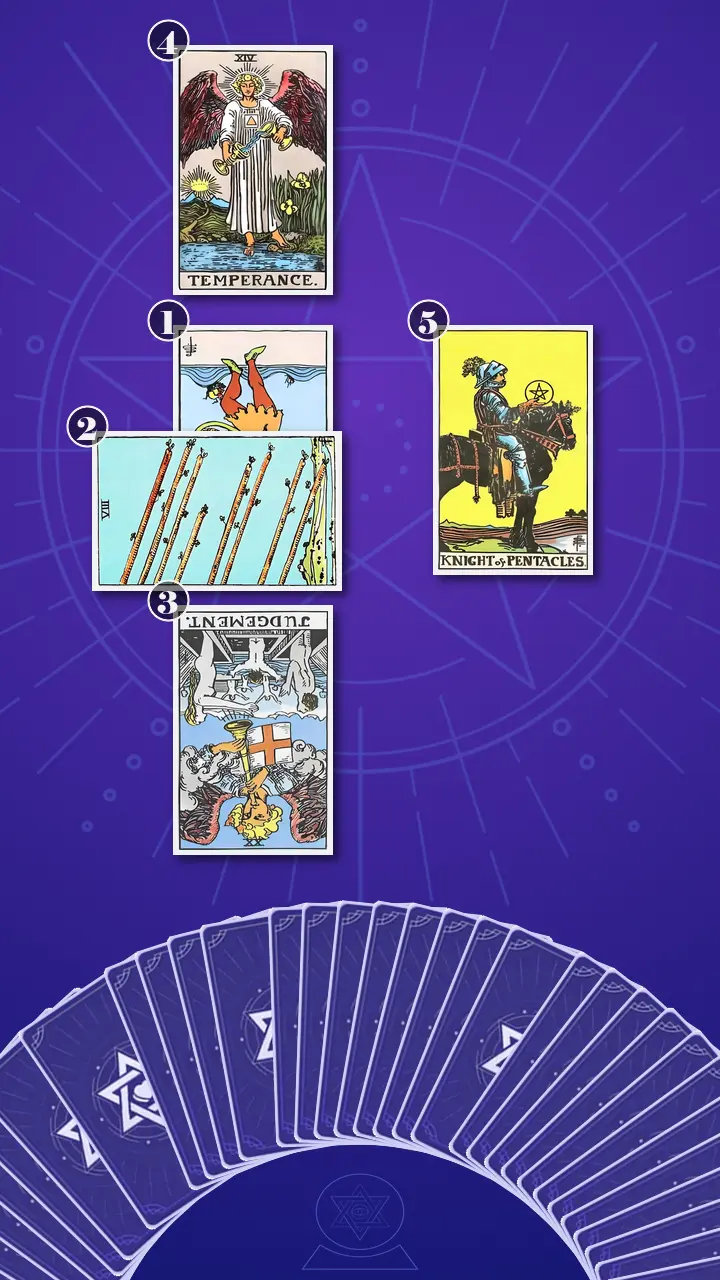
Reading the Map of the Life-Admin Backlog Loop
Position 1: The Evening That Never Lands
The first card I turned over was the one representing the visible catch-up pattern: the backlog behaviors and energy fragmentation most active right now. It was the Two of Pentacles, in reversed position.
I was not surprised. In modern life, this card is the after-work catch-up spin in perfect form: a full agency day of small requests and shifting timelines, then home to a bank alert, unread texts, one open email, the gym bag still by the door, and a brand-new reset plan in Notes instead of one closed loop. It feels like saving six productivity templates, half-building a Notion dashboard, and still not knowing which thing actually needs to be finished first.
In energetic terms, I read this as imbalance through excess motion. Earth is supposed to help practical life land. Reversed here, that grounding function is dropped and unstable. Taylor was moving, checking, planning, toggling, triaging—but not settling. The infinity ribbon in the card mirrored exactly what she had been living: attention looping around the same practical tasks without ever touching down.
'That is so accurate it is kind of rude,' she said with a short laugh that carried more exhaustion than amusement. Her fingers tapped the side of her mug once, then went still. That tiny bitter laugh told me something important: the first layer of defense had softened because she felt recognized.
Position 2: The Lock Screen That Feels Like Traffic
The second card lay across the first, showing what was crossing the present pattern—the pressure point that kept simple tasks from staying simple. It was the Eight of Wands, also reversed.
This card translated immediately into the modern one-screen problem: direct texts, group chats, delivery updates, payment reminders, work pings, OTP codes, and social media all arriving through the same phone. The problem was not just volume. It was speed plus anticipation. For Taylor, answering one message felt like stepping into traffic because it seemed to commit her to ten more.
In energy language, this is blocked Fire. Fire normally moves, lands, and clears space. Reversed, it hangs in midair. That is why unread texts create so much anxiety. Nothing has landed. Everything is still descending. Her nervous system was treating every incoming cue as equally urgent, and once that happens, even a low-balance alert can make the whole evening feel hunted.
I said, 'This is why your lock screen can look objectively manageable while your body reacts like you have opened fifteen Slack threads at once. It is not that everything is huge. It is that everything arrives with the same emotional siren.'
She nodded this time, slower. Her mouth tightened at one corner in that Fleabag-style way people do when they know the pattern in real time and still feel trapped inside it.
Position 3: The Private Courtroom Under the Sink
The third card sat beneath the center, revealing the underlying fear and limiting belief making ordinary obligations feel heavier than they are. It was Judgement, in reversed position.
This is always the card that changes the temperature of a reading. Under the backlog, Taylor was not experiencing a late fee as a late fee. She was experiencing it as evidence. The imagery in Judgement—an angel calling figures up from their coffins—became, in her case, an inner summons to account. One delayed payment. One unopened text. One grocery receipt on the counter. And suddenly the mind generates a court transcript: This should take two minutes, so why does it feel like a referendum on my whole life?
I linked it back to the first card because this was the real blockage in the spread. 'This is why the gym bag stays by the door and the fresh Notes app reset plan appears instead,' I told her. 'The task itself is small. The meaning attached to it is huge. The problem is not that you do nothing. It is that too many things arrive carrying extra meaning. An overdue task is not a character report.'
Her reaction came in three small beats. First, her breathing paused, as if her body had been caught reopening the same internal tab again. Then her eyes lost focus for a second, replaying some private kitchen scene only she could see. Then a quiet wince crossed her face and she nodded once. 'Yes,' she said. 'A late fee feels like a performance review of my whole personality.'
'Exactly,' I said. 'And that is why trying to catch up keeps leaving you more overwhelmed and stuck. You are not just doing admin. You are bracing for judgment every time.'
When Temperance Poured Between Two Cups
When I reached the fourth position, the room changed. The late light against the window had gone softer, and the little hush that sometimes arrives in a real reading settled between us. This was the card naming the key inner reorientation that could interrupt the shame-and-backlog loop. We had reached the bridge.
Position 4: The Pace That Teaches the Body It Is Safe
The fourth card sat above the spread, showing the inner reframe becoming available at the conscious level. It was Temperance, upright.
On the surface, Taylor’s problem looked like poor discipline or weak follow-through. Temperance told a much smarter story. This was not about forcing harder. This was about measured self-regulation—one foot in water, one on land, emotion and practicality linked instead of fighting for the wheel. Its modern translation was immediate: getting home is not the same as having landed. She did not need a mythical clean-slate day. She needed a transition.
Temperance always pulls an old memory forward for me. I grew up in Venice, where water only stays useful when it circulates instead of surging blindly. Later, when I worked with intuition on transoceanic ships, I learned the same law at sea: you do not steady a vessel by shouting at the waves. You guide the current. That is how I use my Venetian Aqua Wisdom in readings, and it paired perfectly here with my energy-flow diagnosis. Taylor’s jaw and shoulders were not telling me she was incapable; they were telling me her system was trying to hold too much pressure with no channel.
I gave her the setup in plain language. 'You get home, drop the gym bag, see one bank alert, remember one text you still have not answered, and within two minutes your whole evening feels contaminated by everything you have not closed.'
Stop treating every loose end like a flood you must fix all at once; with Temperance's steady pour, one measured action can turn scattered pressure into workable rhythm.
I let the sentence hang there. The radiator clicked. Somewhere outside, a streetcar scraped over wet rails. Taylor did not relax immediately. First her fingers froze halfway to her sleeve. Then her jaw set harder, and she looked up at me with a flash of resistance. 'But if that is true,' she said, sharp with the kind of anger that is really grief in a blazer, 'does that mean I have been making it worse?'
'No,' I told her, and I kept my voice steady enough for both of us. 'It means you were trying to solve a flood with flood energy. That is different. Your body learned that every loose end was an emergency, so of course it started sprinting or hiding. Temperance does not accuse. It retrains.'
I watched the insight land in layers. The set of her mouth loosened first. Then her shoulders dropped a fraction, as if two invisible hangers had been taken out from under them. Then came the tender part that follows real clarity: not triumph, but a slight disorientation, like standing up after carrying something heavy for too long and suddenly having to feel your own balance again. Her eyes watered, not dramatically, just enough to catch the light.
'So I do not need to fix everything tonight,' she said finally, almost to herself.
'No,' I said. 'You need one contained next action that teaches your nervous system the evening can happen in sequence.'
I asked her, 'Now, with this new perspective, think about last week. Was there a moment when this would have changed the way your body reacted?'
She gave a softer laugh this time, without the bitterness. 'The TTC auto-load top-up,' she said. 'It took maybe ninety seconds. I treated it like I needed a whole financial summit.'
That was the turning point of the entire reading: from chaotic catch-up mode and self-reproach toward a closure-first rhythm and grounded self-trust. Temperance promised no makeover montage. It promised the first quiet proof—shoes off, bag down, a glass of water, one five-minute timer, one paid bill. The backlog still exists, but this one thing is done. Like closing one browser tab and feeling the whole laptop run quieter.
Position 5: The Boring, Trustworthy Version of Change
The fifth card sat to the right, translating insight into a grounded next step and the embodied rhythm that could support change. It was the Knight of Pentacles, upright.
I smiled when I saw him. After the spinning, the traffic jam, and the internal courtroom, this knight is beautifully unglamorous. In Taylor’s life he looked like paying one bill before scrolling, answering one thread honestly, unpacking the gym bag the same night, muting one non-urgent group chat, and keeping one weekly admin block short enough that she would actually repeat it. The win here is not intensity. The win is becoming someone who trusts her own follow-through because she sees it regularly.
In energy terms, this was grounded Earth restored to balance. The reading began with two pentacles trapped in a loop. It ended with one pentacle held steadily. That symbolic shift mattered to me. The lesson was not more ambition, more apps, or more juggling. It was fewer simultaneous commitments to the self.
'Closure beats reset,' I told her. 'That is this card.' I pointed to the still horse and the single pentacle held with full attention. 'You do not need a heroic evening. You need a boring, trustworthy one.'
She gave me the first real smile of the session. Not huge. Just enough to say the method sounded boring in exactly the way she needed.
Closure Beats Reset: Actionable Advice for the Next 48 Hours
When I laid the story of the spread back to her, it was clean. The Two of Pentacles reversed showed the visible symptom: life-admin tasks scattered across the evening until nothing landed. The Eight of Wands reversed showed the crossing force: a notification traffic jam that made one reply feel like ten. Judgement reversed revealed the true weight under both of them: the private belief that a small delay says something damning about who she is. Temperance shifted the whole frame from flood-response to sequence. And the Knight of Pentacles grounded that shift in repeatable, ordinary follow-through.
I told her the blind spot as directly as I could: she kept waiting for a clean-slate feeling before acting, when the clean-slate feeling was never going to arrive first. Planning had started impersonating completion. Shame had started setting her priorities. The transformation direction was simpler and harder at once: stop waiting for the perfect reset and complete one contained next action while the backlog still exists. You do not have to clear the whole backlog to earn a calmer evening.
- The Canal Gate Landing RitualOn three evenings this week, when you get home to your kitchen or entryway, take your shoes off, set the bag down, drink one glass of water, turn on Do Not Disturb for 5 to 10 minutes, and finish one messy-but-complete task before you open a second app: pay one bill, unpack the gym bag fully, or handle one practical item.If 10 minutes feels too long, make it 3. On your last two TTC stops home, unclench your jaw and drop your shoulders so your body knows the landing ritual has already begun.
- The Two-Line Bridge ReplyChoose one safe person this week and send one short message in a direct thread: 'Hey, I saw this and did not want to leave it hanging. I cannot reply properly right now, but I wanted to answer by tomorrow.' Use it when a delayed text starts feeling emotionally expensive.Draft it in Notes first if that helps. Sufficient response restores movement faster than a polished catch-up paragraph.
- Oldest Item First, Closed LoopsOnce this week, pick the oldest small overdue item that still has a pulse—not the newest and not the easiest—and give it 10 minutes only. Before you open it, read the line 'This is an overdue task, not a character report.' Then record whatever you completed in one visible note titled Closed Loops.Expect your mind to argue that the oldest item is too small, too embarrassing, or not worth doing unless you can clear more. That is the pattern talking. Ten minutes is enough proof for now.
These were not glamorous fixes, and that was exactly the point. Tarot is most useful when card meanings become action in context. Here, actionable advice did not mean changing her personality. It meant giving her evenings a steadier rhythm than shame had been giving them.

A Week Later, the Quiet Proof
A week later, Taylor sent me a message from her kitchen counter. She had muted one non-urgent group chat, paid the overdue transit top-up before opening TikTok, and unpacked the gym bag the same night three times. 'The backlog still exists,' she wrote, 'but it feels less like it is yelling.'
That was all the evidence I needed. Tarot had not made her life perfect. It had made it legible. This journey to clarity was never about becoming a different woman overnight. It was about moving from catch-up mode and self-reproach into a closure-first rhythm, where one finished task at a time could begin rebuilding self-trust.
She paid the transit top-up, then sat alone at the counter with the confirmation screen still open, listening to a streetcar pass outside. Nothing cinematic. Just one calmer jaw, one unpacked gym bag, one evening that felt a little more like her own.
When every small loose end lands in your body like proof that you are slipping, even a five-minute task can feel weirdly heavy—not because you are incapable, but because it has stopped being just a task.
If you stopped waiting for a full clean-slate day, what is one small loose end you would want to close tonight—not to prove anything, but simply because it would make the evening pour a little more quietly between two cups?
This story is adapted from psychological research, written so that those in a similar struggle can see their own pattern in it — and find their next step clearly.These insights are not a substitute for professional psychological, medical, legal, or financial advice.
Learn more about our Journey to Clarity.
How did this insight land for you?
🫂 This Resonates Deeply
🌀 Living This Story
✨ Now I See Clearly
🌱 Seeing New Possibilities
🧰 Useful Framework
🔮 The Confirmation I Needed
💪 Feeling Empowered
🚀 Ready for My Next Step
Author Profile
 AI
AI“Having traveled across cultures... I've learned that what we often lack isn't a simple answer, but a moment of being truly understood. I use a Jungian psychological lens to help you deconstruct your subconscious patterns—not to prove anything, but to be the gentle companion who helps you unravel your knots, free of judgment, so you can reconnect with your inner wisdom.”
In this Introspection Tarot Reading :
Core Expertise
- Shadow Integration Audit: Objectively mapping suppressed emotions (anger, shame, grief) that are covertly draining your psychological bandwidth.
- Inner-Critic Neutralization: Deconstructing the harsh, subconscious self-judgment loop that masquerades as 'self-discipline'.
Service Features
- The Active Imagination Protocol: A structured psychological journaling technique to safely dialogue with your 'Shadow', turning internal friction into deep self-compassion.
Also specializes in :
Explore Related Patterns:
Anxiety SpiralTaylor's kitchen scene escalates with striking speed: banking app, internet bill, Messages, Notes checklist, jaw locked, shoulders buzzing. Within two minutes, ordinary Tuesday admin turns into an emergency drill inside the body. Anxiety Spiral names the chain reaction where one cue triggers another cue, then the whole stack becomes emotionally louder than any single task deserves. The spiral is cognitive and somatic at once: the mind adds meaning, the body braces, and the next notification feels harder to face because the system is already activated. You stay in catch-up mode when every practical prompt becomes part of the same escalating loop. The way out is not to solve the whole backlog while activated; it is to interrupt the chain early with sequence, containment, and one task small enough for the body to register as safe.
Fresh Start FantasyTaylor's fresh Notes app reset plan appears at the exact moment one closed loop would matter more: the bill, the text, the gym bag, the transit top-up. The reset plan gives her a sense of order before she has to touch the messy, overdue item carrying the most emotional charge. Fresh Start Fantasy is the coping mechanism where the mind waits for the right clean-slate state before acting. It feels responsible because it involves planning, systems, and intention, but in this story it quietly delays contact with the real task. The fantasy is not laziness; it is a defense against starting while things still feel imperfect. You stay in catch-up mode when the nervous system believes calm has to arrive before action can begin. Taylor's breakthrough is the opposite sequence: one contained action while the backlog still exists. That is what makes the evening feel less like a total life reset and more like a life that can be handled in order.
Self-Judgment LoopTaylor's line that a late fee feels like a performance review of her whole personality is the clearest doorway into this pattern. The story shows an internal courtroom forming around ordinary admin: one delayed payment, one unopened text, one receipt on the counter, and suddenly the mind starts building evidence against the self. Self-Judgment Loop names the cognitive mechanism underneath that courtroom. Instead of asking, "What is the next practical step?" the mind asks, "What does this say about me?" That shift turns a solvable task into a referendum, which explains why even opening the banking app can make the body brace. You stay in catch-up mode when every loose end has to be emotionally defended before it can be practically handled. The loop is not broken by proving you are finally perfect; it is interrupted when an overdue task is allowed to be just an overdue task, not a character report.
Shame-Driven DelayThe gym bag by the door, the overdue transit top-up, the unread texts, and the late fee are all small on paper, but Taylor's body treats them as emotionally expensive. The task does not stay inside its practical size; it becomes a signal that she is behind, exposed, or failing at being a capable adult. That is the mechanism of Shame-Driven Delay: the delay is not caused by the task itself, but by the self-judgment attached to touching it. When a two-minute payment feels like a performance review of your whole personality, avoidance starts to look irrational from the outside but protective from the inside. The pattern keeps life in catch-up mode because every unfinished item becomes harder to approach the longer it sits there. You are not just closing a task; you are walking back into the emotional charge that gathered around it. The key insight is that completion has to be made smaller than shame, not more dramatic than it.
Urgency BiasTaylor's lock screen does not contain one kind of demand. It mixes direct texts, group chats, delivery updates, payment reminders, work pings, OTP codes, and social media cues into the same glowing surface. The body receives them all through one channel, so the difference between urgent, optional, social, financial, and administrative starts to blur. Urgency Bias names the cognitive distortion that makes every cue feel like it needs immediate triage. Once that filter is active, the phone no longer presents tasks in proportion; it presents a traffic jam. One reply feels like ten more replies, one low-balance alert feels like the evening is hunted, and one app switch becomes the start of a spiral. You stay in catch-up mode because priority gets replaced by alarm. The shift Taylor needs is not more speed, but better signal sorting: one contained next action, one muted non-urgent channel, one small proof that not everything arriving now deserves the same emergency response.
Productivity as SafetyTaylor wants life to feel handled, steady, and unremarkable in the best way. That wish is completely human, but the story shows how easily it becomes tied to proof: the paid bill, the answered text, the unpacked gym bag, the absence of late fees, the feeling that everything is finally under control. Productivity as Safety names the coping mechanism where completion becomes a nervous-system reassurance signal. When it works, getting things done can create structure and self-trust. In Taylor's catch-up mode, though, productivity becomes the condition for feeling safe, so every missed task threatens the whole internal system. You stay in catch-up mode when practical follow-through is asked to carry your entire sense of being okay. The healthier version is not abandoning responsibility; it is letting small actions be small again. One closed loop can support self-trust without becoming evidence that your whole life is finally allowed to feel valid.
Compulsive CheckingTaylor's phone becomes the place where every unfinished loop announces itself. She opens the banking app, remembers a bill, jumps into Messages, notices the checklist, and keeps scanning across channels before any one thing gets resolved. Compulsive Checking names the attempt to regain control by repeatedly scanning for what might need attention. The checking makes sense as a defensive strategy because it promises awareness: if you can see every cue, maybe nothing will surprise you. In Taylor's story, though, each check adds another demand to the stack. You stay in catch-up mode when scanning replaces closing. The phone gives a fresh hit of information, but the nervous system needs a different signal: one finished loop, one muted channel, one moment where checking stops being the ritual and completion becomes the proof.
Explore Related Struggles:
Closure DeficitThe gym bag by the door, the open email, the bank alert, and the unread thread all stay half-present in Taylor's kitchen. None of them is catastrophic on its own, but together they prevent the evening from feeling finished. Closure Deficit is the missing body-signal that a small thing has ended. Without that signal, unfinished tasks keep occupying space long after their practical size should have expired, and your attention keeps circling them as if they are still actively demanding an answer. One transit top-up, one unpacked bag, or one honest reply does not erase the whole backlog. It gives the system proof of sequence, which is why a single closed loop can make the whole evening feel a little more like yours again.
Productivity Shame BindTaylor does not meet the late fee as a late fee. One delayed payment, one unopened text, or one receipt on the counter becomes evidence in a private courtroom where ordinary admin is asked to testify about her whole competence. When a two-minute task becomes a character report, the task stops being practical. You are no longer just deciding whether to pay a bill or answer a thread; you are bracing against the feeling that the outcome will say something final about who you are. Productivity Shame Bind is the structure that keeps catch-up mode emotionally expensive. The backlog grows heavier because every loose end has been loaded with proof, and closing one task can feel less like relief than surviving another review.
Urgency-Compass FusionTaylor's lock screen puts group chats, payment reminders, OTP codes, work pings, delivery updates, and social media into the same small rectangle. A low-balance alert and a direct message arrive through the same channel, so the body receives them with the same force. Urgency-Compass Fusion names what happens when priority stops being a compass and becomes a siren. You cannot easily tell which cue matters now, which one can wait, and which one is only loud because it arrived on the same screen as everything else. That is why one reply can feel like stepping into traffic. The issue is not that every task is huge; it is that every cue enters with the emotional volume of something huge, and the internal ranking system gets drowned out before a simple next step can form.
Mental Bandwidth DepletionTaylor's phone is warm, one AirPod is still in, the microwave fan is loud, and the leftovers are already going cold. Work, banking, texts, checklists, and social feeds are all present in the same kitchen before she has had any real landing time. Mental Bandwidth Depletion is not emptiness; it is saturation. You may still be capable, funny, employed, and trying, while the usable space for sequencing has already been taken up by too many simultaneous inputs. In that state, even a small task can feel weirdly heavy because the system has no quiet lane left for proportion. The bill is small, the reply is small, the gym bag is small, but the mental space required to sort them has already been spent before the evening begins.
Explore Related Emotions:
Verdict DreadA late fee does not stay a late fee for Taylor. One delayed payment, one unopened text, or one grocery receipt on the counter turns into an internal transcript asking why something so small still feels unfinished. Verdict Dread names the specific pressure underneath the backlog: the fear that an ordinary loose end will be used as evidence against your competence, your adulthood, or your ability to keep life together. The task becomes emotionally loud because it stops being practical and starts feeling evaluative. This is why her body reacts before the task has even been touched. You are not just deciding whether to pay a bill or reply to a thread; you are bracing for what the unfinished item might seem to say about you. The label matters because it separates the real task from the extra meaning attached to it, returning the problem to a size you can actually work with.
Message DreadTaylor looks at one message and feels the whole traffic pattern behind it: direct texts, group chats, delivery updates, work pings, payment reminders, codes, and social media all arriving through the same device. Replying does not feel like answering one person; it feels like stepping into a stream that might immediately ask for more. Message Dread is the body-level anticipation that a small response will open ten more obligations. The unread thread becomes heavier because it carries both social expectation and practical interruption, so avoidance starts to feel less like neglect and more like the only available pause. This feeling directly feeds catch-up mode. When messages feel expensive, they remain half-open, and each half-open thread adds to the background noise of the evening. Naming Message Dread makes it possible to separate the human connection from the imagined avalanche, so a reply can become a bridge instead of another siren.
Micro-Performance ShameTaylor says one more unread text or late fee might prove she is not really on top of things after all. In the kitchen, that fear shows up physically: a locked jaw, buzzing shoulders, and the strange feeling that a normal evening has become an emergency drill. Micro-Performance Shame captures the humiliation of feeling privately watched by your own standards. No audience has to be present for the pressure to feel public; the undone task becomes a tiny stage where you are expected to demonstrate that you are functional, disciplined, and fine. The intensity comes from the mismatch between the scale of the task and the scale of the meaning. A gym bag by the door should be a small object, but in this emotional weather it starts acting like proof of a larger failure. Naming the shame helps you stop treating every loose end as a character test and start seeing it as a practical loop that can be closed without self-punishment.
Scattered OverwhelmTaylor opens the banking app, remembers the internet bill, jumps into Messages, catches sight of the Notes checklist, and within two minutes her body is already bracing. The problem is not that any single task is impossible; it is that every practical cue arrives at the same time and asks for a different version of her attention. That is the emotional logic of Scattered Overwhelm: your mind is not moving through one clear sequence, it is trying to hold several unfinished loops at once. The gym bag, the late fee, the unread text, and the reset plan all become active tabs in the same tiny kitchen, so even a normal Tuesday night starts to feel like a system with no obvious landing point. What makes this feeling so sticky is that motion keeps replacing closure. You can be checking, planning, remembering, and triaging all evening while still feeling as if nothing has actually been handled. Naming Scattered Overwhelm gives the spiral a shape, which is the first step toward choosing one contained action instead of fighting the whole backlog at once.
Explore Related Contexts:
Adulting Performance PressureTaylor is high-functioning at work and socially present in the group chat, yet a late fee, unread thread, grocery receipt, or unpacked gym bag starts to read like proof that she is not really on top of life. The pressure comes from ordinary tasks being forced to carry the meaning of adulthood itself. Adulting Performance Pressure names that social script: being a capable late-20s city adult is measured through invisible maintenance, fast replies, clean follow-through, paid bills, and a home life that appears handled. The story shows how those standards follow Taylor into the kitchen after the agency day is already over. You can see the external weight in her line that a late fee feels like a performance review of her whole personality. The task is small, but the social scorecard attached to it is huge, so every loose end becomes a public-facing competence test even when no one else is in the room.
Catch-Up ParalysisTaylor is not frozen in the sense of doing nothing. She is opening the banking app, switching to Messages, noticing the Notes checklist, planning the reset, and still ending the evening with the core task unfinished. That movement without closure is the structure of Catch-Up Paralysis. The external world keeps presenting her with small demands, but each demand pulls in adjacent demands: one bill points to another account, one text implies a longer reply, one checklist suggests a whole life reset. The action chain becomes too crowded to complete. You can see the trap in the line about waiting for a clean-slate feeling before acting. The system keeps asking for closure, but the environment keeps rewarding more scanning, more preparation, and more triage, leaving the first finished step just out of reach.
Life Admin BacklogTaylor comes home from a full agency day into a kitchen where the leftovers are cooling, the internet bill is still unpaid, unread texts are waiting, and the gym bag is still by the door. The story keeps returning to small unfinished loops rather than one dramatic crisis, which is exactly what makes the pressure so hard to isolate. The external structure here is a backlog of everyday maintenance tasks that all ask for attention after work. None of the items is large on its own, but the bill, reply thread, payment alert, transit top-up, and bag all occupy the same evening space, so the practical load stops behaving like a normal to-do list. You are not looking at a lack of effort in this pattern. You are looking at a life-admin environment where too many open loops remain active at once, making ordinary adulthood feel like a second shift that starts the moment the workday ends.
Notification GuiltTaylor's phone is warm in her hand while banking, Messages, Notes, reminders, work pings, OTP codes, delivery updates, group chats, and social media all share the same device. The story makes the lock screen feel less like a tool and more like a crowded intersection. Notification Guilt fits because the pressure is created by incoming cues that imply obligation before Taylor has even chosen a task. One unread message does not stay one unread message; it appears to carry timing, etiquette, follow-up, and the possibility of disappointing someone. You are dealing with an external attention environment where social, work, financial, and platform signals arrive without hierarchy. When every ping looks equally available and equally unfinished, the phone turns a normal evening into a queue of tiny accusations.
Routine Reset TrialTaylor's next step is deliberately ordinary: shoes off, bag down, water, Do Not Disturb, one short timer, and one messy-but-complete task before a second app opens. The story also shows her testing it in real life by paying the transit top-up, muting a non-urgent group chat, and unpacking the gym bag three times in a week. Routine Reset Trial fits because the structure is not yet a settled lifestyle; it is a small transition system being tested under normal weekday pressure. The point is to make the evening sequential enough for follow-through to happen before the backlog takes over the room. You are watching a new external rhythm being built around capacity and repetition. The trial succeeds not because everything is cleared, but because one contained action creates proof that the evening can be handled in order.
Always On AvailabilityTaylor is physically at home in her downtown kitchen, but the phone keeps work pings, direct texts, group chats, delivery updates, banking alerts, and social platforms in the room with her. The workday has ended, yet the channels of obligation stay open. Always On Availability captures the way her evening boundary is weakened by one device serving every system at once. Agency work, friends, payments, and platforms can all reach her through the same screen, so there is no clean separation between being off duty, being reachable, and being responsible. You are seeing an external availability structure, not just a personal habit around the phone. The kitchen cannot become a landing place while the lock screen keeps importing requests from every part of Taylor's life into the same after-work moment.