Ten Uncorrected Minutes: From Old Shame to a Values-Based Choice

The Six-Times-Edited Sentence: Performative Healing Under Inherited Shame
I recognized Jordan as the Chicago customer-success specialist who could calmly de-escalate an angry client on Slack, then spend twenty minutes deciding whether "I felt uncomfortable" sounded too harsh in a text to a friend. I could see the professional composure; I could also see the cost of keeping it switched on.
At 8:47 p.m. on a Tuesday, I imagined her at the kitchen counter in her shared apartment, rereading the boundary text for the sixth time. The refrigerator hummed beside her, her phone felt warm in her palm, and the blue light from the screen sharpened the sentence she kept deleting: "I felt uncomfortable."
She showed me the draft and said, "How do I loosen old shame without forcing myself to be over it? I know the old rule is not mine anymore, but my body still acts like I broke it." When an old purity rule was activated by anger, desire, grief, or a simple boundary, she opened Notes, a meditation app, or a self-help podcast and turned the reaction into a growth lesson. She wanted to loosen shame gently, but kept grading, editing, and reframing it because a return of shame felt like evidence about her worth.
In that kitchen, shame was not an abstract label I needed to diagnose. It was a drawstring pulled tight through her throat and chest, shortening every breath before an honest preference could reach the outside world; grief and frustration pressed behind it, with apprehension listening for a verdict.
I said, "I am not here to make you perform being over it. Let us look at the pattern without adding another purity checklist. Our Journey to Clarity can begin by giving the feeling a little room, then returning the pen to you."

A Five-Card Compass for the Inner Excavation
I asked Jordan to place both feet on the floor, feel the chair supporting her, and take one slow breath without trying to improve the breath. I shuffled gradually while she held the question in mind. The preparation was a practical transition: a way to gather attention before looking closely at material that usually sent her straight toward explanation.
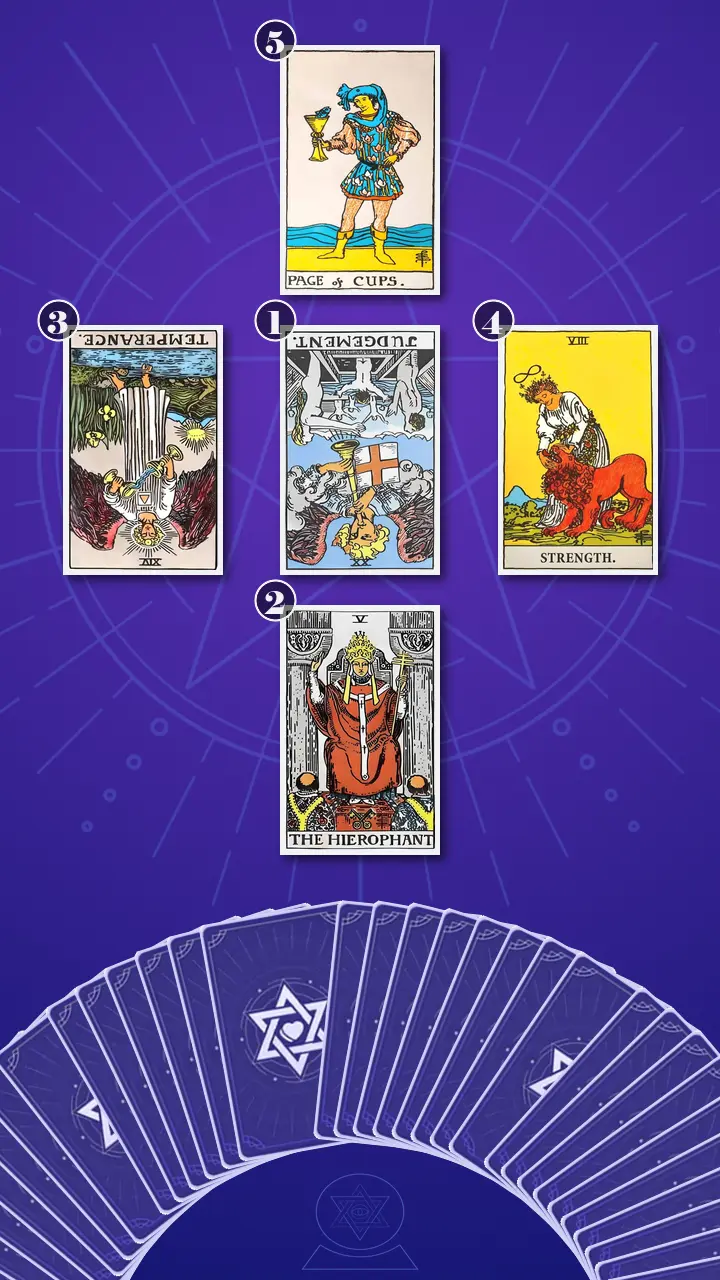
For this reading, I used The Shadow Spread, a five-card tarot spread for tracing present self-judgment through inherited conditioning and spiritual bypassing toward patient strength and emotional curiosity. This spread suited the question because the issue was one coherent internal cycle rather than a maze of unrelated external forces. It could show the present shadow, its root, the defense that kept it running, the resource hidden inside it, and a repeatable integration practice.
I also explained how tarot works in this context. The cards were not verdicts, predictions, or authorities deciding whether Jordan was healed enough. They were an objective visual language for organizing attention. The images gave us something concrete to compare with her messages, her body, her inherited rules, and her actual choices.
I told her that I would begin with the visible habit, move down to the inherited source, return through the protective strategy, cross to the reclaimed resource, and finish with a practical way to receive one feeling at a time. The center would show the internal verdict; the lower card would show where the grading system came from; the side cards would reveal the conflict between bypassing and patient strength; and the upper card would point toward daily curiosity.
The Internal Performance Review
Position 1: The Tribunal in Your Pocket
I said, "Now I am turning over the card representing the present face of Jordan's shadow: the observable habit of treating each shame recurrence as evidence that she has failed to heal." The card was Judgement, in reversed position.
In the Rider-Waite-Smith image, an angel sounds a trumpet above figures rising from gray coffins. I translated that trumpet into the ordinary notification that interrupted Jordan's night: a difficult text appeared, the old alarm rang, and an internal performance review called every sentence to the stand. Was I warm enough? Did I overreact? Have I changed enough? The card's energy was an excess of self-evaluation and a blockage of listening. The awakening call had been mistaken for a summons to defend her progress.
Judgement reversed did not say she was doomed to shame; it showed the loop. She reread a message thread, mentally prosecuted each sentence, and checked whether she felt calm or compassionate enough to speak. I offered a different translation: an old shame response is old information, not a verdict. A feeling had arrived from a previous moral system; it did not have the authority to issue a final sentence about her character.
Jordan's breath caught and her fingers stopped on the card's edge. Her eyes lost focus as if a dozen old message threads had opened behind them. Then she gave a small, bitter laugh. "That is too accurate. Almost cruel."
I nodded. "I hear the cruelty in the loop, not in you. The point is not to win an argument with the feeling. It is to notice the moment you turn a signal into a character review, so the next choice can come from current values rather than an old scorecard." Her jaw remained tight, but she stopped reaching for her phone.
Position 2: The Old Syllabus Beneath the Screen
I moved to the card representing the root of the pattern: the inherited purity framework that linked goodness, belonging, and self-control before Jordan developed self-authored values. I turned over The Hierophant, in upright position.
The seated teacher between the gray pillars, the two initiates below, and the crossed keys at the teacher's feet gave the image its vertical shape. A standard came from above, was received before it could be questioned, and eventually became an internal access code for belonging. In Jordan's life, an old moral syllabus still ran quietly beneath her current values. She could consciously reject the idea that ordinary anger, desire, uncertainty, or a wish to say no made her bad, yet the inherited grading system became loud whenever she risked disapproval.
I was careful here. I did not treat her faith background as a villain, and I did not ask her to reject every inherited value on command. I asked her to separate what she freely endorsed now from what she followed only to prevent shame. The useful question was not, "Which tradition must I destroy?" It was, "Which value is mine, and which rule is asking me to disappear so I can remain acceptable?"
Jordan folded her hands together. "I keep thinking I left that rule years ago," she said. "But I can still hear it when I want something, or when I need to say no." I watched her thumb press into the side of her index finger, then release. "Conscious disagreement does not always make an old rule quiet," I said. "It gives you a chance to notice which voice is speaking before you hand it the microphone."
Position 3: The Two-Cup Shortcut
I said, "Now I am turning over the card representing the shadow's protective strategy: spiritual bypassing through premature gratitude, meaning-making, and forced emotional integration." It was Temperance, in reversed position.
In the Rider-Waite-Smith image, water passes carefully between two cups while one of the angel's feet rests on land and the other touches water. Reversed, the patient stream became a disrupted blend. I saw Jordan's kitchen again: she wrote, "I feel ashamed," and almost immediately moved the cursor toward, "but I am grateful for the lesson." A raw draft became a polished press release before anyone had been allowed to read what happened.
The water was not absent. It was being overmanaged. Jordan mixed hurt with gratitude, anger with alignment, and uncertainty with a new healing goal so quickly that she could no longer taste the original feeling. Your healing routine can become the old purity checklist in softer language. The checklist now used meditation streaks, Notion trackers, podcast clips, and polished language instead of purity points, but the structure remained: monitor, correct, improve, repeat.
Her thumb hovered over the Notes app as if she might add another task. I said, "I am not taking these tools away. I am changing their order. First let the feeling exist. Later, if it helps, you can ask what it means. For now, I do not have to resolve this before I can notice it." That sentence reduced the task from becoming fully healed to spending ten uncorrected minutes with one honest feeling.
Jordan exhaled through her nose, looked at the two cups, and said, "I keep mixing pain with meaning until neither can be tasted." I let the observation stand without turning it into praise. The point was not to make the insight impressive. It was to make the next interruption voluntary, small, and possible.
When Strength Put Down the Weapon
Position 4: Bare Hands, No Weapon
When I placed the fourth card to the right of the center, the room seemed to narrow. A Blue Line train gave a low metallic groan somewhere beyond the apartment windows, then fell quiet. I told Jordan that we had reached the key card, the reclaimed resource and the antidote, not a promise that shame would vanish, but an image of a different relationship to it.
I turned over the card representing the resource hidden inside the struggle: patient strength that can remain with shame without obeying, suppressing, or accelerating it. The card was Strength, in upright position.
The woman in the image has no weapon. Her bare hands rest near the lion's mouth; an infinity sign floats above her head, and a white robe and flower garland soften the encounter without making the lion harmless. I connected that scene to Jordan pressing send on a clear message, noticing her chest tighten, and refusing to delete the boundary or rush to apologize. The upright energy was balanced, embodied courage: not force against shame, not obedience to shame, and not the demand for a perfectly calm body before action.
Here I used one of my signature lenses, Internal Monologue Auditing. I asked Jordan what genre her inner monologue was producing. It was not a wise documentary about healing. It was a courtroom drama with a wellness-podcast soundtrack, where every recurrence supplied evidence and every apology served as closing argument. The audit separated the event from the voice-over: a boundary had been sent; the body had tightened; the voice-over had announced moral danger. Those were three different pieces of information.
I also brought in my Persona Fatigue Diagnosis, my way of noticing the psychological toll of maintaining a social character that conflicts with an authentic self. Jordan had become exceptionally skilled at being the endlessly calm, warm, reasonable customer-success person. That character helped her at work, but it had started answering for her in friendships and dating too. She did not need to fire the character. She needed to stop letting it edit every honest sentence until no preference, anger, or uncertainty remained.
Before I gave her the central sentence, I asked her to picture the exact scene:
Picture Tuesday at 8:47 p.m. in the Chicago apartment: your boundary text is open, the fridge hums, the phone is warm, and "I felt uncomfortable" has been deleted again. Your throat tightens because you want to be gentle, but you are also trying to prove you are already beyond shame.
You do not have to overpower shame to outgrow its rule; meet it with steady, bounded compassion, as the woman in Strength meets the lion without a weapon.
I let the silence remain, then added the wider frame: You do not have to turn shame into a polished spiritual lesson or force a bloom. Patient contact with one honest feeling, followed by one values-based choice, is how its authority can begin to loosen without making emotional perfection the new rule.
Jordan did not answer. First, her breath stopped halfway in, and her fingers froze around the edge of the card. Then her pupils widened; her gaze moved from the lion to the kitchen wall as if old threads were replaying behind it. The rims of her eyes grew pink. A line appeared between her brows. She swallowed, and her shoulders began to lower by degrees rather than collapsing all at once. Finally, her hand opened on the table. "So I can feel guilty and still mean what I said," she whispered. Her voice shook on guilty, then steadied on said. The exhale that followed sounded surprised. Relief arrived with a brief, pale emptiness: without the old verdict to obey, she had to choose. I let that space remain ordinary and unhurried. "Now, use this new perspective to think back," I said. "Was there a moment last week when this insight might have let you feel differently?"
She remembered a date asking to move faster physically than she wanted. She had drafted a clear no, added an apology, and nearly agreed so she would not seem difficult. I watched recognition move across her face, followed by a quieter grief for all the times she had mistaken discomfort for proof of harm. This was the first small crossing from self-surveillance and forced emotional closure toward patient emotional curiosity and values-based self-trust while shame was present.
"Feeling shame is not the same as agreeing with shame," I said. "You can keep a boundary while your body is still catching up."
The Fish in the Single Cup
Position 5: A Message Small Enough to Hold
I turned over the card representing the integration practice: receiving one feeling as limited information and choosing one honest response without demanding complete resolution. It was the Page of Cups, in upright position.
The unexpected fish rising from the Page's single cup felt almost comically specific after the two-cup image of Temperance. The Page did not throw the cup away because the message was surprising, and did not build an entire philosophy around the fish. The figure looked directly at it. That was the practice: receive one emotional message before forwarding it to a grand theory about identity, worth, or the whole healing journey.
I asked Jordan to try the smallest version at the table. She wrote: "Feeling: shame. Need or value: room to be honest. Possible choice: keep the sentence clear and wait before explaining." The words were plain. They did not solve the old purity rule, certify her growth, or promise that another person would approve. They gave her enough present-tense information to make a choice.
Jordan looked at the note and smiled without polishing the smile into a breakthrough. "It feels unfinished," she said. "Yes," I replied. "The Page is a learner, not a life coach delivering the final lesson. One feeling does not have to explain the whole past. One need does not have to become a demand. One possible choice is not a contract."
The card completed the movement from verdict to curiosity. The feeling could be anger, grief, desire, uncertainty, or shame. It could arrive without invalidating previous progress. Jordan could notice it, ask what limited information it carried, and decide what aligned with her current values while leaving the larger meaning open.
The Director's Cut: From Self-Surveillance to Finding Clarity
I gathered the cards into a single story for Jordan. The Hierophant showed how an inherited purity syllabus had once linked goodness, belonging, and self-control. Judgement reversed showed that the syllabus had become an internal performance review, so every old shame response was treated as a failed healing streak. Temperance reversed revealed the protective shortcut: mix the raw feeling with gratitude, growth, or spiritual language before it can ask for anything. Strength offered the missing capacity, patient contact with limits. The Page of Cups translated that capacity into one feeling, one need, and one possible choice.
The Forced Blooming Trap was the central contradiction: Jordan wanted shame to loosen gently, but kept pulling herself open to prove she had bloomed. I told her that the blind spot was not simply having shame. It was treating emotional composure as permission to speak, and treating guilt as evidence that a boundary must be wrong. The direction of change was clear and modest: move from grading every shame response as progress or failure to giving it ten uncorrected minutes of naming, bodily noticing, and values-based choice.
I returned to the method I call The Director's Cut of Self-Compassion. When the inner voice turns punitive, Jordan can pause the scene rather than argue with the whole film. She can change the camera angle from a judge searching for evidence to an objective, supportive observer asking: What happened? What do I notice in my body? What feeling is here? What do I want to protect or choose? This does not delete the difficult footage. It changes the voice-over, so an unfinished scene is no longer narrated as proof of a defective character.
I slid my pen toward her. "These are experiments, not tests," I said. "The cards can show a pattern, but you remain the person who decides whether a message is accurate, whether a boundary is needed, and what your values look like in practice."
Two Small Edits for the Next Forty-Eight Hours
- The Boundary-While-Shame-Is-Present ExperimentOnce this week, when a friendship, dating, work, or body-autonomy moment calls for a preference or limit, write one direct sentence in the Notes app: "I felt uncomfortable when..." or "I would rather..." Read the message once for accuracy, send it without an apology whose only purpose is to prove that you are kind, then place the phone face down for fifteen minutes and notice what your body does.Use a thirty-minute apology pause before adding reassurance. Ask whether you are repairing a specific harm or trying to make someone certify that you are still good. You may revise or pause when the situation is high-stakes; autonomy includes choosing the timing.
- The Uncorrected Ten-Minute PracticeChoose one ten-minute window this week, preferably before opening Calm, Headspace, Spotify self-help, or another healing app. Set a visible timer and write only three lines: "I notice...", "I feel...", and "What I want to protect or choose is..." Leave out the silver lining, lesson, forgiveness statement, and improvement plan until the timer ends.When the timer rings, close the note and make tea, wash a mug, or get ready for bed. Stop early and return to neutral sensory details if the exercise feels too intense. The point is voluntary contact, not a new wellness streak.

A Small, Unpolished Proof
Five days later, I received a message from Jordan. She had sent a friend the sentence she had nearly erased, left out the apology, and put her phone down while the familiar throat-tightening moved through her. She had used the ten-minute note beforehand: one feeling, one need, one possible choice.
She slept through the night, then woke with the thought, "What if I am wrong?" The question stayed, but she smiled and made coffee before reopening the conversation. The boundary was clear, the morning was ordinary, and the uncertainty had not become an emergency.
I did not read that message as a clean before-and-after transformation. I read it as the first visible proof that shame could be present without being obeyed or erased. The Shadow Spread, a five-card tarot spread for tracing present self-judgment through inherited conditioning and spiritual bypassing toward patient strength and emotional curiosity, had not chosen Jordan's future. It had helped her see the next scene clearly enough to choose it herself.
That is what finding clarity looked like in this reading: not the disappearance of an old signal, but a little more space between the signal and the verdict. Jordan was moving from self-surveillance and forced closure toward curiosity, grief that could be named, anger that could carry information, and values-based self-trust without demanding emotional perfection.
When an old shame response tightens your throat and chest, it is easy to mistake its return for proof that you are unworthy. I have learned to leave room for another reading: you may simply be trying to live by chosen values while an inherited rule is still making noise.
If you let one unedited feeling sit in the single cup for ten minutes without grading it, what small, values-based choice might become easier to notice?