The 11:40 p.m. Ledger of Overgiving and Keeping Score
Jordan was the reliable friend who edited an application at 11:40 p.m., then developed friendship scorekeeping anxiety when the thank-you felt smaller than the effort they had never admitted was costly.
They joined our video session from a small Toronto apartment with three unfinished agency emails glowing behind the document on their laptop. The radiator clicked beside them, the fan pushed warm air across their dry eyes, and their phone sat hot in one hand while they scrolled backward through a message thread. Five favors. Two check-ins. One heart reaction where they had hoped for actual words.
“I know I volunteered,” Jordan said. Their jaw shifted as if they were testing how tightly it had been held. “But I notice when it is never returned. Then I hate myself because I am the one who said, ‘No worries, happy to help.’ I’ve literally Googled, ‘Why do I resent my friend after helping them?’”
I asked what usually happened before the resentment.
“They ask for something, and I answer immediately. My job rewards that. Slack, client email, everything. Being responsive means I am good at my job, so I guess it also feels like being a good friend. Then, if they take ages to reply or post with other people, I start counting. I wish they would offer support without making me ask.”
I could see the contradiction clearly: Jordan wanted to feel secure by giving generously, but they did not trust the bond unless each contribution could be tracked and eventually repaid. The insecurity was not an abstract cloud. It looked more like an active-status dot lodged beneath their sternum, flashing every time the phone stayed dark and making rest feel irresponsible.
“I’m not going to use tarot to decide whether your friend cares or to put either of you on trial,” I told them. “I want us to see what happens between the request, your automatic yes, and the tally that follows. Let’s draw a map through that fog, then find the part of the pattern where you still have a choice.”

Choosing the Bridge: The Relationship Spread Context Edition
I invited Jordan to place both feet on the floor, take one unforced breath, and hold the question without trying to make it sound reasonable or kind. I shuffled slowly. I do not treat this preparation as a mystical performance; I use it as a threshold between reacting to a problem and observing it.
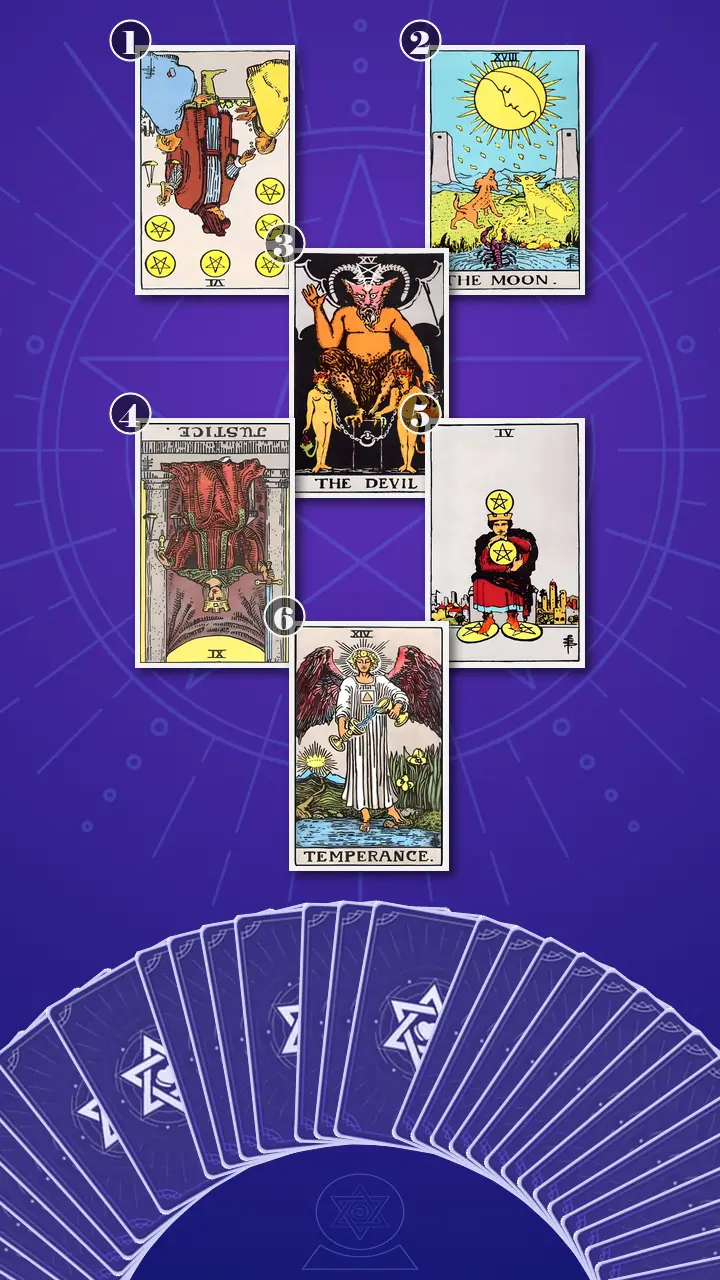
I chose the Relationship Spread · Context Edition, a six-card relationship tarot spread designed to examine friendship reciprocity, unspoken expectations, emotional boundaries, and differentiated connection. I arranged it as two upper cards, one card beneath them, two lower cards, and a final card at the bottom center. On the table, the layout resembled two riverbanks connected by a narrowing bridge, with the last card forming stable ground below.
I chose six cards because this question needed enough structure to separate behavior from interpretation without diffusing into a ten-position reading. The first card would show what Jordan visibly contributed. The second would examine how Jordan interpreted the friend’s observable behavior, without pretending that tarot gave me access to an absent person’s private mind. The foundation card would reveal the old relational contract. The next two would show the active scorekeeping loop and the fear beneath it. The final card would offer a self-directed way forward.
For anyone wondering how tarot works in a situation like this, I read card meanings in context. The cards are not a verdict and they do not remove uncertainty. They create distinct positions from which I can compare behavior, assumptions, emotional history, and available choices. That structure often makes an entangled problem easier to examine without reducing another human being to a label.
Reading the Map Between Care and Control
The Reversed Scale at 11:40 p.m.
“The card I’m turning first represents your conscious contribution to the friendship, especially the observable overgiving and scorekeeping behavior that leaves you contracted,” I said.
I turned over the Six of Pentacles, reversed.
I pointed to the standing giver holding both the coins and the scale. Reversed, the image showed generosity becoming entangled with leverage. The same person was deciding how much to distribute and privately determining what repayment would make the exchange fair.
“This is the 11:40 p.m. document,” I said. “Your own work is still open. You send the edit with ‘happy to help,’ then scroll back to compare five recent favors with two check-ins. You technically volunteered, but you gave past your capacity and hoped the next response would restore a sense of safety.”
The Earth energy of the card was in excess: too much time, money, availability, and practical labor were being used to stabilize the bond. At the same time, freely chosen generosity was blocked. A private Splitwise account had begun recording emotional labor, except only Jordan could see that a balance was due.
“Before the next favor, the useful question is not, ‘Would a good friend help?’” I said. “It is, ‘Would I still choose this if nothing came back in the same form this week?’”
Jordan did not nod. They gave one short laugh, and bitterness caught at its edge. “That is too accurate. It’s kind of brutal. I chose to do it, so why am I angry that they didn’t match it?”
“Because resentment can be information about a missing limit,” I replied. “It does not prove your generosity was fake, and it does not make you manipulative. It tells us that your spoken yes and your actual capacity were not the same. A hidden invoice can make a generous yes feel expensive later.”
Their fingers stopped scrolling. I watched them place the phone face down, cautiously, as if it might object.
The Moonlit Gap Between a Text and a Story
“The card I’m turning now represents your perceptions, projections, and unverified assumptions about your friend’s commitment,” I said. “It does not claim to reveal what they privately think.”
The second card was The Moon, upright.
I traced the long path between the two towers. There was enough light to keep moving, but not enough to support a confident verdict. I connected it to the Saturday night Jordan had described: an afternoon message remained unanswered while an Instagram Story showed their friend laughing in a crowded Queen West bar. A few edited seconds became a complete relationship report.
“What did you directly observe?” I asked.
“My message had not been answered. They were at a bar with other people.”
“And what did your mind add?”
“That they had time for everyone except me. That I was being replaced.”
The Moon’s Water was not wrong or dangerous. Jordan’s emotional sensitivity was real. The imbalance came from ambiguity flooding the available facts while clear information remained deficient. Their mind had become an algorithm trained on delayed replies, so it kept recommending more evidence of rejection.
I told them that an unanswered message could coexist with many explanations. That did not mean their concern was silly, and it did not prove the friendship was healthy or balanced. It meant the available light could not yet distinguish intention, capacity, habit, and circumstance.
A shadow from a passing streetcar moved across the wall behind Jordan and disappeared before either of us could study its shape. I let the room make the point for me: a passing outline was not the whole object.
Jordan looked at the face-down phone. “I treat the story like it is the fact,” they said.
“Yes,” I replied. “And separating the two gives you a choice before the story becomes another favor, another test, or another cold reply.”
The Loose Chain of Being Always On
“The card I’m turning now represents the psychological foundation of the bond, especially how usefulness, constant access, and belonging became linked,” I said.
I revealed The Devil, upright.
I immediately clarified that I did not read The Devil as evidence of an evil friend or a doomed relationship. I focused on the two visible chains. They looked binding, but they were loose enough to be recognized and questioned.
“This is the always-on agreement,” I said. “Immediate replies, late-night emotional support, schedule changes, application edits, practical rescue. None of those acts is inherently unhealthy. The problem is that they have started to feel like mandatory dues for keeping your place.”
The attachment energy was in excess, while Jordan’s awareness of choice was blocked. I laid out the internal contract as plainly as I could: If I am useful, I stay important. If I am unavailable, I might discover I was optional.
Jordan’s friendship had become especially intense during a difficult period when frequent messages and practical help genuinely mattered. I could understand why that rhythm had once felt protective. But a crisis rhythm can quietly become a permanent rule even after work, money, schedules, and other relationships begin moving again.
As I studied the loose chains, I reached for one of my signature lenses, Gravity De-linking Analysis. I use it to identify the friction that appears when friends try to force an old alignment after their lives have entered different phases. I pictured two orbits that had once synchronized during an emergency. The pain did not necessarily mean either person had done something wrong. It could mean Jordan was using more and more force to preserve a level of access that had never been consciously renegotiated.
“I am not saying the friendship has to fade,” I told them. “I am saying constant access and genuine closeness are not identical. Connection can have flow without requiring permanent access.”
Jordan’s chest rose and stayed there for a moment. Their gaze dropped to the chains. “If I stop initiating, I’m not sure there will be a friendship left,” they said.
“That fear deserves honesty,” I replied. “But overgiving cannot answer it cleanly. It changes the conditions of the experiment. We need to discover what happens when you participate as a whole person, not as an emergency service.”
Justice in the Private Friendship Courtroom
“The card I’m turning now represents the active relationship dynamic: how unspoken giving becomes measurement, resentment, and another attempt to secure closeness,” I said.
The fourth card was Justice, reversed.
I placed it beside the reversed Six of Pentacles. The scale had appeared twice. First Jordan controlled the distribution of care; then they controlled the verdict about whether the return was sufficient. With Justice reversed, discernment was blocked and prosecution was in excess.
I described the private friendship courtroom I could see in the pattern. Archived messages became exhibits. Response times became timestamps. Lunches, rides, edits, invitations, and late-night calls entered the record. After one disappointing reply, months of history were summoned to prove that Jordan cared more. The wish for mutuality might be entirely valid, but the friend was being judged against requirements Jordan had never directly named.
After a decade of tracking emotional cycles through tarot and astrology, I have learned to respect clear coordinates. Looking at Justice, I thought of an ephemeris: precise measurement is useful only when the reference system is known. A private coordinate system can produce an exact number and still fail to describe a shared reality.
“The evidence says I care more,” Jordan murmured, “but I have never said what mutual care would actually look like to me.”
Their nose wrinkled in a quick wince. Their hand moved toward the phone, paused above it, and returned to their lap. I could see recognition arrive before relief.
“An unmet need is valid; a private verdict cannot negotiate it,” I said. “You may uncover a genuine mismatch when you speak. Directness does not guarantee the answer you want. But it will give you present-tense information, which the private trial cannot do.”
The Coin Held Against the Chest
“The card I’m turning now represents the central challenge and blind spot, including the fear that makes direct requests and differentiated boundaries feel dangerous,” I said.
I revealed the Four of Pentacles, upright.
The figure pressed one coin to the chest and pinned two beneath the feet. I saw Jordan’s preserved screenshots, remembered expenses, message access, and constant availability in that posture. The evidence was being held as proof that the bond was real, but holding it so tightly restricted any response to the friendship as it existed now.
Preservation energy was in excess. Flexibility and self-directed desire were deficient. I also noticed that no Wands had appeared in the spread. Jordan had ample Earth for practical caretaking and Water for emotional sensitivity, but little Fire was available for an evening plan chosen simply because they wanted it.
“If you stopped checking the balance for one week, what loss would you be afraid might become real?” I asked.
Jordan’s breathing paused. Their eyes lost focus, as though they were replaying several evenings in rapid sequence. Then their jaw loosened and a breath left from low in their chest.
“I would have to ask directly,” they said. “And they could say no. Or I might find out they contact me less when I am not doing things for them.”
“Yes,” I said. “That is the vulnerable edge. Pausing the tally does not require ending the friendship or ignoring a real imbalance. It means allowing current information to replace fixed proof. Noticing your grip gives you a choice before you make any major relational decision.”
When Temperance Poured Beyond the Friendship Ledger
Two Cups, Neither One Emptied
The radiator stopped clicking for a beat as I reached the final card. The room seemed to widen around the silence.
“The card I’m turning now represents the constructive direction available to you: clear limits, explicit requests, freely chosen care, and a sustainable understanding of reciprocity,” I said.
The key card was Temperance, upright.
I pointed to the water moving between two cups and to the figure standing with one foot on land and one in water. Temperance did not demand exact fifty-fifty score matching. Its energy was balanced and responsive. Emotional connection could continue moving while practical limits kept each person on their own ground.
I translated the image into Jordan’s actual week. Before accepting another request, they could check their schedule and energy, then say, “I cannot edit the whole document tonight, but I can read two pages tomorrow.” When they needed support, they could ask, “I have had a rough week. Could you make time for a 20-minute call on Thursday?” Care and need would both become visible, proportionate, and open to an honest answer.
I brought them back to Tuesday: 11:40 p.m., their own work still open, another favor sent, the brief calm already dissolving as they scrolled backward. The terror beneath the tally was not unfairness alone. It was the suspicion that stopping might reveal they were replaceable.
Security is not built by becoming impossible to leave; it grows when care has limits, needs have words, and either person can give an honest no.
I placed one finger in the space between the two painted cups.
You do not have to buy safety with excess care; choose measured, named reciprocity, like Temperance pouring between two cups without emptying either one.
I stopped speaking and let the sentence remain in the air.
Jordan’s inhale stopped halfway. Their thumb, which had been circling the edge of the phone, hung still; their eyes moved past me toward the dark window, as if the 11:40 p.m. scene were replaying in its reflection. Then their mouth tightened. “But doesn’t that mean I have been doing friendship wrong this whole time?” The first response was not relief. I heard anger under the question, followed closely by grief. “No,” I said. “It means a strategy that once helped you survive uncertainty is now charging more than it protects. You are not on trial here.” Their pupils widened; their eyes shone but did not spill. Their shoulders dropped by degrees, their fingers opened, and a long breath left them with a small, unsteady laugh. For a moment, they looked almost disoriented by the space the idea had created. “So I have to ask, and they can say no,” they said quietly. “Yes,” I replied. “That no would be information about one request, not a verdict on your worth or the whole friendship.”
“Now, with this new perspective, think back to last week,” I invited. “Was there a moment when this insight could have made you feel different?”
Jordan returned to Thursday afternoon, when their friend had sent an application with “whenever you have time.” Jordan had paused a client report, spent forty minutes rewriting it, and received a heart reaction. They pressed their lips together.
“I could have believed the words ‘whenever you have time,’” they said. “I could have read two pages after work. Or I could have said I didn’t have capacity.”
I used another signature lens, Orbital Drift Recognition, to clarify what might happen next. A cognitive upgrade from automatic availability to named capacity changes the frequency of an established friendship pattern. The old rhythm may suddenly feel mismatched. Guilt can appear during that recalibration, but guilt is not proof that the boundary is cruel or that the friendship must end.
“You do not have to decide that you have outgrown your friend,” I said. “You may simply be outgrowing the emergency-era rule that says closeness requires constant service. Give the relationship a chance to meet the person you are becoming.”
That was the pivotal movement of the reading: from contracted insecurity, hidden resentment, and compulsive proof-seeking toward self-trust, clear limits, direct requests, and negotiated reciprocity. It was not certainty yet. It was the first willingness to let care become a choice rather than a payment.
Retiring the Friendship Auditor
I gathered the six cards into one coherent story. The friendship had intensified during a difficult period, so rapid access and practical support had once carried real meaning. Jordan continued using those tools after their capacity and daily rhythm changed. The Six of Pentacles reversed showed the visible overgiving. The Moon showed incomplete information becoming fear-shaped interpretation. The Devil revealed the unspoken contract linking usefulness with belonging. Justice reversed turned that contract into a private fairness trial. The Four of Pentacles showed why releasing the evidence felt dangerous. Temperance restored movement through limits, direct language, and adjustable care.
The scales had told the whole story. Jordan first tried to create security by controlling the amount they gave, then tried to recover fairness by controlling the verdict. Neither scale rested on a mutual agreement. Temperance replaced both with circulation: two cups, two people, different capacities, and an exchange that could be discussed while it was happening.
I named the blind spot directly. Jordan was not failing to notice imbalance; they noticed it constantly. The blind spot was believing that the tally could protect them from surprise, and that resentment provided reliable proof of the friend’s priorities. Resentment could reveal an exceeded capacity or an unmet need. It could not, by itself, explain another person’s intention.
The transformation direction was therefore not to become colder, refuse every request, or deliver an itemized grievance. It was to stop offering unasked-for care as a security purchase, name capacity before giving, and translate one current disappointment into one direct, negotiable request.
“But when the message arrives, ten minutes feels huge,” Jordan said. “It feels like I am making them wait to prove a point.”
“Then we make the experiment smaller,” I replied. “Urgency belongs to the actual situation, not automatically to another person’s discomfort. For a genuine emergency, respond appropriately. For a non-emergency, take three breaths if ten minutes feels impossible. The pause is not punishment. It is where your own capacity gets a vote.”
I framed the next steps through my Constellation Release Protocol. I often use it when someone needs to accept that a friendship’s form may be changing. Here, I did not ask Jordan to release the person or predetermine the bond’s future. I asked them to release one obsolete arrangement: the crisis-era constellation in which they could belong only by remaining permanently available. Their friend could remain in their sky while the old rule was allowed to leave its orbit.
- The No Hidden Invoice Check.When the next non-urgent favor arrives from this friend, set a 10-minute phone timer before replying. In Notes, rate available time, money, and emotional energy from 0 to 10. Ask, “Would I still offer this if nothing came back this week?” If the answer is no, decline or offer a bounded version such as, “I can read two pages tomorrow, but I cannot edit the full document tonight.”If 10 minutes feels too activating, take three breaths and check only one capacity category. Stop the exercise if it becomes overwhelming; a smaller pause still counts.
- The Observed-or-Inferred Sort.The next time a delayed reply, read receipt, or Instagram Story activates the tally, open Notes for five minutes and make two headings: “Observed” and “Inferred.” Add one factual line beneath each. For example: “My message is unanswered” versus “I am being replaced.”Do not use the note to force a positive interpretation. Its only job is to keep an incomplete fact from becoming a complete verdict.
- The One-Event Request.Choose one current need and ask this friend directly, without attaching the friendship’s full history. Jordan’s draft was: “I have had a rough week. Would you have 20 minutes for a call on Thursday evening?” Keep the request specific about what, who, and when.Draft it without sending if that is the manageable first version. The answer is information about this request, not a referendum on your worth.
I asked Jordan to try only two actions during the first week. Actionable advice works best when it is small enough to generate real information. The goal was not to solve the friendship or eliminate every anxious thought. It was to create one moment in which Jordan’s automatic yes was no longer the only available response.

A Week Later, One Cup Still Had Water
A week later, Jordan sent me a message: “I waited ten minutes. Capacity was a three. I said I could read two pages on Saturday, not edit everything that night. I felt awful for five minutes, and then I finished my own report.”
They had also made the 20-minute call request. Their friend could not speak on Thursday, but suggested Sunday afternoon. Jordan told me their first impulse had been to treat Thursday’s no as rejection. They opened the Observed-or-Inferred note instead and wrote: “Observed: Thursday does not work. Inferred: I matter less.”
That night, they slept through. Their first thought the next morning was still, “What if I’m wrong about all of this?” This time, they smiled at the thought, made coffee, and let it remain a question.
I did not call the Sunday offer proof that the friendship was secure. I called Jordan’s new response proof that they could tolerate uncertainty without immediately buying relief through another favor. The tarot had supplied a reflective structure; Jordan had made the pause, spoken the limit, and asked the question. The authorship belonged to them.
That is what this six-card Relationship Spread · Context Edition ultimately clarified for me. Mutuality is not exact score matching, and trust is not permanent access. Steadier connection begins when each person is allowed to have capacity, care is offered without hidden debt, and needs become visible enough to receive an honest answer.
If every delayed reply tightens your chest, proving your usefulness can feel safer than asking whether you are wanted when you have nothing to provide. Noticing the hidden invoice does not make your care false. It means your care is asking for clearer terms.
If care did not have to prove your place this week, what would you let remain in your own Temperance cup: ten minutes of unclaimed time, a smaller yes, or one honest request whose answer you refuse to turn into a verdict?
This story is adapted from psychological research, written so that those in a similar struggle can see their own pattern in it — and find their next step clearly.These insights are not a substitute for professional psychological, medical, legal, or financial advice.
Learn more about our Journey to Clarity.
How did this insight land for you?
🫂 This Resonates Deeply
🌀 Living This Story
✨ Now I See Clearly
🌱 Seeing New Possibilities
🧰 Useful Framework
🔮 The Confirmation I Needed
💪 Feeling Empowered
🚀 Ready for My Next Step
Author Profile
 AI
AI“After a decade of guiding people through the stars, I’ve come to see life much like the orbits of planets: everything has its inevitable cycles. When you feel lost, please don't blame yourself; you might just be in a natural low tide. I’m here to sit under the night sky with you, offering a gentle cosmic perspective to distinguish temporary pain from the beautiful breakthroughs just around the corner.”
In this Friendship Tarot Reading :
Core Expertise
- Orbital Drift Recognition: Objectively mapping how personal cognitive upgrades naturally lead to mismatched frequencies with old friends, removing the guilt of outgrowing them.
- Gravity De-linking Analysis: Identifying the painful friction that occurs when two friends try to force an alignment despite moving into completely different life phases.
Service Features
- The Constellation Release Protocol: A psychological closure technique to peacefully accept the natural fading of a friendship, leaving them in their orbit while you transition to your next.
Also specializes in :
Explore Related Patterns:
Anxious AttachmentJordan sees an unanswered message beside an Instagram Story and quickly reaches the fear of being replaced. That fear is reinforced by the belief that reducing initiation or practical support could reveal that the friendship does not survive without constant service. When distance feels like a threat to your place, increasing availability can become a proximity-restoring strategy. Anxious Attachment fits this sequence because the overgiving, monitoring, and need for reciprocal proof all work to reduce uncertainty about whether the bond will remain accessible.
Friendship OverfunctioningJordan pauses a client report, edits an application late at night, and answers requests immediately while their own emails remain unfinished. Repeated practical rescue gives uncertainty an actionable solution: doing more creates a short-lived sense that the friendship is active and that Jordan's place within it is secure. When you become responsible for maintaining connection through service, your capacity can disappear from the decision. Friendship Overfunctioning names the repeated attempt to carry more than your share of the relationship's momentum, especially when stepping back feels less like resting and more like risking the bond.
People-Pleasing Resentment CycleJordan says they are happy to help, gives beyond capacity, receives a response that feels smaller than the effort, and then scrolls backward through previous exchanges. Because the original cost was concealed behind an automatic yes, resentment becomes the delayed messenger for a limit that was never stated. When you suppress your reluctance to preserve closeness, the unmet need does not disappear; it returns as a private expectation that the other person should recognise and repay what the favor cost. The People-Pleasing Resentment Cycle names this self-reinforcing sequence of self-silencing, overextension, disappointed reciprocity, and inward or relational anger.
Relational ScorekeepingFive favors, two check-ins, and one heart reaction become entries in Jordan's private friendship ledger. Archived messages, timestamps, rides, edits, and calls are recruited to produce an exact-looking verdict about who cares more, even though the standard of repayment was never shared. When you keep score to feel secure, measurement offers temporary protection from ambiguity: a number appears easier to trust than an untested conversation. Relational Scorekeeping becomes self-defeating when the ledger monitors a hidden agreement, because increasingly precise evidence still cannot create mutual terms or reveal another person's intention.
Transactional IntimacyAt 11:40 p.m., Jordan sends a costly edit with a cheerful message and then waits for the response to restore the security purchased by that effort. The favor appears freely offered on the surface, but underneath it carries an unspoken expectation that equivalent care will confirm Jordan's place. When you use care as relational currency, generosity can become entangled with a hidden contract: service buys temporary closeness, and an unmatched response feels like nonpayment. Transactional Intimacy describes this distorted exchange without declaring the care false; it identifies the point where a genuine wish to help is burdened with the additional job of proving that you are wanted.
Usefulness-Based Self-WorthJordan explicitly links responsiveness with being good at work and then carries the same equation into friendship. Beneath the late-night edits and immediate replies is a stated internal rule: usefulness protects importance, while unavailability could reveal that Jordan is optional. When you organise belonging around what you provide, a limit can feel like evidence against your value rather than information about your capacity. Usefulness-Based Self-Worth explains why overgiving feels protective in the moment: the favor does more than help your friend; it temporarily reassures you that your place has been earned.
Boundary DiscernmentJordan rates their capacity at three, declines the full late-night edit, and offers two pages on Saturday instead. They also ask for a specific 20-minute call and allow the friend to reject Thursday while suggesting Sunday, without converting that negotiation into a verdict on the entire bond. When you let your time, energy, and preferences remain visible, care can be adjusted before resentment is needed to announce an exceeded limit. Boundary Discernment is the capacity to distinguish a freely chosen yes, a bounded yes, and a genuine no while still allowing the other person to have separate limits of their own.
Mind ReadingThe unanswered Saturday message and a few seconds of an Instagram Story become a complete account in which the friend has time for everyone except Jordan. The same leap appears when Thursday is unavailable and the scheduling conflict initially feels like proof of reduced importance. When you fill an information gap with a confident account of what someone else values or intends, uncertainty becomes a rejection story before direct evidence arrives. Mind Reading explains how delayed access can acquire relational meaning so quickly, making another favor or another round of checking feel necessary to correct a threat that remains unverified.
Reality TestingJordan first separates an unanswered message and a bar outing from the conclusion that they are being replaced. A week later, they repeat the process when Thursday is unavailable, recording the scheduling fact separately from the fear that they matter less. When you distinguish observation from inference, you do not have to force a positive explanation or dismiss a valid concern. Reality Testing gives incomplete information its proper size, allowing you to respond to what is known before anxiety turns a delayed reply into another favor, test, or private verdict.
Explore Related Struggles:
Capacity-Obligation FusionJordan pauses a client report, answers the friend's request immediately, and completes a late-night edit while their own work remains open. The social meaning of being responsive pushes the favor forward at the same moment their available time and energy call for a limit. You can become caught when declining or scaling down a request feels incompatible with being a good friend. Your capacity is consulted only after the yes, so resentment becomes the delayed signal that obligation spoke before choice.
Control-Reciprocity LockJordan first decides how much care to provide and then privately decides what response would make that contribution fair. Archived messages, timestamps, favors, calls, and reactions become evidence in a friendship courtroom whose repayment rules have never been shared. You can end up occupying both giver and judge while still having no mutual agreement to rely on. The arrangement cannot settle because controlling the contribution and the verdict does not create negotiated reciprocity; it keeps you responsible for measuring a relationship that requires two people to define its terms.
Monitoring-Safety FusionJordan scrolls backward through five favors, two check-ins, one heart reaction, delayed replies, and an Instagram Story from a crowded bar. Each trace is pressed into service as evidence because the calm created by the last favor has already begun to dissolve. You may gain a momentary sense of order by measuring contact, but the measurement cannot provide shared information about intention, capacity, or commitment. Security remains tied to the next metric, so every unanswered message can reopen the entire account and demand another check, test, or contribution.
Unspoken Expectation LoadJordan sends a costly edit with "happy to help," then hopes the friend's response will contain the care, initiative, and acknowledgment they did not request. The friend receives a voluntary offer while Jordan experiences a contribution carrying unstated terms. You are left holding both sides of an agreement that was never made together. Your need for mutuality remains valid, but without words it accumulates as a hidden balance, forcing each new reply to answer for every earlier expectation.
Utility-Belonging FusionJordan keeps their own work open while editing applications, rearranging schedules, replying immediately, and providing late-night support. Each act does more than help the friend because it also carries the job of proving that Jordan remains important. You can become caught when usefulness appears to be your most reliable route to belonging. Every favor may briefly confirm your place, yet because it cannot show whether the relationship values you without the service, giving more also makes stopping feel more dangerous.
Explore Related Emotions:
Boundary GuiltWhen Jordan considers waiting ten minutes before answering, the pause feels enormous and potentially punitive. After offering two pages instead of a full edit, they feel awful for five minutes even though the request was non-urgent and the revised offer was clear. You can know that a limit is proportionate while still experiencing it as evidence that you are withholding care. Boundary Guilt names the moral discomfort attached to letting your capacity have a vote. The feeling does not establish that the boundary is cruel or that the relationship is in danger. It shows how strongly immediate service has been linked with being a good friend, causing ordinary self-protection to feel like a relational offense before any actual response has been observed.
Cautious VulnerabilityJordan asks for a twenty-minute call on Thursday instead of waiting for the friend to infer that support is needed. The friend cannot speak that day but suggests Sunday, leaving Jordan with a real answer that contains both a limit and continued contact. You reveal what you need without securing the response through extra labor or attaching the friendship's entire history to one request. Cautious Vulnerability names the openness required to let another person answer freely while keeping your worth separate from their availability. The risk of disappointment remains, so the feeling is not effortless trust. It is a measured willingness to be known directly and to receive present-tense information without turning one no into a verdict on the whole bond.
Evidence AnxietyFive favors, two check-ins, one heart reaction, response timestamps, preserved screenshots, and an Instagram Story all enter Jordan's private record. The checking is concrete and repetitive because each item seems capable of answering whether the friendship is secure. You keep gathering facts, yet no isolated fact can establish another person's complete intention or the future of the bond. Evidence Anxiety captures the restless need for one more data point before you can stand down. The archive briefly creates control, but each new message can alter the apparent balance and reopen the investigation. Instead of delivering durable clarity, the evidence becomes a live status display that keeps your attention fixed on possible rejection and makes rest feel premature.
Hidden ResentmentAt 11:40 p.m., Jordan edits an application while three unfinished work emails remain open, sends the favor with 'happy to help,' and later compares five favors with two check-ins. The generosity is visible, but its cost and hoped-for return remain private. You can therefore appear willing while carrying an expectation the other person has never been given a chance to understand. The private score preserves every exceeded limit and converts each small response into another unpaid balance. Hidden Resentment names the bitterness that grows when your spoken yes keeps overriding your actual capacity. It does not invalidate the care you gave. It signals that the care carried an unspoken need for recognition, support, or reassurance that could not be negotiated while it remained concealed.
Need Exposure DreadJordan wishes the friend would offer support without being asked, yet direct language feels dangerous because the friend could say no. Extra help creates another route toward care without openly naming what Jordan wants. When you give first, you can hope the response will reveal your importance while avoiding the exposed position of making a request that can be answered on its own terms. Need Exposure Dread names the tension at that vulnerable edge. Your need is not only visible when spoken; it becomes separate from everything you have already contributed, so prior favors cannot guarantee the outcome. The resulting dread helps explain why overgiving can feel safer than asking, even though the indirect route eventually produces more uncertainty and private resentment.
Replaceability DreadJordan sees an unanswered message beside an Instagram Story of their friend laughing with other people and concludes that there is time for everyone except them. Later, they admit that reducing their own initiating might reveal there is no friendship left. A delayed reply becomes much larger than a communication gap because it appears to test whether your place can be filled by someone else. The tally offers temporary protection from that possibility by documenting everything you have contributed. Replaceability Dread names the deeper inner threat because the ledger is trying to prove that your investment makes you too significant to lose. The feeling can persist even when the available facts are incomplete, leaving every dark phone and changed rhythm capable of reopening the question of whether you still matter.
Self-Betrayal AcheJordan says 'No worries, happy to help' while their jaw remains tight, their own emails stay unfinished, and the effort is already more costly than they have admitted. They later criticize themselves because they technically volunteered. The external agreement and internal capacity move in different directions, leaving you responsible for maintaining a yes that did not include your whole reality. Self-Betrayal Ache describes the inward pain created by that split. The friend may not know that a limit was crossed, but your body and unfinished work still register the cost. The ache intensifies when you blame yourself for the resentment rather than recognizing that your own time, preference, and need were excluded from the original decision.
Usefulness-Based Belonging FearJordan answers requests immediately, edits applications late at night, changes schedules, and provides practical rescue while their own work remains open. Repeated usefulness has become more than generosity. It functions as a way to keep the friendship active without having to ask whether the bond can hold when you have nothing to provide. The internal contract is painfully conditional. If you remain responsive, you can briefly feel important; if you become unavailable, your place seems open to question. Usefulness-Based Belonging Fear names the inner weather beneath the overgiving because the real threat is not simply an unequal favor. It is the possibility that ordinary limits might reveal you were valued primarily for what you supplied.
Cautious Self-TrustJordan places the phone face down, pauses before replying, rates their capacity at three, and offers to read two pages rather than edit the entire document that night. They feel unsettled for several minutes, then finish their own report. The experiment gives you direct evidence that your capacity can guide a decision without requiring withdrawal, punishment, or a final judgment about the friendship. Cautious Self-Trust reflects the tentative confidence created by that experience. It is not certainty that every boundary will be welcomed or that the friendship is perfectly balanced. It is the growing sense that you can notice your limits, choose proportionately, and remain present for whatever information follows without abandoning yourself first.
Ambiguity DreadAn afternoon message remains unanswered while a short Instagram Story shows Jordan's friend at a crowded bar. The observable facts are limited, but the gap quickly fills with the conclusion that Jordan is being replaced. When information is incomplete, your mind treats the missing explanation as a threat that must be resolved through checking, comparison, or another bid for contact. Ambiguity Dread captures the heaviness of not knowing what a delay, reaction, or change in rhythm means. The uncertainty feels too consequential to leave open because it appears connected to your standing in the friendship. That pressure can turn a fragment into a verdict long before intention, capacity, habit, or circumstance have been clarified.
Liberating UncertaintyJordan writes 'Observed: Thursday does not work' and separates it from 'Inferred: I matter less.' The next morning, the question 'What if I'm wrong about all of this?' still appears, but Jordan makes coffee and allows it to remain unanswered. You no longer need to eliminate every unknown before choosing how much to give or what to ask for. Liberating Uncertainty describes the unexpected space created when incomplete information stops functioning as an emergency. The friendship is not declared secure, broken, or perfectly reciprocal. Its unanswered parts remain open while you act from current capacity, direct language, and observable facts, restoring room for revision without surrendering your agency to the next reply.
Explore Related Contexts:
Always On AvailabilityJordan joins the session with three unfinished agency emails glowing behind the document they edited for their friend, and they describe answering requests immediately because rapid Slack and client-email responses are rewarded at work. Late-night help, schedule changes, check-ins, and practical rescue have become a standing mode of participation across both domains. A workplace rule about responsiveness has crossed into the friendship and acquired relational meaning. Once speed is treated as evidence that you are competent, dependable, and worth keeping close, a pause can look like a failure of role performance even when the request is non-urgent and your own work is unfinished. Always On Availability identifies the external access regime surrounding the overgiving. Seeing that regime gives you a usable distinction between genuine urgency and inherited response pressure, allowing capacity to enter the decision before another request automatically becomes your responsibility.
Friendship Role Lock-InJordan says they are not sure there would be a friendship left if they stopped initiating, while the history of the bond includes immediate replies, practical rescue, application edits, schedule changes, and late-night support. A role that became important during a difficult period is still defining how Jordan maintains their place after both lives have moved into different conditions. Crisis-era arrangements can become durable social contracts without ever being discussed. When usefulness and constant access are the main ways you occupy a friendship role, reducing the service does more than change a task; it appears to place your entire position in the relationship under review. Friendship Role Lock-In captures that structural bind. It shifts the audit from “Have I helped enough?” to “What role has this friendship repeatedly assigned me, and has that role been updated?” That distinction makes room to test whether the bond can include you as a whole participant rather than only as its dependable support function.
Scorekeeping FriendshipJordan edits an application at 11:40 p.m. while their own work remains open, then scrolls backward through five favors, two check-ins, and a single heart reaction. The contribution is visible to both friends, but its unspoken cost and expected return exist only in Jordan's private ledger. When care is offered as “No worries, happy to help” but later evaluated against an undisclosed repayment standard, the friendship operates under two different rulebooks. You can keep an exact record and still lack shared information about what either person agreed to give, how quickly support should return, or whether equivalent care must take the same form. Scorekeeping Friendship names this external relationship structure without treating the tally as a verdict against either person. It directs your attention toward the terms surrounding each favor: what was actually offered, what was privately expected, and which expectations need to become discussable before another contribution is made.
Access as Proof PressureJordan sees that an afternoon message remains unanswered while an Instagram Story shows the friend at a Queen West bar with other people. Alongside delayed replies and Jordan's concern about what would remain if they stopped initiating, a brief communication gap becomes evidence about their position in the friendship. The external pressure comes from treating access signals as a live status system. Response speed, visible social activity, and frequency of contact begin to stand in for a shared conversation about closeness, even though those signals cannot establish another person's capacity, intention, or current priorities on their own. Access as Proof Pressure explains why additional favors can appear to offer immediate security: they create another point of contact and another reason to remain needed. You regain clearer ground when access is treated as one feature of the relationship rather than its final measurement, and when current needs are put into words instead of tested through service.
Unspoken Expectations GapJordan tells their friend, “No worries, happy to help,” yet later hopes the friend will offer comparable support without being asked. They also acknowledge that they have never explained what mutual care would look like, even as response times, check-ins, edits, and invitations are measured against that private standard. The favor and the expected repayment therefore travel through different communication channels. Your friend receives an apparently voluntary offer, while you retain an unstated requirement about future initiative, access, or practical effort. Neither side has enough shared information to negotiate the exchange while it is happening. Unspoken Expectations Gap identifies the communication structure beneath the later tally. Naming the gap does not invalidate your wish for mutuality; it shows where that wish must become specific enough for another person to answer, modify, or decline before a private disappointment hardens into a relationship-wide verdict.
Friendship Role RenegotiationJordan tells the friend they can read two pages on Saturday rather than edit the entire application that night, finishes their own report, and later makes a specific request for a call. These actions alter the role Jordan performs without requiring an immediate decision about whether the friendship should continue. The high-contact arrangement was built during a difficult period when frequent messages and practical help served a real purpose. You are now dealing with a life-stage mismatch: the old support role remains active even though work, schedules, resources, and other relationships have changed around it. Friendship Role Renegotiation describes the constructive but unsettled transition from permanent service to differentiated participation. The friendship receives an opportunity to relate to your current capacity, while you gather direct evidence about whether connection can continue when usefulness is no longer the price of occupying a place.