A Boundary Grew to Three Paragraphs, Then One Reply Stayed Unchased

The 10:38 p.m. Boundary That Became a Verdict
If you can present a Figma critique but rewrite a two-line boundary text six times after a last-minute plan, I suspect you know boundary guilt better than you know actual rest.
Maya was twenty-eight, a junior product designer in London, and very good at making complex systems feel intuitive for everyone except herself. She described a Tuesday night at 10:38 p.m., sitting at the kitchen table in her shared flat and moving one request from Apple Notes into WhatsApp, then back again. The washing machine hummed through the wall. Takeaway garlic lingered in the warm room. Her phone felt hot in her palm as she added a third apology.
The original request was simple: she wanted at least a day's notice before weeknight plans. By the time she considered pressing send, it had become three paragraphs explaining that she loved spending time together, understood that work was unpredictable, and could probably make an exception this Friday. Her jaw had locked. Her chest felt as though someone were tightening a drawstring behind her sternum, one small pull for every possible way the message might be misunderstood.
I reflected the sequence back to her. “You ask for more notice, they respond with less warmth than you hoped, and before anything has actually been decided, your body is already preparing to be left. Then you make the request smaller so closeness can feel normal again.”
She nodded and placed her phone face down between us. “Every boundary starts as self-respect and ends with me wondering whether I've pushed them away. I want closeness that doesn't require me to disappear, but I can't handle what a boundary might make them think of me.”
I could hear the central conflict clearly: Maya wanted mutual closeness and respect, yet every clear limit seemed to activate the fear that belonging was about to be withdrawn. Anxiety came first, but guilt, longing, and vigilance travelled underneath it. That combination powered the overexplain-check-soften cycle that had brought her to me with one question: “Why does every boundary I set make our relationship feel shaky?”
“A relationship can wobble while two real people adjust,” I told her. “A wobble is not yet a verdict. I'm not going to use tarot to tell you what your partner secretly thinks or predict whether you stay together. I want us to make the pattern visible, separate tension from disrespect, and find out where your own choices still live. Let's draw a map through the fog, then hand the pen back to you.”

Choosing the Bridge: A Five-Card Relationship Tarot Spread
I invited Maya to take three ordinary breaths and hold the question in mind while I shuffled. I treat this preparation as a transition for attention, not as a performance of mystery. It gives the nervous system a moment to arrive before the analytical mind starts building another case.
I chose the Relationship Spread · Context Edition, a five-card relationship tarot spread designed for boundary issues and reciprocal communication. How tarot works in a session like this is deliberately modest: the cards externalise a sequence that can otherwise feel like one solid block of distress. Card meanings in context help me examine behaviour, fear, communication, and available choices without pretending that a card can read another person's private motives.
The opening pair would separate Maya's observable contribution from her partner's observable contribution. The centre would show what boundary-setting activated between them. The final pair would expose the fear beneath the wobble and identify a practical next step. I chose this focused bridge instead of a broad Celtic Cross because Maya did not need ten different theories about her life. She needed a clean view of one repeating relationship dynamic.
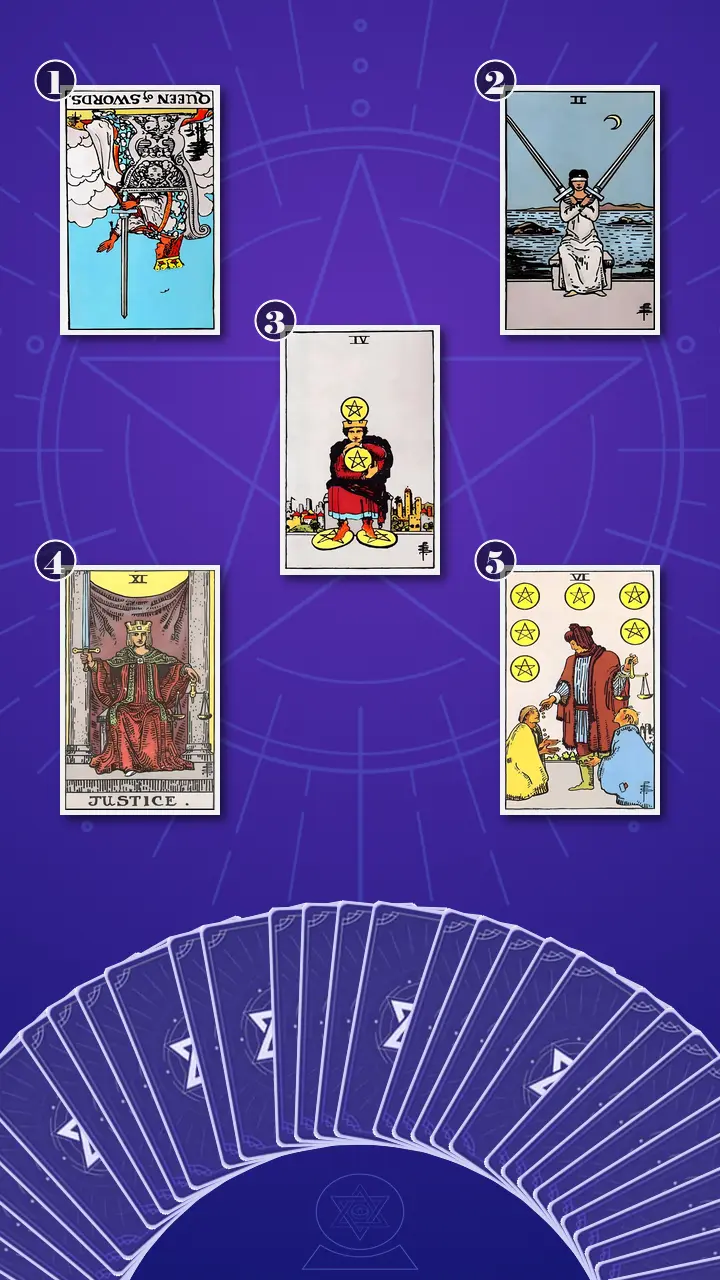
Where Clear Words Started Wearing Armour
Position 1: The Request Buried Beneath Reassurance
Now I turned over the card representing Maya's contribution to the relationship dynamic, specifically the boundary-setting behaviour and defensive communication she could observe in herself. It was the Queen of Swords, reversed.
I showed Maya the Queen's raised sword, the hand still open toward connection, and the solitary throne. Upright, this Queen can distinguish what is true from what is merely feared. Reversed, I read her energy here as Blockage mixed with Excess: clarity was available, but accumulated hurt and anticipated rejection were crowding around it. The request had to carry the need, prove Maya was loving, prevent disappointment, and guarantee that she would not be misunderstood.
I returned to the kitchen table. Maya opened Notes with one clear sentence about needing more notice. Before moving it to WhatsApp, she added apologies, reassurance, and exceptions until the message was doing two conflicting jobs: naming a limit and testing whether her partner would keep loving her after hearing it. Then she left the phone face up, ready to correct the first hint of discomfort.
“It sounds like the sentence underneath the sentence is, ‘I need to say this, but first I have to prove I'm not rejecting you,’” I said. “You are treating your need like a Figma file that requires unanimous stakeholder approval before it can be valid. By version twelve, the design is less accurate than version one because every revision is trying to prevent feedback from existing.”
Maya gave a short, bitter laugh instead of nodding. Her fingers tightened around her mug before releasing it. “That's so accurate it's almost brutal.”
“Accurate doesn't mean blameworthy,” I replied. “This is a protective strategy. It makes sense that you learned to manage other people's perception when tension felt dangerous. We are only asking whether that strategy still lets your real need reach the conversation.”
I asked her to identify the sentence that actually stated the need. She found it immediately. Everything after it, she realised, had been an attempt to control the emotional weather following the request. The Queen was not telling Maya to become colder or sharper. She was asking whether one direct sentence could remain visible without being wrapped in an apology campaign.
Position 2: The Full Stop on the Northern Line
Now I turned over the card representing the other person's contribution as Maya had actually experienced it, focusing on observable words and actions rather than assumed motives. It was the Two of Swords, upright.
The blindfold and crossed blades gave us a precise image of guarded uncertainty. I read the card as Blockage, with a Deficiency of explicit information. A short reply arrived, neither person addressed the practical arrangement, and the empty space filled with prediction. I was careful to tell Maya that the card could not establish why her partner had gone quiet. It could show only that the conversation had become suspended.
Maya had received “Okay.” at 8:14 the next morning while standing on the Northern line platform at Stockwell. Train brakes shrieked against the rails. Her coffee tasted bitter. She studied the full stop, checked the previous use of “okay x,” and began drafting a follow-up apology before the train arrived.
“The inner rule sounds like this,” I said. “‘I don't know what this means, so I will act as if the worst meaning is already true.’ Their first reaction is one data point, not the whole relationship. A brief reply may matter, but it cannot carry the evidential weight of every past conversation and every possible future.”
The Two of Swords was the Normal People problem in miniature: real feeling might exist, but inference, shame, and self-protection had replaced the next direct sentence. Maya wanted certainty, yet asking “Can we check in about this tomorrow?” felt more vulnerable than decoding punctuation for an hour.
I asked what her partner had observably done. Maya answered slowly: they had written “Okay.”, replied several hours later to another message, and had not yet discussed the request. She had no direct evidence that the relationship was ending. Her shoulders did not fully drop, but her thumb stopped rubbing the edge of her phone.
Position 3: The Familiar Rhythm Held Too Tightly
Now I turned over the card representing what boundary-setting activated in the shared interaction: the pause, accommodation, and defensive loop that made the relationship feel shaky. It was the Four of Pentacles, upright.
The figure clutched one pentacle to the chest while pinning two more beneath the feet. I read this as Excess: too much energy was being spent preserving the familiar shape of connection, leaving too little flexibility for the relationship to adjust around two real sets of limits. Although the Four often describes individual security-seeking, its position here located the grip inside the interactional loop rather than assigning moral fault to either person.
Maya told me about a Friday at 6:22 p.m. in her Shoreditch studio. Rain tapped the windows, the printer produced its dry mechanical whirr, and a last-minute invitation appeared over a Figma notification. She had planned a quiet night. Her shoulders had already climbed towards her ears, but she typed, “Maybe, let me see,” because maintaining the usual rhythm of contact felt safer than allowing closeness to change around a genuine no.
She later offered an exception before her partner requested one. She kept the evening empty in case reassurance was needed. The familiar contact pattern returned, but her need for rest became difficult to locate, and resentment followed it onto the bus home.
“The grip says, ‘If the rhythm stays the same, maybe the relationship is still safe,’” I told her. “But immediate calm can be expensive when your need pays for it.”
Maya's lips pressed together. Her gaze moved away from the card and stayed on the rain threading down my window. After a long pause, she said, “I thought I was being flexible. I didn't realise I was keeping myself available for repair before anyone had even said something was broken.”
I marked the Four as the spread's main blockage. The fear beneath it was not simply conflict. It was the possibility that a changed schedule, an awkward evening, or a disappointed tone might expose Maya as difficult to love. By shrinking the need, she could preserve predictability for a few hours, but she could not discover whether the relationship was capable of sustainable reciprocity.
When Justice Took the Verdict Out of the Room
Position 4: The Sword That Made Two Needs Visible
Now I turned over the card representing the underlying fear beneath the instability, specifically the belief that a clear limit could cost closeness, self-worth, or belonging. It was the key card of the reading: Justice, upright.
The room seemed to quiet around it. The kettle clicked off behind me, and a thin strip of late London light fell across the card, touching the upright sword and both scales with almost irritating precision.
An upright antidote in a fear position can look contradictory, so I explained the card carefully. Maya feared Justice as judgment. She imagined that setting a boundary placed her before an invisible court where her partner's first reaction would decide whether she was reasonable, selfish, or lovable. Yet Justice upright does not ask for a verdict on her worth. I read its energy as Balance: one direct statement, two visible sets of needs, and a proportionate assessment of what happens over time.
As an artist, I thought of a film production call sheet. A call sheet names when someone is available, what a scene requires, and which constraints the team must work with. It does not announce that the film has failed. It makes honest collaboration possible. Maya had been treating every limit as a cancellation notice when it was closer to necessary production information.
I used a diagnostic tool I call Toxic Script Identification. The name refers to a destructive script, not to labelling either person as toxic. In Maya's repeating scene, she became the Pleading Applicant, submitting a need alongside evidence that she still deserved closeness. A quiet or emotionally cool response then occupied the role of Silent Decider, whether or not her partner intended it. Maya's fear wrote the final line before the other person had actually spoken it.
I followed that with a Dialogue Loop Audit. The sequence was painfully compact: Maya said, “Could we have more notice?” Her partner replied, “Okay.” Maya answered the feared subtext rather than the visible message: “Sorry, I didn't mean we shouldn't see each other. Friday could still work.” The discussion about notice disappeared, and both people were left with tension but no clear agreement.
At 10:38 p.m., the phone had been warm in Maya's hand and the boundary had grown from two lines to three apologetic paragraphs. Nothing had been decided, yet her tight chest was already treating silence as an answer about whether she still belonged.
A clear boundary is not a verdict that love is failing; like Justice's upright sword and balanced scales, it is a fair statement of needs, limits, and shared responsibility.
I let the sentence sit between us. Then I translated it into the plainest language I could.
A boundary is information for negotiation, not a referendum on your lovability; the relationship is revealed by how both people work with that information over time.
Maya did not relax immediately. First, her breath stopped and her fingers remained suspended above the face-down phone. Then her eyes lost focus, as though she were replaying the kitchen table, the Northern line platform, and every exception she had offered before one was requested. Colour rose into her cheeks. “But doesn't that mean I've been doing it wrong this whole time?” she asked, with a brief flash of anger that sounded closer to grief. I told her no. She had been using a protective response that sometimes restored warmth quickly; she was now noticing its cost. Her jaw trembled once before unclenching. Her shoulders lowered, but the release brought a moment of almost dizzy stillness. Clarity had removed the impossible task of perfect wording, yet it had also returned responsibility for keeping her need visible. She exhaled from deep in her chest and said, more quietly, “So I don't have to decide what the whole relationship means from the first reply.”
“Now, with this new perspective, think back: was there a moment last week when this insight could have made you feel different?” I asked.
Maya returned to Friday. She could see a different version of the scene: declining the invitation, letting disappointment exist, using the evening for the rest she had planned, and returning to the conversation at an agreed time. The possibility made her look relieved, then briefly sad. She was beginning to understand how often she had abandoned her own evening before anyone had explicitly asked her to.
I named the shift I was witnessing. This was not a leap from anxiety to perfect confidence. It was one credible movement from rejection-driven hypervigilance and self-silencing towards clear boundaries, reciprocal conversation, and steadier self-trust. Her partner's reaction could matter without becoming the measure of Maya's worth.
To reinforce the insight, I set a ten-minute timer and asked Maya to open Notes. She wrote three headings: “What I need,” “What is flexible,” and “What I will do.” She placed one sentence beneath each, then built one boundary sentence with one reason. I reminded her that she did not have to send it automatically. She could choose whether, when, and where to use it. If her body became overwhelmed or a conversation felt emotionally or physically unsafe, the exercise could stop with the need remaining visible only to her.
Justice also gave us an ethical distinction. Temporary disappointment, awkwardness, or a delayed response is not automatically disrespect. Repeated pressure, insults, coercion, retaliation, or repeated disregard of a clearly stated limit are different information. Maya did not need to argue a boundary into legitimacy in a hostile exchange. Fair assessment included her right to pause or leave the conversation.
The Scale Became a Shared Calendar
Position 5: Care Measured by Mutual Follow-Through
Now I turned over the card representing a practical way to move towards clearer boundaries and reciprocal communication without deciding the relationship's outcome for either person. It was the Six of Pentacles, upright.
The merchant held a scale while distributing measured coins. I read this as Balance expressed through behaviour. Justice supplied the principle; the Six of Pentacles brought it down to earth. Care could be generous without requiring unlimited access, and reciprocity could be observed without becoming a courtroom scorecard.
I asked Maya to imagine a fifteen-minute conversation beside a shared calendar. She would request that weeknight plans be confirmed the day before. Her partner could say what amount of notice was realistically possible. Together, they could decide what happened when plans changed: a last-minute invitation could remain an invitation, and a no would not require an apology campaign.
For one week, Maya could notice visible actions. Did each person acknowledge requests, adjust where possible, respect a no, initiate repair, and follow through on an agreement? This was a two-way API in product-design language: both people stated constraints and responded to information. One person did not remain permanently available so the system could appear functional.
“I don't have to overgive before I'm allowed to ask what is mutual,” Maya said. She picked up her phone, but this time she opened her calendar rather than WhatsApp.
“Exactly,” I replied. “Closeness is steadier when two limits can stay in the room. The Six of Pentacles does not promise what your partner will offer. It gives you a way to notice whether exchange becomes more workable, remains uneven, or cannot be discussed respectfully. That information belongs to you.”
Finding Clarity Without Deleting the Need
Seen together, the five cards formed a sequence rather than a prediction. The Queen of Swords reversed showed truth becoming defensive because Maya expected clarity to cost connection. The Two of Swords showed the pause where incomplete digital cues became a verdict. The Four of Pentacles revealed the grip on familiar warmth, even when preserving it required self-erasure. Justice interrupted the script by making the boundary clear, proportionate, and discussable. The Six of Pentacles asked both people to turn that clarity into observable reciprocity.
The repeated swords told their own story: truth began raised defensively, crossed over the chest, and finally stood upright beside balanced scales. Maya's cognitive blind spot was not that she cared too much. It was that she had been measuring relationship security by how quickly tension disappeared, rather than by whether both people's needs could remain visible and receive respectful follow-through.
I told her that the transformation was not “set firmer boundaries and stop caring how anyone reacts.” Reactions matter in relationships. The shift was to stop treating one reaction as the final meaning of the relationship and to stop purchasing immediate calm with the disappearance of her need. Tarot had not chosen an outcome for her. It had given her production notes for the next scene, and she remained the person holding the pen.
- The One-Sentence Justice Note On Monday evening, spend ten minutes in Notes. Write one sentence under each heading: ‘What I need,’ ‘What is flexible,’ and ‘What I will do.’ Turn those lines into one boundary with one reason, such as: ‘I need a day's notice for weeknight plans because I need time to manage work and rest. If that isn't possible, I may sit the plan out.’ Choose a check-in time before speaking, such as the following evening after dinner. Start with the five-minute version if ten feels loaded. Write the need and one fact without sending anything. Until the check-in, place follow-up thoughts in Notes instead of automatically texting them.
- The Pattern Interruption Script During the next planned conversation, use a fifteen-minute window at the kitchen table or on a weekend walk. If a short reply or cooler tone triggers the usual apology loop, replace the default response with: ‘I notice this feels tense. We don't have to solve it immediately. My need is still one day's notice, and I'd like us to check in tomorrow about what is realistic for both of us.’ Then ask one reciprocal question: ‘What can you realistically offer when advance notice isn't possible?’ Role-play the line aloud once beforehand. The goal is not perfect delivery or instant agreement. It is to interrupt the known trigger-response sequence long enough for a different conversation to become possible.
- The Facts-Before-Forecasting Check For seven days, keep a private phone note with two sections: ‘Observed’ and ‘Predicted.’ Record exact words, timing, schedule changes, acknowledgements, respected noes, and follow-ups under Observed. Put thoughts such as ‘They are losing interest’ under Predicted. Add one line each evening for what Maya offered and what her partner offered. Keep this descriptive, private, and limited to three minutes a day. It is an observation tool, not evidence for prosecution. The minimum version is one fact and one forecast after a difficult exchange.
I added one firm boundary around the exercises themselves: Maya did not owe anyone unlimited discussion, instant composure, or repeated explanations. If an exchange became coercive, hostile, retaliatory, or persistently dismissive, the next constructive step could be to stop the conversation and seek support, not to produce a more persuasive paragraph.

A Week Later: One Reply Stayed Unchased
Seven days later, I received a short message from Maya. She had sent the one-sentence request and left it alone until the planned check-in. The first response was briefer than she wanted, and her hand had still reached for Notes. This time, however, she recorded the prediction instead of sending another apology.
At the check-in, Maya and her partner agreed to confirm weeknight plans by 6 p.m. the day before when possible. When that was not possible, a last-minute invitation would not carry an expectation that she attend. It was a trial arrangement, not a grand resolution, and both people would revisit it after a week.
She told me she slept through that night. Her first thought the next morning was still, “What if I've made this worse?” She noticed it, smiled once, and made coffee without opening WhatsApp.
I did not read that as proof that the relationship had been solved. I read it as something more useful: Maya had allowed one small truth to remain visible long enough for reality, rather than fear alone, to respond. Her Journey to Clarity was still in production, but she was no longer handing every first reaction the power to write the ending.
When the screen stays quiet after we name a need, many of us feel the chest tighten and the hand reach for another apology. We become caught between wanting closeness and fearing that being fully visible will cost us our place in it. Simply recognising that script means the next line no longer has to arrive automatically.
If your next boundary could be production information rather than a verdict, what one small truth would you leave on the call sheet, visible long enough for a real conversation to meet it?