Mapping One Accessibility Handoff: From Career Tabs to Evidence

The Two Tabs: Binary Career-Choice Paralysis Between a Stable Professional Role and Meaningful Work
If you are a product operations specialist in Toronto who opens LinkedIn after a draining workday and sees another peer announce a purpose-led career change, you may recognize career pivot anxiety before you even reach the salary section.
I met Alex at 10:47 p.m. in a Toronto apartment where the laptop fan hummed beside a cooling mug of tea. One browser tab held their current job description; three others held mission-led vacancies. I watched them drag salary from essential to optional in a colour-coded Google Sheet, refresh LinkedIn, and close the laptop with an informational message still unsent.
Alex worked as a product operations specialist at a mid-sized digital services company. Their role paid the rent, rewarded their competence, and gave them a professional story they could explain. Meaningful work felt like the other door, the one that might lead toward public benefit, access, or service. They said, "I can explain every option except the one I could actually try. Staying feels passive, but leaving feels performative."
To me, their uncertainty looked like trying to read two competing road signs through a windscreen covered in rain: the harder they stared, the more urgently they needed a perfect direction, and the less they could see the road beneath them. Their chest was tight, their shoulders stayed lifted, and their restless energy kept the decision tabs open long after the workday had ended. I told them, "You are not failing to find the answer; you may be asking one decision to provide evidence that only a small experiment can create. We do not have to force a resignation or predict your future tonight. We can use the cards as a clear thinking tool and draw a map toward finding clarity."

Choosing a Compass for the Career Crossroads
I asked Alex to place both feet on the floor, take one slower breath, and name the question without trying to solve it. I shuffled gradually while the traffic outside softened, using the pause as a practical transition from research mode into observation.
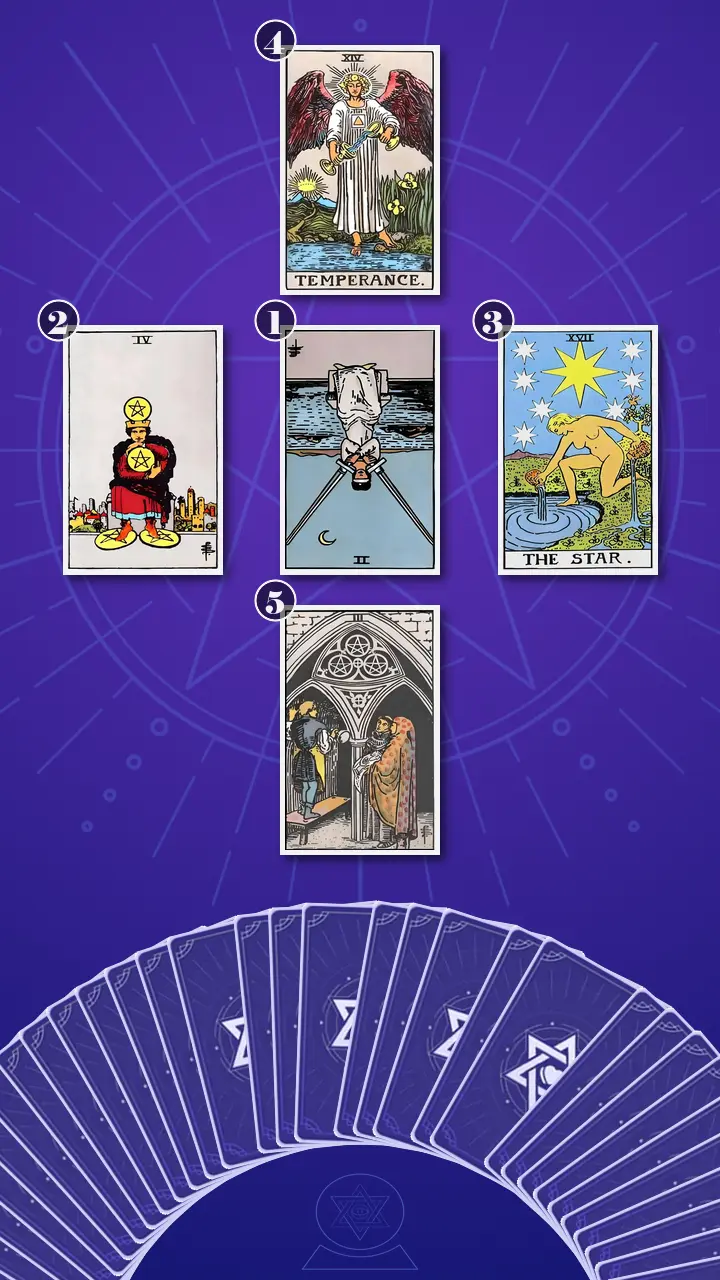
Today I used a five-card Decision Cross tarot spread for identifying and testing an integrative third career path. For anyone wondering how tarot works in a decision like this, I was not asking the cards to select an employer or announce a guaranteed outcome. I was using a compact structure to separate assumptions from evidence and to give each part of the dilemma a clear place to speak.
This contextual edition is the smallest classic structure that can hold the central blockage, the current role, meaningful work, the hidden factor between them, and a practical next step without turning the session into an unnecessary audit of Alex's entire life. The centre would show the observable decision blockage. The left card would examine what the current role protected and constrained. The right card would reveal what meaningful work represented beneath the job-title fantasy. Above the conflict, I would look for the missing third-path principle; below it, I would look for a reversible experiment.
Reading the Map Beyond the Screen
Position 1: The Comparison Loop - Two of Swords, Reversed
Now I turned over the card representing the observable decision blockage: repeated comparison between the current role and meaningful work without a testable next move. The card was the Two of Swords, in reversed position.
The image showed a blindfolded figure holding two crossed swords tightly across the chest, with unsettled water behind them. It was the exact posture of Alex at 10:47 p.m., keeping the current-role tab and meaningful-work tab in opposition while adjusting the comparison model instead of sending the message already sitting in drafts. The blindfold became the limits of screen-based certainty; the crossed swords became two complete career identities blocking movement; the water became the emotional and practical information that more research could not provide.
Reversed, this was blocked air: thought had become excess, and neutrality had become a choice with consequences. The pattern was no longer simply careful decision-making. It was a loop in which postponement briefly restored control, then created a reason to gather still more information. I said, "The question may not be which path wins. It may be which part of this binary you can loosen without treating the test as a commitment."
I returned to the inner line I had heard in the unsent message: "If I compare one more variable, I will finally feel ready." I contrasted the visible research with the absent conversation, contribution, or small piece of lived evidence.
I expected a quiet nod. Instead, Alex gave a short, bitter laugh. "That is almost rude," they said. I watched three small reactions move through them: first, their breath paused and their fingers froze above the spreadsheet; then their eyes lost focus as if replaying the same late-night sequence; finally, their jaw loosened and their shoulders dropped by a fraction. I did not make the recognition into a verdict. Naming the loop without blame was already a way out of it.
Position 2: What the Ground Protects - Four of Pentacles, Upright
Now I turned over the card representing what the current role genuinely protected, what resources it provided, and what became constrained when Alex treated it as a fixed identity. The card was the Four of Pentacles, in upright position.
The figure held one pentacle against the chest while two more pinned both feet to the ground, with a city set apart in the distance. I connected it to the praise Alex had received after handling a difficult operations issue. They had stayed late to volunteer for another task, then taken that praise as evidence that leaving would be irrational. Salary, competence, stakeholder trust, routine, and professional credibility were not imaginary comforts. They were real resources, especially in a city where rent and ordinary expenses made an all-or-nothing move materially significant.
But the energy was over-held earth: stability had become containment. Alex was protecting something useful so tightly that movement began to look like betrayal. I said, "Your current role can be a resource without becoming your whole identity." Product operations had taught them process mapping, stakeholder coordination, and workflow improvement. None of those skills belonged exclusively to one job title.
I remembered the trading floor where I had spent years watching people confuse the price already paid with the value of the next decision. The lesson was not to become detached or cold. It was to separate the asset from the story attached to it. A trusted skill could travel. A salary could be protected while a different use for competence was tested.
Alex's hand moved from their chest to the edge of the table. They did not look relieved yet. They looked less defended, as if the role had stopped being a wall and become something they could carry.
Position 3: The Light They Are Chasing - The Star, Upright
Now I turned over the card representing what meaningful work represented to Alex, including the values it revealed and the expectations attached to it. The card was The Star, in upright position.
One figure poured water into a pool and onto the earth, remaining connected to both. Above them, one large star held its place among smaller lights. I thought of the polished LinkedIn announcement Alex had seen on the TTC Line 1, the warm lift in their chest when a former colleague described leaving tech for purpose-led work, and the comparison hangover that followed when every vacancy failed to feel certain enough.
The Star carried genuine hope, renewal, authenticity, and direction. Its water was flowing rather than blocked. Yet the energy could become excess when Alex demanded that meaningful work arrive as a perfect job title, a clean escape from administration, meetings, and ordinary friction. I asked, "When you say meaningful, which problem or contribution are you actually pointing toward? What makes your attention feel usefully awake, even when the task itself is not glamorous?"
The card did not dismiss the longing. It gave the longing better criteria. Meaning could be a signal repeated across conversations, problems, and contributions, not a product landing page that promised an entirely different life. The water reaching both the pool and the soil suggested that values could replenish inner life and practical work at the same time.
Alex looked from The Star to the Four of Pentacles. Their expression held recognition and a trace of disappointment. They had wanted the right title to solve a values problem. I saw them begin to consider that the title might be the least useful unit of analysis.
When Temperance Poured Between Two Cups
Position 4: The Bridge Above the Argument - Temperance, Upright
Now I turned over the card representing the overlooked third-path principle that could integrate useful parts of the current role with the values associated with meaningful work. The card was Temperance, in upright position.
The room seemed to narrow around the image. The air conditioner clicked off, leaving the faint sound of a streetcar bell beyond the window. Temperance stood with one foot on land and one in water, moving liquid between two raised cups. Neither cup had been discarded. The card's upright energy was balance through deliberate synthesis, patient adjustment, and flexible self-trust.
I told Alex that the third path was not compromise for its own sake. It was a designed combination: one trusted skill, one meaningful problem, and one bounded setting in which reality could answer back. An accessibility problem in a customer-facing workflow could meet their operations skill. An internal initiative, a collaboration with a community organiser, or a one-week process pilot could let both practical footing and values-based curiosity remain in the same frame.
At that point I used my signature diagnostic, Sunk Cost Neutralization. I drew three headings on a clean page: what Alex had genuinely built, what they had already spent and could not recover, and what future opportunity cost might come from leaving the question untested. Time, salary, and competence belonged in the first conversation as resources, but they did not own every future year. Past investment could be respected without being allowed to dictate the next move. The exercise turned a vague fear of waste into separate, discussable variables.
Alex was still trying to make the choice safe enough to be permanent. The spreadsheet criteria moved from essential to optional; the unsent message sat in drafts; the screen looked busy, but no new evidence had entered. I could feel the old demand: understand the whole path before touching any part of it.
You do not have to prove that work matters by abandoning everything you have; combine one trusted skill with one values-led experiment, as Temperance pours between two cups.
For a second, Alex did not move. Their breath stopped halfway in, and their pupils widened as they looked at the two cups. Then their eyes left the card and travelled across the page, as if the familiar choices had become physical objects that could be rearranged. I saw the moment an old memory entered the new frame: the saved accessibility notes, the colleague who had mentioned a recurring handoff problem, the process skills they had treated as evidence for staying rather than material for building. Finally, a long breath moved through their chest. Their clenched hand opened against the table, and their shoulders lowered. The exhale carried relief, but also a brief, lightheaded blankness. A smaller decision meant fewer excuses and more responsibility for noticing what happened next. Their voice came quietly: "So the test can be real without being permanent."
I asked, "Now, use this new perspective to think back to last week. Was there a moment when this insight could have made things feel different?"
That was the first movement from contracted uncertainty toward grounded curiosity. We were not claiming that one experiment would reveal a perfect career. We were making room for designing a bounded skill-plus-meaning experiment to gather lived evidence before making a permanent career decision. The third path might not be hidden in another job listing; it might begin where one trusted skill meets one meaningful problem.
Position 5: The Workbench - Three of Pentacles, Upright
Now I turned over the card representing guidance for moving forward: one reversible, evidence-producing action that could interrupt the analysis cycle. The card was the Three of Pentacles, in upright position.
A craftsperson stood on a raised bench while two collaborators held and discussed a plan. The unfinished arch beneath them was not a failed building. It was visible work in progress, shaped by skill, scope, conversation, and feedback. I connected it to a possible Wednesday at Alex's company: a blank Notion page, one colleague, one recurring accessibility problem in a customer workflow, and a map of the handoff rather than another job-board search.
The energy had returned to earth, but it was no longer private possession. It was collaborative construction. Instead of privately designing an entire career answer, Alex could ask one person about one real problem, offer one relevant piece of work, and give the contribution a clear ending point. A 60-minute review or one-week pilot could produce more useful information than another month of imagined outcomes.
The absence of Wands mattered to me. There was no demand for a dramatic burst of career-change momentum. Action would have to be kindled deliberately through a small task. Alex opened a new note and wrote three words: skill, problem, collaborator. Their chest was still tight, but the tension had changed from frozen pressure into cautious curiosity.
The Working Draft: Finding Clarity Before the Exit
The Third Path Is a Design, Not a Job Title
The five cards told a coherent story. The reversed Two of Swords showed why Alex kept researching without moving: analysis offered temporary control while keeping lived evidence outside the room. The Four of Pentacles showed what staying protected, and why those resources deserved respect rather than contempt. The Star restored the values beneath the longing, while also separating meaningful contribution from an idealised destination. Temperance changed the dimension of the argument, and the Three of Pentacles brought that insight down to a shared piece of work.
The blind spot was treating postponement as neutral and assuming that a valid career move had to resolve the entire role-versus-meaning conflict at once. The transformation direction was simpler and more demanding: stop comparing two complete identities and run one bounded experiment that combines an existing skill with a personally meaningful problem. That is how career direction can move from prediction to curiosity, then from curiosity to observed fit.
I also applied my Asymmetric Risk-Benefit Analysis. A short conversation with one collaborator has a limited, reversible downside and can produce information that a spreadsheet cannot. A one-week pilot can be paused, revised, or declined. A resignation has larger fixed consequences. Meanwhile, endless comparison carries its own opportunity cost because it consumes evenings without testing the question. This was not pressure to leave. It was a way to give each possible move an honest shape.
I call the next exercise The 3rd-Option Leverage Test: a rigorous but contained 72-hour strategy for finding a third path when Option A and Option B feel like zero-sum dead ends. I told Alex, "Do not make the experiment carry the weight of a resignation letter. Give it one person, one problem, one hour, and one learning question."
The Two-Cup Career Test: Actionable Next Steps
- Name one overlap in 20 minutes.By Tuesday evening, choose one existing skill from the current role, such as process mapping, stakeholder coordination, or workflow improvement, and place it beside one meaningful problem already named in your saved notes. Write one sentence in a Notion page or phone note: I could use my skill in ___ to explore the problem of ___ with ___ for ___ minutes or one week.If the spreadsheet turns into another comparison system, use a plain note and stop after one pairing. Do not calculate every salary scenario before the test exists.
- Run the 72-hour third-option test.Within 72 hours, send one short message to a colleague, community organiser, or mission-led contact and book a 30-minute conversation about one real problem. During or after the conversation, offer a bounded 60-minute contribution or a one-week pilot with a clear deliverable, such as mapping one user journey, reviewing one handoff, or documenting one operational gap.State the time limit before beginning. Keep the experiment unpaid or explicitly time-limited unless you freely choose otherwise, and remember that you can pause, decline, or stop without turning the result into a judgement about your worth.
- Debrief the evidence in 10 minutes.After the conversation or pilot, write three factual notes: what you did, what changed for another person or the process, and what you noticed in your body before and after. Rate usefulness, curiosity, and depletion from 1 to 5, then choose one adjustment for the following week: repeat the contribution, change the problem, change the collaborator, or stop and record why.A mixed or ordinary result is still evidence. Let a low score guide a smaller adjustment instead of forcing an immediate exit, and review the notes after a neutral pause rather than in the middle of a workday.

A Small Proof, Not a New Identity
Four days later, I received a Slack message from Alex: "I mapped the accessibility handoff with Priya for an hour. It is not a new career, but it is real." They had not resigned. They had not discovered a perfect title. They had produced one piece of evidence about what it felt like to use a trusted operational skill on a problem they genuinely cared about, with another person able to respond.
The next morning, Alex slept through the night, but their first thought was still, "What if I am wrong?" This time they smiled, opened the three-signal note, and added a question instead of another vacancy. The change was light but not complete, and that was precisely why I trusted it.
My Journey to Clarity with Alex did not end with the cards deciding their future. It ended with the decision becoming workable. The current role could remain a resource without being a permanent identity; meaningful work could become a practical criterion; and clarity could be built from contact, contribution, and feedback before it was named as a career.
When staying makes your chest tighten around a life you can explain and leaving feels like stepping off a financial ledge, it is easy to mistake the need for a small test for proof that you cannot trust your own judgement. But needing a bounded experiment can simply mean that your next answer belongs in the real world, where it can be observed and revised.
If you did not have to choose a new identity this week, what existing skill could you place beside one meaningful problem for a small, time-limited test?