Twenty-Seven Family Chat Messages, Then a Boundary Held Through Dinner

The Twenty-Seven-Message Dinner
I told Alex, “If you can coordinate six stakeholders at work but lose an entire evening rewriting two relatives' texts, family mediator burnout may look less like one dramatic fight and more like twenty-seven unread messages before dinner.”
I was sitting across from her in my Toronto reading room when she described the Tuesday night that had brought her to me. At 8:47 PM, her nonprofit budget sheet was still open on her laptop, the family iMessage thread had jumped from three unread messages to twenty-seven, and she had opened two private chats to soften everyone's wording. The fridge hummed beside her. Ginger takeout had gone cold. Her phone felt warm against her palm, while her jaw stayed locked and her shoulders rose toward her ears.
She had tried to keep her evening. She had also tried to keep the family connected. The contradiction was doing the real work: she wanted the fight to stop, but feared that stepping out of the mediator role would let everything worsen. “I want peace,” she said, “but I keep becoming part of the argument. If I stop replying, everyone will think I do not care.”
I watched her thumb hover over another draft and then settle against the phone without pressing send. The anxiety was not an abstract feeling in that room; it moved through her like a fire alarm wired directly to her hands, chest, and teeth. I told her that I understood why the role had become so hard to leave, and that I would not use the cards to decide who was right or predict how her relatives would react. I would use them as an objective map of the message route, the pressure beneath it, and the part she could choose for herself. Care is not the same as carrying. Our work that evening was to find clarity without making her responsible for creating it for everyone else.

Choosing a Bridge Through the Noise
I asked Alex to place her phone face down and take three unhurried breaths. I did not present this as a mystical requirement. It was a small psychological threshold: a way to move from reacting to notifications to observing the question she had actually brought into the room. I shuffled slowly while she kept both feet on the floor.
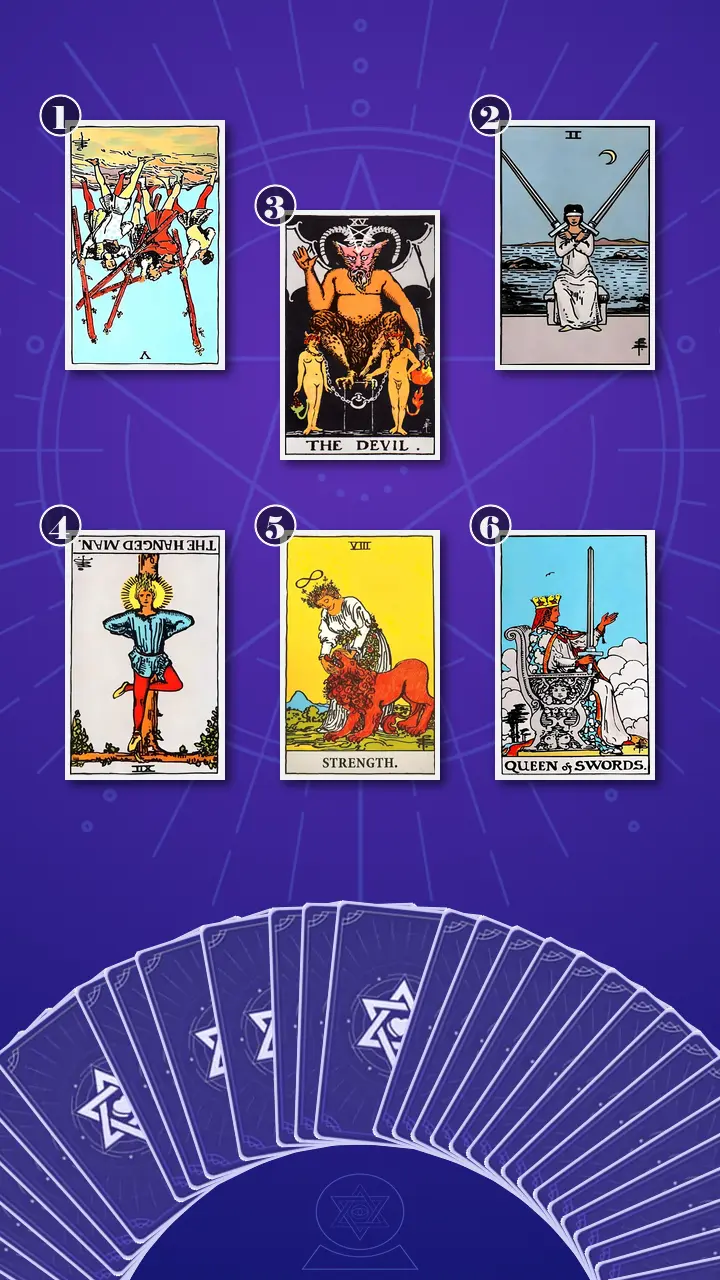
“Today I am using the Relationship Spread · Context Edition,” I explained. “It is designed for a relationship pattern rather than a prediction about another person's behaviour. In this case, it gives us room to see your current mediator stance, the wider family field, the escalation loop, the hidden strain, the resource available to you, and a self-chosen next step.”
I also explained this to the reader who might be looking up how tarot works in family conflict: the cards would not prove that one relative was toxic, determine whether Alex should cut anyone off, or guarantee that a boundary would calm the group chat. The value of the reading would come from placing card meanings in context and comparing the symbols with observable behaviour. The six cards formed a shallow bridge in two rows. The upper row would diagnose the route into the conflict. The lower row would move from over-sacrifice through regulation to direct ownership.
“The first card shows what you visibly do when the argument recruits you,” I said. “The second shows the family field that keeps direct speech postponed. The third exposes the repeating loop. Then we will look at the strain beneath your role, the strength that does not require control, and the boundary you can choose without deciding for anybody else.”
The Map of the Relay
The Crossed Wands of the Mediator Role
“Now I am turning over the card for the current mediator stance: the observable behaviour of stepping into the family argument, relaying messages, and accepting the short-term relief that follows.” I turned the first card. “This is the Five of Wands, in reversed position.”
The five figures on the card held crossed wands with no clear centre and no agreed leader. I connected that image to Alex's 8:47 PM kitchen table: the family thread, two private chats, the unfinished budget sheet, and the neutral summary she was trying to publish back into the argument. The modern scene had the overlapping dialogue of The Bear, where every voice reacts before anyone has finished speaking. Alex was trying to become the person who could lower the volume, but her edits gave the disorder another object to react to.
Reversed, the Five of Wands did not mean that the conflict had disappeared. It showed scattered energy turned inward and managed indirectly. The brief six-minute quiet after Alex's summary was a temporary reduction in noise, not resolution. The original speakers still had not taken ownership of the direct conversation. The energy was blocked by over-coordination: the harder Alex worked to arrange every voice, the more her wording became part of the contest.
I read the inner sentence I could hear beneath her behaviour: “If I organise every voice, maybe nobody will get hurt.” Then I named the observable result: somebody disputed the translation, another person asked what Alex had really meant, and the three-way loop started again. I asked, “What boundary would let you stop managing the exchange without pretending that the conflict does not exist?”
Alex gave a short, bitter laugh instead of nodding. “That is too accurate,” she said. “Almost cruel.” Her thumb stopped over the screen, and she looked from the card to the cold container of food beside her. I told her the card was not a verdict on her intentions. It was showing the short-term reward of being useful and the hidden cost of becoming the communication route. Her expression softened, but she kept one hand wrapped tightly around her phone.
The Still Water Behind the Family Field
“Now I am turning over the card for the family field: the guarded stalemate and indirect communication that pull you into the argument without assigning a fixed identity to anyone involved.” The second card was the Two of Swords, in upright position.
I pointed to the blindfold, the crossed swords held across the figure's chest, and the still water beneath the crescent moon. Alex knew exactly what the image looked like in modern life. One relative sent her screenshots and asked what the other person had intended. The other called privately and asked Alex to explain what had supposedly been said. Each person held a defended position, while the direct sentence between them remained unspoken.
The upright Two of Swords showed a blockage in the air of communication. It was not peace; it was protected stillness. The family field had found a way to postpone exposure by asking Alex to hold two incompatible versions at once. Each relative could remain guarded, and Alex could keep believing that the right explanation might make direct speech safe.
“What conversation is being postponed each time you step in?” I asked. “And which words belong to the original speakers, even if they say them badly, awkwardly, or later than you would prefer?”
Alex lowered her eyes to the card. “They want me to tell them what they cannot say to each other,” she said. “I keep calling that helping.” I heard no accusation in her voice, only the first clean separation between listening and carrying. She rubbed the edge of a card with one finger, then let her hand fall into her lap.
The Chain Made of Good Intentions
“Now I am turning over the card for the escalation loop: the pattern in which guilt, usefulness, control, and the relay role reinforce one another.” I placed the third card between the upper row and the lower row. “This is The Devil, in upright position.”
I brought Alex back to the Saturday cafe near Trinity Bellwoods Park. Her friend had found a table, the espresso grinder was shrieking, and Alex had stepped out of the queue to record a family voice note after seeing, “You're the only one they'll listen to.” She had felt important and trapped in the same breath. No formal rota had assigned her the shift, yet her body had reported for duty as if the notification were a contract.
The Devil was not a prediction about her relatives' character. It showed an attachment that had become compulsive through repetition. Alex carried the message, the original speakers avoided direct ownership, the conflict briefly quieted, and the next argument recruited her even earlier. Every message you relay gives the conflict another route through you.
This is where I used one of my signature diagnostic tools, Guilt-Debt Neutralization. I explained that I treat parental or family emotional blackmail, and the implied debt inside phrases such as “You're the only one who can fix this,” as unverified psychological bad debt. I audit the claim rather than automatically paying it. What was actually promised? Who made the promise? Is Alex responsible for another adult's direct conversation? Does refusing a relay request truly cancel the relationship, or does it only interrupt an established service?
“This does not require me to label anyone manipulative,” I said. “It asks me to separate a feeling of obligation from an actual obligation. The loose chain is real as a pressure pattern, but it is not a law of nature.”
Alex's breath caught first. Her eyes moved away from the Devil and seemed to replay the cafe message. Then her fingers tightened around the edge of her sleeve as she silently tested the sentence, “If I say no, I may stop mattering.” After a long pause, her shoulders lowered by a fraction. “I want to say no,” she admitted, “but I do not want to discover that usefulness was the only reason they kept me close.”
I answered carefully. “The cards cannot tell us what they will choose. They can show that belonging and availability have become fused in your mind. We can work on separating them without making a dramatic decision tonight.”
The Exit That Never Arrives
The Suspension Beneath the Good Daughter Story
“Now I am turning over the card for the hidden role strain: the place where delayed withdrawal and over-sacrifice keep you available past your limit.” The fourth card was The Hanged Man, in reversed position.
I described the Sunday at 10:42 PM that Alex had given me: one sock still on, the room dark except for the blue-white phone screen, shower pipes rattling through the wall. She had typed, “I need to sleep,” deleted it after another notification, and stayed for forty more minutes. The stopping point kept moving because she was waiting for the argument to become calm enough to make leaving look acceptable.
The Hanged Man reversed showed perspective turned into stagnation. A pause could create insight when it was chosen; here, the pause had become a suspended life. Dinner, sleep, exercise, weekend plans, and the right to leave an emotionally charged call were all postponed until everyone understood each other. That perfect exit did not arrive because no argument could provide permission for Alex to have a limit.
“What were you waiting to happen before you believed you were allowed to leave?” I asked.
She stared at the phone she had placed face down. “I was waiting for them both to feel understood,” she said. “Which means I was waiting forever.”
I let the silence stay intact instead of rushing to comfort her out of it. A pause is not abandonment; it is where ownership becomes visible. Alex breathed out slowly, and for the first time that evening her hands were still without being held together by tension.
The Courage to Lower the Volume
Strength Without Taking Over
“Now I am turning over the card for the regulating resource: the quality that lets you tolerate emotional intensity without taking control of the exchange.” The fifth card was Strength, in upright position.
The woman on the card did not overpower the lion. Her hands were gentle, her expression steady, and the infinity symbol above her head suggested a capacity that did not need to prove itself through force. I translated that into the ten minutes between receiving “Call me now” and deciding whether to respond. Alex could notice a clenched jaw, place both feet on the floor, and let the phone remain face down long enough for urgency to stop receiving automatic publishing rights.
Strength was not emotional suppression and it was not agreeing with every account. It was the ability to say, “I can hear that you are upset,” without adding, “and I will explain it to the other person.” I asked Alex whether calm presence could remain caring even when it did not produce immediate agreement.
The soundscape in the room changed as I spoke. I stopped shuffling. The heater clicked off. Instead of overlapping alerts, there was one measured sentence followed by deliberate silence. Alex unclenched one hand, then the other. “I am worried that a calm boundary will sound cold,” she said.
“Calm is not cold,” I replied. “It is a way of lowering the volume without rewriting the track. You can acknowledge the heat and leave the actual words with the person who said them.”
She looked at the Strength card and gave a cautious nod. I saw the possibility become physical before she trusted it intellectually: her breathing slowed, her shoulders moved away from her ears, and her phone stayed face down for another minute.
When the Queen of Swords Opened the Sky
The Clear Witness at the Edge of the Intersection
The room became noticeably quieter before I touched the last card. I placed my hand beside it rather than turning it immediately. “This is the bridge between insight and action,” I said. “It does not tell us what your family will do. It shows the next part of the relationship that belongs to you.”
“Now I am turning over the card for the self-chosen next step and integration: the boundary that turns the transformation into a behaviour you can choose without deciding for anyone else.” I turned the card. “This is the Queen of Swords, in upright position.”
The Queen held one sword upright before her, while her other hand extended toward what was directly in front of her. The open sky behind the throne gave the image room to breathe. I set it against the Two of Swords, where two blades had protected a postponed conversation across the figure's chest. The visual movement was from defensive symmetry to deliberate clarity, from carrying an unspoken dispute to naming a boundary directly.
In modern life, the Queen was Alex replacing six carefully edited explanations with one sentence in Apple Notes: “I care about both of you, but I am not going to relay messages or interpret what either person meant. Please speak to each other directly when you are ready.” The upright sword was the clean sentence. The extended hand marked what she could offer. The open sky represented communication no longer crowded by side-channel interpretations.
I felt an old Wall Street reflex move through me as I studied the card. Years on a trading floor had taught me that a complicated position did not become safer because I kept editing the explanation around it. Risk became legible when ownership, limits, and decision rights were stated plainly. I had once mistaken a dense spreadsheet for control. I now recognised the same temptation in Alex's beautifully worded messages.
The Queen's energy was balanced Air: clear perception, direct speech, compassionate detachment, and a willingness to let discomfort belong to the people having the conflict. It did not ask Alex to become hard. It asked her to become a clear witness instead of the family's communication infrastructure.
At 8:47 PM, the takeout is cold, the family chat has twenty-seven unread messages, and Alex is editing two private drafts while her jaw locks. The harder she works to make every voice safe, the more the argument learns to travel through her. She is still trying to earn calm by becoming the route.
Do not measure care by how completely you can control the exchange; like the Queen of Swords holding her blade upright, speak one clear boundary and let each person own their words.
For a moment, Alex's breath stopped and her thumb hovered above the phone. Then her eyes lost focus as if the last several months were replaying in quick, silent clips: the cold dinners, the postponed bedtimes, the messages she had rewritten until nobody recognised the original words. A flush rose along her cheeks. Her pupils widened, and her eyes grew bright, but she did not look away from the Queen.
“But does this mean I was wrong every time?” she asked, her voice suddenly smaller. I heard the anger and grief underneath the question. Her shoulders were still braced, and one hand was curled into a fist against her knee. I told her no. Her old strategy had sometimes created a few quiet minutes. The insight was not that she had failed; it was that she had been paying for temporary quiet with her time, attention, and sense of responsibility.
Her fist opened slowly. Her shoulders dropped, first by a centimetre and then enough for a full breath to reach her ribs. She gave a shaky exhale that sounded almost like an “oh,” and pressed both feet into the floor. “I can care without being the route,” she said. I invited her to use that new perspective to revisit the previous week: was there a moment when seeing the difference between care and carrying could have let her feel different, even if the family argument itself stayed unresolved?
I named the emotional movement clearly. This was a first step from guilt-driven hypervigilance and compulsive mediation toward compassionate detachment, direct speech, and steadier self-trust. Clarity did not mean certainty about other people's reactions. It meant that Alex could identify which part of the intersection was hers to direct and which traffic she had never been appointed to control.
The One-Sentence Scope Check
I gathered the six cards into a single story. The reversed Five of Wands showed Alex scattering herself across competing voices, and the Two of Swords showed a family field where direct speech remained protected behind crossed positions. The Devil revealed the guilt-based relay loop: being needed produced a brief sense of belonging, while every successful intervention taught the system to recruit her sooner. The reversed Hanged Man showed the cost of waiting for permission to leave. Strength offered the hinge: calm presence without takeover. The Queen of Swords completed the bridge with a clear boundary and a return of ownership.
That answered why family fights could get worse when Alex mediated. Her intention was to stop escalation, but the temporary quiet reinforced the three-way channel. The conflict did not disappear; it learned to travel through her. My core metaphor was the crowded intersection: she had been standing in the middle, directing every car while each driver reacted to her gestures. The next position was not another traffic-management technique. It was the edge of the intersection, with a clear sign stating what she would and would not carry.
I told her the blind spot was not a lack of empathy or communication skill. It was the assumption that more explanation creates more safety, and that her relatives' discomfort is evidence that her boundary is wrong. Her transformation direction was from proving care by controlling the exchange to showing care through one clear limit, direct communication, and allowing each adult to own their words.
To make that practical, I used my Strategic Disengagement Plan. It is a calculated protocol for reducing the financial and emotional leverage points that keep a person permanently available. In this case, the leverage point was not money or housing; it was the belief that Alex had to remain reachable, neutral, and endlessly explanatory to preserve belonging. The plan did not require a dramatic cutoff. It required a defined script, a defined pause, and a defined return to her own evening.
- Save one no-relay sentenceThis week, Alex can open Apple Notes and save: “I care about both of you, but I am not going to relay messages or interpret what either person meant. Please speak to each other directly when you are ready.” When the next relative asks her to pass something on, she can send only that boundary, without a verdict, summary, or softened rewrite. Afterward, she can turn on Do Not Disturb for thirty minutes and place the phone outside arm's reach.Keep an energy budget of one sentence and, if needed, one repetition: “My answer is the same; I will not pass messages between you.” If thirty minutes feels too exposed, begin with five. A boundary does not require agreement to exist. If a message involves threats or immediate safety concerns, Alex should treat it as a safety issue and seek appropriate local or professional support rather than taking sole responsibility for mediation.
- Use the ten-minute pauseBefore answering the next charged call or message, Alex can set a ten-minute timer, place both feet on the floor, and name three observable facts: “My jaw is tight. I feel guilty. Two adults are asking me to carry their conversation.” She can then send one acknowledging sentence, such as “I can hear that you are upset,” without promising to explain, fix, judge, or contact anyone else. During one difficult call, she can say, “I have five more minutes, and I will not contact the other person for you,” and end when the time arrives.The pause is about Alex's participation, not about suppressing anyone else's emotion. If ten minutes is unavailable, use one breath or a two-minute timer. Decide the call limit before answering, and remember that leaving an insulting, pressuring, or unsafe interaction earlier is still a valid boundary.

The Quiet Proof of a Boundary
Four days later, I received a message from Alex: she had sent the no-relay sentence, turned on Do Not Disturb for thirty minutes, and eaten dinner while the family chat continued without her. One relative replied, “Fine.” The old guilt arrived, but Alex left the phone face down.
I did not call that a healed family or a guaranteed new pattern. I called it evidence. Alex had moved from the middle of the intersection to its edge for half an hour, and the world had not required her to direct every car. The next morning, she still wondered whether she had been too harsh. She also noticed that she had slept through the night.
That is how a Journey to Clarity usually begins: not with the whole situation solved, but with one part of the story becoming legible. The cards had not taken control away from Alex. They had helped her see that compassionate detachment could protect connection more honestly than compulsive mediation. She was learning that self-trust could be practised in small, repeatable acts.
When the family chat starts firing and your chest tightens before you have even opened it, the hardest part is not only the conflict; it is the fear that putting down the mediator role might also put your belonging at risk. Being the family switchboard is a role, not proof that you belong. I leave the reading with the distinction Alex carried out of the room: care can remain present while ownership returns to the people having the conflict.
If caring did not require you to carry the conversation, what is one clear sentence you might allow yourself to imagine saying next time?