"Unpaid Therapist in My Friendships": A Twenty-Minute Care Boundary

Finding Clarity in the 12:18 a.m. Voice Note
If you are a junior product designer in London who checks a friend’s voice note during lunch, writes a careful ten-paragraph reply, and still feels guilty for not doing more, I want you to know I have seen the unpaid therapist in my friendships trap from inside a consultation room.
Maya sat on the edge of her bed in a rented East London flat at 12:18 a.m. on a Wednesday. A ten-minute WhatsApp voice note about a breakup played again while the radiator clicked and rain tapped the window. Her phone felt warm in her palm. She was still wearing her coat, drafting the perfect reply instead of sleeping.
She looked at me and said, I am good at holding space, but I do not know where my space ends. Her question was direct: why did she keep becoming the unpaid therapist in her friendships? She wanted to support people she loved, yet every crisis seemed to turn her into the listener, adviser, researcher, and emotional first responder long after her own capacity had run out.
I could see the exhaustion in the small movements she was trying to hide: tightness gathering in her chest before replying, heavy shoulders after a long call, restless fingers hovering over the screen. It was like carrying a leaking bucket through the night while apologising to the water for making the floor wet. She wanted connection, but she was quietly becoming resentful of the emotional labour required to keep it.
I told her, You can love someone and still not have the capacity to be their crisis line tonight. I was not there to decide which friendships were good or bad, or to frighten her with predictions. I wanted to help her turn the fog into a map, so she could see where care ended, where choice began, and whether the friendship had room for her whole self.
Choosing a Map for One-Sided Emotional Labour
I asked Maya to put both feet on the floor, take one slow breath, and name the question without editing it into something more polite. Then I shuffled slowly while she held the image of the phone in her hand. The ritual was a transition into attention, not a performance of supernatural certainty.
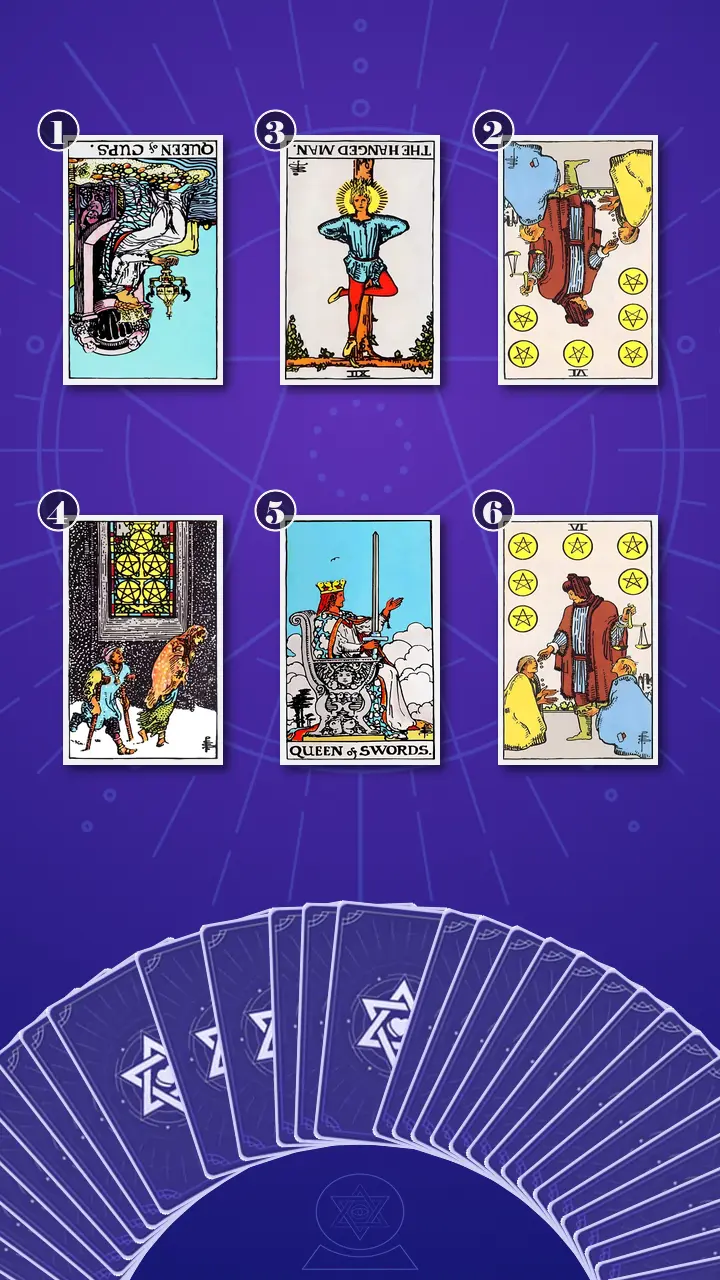
Today I used the Relationship Spread · Context Edition, a six-card relationship tarot spread for friendship boundaries and reciprocity. For readers wondering how tarot works here, the cards are being used as an objective reflection tool: they organise observable behaviour, emotional assumptions, and possible experiments so that intuition can meet evidence. This spread was appropriate because the issue was relational rather than predictive. It examined Maya’s role, the support she experienced from friends, the shared dynamic, the fear underneath it, the resource available to her, and one practical direction she could test.
The layout followed a bridge from private capacity to mutual exchange. The upper row held the presenting pattern, the relational pull, and the shared atmosphere. The lower row moved through the underlying fear, the boundary resource, and the reciprocal practice. I explained that the fourth card would show why a simple limit could feel like exclusion, while the fifth and sixth would point toward clear communication and an observable experiment. No card could tell Maya how another person would behave. The point was to return the decision to the person living the relationship.
When the Emotional Inbox Has No Office Hours
The Closed Cup at Lunch
Now turning over the card for Presenting pattern: show the observable moment in which Maya becomes the primary listener and adviser, linking directly to the diagnosis of staying engaged beyond her capacity, I found the Queen of Cups, in reversed position.
In its standard meaning, the Queen of Cups describes emotional sensitivity and the way someone participates through care. Reversed, her Water energy is blocked and over-absorbed. The card shows a queen studying a closed, ornate cup while water surrounds her throne. I saw Maya in the same image when she opened a friend’s ten-paragraph voice note during lunch, held the phone like an emotional container, and searched for the perfect comforting reply before checking whether she had eaten, slept, or had any room left to listen.
The problem was not that Maya cared too much in some moral or mystical sense. The problem was that compassion had become automatic access. The sequence was almost mechanical: They need me -> I should respond perfectly -> my own need can wait. The recommendation algorithm of someone else’s distress was deciding what deserved her attention next. Her work in Figma, her lunch, her body, and her own difficult day were pushed below the red notification badge.
Maya did not nod. She gave a short, bitter laugh and said, That is too accurate. Almost rude. I let the humour stay in the room because it was protecting something tender. Then I said that the card was not asking her to close every door. It was asking her to check whether the cup had room before she offered it. She looked down at her hands and rubbed one thumbnail over the other, recognising the sequence before she was ready to call it a pattern.
The Scales Tilted Toward the Crisis
Now turning over the card for Relational pull: reveal how friends’ needs and bids for support are experienced by Maya, without making a fixed judgment about the friends themselves, I found the Six of Pentacles, in reversed position.
The classic Six of Pentacles concerns giving, receiving, resources, and the balance of an exchange. Reversed, its Earth energy is blocked. On the Northern line after work, Maya sent a friend a long voice note with breakup advice, a therapist-search link, and a plan for the next morning. The carriage smelled of rain and hot brakes. She nearly added that work had been making her tense, then deleted the sentence because the chat was already full of the other person’s crisis.
I told her this card did not require a villain. It showed a repeated shape: emotional triage, detailed advice, practical research, and attention flowing toward the friend while Maya’s personhood became less visible. She was often contacted when someone needed to vent or make a decision, and she began to associate an incoming message with a task. That was one-sided emotional labour, even when everyone involved was acting from genuine need rather than deliberate exploitation.
I placed the first two cards beside each other and used the inner monologue the spread had revealed: They need me, so I should respond perfectly. If I bring up my own life, I will make the moment about me. My need can wait. Maya’s shoulders lifted as though she had been bracing for a verdict. Then she exhaled through her nose and looked from the tilted scales back to the closed cup. She could recognise the invisible work without turning care into an invoice.
The Call With No Exit Button
Now turning over the card for Shared dynamic: name the one-way emotional labor pattern that develops between Maya’s availability and the friendship’s need for support, I found The Hanged Man, in reversed position.
The Hanged Man traditionally represents a pause, surrender, and a changed perspective. Reversed, the pause has lost its choice. The figure hanging by one foot became Maya on a video call at 11:47 p.m., listening to the same story for the second time while her laptop fan hummed and an early presentation reminder flashed on her calendar. Her attention had gone foggy, but she could not say goodbye because the friend was still upset.
I explained that this was the moment patience became suspension. Maya was leaving her own calendar tab open indefinitely, waiting for another person’s nervous system to give her permission to move. She had confused staying connected with staying responsible. I said the sentence that came through the card plainly: You do not have to wait for someone else to feel completely okay before your own life can resume.
She pressed her lips together and admitted, I keep telling myself I am just being patient. I asked what she was postponing while she waited for someone else to feel completely okay. Her eyes moved toward the dark window. The answer did not arrive as a dramatic confession. It appeared in the tiny pause before she mentioned sleep, work, dating, and the ordinary parts of herself that had been placed on hold.
The Cold Street Outside the Lit Window
Now turning over the card for Underlying fear: expose the belonging concern beneath the pattern, specifically the belief that limits could make Maya unwanted unless she remains useful, I found the Five of Pentacles, in upright position.
The Five of Pentacles carries the image of hardship, exclusion, and support that appears close but inaccessible. I returned with Maya to 7:06 p.m. outside a Tesco in East London, where she had texted that she could not talk because of a deadline. Her friend replied, No worries, I just thought you might be around. There was no accusation, but Maya reread the message under the cold shop lights and felt her stomach drop as her mind supplied a closed door.
The illuminated window above the figures was the belonging she feared losing. A normal limit felt emotionally similar to being left outside the warm circle. I asked her to separate the facts from the story: the fact was that she had limited capacity and the friend sounded disappointed; the story was that the friendship was ending because Maya was no longer useful. Then I gave her the line I wanted her to remember: Being needed is not the same as being known.
Maya’s hand stopped halfway to her phone. First her breathing became shallow. Then her eyes softened as she replayed every time she had apologised for a full calendar or explained her exhaustion as if presenting evidence in court. Finally, her shoulders dropped by a fraction. The fear was real, but the card did not make it a prophecy. It made the fear visible enough to question.
When the Queen of Swords Drew a Line
The Blade That Keeps Care Honest
The room changed when I reached the fifth card. The radiator clicked once and went quiet. Outside, rain dragged thin lines down the glass, and the silence gave the next image more weight than the others.
Now turning over the card for Boundary resource: identify the discernment and communication capacity that can interrupt automatic availability while preserving care, I found the Queen of Swords, in upright position.
Her upright Air energy brought clear perception, direct speech, independence, and a boundary shaped by experience rather than punishment. The modern version was Maya typing, I care about you, and I have twenty minutes tonight. I can listen to what feels most important, but I cannot plan the whole situation with you. Her phone was upright in her hand, her wording was precise, and the stopping point was visible. Like a clean frame in Figma, the sentence defined what was in scope without implying that everything outside the frame was worthless.
As I looked at the sword, I remembered my years on Wall Street. I had learned that a position could look valuable on paper and still drain more capital than it could sustain. That memory is why I use my Reciprocity ROI Analysis with care. I do not reduce friendship to a spreadsheet. I look at the actual emotional give-and-take: who initiates during crises, who listens, who asks follow-up questions, who makes room, and what happens to each person’s capacity after the conversation.
I also used my Sunk-Cost Decoupling in Loyalty. Ten years of history matters, but it is not a permanent contract requiring Maya to accept the current arrangement unchanged. History can explain why she feels loyal without deciding what she must offer tonight. The Queen of Swords was not telling her to stop loving people. She was separating affection from unlimited access and giving direct language a chance to protect the connection.
I said, A boundary is a capacity update, not a character verdict. Then I asked her to imagine sending the sentence without adding three paragraphs of apology. The Queen’s raised hand was not a slammed door. It was a pause before consent, a clean account of what she could give, and an invitation for the other person to respond to the real version of her capacity.
At 12:18 a.m., a friend could still be talking through a breakup while Maya’s phone warmed her palm, tomorrow’s work waited, and the call had no end. I could see the old equation closing around her: if she stopped before the friend felt better, she would be a bad friend.
You do not have to earn belonging by remaining endlessly available; you can protect honest connection with a clear limit, like the Queen of Swords holding her upright blade.
I let the sentence sit between us. Then I added, The real question is not whether you care enough to stay forever. It is whether care can remain honest when you name what you can actually give. A limit does not prove that you belong; it gives the friendship a chance to show whether it can hold both people.
For a moment, Maya’s breath stopped. Her fingers hovered above her phone, and the muscles around her mouth tightened as if the sentence had physically blocked the exit. Then her gaze lost focus. I watched her replay the Tesco message, the neutral No worries, the cold shop lights, and the closed door her mind had supplied. Her jaw shifted once. A flush reached her cheeks, and she looked at me with sudden, almost angry recognition. But does that mean I got it wrong before? she asked. I did not rush to turn the anger into gratitude. I told her that earlier choices had protected belonging as she understood it then; clearer information could change the next choice without requiring shame. Her clenched hand opened slowly. Her eyes grew bright, her shoulders lowered, and her first exhale trembled through her chest. The relief carried a brief, dizzy blankness, the vulnerable space left when an old rule stops speaking. For the next ten minutes, I asked her to draft one capacity-based reply and choose freely whether to send, edit, or delete it.
I then asked her, Now use this new perspective to revisit last week. Was there a moment when this insight could have helped you feel different?
I named what had shifted: this was not a final answer about a friendship. It was the first step from automatic emotional availability and usefulness-based belonging toward capacity-aware care and mutual friendship support. Maya did not have to feel completely fearless before practising it. She only had to notice that guilt could be present without being placed in charge.
The Same Scales, Turned Upright
Now turning over the card for Reciprocal practice: translate the transformation into a small, observable experiment that lets Maya offer support while also making space for her own needs, I found the Six of Pentacles, in upright position.
The same number and suit had appeared earlier, but the Earth energy was no longer blocked. I showed Maya a before-and-after pair built from the same phone screen. In the first scene, she replied from a crowded commute, Tell me everything, and made herself responsible for the entire crisis. In the second, she wrote, I have twenty minutes, and do you want listening or ideas? After that, she shared one true detail about her week: I have been tense about my presentation.
The level scales did not promise equal minutes or instant repayment. They represented deliberate generosity, consent, time, and mutual visibility. I told her, The goal is not equal minutes; it is room for both people to remain real. This was not a hidden test for whether her friend would perform perfectly. It was a small way to observe whether the relationship could make space for Maya when she stopped disappearing into the helper role.
Maya began editing an upcoming reply in her head. I saw her thumb hover, then stop before the familiar three-paragraph apology. She looked less triumphant than attentive, which I trusted more. The new practice was not withdrawal replacing care. It was choice replacing automatic availability.
The One-Page Capacity Frame
I laid the six cards out as one story. The reversed Queen of Cups showed Maya absorbing a friend’s feelings before checking her own capacity. The reversed Six of Pentacles showed that attention and practical help had begun moving mostly in one direction. The reversed Hanged Man kept the arrangement suspended through delayed endings and postponed needs. The Five of Pentacles exposed the fear underneath it: if Maya was not useful, she might be left outside belonging. The Queen of Swords supplied language and discernment. The upright Six of Pentacles grounded that insight in bounded support and a chance to notice reciprocal space.
The cognitive blind spot was not simply that Maya had weak boundaries. She had been treating a friend’s disappointment as evidence of rejection and her own exhaustion as evidence of loyalty. She was also keeping a silent scorecard, then judging herself for having one. I asked her to replace character verdicts with behavioural facts: I am often contacted during crises and rarely asked about my week. That sentence was more useful than calling herself selfish or calling a friend toxic.
The core contradiction was clear: Maya wanted to support friends, but she repeatedly became the unpaid therapist in friendships because she believed unlimited availability protected belonging. The transformation direction was equally clear: check capacity, state a compassionate time limit, and observe whether support moves in both directions. This was actionable advice, not a demand to solve her entire social life in one night.
- Run the open-inbox checkBefore replying to one non-urgent emotional voice note this week, set a ten-minute timer and write three words in your notes app: energy, time, willingness. Choose what you can honestly offer, such as no listening tonight, ten minutes by text, or a twenty-minute call. Send a two-sentence capacity-based reply, then put the phone in another room for ten minutes.Use the five-minute version if ten minutes feels too exposed. Keep the longer, perfect reply in Notes without sending it. A boundary describes your present capacity; it does not pass judgment on the friendship.
- Name the twenty-minute care boundaryAt the next support request, tell the friend the stopping point before asking detailed questions: ‘I care about you, and I can talk until 8:30.’ Then ask, ‘Do you want listening, practical ideas, or help finding another kind of support?’ When the time ends, say, ‘I am going to stop here for tonight. I care about you, and I can check in on Thursday if I still have room.’Do not add an apology unless you have broken an agreement. Replace ‘Sorry, I am terrible’ with ‘Thanks for understanding.’ A friend may feel disappointed without that feeling becoming your next emergency to solve.
- Observe reciprocity before rescueAfter one support conversation, record two observations: what support you offered and whether there was room for your experience. Share one small true detail about your week, then watch the pattern across two or three interactions. If the friendship remains organised around crises, use my Friendship Downgrade Strategy: reduce same-day crisis access, invite lower-stakes contact such as a walk or coffee, and let the connection become lower-maintenance without disappearing or punishing anyone.Gather evidence instead of setting a hidden test. The aim is not to invoice the friendship or demand identical responses. It is to separate ten years of history from the current exchange and choose contact that does not require you to abandon yourself.
I emphasised that the Friendship Downgrade Strategy was not a covert punishment or a dramatic announcement. It was a decent, visible change in access: fewer open-ended late-night calls, more deliberate replies, and more ordinary invitations when neither person was in crisis. If Maya eventually chose more distance, that choice could come from observed reality rather than panic.
A Week Later, the Phone Stayed Face Down
Four days later, I received a message from Maya. A friend had sent another breakup voice note, and Maya had waited ten minutes before replying. She had written I care about you, and I have twenty minutes tonight. Do you want listening or ideas? She ended the call when she said she would, then told her friend that work had been making her tense. The friend asked about the presentation the next morning. It was a small response, but it gave Maya new information about what the friendship could hold.
Another friendship did not change as quickly. Maya stopped accepting every crisis request by default and suggested a Saturday coffee instead. The connection felt quieter and slightly lonelier for a while, but she was no longer trying to rescue it through exhaustion.
That night she slept a full night, but woke with the old thought, What if I am wrong? She smiled at it, not because uncertainty had vanished, but because it no longer held the phone.
When I think back on our Journey to Clarity, I do not see tarot replacing Maya’s judgment. I see the cards helping her distinguish emotional weather from evidence, affection from access, and loyalty from a contract she never consciously agreed to. She was moving from being perpetually on call to caring by choice.
For anyone approaching the Relationship Spread · Context Edition for friendship boundaries and reciprocity, I would carry the same quiet standard: notice capacity, speak clearly, and let repeated behaviour show whether there is room for both people. When your chest tightens at the thought of saying no, it can be because you are trying to protect both the friendship and the belief that you have to be useful to deserve your place in it. That deserves compassion, but it is not proof of rejection.
If you let care begin with a quick check of your actual capacity, what small, honest limit might feel possible in your next voice-note exchange?