Changing the Therapist-Friend Role: One Honest Limit Stayed Intact
The 10:43 p.m. Text That Turned Care Into a Job
I met Jordan over video from their Liberty Village condo. At twenty-nine, they could lead a UX critique, handle sharp Figma comments, and keep a hybrid product meeting moving without blinking. Yet one late-night "Are you awake?" text could pull them into the therapist-friend trap before they had checked their own capacity.
Jordan told me the exact moment it had happened again: 10:43 p.m. on a Tuesday. Their show was paused mid-scene, a streetcar ground along King Street outside, and the blue light from a three-minute voice note washed across the otherwise dark room. The phone had grown warm in their palm while they typed, deleted, searched for resources, and finally offered a call. Their jaw tightened with every revision.
"I want to admit that the friendship doesn't fit anymore," they said. "But the second they need me, I become useful again. It feels easier to solve their problem than explain why I'm tired. If I stop being available, what is even left of the friendship?"
I could see the weight in the way their shoulders stayed close to their ears. Their emotional exhaustion looked less like ordinary tiredness and more like running background tabs for somebody else's crisis until their own nervous system had dropped into low-power mode. Rest was available, but guilt kept marking it as an unauthorized expense.
"You are not tired of caring," I told them. "You are tired of care having no edge. I am not going to use tarot to predict whether this friendship survives or tell you whom to keep in your life. I want us to make the pattern visible, separate compassion from obligation, and give you enough clarity to choose your next move for yourself. Let's draw a map through the fog."

Six Cards Laid Like a Bridge Out of the Therapist-Friend Trap
I asked Jordan to place both feet on the floor, take one unforced breath, and hold a single question in mind: "What keeps me in this role, and what would reciprocal care look like now?" I shuffled slowly. I use this pause as a transition from reacting to observing, not as a performance of mystery.
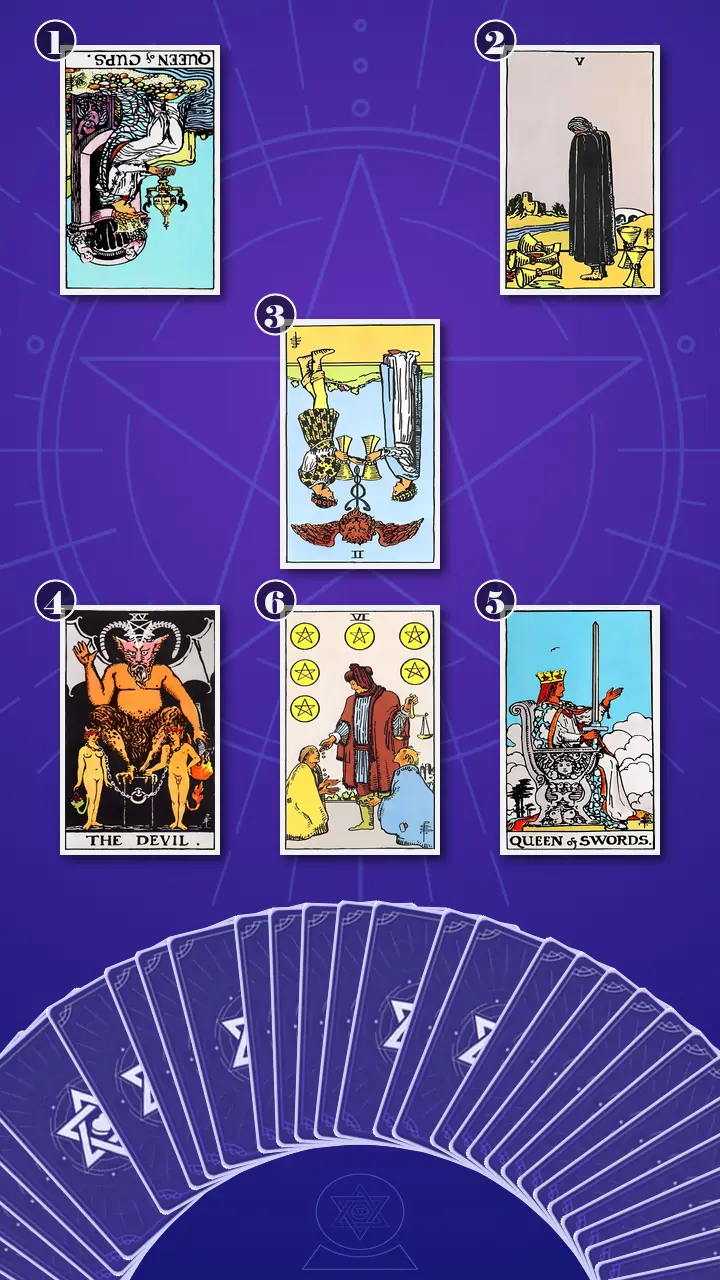
I chose the Relationship Spread · Context Edition, a six-card relationship tarot spread designed here to examine emotional labor, hidden attachment, friendship boundaries, and reciprocity. A broad predictive spread would have created noise around a problem that was already specific. Jordan did not need a verdict about the friend's motives or a forecast of the friendship's ending. They needed to see how the dynamic worked and which part of it they could actually change.
I arranged the cards as a bridge. The upper pair would show Jordan's role and the friend's expressed emotional stance. The center card would reveal what was currently happening between them. Beneath that, one card would expose the hidden attachment keeping the pattern in place, while another would identify the boundary Jordan could reclaim. The final card would ground the reading in a small experiment with mutuality.
This is how tarot works best for me: not as an authority replacing judgment, but as an objective pattern-recognition tool. Card meanings in context can place a familiar image beside a familiar behavior, giving intuition enough structure to become actionable. Jordan would remain the person deciding what the evidence meant and what happened next.
Reading the Waterline of a One-Sided Friendship
I noticed that the first three cards were all Cups. The opening of the spread was saturated with emotional sensitivity, grief, and relationship energy. Water was not the enemy here. The question was whether Jordan could hold it without allowing every new wave to enter their workday, bedroom, calendar, and body.
Position 1: The Cup Beside the Open Figma File
I turned over the first card, representing Jordan's role and perspective in the connection, including the habit of absorbing crises and providing extended emotional labor. It was the Queen of Cups, reversed.
I drew Jordan's attention to the Queen studying the closed cup at the water's edge. "She is sensitive enough to detect every change in the emotional weather," I explained, "but reversed, she can become so occupied with another person's container that she forgets to inspect her own."
I brought the image into Jordan's Wednesday morning. At 8:12 a.m., an overnight crisis message appeared while Figma was loading. Jordan opened the message first, left a reply draft beside the design file, and searched for the perfect reassuring language between Slack pings and meetings. They already knew what the friend might need, but had not asked what they could give.
I read this reversal as an excess of emotional receptivity combined with a deficiency of containment. Empathy had become a monitoring job. That did not make Jordan's sensitivity unhealthy; it showed where a real strength had been pushed past capacity until compassion turned into self-abandonment.
"The next time their name appears on your lock screen," I asked, "what happens before you check whether you have the energy to engage?"
Jordan gave a short laugh, but there was no humor in it. Their fingers rubbed the seam of their sleeve as they looked away from the card. "That's so accurate it feels a little cruel. I think, I already know what they need. I never think, What can I actually give?"
"Then the card has identified the sequence, not condemned you for it," I said. "Your first task is not to become less caring. It is to put your own cup back inside the frame."
Position 2: Pain That Does Not Become an Assignment
I opened the card representing the friend's expressed emotional stance and needs as they appeared in the recurring crisis-centered conversations. The Five of Cups, upright, showed a cloaked figure facing three spilled cups while two remained standing behind them.
I did not use the image to diagnose the friend. I used it to describe what Jordan could actually observe: a casual Saturday coffee repeatedly became a detailed account of loss, disappointment, or conflict. Jordan heard genuine hurt and immediately generated reframes, resources, and next steps, as though witnessing pain silently assigned them responsibility for turning the whole scene around.
I described the energy as an excessive concentration on what had gone wrong. The Five of Cups validated the gravity entering those conversations, but the two standing cups and distant bridge also suggested that the friend retained resources, choices, and routes Jordan did not have to manufacture.
"Their pain can be real without becoming your assignment," I told Jordan. "You can acknowledge the spilled cups without taking a mop, a project plan, and an overnight shift into the picture."
Jordan's mouth tightened first. Then their chin dipped in a slow nod. "I don't think they always ask me to fix it," they said. "Sometimes I silently add that part because listening without solving feels like I'm failing."
"That distinction matters," I replied. "Their expressed need and the extra responsibility you assume are not automatically the same thing."
Position 3: Two Drinks, One Life in the Conversation
I turned over the card representing the present pattern between them, especially the point where care had become an uneven emotional exchange. It was the Two of Cups, reversed.
The traditional image expects two raised cups to meet. Reversed, I saw the interrupted exchange Jordan had described at an Ossington cafe: two drinks on the table, condensation spreading across the wood, the espresso grinder shrieking, and only one life occupying the conversation. After ninety minutes of questions, reassurance, and follow-up plans, Jordan's product launch and difficult week had never entered the room.
I read the reversal as a blockage in reciprocity. It did not prove that no care existed, and it did not make the friend a villain. It showed an observable mismatch between remaining connected and being mutually known. Jordan had been trying to supply the missing half of the exchange by doing even more emotional work.
"Think about your last three conversations," I said. "Who was asked follow-up questions? Whose life occupied the available space? And what happened in your body afterward?"
Jordan's breath paused. Their fingertips pressed flat against the desk while their gaze drifted beyond my image on the screen, as though three recent conversations were replaying in sequence. Then a low "Oh" left their chest, and their shoulders shifted downward by a fraction.
"They are genuinely struggling," Jordan said. "And I'm also genuinely missing from the exchange. I keep acting like admitting the second part would cancel out the first."
"It doesn't," I said. "Care and reciprocity are separate questions. You can care about what someone is facing and still ask whether the current shape of the friendship has room for you."
Position 4: The Invisible Belonging Fee
I opened the card representing the hidden attachment that kept Jordan returning to the therapist role. The atmosphere seemed to grow heavier around The Devil, upright, but I was careful to name what this card did and did not mean. It was not evidence of an evil friend, a doomed relationship, or an unbreakable bond. It represented attachment, compulsion, and a fear-based bargain.
I pointed to the loose chains around the figures. "The chain feels compulsory because a belief gives it power," I explained. "In your life, it appears when you draft, 'I cannot talk tonight,' feel your stomach clench, and add three apologies, two suggestions, and another offer for tomorrow. By the time you press send, the boundary has turned back into availability."
I translated the chain into an app permission granted years ago and never reviewed. The friendship still had full access to Jordan's notifications, evenings, attention, and recovery time because changing the permission felt like risking the entire account. Each crisis response had become another payment toward an invisible membership fee: If I am not useful, why would they keep me?
"Resentment often arrives where an honest limit kept getting edited out," I said. "It is not proof that you are uncaring. It may be information about the cost of repeatedly overriding your own no."
Jordan went still at the word fee. Their eyes narrowed, then moved back over the loose chains. Their hand closed around the mug and slowly released it. "Paying for belonging with usefulness," they said. "That's what it feels like. And if I stop paying, I have to find out whether my ordinary presence was ever enough."
"Yes," I said. "That is the fear beneath the therapist role. The card is not ordering you to leave. It is showing you that the role is maintained partly by a belief you are now free to examine."
When the Queen of Swords Drew a Clean Line
Position 5: The Boundary With an Open Hand
I turned over the card representing the boundary and truth Jordan needed to reclaim. The opening water of the spread gave way to air: the Queen of Swords, upright. Her sword was raised and visible, but her other hand remained open. To me, that pairing was the whole grammar of a compassionate friendship boundary: one gesture named the limit, and the other preserved humanity.
I explained the Queen of Swords meaning in this context through a message short enough to remain true: "I care about what is happening. I can listen for twenty minutes tonight, but I cannot keep processing this after that." Her energy was balanced discernment, neither the excess of endless access nor the deficiency of abrupt, unexplained distance.
"A boundary is information about your capacity, not a verdict on their character," I said. "Directness is not cruelty, and another adult's disappointment is not automatic evidence that your limit was wrong."
The raised sword brought back a memory from my years on Wall Street: a trading desk late at night, screens still glaring, everyone tempted to defend a position because too much time and identity had already been invested in it. I learned there that past investment cannot answer a present-risk question. I use a gentler version of that principle in relationships, which I call Sunk-Cost Decoupling in Loyalty.
"The years of history are real," I told Jordan. "Decoupling them from the present does not declare those years wasted. It means ten years of closeness are evidence of what the friendship has meant, not prepaid consent to the same level of access forever. The Queen's sword separates loyalty to the history from obligation to keep reenacting its old structure."
I returned us to 10:43 p.m.: the paused show, the crisis text lighting the room, and Jordan drafting the perfect reply while their jaw tightened. Protecting one quiet night had felt more dangerous than surrendering it because the old role still promised belonging.
"A friendship boundary does not withdraw compassion; it reveals whether closeness can exist when you are no longer earning your place through emotional labor."
Being endlessly available is not proof of love; speak the boundary plainly and let the Queen of Swords' raised blade separate compassion from responsibility.
For one beat, Jordan froze. Their breath stopped high in their chest, and the fingers of their right hand hovered above the rim of the mug. Then their gaze slipped past the card and lost focus; I could almost see the deleted boundary drafts replaying behind their eyes. Their pupils widened. Their jaw shifted once, hard, before the muscles released. The hand around the mug loosened one finger at a time, and both shoulders dropped as though a loaded backpack had been set on the floor. Then came the surprise: not relief, but anger. "But doesn't that mean I've been wrong this whole time?" they asked, the last words sharper and thinner. "Like I've spent years doing friendship wrong?" I let the question stand through one click of the radiator. "It means a strategy that once helped you feel close now costs more than it protects," I said. Their eyes shone; they looked embarrassed, then stopped an apology before it formed. A tremulous breath left them. The release was real, but so was the brief dizziness of having no old role to hide inside.
I asked, "Now, with this new perspective, think back to last week. Was there a moment when this insight could have made the experience feel different?"
"Sunday in my kitchen," Jordan said. "I was making dinner when they messaged. I almost cancelled plans with someone else. If I'd seen compassion and responsibility as separate, I could have cared that they were hurting without treating my whole evening as available."
I told Jordan that this was the central crossing of the reading. It was not simply a better text message. It was one step from guilt-driven emotional overfunctioning toward self-trusting, compassionate reciprocity: from asking, "How do I prevent their reaction?" to asking, "What can I honestly offer, and what belongs to them to manage?"
I then invited Jordan to open a blank note for five minutes and complete three lines: "I have capacity for...", "I do not have capacity for...", and "I can reply by..." I asked them not to send anything yet. The first move was simply making their real capacity visible to themselves, even if the smallest honest version was a ten-minute call or a reply the next day. I also made the safeguard explicit: Jordan could stop if the exercise felt too activating, and an immediate safety concern could be redirected to appropriate local crisis or emergency support rather than held by one friend alone.
Position 6: The Scales and the Attention Budget
I opened the final card, representing a self-directed experiment in mutuality: how Jordan could act on limited capacity, stop solving the friend's experience, and observe the bond without making a prediction for either person. It was the Six of Pentacles, upright.
I pointed to the balanced scales and the deliberate distribution of coins. The energy here was balance made practical. Care was not presented as an infinite emotional subscription. It was a finite weekly budget of time, attention, curiosity, and rest, offered by choice and in proportion to actual capacity.
In Jordan's life, the card looked like choosing one realistic form of support, sharing one genuine update about their own week, and noticing what happened. Did the friend respect the twenty-minute limit? Did they ask a follow-up question about Jordan's launch? Could attention circulate, or did it return immediately to the same crisis channel?
I introduced another tool from my old analytical life: Reciprocity ROI Analysis. I was careful with the phrase. "This is not about monetizing affection, demanding a perfect fifty-fifty split, or keeping a secret score," I said. "It is an objective look at what you offer, what you ask for, what actually returns, and what the exchange costs your body over time. The return might be curiosity, reliability, room for your life, respect for a no, or the simple feeling that you do not have to perform usefulness to stay connected."
"So I don't have to decide today whether the friendship is over," Jordan said. Their thumb moved across the edge of the note, but the grip was lighter now. "I can change what I contribute and watch what the relationship is actually capable of holding."
"Exactly," I replied. "Mutuality is not a promise you extract; it is a pattern you can observe. One interaction is not a final judgment, but repeated behavior is information. Tarot has not chosen the outcome. It has helped us define what evidence would allow you to choose with clearer self-trust."
From an Emergency Kit to an Attention Budget
I drew an imaginary line through the six cards. The friendship began in an earlier life stage when intense mutual support had felt like closeness. Over time, Jordan kept carrying that history like an emergency kit, scanning every message for the next problem to solve. The friend's visible distress activated Jordan's sensitivity; the reversed Two of Cups showed that the exchange had stopped making equal room for both lives; and The Devil exposed the hidden bargain that usefulness secured belonging. The two final cards supplied the unused resources: plain language, proportion, and the ability to observe reciprocity without predicting the friendship's fate.
I named Jordan's cognitive blind spot directly. They had been evaluating every boundary by whether it might upset the friend, rather than by whether it truthfully represented Jordan's capacity. They had also treated resentment as a moral failure and history as a reason the current arrangement could not change. That kept their needs out of the evidence.
The transformation was therefore not from kindness to detachment. It was from earning closeness through emotional labor to practicing clear, reciprocal boundaries while allowing the friend to own their experience. The spread contained no Wands, and I found that useful: Jordan did not need a dramatic confrontation to prove growth. Deliberate words and repeated, grounded choices were enough to begin.
Three Small Tests of a Different Friendship Role
- Make the three-line capacity note. Before answering the next emotionally intense message, set a two-minute phone timer and write: "I have capacity for...", "I do not have capacity for...", and "I can offer..." Do this in Notes before opening a reply box, whether the message arrives at work or after 10 p.m. Start with the minimum version and do not send it immediately. The aim is to see your capacity before guilt edits it.
- Send one care-plus-limit sentence. Use one plain boundary this week: "I care about what is happening, and I do not have capacity for a long call tonight. I can check in for twenty minutes tomorrow." Set the timer when the call begins, and end when the offered window ends. Keep the message to care, present capacity, and one bounded offer. Resist adding apology paragraphs, extra advice, or open-ended access.
- Run a two-week Friendship Downgrade Strategy. For the next two catch-ups, replace always-on crisis access with lower-maintenance, activity-based contact: one forty-five-minute coffee, one walk around Trinity Bellwoods, or a scheduled call with a clear endpoint. Share one real update from your week and record four facts afterward: what you offered, what you asked for, what happened, and how your body felt. Treat this as observation, not a secret test or punishment. A single awkward exchange is not a verdict; the strategy gradually changes access so the friendship can reveal whether it has room for both people.
I reminded Jordan that they remained free to offer less or nothing when capacity was absent. If a message suggested immediate danger, the compassionate response could include appropriate local crisis or emergency support; one friend did not have to become the sole safety system. The purpose of these next steps was not to force a specific outcome. It was to return choice to the person whose limits had kept disappearing.

A Week Later, the Quiet Proof
A week later, I received a message from Jordan: "I used the three lines. I sent, 'I care, I can't do a long call tonight, and I can give you twenty minutes tomorrow.' I didn't add an apology. They replied 'okay,' just okay, and I felt sick for an hour. But I didn't reopen the conversation or offer more."
Jordan told me the next day's call ended at twenty minutes. Before hanging up, they said, "I want ten minutes next time to tell you about my launch review." The friend agreed. That agreement did not solve the friendship, and Jordan knew it. It was simply the first observable evidence that a different structure could be named.
That night, Jordan slept through. In the morning, their first thought was, "What if I got it wrong?" Then they noticed their jaw was loose and smiled, not because the friendship was solved, but because the choice was finally theirs.
I saw the Journey to Clarity in that small proof. The cards had not rescued Jordan, ended the relationship, or guaranteed reciprocity. They had helped Jordan see the hidden bargain, name a truthful limit, and gather real information. Jordan was winning their narrative back through their own discernment.
When your jaw tightens over another carefully worded reply, the hardest part may be knowing you have outgrown the therapist role while still fearing that the friendship will disappear when you stop performing it. If you can notice that fear without immediately paying the old belonging fee, you are already standing somewhere new: between the Queen's open hand and her raised sword, where care and responsibility finally have separate names.
If your place in the friendship did not have to be earned through availability, what small, honest limit could you become curious about naming this week?