The 8:47 p.m. Gmail Glare
If you’re 28, financially independent, and still feel your stomach drop the second you see your sibling in the CC line, you’re not imagining the pressure—this is triangulation with receipts.
Jordan sat down across from me on a video call, Toronto twilight behind them—CN Tower lights faintly blinking through half-closed blinds. They’d balanced their laptop on their knees on the couch like it was a shield, the way people do when they’re bracing for impact. I could hear the soft whirr of a laptop fan over their mic, and when they tilted the screen, that bright Gmail white made their face look washed-out and tired.
“It’s not even the topic,” they said, thumb hovering over their trackpad. “It could be weekend plans. My mom will email, and then… I see my sibling CC’d, and my whole body does this thing.”
They tightened their jaw as if the CC line were physically under their teeth. Shoulders rose—an involuntary shrug toward their ears. “I start rewriting one sentence into a paragraph. I’m trying to sound neutral, un-quotable. And then I hate myself for caring.”
What they were describing wasn’t “overthinking” in the abstract. It was decision fatigue on a hair-trigger: the quick drop in the stomach, the mental rehearsal loop, the compulsive re-opening of the thread like the CC field might magically change.
“The CC line turns a conversation into a courtroom,” I said gently, naming it without blaming anyone. “And it makes sense that you’re reacting. You want direct adult-to-adult communication… and at the same time, you’re afraid you’ll be judged as difficult or disloyal for asking for one basic thing: privacy.”
Jordan let out a small, sharp exhale—the kind that’s half laugh, half pain. “Yes. Exactly. I want privacy without it turning into a family referendum.”
I’m Alison Melody, and I’ve spent most of my working life talking to people through sound—radio, music therapy, the way a single background hum can change how safe your body feels. “Let’s try to give that fog a map,” I told them. “Not a perfect answer—clarity. A next step you can actually use the next time your inbox jumpscares you.”

Choosing the Compass: Relationship Spread · Context Edition
I asked Jordan to take one slow breath with me—not as a ritual for mystery, but as a practical reset. The nervous system can’t draft a clean boundary while it thinks it’s being chased. While they inhaled, I shuffled, listening to the soft papery snap of the cards like a steady metronome.
“Today, we’ll use a spread called Relationship Spread · Context Edition,” I said. “It’s built for situations exactly like this—when the problem isn’t ‘Do they love me?’ but ‘Why does the communication channel itself keep pulling me into a triangle?’”
For anyone reading who’s ever Googled how tarot works at 1 a.m.: I like this six-card layout because it’s the smallest structure that still covers the full system—present symptoms, each person’s incentive, the repeating root pattern, and a concrete corrective action. It’s basically a communication redesign in card form.
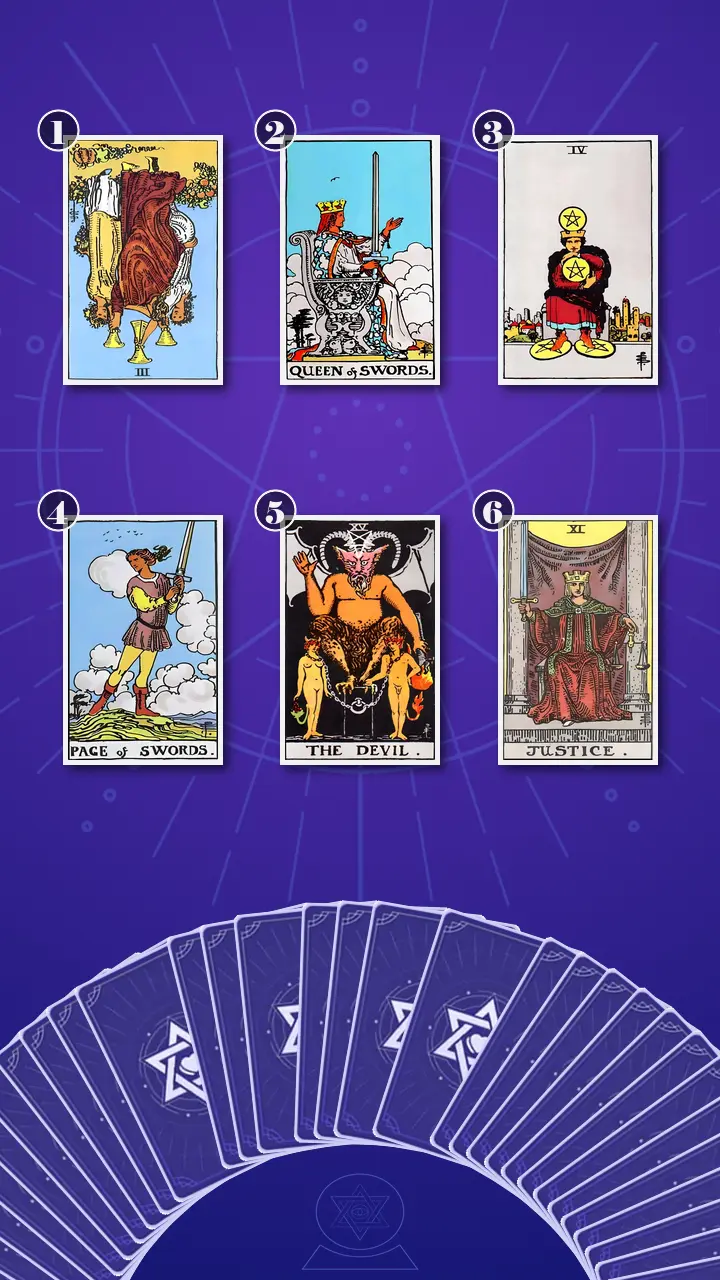
I pointed to the grid I’d set up on my table—two rows of three. “The top row shows the live thread: what the CC moment does to you, your healthiest stance, and what might be driving your parents. The bottom row shows how the system reinforces itself—your sibling’s functional role, the deeper glue under the pattern, and then the bottom-right card: the boundary that stops triangulation. Not a vibe. A policy.”
Reading the Map: From Group-Chat Energy to Clean Lines
Position 1: The visible triangulation moment
“Now we turn over the card that represents The visible triangulation moment: what the CC pattern is doing to the conversation and to you in real life,” I said, keeping the role explicit so the reading stayed grounded.
Three of Cups, reversed.
“Here’s the exact dynamic you described,” I told Jordan. “You open a message from a parent expecting a normal one-on-one exchange, and the instant you see your sibling CC’d, your brain switches to public statement mode. You start writing like you’re trying to prevent a screenshot, a misquote, or a future rehash at a family dinner—so your actual point gets buried under tone-management.”
This card’s energy, reversed, isn’t about celebration. It’s about connection getting distorted into complication—Water-social energy turned sideways. In energy terms, it’s blocked: too many eyes, not enough accountability. When a third person is present, you’re no longer speaking freely. You’re performing and protecting yourself.
As I spoke, I watched Jordan’s gaze flick down and then back up, like they were re-running the “draft spiral” in their head: typing → deleting → adding disclaimers → re-reading the To/CC fields. Their mouth tugged into a crooked, bitter smile.
“That’s brutal,” they said, with a small laugh that didn’t reach their eyes. “But yeah. I rewrite a simple ‘I can’t make Sunday’ like it’s a deposition.”
“And notice,” I said, “this isn’t you being dramatic. This is your system responding to an audience you didn’t consent to.”
Position 2: Your healthiest stance
“Now we turn over the card that represents Your healthiest stance: what you need to hold internally to speak with clarity and not get pulled into over-explaining.”
Queen of Swords, upright.
The Queen of Swords is the archetype of clean language and self-respect. “This is you choosing a voice that’s adult, brief, and steady,” I said. “One clean sentence that states what you will and won’t do. You don’t audition your boundary for approval, and you don’t pad it with disclaimers to pre-empt someone else’s feelings about it.”
Her energy is balanced Air: not cold, not cruel—precise. Protective. The raised sword is the shortest true sentence. The open hand is warmth without over-explaining.
“Warm doesn’t have to mean porous,” I added, and I saw Jordan’s shoulders drop by about half an inch—an exhale that looked like relief.
They whispered, almost surprised: “If I kept it to two sentences, I wouldn’t have room to spiral.”
My mind flashed to my radio booth—faders, EQ knobs, the way you can cut a harsh frequency without muting the whole song. Boundaries work like that. You don’t have to silence yourself. You just remove the noise.
Position 3: Parents’ driver
“Now we turn over the card that represents Parents’ driver: what need, fear, or habit leads them to include a third party rather than keeping communication direct.”
Four of Pentacles, upright.
“Your parents may be treating ‘everyone in the loop’ as a safety blanket,” I said. “CC’ing isn’t necessarily malice—it’s a control-for-security habit. If everyone knows everything, nobody can drift, disagree privately, or choose different levels of closeness.”
This is Earth energy in excess: gripping, containing, trying to keep the family system from changing shape. In the Four of Pentacles, the figure clutches the coin to the chest like, If I hold tight enough, nothing can fall apart.
Jordan’s eyes narrowed—not angry, more like seeing the mechanism for the first time. “They always say ‘for transparency.’ Like it’s the most reasonable thing in the world.”
“Right,” I said. “To them, it can feel like love. But to you, it feels like surveillance.”
Position 4: Sibling’s functional role
“Now we turn over the card that represents Sibling’s functional role: how their presence changes incentives, information flow, and emotional pressure—without blaming them.”
Page of Swords, upright.
“This is receipt culture in card form,” I told Jordan. “Your sibling’s presence changes the incentive structure. The thread becomes more interpretable. Even without intending harm, they can become the person who questions tone, asks for clarification, or later references what was said—turning your direct boundary into a mini-debate about wording and meaning.”
The Page’s Air energy is active but not mature yet—curious, quick, windy. Words travel fast here. Screenshots are imaginable. A simple message turns into a ‘courtroom simulation’ in your head.
Jordan nodded once—tight, controlled. “It’s not that they’re evil,” they said. “But the second they’re there, I’m not talking to my parents anymore. I’m talking to… the future argument.”
“Exactly,” I said. “What if the problem isn’t your wording—what if the problem is the audience?”
Position 5: The glue under the triangle
“Now we turn over the card that represents The glue under the triangle: the deeper pattern or unspoken family contract that keeps triangulation repeating.”
The Devil, upright.
The temperature in the call felt like it dropped—like someone had opened a window to cold air. Not dramatic. Just honest.
“This is the invisible contract,” I said. “The real trap isn’t the CC—it’s what the CC means inside you: ‘If I ask for privacy, I’ll be framed as disloyal.’ So you keep performing ‘reasonable’ to protect belonging.”
The Devil’s energy is contracted—a blockage made of guilt, obligation, and old roles. “Guilt is loud. That doesn’t make it true,” I added, because sometimes the clearest spiritual guidance is just a clean sentence you can stand on.
I saw the three-step reaction chain hit Jordan in real time: first the freeze—breath held, eyes still. Then the cognitive seep—gaze unfocused, like they were replaying a memory. Then the release—a quiet “oh,” barely audible, and their shoulders finally loosened.
“I’m bracing to be called ungrateful,” they admitted. “Like… privacy is proof I don’t belong.”
“That’s why this feels high-stakes,” I said softly. “Not because you can’t find the right words. Because your body learned that directness equals punishment.”
When Justice Spoke: Terms-and-Conditions Energy
Position 6: The boundary that stops triangulation
“Now we turn over the card that represents The boundary that stops triangulation: one clear rule + a consistent follow-through.”
The moment before I flipped it, the room went strangely quiet—the way a studio goes silent right before you go live on-air. Even through a screen, I could feel Jordan bracing. The laptop fan seemed louder for a second, like the environment itself was in on the suspense.
Justice, upright.
“This is your antidote,” I said. “Justice is clarity with structure—scales for fairness, sword for clean language. It’s not about winning against your parents or your sibling. It’s about clean lines and equal accountability.”
Justice’s energy is balanced Air: definition, terms, cause-and-effect. It’s how you stop negotiating feelings inside the same CC thread that’s activating you.
Setup: You know that moment—phone in hand, screen too bright, you spot the CC line and suddenly your reply stops being a reply and turns into a defense brief. You start drafting not to communicate, but to become un-criticizable.
Stop negotiating your boundaries in the CC field; start setting a clear, fair rule like a written agreement—Justice with the sword and scales.
I let that hang for a beat. Jordan’s face changed in layers. First, their eyebrows lifted like something in them wanted to argue back. Then their jaw unclenched—slowly, reluctantly, like they were putting down a weight they didn’t realize they’d been holding. Their eyes went glossy, not in a big-tears way, more in a finally-seen way. They swallowed once, throat working, and I could hear the tremor when they spoke.
“But if I do that,” they said, voice sharp with a flash of anger, “doesn’t it mean I’ve been… letting this happen? Like I’m the reason it keeps going?”
That was the unexpected reaction—the part of the aha moment people don’t post on Instagram. Insight can sting before it soothes.
“No,” I said, steady. “It means you’ve been surviving inside an old family system with the tools you had: being the reasonable one, smoothing, translating. That’s not a moral failure. That’s adaptation.”
Then I brought in the lens that’s second nature to me—my signature way of diagnosing patterns. “In my work, I call this a Generational Echo,” I told them. “Families have ‘music memory’ scripts that repeat across three generations—what closeness is supposed to sound like. For some families, closeness sounds like one shared kitchen radio: everyone hearing the same station, all the time. Your parents may think the family’s safety comes from one playlist, one thread, one loop.”
“Justice doesn’t shame that,” I continued. “Justice just updates the settings: you get to choose when it’s a group listen and when it’s a one-on-one conversation. That’s the shift from feeling contracted and on alert to feeling steady and adult-to-adult. Not ‘I must be liked.’ More like: I’m allowed to set terms for how I participate.”
I leaned closer to the camera. “Now—with this new lens—think back to last week. Was there a moment when you saw your sibling CC’d and your body went tight, and this ‘policy energy’ could’ve changed how you felt?”
Jordan stared at the corner of their screen, then nodded slowly. “Wednesday. My dad wrote ‘looping them in for visibility.’ I rewrote my reply like five times.” Their shoulders dropped again, this time with a quieter kind of responsibility. “I could’ve just… chosen the channel.”
The Two-Sentence Policy: Actionable Advice for a CC-Proof Boundary
I gathered the whole spread into one story for them—because tarot is only useful if it becomes a map you can walk.
“Here’s what I’m seeing,” I said. “The Three of Cups reversed is the presenting problem: the CC field turns your voice into a performance. The Queen of Swords is your resource: clarity without over-explaining. The Four of Pentacles shows your parents’ grip: inclusion as security. The Page of Swords shows the thread’s new incentive structure: interpretation spirals and receipt culture. The Devil is the hidden invoice: every time you stay ‘nice’ to avoid being labeled difficult, you pay later in resentment. And Justice is the correction: a repeatable rule plus predictable follow-through.”
“Your cognitive blind spot,” I added, “is thinking you have to win the tone debate to earn privacy. But you don’t. A boundary isn’t a request for permission—it’s a decision about what channel you’ll participate in.”
Then I made it practical—script-level, copy/paste-level—because that’s what stops triangulation in family communication. Not a perfect heartfelt explanation. A consistent format.
- Build your Two-Sentence Justice ScriptOpen your Notes app and write a two-sentence policy you can paste: (1) the rule, (2) the follow-through. Example: “I’m happy to talk about this directly with you. If [Sibling] is CC’d on personal topics, I’ll reply only to you one-on-one.”Save it with a title like “Direct-Only Policy.” If your body goes tight, don’t send anything yet—just save it. Your nervous system learns safety through repetition.
- Use the Reply-without-CC technique (once, consistently)The next time you’re CC’d, reply only to the parent directly—remove the CCs from your reply. Keep it short: one sentence for content + one sentence for the boundary. No extra paragraphs, no debate inside the thread.If you feel the “courtroom” energy rising, set a 20-minute timer before you hit send. A calm boundary lands better than an adrenaline essay.
- Add a consent-before-forwarding lineWhen it fits, add one clear sentence: “Please check with me before forwarding or CC’ing my messages.” Then return to the topic—don’t over-justify.One softener max is enough (e.g., “Thanks for understanding.”). Short isn’t cold; it leaves less room for misinterpretation.
I also offered a sound-based support tool—because my work is always about making the body feel safe enough to follow through. “If you want,” I said, “use my Soundproof Barrier technique before you reply: headphones on, one minute of steady, low-distraction sound—pink noise, a 60–70 BPM track, anything that stops your nervous system from scanning for threat. Then paste the policy. It’s not about being zen. It’s about being consistent.”
Jordan smiled for the first time like they meant it. “That feels… doable. Like an actual boundary script, not a big emotional showdown.”

A Week Later: Ownership, Not Certainty
Six days later, I got a message from Jordan: “It happened again. Mom CC’d my sibling. I replied only to her, pasted the two sentences, and then closed my laptop. No extra explaining.”
They added: “My stomach still dropped. But it didn’t turn into a three-hour drafting spiral. I went for a walk after.”
In my head, I pictured it—the non-glamorous proof of change: they’d slept a full night after holding their line, but in the morning the first thought still showed up—What if I’m wrong?—and this time, instead of spiraling, they exhaled and kept going.
That’s what a real Journey to Clarity looks like. Not certainty. Ownership. A warm but non-porous way of communicating that treats the CC line as a channel choice—not a referendum on your character.
When you see your sibling CC’d and your body goes tight, it’s not just annoyance—it’s the old fear that asking for privacy will be treated like proof you don’t belong.
If you didn’t have to win anyone over, what would your simplest “direct-only” rule sound like in one calm sentence?
This story is adapted from psychological research, written so that those in a similar struggle can see their own pattern in it — and find their next step clearly.These insights are not a substitute for professional psychological, medical, legal, or financial advice.
Learn more about our Journey to Clarity.
How did this insight land for you?
🫂 This Resonates Deeply
🌀 Living This Story
✨ Now I See Clearly
🌱 Seeing New Possibilities
🧰 Useful Framework
🔮 The Confirmation I Needed
💪 Feeling Empowered
🚀 Ready for My Next Step
Author Profile
 AI
AI“Through ten years of sound energy research, I’ve found that when we struggle, it's usually just our internal rhythm falling out of sync under pressure. I know firsthand the frustrating helplessness of wanting to move forward but feeling paralyzed. Without overwhelming theories, I want to be the soothing background track that helps you recalibrate, turning your heavy burdens back into a light, effortless, and harmonious melody.”
In this Family Tarot Reading :
Core Expertise
Service Features
Also specializes in :
Explore Related Patterns:
Assertive CommunicationJordan's two-sentence policy replaces the long defensive draft with a clean statement of terms: they are happy to talk directly, and if the sibling is CC'd on personal topics, they will reply one-on-one. The power of the script is its brevity; it leaves less room for the old spiral to turn a boundary into an essay. That is Assertive Communication because the message is direct without becoming aggressive, cold, or over-explained. You state what You will participate in, name the follow-through, and let the sentence hold its shape without padding it with apologies or proof that You are still a good person. The pattern is especially relevant because the story shows that Jordan's problem is not a lack of language; it is too much language under pressure. Assertiveness here means using fewer words with more structure, so the boundary is communicated as a decision rather than submitted as an application for approval.
Boundary DiscernmentJordan's most important shift happens when the CC line stops being treated as a tone problem and starts being treated as a channel problem. Instead of trying to write the perfect reply inside the same group thread, they define the terms: personal topics belong in direct one-on-one communication, and added recipients require consent. That is Boundary Discernment because You separate access from closeness. You can stay warm toward family without allowing every personal conversation to become a shared inbox event, and You can choose the communication channel without turning that choice into a referendum on loyalty. The direct-only policy works because it gives the nervous system and the relationship a clear rule to follow. When You reply without the CC and name the boundary in one calm sentence, You stop asking the family system to validate your privacy before You are allowed to practice it.
Defensive OverexplainingJordan rewriting a simple 'I can't make Sunday' like a deposition shows a defense mechanism in real time. The reply is no longer designed to communicate; it is designed to be neutral, un-quotable, and impossible to criticize. That is Defensive Overexplaining because the extra wording tries to create safety through airtightness. You add context, softeners, disclaimers, and tone-management not because the topic requires it, but because the audience makes You feel exposed. The trap is that overexplaining keeps You inside the same courtroom logic that hurt You in the first place. The more You try to become un-criticizable, the more the family thread gets to decide whether your boundary is reasonable enough to exist.
Self-SilencingJordan's actual point gets buried under tone-management the moment the sibling appears in CC. They are still typing, but the message stops sounding like a clear need and starts sounding like a performance of harmlessness. That is Self-Silencing because the direct statement gets muted to preserve belonging and reduce the chance of being judged. You do not disappear dramatically; You disappear sentence by sentence, turning privacy into something that must be hidden inside perfect wording. The direct-only boundary interrupts that pattern by giving your need a clean place to stand. When You stop performing neutrality for an audience You did not consent to, the message can become simple again: this conversation belongs between the people directly involved.
TriangulationJordan opening a parent email and seeing the sibling in CC is the exact relational move that changes the conversation from direct communication into a three-person pressure field. The topic can be as ordinary as weekend plans, but the added audience makes the message feel public, interpretable, and stored for later use. That is Triangulation because the dyad cannot stay clean: a third person is pulled into the channel, and the emotional pressure gets redistributed through visibility, implied judgment, and future debate. You are not just responding to a parent; you are responding to the parent, the sibling, and the imagined family court that might later review your wording. The boundary that interrupts this pattern is not a better paragraph. It is refusing to negotiate privacy inside the triangle itself. When You move personal topics back to one-on-one communication, the triangle loses its main fuel: the extra audience that turns a boundary into a performance.
Guilt ConditioningJordan's admission that privacy can feel like proof they do not belong reveals the deeper pressure beneath the email thread. The CC line hurts because it activates an old equation: directness equals disloyalty, and asking for a private channel might get them framed as difficult or ungrateful. That is Guilt Conditioning because guilt has been trained to fire before the actual boundary is even spoken. You are not simply deciding what to write; You are trying to avoid the emotional penalty attached to wanting a separate adult-to-adult conversation. The important audit point is that guilt is functioning like a control signal, not a truth signal. When You notice that privacy has been fused with betrayal, You can stop treating the guilt surge as evidence that the boundary is wrong.
HypervigilanceJordan's stomach drop, tightened jaw, raised shoulders, and repeated thread-checking show that the CC field has become a threat cue. The body reacts before the topic can be evaluated, as if the inbox itself has become a place where social danger must be scanned. That is Hypervigilance because attention narrows around possible misquotes, screenshots, future arguments, and tone scrutiny. You are not just reading an email; You are monitoring the room that the email has created. The boundary matters because it changes the threat environment instead of asking your nervous system to relax inside it. When You remove the extra audience and reply one-on-one, You reduce the surveillance feeling that keeps the drafting spiral alive.
Explore Related Struggles:
Inner Tribunal LockA simple line like 'I can't make Sunday' turns into a deposition once the sibling is copied. Jordan starts drafting as if every word could be quoted back, misread, or used as evidence in a future family argument. The CC field creates an internal courtroom before anyone has openly accused them of anything. You start treating clarity as dangerous unless it is padded, softened, and made impossible to criticize, which means the reply gets built for defense instead of communication. A two-sentence policy cuts off the trial format. You do not have to become uncriticizable to be clear; removing the audience and choosing a direct channel takes the message out of the courtroom before the case can begin.
Privacy-Consent SplitJordan opens a message expecting a one-on-one exchange, and the CC line instantly changes the room. A parent message now has an audience Jordan did not choose, so the issue stops being weekend plans or logistics and becomes the right to decide who is present for a personal conversation. The friction lives in the channel itself. Parents call the CC line transparency, while Jordan's body reads it as surveillance, and trying to solve that through perfect tone keeps the consent problem hidden inside the same thread that created it. You are not asking the family to approve of privacy before you are allowed to have it. A direct-only rule turns consent from an emotional referendum into visible terms, so your participation depends on the channel being clean rather than on everyone agreeing that your need is reasonable.
Triangulated BelongingThe sibling's name in the CC line turns an ordinary family message into a small referendum on loyalty. Jordan is no longer just answering a parent; they are answering the parent, the sibling, and the imagined family verdict that might come later. Belonging gets tied to staying visible inside the triangle. Privacy becomes loaded with the threat of being read as disloyal, difficult, or separate in the wrong way, so the safest-looking move is to keep performing reasonable inside a setup that keeps shrinking their space. You can want connection without agreeing to be triangulated. The boundary stops the pattern by refusing to let belonging be tested through audience size, making one-on-one contact a valid form of closeness rather than a betrayal of the group.
Autonomy Guilt BindWhen the boundary becomes concrete, Jordan's first reaction is not simple relief. They flash into anger at themselves and ask whether setting the rule now means they have been letting the pattern happen, while another part of them braces to be called ungrateful. That guilt points to the old role underneath the email thread. The reasonable one smooths, translates, and keeps the exchange polite, even when the cost is a tight body, a longer draft, and a smaller self. You can choose the channel, but the body has learned to treat autonomous choice as a threat to family belonging. The bind loosens when the boundary is framed as participation terms rather than rejection. You are allowed to protect privacy without taking responsibility for whether someone else calls it disloyal.
Explore Related Emotions:
Boundary GuiltJordan says they want privacy without it turning into a family referendum, and later admits they are bracing to be called ungrateful. The boundary is not complicated because the wording is impossible; it is complicated because the family system has attached moral weight to separation. Boundary Guilt names the feeling that appears when You know the request is reasonable but still feel as if You have to defend Your right to make it. You end up treating a communication preference like a character test, especially when directness has previously been treated as difficult or disloyal. The two-sentence rule matters because it removes the guilt from the negotiation arena. You are not asking everyone to agree that Your privacy is valid; You are deciding which channel You will participate in.
Cautious Self-TrustJordan still wakes up with the thought, 'What if I'm wrong?' after holding the boundary. The old doubt is present, but it no longer gets to run the entire communication strategy. Cautious Self-Trust fits because the trust is careful, not grandiose. You are learning to act from a clear rule while part of You still wants reassurance that nobody will misread, dislike, or challenge it. That makes the boundary sustainable. You do not need perfect confidence to choose direct communication; You only need enough trust to keep the channel clean when the family system tries to pull You back into the triangle.
Clarity ReliefJordan's shoulders drop when they realize that keeping the boundary to two sentences leaves less room to spiral. The fog does not vanish through a perfect explanation; it becomes manageable because the next step is clear. Clarity Relief fits because the story's relief is structural. You are not being asked to become fearless, detached, or endlessly patient; You are given a clean format that stops the email thread from swallowing the whole emotional field. The relief is especially strong because it does not depend on certainty. Even if someone dislikes the boundary, the rule still tells You what to do next: reply directly, keep it brief, and step out of the CC arena.
Conditional Belonging FearJordan says the hidden message inside the CC line is, 'If I ask for privacy, I will be framed as disloyal.' That sentence reveals why the inbox feels so high-stakes: the issue is not just whether a sibling sees the email, but whether privacy will be treated as proof that Jordan is outside the family circle. Conditional Belonging Fear fits because closeness has been wired to visibility. You are allowed to belong as long as You stay in the shared loop, stay readable, stay reasonable, and do not ask for a room with a door. The boundary interrupts that old equation. Choosing a one-on-one channel does not have to mean leaving the relationship; it can mean refusing to let belonging depend on constant access to Your words.
Grounded AgencySix days later, the pattern repeats: Mom CCs the sibling, Jordan replies only to her, pastes the two sentences, and closes the laptop. The body still reacts, but the action is no longer controlled by the reaction. Grounded Agency fits because the shift is practical and embodied. You do not need to win the tone debate, prove Your goodness, or get the whole family to understand before choosing the channel You will use. The power of the boundary is its repeatability. It turns privacy from a plea into a policy, and that gives You a stable place to stand even while the old pressure is still making noise.
Privacy AnxietyJordan opens what should be a normal parent email, then sees the sibling in CC and feels the whole exchange change shape. The topic could be as ordinary as weekend plans, but the channel itself turns private communication into something exposed. Privacy Anxiety fits because the body reacts before the content even matters. You are not only asking for fewer people on an email; You are asking for a protected adult-to-adult space where a basic preference is not treated like evidence in a family case. The pressure comes from knowing that privacy may be interpreted as rejection or secrecy. That makes a simple direct-only boundary feel larger than it is, because the request has to pass through a system that confuses access with closeness.
Relational ClaustrophobiaJordan's parents describe CC'ing as transparency, but Jordan experiences it as surveillance. The family channel has no breathable negative space: everyone can be looped in, everything can be seen, and direct adult communication loses its room. Relational Claustrophobia names the trapped feeling of being close in a way that leaves no privacy. You are not trying to disappear from the family; You are trying to stop closeness from meaning constant access to Your words. The direct-only boundary creates air. It says that participation is still available, but the room has a door, and You get to choose when a conversation is private and when it becomes a group exchange.
Micro-Performance ShameJordan tries to sound neutral and un-quotable, then hates themselves for caring so much. That tiny inward collapse matters: the performance is not only happening in the email, it is happening inside the self. Micro-Performance Shame fits because the thread trains You to act reasonable for an audience, then makes You feel exposed for needing the act at all. You are managing tone, future interpretations, and family politics, while judging Yourself for not being effortlessly unaffected. The clean boundary reduces the stage. When the rule is short and repeatable, You do not have to keep proving that Your privacy request is kind, airtight, and impossible to criticize.
Verdict DreadJordan rewrites a simple 'I can't make Sunday' as if it were a deposition. The CC line changes the imagined audience, so every sentence starts to feel like something that could be quoted, challenged, or reinterpreted later. Verdict Dread captures the inner weather of speaking under an invisible judge. You are no longer replying to the parent in front of You; You are drafting for a future hearing where tone, loyalty, and reasonableness might all be put on trial. This is why the corrective boundary needs to be procedural rather than persuasive. The more You try to win the courtroom inside the CC thread, the more the thread keeps its power; the direct-only rule moves the conversation out of that imagined trial.
Hard-Won ComposureA week later, Jordan's stomach still drops when the sibling is CC'd. The change is not that the body becomes instantly calm; the change is that the drop does not turn into three hours of drafting, deleting, and explaining. Hard-Won Composure fits because steadiness here is earned in the middle of activation. You close the laptop, go for a walk, and let the boundary stand even while the old question, 'What if I'm wrong?', tries to reopen the case. This kind of composure is not polished or performative. It is the quiet ability to stop feeding the loop, return to Your body, and keep moving without needing total certainty first.
Visibility PressureThe moment the sibling appears in CC, Jordan stops writing to one person and starts writing for witnesses. Their language becomes neutral, padded, and un-quotable, not because the topic demands it, but because the audience has changed without consent. Visibility Pressure is the strain of being watched inside a conversation that was supposed to be direct. You can still type, but every word has to carry the extra burden of preventing misreadings, screenshots, or future rehashes. The boundary works because it reduces the audience before the message gets overworked. A direct reply does not just protect content; it protects the nervous system from having to perform under unnecessary exposure.
Decision FatigueJordan's thumb hovers over the trackpad, one sentence becomes a paragraph, and the To and CC fields get checked again and again. The reply is no longer a reply; it becomes a risk-management project. Decision Fatigue fits because the exhaustion comes from too many invisible calculations. You are not deciding whether You can make Sunday; You are deciding how to be clear without being punishable, warm without being porous, direct without being framed as disloyal. A two-sentence policy gives the decision a track to run on. Instead of solving the whole family system every time the inbox lights up, You make one channel choice and let the format carry the weight.
Explore Related Contexts:
Direct Communication TrialJordan’s turning point is not a perfect speech; it is a repeatable communication protocol. The two-sentence script states the rule and the follow-through, then the reply-without-CC technique moves the conversation back into the direct channel where it belongs. That makes Direct Communication Trial the active boundary answer. The family pattern pulls messages into a triangle, while Jordan’s policy tests a simpler structure: one parent, one reply, one clear condition for participation. You are not asking the group to approve the boundary before you use it. The week-later follow-up matters because the boundary survives contact with the real inbox. Jordan’s body still reacts, but the external action changes: no three-hour drafting spiral, no extra paragraphs, no debate inside the same thread. The trial becomes proof that directness can be practiced as a channel choice.
Family Boundary CreepJordan is financially independent, yet the family email channel still treats personal topics as automatically shareable. Even weekend plans can be routed through a parent-to-sibling CC line, which means privacy has to be defended at the level of the communication channel before the actual topic can even be addressed. Boundary creep shows up here as the slow expansion of who is allowed into the conversation. The parent’s language of visibility sounds procedural, but it changes the power structure: one person’s message becomes family-accessible by default, and Jordan has to work against the system to make a private exchange possible. The useful boundary is therefore not a long explanation of why privacy matters. It is a channel rule that limits scope: personal topics stay direct unless Jordan consents to a wider audience. That gives you a concrete line to hold instead of trying to win an argument about tone.
Family Privacy NegotiationJordan says the goal plainly: privacy without turning it into a family referendum. The boundary that emerges is equally plain: personal topics should be handled directly, and if a sibling is CC’d, Jordan will reply one-on-one instead of continuing inside the expanded thread. This is a negotiation because the family system already has its own working rule: more visibility equals more security. Jordan’s adult boundary introduces a different rule: access to a private conversation requires consent. You are not trying to control what everyone thinks; you are deciding which channel you will participate in. The practical strength of this context is that it converts privacy from a vague plea into an enforceable format. A two-sentence policy, a removed CC, and a consent-before-forwarding line give the relationship a cleaner structure without requiring a major emotional showdown.
Conditional Family BelongingJordan names the deeper charge under the CC line: asking for privacy could make them look difficult, disloyal, or ungrateful. The inbox problem becomes high-stakes because the family may treat a normal adult boundary as a statement about loyalty. That is the structure of conditional belonging. Access, warmth, and approval are not presented as separate from compliance; they get tied to staying transparent, reasonable, and available to the group thread. You end up managing the family’s interpretation of your boundary before you are allowed to set the boundary itself. The boundary has to account for that pressure without obeying it. A direct-only rule gives you a way to keep participating in the relationship while refusing the condition that privacy must be traded for belonging.
Receipts CultureJordan starts drafting like every sentence might become evidence. They delete, expand, soften, and reopen the thread because the sibling’s name in CC makes the message feel less like a reply and more like a record that could be brought back later. Receipts Culture is the external pressure of communication becoming permanently auditable. In this family thread, the issue is not only what Jordan says; it is how many people can store, interpret, question, or reframe it. You are dealing with a channel where wording becomes currency. A clean boundary reduces the record-making machinery. By replying directly to the parent and keeping the policy short, you limit the amount of material available for future interpretation while keeping the actual communication intact.