Three Columns in Notes: When Silence Stopped Setting the Terms

Finding Clarity in the WhatsApp Thread Before the Coat Came Off
I often meet people who can coordinate five workstreams across Slack, Teams, and Google Calendar but find that one fading WhatsApp thread can derail an entire evening. Alex, a 29-year-old project coordinator in London, embodied that contradiction when her video tile appeared at 6:18 on a wet Tuesday. She was still wearing her damp work coat. A kettle clicked behind her, rain tapped the dark window of her Zone 2 flat, and her phone glowed warmly against her palm.
Before she had turned on a lamp, she had reopened the same exchange. The last message still read, "Sorry, mad week." Above it sat the warmer conversations from a month earlier, preserved in the thread like a version of the relationship she could scroll back into. Her thumb hovered over a Notes draft asking what had changed.
"Why do I keep chasing clarity during a slow fade?" she asked me. "If I could just understand it, I could finally let go. But if I ask directly, I might sound needy. Or I might make the loss official."
I watched her reach for the phone again and stop herself. The uncertainty seemed to sit under her sternum like a trapped notification, vibrating without ever resolving into a message. Hurt, longing, and resentment kept taking turns wearing the same disguise: analysis.
"It makes sense that your mind is trying to complete the sentence," I told her. "An unnamed ending can make the whole connection feel as though it is awaiting a verdict. I am not going to use tarot to guess what this person secretly thinks or predict whether they will return. I want us to map what is observable, what the silence activates in you, and what remains yours to choose. We are looking for clarity, not a verdict on your worth."

Choosing a Map for an Ambiguous Ending
I asked Alex to put both feet on the floor, set her phone face down, and say the question once without refining it. I shuffled slowly. The small ritual was not about summoning a hidden answer; it was a psychological transition from chasing signals to holding one question steady.
I chose the Relationship Spread · Context Edition, a six-card cross designed for relationship ambiguity. For anyone wondering how tarot works during a slow fade, I use the cards as structured prompts. Their symbols externalise a loop that is difficult to examine while it is running inside the mind. The spread helps us read card meanings in context without claiming access to another person's private motives.
I chose this relationship tarot spread because Alex's problem had several distinct layers. The first position would show her present stance when contact thinned out. The second would examine observable reciprocity, including initiation, directness, and follow-through. The centre would name the emotional injury beneath the messaging puzzle. Above it, a challenge card would expose the interpretive blind spot; below it, a guidance card would establish a fair clarity standard. The final position would translate that standard into a self-authored next step.
Visually, the cross resembled a tangled conversation thread. It began around a central hurt, rose into uncertainty, and then descended toward a line Alex could actually follow. That was why I wanted this spread rather than an outcome forecast: the useful question was not, "What will they do?" It was, "What can Alex know, name, and choose now?"
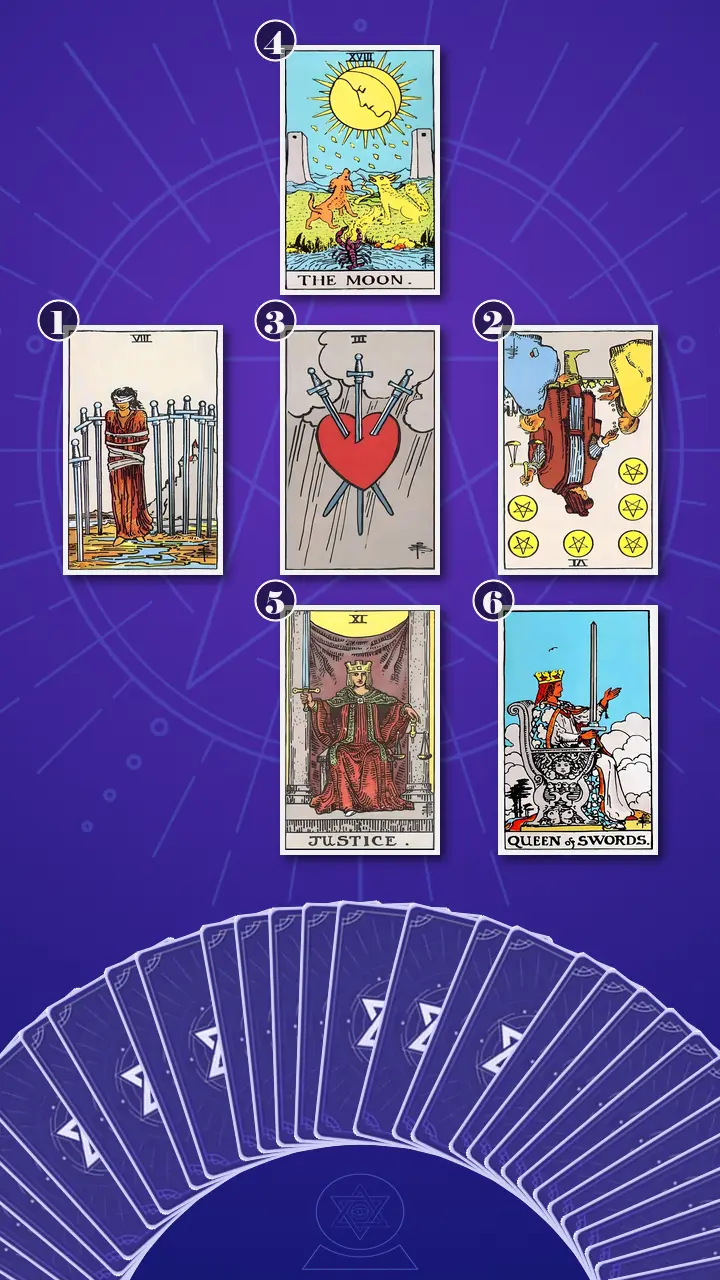
Four Cards in the Blue Light
Position One: The Locked Gate That Wasn't Locked
I turned the card in the position representing Alex's present stance in the relationship, the specific clarity-seeking behaviour and contracted posture that appeared when she noticed the slow fade. It was the Eight of Swords, upright.
I pointed to the blindfolded figure, the surrounding swords, and the ropes that looked restrictive without being completely fixed. The blindfold represented information Alex did not have. The loose bindings represented the distinction she had been missing: limited visibility was not the same as having no available movement.
The card reproduced the scene from ten minutes earlier. At 6:18, still wearing a damp coat, she had treated an unanswered question as a locked gate. No boundary, decision, dinner, or emotional movement could happen until the other person explained what had changed. It was like standing in a Tube station with several exits in view while staring at the delayed-service board as if walking were forbidden until the announcement supplied a reason.
"The inner rule sounds like this," I said. "Until I know why, I cannot let myself step back. Until I know what they feel, I cannot trust what I am receiving. Until the missing sentence arrives, I have to keep the project open."
Air, the element of thought, was contracted and blocked here. Thought was not giving Alex perspective; it was forming a ring around the same missing information. Checking created motion without creating new knowledge. "Checking is an action," I told her, "but it is not the same as getting an answer."
Alex gave one short laugh, but there was no humour in it. Her fingers tightened around the phone, her eyes moved back to the card, and then her mouth pulled into a rueful half-smile. "That is so accurate it feels a bit brutal."
"Only if we turn the card into blame," I replied. "I do not. The Eight of Swords is showing us where agency has been made conditional. I am not asking you to know less or care less. I am asking which choice is already available before another explanation arrives."
Position Two: The Shared Bill One Person Kept Covering
I turned the card in the position representing the observable interaction pattern, the visible exchange of effort and availability without any claim about the other person's hidden intent. It was the Six of Pentacles, reversed.
In the traditional image, one figure holds scales while distributing coins to people below. Reversed, those scales no longer described a stable exchange. The Earth energy that might have grounded the connection through consistent action was deficient. Alex was trying to compensate for that missing stability by supplying more patience, more flexibility, and more interpretation.
She recognised the modern version immediately. A vague "We should catch up soon" would arrive, and she would respond warmly, offer three evenings, add that there was "no stress" if work was busy, and wait. When no plan followed, she would draft something even lighter. It was the relationship equivalent of repeatedly covering a shared bill while calling the imbalance temporary.
"Maybe if I make this easier, lighter, and less demanding, they will meet me here," I said, voicing the bargain. "But generosity and compensation are not the same thing. Patience can be kind. It can also become the name you give to carrying the interaction alone."
Her eyebrows lifted, then drew together. I watched her silently count recent conversations. One hand opened on the table as if she had put down an invisible total.
"I initiated the last four," she said. "And I turned both of their vague suggestions into actual dates."
"That does not prove why they are less available," I said. "It does give us information about the exchange. A vague reply can keep hope alive without making the exchange reciprocal."
Position Three: The Hurt Beneath the Messaging Puzzle
I turned the card in the position representing the emotional centre of the lock, the wound that made an explanation feel necessary before closure could begin. It was the Three of Swords, upright.
The red heart beneath grey rain clouds was direct. I did not present it as a prediction of betrayal or an announcement that a breakup was fated. I used it to name pain already present in the room. Alex had been calling the experience confusing because comparing wording felt more manageable than saying, "I am hurt that something meaningful is disappearing without being named."
I returned with her to 10:52 p.m., when she had placed an early affectionate message beside the latest cool two-line reply. Blue light had washed across the duvet, the radiator had knocked in the silence, and her throat had tightened. Every rereading gave the hurt another mental entry point. The swords showed Air in excess: analysis repeatedly passing through an exposed emotional centre.
"What hurts before your mind starts explaining it?" I asked.
Alex's breath caught. She looked away from the screen, rubbed the heel of her hand over her sternum, and stayed quiet long enough for the kettle to click off behind her.
"That I mattered less than I thought," she said finally. "And that I might not have been worth an honest conversation."
"The absence of an explanation can touch that fear," I said. "It cannot establish it as fact. Your hurt is real without becoming evidence against your worth. We can acknowledge the loss without asking the other person to certify that it mattered."
Position Four: Three Stories Beneath One Online Status
I turned the card in the position representing the attachment trigger and interpretive blind spot, where missing information activated monitoring, self-blame, hope, and suspicion. It was The Moon, upright.
The image showed a winding path under uncertain light, with a dog, a wolf, and a crayfish responding differently to the same moon. I told Alex that The Moon did not prove deception. It showed incomplete visibility and the human tendency to fill gaps with stories that briefly feel like facts.
Alex had lived that card on the Victoria line. She had seen the other person posting an Instagram Story while her direct message remained unanswered. From one signal, her mind generated three routes: "They are overwhelmed," "I ruined it," and "They are keeping me around." Like a map app in a low-signal area, her internal location dot kept jumping, and every jump felt like a confirmed route.
The energy problem here combined deficiency and excess. Direct information was deficient; projection was in excess. Her intuition could legitimately register that the contact no longer felt safe or reciprocal, but intuition could not reveal a private motive from an "Active now" label.
I used a diagnostic lens I call Boundary Permeability Assessment. I asked where Alex's identity ended and the other person's silence began. Her boundary had become so permeable that their public online activity entered her emotional system as unofficial evidence about her desirability. A Story post could alter her view of herself even though it contained no direct information about the relationship.
Her fingertips went still. Her gaze lost focus for a moment, as if three recent commutes were replaying behind her eyes. Then she exhaled through her nose and placed the phone farther from her body.
"So the discomfort might be telling me something," she said, "but the explanation I attach to it is still a story."
"Exactly," I said. "The Moon asks you to respect the discomfort without promoting one unverified story into hidden certainty."
When Justice Put the Phone on the Scales
Position Five: The Standard That Did Not Need Their Permission
The radiator behind Alex clicked once and then went still. Rain continued tracing the window, but more softly now. I turned the card in the position representing the clarity standard and transformative hinge, the fair principle she could use to separate evidence from projection and protect her self-worth. It was Justice, upright.
Justice held an upright sword and level scales. Unlike the crossed swords around the blindfolded figure, this blade did not trap thought inside competing explanations. It discriminated. Unlike the reversed scales of the Six of Pentacles, these scales did not ask Alex to keep contributing until the exchange somehow balanced itself. They asked her to weigh what was present.
I invited her to imagine a plain page with three headings: "Observed," "Imagined," and "Mine to choose." Under the first belonged the reply gaps, who initiated, whether questions were answered directly, and whether proposed plans became real. Under the second belonged every hopeful, threatening, and self-blaming motive. Under the third belonged her relational standard.
My mind went briefly to the perfume laboratory where I had spent fifteen years evaluating scent on paper blotters. Pressing my nose against one strip never made an accord clearer; it overwhelmed the receptors until one note occupied everything. I had to create distance, let the fragrance diffuse, and compare it against a stable reference.
I told Alex that I call this Intimacy Distance Calibration. She had been moving closer and closer to the fading signal, trying to smell an answer from it, until its ambiguity filled the entire room. Justice did not ask her to deny that the connection had a beautiful opening. It asked her to introduce enough air to assess its present form. One scale could hold, "This mattered to me." The other could hold, "What I am receiving now may still be insufficient." Neither truth cancelled the other.
I asked her to return to 10:52 p.m.: Notes open, radiator ticking, jaw tight, and a simple question buried beneath apology clauses. She had been trying to write a message so perfect that it could not receive an unwanted answer, while not sending it kept her waiting for the sentence that would make everything make sense.
You do not have to keep extracting explanations from a slow fade to prove that the connection mattered; you can weigh observable reciprocity, name your relational standard, and let Justice's scales guide the boundary you control.
I let the sentence sit between us.
I watched Alex's breathing stop first. Her thumb remained suspended above the dark phone, and her pupils widened as if the room had shifted half an inch around her. Then her eyes moved away from me. I could see her replaying the offered dates, the softened questions, and the evenings organised around a notification that might reset everything. Her jaw tightened before her face changed. "But doesn't that mean I have spent months getting this wrong?" she asked, sharper than she had sounded all evening. The anger arrived before relief, and I did not hurry it away. Her fingers curled into her palm, loosened one at a time, and then spread flat on the table. A long breath left her chest. Her shoulders dropped, but the release brought a brief, unsteady look, the slight dizziness that can follow when a burden is removed and choice becomes visible. Her eyes shone without spilling over. "If I do not need their answer," she said more quietly, "then I have to decide what is enough for me."
"Yes," I said. "And that responsibility can feel tender, not triumphant. You were not foolish. Checking, researching, and rewriting gave you a few minutes of control when the connection felt unstable. Those strategies protected hope. They simply cannot create reciprocity. Their explanation could add context, but it does not have to authorise your perception or your boundary. You do not need a confession to call a pattern unclear, unequal, or no longer enough for you."
I then asked, "Now, using this new perspective, think back to last week. Was there a moment when this insight could have made you feel differently?"
"When they wrote, 'We should catch up soon,'" she said. "I treated it as a promise and immediately offered dates. I could have noticed that it was still vague. I could have waited for follow-through instead of doing the next part for them."
I named the crossing plainly. This was not a leap from caring to detachment. It was a move from anxious monitoring and explanation-dependent closure toward evidence-based discernment, self-trust, and a self-authored relational boundary. The uncertainty had not vanished. It had stopped holding every available choice hostage.
Position Six: One Clean Sentence and an Open Hand
I turned the final card in the position representing the self-authored boundary and next step, the action Alex could control without deciding for the other person. It was the Queen of Swords, upright.
The Queen held her sword vertically while extending an open hand. I read both gestures together. The sword supported concise truth; the hand remained receptive to an honest response. Clear communication did not require punishment, emotional shutdown, or pretending the connection had meant nothing.
In Alex's life, the card translated into one calm message: "I've noticed our contact has become less consistent. I'm looking for direct, reciprocal communication. Are you still interested in continuing this?" Before sending, she could decide what she would do with a clear yes, a clear no, another vague answer, or no answer. She was equally free to draft it without sending if contact felt destabilising or misaligned with her values.
The Queen's Air was balanced and enacted. Justice had defined the standard; the Queen gave that standard a voice. This was the Wands energy missing from the earlier spread, not impulsive action, but deliberate movement after thought had served its proper purpose.
"Would that be an ultimatum?" Alex asked.
"Not if the boundary governs your participation rather than trying to control their response," I said. "You can ask once without turning the answer into a verdict on your worth. The open hand means you can receive what is actually offered. The sword means you do not have to rewrite it into something else. Clarity becomes useful when it changes what you are willing to participate in."
Alex nodded once. Her expression still carried grief, but her hand no longer covered the phone.
The Seven-Minute Route Back to Her Own Standard
I gathered the six cards into one coherent line. The Eight of Swords showed why Alex felt unable to move without an explanation. The reversed Six of Pentacles showed how she tried to manufacture balance by giving more. The Three of Swords named the hurt that made the unnamed ending feel like a verdict. The Moon showed how missing information became competing digital stories. Justice separated the visible pattern from those stories, and the Queen of Swords turned discernment into a respectful boundary.
The cognitive blind spot was not that Alex had failed to decode the right clue. It was that she had mistaken an explanation for permission. Her project-coordination reflex worked well in a job with shared calendars, owners, status updates, and escalation routes. In a fading relationship, the same reflex kept treating silence as a blocked task someone else needed to complete. The transformation was to close the gap between perception and participation: observe the exchange, name the need, and choose how long her attention remained available.
When I suggested a short pause from monitoring, Alex frowned. "But what if I miss the reply? Even two hours feels like a lot right now."
"Then we make the experiment smaller," I said. "A boundary that floods your nervous system is not useful practice. Start with one hour, or move the app off the first screen until dinner. This is not a dating tactic and it is not designed to make anyone chase you. It is simply oxygen between an urge and an action."
- The Seven-Minute Justice Sheet On one evening this week, set a seven-minute timer and divide a notebook page or Notes screen into three columns: "Observed behaviour," "Possible explanations," and "My relational standard." Add three neutral facts, one story your mind keeps rehearsing, and one sentence beginning, "For me to keep investing, I need..." Minimum version: write one line in each column. Do not use the page to prosecute anyone's intent. If the exercise increases the urge to monitor, stop after one fact and put the phone face down for two minutes.
- The One-Ask Boundary Draft two or three sentences in Notes that name the reduced contact, state the need for direct and reciprocal communication, and ask one answerable question. Read the draft aloud once, remove apology padding such as "I'm probably overthinking" or "No pressure at all," and decide in advance what you will do with a clear, vague, or absent reply. Sending is optional. The useful part is making the pattern, need, and choice audible without inventing the boundary during an emotional spike.
- The Blank Space Protocol Choose one one- or two-hour block after work. Mute the chat, hide activity status, or move the messaging app off the first phone screen. Write the next planned check time on a sticky note. When the urge appears, name the trigger in five words or fewer, such as "quiet flat after work." Treat the blank space as a reversible attention boundary, never as punishment or a test. If two hours feels too activating, use twenty minutes and make tea before checking.

A Week Later: Tea Before the Blue Ticks
Six days later, I received a message from Alex. It read, "I did the three columns. The facts were annoyingly short. The stories filled half the screen. My standard was one sentence." She had read the Queen of Swords draft aloud, removed four apology clauses, and chosen to send it. No fuller answer had arrived yet.
The proof of change was smaller and more convincing than a dramatic ending. At 10:52 that night, she used the Blank Space Protocol, made dinner, and left the phone in another room until the time she had chosen. She did not claim she had stopped caring. She reported that the waiting no longer got to organise the whole evening.
She had also slept through the night. Her first waking thought was still, "What if I'm wrong?" She told me she smiled, made tea, and waited until after breakfast to look at her phone.
I did not credit the cards with making that choice. The cards had given Alex an objective surface on which to separate restriction, imbalance, hurt, projection, discernment, and speech. She supplied the honesty. She created the distance. She decided that her relational standard belonged on the scales. That was the real Journey to Clarity: not certainty about someone else's motives, but the first grounded evidence that she could trust herself while an answer remained incomplete.
When someone fades without naming it, I know how heavy a phone can feel in the hand and how tightly the chest can close around an impossible bargain: keep waiting for the sentence that protects your worth, or trust yourself without it. If that bargain is familiar tonight, noticing it already means the silence is no longer making every decision unseen.
If your own relational standard were allowed onto Justice's scales beside their missing explanation, what small piece of blank space would feel honest for you to create tonight?