Finding Clarity in the 8:47 p.m. Draft Spiral
If you’ve ever saved an apology as ‘Draft 1, Draft 2, Draft FINAL (real final)’ and still couldn’t hit send, you’re not alone—and yes, it’s peak people-pleasing communication paralysis.
Taylor came to my café in Toronto’s Little Italy on a Sunday night when the street outside was already quieting down—just the occasional TTC rumble in the distance and the soft click-click of an old radiator behind the back booth. She set her laptop on the small marble table like it was evidence. The screen brightness was too harsh for the hour, and her phone kept lighting up with a Slack preview she refused to open.
“I keep rewriting this apology email,” she said, not looking at me yet—eyes locked on the draft the way you stare at a pot you’re afraid will boil over. “I want it to be sincere. But I’m terrified I’ll sound… difficult. Like one sentence and I’m permanently the problem.”
I watched her shoulders creep up as if her body wanted to become smaller than the moment. Her fingers hovered over the trackpad—restless, ready to undo, redo, reword. It was the kind of tension I see in people who treat ‘Send’ like a popularity meter: tight chest, jaw braced, breath stuck high.
“Over-apologizing is often just anxiety wearing a polite outfit,” I told her gently. “We’re going to make this less about perfect tone—and more about finding clarity you can actually live with. Let’s draw a map through the fog.”

Choosing the Compass: Celtic Cross · Context Edition
I slid a small cup of espresso toward her—more for grounding than for caffeine—and asked her to take one slow breath in, one out, and hold the question in her mind: What’s my next step past people-pleasing, so I can send this apology cleanly? While I shuffled, I paid attention the way I always do—part tarot reader, part café owner who’s watched a thousand nervous hands clutch cups.
Her fingers wrapped the porcelain tightly. I did my Cup Temperature Scan without making it weird: the way she held it, the way she didn’t sip, how quickly the heat seemed to leave the cup while she stared at the draft. When someone’s energy is dropping fast, the cup cools fast too—not because of physics alone, but because their attention is leaking into a loop.
“We’ll use a spread called the Celtic Cross · Context Edition,” I said, laying out the cards. “It’s perfect for moments like this—when you’re stuck on the surface problem (the draft) but what’s really running the show is a deeper pattern (people-pleasing, fear of being judged).”
For you reading along: this spread works here because it creates a full chain—present block → deeper root → your stance → practical integration. And I keep it ethical by framing position 6 as a momentum check (what your current pattern tends to create next), and position 10 as an integration step (what you can do) instead of pretending I can predict the recipient’s reaction.
“The first card will show what your unsent draft is really expressing,” I told Taylor. “The crossing card will show the immediate block—what keeps interfering with a clean apology. And the final card will give us a practical, grounded next step you can actually take.”
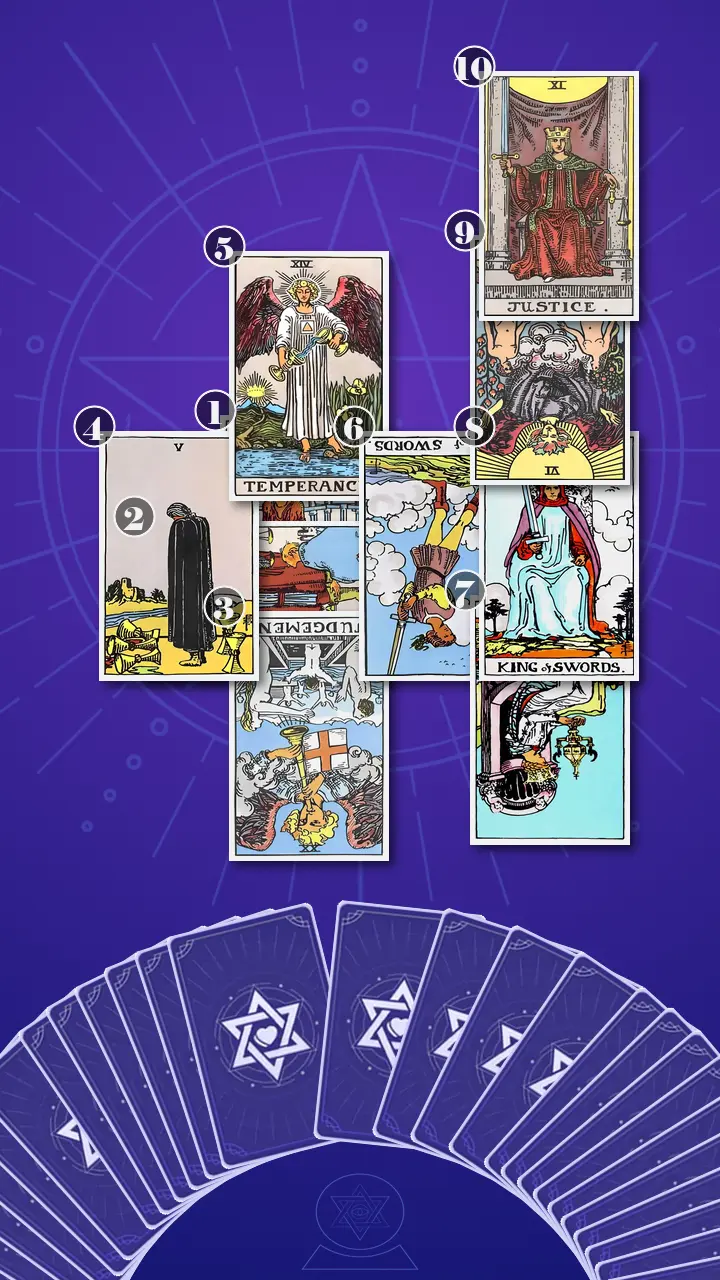
She nodded once, but it looked like her body was bracing for a verdict. Like the email wasn’t an email—it was a courtroom.
Position 1: The current communication freeze
“Now turning over is the card representing the current communication freeze: what the draft email is really expressing (and why it feels hard to hit send).”
Eight of Swords, upright.
I didn’t need to dramatize it; the image did that on its own. Mental restriction. The feeling of being trapped—while the bindings are loose enough to step out of.
In modern life, this looks exactly like what you already know: Taylor staring at her draft like there are only two exits—over-apologize or make it worse. Lunch break toggling between Outlook and Slack. Re-reading the same sentence. Tight chest, shoulders up. Convinced the “wrong” tone will follow her through team dynamics like a bad screenshot.
Energetically, this is a blockage of Air: too much thinking with not enough permission to act. The Eight of Swords doesn’t say “you are trapped.” It says “you are imagining the trap so vividly, you’re forgetting you can move.”
Taylor let out a short laugh that sounded like it got caught on the way up. “That’s… kind of brutal,” she said. “Like, yeah. I’m acting like there’s a sniper trained on my punctuation.”
“That laugh is important,” I told her. “It’s your self-awareness trying to cut through the blindfold.”
Position 2: The immediate block (the people-pleasing reflex)
“Now turning over is the card representing the immediate block: what most interferes with a clean apology.”
Six of Pentacles, reversed.
“This is the approval economy,” I said. “In the draft, you start paying extra—adding apologies, concessions, reassurance lines—like you’re trying to settle an emotional debt with interest.”
The energy here is excess: too much giving, too much lowering yourself, too much trying to control the other person’s response by ‘overpaying’ emotionally. It’s tipping culture, but for feelings—tipping 30% in apologies hoping the service will be nice again.
And this is where my café brain kicked in—my Stress Flavor Profile. “Do you know what over-extraction tastes like?” I asked. “Bitter. Thin. Like you pulled too much from the grounds because you were afraid it wouldn’t be strong enough.”
She swallowed. “Yeah.”
“Your apology is getting over-extracted,” I said. “Not because you’re insincere—but because you’re pulling extra sentences to buy safety. And the more you pull, the more bitter you feel. That’s where resentment sneaks in later.”
Her eyes flicked to her laptop. “I literally added, ‘I totally understand if you’re upset, I take full responsibility,’ and… I don’t fully mean it. But it feels safer.”
“Exactly,” I said. “A clean apology isn’t about paying emotional interest.”
Position 3: The underlying fear (self-worth, belonging, control)
“Now turning over is the card representing the underlying fear: what this situation is touching in self-worth, belonging, or control.”
Judgement, reversed.
“Here’s the inner trial,” I said. “Under the email is an invisible courtroom. The apology isn’t only about the action—it’s about avoiding a guilty verdict on your character.”
Energetically, this is a blockage of renewal. Judgement upright is growth: you hear the call, you learn, you move forward. Reversed, the trumpet becomes an alarm: you’re about to be condemned.
I gave her two lines—one from the courtroom, one from adulthood:
“Courtroom line: ‘I’m not trying to be difficult.’ (That’s character defense.)
Adult line: ‘I missed X, and I see how it impacted Y.’ (That’s accountable and specific.)”
She nodded so tightly it looked like her neck hurt. “I write like everything is going to be forwarded to someone who hates me.”
I had a quick flash of my own life—twenty years of running a café, learning that a tiny mistake doesn’t require a public confession. You wipe the counter. You remake the drink. You don’t set yourself on fire to prove you care.
“Clarity isn’t cruelty—it’s the structure that makes repair possible,” I said. “And structure is what shame hates.”
Position 4: The recent emotional backdrop
“Now turning over is the card representing the recent emotional backdrop: what happened internally that brought you to this drafting moment.”
Five of Cups, upright.
“This is the emotional hangover,” I said. “After the misstep, you can only see what spilled.”
Energetically, this is imbalance—not because you don’t care, but because regret narrows your vision. You replay the moment on the streetcar, you write from ‘undo the past’ instead of ‘repair the present.’ The card even shows two cups still standing, and a bridge forward—but the figure can’t look up yet.
Taylor’s shoulders dropped a millimeter. “That’s exactly it. I’m not even sure what I’m apologizing for anymore.”
“That sentence,” I said, “is the moment the bridge appears.”
Position 5: What you’re aiming for consciously
“Now turning over is the card representing what you’re aiming for consciously: the kind of repair you want to create and the values you want to act from.”
Temperance, upright.
“You want a measured apology that’s both human and specific,” I said. “No groveling, no cold corporate distance. ‘Clear + kind,’ not ‘perfect + harmless.’”
Energetically, Temperance is balance. It’s the middle-way edit. I asked her to do the most unglamorous thing that works: read her draft out loud once, just once. Not to optimize it like a Huberman Lab experiment—just to listen.
As she read, her voice got quiet on the parts that were bargaining. It got steadier on the parts that were factual.
“Make exactly one adjustment,” I said. “If it sounds like pleading, remove one softener. If it sounds like a legal defense, add one human line. That’s all.”
She exhaled like her breath finally found her ribs.
Position 6: Near-future default pattern (momentum check)
“Now turning over is the card representing the near-future default pattern: what happens next if you keep operating from the same drafting mindset.”
Page of Swords, reversed.
“If nothing changes,” I said, “the next move is more jittery vigilance—refreshing the draft, rewriting subject lines, scanning every sentence for how it could be misread. You risk either sending multiple follow-ups to fix the fix, or going silent because the monitoring gets too loud.”
Energetically, this is excess Air again—wind-tossed thoughts with no landing gear. It’s the ‘47 tabs open’ brain: trying to prevent one mistake until your system overheats.
She gave me a look that was half embarrassed, half relieved to be called out accurately. “I literally changed the subject line from ‘Quick note’ to ‘Checking in’ to ‘Apology’ and back.”
“That’s the Page,” I said. “Always on guard.”
Position 7: Your role in the dynamic (your internal stance)
“Now turning over is the card representing your role in the dynamic: the internal stance you’re taking while writing and apologizing.”
Queen of Cups, reversed.
“This is empathy with leaky boundaries,” I said. “You’re shaping every line around keeping them comfortable. The apology becomes soothing instead of repair.”
Energetically, this is a deficiency of containment. The Queen’s cup is meant to hold emotion with care; reversed, the container leaks, and suddenly you’re holding everyone’s feelings in your hands like hot coffee you can’t put down.
Taylor’s voice went small. “If they feel bad, it means I failed.”
“You can acknowledge impact without taking custody of their feelings,” I said. “That’s the shoreline in the card—care can exist without self-erasure.”
Position 8: The other side of the conversation (what the situation asks for)
“Now turning over is the card representing the other side of the conversation: what the situation is asking for from a clarity/boundary perspective.”
King of Swords, upright.
“This is the adult clarity the situation is calling for,” I said. “Especially at work: brief, factual acknowledgment and a reasonable next step. Readable. Actionable. No emotional essay that asks the other person to manage your feelings back.”
Energetically, this is balance—Air in its mature form. ‘Say what’s true, then stop.’
She blinked. “It’s weird, because I respect that in other people.”
“Right,” I said. “But your nervous system thinks that voice will make you unlikable. Like you’ll turn into your Severance work-self: competent, but cold. That’s not what the King is. The King is calm.”
Position 9: Hope and fear (what you want, what you’re afraid it reveals)
“Now turning over is the card representing hope and fear: what you most want from this email and what you’re afraid it will reveal.”
The Lovers, reversed.
“This is the split between two values—honesty and being liked,” I said. “So the email mixes signals: apologizing while subtly asking for reassurance.”
Energetically, this is imbalance—not a lack of love, but misalignment. You hope for restored harmony, and you fear that straightforwardness will cost connection, so you edit yourself into confusion.
She stared at the card like it was rude for being right. “I just want this to be over without anyone being mad.”
“That’s such a human hope,” I said. “And it’s also the trap: hoping to pre-solve their feelings. The way out is values-based clarity, not approval-based performance.”
The Inner Courtroom Went Quiet: Justice and the Three-Sentence Apology
When I reached for the final card, the café felt suddenly smaller—like the air had turned down its volume. Even the espresso machine behind the counter clicked once and settled.
“Now turning over is the card representing integration and next step: the healthiest way to frame and send the apology past people-pleasing.”
Justice, upright.
Her eyes tracked the scales in the image before she looked at my face. This wasn’t a card about being harsh. It was a card about being accurate.
Setup: You’re back at that late-night draft—the screen glow, the blinking cursor, the tight chest—like the email is asking you to prove you’re a good person before you’re allowed to press Send. In that state, every sentence becomes a negotiation for safety instead of a repair.
Delivery:
Stop trying to write an apology that guarantees you’ll be liked; write the fair, factual truth like Justice’s balanced scales, and let the clarity do the work.
I let it sit. No extra explanation. No padding. The way a good espresso needs a pause after it pulls—so the flavor can actually land.
Reinforcement: Taylor’s body did a whole three-step reaction chain in real time. First, a freeze—her breath paused, and her fingers stopped hovering like they were finally allowed to rest. Then, the mental replay—her gaze went slightly unfocused, like she was watching the incident back but with the sound turned down, less shame-saturated. Then, the release—a slow exhale from deep in her chest, shoulders lowering as if they’d been carrying a backpack she didn’t know she put on.
“But if I’m not… extra nice,” she said, and there was a flash of anger under the fear, “won’t they think I’m defensive?”
“That’s the old agreement,” I said, a little firmer now—my coach voice coming out. “That clarity equals danger. But Justice is not asking you to be ‘tough.’ Justice is asking you to be proportional.”
I pulled her laptop a little closer, like we were both editors now. “Open a fresh draft. Write only three sentences: (1) What I did. (2) Impact I acknowledge. (3) What I’ll do differently / next step. Everything else goes in a separate note called ‘People-Pleasing Extras.’ Not in the email.”
Then I added the boundary line I wanted her nervous system to hear, not just her brain: “Write one private line above it: Their feelings are real; they are not my job to control.”
And because I’m a café owner who thinks in rhythms, not willpower, I offered a tiny reset: “Before you touch the wording again, do my 5-Minute Coffee Meditation. Grind a small scoop of beans—if you don’t have beans at home, just hold your mug and inhale whatever you’ve got. Three slow breaths. Let your shoulders drop. We’re not performing distress. We’re practicing clean repair.”
I looked at her. “Now, with this new lens—when was a moment last week where this would’ve changed how you felt?”
She swallowed, eyes damp but steady. “Thursday night. I was rewriting ‘I’m sorry if’ like… fifteen times. If someone had told me ‘fair, factual truth’ then, I think I would’ve sent it.”
“That’s the shift,” I said. “From self-doubt trying to disappear… to grounded accountability that can tolerate an imperfect response.”
And I gave it language she could keep: “A clean apology isn’t a performance for approval—it’s proportional responsibility plus clear truth.”
From Insight to Action: The Justice Send Plan
I gathered the whole spread into one story, so it didn’t stay as ten separate insights.
“Here’s what I see,” I said. “Regret (Five of Cups) narrowed your focus and made the mistake feel bigger than it is. That fed the trap (Eight of Swords): you started believing there’s only one ‘safe’ tone. People-pleasing took over (Six of Pentacles reversed) and you began paying emotional interest—extra apologies, extra softness—to buy reassurance. Underneath, Judgement reversed turned this into a trial about your worth. Your empathy (Queen of Cups reversed) tried to absorb their feelings as your job. But the situation itself is asking for King of Swords clarity—structured, readable, adult. Justice is the integration: fairness, proportion, and calm truth.”
“Your cognitive blind spot,” I added, “is believing that more words equals more safety. In reality, more words often means more bargaining. The transformation direction is clear: shift from ‘I need to earn forgiveness by over-apologizing’ to ‘I can take proportional responsibility and communicate with clarity, even if someone is temporarily uncomfortable.’”
Taylor’s brow furrowed. “I want to do it. But I swear I don’t even have five minutes. My week is back-to-back meetings.”
“Then we go smaller,” I said. “Italian riposo style—micro-pause, not a personality overhaul. And remember this rule: If you’re editing to get reassurance, you’re done editing.”
- The 3-Sentence Justice DraftOpen a fresh email draft and write only: (1) what you did, (2) the impact you acknowledge, (3) the realistic next step you’ll take. Put every extra apology, qualifier, or backstory line into a separate note titled “People-Pleasing Extras” (not in the email).If three sentences feels “cold,” make it four by adding exactly one human line (e.g., “I value working well together”). Then stop.
- The 60-Second Scales CheckBefore sending, scan each sentence and ask: Is this (a) truthful ownership, (b) impact acknowledgment, or (c) a next step? If it’s asking for reassurance, over-explaining, or apologizing for your feelings, delete it or move it to “Extras.”Pretend it could be forwarded. Only keep what you’d stand by without needing extra context.
- The 20-Minute Timer + Schedule SendSet a 20-minute timer to finalize one draft. When it ends, you get one proofread for clarity and tone—no rewriting. Then schedule-send it for 30–60 minutes later (so you’re not hitting send in a panic state).If your chest tightens and you start adding “just/if/really,” stand up, take 3 slow breaths, and return only to the three required points.

A Week Later: Ownership, Not Certainty
A week later, Taylor texted me a screenshot—cropped to avoid names, but I could see the subject line: simple, clean. No “Quick note??” no “Checking in…” no apology stack. Just honest.
Her message said: “I did the three sentences. I wanted to add five more. I put them in ‘People-Pleasing Extras’ like you said. Then I schedule-sent it. I didn’t feel brave, but I felt… solid.”
She added, almost as an afterthought: “I still woke up the next morning thinking, ‘What if I messed it up?’ But I didn’t reopen the draft. I made coffee and went to work.”
That’s what I love about this kind of tarot reading—how tarot works, at its best, isn’t by predicting a perfect reply. It’s by giving you a structure for integrity when your nervous system wants to bargain. A journey to clarity doesn’t end with certainty; it ends with a clean next step you can stand behind.
When the cursor blinks over your apology draft and your chest tightens, it can feel like one sentence could decide whether you’re still “safe” to be liked—so you keep rewriting, not to clarify, but to disappear.
If you didn’t have to earn forgiveness with extra paragraphs, what would your most fair, factual three sentences be—just for today?
This story is adapted from psychological research, written so that those in a similar struggle can see their own pattern in it — and find their next step clearly.These insights are not a substitute for professional psychological, medical, legal, or financial advice.
Learn more about our Journey to Clarity.
How did this insight land for you?
🫂 This Resonates Deeply
🌀 Living This Story
✨ Now I See Clearly
🌱 Seeing New Possibilities
🧰 Useful Framework
🔮 The Confirmation I Needed
💪 Feeling Empowered
🚀 Ready for My Next Step
Author Profile
 AI
AI“For twenty years, I’ve listened to stories unfold over the warm aroma of coffee. I don’t believe life’s complexities always require grand theories to be solved; often, we just need a safe place to tidy up our reality. I don’t offer high-minded preaching—just grounded, heartfelt insights to help you regain your sense of control amidst the clutter of daily life.”
In this Introspection Tarot Reading :
Core Expertise
Service Features
Also specializes in :
Explore Related Patterns:
Boundary DiffusionTaylor says that if the recipient feels bad, it means she has failed, and she shapes every line around preventing that outcome. The recipient's possible emotions become Taylor's responsibility before the message has even been sent. When you treat another person's discomfort as proof of your wrongdoing, the boundary between acknowledging impact and managing their internal state becomes difficult to see. Boundary Diffusion explains why Taylor gives up accuracy and claims more responsibility than she believes is hers. Care is no longer one value in the conversation; it becomes an obligation to make the other person comfortable at the cost of your own honest position. Restoring the boundary means owning your action and its impact while allowing the recipient's interpretation, timing, and feelings to remain genuinely theirs.
Boundary DiscernmentTaylor writes the private reminder that the recipient's feelings are real but are not hers to control, then moves reassurance-seeking sentences into a separate note. The distinction does not dismiss the other person; it identifies which responsibilities belong inside the apology and which emotional outcomes cannot be ethically guaranteed. When you can separate empathy from emotional custody, care no longer requires self-erasure. Boundary Discernment allows Taylor to offer ownership, acknowledgment, and a next step without asking the recipient to make her feel safe in return. You can remain warm while refusing to claim responsibility you do not believe is yours. That clarity creates room for two people to have different feelings and still participate in an accountable exchange.
Certainty SeekingTaylor keeps rewriting because no version can tell her in advance how the recipient will respond. She nevertheless treats more wording as a possible route to more safety and tries to produce an apology that guarantees she will remain liked. When you ask language to eliminate another person's freedom to interpret and react, editing becomes an attempt to control uncertainty rather than improve clarity. Certainty Seeking makes stopping feel irresponsible because the unresolved response is mistaken for an unresolved draft. You may know intellectually that no message can guarantee harmony while still feeling compelled to search for one more protective phrase. The useful shift is to let accuracy determine when the email is finished and let uncertainty remain where it belongs: in the future response, not in endless revisions.
Defensive OverexplainingTaylor keeps adding apologies, qualifiers, and reassurance after the relevant ownership is already present, including a claim of total responsibility that she does not fully believe. The extra material functions like a pre-emptive defense: if every possible criticism is answered and every possible feeling is soothed, perhaps the recipient will have no reason to judge her. When you explain beyond what is truthful and relevant, detail becomes protection rather than communication. Defensive Overexplaining can make an apology sound less stable because the message starts bargaining with reactions that have not occurred. You may feel safer while adding each sentence, yet the finished email can become less accurate, more emotionally loaded, and harder for the recipient to use. Removing reassurance-seeking language is therefore not emotional withdrawal; it restores a clean boundary between accountable explanation and anxiety management.
People-PleasingTaylor adds that she takes full responsibility even though she does not fully mean it, then surrounds the statement with extra apologies, concessions, and reassurance. The language is serving two jobs at once: repairing a specific mistake and trying to make rejection impossible. When you use extra accommodation to secure emotional safety, accuracy can quietly become less important than appearing easy to forgive. The repeated urge to become smaller, softer, and more agreeable is what makes this People-Pleasing rather than ordinary courtesy. You are not simply considering another person's experience; you are treating their approval as the test of whether your apology was acceptable. Seeing that distinction lets you replace approval-based performance with proportionate ownership, without withdrawing care or becoming unnecessarily cold.
Self-AccountabilityTaylor opens a fresh draft and writes only what she did, the impact she recognizes, and the realistic next step she will take. This structure moves her attention away from proving that she is a good person and back toward the part of the situation she can genuinely own. When you describe conduct precisely and connect it to changed action, responsibility becomes concrete rather than unlimited. Self-Accountability is present because Taylor sends a message she can stand behind without using exaggerated blame to demonstrate sincerity. You do not need certainty about the recipient's reaction to know whether your ownership is truthful and proportionate. This creates a form of repair that remains intact even if the response is temporarily uncomfortable.
Analysis ParalysisTaylor saves multiple supposedly final drafts, rereads the same sentence, cycles through subject lines, and still cannot send the email. The analysis initially promises protection from a wording mistake, but it eventually stops producing useful information. When you keep thinking after the message's purpose has become less clear rather than more clear, analysis has shifted from preparation into avoidance. Analysis Paralysis persists because each new edit briefly feels like progress while postponing the moment when another person can react. You may experience the delay as responsibility or carefulness, even as the search for a perfect formulation makes action less likely. A defined stopping rule works because it changes the decision from “Is this completely safe?” to “Is this accurate, proportionate, and clear enough to send?”
Threshold ToleranceTaylor schedule-sends the three-sentence apology while still wanting to add five more lines, then wakes the next morning with doubts and chooses not to reopen the draft. The discomfort does not disappear before she acts; it stops being the condition that decides whether she can act. When you remain at that threshold without returning to the old reassurance ritual, uncertainty becomes tolerable rather than controlling. Threshold Tolerance is the practical step beyond People-Pleasing because it removes the demand to feel completely safe before communicating honestly. You can notice the fear of being misread, allow the other person to have an imperfect response, and still stand behind a proportionate message. The evidence of progress is not emotional certainty; it is your ability to keep a clear boundary while uncertainty is still present.
CatastrophizingTaylor imagines that one sentence could make her permanently the problem and writes as though the email might be forwarded to someone already committed to judging her. A bounded communication risk is mentally expanded into lasting reputational and relational damage. When you treat a possible negative reaction as the likely beginning of a permanent verdict, every small wording choice can feel disproportionately dangerous. Catastrophizing keeps the nervous system responding to the worst imaginable outcome rather than the evidence available in the present exchange. It does not require you to be consciously dramatic; it can look like careful proofreading, physical bracing, or an inability to stop preparing. Naming the escalation helps you return to the actual task: acknowledge what occurred, state what changes next, and leave hypothetical future judgments outside the draft.
Self-Judgment LoopTaylor experiences the email as an invisible courtroom where a specific mistake could become a verdict on her entire character. Regret then narrows her attention, and straightforward language feels dangerous because it may fail to prove that she is still a good and acceptable person. When you collapse “I did something that needs repair” into “this determines who I am,” accountability becomes fused with self-condemnation. The Self-Judgment Loop is maintained by trying to escape that global verdict through better wording. Each defensive edit keeps the character trial active, which creates more shame and another perceived need to defend yourself. Separating conduct from identity allows you to take responsibility without turning the apology into evidence for or against your worth.
Explore Related Struggles:
Boundary CollapseTaylor adds apologies and concessions until the draft starts carrying more emotion than the actual situation can hold. She even includes a line about taking full responsibility while admitting she does not fully mean it, because the sentence feels safer than saying only what is true. The boundary problem is visible in how the email changes function. It stops being a clean acknowledgment of impact and becomes a container for the other person's possible discomfort, Taylor's fear of being disliked, and the imagined consequences of every phrase. Boundary Collapse fits because her care has lost its edge. You can acknowledge impact without taking custody of someone else's entire reaction, but in this draft spiral the line between repair and self-erasure keeps dissolving. The work is not to care less; it is to give the apology a shape strong enough to hold care without letting it swallow the sender.
Inner Tribunal LockTaylor keeps staring at the apology draft as if the email is evidence in a trial, not a message to a colleague. She says one sentence could make her permanently the problem, and later admits she writes as if everything might be forwarded to someone who already hates her. That turns a specific repair into a character verdict. Instead of asking, "What happened, what impact did it have, and what will I do next?" the draft gets loaded with a second job: prove that she is not difficult, careless, cold, or unlikable. Inner Tribunal Lock fits because the stuck point is not only the email. You are watching the moment when accountability gets fused with self-prosecution, and every edit becomes another attempt to win a case that was never supposed to be on trial. The next step past people-pleasing begins when the apology can name the action without putting the whole self on the stand.
Rumination EntrapmentTaylor keeps revising the same apology until the activity looks productive from the outside but stops producing movement. The subject line changes, the softeners multiply, the possible misreadings keep expanding, and the draft remains open. The loop has a precise friction point: every edit promises relief, then creates another surface to inspect. More wording is supposed to make the email safer, but it also gives Taylor more chances to doubt the tone, bargain for reassurance, or prepare a follow-up to fix the fix. Rumination Entrapment fits because the mind is not simply thinking too much; it is caught in a closed circuit where review replaces decision. You can feel the trap in the way the cursor keeps blinking over a message that already has enough information to be sent, while attention keeps circling back for one more pass.
Truth-Connection SplitTaylor wants the apology to be honest, but she also wants it to end the discomfort without anyone being mad. That is why the message starts mixing two signals at once: accountability for what happened and a quiet request to be reassured that she is still liked. The split shows up in the wording. A sentence that could simply name the impact gets softened into a bid for approval, while a line meant to be kind starts weakening the truth of what she actually means. Truth-Connection Split fits because the core tension is not honesty versus kindness. It is the belief that clear truth might cost connection, so the draft keeps trying to protect the relationship by blurring the message. The next step past people-pleasing is learning that connection does not need every edge sanded off before truth can be spoken.
Vigilance-Execution SplitTaylor's body is already in send-mode pressure before the email goes anywhere: shoulders lifted, chest tight, fingers hovering over undo and redo, phone lighting up with Slack previews she refuses to open. There is plenty of activity, but the action that matters keeps getting delayed. The monitoring system has taken over the execution system. Taylor can scan for tone risk, imagine how a sentence could be forwarded, and detect every possible way the message could land badly, yet that same vigilance blocks the simple next step of sending a proportional apology. Vigilance-Execution Split fits because the draft spiral is powered by a protective skill that has outgrown its job. You are not looking at laziness or lack of accountability; you are looking at alertness so intense that it interrupts completion. The practical shift is to let one clear structure carry the message, so vigilance no longer gets to run the whole room.
Explore Related Emotions:
Accountability DreadTaylor describes the email as though one wrong sentence could make her permanently the problem, and her body braces as if she is waiting for a verdict. The specific action that needs repair becomes inseparable from the possibility that her entire character will be judged. You can understand what you need to own and still experience accountability as an approaching threat to belonging. Accountability Dread names that heavy anticipation, where acknowledging an impact feels as though it might expose far more of you than the situation actually requires.
Alignment ReliefTaylor's voice steadies on the factual parts of the apology, and her body releases when the message is reduced to what she did, the impact she acknowledges, and the next step she can honestly take. The wording now makes room for care, accuracy, and her own boundaries at the same time. When your language matches your values closely enough, the internal argument can quiet. Alignment Relief is the release that comes from no longer forcing honesty and connection to compete for space inside the same sentence.
Approval AnxietyTaylor's phone keeps lighting up while she stares at the draft, shoulders raised and fingers poised to rewrite. She adds apologies, concessions, and reassurance lines because every phrase seems capable of changing whether the recipient still sees her as acceptable. When another person's approval becomes the hidden measure of safety, you can experience communication as a referendum on your social worth. Approval Anxiety names the pressure to secure acceptance through wording before you allow yourself to act.
Boundary GuiltWhen Taylor hears that she can stop adding extra softness, she immediately worries that the recipient will see her as defensive. She also says that another person's bad feelings would mean she had failed, making emotional caretaking feel like part of the debt she owes. A limit can feel morally wrong when you have learned to measure care by how much discomfort you absorb. Boundary Guilt names the unease that appears when you allow responsibility to have an endpoint and leave another person free to have a response you do not control.
Certainty HungerTaylor says she wants the situation to be over without anyone being angry, and she edits as though the correct sentence could secure that outcome in advance. The recipient's unwritten reply is already occupying the draft, making completion depend on information she cannot yet have. You may find it difficult to settle when responsible action does not come with a guaranteed reception. Certainty Hunger names the persistent need for an assurance that would make movement feel completely risk-free, even when the available task is already clear.
Grounded AgencyA week later, Taylor has written the three sentences, moved the extra paragraphs elsewhere, schedule-sent the email, and left the draft closed the next morning. She still notices the thought that she may have got it wrong, yet she makes coffee and continues with her day. You can feel solid without possessing certainty about another person's response. Grounded Agency is the lived sense that your action belongs to you because it reflects what you honestly own, what you can change, and where your responsibility ends.
Self-Betrayal AcheTaylor adds that she takes full responsibility and then admits she does not fully mean it. Her wish to sound safe and agreeable has begun to remove her actual assessment of what happened from the message. When your outward words keep moving away from your inward truth, you can feel a private sting beneath the polished tone. Self-Betrayal Ache names the pain of recognizing that acceptance is being purchased with language that does not fully represent you.
Hard-Won ComposureWhen the proportional framing lands, Taylor's fingers stop hovering, her shoulders lower, and her breath reaches deeper into her chest. A week later she describes feeling solid rather than brave, with the next morning's doubts still present but no longer directing her hands back to the draft. Composure can be real even when it has to be maintained in the presence of residual tension. Hard-Won Composure names the steadiness you reach after sustained inner effort, where your body can remain with an imperfect outcome without resuming the struggle for control.
Cognitive OverwhelmTaylor saves multiple supposedly final drafts, changes the subject line back and forth, toggles between Outlook and Slack, and scans each sentence for possible misreadings. Every edit opens another hypothetical branch, so the draft accumulates options without moving closer to completion. Your attention can feel crowded even while you are sitting completely still. Cognitive Overwhelm names the inner saturation produced when too many interpretations, precautions, and revisions compete for the same limited space.
Conflict HangoverTaylor replays the misstep on the streetcar, keeps returning to the same language, and eventually admits that she is no longer sure what she is apologizing for. The original moment has ended, but its residue continues to narrow what she can see in the present. A conflict can remain active inside you after the external event is over, colouring later thoughts and making repair feel like an attempt to reverse time. Conflict Hangover names that lingering emotional aftereffect, where the past still sets the tone of the current conversation.
Explore Related Contexts:
Approval BottleneckTaylor keeps saving and revising the apology email while Slack previews light up beside her, treating the Send button less like a communication tool and more like a social verdict. The draft has become a place where one sentence seems capable of deciding whether she stays acceptable, easy to work with, and safe from being labeled difficult. That is why Approval Bottleneck fits the story more precisely than a generic communication issue. Her next step is blocked at the point where clear action has to pass through imagined approval first: extra apologies, softeners, and reassurance lines are added not because they make the repair more accurate, but because they seem to reduce the risk of disapproval. You are looking at an external communication stage where workplace acceptance has become the gatekeeper for accountability. The useful move is not to perfect the emotional temperature of the email, but to separate proportional responsibility from approval-seeking performance so the message can become sendable again.
Defensive Communication LoopTaylor changes the subject line from “Quick note” to “Checking in” to “Apology” and back, then scans the draft for every possible way it could be misread. The email stops functioning as a simple repair and turns into a defensive communication loop, where each revision is meant to prevent a new interpretation problem. The structure around her matters: this is a workplace message moving through Outlook, Slack, and team dynamics, where tone can feel permanently archived, forwarded, or socially replayed. That environment makes the draft feel less like an apology and more like a statement being prepared for cross-examination. You are not just dealing with wording friction. You are dealing with a communication channel where accountability, reputation, and social readability are tangled together, so the practical next step has to create a stopping rule before the loop keeps producing more explanations.
Office Emotional LaborTaylor writes lines like “I totally understand if you’re upset, I take full responsibility,” then admits she does not fully mean them, only that they feel safer. The apology has expanded beyond naming what happened and what she will do next; it now includes the extra task of cushioning the other person’s reaction. That is the external weight in Office Emotional Labor. In a professional setting, she is not only trying to repair a misstep; she is also performing warmth, reassurance, and harmlessness so she will not be read as difficult. The emotional maintenance becomes unpaid work inside the email itself. You can see why the three-sentence structure matters. It does not remove care from the message; it stops the workplace channel from turning care into self-erasure, letting accountability stay specific instead of becoming a performance of unlimited accommodation.
Tone PolicingTaylor says she writes like everything is going to be forwarded to someone who hates her, and the story repeatedly returns to the danger of sounding difficult, defensive, or cold. The visible problem is an apology draft, but the pressure around it is the policing of tone inside a work relationship. Tone Policing fits because the stakes are not limited to whether the apology is accurate. The message is being filtered through an imagined social review board where directness could be treated as attitude, proportionality could be mistaken for defensiveness, and one sentence could travel through team dynamics as reputational evidence. You are facing a context where clear communication has to survive a narrow acceptability range. Naming that pressure helps separate legitimate repair from the extra performance of making every sentence impossible to criticize.