Family Mediator Burnout: Naming One Boundary, Taking a Pause

The 8:47 p.m. Cost of Compulsive Peacekeeping During Family Fights
If you are the person everyone calls calm and reasonable, you may interrupt a family argument before anyone has finished speaking, especially when a video call starts sounding less like a conversation and more like a real-time crisis.
Jordan, a 27-year-old junior project coordinator in Toronto, joined my video consultation at 8:47 on a Tuesday evening. A family call had ended minutes earlier, but the laptop fan was still humming beside her cold dinner. Her phone looked warm in her palm as she opened three private message threads, closed one, then opened it again under the blue light of her bedroom lamp.
“I know what I’m doing,” she told me. “I’m rewriting what everyone said so nobody reads it in the worst possible way. But if I don’t step in, this will get worse. And staying out of it feels like choosing a side.”
Her question was simple enough to fit in one sentence: “Why do I keep playing peacekeeper when family fights escalate?” The weight behind it was not simple. I watched her jaw lock whenever a notification appeared. The anxiety moved through her like a smoke alarm wired to every sharpened syllable rather than to actual fire: chest contracting, hands reaching for the keyboard, words rushing forward before anyone could say something she believed might be irreversible.
“You are not just keeping the peace,” I said. “You are carrying the consequences everyone else gets to leave in the room.”
Her fingers stopped. I told her I was not going to use tarot to predict the next family blow-up, diagnose her relatives, or decide who was right. I wanted us to identify the mechanism that kept recruiting her into the family peacekeeper role, then find one boundary that would return her voice, time, and choices to her. “Let’s make a map of the fog,” I said, “but you’ll decide where to walk.”

Choosing the Compass: A Five-Card Relationship Tarot Spread
I asked Jordan to close the private chats for the length of one slow breath. That was not a mystical requirement. It was a practical transition, giving her nervous system one task instead of five. I shuffled while she held the question in mind, then laid five cards in a cross.
I chose the Relationship Spread · Context Edition, a five-card contextualized Relationship Tarot Spread designed for self-exploration rather than prediction. For readers wondering how tarot works in a situation like this, the value lies in structure: the cards separate a crowded emotional experience into observable roles, recurring patterns, available choices, and next steps. Card meanings in context can help intuition and logic meet without pretending that a symbol is objective proof of another person’s motives.
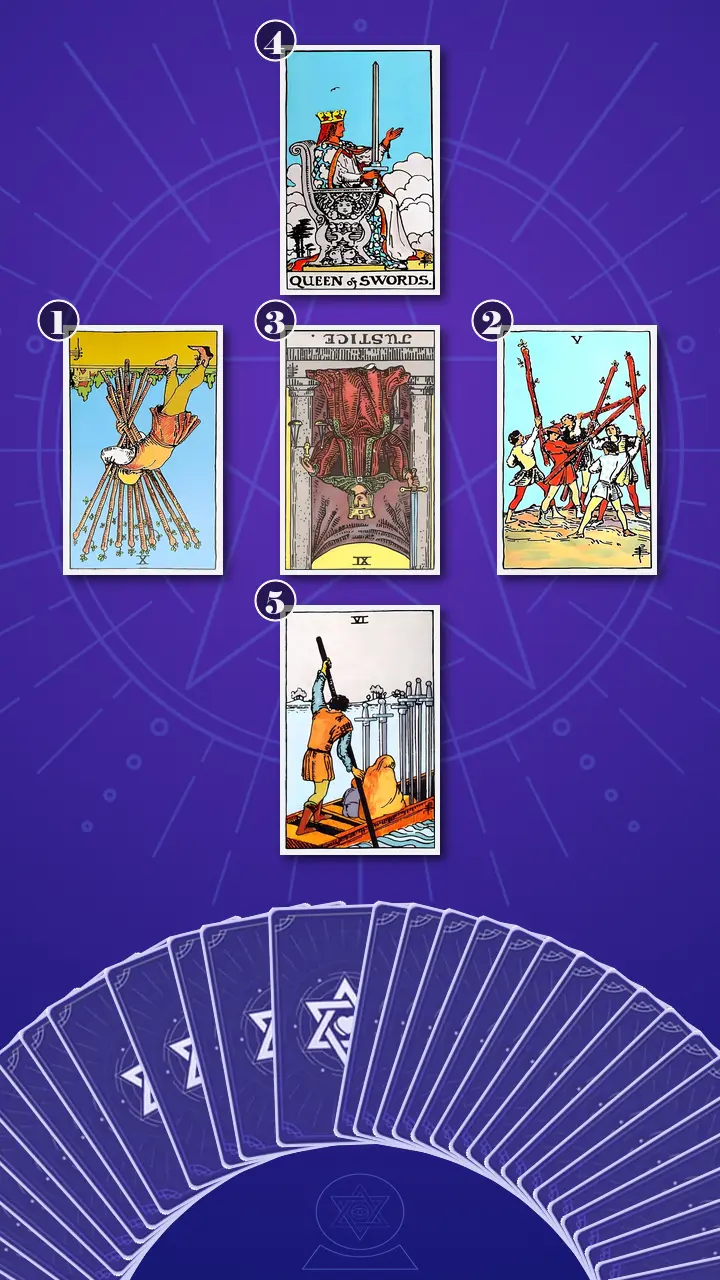
The first card, placed to the left, would show Jordan’s current peacekeeping role. The second, placed to the right, would represent the whole family conflict field rather than blaming one relative. The centre card would expose the pattern maintaining her involvement. Above it, the fourth card would identify the boundary and truth required. Below it, the fifth would turn that truth into a concrete boundary experiment.
This adaptation mattered. Jordan was not asking about one identifiable counterpart, so a conventional other-person position would have oversimplified the situation. She also did not need vague advice about “communicating better.” She needed a precise way to distinguish what she could communicate from what each relative had to manage for themselves.
When Carrying Everyone Becomes a Job
Position 1: The Unpaid Project Manager of the Argument
I turned over the card representing Jordan’s self and current role: the Ten of Wands, reversed.
In the Rider-Waite-Smith image, a figure bends beneath ten wooden staffs. The bundle hides the figure’s face even though a town remains visible in the distance. I asked Jordan to notice the visual logic before I interpreted it: the destination still existed, but the person carrying the load could no longer see where they were going.
In Jordan’s life, this looked like becoming the family conflict’s unpaid project manager. After a group call, she opened three private chats, rewrote each person’s words into something more acceptable, watched the typing indicators, and postponed her own evening until the thread seemed quiet. Her face, meaning her actual view, disappeared behind the labour of carrying everybody else’s pressure. The distant town was the dinner, sleep, work, and personal time waiting beyond the screen.
The reversed energy showed both excess and blockage: too much assumed responsibility, combined with difficulty releasing it. Carrying the conflict gave her a temporary sense of usefulness, so putting it down felt less like rest and more like negligence. The reversal was not a bad omen. It was pressure asking for a safer form of release.
“If I explain this correctly,” I said, offering the sentence I could hear beneath her behaviour, “then maybe nobody will escalate.”
Jordan gave a short laugh with a bitter edge. “That’s so accurate it’s kind of brutal.” Her mouth curved, but her eyes stayed fixed on the card.
“Accurate doesn’t have to mean condemning,” I replied. “This role probably became convincing because it produced brief relief. We’re looking at its cost now, not shaming the reason you learned it.”
I asked what one sentence about her own limit might replace an entire evening of translation. She looked at the open Notes app and said, very quietly, “I don’t know. I usually know what everyone else should say.”
I also named the overcorrection risk. Putting down the Ten of Wands did not require abruptly refusing every message or disappearing without explanation. Jordan could pause after naming a boundary. Release did not have to become retaliation.
Position 2: Five Voices and No Shared Rules
I turned over the card representing the family conflict field and the competing energies that invited Jordan to mediate: the Five of Wands, upright.
Five figures raised their staffs at different angles. The wands crossed, but there was no central authority, shared rhythm, or obvious winner. I told Jordan this card validated something important: the conflict field was genuinely noisy. She was not inventing the overlapping voices, abrupt exits, rapid messages, or pressure in the room.
In modern terms, it was the family video call where two people spoke at once, another left and returned with a longer message, and Jordan began summarizing each position before anyone had agreed to participate in an organized conversation. It had the behavioural rhythm of The Bear: several strong reactions colliding at speed while one person tried to keep the whole room functional.
The upright Fire energy was active but excessive. Friction scattered across too many competing claims, and Jordan interpreted the lack of structure as a personal emergency. It was like an algorithm receiving five incompatible signals and asking her to become the missing sorting system. Yet one perfectly worded intervention could not create listening where no shared terms for listening existed.
“What happens in your body at the exact moment you decide the argument has become your assignment?” I asked.
Jordan lifted both hands without seeming to notice. “My chest tightens, and I start talking faster. I say, ‘Can we all just be reasonable?’ before I’ve even decided what I think.” Her hands remained suspended for a second, then lowered slowly into her lap.
“A family argument can be yours to witness without becoming yours to manage,” I said. “The card does not deny the conflict. It changes who owns the work of responding to it.”
The Fairness Spreadsheet Nobody Asked For
Position 3: Justice Reversed and the Private Trial
I turned over the centre card, representing the relational pattern and the underlying fear that kept Jordan involved: Justice, reversed.
The scales and sword should have offered discernment, accountability, and proportion. Reversed, that Air energy had become blocked and distorted. Jordan was not merely remembering the argument. She was building a private fairness audit: who interrupted whom, which phrase sounded harsher, who apologized first, and whether each relative carried precisely equal blame.
The morning after a fight, she would replay the sequence in bed and draft balanced summaries because neutrality felt safer than admitting that something had hurt her. The analysis was supposed to produce fairness, but it had quietly imposed a condition: Jordan believed she needed a complete verdict before she was entitled to name her own experience or decide what she would participate in.
Seeing Justice reversed, my mind flashed back to the trading floor. A risk book could appear balanced while one desk still carried nearly all the exposure. Equal-looking columns did not guarantee that the underlying burden was fairly distributed. In Jordan’s family system, calling everyone equally responsible could sound neutral while leaving her to absorb the emotional follow-up alone.
“Neutrality is not the same as disappearing from your own experience,” I told her. “Equal participation in an argument does not always mean equal impact, and you do not need to adjudicate every person before saying what happened to you.”
Her index finger stopped tracing the edge of the Ten of Wands. Her gaze lost focus for a moment, as though she were rereading a recent thread from memory. Then she pressed her lips together and released them.
“I can’t decide what I’m allowed to feel until I know who was most wrong,” she said. “If I can find the fairest version, I can write something nobody resents.”
“And has that ever guaranteed that nobody resents it?” I asked.
She shook her head. “No. It just makes the message longer.”
Justice reversed exposed the central blockage without blaming her for using analysis as protection. She had been confusing witnessing with adjudicating. She could accurately describe what she saw, felt, and would accept without turning the family exchange into a trial she had to conclude.
When the Queen of Swords Took Her Seat
Position 4: One Clean Truth at the Edge of the Noise
The refrigerator behind Jordan clicked off as I reached for the fourth card. The sudden quiet seemed to widen the room around her, and even the laptop fan sounded farther away.
I turned over the card representing the boundary and truth required to interrupt the peacekeeping cycle: the Queen of Swords, upright.
The Queen sat with her face fully visible, unlike the obscured figure in the Ten of Wands. Her sword rose vertically, creating a clean line, while her open hand extended toward the world. I read that combination as balanced Air: discernment without coldness, direct communication without attack, and emotional self-possession without the need to control every surrounding reaction.
In Jordan’s actual family call, the card sounded like this: “I am willing to talk when we can take turns, but I am stepping out while people are shouting.” No paragraph about everyone’s motives. No balanced summary. No request for permission. The sword gave the sentence its edge; the open hand kept it relational rather than punitive.
I took us back to 8:47: warm phone, three open threads, cold dinner. The call had ended, yet her body was still trying to contain it. She was not choosing between care and cruelty; she was trapped in the demand to control what happened next.
Do not use your body and words to hold the family argument together; take the Queen of Swords' seat, speak one clean truth, and let the raised blade mark where your responsibility ends.
I let the sentence remain in the quiet.
I watched her inhale stop halfway. Her right thumb, still hovering above the trackpad, froze first. Her pupils widened, and her lower eyelids brightened as her gaze moved from my screen to the three private chats. Her focus went distant, as though the previous week’s call were replaying behind her eyes. Her eyebrows tightened. “But doesn’t that mean I was wrong all those years? That I made it worse?” The words came out low and angry, not relieved. I let the silence hold. “No,” I said. “It means a strategy that once made you feel useful and safer now has costs your body can no longer hide. We are not putting your care on trial.” Her jaw trembled once; then her fingers opened, her shoulders dropped, and a long breath left her chest. For a second she looked almost blank, with the slight dizziness that comes when a burden lifts and choice arrives. “So I have to let them be upset.” “Possibly,” I said. “Their reaction is information, not a verdict on your boundary.”
I asked, “Now, with this new perspective, think back to last week. Was there a moment when this insight could have made you feel different?”
Jordan remembered a call in which two relatives had started shouting over holiday plans. She had spent twenty minutes translating each person’s intentions, then another hour sending private explanations. “I could have said I wasn’t available for shouting,” she said. “I didn’t have to decide what they meant.”
I brought in a diagnostic lens I call Guilt-Debt Neutralization. In finance, an urgent demand is not automatically a valid liability. I verify who incurred it, under what agreement, and with what evidence. Boundary guilt can arrive like unverified psychological bad debt with an alarming message attached: pay immediately, or you have damaged the relationship.
I asked Jordan to audit that claim. Had she agreed to manage every relative’s reaction? What evidence showed that a twenty-minute pause caused the family conflict? Which words and consequences belonged to each speaker? She had abundant evidence that the arguments sometimes continued after her mediation. She had no reliable evidence that her refusal to mediate created them.
I was careful not to label her relatives or claim the cards had uncovered manipulation. The audit was about the guilt claim, not about putting the family on trial. It allowed Jordan to ask whether the emotional invoice was genuinely hers before paying it with another hour of explanation.
“A clear boundary is still participation,” I said. “It is simply participation from your side of the line.”
This was the reading’s key crossover: from a hypervigilant family conflict controller who disappeared into mediation to a self-directed participant who could stay connected through clear boundaries. It was not a leap from caring to not caring. It was one step from compulsory control toward deliberate participation.
Within ten minutes, I asked Jordan to write two sentences: “I am available for a conversation where we take turns,” and “I am not available for being on a call while people are shouting.” She read them aloud once. Her voice shook on the second sentence, but she did not add an apology. Then I asked her to put the phone face-down for five minutes before deciding whether either sentence belonged in a real message.
I reminded her that the exercise was adjustable. If five minutes felt overwhelming, she could begin with one. If a conflict ever involved threats, coercion, or immediate danger, her task would not be to mediate more skillfully; it would be to prioritize safety and contact appropriate local support.
Position 5: The Boat That Does Not Need Permission to Leave
I turned over the final card, representing the boundary experiment and Jordan’s self-directed next step: the Six of Swords, upright.
A boat moved from rough water toward calmer water. A ferryman guided the passage, but six swords remained standing in the boat. I told Jordan this was not a promise that her family would become calmer. It showed balanced mental energy becoming movement: a clear boundary followed by enough physical distance to think.
In her life, the card looked like stating her limit, ending the call, putting her phone on Do Not Disturb, and walking through her Toronto neighbourhood before deciding whether a later conversation was hers to enter. The unresolved facts remained in the boat. Stepping away did not erase the argument or force a final decision about the relationship.
“You can leave the conversation without leaving the relationship permanently undecided,” I said. “Distance becomes punishment when it is used to control someone. A structured pause is different: you state what you are doing, protect your capacity, and decide later whether re-entry is appropriate.”
I asked what amount of distance would be small enough to try but large enough to interrupt the automatic follow-up messages.
Jordan placed her phone face-down. “Twenty minutes with the group chat closed,” she said. “Maybe a walk around the block. And if I come back, I can say tomorrow instead of solving it tonight.” The last word came with a softer exhale.
The Strategic Disengagement Plan: One Sentence, One Pause
I gathered the five cards into one coherent story. Jordan had been praised for being calm and reasonable, so the Ten of Wands role had become both heavy and relationally valuable. The Five of Wands showed that the conflict around her was genuinely active, but Justice reversed revealed how she converted shared friction into a private fairness assignment. The Queen of Swords restored her visible face and personal voice. The Six of Swords gave that voice a physical follow-through.
The core pattern resembled a person standing between two swinging doors and using her body to prevent them from colliding. Every brief pause in the argument felt like proof that her body had to stay there. Yet the pause showed only that her intervention reduced her immediate physical alarm; it did not prove that she had prevented catastrophe.
That was Jordan’s cognitive blind spot: she had mistaken temporary relief for evidence of personal responsibility. Her next shift was not to become detached or perfectly fearless. It was to distinguish what she could communicate from what each family member had to manage, then express one clear limit and allow a deliberate pause.
I translated the reading into my Strategic Disengagement Plan. Strategic did not mean manipulative or cold. It meant making decisions while the room was quiet, before her clenched jaw and racing hands took over. We identified three leverage points that kept the mediator reflex active, whether or not anyone used them deliberately: immediate access to her attention, open-ended pressure to explain, and no defined condition for leaving or returning.
- Put the Ownership Line in Notes Before one predictable family call this week, take two minutes to type: “I can speak about my limit; I cannot manage everyone’s reaction.” Keep the sentence visible beside the call so you do not have to invent clarity while several people are talking. Tip: If one sentence feels cold or incomplete, use it anyway as a private orientation line. You are not required to send it or turn it into a paragraph.
- Use One Clean Truth and a Timed Crossing When voices rise, say once: “I am willing to continue when we can take turns.” Allow ten seconds of silence. If the shouting continues, end the call for twenty minutes, put the phone on Do Not Disturb in another room, and take a short walk or make tea before choosing whether to re-enter. Tip: If twenty minutes feels impossible, begin with five and draft no messages. You may name a possible return condition, such as tomorrow afternoon or when voices are calmer, without promising immediate re-entry.
- Witness, Do Not Adjudicate After the conversation, set a three-minute timer and write two headings: “What I directly experienced” and “What belongs to them.” Circle one sentence about your own experience or limit. Do not turn the second section into private follow-up messages unless someone has specifically asked for your view and you choose to answer. Tip: If you want support, ask a trusted friend to check whether the boundary is clear, not to decide who was right. Keep the final wording and the decision to send it yours.
I told Jordan that these were experiments, not moral tests. If she mediated again, that would be data rather than failure. The aim was to create one repeatable piece of Earth beneath all the Wands and Swords: phone down, feet on pavement, ten minutes in which the family atmosphere did not own her body.

A Week Later: The Quiet Proof
Six days later, I received a message from Jordan: “Used the sentence. My voice shook. Someone kept shouting, so I ended the call. No private follow-ups.” She had put her phone on Do Not Disturb and walked one Toronto block twice before coming home. The argument had not been resolved, but her evening had not become an unpaid second shift.
She slept through the night, but her first thought in the morning was, “What if I made it worse?” She told me she smiled at the thought, made coffee, and waited until lunch before checking the chat.
Later, she sent one practical message: “I can revisit this tomorrow if we can take turns.” She did not explain what every relative had meant. Nobody congratulated her for setting a boundary, and the family system did not transform in a week. The proof was smaller and more credible: Jordan stated her terms, tolerated the guilt, and allowed other adults to own their responses.
I did not see tarot make the decision for her. I saw the cards give visible structure to a pattern she already knew in her clenched jaw, cold dinner, and three open chats. Jordan created the change by testing one sentence and one pause. That was her Journey to Clarity: not certainty that nobody would become upset, but confidence that another person’s reaction did not erase her right to choose her participation.
If voices rise and your chest tightens before anyone has finished speaking, it can feel safer to become the family’s translator than to discover that you cannot control what happens next. If that is where you are tonight, noticing the difference between care and compulsory control already means you are no longer standing at the beginning.
If you could stay connected without using your voice, phone, or body to hold the whole argument together, what one small Queen-of-Swords limit might you let yourself say before taking your Six-of-Swords pause?