Close Friend Asks for Space: Rejection Fear Moves Toward Measured Care

The 9:14 Message That Swallowed the Screen
I knew Casey (name changed for privacy) might recognise herself in one sentence: if you are the loyal friend who can handle a packed product sprint but not the words “I need a few days,” you may know the boundary panic that begins before you have even put your phone down.
She came to me after a Tuesday morning in a downtown Toronto design office. At 9:14, a Figma prototype glowed on one monitor while her closest friend’s message sat open on the other: “I need a few days to myself.” Slack pings cut through the fluorescent hum. The phone was warm against her damp palm, and every muscle across her chest seemed to draw inward.
Casey told me she had typed, “Of course.” Then she added three lines asking whether the friendship was okay. She deleted them, rewrote them, and began negotiating with herself about whether a check-in time would sound respectful or “too much.” Her hand kept returning to the phone while the design file waited unfinished.
“If they need space from me, what am I supposed to believe that means?” she asked across the small table in my studio. “I want to respect it. I really do. But I can respect the boundary once I know the friendship is still safe.”
I watched her press her thumb into the side of her phone. Her fear of abandonment was not arriving as a clean thought. It felt more like a TTC emergency brake being pulled behind her sternum: a sudden internal lurch, a drop in the stomach, and restless hands searching for something solid before the train had even stopped.
She described checking whether her friend was active online but not replying, comparing an Instagram Story timestamp with the iMessage “Delivered” label, and drafting another “just checking” text. She knew the follow-ups were adding pressure. That knowledge brought shame, but it did not make the silence easier to hold.
“Silence feels like proof when fear has already written the verdict,” I said. “I hear two real needs colliding. You want closeness because the friendship matters, and your friend has asked for autonomy because their space matters. I’m not going to tell you that one need makes the other person wrong. I’m going to help you see the loop clearly enough that you can choose your next move instead of letting the loop choose it for you. Let’s draw a map through this fog.”

Choosing a Map That Does Not Invent Motives
I asked Casey to place both feet on the floor, take one ordinary breath, and hold the question without trying to improve it: “Why do I keep pushing back when my closest friend asks for space?” I shuffled slowly. I use this brief ritual as a transition from reacting to observing, not as a performance of mystery.
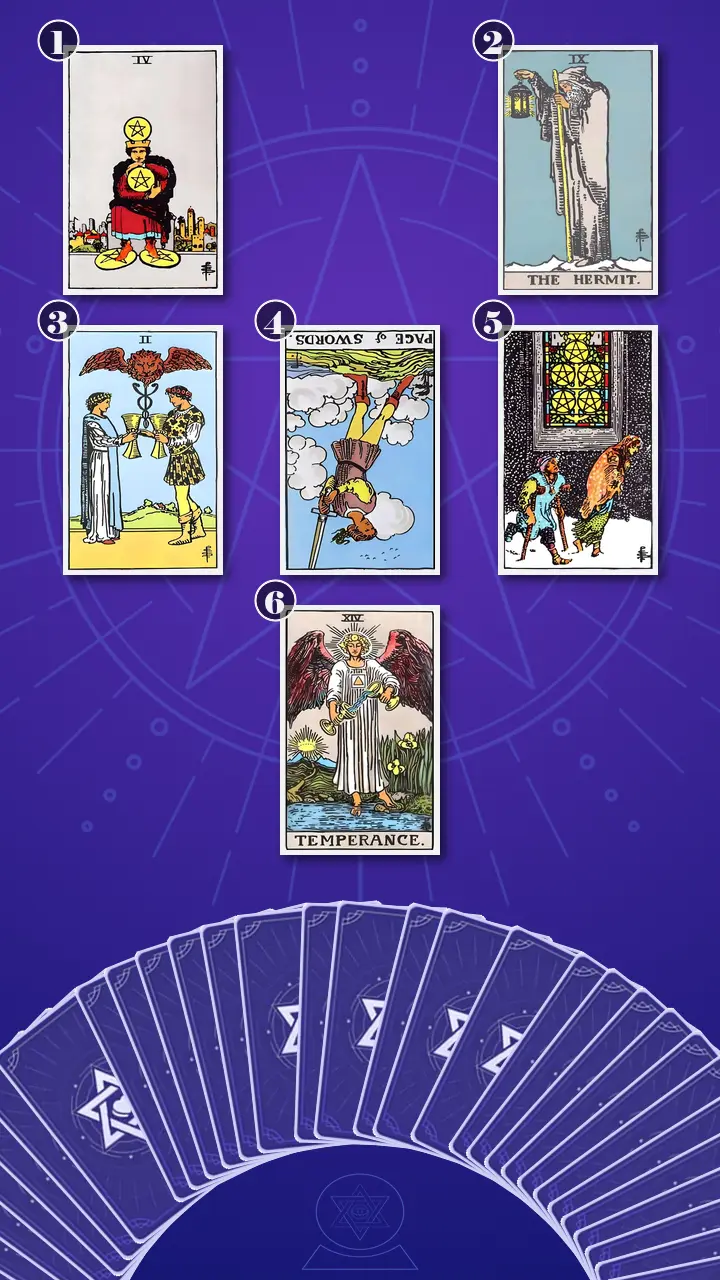
I chose the Relationship Spread · Context Edition, a six-card relationship tarot spread for friendship boundaries. I explained that this is how tarot works in my practice: the cards do not reveal a friend’s private thoughts, predict whether a friendship will survive, or replace a direct conversation. They give us a stable visual structure for examining behaviour, interpretation, emotional roots, relational resources, and actionable next steps.
I selected this spread because Casey’s question was not fundamentally about timing or fate. It concerned a boundary, a communication mismatch, and the difference between closeness and constant access. A larger spread would have added material we did not need. These six positions kept the reading ethically focused on what Casey could know and influence.
I showed her the layout. The first card would describe her observable stance when contact became uncertain. The second would hold only the friend’s explicit request for space, without claiming access to motives. The centre would reveal the bond, the communication challenge, and the hidden belonging fear beneath the pushback. The final card would form the stabilising point below them, offering a constructive direction rather than a guaranteed outcome.
On the table, the arrangement resembled two people standing on opposite sides of a narrow bridge. I told Casey that the purpose was not to force either person across. It was to understand what might make a respectful crossing possible when, and only when, both people wanted to meet there.
The Grip, the Lantern, and Two Separate Cups
Position One: Guarding Every Point of Contact
“The card now turning over represents your current stance: the visible pushback and contracted holding pattern that appears when the friendship feels uncertain,” I said. “It is the Four of Pentacles, upright.”
I pointed to the seated RWS figure. One pentacle was clutched against the chest, two occupied the head and crown, and another was pinned beneath the feet. I saw a person trying to secure every available contact point at once: feeling, thought, ground, and future.
“This is your phone face-up beside an unfinished Figma file,” I told her. “You draft an acknowledgment, add a reassurance question, and then propose a check-in time. The thought underneath it is: ‘If I can just get one clear reply, then I can stop checking.’ You call it protecting the friendship, but part of the behaviour is trying to secure constant access before your friend has freely chosen the next contact.”
The Four of Pentacles was upright, but its Earth energy had moved into excess. The healthy wish for security had contracted into control. The card did not shame Casey for valuing the bond; it showed why her chest, feet, and mind all seemed occupied with holding it in place. Each follow-up offered a few minutes of relief, but that relief taught her nervous system that uncertainty had to be interrupted immediately.
Casey gave a short laugh with no humour in it. “That’s so accurate it’s almost cruel.” Her shoulders lifted, and then she looked away from the card as if it had caught her doing something private.
“Accuracy is only useful if it creates choice,” I said. “I’m not calling your care controlling as a character judgment. I’m showing you the point where care becomes pressure because fear has taken over the timing.”
Position Two: The Hermit’s Small, Contained Light
“The card now turning over represents your friend’s explicit boundary: what we can responsibly hear from the request without inventing private motives,” I said. “It is The Hermit, upright.”
The Hermit stood apart on the mountain, holding a lantern whose light illuminated only a small area. I described that light as a desk lamp in a quiet room, not the shutdown of an entire building. A request for space can be like switching on Focus mode, not deleting the contact.
“Your friend said, ‘I need a few days to myself,’” I said. “Your fear translated that into, ‘I am leaving you.’ Those are not the same statement. The first is information about a present boundary. The second is a feared verdict about the entire relationship.”
The Hermit’s energy was balanced and deliberate. It represented solitude used for reflection, not silence used as punishment. I was careful not to claim that the card proved why the friend needed room or what they would decide later. It simply asked Casey to let the stated words remain the stated words.
“A boundary is information, not an invitation to negotiate until the fear goes quiet,” I said. “If the request is clear, respecting it does not require the other person to explain their whole internal world first.”
Casey unlocked her phone, reread the message, and then read it again more slowly. Her thumb stopped moving. “I heard ‘a few days,’” she said, “but I reacted to ‘I’m done with you.’”
I nodded. That distinction was the first movement in the reading. She did not suddenly feel comfortable with the pause, but she had begun separating what she knew from what fear was adding.
Position Three: Mutual Care Without a Permanently Open Line
“The card now turning over represents the bond and its available resource: the kind of mutual care that can still matter when response speed is removed as the main proof of security,” I said. “It is the Two of Cups, upright.”
I drew Casey’s attention to the two figures. Each held a separate cup. They met in the space between them, but neither surrendered the vessel in their own hands. I read the card as balanced Water: emotional exchange, direct recognition, and chosen participation.
“Imagine that contact is mutually welcomed again and you meet for coffee,” I said. “You each arrive with a separate cup and a separate perspective. The meaningful part is not that you have won back unrestricted access. It is that both of you are freely present, able to listen, speak, and decide what kind of communication you can genuinely offer.”
I could see the product designer in Casey trying to update the relationship model in real time. The old model treated the friendship like a permanently open support channel. The Two of Cups offered a different interface: two autonomous people granting access through consent and reciprocity, not one person remaining continuously available to regulate the other’s uncertainty.
“Mutual care is not the same as constant access,” I said. “Reciprocity is not getting a reply whenever panic spikes. It is both people being able to speak and choose when they are actually present.”
Casey’s exhale was quiet but long. Her grip shifted, and she placed the phone beside her rather than keeping it in her hand. “That sounds better,” she said, “but also less guaranteed.”
“It is less guaranteed,” I replied. “Tarot cannot remove that reality. What it can do is help you stop confusing a guarantee with a relationship.”
When the Green Dot Became Evidence
Position Four: Turning a Reply Gap Into a Research Project
“The card now turning over represents the interaction challenge: the rereading, checking, follow-up messaging, and interpretation loop that keeps the pressure alive,” I said. “It is the Page of Swords, reversed.”
The upright Page can bring alert curiosity and active communication. Reversed, that Air became blocked and overactive at the same time: restless observation without reliable context, questions sent before answers had room to arrive, and intelligence recruited into surveillance.
I reconstructed the 10:51 p.m. loop Casey had described. The room was dark except for the phone. She reopened the chat, checked the Instagram green dot, compared the Story timestamp, examined a full stop that would once have meant nothing, and drafted a second question before the first had been answered.
“The internal sequence goes: ‘They were active, so they saw it. If they saw it and didn’t reply, they must be choosing distance. If they are choosing distance, I need to understand why now,’” I said. “The observable fact is online activity. The feared interpretation is that the friendship has been withdrawn. Your mind is building an incident report before you have confirmed that an incident exists.”
I thought of the recommendation systems Casey helped design. Every refresh was training a private rejection algorithm: show it a green dot, and it served the most threatening interpretation because threat kept her engaged. More checking did not produce better data. It made one interpretation feel familiar enough to resemble certainty.
I also remembered formulas from my years at the perfume bench. A beautiful top note can become sharp and suffocating when overdosed. Casey’s analytical skill was not the enemy; its dosage and timing had become distorted. The same instinct that improved a Figma critique could not solve another person’s temporary unavailability through additional inputs.
Casey winced, then turned the phone face-down. “I literally compared the Story time with when my message was delivered.” Her fingertips stayed on the case for a second before she drew her hand back.
“The reversed Page is not recommending that you disappear or post something indirect to provoke a response,” I said. “Its constructive expression is one clear message, if one is still needed, followed by enough time for information to arrive without being forced.”
Position Five: The Warm Window Across the Snow
“The card now turning over represents the hidden emotional pattern: the fear that distance means you have been placed outside the relationship or found unworthy of lasting belonging,” I said. “It is the Five of Pentacles, upright.”
Two figures moved through snow beneath an illuminated stained-glass window. I asked Casey to return to the 6:17 p.m. Line 1 ride when she had seen her friend’s restaurant Story. She remembered the train brakes squealing, wet coats carrying the faint smell of rain, cold metal beneath her hand, and her stomach dropping as the bright post loaded above the unanswered chat.
“The image on your phone became the lit window in this card,” I said. “Warmth seemed available to everyone except you. Your mind added: ‘I have already been replaced, and everyone else can see it.’ But the post did not establish that conclusion. It touched an older fear and made that fear feel current.”
The Five of Pentacles showed Earth in deficiency: not necessarily an actual absence of all support, but a scarcity story so total that other forms of belonging became difficult to register. Casey had a roommate, a lively group chat, and acquaintances who would meet for coffee, yet one unavailable relationship eclipsed every other light.
“You are not only checking the chat; you are checking whether you still belong,” I said. “The unanswered message hurts, but the weight in your stomach is carrying a much larger question: ‘If this person steps away, does that prove I was never worth staying close to?’”
Her breathing stopped for a beat. Her gaze lost focus as if she were replaying the TTC scene, and then her fingers slowly released the edge of the chair. “That’s the part I don’t say out loud,” she replied. “I’m not only scared they need a break. I’m scared the break reveals what they really think of me.”
“I believe that fear is real as an experience,” I said. “I do not believe its intensity makes it evidence. This card names the story beneath the pushback; it does not predict abandonment or declare you excluded.”
When Temperance Made Room to Breathe
Position Six: Care and Restraint in the Same Pair of Hands
The rain tapped more softly against the studio window as I reached for the final card. The ventilation clicked off, and the room seemed to widen around the faint trace of bergamot and cedar still resting on a blotter near my notebook.
“The card now turning over represents the constructive direction: a boundary-respecting practice in which care, autonomy, and your own steadiness can coexist,” I said. “It is Temperance, upright.”
The angel poured water between two distinct cups while keeping one foot on solid ground and one in water. This was balanced energy: feeling remained present, but it no longer had to become immediate action. Groundedness did not erase care, and care did not erase separation.
I used the diagnostic lens I call Boundary Permeability Diagnosis. In perfumery, two accords can belong beautifully in the same composition without being poured into one undifferentiated mass. Each needs enough air to retain its shape. Here, Casey’s fear was bleeding across the friend’s stated boundary through repeated contact, while the friend’s silence was bleeding into Casey’s work, dinner, commute, and sleep because no part of her evening had been allowed to remain psychologically separate.
“The solution is not to seal yourself off,” I said. “It is to restore a breathable membrane. Your care can cross as one respectful acknowledgment. Your questions can remain in Notes. Your attention can return to dinner, a walk, your roommate, or one fifteen-minute Figma task while the pause remains intact.”
I asked Casey to picture 10:38 p.m.: the chat still open, an Instagram Story changed, and her thumb hovering over one more “just checking” text. She wanted to honour the pause, but her body was treating it as though the friendship were disappearing in real time.
“Space is not proof that care has ended; sometimes the most relationship-protective response is to let a clear boundary remain clear.”
Do not treat immediate access as the only proof of connection; blend care with restraint, like Temperance pouring between two separate cups.
For one beat, Casey did not breathe. Her fingers froze halfway to the phone, and her eyes stayed fixed on the water passing between the illustrated cups. Then her eyebrows drew together. “But doesn’t that mean I’ve been wrong this whole time?” she asked, the words sharper than anything she had said before. I heard anger protecting a sudden ache. “It means a strategy that once gave you short-term relief is now costing both of you room,” I replied. “That is not the same as saying your need for connection was wrong.” Her gaze slipped out of focus, her jaw loosened, and the hand beside the phone slowly opened. A breath left her with a slight tremor. Her shoulders lowered, but relief was followed by a brief, almost dizzy blankness. “So I have to live with not knowing,” she said. “For a while, yes,” I answered. “And you still get to decide later what kind of friendship and communication work for you. Respect is not self-erasure or indefinite waiting.”
I leaned forward slightly. “Now, using this new perspective, think back to last week. Was there a moment when this insight could have made the experience feel different?”
Casey returned to the restaurant Story on the TTC. “I could have said, ‘That post is not a complete report on their emotional capacity,’” she replied. “I still would have felt awful, but I might not have sent the second message.”
I set a seven-minute timer and opened a private note with two headings: What I know and What fear is adding. Under the first, Casey copied the exact request for a few days. Under the second, she wrote, “They are replacing me, the friendship is ending, and I need to fix it tonight.” Because she had already acknowledged the request, we did not create another message to perform respect. When the exercise tightened her chest again, she put the phone face-down for one minute and chose to continue.
This was the key crossing in her Journey to Clarity: not from caring to detachment, and not from uncertainty to a guaranteed outcome, but from fearful message-monitoring toward grounded respect for boundaries and reciprocal connection. The change was small enough to practise. She could feel the fear, identify the story it was adding, and choose not to make her friend responsible for regulating every wave.
The Space Calibration Ritual
I gathered the spread into one coherent sequence. The Four of Pentacles showed Casey gripping a valued bond because immediate contact had become her measure of safety. The Hermit presented the friend’s clear request for solitude. The Two of Cups confirmed that mutuality involves two separate people, while the reversed Page of Swords revealed how uncertainty became surveillance and reactive messaging. Beneath the entire loop, the Five of Pentacles exposed the fear of being left outside warmth. Temperance did not promise that the friendship would remain unchanged. It offered Casey a way to stop holding the door handle so tightly that neither person could choose how to approach it.
I named the cognitive blind spot plainly: Casey had been treating a clear boundary as incomplete information unless it also reassured her. She believed she could respect the space only after the friend removed the emotional risk. In practice, that made the friend’s autonomy responsible for calming Casey before it was allowed to exist.
The transformation direction was equally plain. Casey could hear a boundary as information rather than a verdict, send one respectful response if one was still needed, and return some attention to her own life. Later, if contact was mutually welcomed, she could express her preferences and assess whether the friendship met her needs. Respecting another person’s space did not cancel her agency.
I translated Temperance into my Space Calibration Ritual: specific digital and physical blank spaces designed to stop emotional urgency from occupying the whole atmosphere. I gave Casey three small experiments, not rules or guarantees.
- The Seven-Minute Facts-versus-Fear Note When a reply gap triggers checking, set a seven-minute timer in Notes. Copy the friend’s exact words under “What I know.” Under “What fear is adding,” write one sentence containing the conclusion your mind is rushing toward. Tip: Do not document every timestamp. The minimum version is one fact and one feared story. Stop at seven minutes so the exercise does not become another investigation.
- The One-Sentence Acknowledgment If the request has not already been acknowledged, draft: “I hear you, and I’ll give you the space you asked for. No need to reply.” Read it once and decide whether sending it is necessary. If acknowledgment has already been sent, add nothing merely to prove that you understand. Tip: Remove every question mark before deciding. A genuine safety or logistical issue can still be handled directly, but it should not become a hidden route back into reassurance-seeking.
- The Ten-Minute Space Calibration When the urge to follow up appears, mute the chat, leave any necessary emergency channel available, and place the phone screen-down across the room for ten minutes. Use that space for one fifteen-minute Figma task, one block of walking, or making dinner with the roommate. Tip: Begin with ninety seconds if ten minutes feels impossible. The pause is for reclaiming attention, not punishing the friend, making them miss you, or guaranteeing that they return.
I also drew two cups in Casey’s notebook and labelled them Mine and Theirs. Under Mine, I wrote: feelings, choices, the next ten minutes, and the right to discuss her needs when conversation was welcomed. Under Theirs, I wrote: timing, private thoughts, capacity, and the choice to re-engage. The line between the cups was not a wall. It was the space that kept care from becoming enmeshment.
“These practices do not guarantee reconciliation,” I told her. “They also do not require you to wait forever or accept a friendship that cannot meet your needs. They help you avoid overriding the present boundary while you gather real information and keep your own choices intact.”

The Evening Became Hers Again
Six days later, I received a message from Casey. She had noticed the urge to check during a design task, placed the phone across the room, and set a ten-minute timer. When it ended, she chose another five minutes, finished the icon states she had been avoiding, and made noodles with her roommate.
The chat was still quiet. She slept through the night, but her first thought in the morning was, “What if I got it wrong?” She noticed the thought, smiled once, and made coffee before checking.
I did not read that moment as proof that everything was resolved. I read it as the first concrete evidence of a new capacity: Casey could care deeply, respect the pause, and remain present in her own life without turning restraint into a tactic. The cards had not taken control of her future. They had helped her see where control was already narrowing her choices, and she had chosen one small movement toward space.
I have seen how, when someone we love asks for room, the chest can tighten and the hand can reach for the phone before we have words for the real fear: that loosening our grip will leave us outside the relationship altogether. Clarity is not certainty about what the other person will do. Sometimes it is the first breathable moment in which we can distinguish their boundary, our fear, and the choices that still belong to us.
If immediate access were no longer your test of care, what small part of your own evening would you return to while Temperance’s two cups remain separate and the pause is still a pause?