From Five Career Tabs to One Value-in-Role Test: A Toronto Story

The 11:40 p.m. Career Advice Spiral
If you are a late-twenties city knowledge worker who can explain every career framework but still cannot name the next experiment, career advice overload may be disguising itself as responsible preparation.
At 11:40 p.m. on a Tuesday, Alex sat at the kitchen table in their Toronto rental, framed by the small rectangle of our video call. A content-design job description occupied one side of the laptop; a purpose worksheet and five advice tabs crowded the other. The fan hummed against the tabletop, their tea had gone cold, and blue screen light caught a note titled “final criteria,” already rewritten three times that week.
I watched Alex add another bullet point, delete it, and press their tongue against a visibly tight jaw. Their shoulders had risen almost to their ears.
“I can explain every framework,” they said, “but I still cannot tell you what I want. A job title feels too small, but purpose feels too vague to act on. The role would give me structure and enough stability to breathe around Toronto rent. Then I read something about meaningful work, and accepting structure suddenly feels like losing part of myself.”
They glanced at the open tabs. “So I look for one more answer. Every new answer changes the question.”
The confusion had become like running six GPS apps at once: each voice confidently recalculated a different route while the car remained parked, engine warm, nowhere travelled. It was not that Alex lacked values. Every new framework simply gave those values a different vocabulary, a different hierarchy, and a different verdict.
“I do not think we need another verdict tonight,” I said. “And I am not going to use tarot to tell you which career is destined for you. I want us to see the feedback loop clearly, separate useful guidance from borrowed authority, and find one next step small enough to produce real evidence. Let us draw a map through the fog, then leave the steering wheel with you.”

A Grid for the Career Crossroads
I asked Alex to close the advice tabs without deleting or renouncing anything, place both feet on the floor, and take one unforced breath. I shuffled slowly while they held a single question in mind: “Why does more advice keep me torn between role and purpose?” The pause was not a mystical performance. It was a way to stop feeding the question for a moment so we could observe its existing shape.
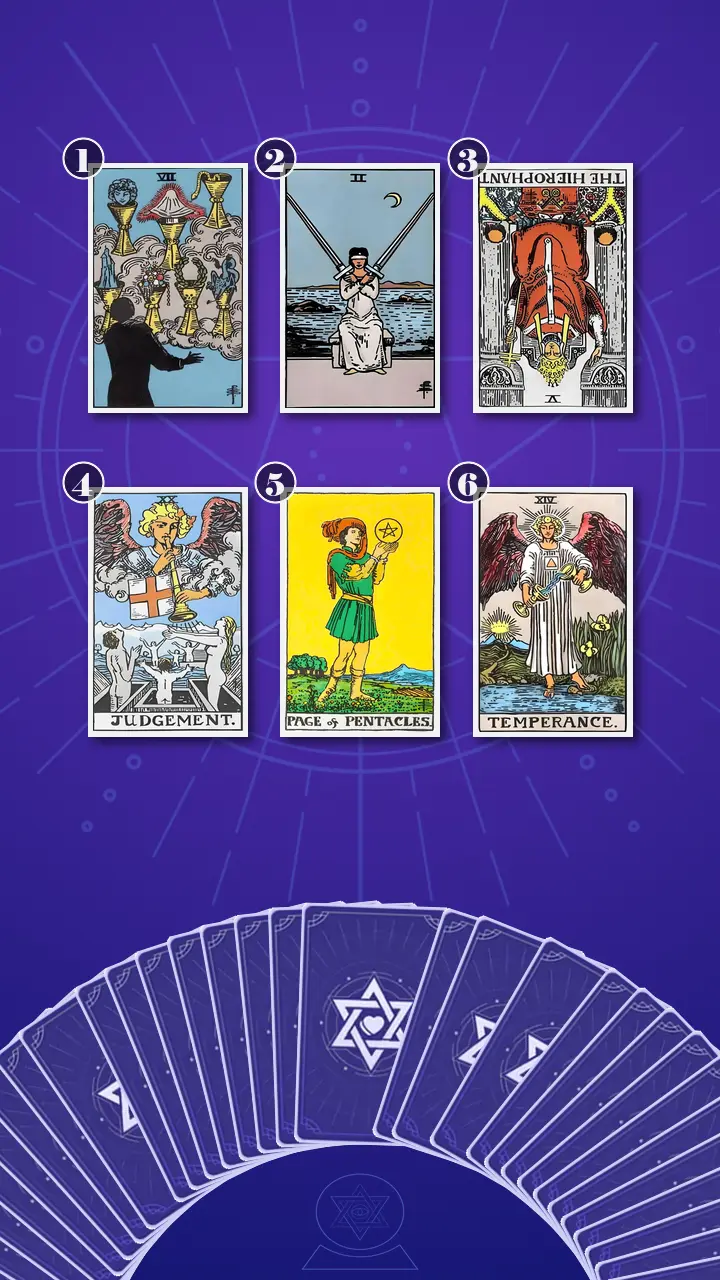
I chose the Transformation Path Grid · Context Edition, a six-card tarot spread arranged in two rows of three. I use it when a problem is not really a clean choice between two options, but a self-reinforcing system: advice brings temporary relief, relief encourages more advice, conflicting rules multiply, and direct experience keeps getting postponed.
A Decision Cross would have forced role and purpose into opposing camps. A Celtic Cross would have added future-facing positions that Alex did not need. This grid was more precise. The top row would show the visible pattern, the mechanism maintaining it, and the deeper authority structure underneath. The bottom row would reveal the catalyst, a practical experiment, and the integrated understanding that could follow.
I also explained how tarot works in a consultation like this. I do not treat card meanings as predictions detached from context. I compare the symbols with observable behavior, language, constraints, and bodily responses. The cards offer an external arrangement of the problem, which makes hidden assumptions easier to inspect. Alex would decide what fit, what did not, and what action was worth testing.
Seven Cups, Five Tabs, and No Contact
Position 1: Possibilities Mistaken for Evidence
I began with the card representing the visible behavior through which accumulating advice kept producing more possible roles, definitions of purpose, and decision criteria while no direction received a fair test. I turned over the Seven of Cups, upright.
The silhouetted figure on the card faces seven cups suspended on a cloud. Each contains a different promise, prize, projection, or risk, but none is within ordinary reach. I pointed from that image to the laptop screen. At 11:40 p.m., Alex had been standing in exactly that symbolic position: one tab promised a stable career track, another promoted creative independence, a third defined purpose as service, and a fourth warned against allowing work to define identity.
“This role could mean I am finally building something,” Alex said, recognizing the loop. “But that creator says a conventional career can become a trap. Then another framework says purpose should be measurable impact. And what if autonomy is actually the more authentic path?”
The Seven of Cups showed an excess of Water energy: possibility, longing, and imagination had multiplied faster than discernment could contain them. None of those possibilities was inherently false. The problem was distance. Alex could imagine every identity persuasively without making contact with the ordinary work required by any one of them.
“Feeling informed has started to feel like progress,” I said, “but possibility is not evidence. Which of these futures is supported by something you have actually done, and which one feels compelling mainly because someone else described it well?”
Alex gave a short, bitter laugh, pulled one hand away from the keyboard, and looked at the glowing row of tabs as though seeing the archive from across the room. “That is so accurate it is almost rude,” they said. The laugh faded, but their hand did not return to the trackpad.
Position 2: The Spreadsheet with No Weights
I next turned over the card representing the immediate mechanism keeping Alex stuck, especially the protected stalemate created by treating role and purpose as a permanent either-or decision. It was the Two of Swords, upright.
The seated figure wears a blindfold and holds two swords crossed tightly over the chest. I asked Alex about their comparison document. They showed me columns for salary, stability, creativity, impact, flexibility, identity fit, and future regret. Every category was carefully populated. None had been personally weighted.
“If I rank stability too highly, I worry I am selling out,” Alex said. “If I rank purpose too highly, I worry I am being reckless.”
Here, Air energy was not absent; it was blocked. Alex had plenty of analysis, but thought had become a defensive equilibrium. The unweighted spreadsheet prevented a wrong ranking by preventing any ranking at all. Its hidden logic was simple: if no criterion mattered more, Alex could not be accused, even internally, of valuing the wrong thing.
“A balanced list is not a decision if none of the criteria are allowed to matter more,” I said. “You are protected from exposing a preference, but you are also cut off from using that preference as information.”
Alex inhaled and held the breath. Their eyes moved away from the cards, as though replaying the moment their cursor had hovered over the empty weighting cells. Then the breath left slowly, and one shoulder dropped before the other.
“I kept calling it objectivity,” they said. “But I think I was trying to make sure nobody, including future me, could say I chose badly.”
The Invisible Career Panel at the Table
Position 3: Borrowed Rules in a Personal Voice
I turned to the card representing the deeper fear and authority pattern beneath the loop: distrusting personal judgment while using external frameworks as competing internal rules. The card was The Hierophant, reversed.
Upright, the Hierophant sits between institutional pillars, raises a formal teaching hand, and receives the attention of two kneeling followers. Reversed, the card can reveal a complicated relationship with authority. It may show a person consciously questioning established systems while still allowing those systems to organize every private decision.
I asked Alex to imagine an invisible panel around their kitchen table. A manager advocated progression. A career creator insisted that purpose should govern every choice. One friend prioritized stability. Another treated creative freedom as the only honest path. A podcast host at 1.5x speed promoted reinvention before the next TTC stop.
“I disagree with all of them in different ways,” Alex said, “so why does disappointing any of them still feel irresponsible?”
That question held the card’s root. Alex would save an expert framework, translate it into a personal rule, and reorganize the decision around it. When lived experience failed to fit, the framework retained authority and Alex’s judgment went on trial. A newer expert would eventually replace the old one, but the court remained in session.
The reversal showed blocked authority energy, with a risk of overcorrection. Alex could reject every structured role to prove independence and still let conventional career culture control the decision through negative engagement, much like an algorithm that shapes attention through the posts a user argues with. Rejecting structure reactively would not be the same as choosing freely. It could also discard legitimate income, mentorship, and skill-building without producing clearer evidence about purpose.
For a moment, I thought of the familiar pattern in The Wizard of Oz: an outside authority is expected to confer what the travellers can recognize only through capacities they have already demonstrated. I did not use that comparison to dismiss guidance. Teachers, friends, and frameworks can be useful. The distinction is between learning from a map and surrendering personal judgment to it.
“Advice is input, not a verdict,” I said.
Alex’s fingers tightened around the cold mug, their gaze lost focus, and then their grip loosened. “I have been calling it research,” they said quietly. “But half the time I am checking whether I have permission to want what I want.”
When the Trumpet Replaced the Podcast Intro
Position 4: The Evidence Already in the Archive
I moved to the lower row and turned over the card representing the leverage point that could interrupt advice accumulation through an honest review of repeated lived evidence. It was Judgement, upright.
On the card, an angel sounds a trumpet and figures rise with open arms. The image is sometimes mistaken for an external verdict, but its movement begins with response. The figures do not request another explanation. They answer what has already become audible.
I asked Alex to replace the sound of another podcast intro with a quieter review of sent work, calendar entries, and remembered conversations. “Where have you already seen meaning in action?” I asked. “Not as a job title. Not as a calling. What were you actually doing?”
Alex opened their calendar rather than the browser. They recalled rewriting a benefits page that colleagues had found confusing, simplifying an onboarding flow after a new employee got stuck, and helping a teammate turn scattered research into a clear presentation.
“In all three, I was making something complicated easier to use,” they said. “I did not think those moments were big enough to count.”
Judgement brought balanced self-review into a stagnant system. It did not prove that Alex must remain a content designer or discover a destined calling in accessibility. It showed a repeated behavior associated with engagement, contribution, and integrity. That was evidence worth answering.
I also noted that no Wands card had appeared. Alex had consumed plenty of inspiring language, but activation was the least represented function in the spread. Another motivating concept would not correct that absence. A scheduled response might.
Alex exhaled through pursed lips and closed the calendar only after writing down the three examples. Their posture was still cautious, but the caution no longer looked frozen. It looked attentive.
Position 5: One Task, One Value, One Stopping Point
I turned over the card representing the practical next action through which a value could be tested inside a bounded, observable task. It was the Page of Pentacles, upright.
The Page holds one pentacle at eye level while a fertile field remains open around them. That focus is the opposite of the Seven of Cups. The Page does not demand a complete identity before beginning. The Page studies one tangible object, practises, and learns.
“You are not choosing a permanent identity; you are choosing the next place to gather evidence,” I said.
I asked Alex to name one value and one task small enough to schedule. They chose accessibility and proposed a two-hour prototype that would simplify a confusing onboarding sequence. We reduced it further: one document titled “Value-in-Role Test,” one defined deliverable, one calendar block, and a hard stopping point. Afterward, Alex would record what held their attention, what drained them, and what they would change before repeating it.
The Page restored an underused Earth energy: practical curiosity, embodied learning, and contact with a real result. The test did not need to be impressive, public, unpaid, or career-changing. A simulated task or adaptation of ordinary paid work would count. Its purpose was information, not performance.
“This does not have to prove who I am,” Alex said, trying the sentence aloud. “It only has to show me what happens when I practise this.”
I watched their expression shift from the strained concentration of a person naming an identity to the quieter focus of someone scoping a task. The career crisis had not disappeared, but it had become small enough to fit into a calendar.
When Temperance Joined the Two Cups
Position 6: The Role That Could Carry Meaning
The laptop fan, so noticeable at the start of the session, cycled into silence. Rain traced the Toronto window behind Alex, and the final card waited at the bottom right of the grid. I turned over the card representing the new understanding available when the entire reading was integrated: Temperance, upright.
Temperance pours a continuous stream between two cups, with one foot on land and one in water. The card does not force one element to defeat the other. It shows active proportion: practical conditions and inner meaning exchanging information until a sustainable relationship emerges.
I brought Alex back to the scene at 11:40 p.m.: the job description beside the purpose worksheet, the five career tabs, the locked jaw, and “final criteria” on revision three. They had been trying to identify the correct side before allowing either side to enter lived experience.
At that point I used what I call Historical Crossroad Matching. On archaeological digs, I learned that a historical crossroads rarely offers a pure choice between preserving everything and abandoning everything. Structures are repurposed. Roads built under one system later carry merchants, letters, families, and ideas the original builders never anticipated. A container can outlive its first definition because people change what it carries.
I applied the same bird’s-eye view to Alex’s dilemma. The job title, the latest creator vocabulary, and the pressure to appear fully formed might belong to a short layer of time. The capacities Alex repeatedly valued, clarifying, teaching, making systems more accessible, and creating enough material stability to practise them sustainably, had a better chance of surviving the test of time. A role could provide a road without dictating every destination.
The choice is not between a hollow role and a perfect calling; blend structure with meaning through small lived experiments, as Temperance pours one cup into the other.
I let the sentence remain between us. Then I made the implication plainer: “A role does not have to define your purpose. It can be a revisable place where you practise it and gather evidence about what meaning looks like in real life.”
For one beat, Alex’s breathing stopped. Their fingers hovered above the keyboard, and their eyes widened before drifting toward the job description, as though several recent evenings were replaying behind the screen. Then their brow tightened. “But doesn’t that mean I have spent all this time solving the wrong problem?” they asked, with a flash of anger that sounded sharper than anything they had said all night. I told them the research had not made them foolish; it had revealed the limit of research for a question that required contact. Their mouth opened, then closed. The anger softened into grief for the time spent circling, and their eyes shone briefly. Their shoulders lowered, their hand unclenched, and a long breath left their chest. The release came with a moment of blankness too: clarity had removed the excuse to wait for certainty, leaving Alex face-to-face with the smaller responsibility of choosing a test.
“Now, using this new perspective, think back: was there a moment last week when this insight could have made you feel different?” I asked.
Alex looked again at the role description. “The phrase ‘career track’ made me want to close it,” they said. “But the actual responsibilities included simplifying complex information for people. I treated the title as a verdict and almost ignored the work.”
That recognition marked the key crossing in the reading: from borrowed-framework confusion toward evidence-led self-trust. It was not total certainty. It was the first willingness to let structure and meaning inform one another instead of demanding that one win.
The Ten-Year Layer and the Next Seven Days
I read the spread back to Alex as one connected story. The Seven of Cups showed advice multiplying attractive identities. The Two of Swords showed analysis protecting them from the vulnerability of weighting a preference. The reversed Hierophant revealed why the protection persisted: external guidance had become a rotating set of internal rules. Judgement redirected attention to repeated lived evidence, the Page of Pentacles placed one piece of that evidence into a bounded experiment, and Temperance transformed the original binary into an adjustable relationship.
The core pattern resembled six GPS apps recalculating while the car stayed parked. Alex’s blind spot was not a lack of intelligence or seriousness. It was the assumption that the right framework should produce a complete identity before action, and that a practical role or meaningful purpose must therefore become a permanent verdict. The transformation was more modest and more useful: treat advice as optional input, choose one value, practise it inside one real structure, and allow observed experience to revise the map.
To keep that insight from becoming one more elegant note, I introduced my Time Stratigraphy Exercise. In archaeology, a single surface can contain layers deposited under very different conditions. I asked Alex to view the dilemma from three layers of time: the self looking back ten years from now, the material needs of the current season, and the smallest test available this week. That perspective helps distinguish an enduring value from a short-lived pressure without pretending that today’s financial constraints are trivial.
- Run the ten-minute Two-Cup check. At the kitchen table, set a timer for ten minutes and imagine your ten-year-future self reviewing this week without judging the eventual job title. Create two columns: “Structure I need” and “Value I want to practise.” Add one current requirement, such as a salary floor or predictable hours, and one value, such as accessibility or service. Write one ordinary work task where they could coexist. Stop when the timer ends. This is an observation exercise, not a commitment to accept, reject, quit, or announce anything. If it feels too large, name only the value.
- Collect three pieces of lived evidence. On Monday evening, spend ten minutes searching your calendar, sent messages, or work archive for one moment when you felt useful, engaged, or aligned. Before Friday, add two more. Record the specific action rather than the title, then underline any repeated verb: clarifying, teaching, organizing, advocating, making, or connecting. Ordinary moments count. Do not include confidential information, and do not use the review to prove that you must stay or leave. One event is a valid minimum version.
- Schedule one Value-in-Role Test. Choose one value and block 30 to 120 minutes this week for a real or simulated content-design task that expresses it. Use one document, define one deliverable at the top, and stop when the calendar block ends. Then record three observations: what held your attention, what drained you, and what you would change next time. Keep the test private and bounded unless sharing genuinely helps. A 20-minute mock artifact is enough; the goal is to learn, not to perform a new identity.
I asked Alex to keep new career-advice intake paused for seven days while running the experiment. The pause was not a rejection of expertise. It was a temporary way to hear whether their own signal became clearer when no new framework was allowed to rewrite the criteria.

Four Days Later: The Quiet Proof
Four days later, I received a message from Alex. They had blocked thirty-five minutes, revised one confusing onboarding screen for accessibility, and stopped when the timer ended. No course comparison, no new Notion template, no attempt to decide whether the task qualified as a calling.
“I noticed I wanted to keep going,” they wrote. “I also noticed that predictable scope helped me focus. I thought structure would flatten the meaning, but it gave the meaning somewhere to happen.”
They had slept through the night. Their first thought in the morning was still, “What if I am wrong?” They told me they had smiled at the thought, made coffee, and left the question unanswered.
I did not see a life solved in that message. I saw a small, credible movement from perpetual preparation into grounded curiosity. The cards had not chosen for Alex. Alex had used the cards to notice the loop, test an alternative, and recover a piece of authority that had always been theirs.
A role can hold your purpose without having to become your purpose. For Alex, the journey to clarity began when seven distant promises became two cups connected by one observable stream: structure supporting a value, and a value giving structure direction.
When I picture a jaw tightening over one more comparison table, I do not see someone who lacks insight. I see the ache of trying to secure an expert guarantee before allowing either stability or meaning to matter. Simply recognizing that no framework can remove the vulnerability of personal choice already changes the ground beneath the decision.
If your role could become a revisable cup rather than a verdict on who you are, which enduring value would you become curious to pour into one ordinary task this week?