Stuck in a Stable Life, One Message Tested What Might Fit Better

When a Comfortable Life No Longer Fits
You are the person with a stable city job, manageable rent, and a folder full of possible exits, yet Career Pivot Anxiety appears the second one saved idea asks you to press Send. I recognized that pattern before Maya, a 28-year-old operations coordinator, had finished settling into our video call from her Toronto apartment.
It was 8:47 on a wet Tuesday evening. At my invitation, Maya opened a Notes folder titled "Next Chapter" and scrolled past saved roles, course links, and a half-written email to someone working in a field she admired. The radiator clicked behind her. Traffic hissed over rain-dark pavement below the window. She shifted the phone in her palm and told me it had gone warm, but her thumb remained suspended above the unfinished message.
Then her shoulders sank. She closed the note and reached for the lunch container she had packed for another familiar workday.
"I can describe the life I want," she said. "I have folders, budgets, timelines, everything. But when I have to do one thing that makes it real, I go back to my normal routine. Everyone says I have a good life, so why does it feel like I'm waiting outside it?"
Her life worked on paper: a reliable salary, a comfortable apartment, a professional identity other people understood. But the Sunday Scaries kept returning as a flat pull beneath her ribs. Each new possibility gave her a brief current of energy; each application, conversation, or imperfect first attempt made her chest tighten and her limbs feel poured full of wet concrete.
Her ambivalence reminded me of standing between two subway platforms while both trains arrived: her body leaned toward movement, but her fear kept one foot pressed against the brake. The conflict was clear. She wanted to create a life that fit who she was now, yet familiar comfort offered immediate relief from the uncertainty of finding out whether she could.
"I keep calling it stability," she said, "because saying fear would be more honest."
"We don't need to put comfort on trial," I told her. "Your income, home, and routines may be supporting you in real ways. I want us to find the point where support becomes an automatic veto. We can use the cards to map that distinction, then identify one next step that does not require you to gamble your whole life."
I was not there to predict whether she would quit, move, or discover a single perfect calling. I was there to help her see the loop clearly enough to choose what happened next. That was the purpose of our Journey to Clarity: not certainty on demand, but a usable map through the fog.

Choosing Six Stepping Stones Through the Fog
I asked Maya to place both feet on the floor, take one unforced breath, and say her question without explaining or defending it: "Why do I keep choosing comfort in a life that no longer fits me?" I shuffled slowly while she held that sentence in mind. I use this pause as a focusing tool, not as supernatural theatre. It helps separate the actual question from the noise gathered around it.
I chose the Transformation Path Grid (6) · Context Edition, a six-card career-change tarot spread arranged in two rows of three. I chose it because Maya was not facing a simple Option A versus Option B decision. She was caught in a self-reinforcing system: possibility triggered fear, fear triggered more research, research preserved the familiar routine, and postponement produced relief before resentment arrived.
For anyone wondering how tarot works in a situation like this, I treat card meanings in context as structured prompts for observation. The cards do not overrule facts or make decisions. They help us examine a pattern from distinct angles so that intuition can be tested against visible behaviour, practical limits, and real-world evidence.
The top row of this Transformation Path Grid would show Maya's observable manifestation gap, the attachment making the pattern feel binding, and the hidden belief sustaining the stalemate. The lower row would identify a catalytic spark, translate it into a repeatable action, and show what self-directed integration might look like. I preferred this compact progression to a broader outcome spread because Maya did not need a forecast. She needed to see how the loop renewed itself and where she could interrupt it.
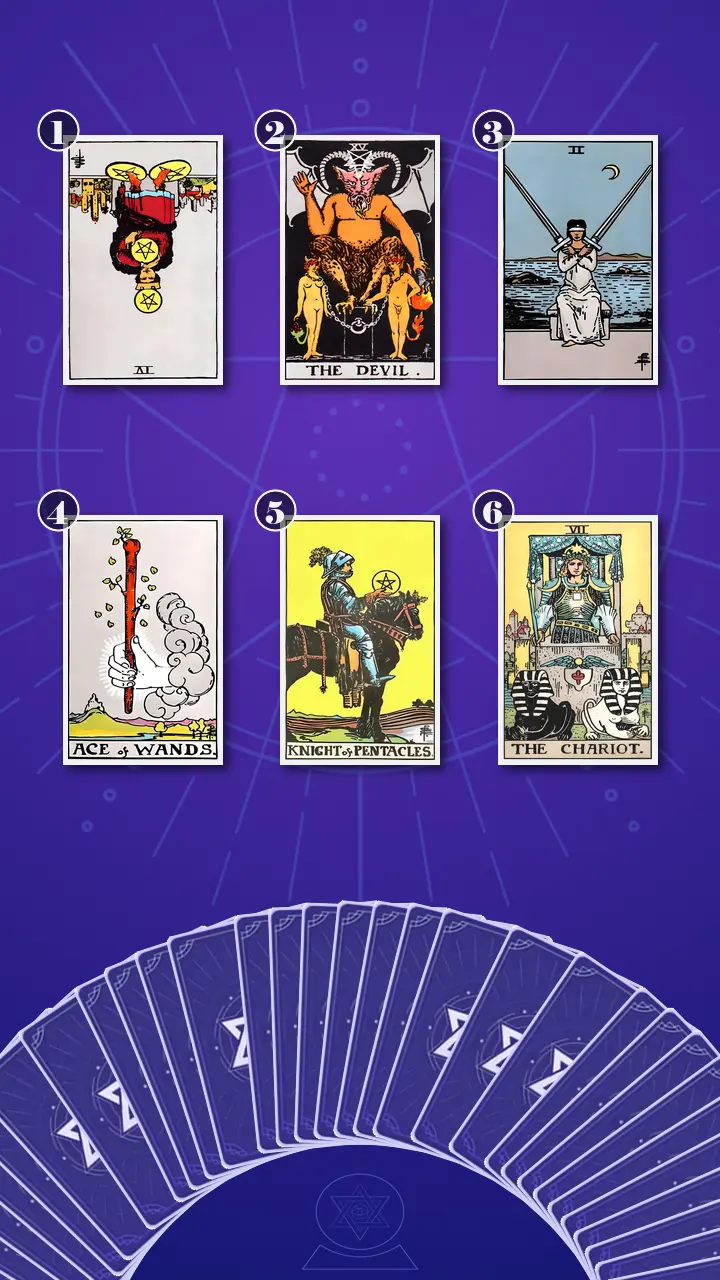
Reading the Top Row: How the Comfortable Loop Renewed Itself
The Reversed Four of Pentacles and the Grip That Looked Like Planning
"The card I am opening now represents the observable manifestation gap," I said, "the place where you imagine a better-fitting life and then return to a familiar routine when one concrete step creates discomfort."
I turned over the Four of Pentacles, reversed.
I pointed to the figure pressing one pentacle against his chest while keeping others fixed beneath his feet and above his head. "This is a picture of trying to secure every variable before permitting movement: income, schedule, identity, reputation, and outcome. Reversed, that protective Earth energy has become blocked by excessive control. Security is no longer circulating as a resource. It is being held so tightly that it restricts the person it was meant to protect."
The modern-life translation was already glowing in Maya's hand. At 8:47, she had reviewed a carefully organised career-change plan and closed it before sending one inquiry because tomorrow's salary, schedule, and familiar identity were easier to contain. It was like maintaining a flawless Notion dashboard until updating the system replaced doing the project it had been built to support.
"The inner line sounds something like, 'I know this no longer fits, but at least I know how to survive it,'" I said. "That sentence deserves respect. Survival knowledge matters. But we still need to ask whether you are choosing that support today or automatically defending it because it is familiar."
Maya gave a short laugh, sharp with recognition. "That is so accurate it feels a little brutal." Her fingertips pressed into the edge of her phone before loosening again.
"Then let's take the brutality out and keep the accuracy," I replied. "This card is describing a strategy, not accusing your character. The strategy protected useful parts of your life. Our question is whether it now controls more territory than you intend to give it."
I also cautioned her against the reversed card's overcorrection. Loosening a grip did not mean abruptly quitting, draining savings, or creating instability to prove she was brave. It could mean preserving three supports that genuinely mattered while relaxing one low-risk comfort pattern for seven days.
"What exact action sits between opening that folder and closing it?" I asked.
"Sending the message," she said. This time, she did not add an explanation.
The Devil and the Bargain with Immediate Relief
"The next card represents the binding influence," I said, "including the real rewards that make the current arrangement easier to preserve and the unexamined bargain hidden inside those rewards."
I revealed The Devil, upright.
I watched Maya's eyes go straight to the chains around the two figures. They looked binding, but they also looked loose enough to remove. "This card is not calling your job evil, and it is not predicting entrapment," I told her. "It names attachment: the point where a material or emotional reward becomes confused with the absence of choice."
She had received a modest raise the previous Thursday. At 4:56, while the office ventilation hummed and cold coffee coated her tongue, a Slack message had praised her reliability and confirmed the new amount. Her shoulders had dropped in immediate relief. Then she had closed a course tab she had opened at lunch.
"I thought, 'Leaving after this would be ungrateful and financially stupid,'" she said.
"The raise is real support," I replied. "Your rent is real. Benefits, energy, and the Toronto cost of living are real. The Devil asks a narrower question: does receiving support mean you must refuse every experiment that would not actually threaten it?"
I thought briefly of compensation meetings from my Wall Street years, where golden handcuffs were rarely presented as chains. They arrived as rational incentives, one reasonable concession at a time. I learned there that a deal could provide genuine downside protection while quietly accumulating an uncapped opportunity cost.
I used my Asymmetric Risk-Benefit Analysis to make that structure visible. Remaining exactly where she was offered an immediate, predictable benefit: no exposure, no awkward beginner phase, no threat to income tonight. Its larger cost was delayed and cumulative: another missed enrolment window, another unsent message, another Sunday spent making an emotionally flat week more efficient. A private informational conversation, by contrast, had a tightly capped downside and a potentially useful upside. It could cost twenty minutes and produce information, a connection, or a clearer no.
"The relief is immediate; the resentment has a slower billing cycle," I said.
Maya's jaw tightened. She looked down at the loose chains. After a moment, she said, "The paycheck is the obvious reward. But I think the bigger one is that no one gets to see me try something I might be bad at."
That distinction mattered. I did not ask her to pretend every chain was imaginary. I asked her to identify which constraints had been verified and which bargain was being maintained by fear of visibility. The Devil became less frightening once we treated it as a contract whose clauses could be read.
The Two of Swords and the Tabs That Never Closed
"The card I am opening now represents the root beneath the visible delay," I said. "It names the inner conflict between wanting movement and refusing to move until uncertainty has been removed."
I turned over the Two of Swords, upright.
The blindfolded figure held two blades crossed over her chest while still water waited behind her. I read the energy as excessive Air paired with deficient lived input. Maya's mind was doing more and more comparison work while her emotional and practical information remained at a distance.
Her version of the card was a Tuesday night at the kitchen table: one browser tab open to a communications role at a nonprofit, another open to a part-time design course, and a Google Sheet expanding from eight criteria to twelve. As long as both options remained theoretical, neither could disappoint her. Neither could teach her anything, either.
"It is like running an A/B test inside a planning document but never allowing either version to reach a real user," I said. "Research becomes avoidance when no new evidence is allowed to enter."
Maya's fingers stopped moving. Her gaze drifted beyond the cards, as though she were watching that kitchen-table scene replay. Then she drew a slow breath and stated the two truths without trying to make one defeat the other.
"Part of me wants security," she said. "Part of me wants work that feels more alive."
"Both are valid," I said. "The stalemate comes from the third sentence: 'I cannot act until one of those truths disappears.' What if neither has to disappear?"
She looked back at the blindfold. "Then I would need a way to learn without treating the test as a life sentence."
That was the opening the lower row was waiting for.
When the Ace of Wands Moved Her Thumb Toward Send
An Available Beginning, Not a Final Identity
The radiator gave one last metallic click and fell quiet. A line of rain moved down the window behind Maya, catching the streetlight like an underline. I let the room settle before touching the fourth card.
"The card I am opening now is the catalyst," I said. "It represents the smallest spark capable of interrupting the comfort loop and reconnecting desire to an observable experiment."
I revealed the Ace of Wands, upright.
A hand emerged from a cloud holding a living wand that had already begun to sprout. The hills ahead were uneven, and the whole road was not visible. That was precisely the point. Fire had been missing from the upper row: Maya had Earth trying to control every condition and Air trying to think its way beyond uncertainty. The Ace introduced balanced Fire as initiative, curiosity, and contact. It was not an order to burn down her current life. It was permission to begin something small enough to contain.
I returned us to 8:47 p.m.: the saved roles, courses, and half-written messages still glowing on her phone. She could picture the alternative life clearly, yet the moment one tap would make it real, her chest tightened and tomorrow's familiar routine won again.
In practical terms, the Ace could be one exploratory message, one introductory class, or one twenty-minute creative pilot completed within seven days. Its job was not to prove that Maya had found the right future. Its job was to turn an unlived possibility into information about fit, energy, friction, and interest.
This was where I brought in a diagnostic tool I call Sunk Cost Neutralization. I drew two columns on the page between us: value already received and choice still available. The years Maya had invested in her role had paid rent, built operational skill, created friendships, and given her a workable base. Those returns were real. But past time and emotional effort did not acquire voting rights over every future week.
Do not wait for comfort to certify that a life fits you; let the Ace of Wands turn the unlived possibility into one small, honest experiment.
I paused, then gave her the plainest translation I had.
"You do not need a final answer about your life. You need one honest experiment that lets reality answer back."
At first, Maya's breath stopped. Her thumb froze above the phone, and her pupils widened before her gaze slipped past the screen, as if the last two years were replaying somewhere over my shoulder. Then her brow tightened.
"But doesn't that mean I got the last two years wrong?" she said. "That I wasted them?"
I did not rush to turn that anger into optimism. "No. Those years paid rent, built skills, and gave you stability you genuinely needed. Their value is not erased. They simply do not own your next decision."
Her lips parted, but no answer came. The fist resting near her mug slowly opened, one finger at a time. Her shoulders dropped on a long, uneven breath; her eyes reddened, and a small, almost embarrassed laugh followed. Then came a brief blank look, the lightheaded vulnerability that can arrive when a burden is removed and choice becomes visible.
"So I am responsible for choosing the experiment," she said, her voice lower and slightly shaky.
"Yes," I said. "And you are also allowed to set its limits."
I invited her back into lived memory. "Now, with this new perspective, think about last week. Was there a moment when this insight could have made you feel different?"
She returned to the Thursday raise. "I could have let the raise be useful without letting it decide whether I sent one message," she said. "The message would not have cancelled the stability."
I asked her to open a fresh note and make an eight-minute Experiment Card. She wrote five lines: the value she wanted to test, one action she could complete within seven days, the exact time she would do it, a money-and-energy ceiling, and a clear exit point. Her minimum version was a two-sentence exploratory message to one person. She did not need to disclose anything to her employer, make a public announcement, spend beyond her means, or continue if the test felt too exposing.
"This does not have to become my whole life," she read from the note. "It only has to teach me something."
I named the transition carefully. This was not instant confidence, and it was not a final career decision. It was the first crossing from stagnant ambivalence and certainty-seeking private planning toward evidence-based confidence. Curiosity had been given a boundary, a time, and a form. Maya was beginning to replace the demand for certainty with the ability to learn.
When the Spark Learned to Keep an Appointment
The Knight of Pentacles and the Quiet Fit Test
"The fifth position translates the catalyst into practical guidance," I said. "It shows the bounded action that can reduce the gap through steady evidence instead of a dramatic exit."
I turned over the Knight of Pentacles, upright.
The horse stood still, but the cultivated field showed that stillness was not the same as stagnation. The knight held one pentacle with deliberate attention. Here, Earth energy had returned in balance. Unlike the reversed Four, which tried to pin every part of life into place, the Knight gave one chosen commitment a reliable container.
I translated the image into an ordinary Toronto week: the same library desk, the same calendar alert, one twenty-five-minute task, and a three-line evidence note. Maya could use the session for an application paragraph, a class exercise, a portfolio sample, or preparation for an informational conversation. Afterward, she would record what she did, what gave or drained energy, and one practical fact she learned.
"It may not be dramatic enough to post," I said, "but it is real enough to repeat. Motivation is volatile. A calendar appointment is observable."
Maya opened her calendar, then frowned. "Tuesday evenings always get eaten by late Slack messages, groceries, or being too tired to think. I don't want to create another plan I fail to follow."
"Good objection," I said. "We schedule for your actual life, not your fantasy week. Pick a slot with reasonable capacity, cap it at twenty-five minutes, and create an eight-minute minimum version. Missing one session becomes data about the design. It does not become evidence that you cannot change."
She chose Saturday at 11:00 a.m. at her local library and repeated the event for four weeks under the title "Fit Test." I watched her save it. The gesture was small, but unlike the polished plans in her folder, it now had a time and place in the physical world.
The Chariot and the Right to Steer Both Needs
"The final card represents integration," I said. "It shows a self-directed relationship with comfort and change, without predicting a specific job or external outcome."
I revealed The Chariot, upright.
The charioteer stood between black and white sphinxes, with the city behind him and the road ahead. I did not read the opposing figures as a demand to eliminate conflict. I read them as two valid forces requiring conscious coordination: the need for security and the need for movement.
The Chariot's energy was integration through direction. Maya could keep her income, apartment, rest, relationships, and chosen routines while deliberately steering one defined part of the week toward work that felt more aligned. Comfort could become infrastructure for experimentation rather than an automatic veto against it.
"Keep the support; loosen its veto power," I told her.
Maya repeated the sentence under her breath. Then she looked at next week's calendar and said, "I can keep what supports me without letting it choose everything for me." Her shoulders relaxed, and the two needs that had looked like an ultimatum began to sound more like inputs she could manage.
I also noticed that no dedicated Cups card had appeared in the spread. I took that absence as a useful prompt, not an omen. Maya had spent so much time evaluating money, logistics, and arguments that emotional fit needed to be named deliberately. Her evidence log would therefore include energy before and after each test. Salary and approval could not be asked to report on aliveness; they measured different things.
The Chariot did not promise that every experiment would succeed. It showed something more durable: Maya could steer while uncertainty remained in the vehicle.
Finding the Third Path Between Staying and Escaping
I laid the six cards into one continuous story. Maya's stable routine had once provided genuine value, but the reversed Four of Pentacles showed her trying to secure every condition before moving. The Devil revealed the bargain underneath: postponement removed immediate exposure while its emotional cost accumulated quietly. The Two of Swords showed how research kept desire and fear equally protected from evidence. Then the Ace of Wands introduced one living test, the Knight gave it a repeatable structure, and the Chariot returned authority to the person steering.
The beautifully furnished room in Maya's mind had never been locked. She had been treating the familiar furniture as proof that opening the door would be reckless. The cards did not tell her to abandon the room. They showed her that she could use it as a base while stepping outside long enough to gather information.
Her central blind spot was treating inaction as neutral while counting only visible action as risky. Staying unchanged also had consequences: time passed, resentment accumulated, and every unsent message reinforced the story that she could not trust herself. Her second blind spot was treating prior investment as an obligation to keep investing, even when a reversible experiment would not destroy what she had built.
The transformation direction was therefore precise: replace the demand for a final life decision with one time-bounded, values-aligned experiment that creates evidence through action. Clarity would not arrive as a perfect answer before movement. It would develop through repeated contact with reality.
To keep Maya out of the false choice between "stay exactly as I am" and "blow up my life," I introduced my 3rd-Option Leverage Test. It is a seventy-two-hour exercise for finding structural room between two apparent dead ends. In Maya's case, the hidden third path was to keep the supports that protected rent, health, rest, and privacy while using a small portion of that stability to finance a controlled experiment.
- Run the 72-hour 3rd-Option Leverage Test.Tonight, write Option A as "preserve every variable and keep researching" and Option B as "make a dramatic exit." During the first 24 hours, list no more than three supports you actively choose to keep. By hour 48, draft three hybrid paths that preserve those supports while allowing movement. By hour 72, select one seven-day test and complete the five-line Experiment Card: value, action, exact time, resource ceiling, and exit point.Keep every third option reversible. A test should create information without threatening housing, income, privacy, rest, or personal safety.
- Send the one-message reality test.On Tuesday at 7:30 p.m., spend no more than ten minutes reviewing the saved profile of one person in a field Maya has already researched. Send a four-sentence email or LinkedIn message: who she is, why the person's work caught her attention, one specific question, and an easy opt-out. The exposure ceiling is one recipient, with no public post and no disclosure to her employer.If four sentences feel too visible, use the minimum version: draft two sentences and schedule the send time before closing the note.
- Keep the four-week Fit Test appointment.For four Saturdays at 11:00 a.m., work for twenty-five minutes at the same library desk on one application paragraph, class exercise, portfolio pilot, or conversation task. After each session, log three fields: what I did, energy before and after, and one practical fact learned. Cap the entire experiment at CAD 50 and two hours per week.Use the eight-minute version on a low-energy week. After four sessions, continue, redesign, or stop. Each choice is a review decision, not a verdict on character.
Maya chose the informational message as her seven-day Ace of Wands experiment. The Fit Test would give it the Knight's continuity, while the Keep and Move distinction would let the Chariot coordinate support and direction. None of these steps required her to announce a reinvention. They required only enough courage to let one piece of reality answer back.

A Week Later: One Sent Message, Not a New Identity
Six days later, I received a message from Maya. "Sent it at 7:34," she wrote. "I stared at the screen for a full minute afterward, but I didn't unsend it." The person replied the next morning and offered a twenty-minute conversation the following week.
The reply did not solve Maya's career. It did something more credible: it made one possibility less imaginary. She learned that her operations experience could transfer into the kind of work she was exploring, and she left the conversation with two practical questions for her Saturday Fit Test.
In a later message, she described Sunday evening for me. She still meal-prepped under the radiator's click, but a twenty-five-minute Fit Test sat in her calendar. She slept through the night; her first thought was still, "What if I'm wrong?" This time, she smiled, made coffee, and kept the appointment.
That was the quiet proof of our Journey to Clarity. The cards had not selected a future or removed uncertainty. They had made a pattern observable, translated intuition into actionable advice, and helped Maya distinguish genuine security from comfort acting as a veto. She supplied the message, the calendar block, and the willingness to learn. The authorship remained hers.
When you can describe the life you want but your chest tightens at the first Send button, staying can feel less like a free choice than a way to avoid finding out whether you can trust yourself. If that is where you are tonight, noticing the loose chain is already different from believing there is no choice.
If one small experiment did not have to decide your future, which saved possibility would you let the Ace's sprouting wand turn into one honest calendar event for the next seven days?