The Sunday Night Map of Borrowed Milestones
I recognized Maya as the junior project coordinator who could organize everyone else's priorities but kept rewriting her own plan after work, especially when a LinkedIn promotion post turned an ordinary Sunday into Comparison Fatigue.
At 8:47 PM in her shared London flat, I watched her scroll through Instagram Stories about a former classmate's promotion while a rent alert glowed on her phone. The radiator ticked beside the small kitchen table. Blue screen light fell across a cold mug, and the detergent smell from drying laundry hung in the room as she opened one career tab, then another.
When I asked what had brought her in, Maya said, 'I have a plan, but I do not know if it belongs to me.' She could explain the salary, title, timeline, and respectable logic behind several possible futures. When the question became what she actually wanted, her throat tightened before her words arrived.
I saw her uncertainty as a house built from borrowed floor plans: every room was labelled sensible, every route had been approved by someone, and none of the doors had been chosen by her. Her chest carried the weight of other people's visible milestones, while her restless hands kept reopening the same notes as though one more comparison might finally reveal a direction.
I told her, 'You are not failing because clarity has not arrived on schedule. A sensible path can still be a borrowed path. We can use these cards as a clear visual language, not a verdict, and look at where the script came from, how it is keeping you still, and what small direction might feel like yours.' That was the beginning of our journey to clarity.
Choosing a Compass at the Career Crossroads
I asked Maya to place her phone face down, take one unhurried breath, and hold the question without trying to solve it. I shuffled slowly, treating the ritual as a boundary between the noise of the week and the attention we were making together, not as a performance of supernatural certainty.
I chose the Past-Present-Future - Context Edition, a contextualized Past-Present-Future tarot spread. For readers wondering how tarot works in a conversation like this, the cards give us concrete images for card meanings in context: we can examine a pattern, name its effect, and decide what deserves a real-world test. They do not remove Maya's agency or predict a fixed outcome.
This spread suited her because she had not named two clear external options. Her real question was about authorship. The first position would show the inherited script and external authority shaping her choices. The second would reveal the current inner split, the comparison and advice-seeking that maintained her delay. The third would point toward a self-authored direction, not a permanent answer, but a quality of attention she could carry into her next steps.
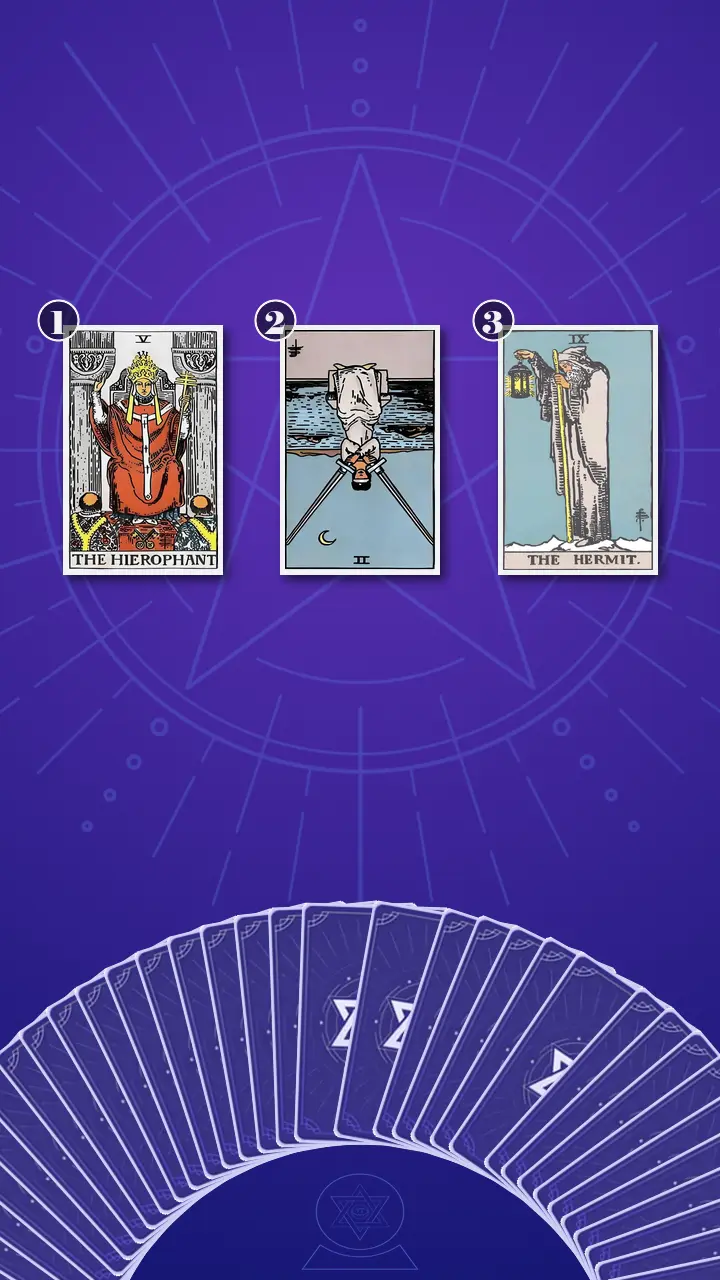
I laid the three cards in a straight line, left to right: a formal signpost, a blocked gate, and a small light carried by a traveller. The structure gave us a calm way to explore career direction when feeling stuck, without asking Maya to defend an identity she had not finished discovering.
Reading the Map Without Handing It Away
The Hierophant and the Borrowed Route
I turned over the left-hand card, the position of inherited script and external authority. It was The Hierophant, upright.
In the RWS image, the seated teacher between two gray pillars raises one hand while two acolytes kneel below. The crossed keys at his feet suggest access and permission. I read the card as an excess of external authority, not because institutions, stable work, or professional guidance are wrong, but because Maya had begun treating recognizability as evidence. A promotion track, a respected company, or a friend's confident advice could tell her that a route made sense. None of them could tell her whether the route gave her energy on an ordinary Tuesday.
I pointed to the keys. 'These are the permissions you keep waiting to receive,' I said. 'The teacher is professional convention. The acolytes are the repeated voices saying what a sensible person does next. The question is not whether the map is respectable. It is whether the map still matches your values.' Other people's certainty could be information without becoming her instruction.
I also used my Persona Fatigue Diagnosis. I described the composed, strategic character Maya had learned to maintain: the woman with a five-year plan, a polished LinkedIn headline, and a reassuring answer ready for a birthday dinner or performance review. 'That persona is not fake,' I told her. 'It is simply doing overtime. The fatigue may be telling you that your public character and private direction have been asked to share one voice for too long.'
Maya did not nod. First, her breath caught and her thumb stopped above her phone. Next, her gaze drifted to the crossed keys as if a memory had surfaced behind the image. Finally, she released a small, bitter laugh and said, 'That is uncomfortably accurate.' I let the recognition settle without turning it into a diagnosis. Then I asked, 'Which milestone have you been treating as a rule because it is easy for other people to recognize?'
The Reversed Two of Swords and the Twenty-Seven-Tab Stalemate
I moved to the centre, the position of current inner split, the observable comparison, advice-seeking, and delayed commitment through which her drift was being maintained. The card was the Two of Swords, reversed.
The blindfold covered the seated figure's eyes, and two swords crossed her chest. Behind her, dark water held emotional information at a distance. I connected the image to the scene Maya had described at 11:03 PM: two career plans in separate notes, four advice messages bookmarked, and a browser full of salary comparisons. The crossed swords were two standards held against each other: what she wanted to test and what she could defend to other people.
Reversed, the card showed a blockage becoming harder to contain. Mental analysis had become excessive, while direct information from her body and curiosity had been pushed outside the conversation. The stalemate gave her short-term relief because no choice could disappoint anyone yet. It also prevented experience from teaching her anything. I told her that this was a protective pattern, not a character defect, and that escaping it did not require abruptly rejecting every conventional option or accepting the next respectable title.
I asked her to hear the inner monologue as two separate lines: 'If I choose this, then... If I choose that, then...' Then I placed a third line beside them: 'What do I want to test, and what am I only trying to defend?' I compared the reversed blindfold to a phone notification stack finally sorting itself enough to show which messages came from other people and which preference had been quietly present underneath.
I invited her to complete two sentences without forcing an either-or answer: 'One expectation I inherited is...' and 'One thing I could test for myself is...' Her fingers hovered over the edge of the card. She drew in a breath, held it, then let it out before opening another tab. The release was small, but it was the first evidence that clarity could begin as an observation rather than a final decision.
When the Hermit's Lantern Changed the Question
The Light You Carry: The Hermit, Upright
The room seemed to quiet before I touched the final card. I turned over the position of self-authored direction, the emerging orientation that could help Maya distinguish personal values from borrowed expectations. It was The Hermit, upright.
The Hermit's lantern was held at chest height, not raised like a spotlight that could reveal an entire career. His staff offered support, and the mountain path beneath his feet suggested patience and gradual movement. I read the energy as focused inner discernment: enough light to see the next few steps, enough steadiness to keep walking, and no demand to solve an entire life in one sitting.
I told Maya that my Internal Monologue Auditing lens heard a destructive genre in the story she had been telling herself. It was a quiet courtroom drama in which every possible choice had to prove its social legitimacy before she was allowed to enjoy it. The question 'What will make sense to them?' kept replacing 'What can I learn from trying this once?' As an artist, I have learned that a film can remain trapped in a painful scene simply because nobody calls cut. Sometimes the next act begins when the narrator's genre changes.
I named the setup plainly: at 8:47 PM on Sunday in her London flat, the rent alert was glowing while she compared a friend's promotion, a new course, and three career plans. Her shoulders had tightened. She called it research, but part of her was waiting for someone else to choose.
Stop using approved milestones as your only compass; let The Hermit's lantern illuminate one value you can test in your own life this week.
For a second, Maya became perfectly still. Her breath stopped halfway in, and her pupils widened as if the room's focus had changed. Her right hand held the edge of the card without lifting it. Then her eyes lost their focus; I could almost see the last week replaying, the promotion post, the course, the message to a friend, each one asking for permission in a different accent. Her jaw tightened. 'But if I stop trying to find the correct script,' she said, 'what if I choose something that makes me look lost?' I let the silence stay. Finally, her fingers released the card, her shoulders dropped, and a long breath moved through her chest with a slight tremor. Relief arrived beside a small, dizzy blankness: a clear path still required her to walk it. Her eyes had begun to glass over, but she looked at the lantern again and whispered, 'I could test meaningful, not impressive.' Public certainty loosened enough for private evidence to enter.
I asked her, 'Now, use this new perspective to revisit last week. Was there a moment when this insight could have made you feel different, even before you knew what to choose?' Maya described the evening she abandoned a creative course after finding one with better reviews. She had not needed another verdict. She had needed to notice what kind of attention the first course had awakened before the comparison took over.
I told her that this was the movement from borrowed certainty, social comparison, and analysis paralysis toward values-based self-trust through quiet reflection and reversible experiments. Clarity was not a feeling she had to wait for. It could be evidence gathered by testing one value. The Hermit did not choose a route for her; Maya was the person carrying the lantern.
From Borrowed Certainty to One Honest Experiment
When I placed the cards back in their line, the story became simple without becoming simplistic. The Hierophant showed how recognizable milestones had supplied a ready-made map. The reversed Two of Swords showed Maya protecting every possible future from the risk of being wrong, using research and other people's opinions to avoid owning an uncertain preference. The Hermit revealed the resource that had been present beneath the noise: patient attention, a personal value, and the willingness to gather lived evidence.
I returned to the metaphor of a Notion template someone else had built. It was beautifully organised and easy to duplicate, but it had not been designed around the way Maya actually lived. Her blind spot was assuming that clarity had to arrive before movement, and that the most defensible choice was therefore the most responsible one. A stable job or a conventional promotion might still be right for her. The cards simply asked her to choose it because it fits, not because it makes her legible.
For the next steps, I used my Director's Cut of Self-Compassion. This is a mental editing practice for interrupting the punitive judge in the middle of a spiral and replacing its narration with an objective, supportive observer. Maya did not need to make the internal monologue flattering. She needed to make it accurate enough to let her act.
A Small Compass I Could Actually Use
- The One-Value Lantern TestOn Wednesday at 7:30 PM, Maya can sit at the kitchen table with LinkedIn closed and write three words for the kind of experience she wants more of at work. She can circle one and describe one recent moment when she felt even 5 percent of it.Set a 10-minute timer and use one value word only. The note can remain private; it is an observation, not a commitment.
- Mine / Borrowed / TestBefore Sunday planning, Maya can open a blank note titled 'Mine / Borrowed / Test' and place one current goal in each column. She should not solve the list. She only needs to notice which goal came from another person's definition of a sensible next step.If the exercise feels vague or unproductive, stop after one expectation and one preference. A two-minute version still counts.
- The Reversible Direction ExperimentDuring a 30-minute Google Calendar review this week, Maya can choose one low-stakes experiment: message one person about the daily reality of a role, attend one free online session, or make one rough page for a creative idea. Before acting, she can use the Director's Cut: pause when the voice says 'If it is not impressive, it does not count,' label that voice as a punitive judge, and rewrite it as 'I am gathering information, not proving my identity.'Record three neutral observations about attention, energy, or resistance afterward. The experiment is a beta test, not a lifetime contract.

A Small Light on a Monday Morning
Five days later, I received a WhatsApp message from Maya. She had completed the note, circled useful, and asked a former colleague one specific question about the daily reality of a role she had been too embarrassed to consider because it did not sound impressive enough. She wrote, 'I still do not know what I want forever. I know what I want to learn next.'
On the Northern line the following Monday, she told me she did not refresh LinkedIn between stations. She wrote one sentence in her phone instead, then watched her own response without scoring it. She slept a full night, but woke with the old question, 'What if I am wrong?' This time, she made tea and let the question sit beside her.
I saw that as the first quiet proof of change. The cards had not handed Maya a destiny. They had helped her separate inherited expectations from personal values, lower the social volume, and choose one reversible experiment. She had moved from waiting for clarity before acting to building clarity through action, with the pen returned to her own hand.
When 'What do you want next?' makes your throat tighten and your hands reopen the same tabs, you may be caught between wanting a life that feels like yours and staying recognizable enough to feel that you still belong. You do not need a whole life answer to run one honest experiment.
If you let one value become the small circle of The Hermit's lantern, what possibility would you be curious to look at without asking it to become your whole life?
This story is adapted from psychological research, written so that those in a similar struggle can see their own pattern in it — and find their next step clearly.These insights are not a substitute for professional psychological, medical, legal, or financial advice.
Learn more about our Journey to Clarity.
How did this insight land for you?
🫂 This Resonates Deeply
🌀 Living This Story
✨ Now I See Clearly
🌱 Seeing New Possibilities
🧰 Useful Framework
🔮 The Confirmation I Needed
💪 Feeling Empowered
🚀 Ready for My Next Step
Author Profile
 AI
AI“I’ve always felt our lives are films currently in production. As an artist, I know that when you feel stuck, it’s often because you’ve bravely stayed in a painful scene for just a little too long. I’m not here to coldly analyze you. I want to sit closely with you, look at those difficult moments with profound empathy, and gently hand you the pen so you have the courage to write your next beautiful act.”
In this Introspection Tarot Reading :
Core Expertise
- Internal Monologue Auditing: Identifying the destructive 'genre' (e.g., tragedy, horror) of your subconscious thoughts that constantly induces anxiety.
- Persona Fatigue Diagnosis: Assessing the heavy psychological toll of maintaining an artificial 'social character' that conflicts with your authentic self.
Service Features
- The Director's Cut of Self-Compassion: A mental editing technique to pause a spiral of self-hatred, reframing the internal narrative from a punitive judge to an objective, supportive observer.
Also specializes in :
Explore Related Patterns:
Advice-Based Permission SeekingMaya keeps four advice messages bookmarked while moving between two career plans, and she recognizes that part of her is waiting for someone else to choose. Advice is no longer serving only as information about possible roles; it is being asked to provide permission for a preference she does not yet feel entitled to own. You may recognize the protective payoff in this strategy. If someone else authorizes the choice, you are less exposed to responsibility, regret, or the possibility that others will not understand it, but repeated permission seeking also teaches you to distrust any direction that has not been externally approved.
Borrowed Certainty LoopAt 8:47 PM, Maya moves from a former classmate's promotion to salary tabs, bookmarked advice, and another rewrite of her career plan. Each source offers a brief sense that the next step can be verified from outside, but the standard changes whenever a new signal appears, so the research does not settle ownership; it sends her around the same circuit. You may recognize this when other people's certainty feels easier to trust than your own incomplete preference. The loop protects you from the immediate exposure of choosing without permission, but it also prevents lived evidence from accumulating, leaving the next opinion free to overwrite the last plan.
Boundary DiscernmentMaya places her phone face down, separates goals into 'Mine / Borrowed / Test,' and later asks a former colleague about the daily reality of a role rather than asking whether she should choose it. These actions do not remove outside influence; they clarify what outside information is allowed to do. You strengthen psychological boundaries when you can hear advice, notice a social expectation, and still reserve authorship of the next step. The distinction turns other people's certainty into usable data without requiring you either to obey it or reject it reflexively, leaving enough space for your own response to become visible.
Career Optics ParalysisMaya can explain the salary, title, timeline, and respectable logic of several futures, but her throat tightens when the question turns to what she wants. She later abandons a creative course that had awakened her attention after finding one with better reviews, showing how quickly public defensibility can overrule private interest. You may recognize this when a choice has to look coherent, impressive, or easy to explain before you allow yourself to test it. Career optics then become a safety filter rather than neutral information, and the fear of appearing lost keeps you from gathering the experience that could make your direction clearer.
Values-Based Decision MakingMaya circles 'useful,' asks about the daily reality of a role she had dismissed as insufficiently impressive, and records what she wants to learn next. A broad identity question becomes one personally meaningful criterion and one action capable of producing real evidence. You do not need a complete life philosophy before making a values-based choice. When a value guides a reversible test, the decision no longer has to prove your identity or satisfy every audience; it only has to show you whether the experience moves closer to the quality you chose to examine.
Cognitive DissonanceMaya's sentence, 'I have a plan, but I do not know if it belongs to me,' places the conflict in plain view. Her polished headline, five-year plan, and reassuring public answer support an identity of strategic certainty, while her private attention keeps questioning whether the route has any personal authorship. You may experience the same friction when two incompatible rules are operating at once. One rule says that a responsible person should present a coherent, recognizable direction, while the other registers that coherence without personal fit is not enough; repeatedly rewriting the plan reduces the discomfort for a moment without deciding which rule should lead.
IntellectualizationMaya can describe salaries, titles, timelines, reviews, and the respectable logic of several futures while struggling to name what she wants. Her twenty-seven-tab research process keeps the problem in an abstract language she can manage, while information from her tightening throat, restless hands, attention, and curiosity remains outside the decision. You may use analysis in the same way when a preference feels too uncertain or socially exposed to state directly. The reasoning is not false or useless, but it becomes a defense when producing more explanation repeatedly replaces contact with the lived evidence the explanation is supposed to serve.
Explore Related Struggles:
Belonging-Authenticity SplitMaya worries that leaving the correct script will make her look lost, and her polished public character keeps supplying the reassuring answers expected at birthday dinners and performance reviews. Keeping every route open protects her social legibility, but it prevents private preference from becoming visible through action. You are held in this split when a self-authored choice could make your life feel more genuine while also making you harder for other people to categorize. Belonging then seems to require a recognizable identity, while authenticity requires room to test something before it can be neatly explained. The struggle is to let connection remain possible without making social readability the price of having a direction of your own.
Borrowed Purpose LockMaya can explain the salary, title, timeline, and respectable logic behind several possible futures, yet she keeps rewriting her plan because none of those routes has been selected through her own values. The borrowed map gives her a convincing destination and a socially approved timetable while leaving the person who is meant to travel it outside the decision. You can follow a path that looks coherent without having authored its purpose. The lock forms when other people's milestones organize your movement so completely that your own direction is expected to appear inside their map. Naming where the script came from lets you treat convention as information while recovering the authority to decide whether it fits your actual life.
Clarity-Exposure SplitWhen Maya is asked what she wants, her throat tightens before her words arrive, and she returns to the safety of plans that can be justified. Naming a preference would end the protection created by keeping every future available. It would expose one uncertain choice to other people's judgment and make its outcome partly hers to carry. You may experience unclear direction as more than a lack of information when clarity itself would make you visible. Remaining undecided protects you from being publicly wrong, but it also keeps your own preference from becoming concrete enough to test. A reversible experiment gives clarity a smaller surface area, allowing you to encounter your direction without turning one choice into a final identity verdict.
Recognizability-Identity FusionMaya maintains a five-year plan, a polished LinkedIn headline, and a reassuring answer for professional and social settings even while she cannot identify which future belongs to her. Recognizability has become evidence in its own right, so a direction appears valid when other people can quickly understand and approve it. You become trapped in this fusion when being legible starts to determine which parts of you are allowed to count. An unimpressive experiment can then feel like a threat to identity rather than a source of information. Separating identity from recognizability lets a path earn its place through lived fit, even before it can be presented as a polished story.
Certainty-Safety FusionMaya keeps several futures protected from the possibility of being wrong, and the stalemate offers short-term relief because no decision can disappoint anyone yet. She requires clarity before movement, but that requirement blocks the direct experience that could teach her what fits. Even after one useful experiment, the question of being wrong remains beside her the next morning. You can make certainty carry the entire burden of safety until no real choice is safe enough to begin. The result is a closed loop in which action waits for evidence that only action can provide. Treating a next step as a test rather than a lifetime contract creates room for uncertainty without handing it control of the decision.
Inner Tribunal LockEvery option in Maya's internal courtroom must prove its social legitimacy before she is allowed to enjoy or explore it. The question of what will make sense to other people replaces what she could learn by trying something once, and the verdict arrives early whenever an experiment does not look impressive enough to count. You are placed in two incompatible roles when you must be both the person making a choice and the advocate defending it to an imagined audience. Curiosity cannot speak freely because it is treated as evidence under cross-examination rather than a valid source of direction. An objective inner observer can loosen the lock by separating what actually happened from the verdict that says every action must justify your whole identity.
Research-Authorship SplitAt 11:03 PM, Maya has two career plans, four bookmarked advice messages, and a browser full of salary comparisons. She calls the process research, yet each new source postpones the moment when she must decide what she personally wants to test. A tool meant to inform her choice has taken over the role of making it. You can gather increasingly precise information while becoming less present as the author of the decision. The split hardens when every external opinion receives decision-making weight but your curiosity is admitted only after it has been validated. Research becomes useful again when it answers a question you chose, rather than continually replacing the person who must choose the question.
Prestige-Fit SplitMaya ranks possible futures through salary, title, reviews, and respectable logic, then abandons a creative course when another option carries stronger external validation. Those measures can show which route is easier to defend, but they cannot show what kind of work sustains her attention or gives her energy during an ordinary day. You can therefore make an apparently rational comparison while leaving personal fit unmeasured. The split does not mean that a prestigious or conventional path must be wrong. It means prestige has been allowed to deliver the verdict before your lived response has been admitted as evidence.
Explore Related Emotions:
Authorship AnxietyAt 8:47 PM in your shared London flat, you moved between a former classmate's promotion, the rent alert, and several career tabs while saying, "I have a plan, but I do not know if it belongs to me." The practical plans were intact, but their authorship had become blurred by the need for a path that other people could recognize. When the question became what you actually wanted, your throat tightened, and "What will make sense to them?" displaced "What can I learn from trying this once?" That friction makes authorship itself feel exposed, so clarity becomes a test of how you will appear rather than information you can gather. Naming the anxiety returns the pen to the part of you that can choose, test, and revise.
Prestige Permission AnxietyThe promotion post, the respected-company track, and the polished LinkedIn headline all sit inside your definition of a sensible future, while the crossed keys represent the permissions you keep waiting to receive. You can explain why a route is respectable, yet recognition still has to arrive before the route feels safe to claim. Professional convention has become a gatekeeper between you and your own preference. You can use advice as information without allowing it to become an instruction, which lets the question shift from whether a route looks impressive to whether it matches your values on an ordinary Tuesday. That shift makes permission something you examine rather than something you wait for.
Cautious Self-TrustFive days later, you wrote, "I still do not know what I want forever. I know what I want to learn next," and asked a former colleague about the daily reality of a role you had been too embarrassed to consider. On the Northern line, you watched your own response without scoring it and let "What if I am wrong?" sit beside your tea. Self-trust appears here as modest, testable evidence rather than a grand declaration. You are beginning to distinguish a private preference from a public performance while allowing the answer to develop through contact with your own life. The caution is part of the credibility because the direction does not have to feel certain before it can be yours.
Preference Exposure DreadWhen you ask, "What if I choose something that makes me look lost?" a private preference becomes a public risk. The role you were embarrassed to consider because it did not sound impressive enough and the creative course you abandoned show how quickly another person's imagined reaction can interrupt your own interest. Your preference is being asked to prove its social legitimacy before it is allowed to become evidence. That makes choosing feel like exposure rather than exploration. A low-stakes test gives you contact with what you want without requiring the preference to perform certainty in front of an audience.
Borrowed Certainty ReliefTwo career plans, four bookmarked advice messages, salary comparisons, and a browser full of tabs let you keep every future under review. As long as no option is claimed, no choice has to disappoint anyone, and the respectable map gives you a temporary place to stand. That comfort is not imaginary, but it keeps lived evidence and private preference outside the decision. You can acknowledge the shelter provided by a borrowed route while asking whether it gives you energy on an ordinary Tuesday. Seeing the relief clearly makes it possible to decide whether it is supporting you or keeping you still.
Comparison FatigueAt 8:47 PM, a former classmate's promotion post turned an ordinary Sunday into a comparison exercise, and your hands reopened one career tab after another while the cold mug and rent alert stayed beside you. Later, a better-reviewed course displaced the creative course that had first awakened your attention. Each comparison promised a more defensible answer, but it pulled you further from the direct evidence of what held your interest. The tiredness comes from repeatedly scoring your direction against other people's visible milestones, leaving less attention for your own response. Closing the comparison long enough to observe one value gives your experience room to speak without competing for a ranking.
Explore Related Contexts:
Authority Approval BottleneckMaya bookmarks four advice messages, compares course reviews, studies a classmate's promotion, and looks to respected employers and confident friends for evidence that a route is correct. Even after assembling that evidence, she remains at the decision point because the information is also being asked to grant permission. An Authority Approval Bottleneck forms when advice is plentiful but the right to act stays concentrated in institutions, rankings, peers, or anticipated audiences. You can consult those sources without allowing them to issue the final authorization. The useful distinction is between information about a route and authority over your choice, because only the first needs to remain external.
Prestige TrapMaya abandons a creative course after finding one with better reviews, hesitates to consider a role because it sounds insufficiently impressive, and measures possible futures through promotions, salaries, titles, and respected company names. These status signals determine which options survive long enough to be explored, even when they reveal little about the work itself. You are caught in a Prestige Trap when public credibility becomes the entry requirement for private curiosity. The trap is structural because employers, platforms, rankings, and professional audiences all reward legibility, making prestige easier to verify than everyday fit. Separating the social value of a title from the lived conditions of the role lets you examine both without treating one as proof of the other.
Rigid Life Script Lock-InMaya has a five-year plan, a polished LinkedIn headline, and credible explanations ready for performance reviews and birthday dinners. Her possible futures arrive with approved titles, salaries, timelines, and professional logic, yet the routes have been selected for recognizability before their fit with her daily life has been examined. You encounter Rigid Life Script Lock-In when socially approved milestones operate as rules governing which futures are allowed to count. The structure can keep you moving on paper while withholding permission to investigate a less legible option. Naming who supplied each rule, where it is enforced, and what evidence it excludes gives you a way to separate useful convention from a script that has acquired too much decision-making power.
Career Direction Validation TrialMaya closes LinkedIn, circles one value, and asks a former colleague a specific question about the daily reality of a role she had dismissed because it did not sound impressive enough. She does not announce a reinvention or commit to a permanent route; she uses one real exchange to test whether the work deserves further attention. You are in a Career Direction Validation Trial when a possible route needs contact with reality before it can support a larger decision. The trial restores proportion: a conversation, session, or small piece of work can generate evidence without requiring you to prove a new identity. Direction becomes something you investigate through bounded action, while the right to continue, revise, or stop remains with you.
Career Exploration ParalysisAt 11:03 PM, Maya has two career plans in separate notes, four advice messages bookmarked, and a browser full of salary comparisons. The tabs keep multiplying while no option receives the direct test that could reveal what the work is like, so extensive activity produces very little movement. Career Exploration Paralysis develops when the environment supplies more comparable information than usable evidence. You can remain busy researching while every route stays hypothetical and every commitment carries the weight of a permanent identity claim. A bounded real-world test changes the type of information available: instead of another opinion about what should fit, you gain evidence about what the option actually asks of you.
Values Alignment CrossroadsMaya can explain the salary, title, timeline, and respectable logic behind several futures, but none of those specifications answers what she wants from an ordinary working day. Later, she replaces the demand for an impressive answer with the words "meaningful" and "useful," giving her a criterion that can be tested through experience. You reach a Values Alignment Crossroads when viable routes exist but the standards used to choose among them are being renegotiated. The practical opening is not to reject every conventional route; it is to compare each route with evidence about the work, attention, and contribution you actually want, so external approval becomes one source of information rather than the owner of the decision.