When Blank-Page Paralysis Wears the 'Gifted Kid' Label
When Jordan appeared on my screen from Toronto, I recognized a pattern I hear from junior creatives more often than most people expect: if you were the smart kid in school and now every blank document feels like a quiet referendum on whether that was ever real, former gifted kid perfectionism can hide in very polished office-casual clothes.
She described a Tuesday at 9:18 p.m., alone at her small apartment table after work. A half-finished takeout container sat beside the laptop; the room smelled faintly of cold soy sauce; the radiator kept ticking in the background while the fan in her computer ran warm against her wrists. She opened Google Docs, typed a smart working title, wrote one line, deleted it before it had properly landed, then flipped to competitor articles and her notes app instead. It looked like she was getting organized. Her body knew she was bracing for a test.
“I can edit a bad draft,” she told me, “but I still act like the first sentence has to prove something.” That was the contradiction in full view: she wanted to write freely and make progress, but she feared an ordinary first draft would expose her as not truly gifted. The feeling had a body to it. Her chest went tight, her jaw locked, and her hands hovered over the keyboard like birds over water they no longer trusted. The dread she described was not abstract; it sounded like a seatbelt ratcheted one click too tight across the ribs.
I nodded. “I know this kind of blank doc freeze,” I said. “It often looks like writer’s block, but it’s really a courtroom set up inside the act of starting. Let’s make a map of it together. Our journey today is not to force brilliance. It’s to find clarity about what the page has been made to mean.”
Choosing the Compass: The Shadow Spread · Context Edition
I asked Jordan to put one hand on the desk and take one slower breath before I shuffled. I use that pause less as mystique than as a handbrake; it helps the nervous system stop sprinting long enough for the real pattern to come into view.
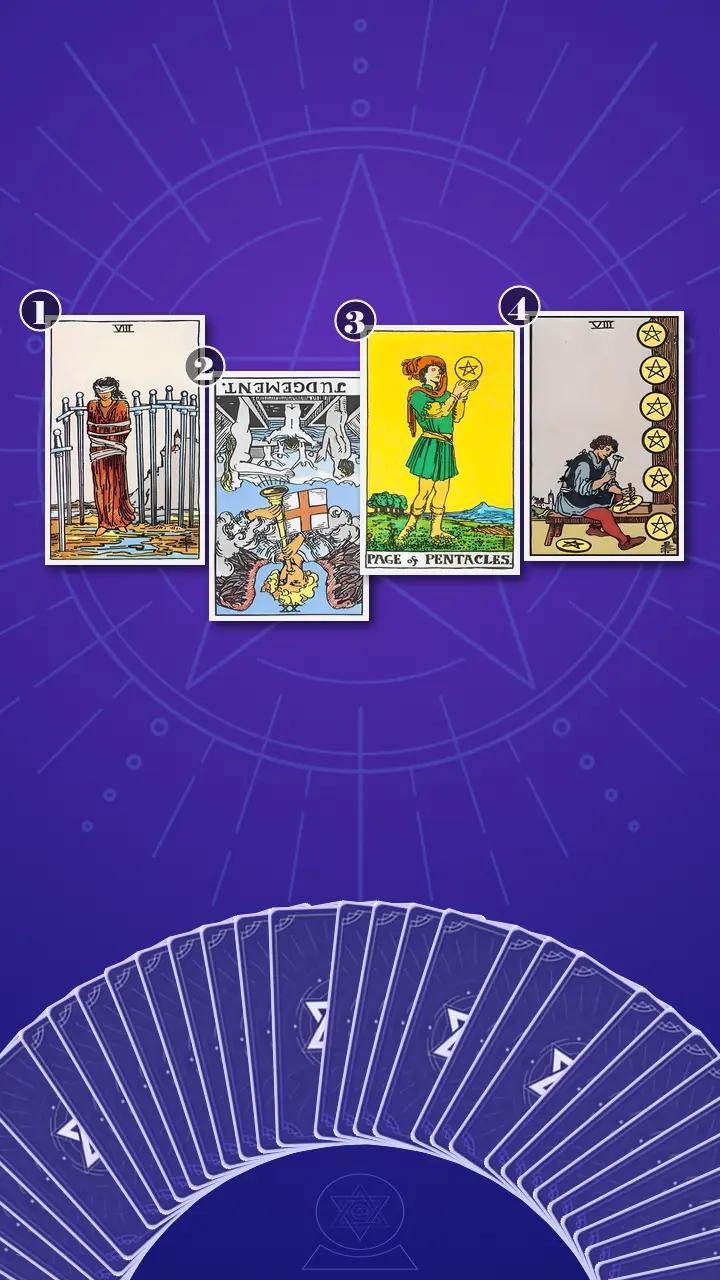
For her question, I chose The Shadow Spread · Context Edition. It is one of my preferred spreads for blank-page anxiety and former gifted kid perfectionism because it does not stay at the surface symptom. It moves, step by step, from the visible freeze to the hidden identity wound, then toward the exact shift and practice that can loosen it. Four cards are enough here. Overthinking is already part of the problem; the spread must clarify, not add more mental furniture.
This is how tarot works best in my practice: not as vague prediction, but as structured pattern recognition. The first position would show the blank-page paralysis itself. The second would reveal the deeper scorecard underneath it. The third—our bridge card—would name the shift from proving talent to practicing craft. The fourth would turn that insight into grounded, actionable next steps for the week ahead.
The Courtroom Under the Blinking Cursor
Position 1: The Loop That Looks Like Prep
I turned the first card. “This position presents the blank-page freeze itself,” I said, “the visible loop: open the doc, delete the start, substitute prep for writing.” The card was the Eight of Swords, upright.
I told Jordan this was almost painfully literal. In modern life, the Eight of Swords looks exactly like her opening a blank Google Doc after work, typing a promising title, deleting the first line, and then spending the next half hour tab-switching, outline-tweaking, and renaming folders because the draft feels dangerous before it is even real. The energy here is blocked Air: too much self-monitoring, not enough motion. The blindfold is imagined consequence crowding out the actual task. The loose bindings are the freedom she forgets she still has—to write badly, revise later, and continue breathing. The ring of swords is every strict rule about good writing she obeys before any sentence exists.
“It’s like having twenty browser tabs open and mistaking tab-switching for progress,” I said. “Research can be care, but it can also be camouflage.”
Jordan gave a short laugh with a bitter edge. “That’s so accurate it’s almost rude,” she said. Then she pressed her thumb into the side of her mug, looked down, and let out the smallest breath through her nose. I watched the recognition land. The mind in this card moves fast; the body goes still. That is exactly why it feels so baffling from the inside.
I asked her the simplest question in the spread: “In the first three minutes of the last blank document, what did you actually do?” She didn’t need to think long. “Type, delete, rename, compare,” she said. “In that order.”
Position 2: The Old Verdict Behind the Cursor
I turned the second card. “This position reveals the deeper identity wound under the freeze,” I said, “including the fear that ordinary work will disprove the old ‘gifted kid’ label.” The card was Judgement, reversed.
Whenever Judgement appears reversed in a reading like this, I know I am looking at an inner tribunal. I told Jordan that this card was not about a lack of ability. It was about an overactive scorecard. Before the draft exists, the reviewers arrive: old teacher praise, a manager saying ‘just send me a rough draft,’ a friend’s polished Substack screenshot, LinkedIn promotion posts that somehow hit harder on the commute than they do at a desk. In modern terms, this card is an old report-card pop-up appearing over a new file. It has that eerie fused-identity pressure of Severance: work output and self-worth suddenly feel like the same thing.
The trumpet in the card becomes old praise turned alarm bell. The rising figures become every version of herself summoned for evaluation. The distant mountains become the impossible standard she feels she must reach before she is allowed to relax. This is blocked fire wrapped inside a judgment loop: not a clean call to create, but a verdict delivered in advance. Since when did a first paragraph become a courtroom?
Jordan went very still. First her breath paused. Then her eyes lost focus for a second, as if she were back in a glass meeting room hearing the phrase rough draft land like a trap. Then came a slow exhale from deep in her chest. “That’s exactly it,” she said. “Feedback on a draft never feels like feedback on a draft. It feels like feedback on whether I’m still… good, fundamentally.”
“Yes,” I said gently. “You are not only trying to write. You are trying to be re-approved. That is why everyone saying ‘just start’ makes you feel worse. They are talking to the task. Your body thinks it is being marched into judgment.”
When the Page of Pentacles Opened the Workshop Door
Position 3: One Real Pentacle at a Time
When I turned the third card, the light from my desk lamp caught the gold circle in the image and, for a moment, even the room seemed to quiet itself around it. “This position identifies the direct antidote,” I said, “the mindset shift from proving talent to practicing craft.” The card was the Page of Pentacles, upright.
The Page of Pentacles is one of the most practical cards in the deck. In Jordan’s life, it looks like one plain document titled Practice Draft, one concrete paragraph goal, one short timer, and one better question: not ‘Does this prove anything?’ but ‘What can this paragraph teach me today?’ The energy here is balanced Earth—grounded, teachable, unglamorous in the healthiest way. The Page does not audition. The Page studies.
When this card appears for a client trapped by old labels, I use a lens I call Skill Archaeology. Years ago, on a dig, I remember kneeling over what looked like an utterly unimpressive shard of pottery. No one would have mistaken it for treasure. Yet that modest fragment told us exactly where the wall line ran. Since then, I have never trusted shiny stories more than durable evidence. So I looked at Jordan the same way: beneath the ‘gifted kid’ label, what overlooked tools were still intact? I did not find a lack of talent. I found buried craft assets—editorial sensitivity, patience with nuance, and a genuine instinct for audience pain. None of those require brilliance on command. They require contact with real material.
Late at night, with the doc open, the title already typed, the bullets reorganized twice, and the cursor blinking while the jaw hardens, it can feel as if the page is judging identity instead of waiting for thought.
You are not here to pass the old test again; you are here to hold one real pentacle at a time and let practice teach you.
Jordan did not relax immediately. First, her fingers froze around the mug. Then her gaze slipped away from the camera, unfocused, as though she were replaying a dozen late-night writing sessions at once. Then a flash of anger crossed her face—not at me, but at the old arrangement. “But if that’s true,” she said, “then I’ve been treating every document like a report card for years.”
“Yes,” I said. “And that doesn’t mean you were foolish. It means you built a protection system around shame. But page one does not need to prove you are gifted; it only needs to give your craft something real to work with. A first draft is information, not a verdict. The blank page is not asking if you’re gifted. It’s asking if you’re willing to practice.”
I watched the insight move through her in layers. Her mouth parted slightly. Her shoulders dropped, not dramatically, but enough to show the pressure had shifted one notch. Then came the strange secondary feeling I often see after a real breakthrough: not pure relief, but that small dizzy emptiness people feel when a burden they have balanced for years is suddenly set down. I gave the moment room. “Now,” I asked, “with this new lens, think back to last week. Was there a moment when this would have changed how you felt?”
She nodded almost at once. “When I deleted the first sentence,” she said quietly. “I could have just let it be ugly. I didn’t need it to mean anything yet.” That was the bridge card doing its work. Not grand confidence. Not instant ease. Just the first real step from self-conscious dread and courtroom-style self-judgment toward grounded curiosity.
Position 4: The Bench, the Folder, the Quiet Reps
I turned the final card. “This position translates the insight into a writing rhythm you can actually live with,” I said. The card was the Eight of Pentacles, upright.
I told Jordan I loved the structural honesty of this spread: it begins and ends with an Eight. The first Eight is repetition as imprisonment—looping in the mind, deleting, renaming, comparing, over-preparing. The last Eight is repetition as craft—same chair, same folder, one more saved draft, one more ordinary rep. The problem was never repetition itself. The problem was the kind of repetition she had been practicing. This card brings balanced Earth again: bench work, accumulated skill, and trust built not by one cinematic breakthrough but by visible contact with the task.
“So,” Jordan said, a tired smile pulling at one corner of her mouth, “the answer is basically to get a little boring on purpose?”
“Exactly,” I said. “Boring enough that your nervous system stops reading the page like a public trial. What changes when the page stops being a mirror and starts being a workbench? Quite a lot, actually.”
Finding Clarity at the Workbench
When I drew the story of the spread together for her, it was plain. The Eight of Swords showed the visible symptom: blank-page paralysis, the kind that deletes the opening line and hides in competitor tabs. Judgement reversed showed the hidden driver: an old smart-kid scorecard that turns every first pass into a referendum on worth. The Page of Pentacles showed the key shift: move from using each draft to prove giftedness to using each draft to practice craft. The Eight of Pentacles showed the integration: not a personality transplant, but a repeatable writing rhythm. Her cognitive blind spot was this—she had been treating effort as incriminating evidence, when in real craft it is simply how skill is made.
“So what do I actually do tonight?” she asked.
I smiled, because this is the part I care about most. “I use a strategy I call Megalith Transport,” I told her. “No one moves a standing stone in one heroic lift. You break the impossible weight into grounded stages, put rollers underneath it, and move it a little at a time. Drafting works the same way. You do not need a better identity before you start. You need a smaller next step.”
She grimaced. “But after work I’m fried. Even seven minutes can feel fake-small.”
“That,” I said, “is the old tribunal talking. Small is not fake. Small is what gets past the guard.”
- Name the Inner PanelBefore your next after-work writing session or rough-draft request, put a sticky note on the desk or a header in the doc that says: ‘Old approval voice’ or ‘School voice.’ Under it, add one sentence: ‘This draft is allowed to be information, not a verdict.’ It takes under 30 seconds and it separates the task from the tribunal.If the wording feels cheesy, make it neutral. The point is one inch of distance, not a performance of healing.
- Open a Practice DraftThis week, create one document literally titled ‘Practice Draft’ or ‘First Pass.’ At your kitchen table or desk, set a 7-minute timer and write six plain lines or one messy paragraph on one very small prompt—something like ‘explain the audience problem’ or ‘draft the opening in ordinary language.’ No deleting until the timer ends.If resistance spikes, type badly on purpose for the first two lines. You are allowed to stop after 7 minutes. You are allowed to keep the file private.
- Build a Bench Reps FolderChoose two nights this week after dinner. Sit in the same chair, open the same folder, and do one 12- to 25-minute writing rep. Save each session without renaming it into something more impressive, and add one line at the top before closing the file: ‘Today this draft taught me…’Keep it ordinary. Same chair, same folder, same short window is enough. If you miss a day, do not compensate with a marathon. Just return to the bench.
These were not tricks to make her feel confident before starting. They were ways to make starting small enough that confidence no longer had to go first. Make one pentacle, not a masterpiece.
A Week Later, the Quiet Proof
A week later, Jordan sent me a screenshot from her phone. In the folder were four bluntly named files: Practice Draft, First Pass Tuesday, Audience Paragraph, and Rough Opener. Her message was only one line long: “Still hated sentence one, but I got to sentence ten before panic got a vote.”
She added another note a moment later. She had slept properly after one of those sessions, though the next morning her first thought was still, What if it’s mediocre? This time, she told me, she laughed, opened the same folder, and wrote anyway.
That is what finding clarity usually looks like in my practice. Not certainty. Not the return of childhood ease. A workable relationship with practice. This is why I return to The Shadow Spread · Context Edition whenever someone asks me, “Why do I freeze when I open a blank document?” The cards do not shame the freeze. They show where the old verdict lives, and they turn it into actionable advice and next steps.
I know there is a particular loneliness in wanting to make progress while your chest tightens around the fear that one ordinary paragraph could undo the version of you who was once praised for making it look easy.
So when the cursor starts blinking like a judge again this week, what one small pentacle—six plain lines, one messy paragraph, a 7-minute first pass—would you be willing to let exist as practice?
This story is adapted from psychological research, written so that those in a similar struggle can see their own pattern in it — and find their next step clearly.These insights are not a substitute for professional psychological, medical, legal, or financial advice.
Learn more about our Journey to Clarity.
How did this insight land for you?
🫂 This Resonates Deeply
🌀 Living This Story
✨ Now I See Clearly
🌱 Seeing New Possibilities
🧰 Useful Framework
🔮 The Confirmation I Needed
💪 Feeling Empowered
🚀 Ready for My Next Step
Author Profile
 AI
AI“Having spent a lifetime at Cambridge and on archaeological digs, I’ve witnessed the rise and fall of countless civilizations. Please know that your current struggles are not a permanent fate, but merely a necessary fracture before rebuilding. I won't lecture you; instead, I invite you to sit with me in the ruins, using a patient, historical perspective to gently dust off the true, enduring value hidden beneath your temporary doubts.”
In this Career Tarot Reading :
Core Expertise
- Core Competency Excavation: Digging through the 'strata' of your past roles to uncover undervalued, highly transferable foundational skills.
- Career Epoch Analogies: Contextualizing your career plateau as the end of one professional era and the necessary foundation for the next.
Service Features
- The Resume Stratigraphy Review: A structured framework to rewrite your professional narrative, highlighting immutable assets over obsolete job titles.
Also specializes in :
Explore Related Patterns:
Self-Judgment LoopJordan's blank page is described as a courtroom under the blinking cursor, and that image is not decorative. It captures the exact cognitive loop in the story. Before there is a draft to evaluate, an internal panel has already started reviewing the self. Self-Judgment Loop fits because the judgment happens early, repeatedly, and ahead of evidence. You can see one sentence become a verdict, one rough-draft request become a trap, and one ordinary writing session become a trial about whether she is still fundamentally good. The loop is not feedback. It is preemptive sentencing. The story loosens the loop by creating distance from the panel. Naming the old approval voice or school voice does not erase it, but it stops it from pretending to be objective truth. That inch of separation lets the draft return to its proper size. It can be worked on without becoming the whole case against the self.
Perfectionism-Driven AvoidanceJordan opening Google Docs after work, typing a smart title, deleting the first line, and moving into competitor tabs gives this pattern its clearest behavioral anchor. The draft is not blocked because she has no ideas. It is blocked because the first visible sentence has been given the impossible job of proving that the gifted-kid label was real. That turns preparation into a defense mechanism. You can see the avoidance look rational on the surface while the deeper rule stays untouched. If the first pass is ordinary, identity feels exposed. Perfectionism-Driven Avoidance fits because the high standard does not improve the writing process here. It keeps the process from starting until the work can no longer threaten the old label. The shift in the story is not about lowering standards into carelessness. It is about separating craft from self-verdict. Once a first draft becomes information instead of evidence, the nervous system no longer has to treat one messy paragraph like a permanent record.
Achievement FusionJordan says feedback on a draft does not feel like feedback on a draft. It feels like feedback on whether she is still good fundamentally. That sentence reveals the fusion at the center of the story. Work output and self-worth have been pressed so tightly together that an ordinary paragraph can feel like a threat to the whole self. Achievement Fusion names the mechanism that makes the old gifted-kid label so hard to outgrow. You can see how the label once offered identity stability, but now it makes every new piece of work carry too much symbolic weight. The page is not just a page. It becomes a mirror asking whether the former smart kid can still perform proof on command. The corrective movement is the workshop frame. Practice Draft, one paragraph, one timer, one saved file. These details matter because they move achievement back into reality. Skill becomes something built through contact with material, not something your identity has to demonstrate before you are allowed to begin.
Freeze ResponseJordan's chest tightening, jaw locking, and hands hovering above the keyboard make the freeze visible in the body. The story is not only about thinking too much. It shows a nervous-system shutdown around the moment when thought has to become a visible sentence. Freeze Response fits because the page has been coded as evaluation before it has been coded as material. You can see how the body reacts as if the rough draft is not a work task but a public trial. Deleting the line before it lands becomes a way to exit the threat without technically leaving the desk. The practice frame works because it lowers the threat signal. Seven minutes, six plain lines, no deleting until the timer ends. Those constraints give the body a smaller doorway into action, so writing can restart before confidence has to appear.
Imposter SyndromeJordan's fear that an ordinary first draft would expose her as not truly gifted is the core evidence for this pattern. The threat is not merely a weak sentence. The threat is being found out by the old scorecard that still decides whether she counts as competent. Imposter Syndrome fits because the story keeps returning to exposure language. You can see the imagined reviewers arrive before the draft exists. Teacher praise, a manager's rough-draft request, polished online examples, and peer comparison all become a panel that might discover she was never as capable as people thought. The useful audit is that this fear does not prove fraudulence. It proves that the task has been loaded with identity surveillance. When the file becomes a practice draft instead of a performance record, the work can be rough without turning into evidence against the self.
Potential HoardingJordan deleting the first sentence before it has properly landed shows how potential can feel safer than output. As long as the paragraph does not exist, it cannot be mediocre. As long as it cannot be mediocre, the old gifted identity does not have to meet ordinary evidence. Potential Hoarding fits because the story is not just about wanting to write well. It is about protecting the idea of being capable by delaying contact with imperfect work. You can see the trap clearly when she realizes she has treated every document like a report card for years. The blank page preserves possibility, while the draft risks measurement. The way out is not a grand declaration of talent. It is contact with real material. Four bluntly named files, sentence ten before panic gets a vote, and the same folder opened again the next morning all turn stored potential into practiced skill.
Explore Related Struggles:
Grade-Identity FusionJordan opens a new Google Doc after work, writes one line, deletes it, and ends up back in competitor tabs because the first sentence has been loaded with the old gifted kid label. The page is not treated as a draft surface; it is treated like the next report card, a place where the adult version of her has to prove the school version was real. That fusion explains why ordinary effort feels so charged. You are not just trying to produce a paragraph; you are trying to keep a praised identity from being downgraded by a messy first pass. Once a draft becomes evidence about who you are, practice stops feeling neutral and the blank page freezes at the exact point where learning should begin.
Inner Tribunal LockBefore Jordan has a usable paragraph, the reviewers are already in the room. Old teacher praise, a manager asking for a rough draft, a friend's polished Substack screenshot, and LinkedIn promotion posts all crowd the same blank Google Doc, so the cursor starts to feel less like a tool and more like a witness stand. That is the lock: You are not meeting a writing task at normal size. You are meeting an internal panel that wants a verdict before there is evidence. When the tribunal arrives before the draft, starting feels dangerous because the page is no longer asking for language; it is asking you to defend who you are.
Performance-Worth FusionJordan says she can edit a bad draft, yet she still acts like the first sentence has to prove something. Later she names the deeper fuse directly: feedback on a draft does not feel like feedback on a draft; it feels like feedback on whether she is still good, fundamentally. When performance and worth occupy the same place, a rough draft cannot simply be rough. You begin treating every ordinary work-in-progress as a measurement of your value, so execution becomes loaded with stakes that the task itself cannot carry. The page freezes because it has been made responsible for proving the self, not just holding the next imperfect sentence.
Visibility-Execution SplitJordan is physically alone at her apartment table, but the moment a sentence appears, the document stops feeling private. Competitor tabs, polished peer work, manager expectations, and the old gifted label turn a quiet draft into something that feels socially visible before anyone has actually read it. Execution asks the work to become visible; visibility reads as exposure. You can research, rename, compare, and prepare because those actions keep the self partially hidden, but a sentence has a body on the page. The split forms right there: the part of you that wants progress needs visibility, while the part protecting you treats visibility as the danger.
Approval-Safety FusionJordan is not only trying to write; she is trying to be re-approved. The story names old teacher praise, a manager's rough draft request, polished peer output, and achievement posts as signals that all get pulled into the same blank file. When approval becomes the condition for safety, private practice starts to feel unavailable. You cannot simply make a draft and learn from it because the nervous system wants the invisible panel to approve the move first. The freeze is the cost of outsourcing permission to reviewers who are not actually in the room.
Explore Related Emotions:
Beginner ShameThe first sentence is deleted before it has properly landed, as if it has already failed by being ordinary. Jordan's body braces around the simple act of beginning because a messy line seems to contradict the identity of someone who was once praised for making things look easy. Beginner Shame is the sting of needing practice when your old self-image was built around effortless competence. You may know intellectually that drafts are supposed to be rough, yet the moment your own roughness appears, it feels exposed and disqualifying. The shame is not about lacking craft; it is about being seen at the human stage of learning.
Imposter Exposure FearJordan says she can edit a bad draft, but still acts like the first sentence has to prove something. That contradiction is the center of Imposter Exposure Fear: the page is not threatening because it is blank, but because it might reveal that the old praise was fragile. The ordinary mess of drafting becomes emotionally loaded when you believe it could expose you as less capable than people once thought. You are not afraid only of a weak sentence; you are afraid that a weak sentence will be treated as evidence about who you really are. That is why even a private first line can feel too visible.
Label Trap DreadThe gifted kid label follows the blank document into adulthood, no longer as simple praise but as a standard Jordan has to keep proving. A first paragraph becomes loaded with the question of whether the old identity still holds. Label Trap Dread fits because the label has become too narrow for the actual process of making things. You are caught between wanting to create freely and needing each attempt to protect a past version of yourself. The dread comes from feeling that practice might loosen the label, even though practice is what gives you room beyond it.
Performance FreezeThe Google Doc opens after work, one line appears, and then it disappears before it has time to become workable material. Jordan's body answers before her craft can: chest tight, jaw locked, hands hovering over the keyboard while the mind keeps moving through titles, tabs, notes, and comparison. Performance Freeze fits because the block is not a lack of ideas; it is a start-point shutdown under evaluation pressure. You can still think, organize, and research, but the moment the work asks to become visible, the body treats the page like a test and substitutes motion around the task for contact with the task itself.
Self-Audit AnxietyType, delete, rename, compare becomes Jordan's first-three-minutes sequence. The page is monitored before it is inhabited, and every possible sentence seems to pass through an internal review process before it has enough substance to be revised. Self-Audit Anxiety fits because the mind keeps inspecting the work at a stage when the work needs contact, not inspection. You are trying to protect yourself by catching failure early, but the audit starts so soon that it prevents any real evidence from forming. The result is a tense inner weather where even private thought has to clear a quality check.
Verdict DreadThe cursor keeps getting described as a judge: a quiet referendum, a courtroom, an old report-card pop-up over a new file. Before Jordan has a paragraph, the draft already feels as if it is asking whether the gifted kid identity was ever real. Verdict Dread names the specific pressure of being evaluated in advance. You are not only trying to start a piece of writing; you are trying to survive the meaning the page has been made to carry. The dread comes from the sense that an ordinary first pass could become a ruling on your worth rather than a rough object you can revise.
Approval AnxietyOld teacher praise, a manager asking for a rough draft, polished Substack screenshots, and LinkedIn promotion posts all enter the room before Jordan's own paragraph can breathe. The draft is crowded by imagined reviewers, even when she is physically alone at her apartment table. Approval Anxiety fits because starting has become dependent on an invisible panel signing off first. You are not just looking for a sentence that works; you are looking for proof that you are still allowed to be seen as capable. That makes ordinary writing feel like a bid for re-approval instead of a private act of making.
Feedback DreadThe phrase rough draft lands like a trap in Jordan's body. She describes feedback on a draft as feedback on whether she is still good, fundamentally, which turns a normal creative exchange into a threat of personal exposure. Feedback Dread names the moment critique stops being about the work and starts feeling like a public trial of the self. You can understand that feedback is useful, but if your nervous system hears it as a verdict, the blank page becomes dangerous before anyone else has even read it. The dread is attached to being interpreted, not just being edited.
Explore Related Contexts:
Creative Career Legitimacy ScrutinyJordan is a junior creative, and the blank document is not just a document in her social field. It is a test of whether the childhood identity of being the smart one can survive adult creative work, where rough drafts, manager feedback, peer output, and public-facing polish all sit close together. Creative Career Legitimacy Scrutiny captures that pressure more precisely than ordinary writer's block. The task is small, but the status implication feels huge: if the first paragraph is mediocre, the old label seems at risk. Seeing this as a legitimacy environment helps you stop treating every draft as a referendum and start asking what kind of support, scope, and practice rhythm a junior creative actually needs to build durable skill.
External Scorecard PressureBefore Jordan's draft exists, the reviewers have already arrived. Old teacher praise, a manager asking for a rough draft, a friend's polished Substack screenshot, and LinkedIn promotion posts all crowd the page with outside standards before she has written enough to revise. That is the logic of External Scorecard Pressure: the work is being measured against imagined audiences, professional comparisons, and past approval before it has had a private first version. You regain leverage by seeing that the pressure is not proof that the sentence must be perfect; it is evidence that too many scoreboards have been allowed into the room too early.
Praise as Performance ContractJordan keeps opening the blank document after work, typing a promising title, writing one line, and deleting it before it can become material. The old gifted kid label has turned praise into a standing performance contract, so the first sentence is not allowed to be ordinary; it is asked to prove that earlier approval still counts. That structure explains why simple advice to just start misses the point. You are not facing a blank page as a neutral task here; you are facing an inherited approval system that has attached legitimacy to visible output. Naming that contract gives you room to separate craft from re-approval and treat a draft as evidence to work with, not a verdict on who you are.
Kitchen Table TribunalThe 9:18 p.m. scene at Jordan's small apartment table is sharply concrete: cold takeout, a warm laptop, a typed title, one deleted line, and then the retreat into competitor tabs and notes. Nothing dramatic has to happen for the room to become a tribunal; the blinking cursor is already positioned as the judge. Kitchen Table Tribunal names the way a private workspace can become an evaluation chamber when the task carries too much identity pressure. You are not simply procrastinating at a desk in this pattern. You are trying to produce inside a space that has been loaded with the authority of a classroom, a manager's review, and an invisible audience before the draft has enough shape to defend itself.