After the Tea Went Cold: Putting Private Care Before Content

The Tea That Looked Warm on Instagram
I have learned that a person can make rest look as if it happened, then look up and realize they never actually got to rest. Maya joined my video consultation at 10:45 p.m. on a Tuesday from her compact Zone 2 flat. A fig-scented candle glowed beside a carefully framed cup of tea; her phone was warm in her palm, but the tea had gone cold. Behind the frame, her work bag lay open on the floor, dinner was untouched, and the fridge hummed into the small silence between us.
She had taken twelve photographs, edited one, posted it to Instagram Stories, and checked the first reactions before opening my call. I watched her refresh the screen once more and then place the phone face down. Her shoulders remained close to her ears, as if her body were still bracing for a work notification.
“I am very good at making rest look like it happened,” she said. “The post says I had this soft, intentional evening. The actual evening is me hungry, scrolling, and thinking I need a better system. I keep waiting for my real life to match the reference image.”
I heard frustration threaded with longing, plus the quieter sting of shame. It seemed to sit in her body like a song paused before its resolving chord: jaw tight, breath shallow, one restless hand repeatedly drifting toward the phone. She was not choosing between beauty and practicality. She was caught between living the soft life she presented online and facing the ordinary, repetitive, imperfect actions required to make that life physically real.
“I am not going to tell you that liking beautiful things is the problem,” I said. “Your eye for beauty is part of your work and part of how you make meaning. We are looking at the point where the image receives the reward before your body receives the care. Visual proximity to rest is not the same as receiving rest.”
I explained that I would not use tarot to pronounce a verdict on her character or predict whether she would finally become a more disciplined person. I wanted to use the cards as an objective pattern-recognition tool: a way to place the scrolling, planning, validation, bodily tension, and postponed tasks where we could inspect their relationship. “Let us make a map of the gap,” I told her, “then find one place where you still have authorship.”

Choosing the Transformation Path Grid
I asked Maya to put both feet on the floor, take one unforced breath, and hold a single question in mind: “Why do I keep curating a soft life online but avoid living it?” I shuffled slowly while she moved her phone beyond easy reach. The brief preparation was not mystical theatre. It gave her attention a clean transition away from the Story metrics and toward the experience beneath them.
I chose the six-card Transformation Path Grid · Context Edition. This spread suited the question because Maya was not facing one isolated choice. She was inside a feedback loop: online curation created emotional proximity and fast validation; that reward supported procrastination; the postponed care widened the image-practice gap; and the resulting shame sent her back toward more curation.
This is how tarot works in my practice. I do not treat a card as a fixed prediction. I read card meanings in context, position by position, so the spread becomes a structured model of the forces already operating in a person’s life. A Past-Present-Future reading would have made Maya’s problem look too linear, while a Celtic Cross would have added more material than this focused pattern needed. The Transformation Path Grid was the smallest map that could show the complete sequence from present state to blockage, root, catalyst, action, and integration.
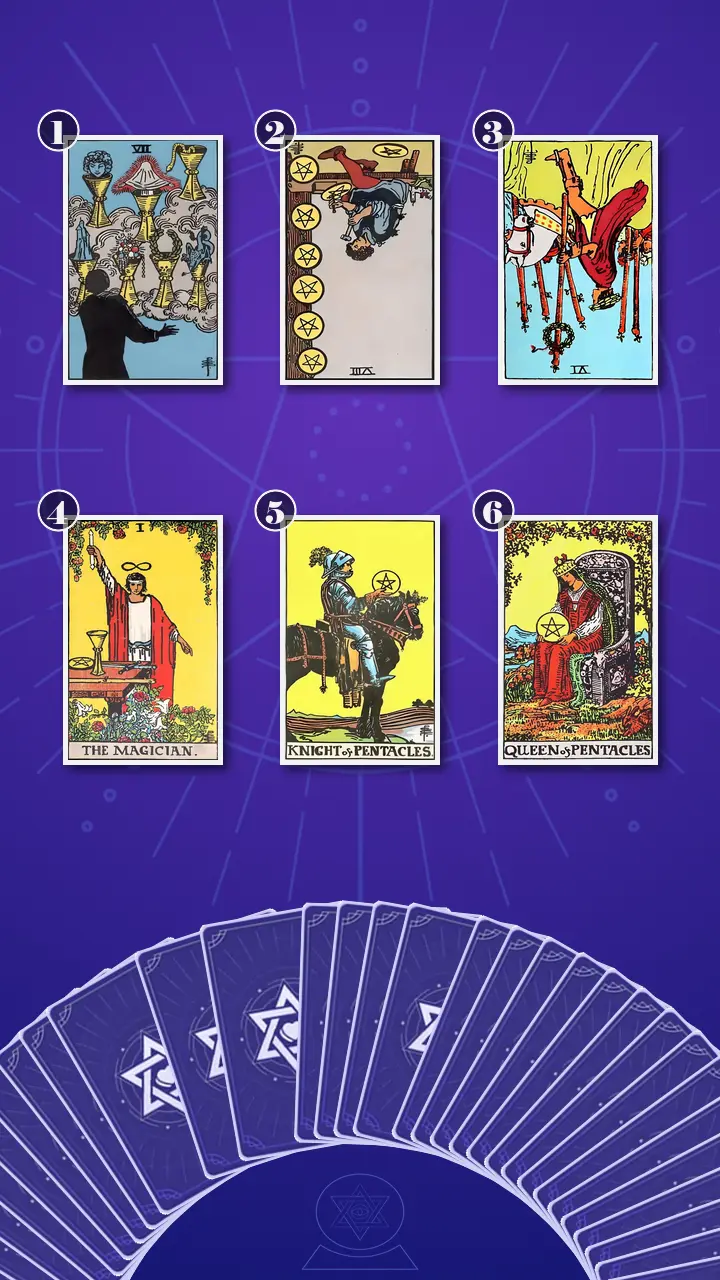
I placed three cards across the upper row and three beneath them. The first would reveal the observable behaviour: the many images of comfort standing in for one lived practice. The second would identify the immediate blockage where planning, editing, shopping, or optimisation replaced repetition. The third would expose the deeper reward structure beneath that blockage. Then the lower row would move through catalytic agency, a practical pathway, and a form of softness that could be maintained without an audience.
“The upper row is the polished shop window,” I said. “The lower row is the practical room behind it. We are not here to smash the window. We are here to help you inhabit the room.”
Seven Floating Lives Above One Cold Cup
Position 1: The Feed of Complete Identities
I turned over the card representing Maya’s observable present-state behaviour: the place where she curated multiple images of comfort and treated visual proximity to the soft life as a substitute for choosing one lived practice. The card was the Seven of Cups, upright.
I pointed to the dark figure facing seven cups suspended in a cloud. Each cup offered a different treasure, promise, or identity, but none had been selected and brought down into the figure’s hands. In Maya’s life, the cloud looked remarkably like a social-media feed: slow-morning person, organised-flat person, skincare person, reader, home cook, café regular, wellness planner. Every tile implied a whole coherent life.
I asked her to picture the previous Sunday at 11:18 p.m. She told me she had moved between Pinterest folders called “Slow Mornings,” “Small Flat Reset,” and “Soft Life 2025.” The ceiling light had been too bright, traffic had hissed over wet pavement outside, and the duvet had twisted around her ankles. Her eyes stung, but her thumb kept moving while the alarm crept closer.
“The inner monologue sounds like this,” I said. “Maybe the right version is the six-step morning routine. No, maybe I need a better bedside setup. Maybe meal prep is the answer. Maybe I need different storage first.” Each image let her visit the desired life without requiring her to close the other tabs and choose one imperfect need. Browsing was not empty; it provided imagination, relief, and possibility. But the physical contact remained missing. Many beautiful options floated above one body that needed sleep.
Energetically, I read this as an excess and diffusion of Water. Maya did not lack desire, taste, or emotional intelligence. Her longing had no container. The more complete identities she contemplated, the harder it became to choose one unremarkable action such as turning off the ceiling light, drinking water, or putting the phone down.
Maya gave a short laugh, but there was no amusement in it. Her fingers tightened around the sleeve of her jumper, then loosened. “That is so accurate it feels slightly brutal,” she said. “I really do visit the life instead of picking one part of it.”
“The card is describing a reward pattern, not accusing you of being fake,” I replied. “You are not failing at softness; the preview is simply paying out faster than the practice.”
Position 2: The Tracker That Ate the Evening
I turned over the card representing the immediate blockage: procrastination expressed through planning, optimisation, shopping, editing, and system redesign. It was the Eight of Pentacles, reversed.
Upright, the craftsperson on this card gives sustained attention to one pentacle at a time. The ordered row records practice made visible through repetition. Reversed, that Earth energy was blocked and overcontrolled. Maya’s attention was active, but it was being invested in the container around the habit rather than the habit itself.
I brought her back to a Tuesday night at the kitchen table. She had opened a Notion template for a “Realistic Evening Reset” and spent forty-two minutes renaming sections, changing icons, testing cover images, and adjusting the typography. The fridge hummed. A dry mug ring stuck to the table beneath her elbow. Breakfast remained unprepared, dinner remained uneaten, and the practical care task never received the craftsmanship she had poured into its dashboard.
“If I can make the system coherent enough, following it will finally feel natural,” I said, giving voice to the logic I saw in the card. “But repetition inevitably becomes boring, interrupted, and visually uneven. Every redesign returns you to the exciting first note, so the song never reaches the second bar.”
This was where I used my Somatic Rhythm Mapping. I do not use that phrase as a medical diagnosis; I use rhythm as a practical way to notice how daily architecture lands in the body. Maya’s working day ran at a rapid content-production tempo: briefs, Slack messages, performance metrics, edits, approvals, and an Overground commute full of more screens. At home, she expected herself to jump directly from that tempo into immaculate calm. Her tight shoulders, tired eyes, shallow breathing, and hand-to-phone motion suggested that the transition had no downbeat, no pause in which her nervous system could register that work had ended.
In ten years of sound-energy research, I have often noticed that adding more notes does not resolve a dissonant phrase. Sometimes the arrangement needs one clean rest. Looking at the reversed Eight, I thought of a track buried under too many polished layers while its basic rhythm remained inaudible. Maya did not need a more sophisticated self-care score. She needed a simpler entry beat.
Her breathing stopped for a moment. Her gaze moved away from the card as if she were replaying the Notion scene frame by frame. Then she exhaled through her nose and rubbed the heel of her hand against her sternum. “I always call that planning,” she said quietly. “But I can see how it protects me from finding out whether I will actually do the boring bit.”
Position 3: When Story Views Become a Private Performance Review
I turned over the card representing the deeper root: Maya’s fear that imperfect private action would not support her self-worth as quickly or visibly as a polished online identity. The card was the Six of Wands, reversed.
I centred the laurel-crowned rider and the watching crowd. Upright, this card can describe recognition and confidence strengthened by being witnessed. Reversed, its Fire was not absent; it was redirected outward and made unstable. Maya could generate confidence, but the confidence needed a visible response to stay lit.
I asked about a recent bath-and-book Story. Maya had balanced the book beside the bath, adjusted the towel, and retaken the frame while steam fogged the mirror. A work notification vibrated against the sink. She posted the image and refreshed the reactions while still sitting on the closed toilet lid, answering messages beside the bath she had not entered. Each notification produced a quick lift. When engagement slowed, the room dropped back into silence and her body was still waiting.
“It is like using Instagram Insights as a performance review for a private evening,” I said. “Reach and saves can tell you whether an image connected with people. They cannot tell you whether you ate, rested, felt the water, or became less available to work. Those are different measures.”
Maya’s hand moved instinctively toward her phone and stopped halfway. Her eyes unfocused; then her fingers curled back into her palm. “If people respond, at least I know this version of me is believable,” she said. “If nobody sees the soft moment, I am not sure it counts.”
I let the sentence settle before answering. “Posting is not inherently false, and receiving a response is not a moral failure. The problem is that public recognition pays immediately, while bodily relief arrives more slowly and cannot be displayed as a neat metric. The question is whether the audience has become the only authorised witness to your care.”
When The Magician Put the Phone Down
Position 4: The One-Beat Handoff from Image to Action
The traffic outside softened. A radiator clicked once in Maya’s flat, and her laptop automatically dimmed, leaving the candlelight clearer around the cold cup. I turned over the card representing the catalytic shift from aesthetic preparation to self-directed agency. It was the Magician, upright, the Bridge at the centre of the reading.
The Magician stood behind a table holding the four suit tools. One hand raised the wand; the other pointed toward the earth. Unlike the cups floating beyond reach or the rider elevated by a crowd, this figure directed available resources toward material contact. I read the card as balanced coordination: Air clarified one intention, Fire initiated it, Water connected it to an authentic need, and Earth gave it form.
At 10:45 p.m., the candle was lit and the Story was live, but the tea was cold, dinner was untouched, and Maya’s shoulders were tight. The evening already looked soft on-screen while her body was still waiting to receive it.
I used my Execution Block Dismantling lens to locate the dissonant chord. The failure was not in Maya’s desire for care or in her ability to design it. It happened in the one-beat handoff between seeing and doing. When a care task looked repetitive, unimpressive, or uncertain, opening an editing, shopping, or inspiration app removed the starting friction and supplied a quick reward. Her intention was repeatedly routed into representation before it could reach contact.
“I thought I was missing the right setup,” Maya said, looking from the card to the kettle behind her. “I might actually be missing the moment where I use what I already have.”
I nodded. “You do not need a better image of care; you need one thing already within reach turned into one private act. Do the care before you make the care legible.”
A polished mood board is not proof of progress; choose one tool already on The Magician's table and turn intention into a small action before you make it visible.
For one beat, Maya stopped breathing. Her fingers hovered above the table, completely still. Then her pupils widened and her gaze lost focus, as if she were replaying every cold drink, staged bath, and abandoned reset at once. Her mouth tightened before her eyes began to shine. She pulled her shoulders down, opened both hands, and released a breath that trembled on the way out.
“But doesn’t that mean I have been doing all of this wrong?” she asked, sudden anger sharpening the words. “I have spent years building this version of myself.”
“It means the old method solved a real short-term problem,” I said. “It gave you imagination, coherence, professional fluency, and fast reassurance. It just could not feed you or put you to bed. We do not need to put your past on trial. We need to stop asking the image to do the body’s job.”
Her face softened, but the relief was not simple. I watched the anger give way to a brief, almost dizzy blankness: the vulnerable moment when a clear path also reveals personal choice. She was no longer waiting for a perfect identity to take control, which meant the next small movement belonged to her.
“Now, using this new perspective, think back to last week,” I said. “Was there a moment when this insight might have made the evening feel different?”
Maya looked toward the open work bag. “Wednesday,” she said. “I had leftovers in the fridge. I could have put my phone in that bag, eaten for ten minutes, and taken the bath afterward. I did not need to fix the whole night.”
I named the crossing I had just witnessed. It was the first movement from validation-driven frustration and aesthetic procrastination to private self-trust, repeatable care, and grounded enjoyment without an audience. The Magician did not promise that Maya would never scroll, post, compare, or stall again. It showed that focused agency was already available whenever she directed one existing resource toward one bounded act.
The Still Horse on an Ordinary Tuesday
Position 5: Reliability Without a Rebrand
I turned over the card representing the practical pathway: the smallest repeatable practice capable of interrupting procrastination without demanding a complete lifestyle overhaul. It was the Knight of Pentacles, upright.
The horse stood still. The knight held one pentacle steadily at eye level, and cultivated fields stretched behind him. Nothing in the image tried to create a dramatic reveal. Its Earth energy was balanced, paced, and dependable. The stillness was the point.
In Maya’s life, this card looked like the same ten-minute evening reset placed on three nights in her calendar. On a low-energy night after work, the routine might shrink to one item put away, one easy breakfast component prepared, or one Do Not Disturb schedule switched on. She would add a plain checkmark, take no photograph, and resist redesigning the routine after one interruption.
“It can be the same small version again,” I said. “Repetition is not evidence that you lack imagination. Repetition is not the opposite of softness; it is how softness becomes available on an ordinary Tuesday.”
Maya’s shoulders dropped further, but she raised a practical objection. “What if work overruns and I genuinely cannot find ten minutes? That happens more than I want to admit.”
“Then the two-minute version counts,” I replied. “Filling a glass, putting food on a plate, moving one item from the bed, or activating Do Not Disturb can be the entire practice. Missing a night creates no debt. The Knight protects continuity by making return easy, not by punishing interruption.”
She nodded once, slowly. I saw recognition mixed with a little grief for all the elaborate routines that had collapsed under their own weight. Then she opened her Notes app, not to build a new operating system, but to write: “Small enough to repeat after a bad commute.”
Position 6: A Flat the Body Can Actually Use
I turned over the final card, representing the integrated state in which softness could be grounded in maintained routines, material care, sensory presence, and boundaries that remained meaningful without an audience. It was the Queen of Pentacles, upright.
The Queen held one pentacle with both hands inside a fertile but visibly maintained environment. I showed Maya how this image answered the Seven of Cups. At the beginning, seven complete possibilities floated beyond reach. Here, one material reality received sustained attention. The Earth energy had become embodied and integrated.
I did not interpret the Queen as a demand that Maya become a flawless domestic caretaker or recreate a spacious apartment from Pinterest. Her compact London flat would still have shared surfaces, high rent, awkward storage, and a work bag that sometimes landed on the floor. Integration looked smaller and more useful: eating before depletion, keeping one bedside surface clear enough to use, charging the phone beyond arm’s reach, muting non-urgent work notifications, and drinking tea while it was still warm.
“Nothing there would necessarily perform well online,” I said. “But your body could use all of it. This Queen does not ask whether the room proves you are a soft-life person. She asks whether the conditions support the person actually living in the room.”
Maya looked around the flat rather than at the camera. Her eyes paused on the kettle, the leftovers, the work bag, and one cluttered patch beside the bed. I watched her face change as the room stopped appearing like failed content and became a collection of available tools.
“So I do not have to stop posting,” she said. “I just need the post to come after I have had some of the experience.”
“Exactly,” I replied. “Your online expression can reflect a life you are already practising, but it does not get to decide whether your private comfort was real. A soft life is a maintained condition, not a content category.”
Care Before Content, in Three Quiet Beats
I drew the six cards together into one causal story. The Seven of Cups showed abundant longing dispersed across complete lifestyle identities. The reversed Eight of Pentacles showed why inspiration did not become practice: Maya refined systems and representations while Earth could not settle into repetition. The reversed Six of Wands revealed the hidden reward system, where visible recognition supplied faster reassurance than private bodily relief.
The lower row replaced that circuit. The Magician coordinated what was already available into one deliberate act. The Knight of Pentacles protected that act through realistic repetition. The Queen of Pentacles turned repetition into inhabitable conditions: food, rest, usable space, protected attention, and boundaries. I also noted the absence of a standalone Swords card. More conceptual analysis was not the missing ingredient. Thought became useful only when it was coordinated with physical action.
Maya’s cognitive blind spot was the belief that a routine had to feel coherent, effortless, and aesthetically convincing before it could count as care. That belief made readiness look like something she could design in advance. The cards showed a different transformation direction: practise one ten-minute act of comfort before posting, planning, or purchasing anything related to it, then let completion build the confidence that appearance had been trying to supply.
I offered two pieces of actionable advice as experiments, not commandments. Each had an exit point, a low-energy version, and evidence simple enough that it could not become another design project.
- Run the three-day Frictionless Tempo Calibration.On three chosen work nights, use the same entry cue: place the phone in the zipped work bag, or switch on Do Not Disturb if the phone must remain accessible. On night one, spend two minutes meeting one body need; on night two, spend five minutes making one small area usable; on night three, allow up to ten minutes for the easiest care task already available, such as heating leftovers, clearing the bedside area, or preparing one part of breakfast. Stop when the timer ends.Mark completion with one plain check and do not rate the mood, beauty, or productivity of the result. A missed night creates no debt; return at the next chosen cue without extending the timer or rewriting the sequence.
- Translate one saved image into one present need.The next time Pinterest, Instagram, or TikTok produces the urge to build a new soft-life system, choose one saved image and write the need underneath it in Notes: food, less visual clutter, a slower bedtime, less noise, or permission to be unavailable. Use one object already in the flat to meet one piece of that need for ten minutes before filming, shopping, or researching.Keep it no-purchase and deliberately incomplete. Afterward, record one sensory fact, such as warm food, quieter notifications, a clear patch of floor, or reduced shoulder tension; do not turn the observation into a performance score.
I called the first practice Frictionless Tempo Calibration because its purpose was not to force Maya into a stricter rhythm. It was to lower the starting friction one beat at a time, giving her daily architecture a gentler transition from high-speed content work into private care. The experiment would succeed if she learned something about entry, resistance, or relief, even if the routine itself needed adjustment.
“Your next steps do not need to prove that you have become a different person,” I said. “They only need to give your private self one piece of evidence that you can be cared for before you are witnessed.”

A Week Later, the Quiet Proof
Six days later, I received a message from Maya. She had come home late, felt the familiar urge to photograph her tea, and noticed her shoulders climbing toward her ears. She put the phone in her work bag, heated the least photogenic leftovers in the fridge, and ate beside the candle while the tea was still warm. Ten minutes later, she decided she had enough energy to clear the bedside surface. She did not photograph either action.
Her message ended, “It was not cinematic. I did not suddenly feel healed or organised. But I was inside the evening instead of producing evidence that it had happened.”
That night she slept through, but her first thought the next morning was still, “What if I cannot keep this going?” She told me she smiled, made the two-minute version, and left for the Overground. Clear, but still tender.
I did not consider the reading successful because tarot had transformed her life. The cards had given visible structure to a loop that previously felt like a personal failure. Maya made the consequential move: she used the map, tested one action, and decided that direct experience could become valid evidence. Her journey to clarity was not certainty. It was ownership.
When the polished post is live but your tea is cold and your shoulders are still tight, the hardest part may be wondering whether private care counts when nobody is there to confirm the version of you it was meant to prove. If you recognise that quiet split, noticing it already places one of The Magician’s tools back in your hands.
If your next soft moment could stay ordinary and unseen, which ten-minute piece of it would you be curious to live before you explain it?