The Box That Felt Like a Surprise Performance Review
If your parents mailing you a box of childhood medals landed on your doorstep like a surprise performance review—and you immediately felt the urge to update LinkedIn even though you didn’t plan to, this is for you.
Jordan slipped into the chair across from me like she’d been trying to take up less space all day. She was 28, a marketing professional in Toronto, the kind of person who can deliver a clean deck at work and still feel like she’s one typo away from being exposed.
“I don’t know why this hit me so hard,” she said, and the sentence had that specific Toronto-weeknight flatness to it—like you’re trying not to make your feelings a problem for anyone else.
She described 9:38 p.m. on a Wednesday in her condo kitchen: the overhead light humming like it was stuck on one thin note, the counter cold under her forearms, TTC noise still faint in her ears even though she’d been home a while. The shipping tape ripped loud in the quiet. Inside: childhood medals, ribbons slightly frayed, metal colder than she expected. She picked one up, set it down, picked it up again, like her hands were auditioning for calm.
“I thought I’d feel proud,” she said. “But I just… dropped. Like—stomach, chest, all of it. And then I opened my laptop. ‘Just to tidy.’”
I knew that move. The emotional trigger lands, and the mind tries to translate it into something measurable—something you can fix.
Jordan swallowed and rubbed at the front of her throat. “It’s like my best self exists in the past. If I’m not winning, I feel like I’m wasting my potential. And then I start rewriting my headline like it’ll make me feel… real again.”
Shame doesn’t always look like tears. Sometimes it’s a tight throat and restless hands, a kind of internal “mute button” pressed hard while you do tasks that look impressive. In Jordan’s body, it was as if her worth had been glued to a highlight reel—and the second the medals appeared, the screen went dark unless she could top it.
“We’re not here to judge you for caring,” I told her. “We’re here to map what your nervous system learned about worth—and what it’s ready to learn now. Let’s see if we can find clarity without turning your life into a scoreboard.”

Choosing the Compass: The Celtic Cross for Self-Worth
I’m Alison Melody—my day job for years has been radio, music therapy, and sound research. I’m used to hearing what people are saying under what they’re saying: the tempo of their breath, the tightness in their voice, the way a sentence speeds up when it’s trying to outrun something tender. Tarot works similarly for me. Not prediction. Pattern recognition—with symbols.
I asked Jordan to take one slow inhale, one slow exhale, and hold the question exactly as she’d lived it: Parents mailed my childhood medals—what’s my self-worth stuck on? While she did that, I shuffled—steady, unhurried. Not as a “ritual” to impress anyone, but as a transition: from spiraling alone to looking at the problem with structure.
“Today I’m going to use a Celtic Cross spread,” I said. “It’s classic for deep inner work because it separates the immediate trigger—the medals—from the mechanics underneath: attachment, inherited standards, and that harsh self-review loop.”
For anyone reading along, here’s why the Celtic Cross matters in a situation like this: it doesn’t just ask ‘what happened?’ It asks ‘why does this keep happening?’ and then it points to what to do next—without turning the reading into a fortune-telling trap.
I pointed to three key zones of the layout as I set it up:
“The first card shows your present reaction—what your body did in the first 30 seconds. The crossing card shows the main blockage: the pattern that keeps self-worth stuck to achievements. And the near-future card—our bridge—shows what gives you leverage quickly, like an accessible handhold out of the loop.”
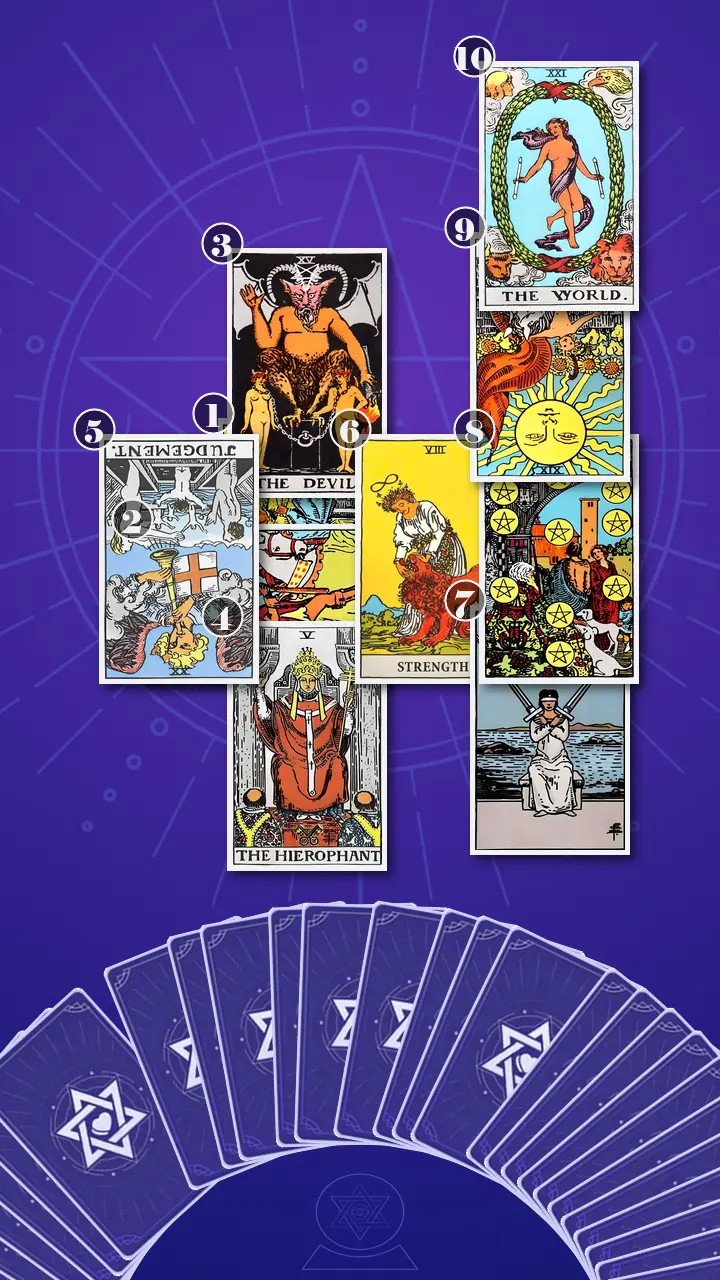
Reading the Map: When Old Medals Turn Into New Pressure
Position 1 — The immediate, observable reaction in the present
“Now flipping over,” I said, “is the card representing the immediate, observable reaction to receiving the medals and how self-worth feels in the present moment.”
Six of Cups, reversed.
I let the image sit between us for a breath. Two children. A cup of flowers. A courtyard that looks like a place you’re supposed to remember fondly.
“This is complicated nostalgia,” I said. “Not the sweet kind. More like: you receive a ‘gift’ from the past and it doesn’t land as comfort—it lands as pressure.”
And I anchored it in her real life, exactly as the card demanded: “This is like when you opened the package expecting pride, but instead your chest tightened and your hands couldn’t stop picking up the medals and putting them down. Your body recognized the medals as a message: prove you still deserve that kind of attention.”
Reversed energy here feels like blockage—the past trying to offer something, but the receiver can’t actually receive it. Not because she’s ungrateful, but because receiving has been wired to evaluation.
Jordan gave a small laugh that wasn’t amusement, more like a reflex to keep it from getting too real. “That’s… too accurate,” she said, and her smile carried a thin edge. “Like, it’s kind of rude.”
Her reaction came in a clear three-beat chain: her breath paused (freeze), her eyes unfocused as if rewatching the tape-tearing moment (cognition), and then her shoulders dropped a millimeter with a quiet, resigned exhale (release). She wasn’t being pitied. She was being seen.
Position 2 — The main block: the pattern that keeps worth stuck to validation
“Now flipping over,” I said, “is the card representing the main block: the pattern that keeps self-worth stuck on achievements and external validation.”
Six of Wands, reversed.
“This is the ‘audience pressure’ card when it’s reversed,” I told her. “Recognition doesn’t land as nourishment. It lands as a raised bar.”
I brought in the modern translation bluntly, because this card is blunt: “LinkedIn notifications become a crowd. Likes become laurel leaves. And your nervous system acts like if you don’t have a headline-worthy win, you shouldn’t take up space.”
The reversed energy here is deficiency and distortion at once: not enough internal confidence to feel steady, and too much dependence on being seen as impressive to feel safe.
Jordan winced, like she’d felt the laurel wreath tighten around her ribs. “Praise makes me anxious,” she said. “Even at work—if someone’s like, ‘Great job,’ I’m already thinking, ‘Okay, now I have to do that again, but bigger.’”
“Exactly,” I said. “This isn’t envy. It’s a safety equation. Visibility got linked to worth.”
Position 3 — The underlying attachment beneath the surface
“Now flipping over,” I said, “is the card representing the underlying attachment or compulsion that runs beneath the surface when worth feels threatened.”
The Devil, upright.
In my work with sound, I’ve learned something simple: if you play one frequency long enough, the body starts to anticipate it. The Devil is like that—an internal contract that has been rehearsed so many times it feels like truth.
“This isn’t ‘you’re bad,’” I said quickly, because The Devil gets unfair PR. “This is attachment. The belief that worth must be earned through performance and kept through constant proof.”
I tapped the image gently. “Notice the chains. In most decks, they’re loose enough to remove. That’s the point. You’re not trapped. But you’ve been living as if you are.”
In modern terms: “This is like telling yourself you’re being ‘responsible’ by obsessing over achievements… when what you’re really doing is trying to buy certainty about your worth.”
The energy here is excess: too much compulsion, too much proving, too much ‘if I just fix my image I’ll feel okay.’ Proof becomes calming—but it’s not nourishing.
Jordan nodded, slower this time. “It feels like relief for like… ten minutes,” she admitted. “Then it’s worse.”
Position 4 — The earlier conditioning: who taught you what “counts”
“Now flipping over,” I said, “is the card representing the childhood or earlier conditioning that taught you what counts and why medals still carry emotional power.”
The Hierophant, upright.
“This is internalized authority,” I said. “School systems. Coaches. Parents who meant well. Rubrics. Gold stars. The idea that being ‘good’ is something you can prove.”
I could almost hear it in her language: the way she said ‘productive’ and ‘tidy’ like moral words.
“Medals fit perfectly inside this framework,” I continued. “They’re official proof you met the standard. So when they show up at your door, you’re not just holding metal. You’re holding a whole old grading system.”
The energy is structure—useful, stabilizing, but also limiting when it becomes the only way you know how to value a life.
Jordan looked down at the card and said, very quietly, “My parents didn’t even say anything intense. They were just like, ‘We found these, thought you’d want them.’ And I still felt… judged.”
“Because the judgement isn’t coming from them in that moment,” I said. “It’s coming from the internal rubric you learned under their roof.”
Position 5 — The conscious story: the verdict you keep trying to reach
“Now flipping over,” I said, “is the card representing your conscious story about what should make you worthy, and the mental verdict you’re trying to reach.”
Judgement, reversed.
I felt my own chest tighten in recognition—not personal, professional. As a radio host, I’ve spent years editing audio: replaying one sentence, one breath, one “um,” trying to make it perfect. Judgement reversed is that, but applied to the self. Endless replays. No release.
“This is the trial that never adjourns,” I told her. “You re-open old achievements like Exhibit A, and your mind cross-examines you with leading questions: ‘Was it real? Would it count today? Did I earn it enough?’”
Then I said the line that always lands, because it’s painfully precise: “You’re not chasing success—you’re chasing a verdict.”
The reversed energy here is blockage: the card wants awakening, but instead it gets stuck in evaluation. Waiting for permission. Waiting for the trumpet to announce you’re allowed to start a new chapter.
Jordan’s gaze went still. A pause opened between us where no one reached for a joke. “I’m literally doing that,” she said. “I’m waiting for something to… clear me.”
Position 6 — The near-term leverage point: the bridge out of proof-seeking
When I reached for the next card, the room felt quieter—not dramatic, just focused, like when a song drops out and you realize you were relying on the beat to keep moving.
“Now flipping over,” I said, “is the card representing the most accessible near-term leverage point: what helps you shift from proof-seeking into self-trust.”
Strength, upright.
Jordan’s eyes widened, just slightly. The lion. The gentle hands. The infinity symbol like a calm loop instead of a panic loop.
Setup. I mirrored her actual scene back to her, because that’s where the leverage lives: “You’re in your condo kitchen at night, medals on the counter, laptop open ‘just to tidy LinkedIn,’ and suddenly your chest goes tight like the room turned into a silent performance review. Your hand hovers over ‘Edit headline’ because that’s the lever you’ve always pulled to feel safe.”
Delivery.
Stop treating your life like it needs a crowd and a laurel wreath to count; start practicing quiet courage that tames the lion from the inside.
I let the sentence hang in the air the way a good chorus does—long enough for the body to catch up to it.
Reinforcement. Jordan’s reaction came in layers. First, her breath hitched like she’d been bracing for a scold and got something kinder instead. Then her mouth tightened—not in resistance, in grief. A quick blink, and her eyes shone. Her shoulders, which had been lifted and rigid like she was holding her own head up by force, slowly dropped. Her hands unclenched on her lap, fingers uncurling one by one. When she finally exhaled, it was long and audible, the kind of exhale that tells me the nervous system just got new data.
“But if I stop…,” she started, and for a second there was heat—almost anger. “Doesn’t that mean I was wrong? Like I wasted all that time?”
I nodded, not rushing her out of it. “No,” I said. “It means you did what worked to get love and safety then. Strength isn’t shaming the old strategy. It’s giving you a new one.”
This is where my own practice comes in—my Generational Echo lens. “Can I try something a little different?” I asked. “In my work, I sometimes listen for a three-generation ‘music memory’ pattern—like a household playlist nobody chose, but everyone learned.”
Jordan leaned in, cautious but curious.
“Your medals are one track,” I said. “A ‘win’ track. Your LinkedIn spiral is another track—‘keep proving’ track. And I want you to imagine the third track, older than you: the family song about what counts. Stability. Respectability. Being impressive. Not because your family is bad—because that’s the survival music many families inherit.”
“Strength,” I continued, tapping the card, “is you changing the playlist without smashing the radio. It’s the moment you notice the ‘prove it’ impulse—and choose to hold it gently instead of letting it drive your next move.”
Then I gave her the micro-practice exactly as we’d planned, because insight without a next step just becomes a prettier spiral:
“Set a 7-minute timer. Put one medal on the table. Place one hand on your chest or throat—where you feel the tightness—and name the impulse out loud: ‘I want to prove I still count.’ Then write two lines:
1) ‘If I didn’t have to prove anything tonight, I would choose ___.’
2) ‘A respectful next step would be ___ (small, doable, no audience).’
And if you feel yourself spiraling or getting numb, stop early on purpose—closing the notebook is part of the practice, not a failure. No posting. No rewriting your bio afterward.”
I watched her eyes flick, involuntarily, as if seeing her laptop in her kitchen. I used the close-up scene the card asked for: “Picture your hand hovering over ‘Edit headline,’ and instead you close the laptop halfway. Not as a punishment. As a choice.”
Then I asked her, gently but directly: “Now, with this new lens—hold the urge, don’t obey it—can you think of a moment last week when you were about to ‘fix your profile’ and what you actually needed was care?”
Jordan stared at the Strength card, then nodded once. “Monday,” she said. “On the TTC. I saw one of those ‘thrilled to announce’ posts and I literally opened Notes like I was performing CPR on my resume.”
“That’s the lion,” I said. “Not your enemy. Just powerful. And trainable.”
In that moment, I could feel the shift we were after: from shame and contraction toward a first taste of grounded self-trust. Not a big declaration—just a new relationship with the impulse.
Position 7 — Your inner posture when nobody is watching
“Now flipping over,” I said, “is the card representing how you’re relating to yourself right now when nobody is watching—your stance, coping style, and inner posture.”
Two of Swords, upright.
“This is protective stalemate,” I said. “The blindfold isn’t ignorance. It’s self-protection. A part of you is keeping your heart and mind split so you don’t have to feel the full weight of this worth question.”
Modern translation: “This is like staying ‘logical’ so you don’t feel the sadness underneath the medals: ‘I thought winning would make me feel secure.’”
The energy here is balance on the surface—calm, competent—but also blockage underneath. Still water. Crossed swords over the chest.
Jordan’s jaw flexed, then softened. “I do that,” she said. “I get practical. I reorganize. I edit. It’s like… safe mode.”
“Noise-cancelling headphones over your heart,” I said, and she gave a small, genuine nod.
Position 8 — Family and environment signals: legacy pressure
“Now flipping over,” I said, “is the card representing family and environment signals—the legacy, expectations, and unspoken messages around success and worth.”
Ten of Pentacles, upright.
“This is the multigenerational storyline,” I told her. “What counts in your system didn’t start with you. It’s been passed down through tangible symbols: credentials, status, ‘making it.’”
I watched her shoulders rise slightly again—just a millimeter. Family pressure has gravity even when it’s unspoken.
“The medals arriving isn’t just a random package,” I said. “It’s a family message about success, even if nobody said a word.”
The energy here is grounding, but also weight. Legacy can be stability. It can also be a rubric you never agreed to.
Position 9 — The hopes and fears: wanting joy, fearing visibility without perfection
“Now flipping over,” I said, “is the card representing what you secretly hope for and what you fear.”
The Sun, reversed.
“You want uncomplicated confidence,” I said. “You want to feel proud and let it be simple.”
Then the reversal: “But you fear being fully seen unless you’re flawless. Like joy will be taken away if it isn’t earned in a visible way—so you dim your own light before anyone else can.”
Modern translation: “You want to post something honest about your life now, but you stop because you can’t package it as a win.”
The energy here is blocked radiance. Not darkness. Just a hand over the dimmer switch.
Jordan whispered, “I miss being proud. Or maybe I miss being praised.”
“Both can be true,” I said. “And neither makes you shallow.”
Position 10 — The integration direction: self-worth as wholeness
“Now flipping over,” I said, “is the card representing integration—what self-worth can grow into if you work with these insights instead of chasing a new trophy.”
The World, upright.
There it was: the wreath again—but this time, not a laurel for applause. A garland of completion. A circle that holds a whole story.
“This is integration,” I said. “Self-worth becoming wholeness rather than a scoreboard.”
I used the wreath transformation motif, because the whole spread had been arguing about it: “The Six of Wands is laurel—approval, crowd, being held up. The World is a wreath of completion. Same shape, different source.”
Then I gave her the future image the card wanted: “Medals on a shelf, not on the table. A life that doesn’t need a pitch deck. Completion isn’t applause. It’s wholeness.”
Jordan’s eyes closed for a second, like she was testing what that would feel like in her body. When she opened them, her voice was steadier. “That sounds… quiet,” she said. “In a good way.”
From Verdict-Seeking to Worth Practice: The Next 7 Days
I gathered the reading into a single, coherent story, because that’s how tarot becomes practical: it turns a messy emotional experience into a readable map.
“Here’s the arc I’m seeing,” I said. “The medals triggered Six of Cups reversed—complicated nostalgia that didn’t feel safe to receive. The crossing Six of Wands reversed shows why: being seen has become a pressure system, not comfort. Underneath, The Devil says the attachment is to proof-as-safety, and The Hierophant shows where it was learned: an inherited grading system for worth. Judgement reversed keeps you stuck in a mental courtroom, waiting for a verdict. The bridge is Strength: not more winning, but gentle authority—the ability to hold the ‘prove it’ urge without obeying it. That opens the path to The World: a wholeness-based identity that can include your medals without requiring them.”
“Your blind spot,” I added, “is that your brain keeps treating proof as the only kind of safety that counts. Proof is calming, but it’s not nourishing. The transformation direction is to move from collecting evidence of worth to practicing worth as a daily relationship with yourself—one honest choice at a time.”
Then I made it concrete. No grand reinvention. No ‘just be confident.’ Just experiments.
- The 7-Minute “Hold-the-Lion” TimerOnce this week, put one medal on the table. Set a 7-minute timer. One hand on your throat/chest. Say out loud: “I want to prove I still count.” Write two lines: (1) “If I didn’t have to prove anything tonight, I would choose ___.” (2) “A respectful next step would be ___ (small, no audience).” Then put the medal away on purpose.If the urge to open LinkedIn spikes, close your laptop halfway—soft close, not a slam. Stopping early is part of the practice.
- The Outcome-Free Respect LogFor 7 days, end your day with one line: “I respect myself today because ___.” Ban outcomes and applause: no numbers, titles, praise, metrics, or “crushed it.” Just values and choices (e.g., “I set a boundary,” “I ate lunch,” “I told the truth”).If your inner critic calls it cringe or unproductive, treat that as proof the old rubric is losing grip. Keep it to one sentence.
- The Soundproof Barrier (a boundary you can feel)At night—especially when the medals or a comparison scroll hits—create a 10-minute “sound wall” before you touch LinkedIn: put on a low-stimulation playlist (no lyrics, steady tempo). Sit in your kitchen or on your couch and let your body downshift before you decide what to do next.Make it easy: one saved playlist called “Not a Verdict.” The goal isn’t to avoid ambition—it’s to separate ambition from self-punishment.

A Week Later: Quiet Proof, Not a Spotlight
A week later, Jordan messaged me. No long essay. Just: “Did the 7-minute thing. Wanted to rewrite my headline. Closed the laptop halfway instead. Wrote: ‘If I didn’t have to prove anything tonight, I’d go to bed.’ Then I actually did. Weirdly proud. Quiet.”
Her follow-up came with a small, bittersweet honesty: she said she slept through the night, but when she woke up, her first thought was still, “What if I’m falling behind?” Then—this was the part that mattered—she noticed it, put a hand on her chest, and whispered, “Hold the lion.”
That’s the Journey to Clarity in real life: not the disappearance of the urge, but the shift in who’s holding the steering wheel. Strength isn’t louder confidence. It’s steadier self-respect.
When proof is the only thing that makes you feel real, even a harmless box of childhood medals can hit like a verdict—tight throat, sinking stomach, and that frantic need to earn your place again.
If you didn’t have to prove you’re impressive this week, what’s one small, private choice that would let you respect yourself in the present tense?
This story is adapted from psychological research, written so that those in a similar struggle can see their own pattern in it — and find their next step clearly.These insights are not a substitute for professional psychological, medical, legal, or financial advice.
Learn more about our Journey to Clarity.
How did this insight land for you?
🫂 This Resonates Deeply
🌀 Living This Story
✨ Now I See Clearly
🌱 Seeing New Possibilities
🧰 Useful Framework
🔮 The Confirmation I Needed
💪 Feeling Empowered
🚀 Ready for My Next Step
Author Profile
 AI
AI“Through ten years of sound energy research, I’ve found that when we struggle, it's usually just our internal rhythm falling out of sync under pressure. I know firsthand the frustrating helplessness of wanting to move forward but feeling paralyzed. Without overwhelming theories, I want to be the soothing background track that helps you recalibrate, turning your heavy burdens back into a light, effortless, and harmonious melody.”
In this Family Tarot Reading :
Core Expertise
Service Features
Also specializes in :
Explore Related Patterns:
Achievement FusionThe medals on the kitchen counter, the urgent pull toward LinkedIn, and the line about feeling real only when winning all point to the same mechanism: achievement has become the container for worth. You are not just remembering old success; you are using visible accomplishment as the evidence file for whether you still count. That creates a proof loop where every win calms the system briefly, then raises the bar again. Achievement Fusion fits because the self is not simply proud of achievements; the self is fused with them, so a quiet night without proof can feel like identity loss.
External ValidationLinkedIn notifications becoming a crowd and likes becoming laurel leaves show that being seen has become a pressure system, not simple encouragement. You are not only wanting recognition; you are asking recognition to regulate whether you feel allowed to take up space. External Validation fits because the outside audience keeps getting promoted into an inner authority. Praise, medals, and profile visibility become safety signals, but because they come from outside you, they cannot stay stable for long.
Nostalgia LoopThe childhood medals do not simply bring back a memory; they make the past feel like a benchmark the present has to beat. You are not stuck because you care about medals, but because those medals become proof that your best self may already have happened. Nostalgia Loop fits because the past keeps being used as a measuring device instead of a chapter of your story. The mind returns to old achievements for comfort, but then converts them into pressure, asking whether your current life still deserves the same attention.
Self-Judgment LoopThe mental courtroom image, with old achievements reopened like Exhibit A, captures how Jordan keeps putting herself back on trial. You are not simply reflecting on the past; you are cross-examining it for permission to feel legitimate now. Self-Judgment Loop fits because the review never produces lasting release. Each piece of proof offers a short verdict, then the inner court reconvenes, asking whether it was real enough, recent enough, or impressive enough to count.
Family Pattern RecognitionThe parents' package was ordinary on the surface, but Jordan's body received it as an old grading system arriving at her door. You begin to see the difference between what was actually said and what the inherited rubric made it mean. Family Pattern Recognition fits because the work is not blaming the family or obeying the legacy. It is naming how stability, respectability, credentials, and being impressive became a household language for worth, so you can choose what still belongs to you.
Shame BindingThe tight throat, restless hands, and impressive-looking tasks show shame operating quietly under competence. You are not breaking down in a visible way; you are muting the feeling and trying to outrun it with actions that look polished. Shame Binding fits because the shame is attached to the question of whether you are still impressive enough to deserve space. When worth is glued to a highlight reel, any ordinary, unposted, uncelebrated moment can feel like evidence against you.
Imposter SyndromeJordan can deliver a clean deck at work and still feel one typo away from being exposed, which shows a split between actual competence and felt legitimacy. You have evidence that you can perform, but your mind treats that evidence as temporary cover rather than durable truth. Imposter Syndrome fits because positive feedback does not land as confirmation; it turns into a new standard you have to outrun. The fear is not only failing, but being seen before the self-image feels flawless enough to survive attention.
Explore Related Struggles:
Grade-Identity FusionJordan's parents simply mail the medals, but the objects arrive with the weight of school systems, coaches, rubrics, gold stars, and family ideas about what counts. Nobody has to say anything intense in the present because the old grading system is already built into the way the medals are received. You can hear that system in the language around being productive, tidy, impressive, and cleared. These are not just preferences; they operate like identity measurements. A medal, a credential, a LinkedIn headline, and a work compliment all become versions of the same question: did you meet the standard enough to be okay? Grade-Identity Fusion captures the structure beneath the trigger. Jordan's identity has been trained to look for official proof before it can relax into worth. The way forward is not rejecting every standard; it is noticing when a standard has become the only available mirror for the self.
Inner Tribunal LockJordan describes old achievements as if they can be reopened, questioned, and tested against the present. The medals become evidence, LinkedIn becomes a statement for the defense, and her own mind keeps asking whether any of it still counts. You can feel the lock in the way no verdict actually releases her. Praise at work raises the bar, childhood proof becomes insufficient, and even the wish to start a new chapter gets delayed until something clears her. The problem is not ordinary self-reflection; it is a courtroom structure that keeps converting life into a case that never adjourns. Inner Tribunal Lock fits because Jordan is not just chasing success. She is chasing authorization from an internal judge built out of old rubrics, family signals, school standards, and professional visibility. Seeing that courtroom as a structure gives her a way to step out of endless cross-examination and back into present-tense choice.
Performance-Worth FusionThe childhood medals do not arrive as neutral memorabilia for Jordan; they land on her kitchen counter like a review of whether she has kept becoming the person those medals once promised. The box turns a private evening into a measurement scene, with the old objects quietly asking whether her present life can still match the highlight reel. You can see the struggle in how fast pride becomes pressure. Jordan does not simply remember winning; she feels pulled into proving that the winning still means something now. Her self-worth is not anchored in being a whole person across time, but in staying visibly excellent enough that the past and present can both be justified. Performance-Worth Fusion names that bind precisely: achievement is no longer just something she did, but the structure that tells her whether she counts. The work is not to stop caring about excellence; it is to separate ambition from the demand that every version of you must keep earning permission to exist.
Approval-Safety FusionJordan opens the box, feels her body drop, and then opens the laptop to tidy LinkedIn as if the platform can stabilize what the medals disturbed. The move is immediate and practical on the surface, but the timing reveals the deeper mechanics: when worth feels threatened, public proof becomes the fastest available safety signal. You are watching approval become more than validation. It becomes a nervous-system shortcut for feeling real, visible, and allowed to take up space. A better headline, a cleaner profile, or a more impressive update can calm the pressure for a moment, but the relief fades because the core question was never actually about the profile. Approval-Safety Fusion captures the reversed lock in this story: being seen as impressive has become confused with being safe enough to exist without apology. The leverage begins when the urge to perform is treated as information rather than instruction, so visibility can stop functioning as the only doorway into self-respect.
Potential OveridentificationJordan says it plainly: it feels like her best self exists in the past. The medals do not just remind her of childhood success; they call up an imagined trajectory, a version of her life where potential was supposed to keep converting into visible wins. You can see the friction between who she is now and the person those medals seem to imply she should have become. The pressure is not only to succeed today, but to prove that early promise was not wasted. That turns the present into a comparison with a projected self rather than a place she can actually inhabit. Potential Overidentification names the bind where promise becomes a burden. Jordan's potential has been treated like a debt she must keep repaying, which makes ordinary growth feel inadequate unless it looks like escalation. The shift is to let potential become capacity again, not a permanent invoice from the past.
Nourishment RejectionThe medals could have been received as care, memory, or pride, but Jordan's body cannot take them in that way. She picks them up and sets them down, tightens around the feeling, and moves toward tasks that can be managed instead of letting the keepsake simply nourish her. You can see the same rejection of nourishment when praise at work makes her think she now has to do it again, bigger. Recognition does not enter as support; it converts into a raised bar before it can settle. Even pride becomes hard to receive because receiving has been wired to evaluation. Nourishment Rejection names the quiet loss inside the performance loop. Jordan is not refusing care because she does not want it; the channel that might have received it has been rerouted through proof, pressure, and future output. Reclaiming self-worth means learning to let some things count as support without turning them into another assignment.
Explore Related Emotions:
Approval AnxietyJordan opens LinkedIn right after the box lands, calling it tidying while her body is still reacting to the medals on the counter. The movement is quick and practical on the surface, but it turns a private emotional hit into a search for visible confirmation. You learned to use approval as a stabilizer. Praise, medals, headlines, and clean professional signals become ways to check whether you are still safe inside your own life. The problem is that approval keeps raising the bar once it arrives, so comfort turns into pressure almost immediately. Approval Anxiety fits because the story keeps showing recognition as something Jordan cannot simply receive. It becomes a demand to repeat, exceed, and stay impressive enough to keep taking up space.
Rulebook ShameThe medals arrive with no harsh note from her parents, yet Jordan still feels judged. What lands is not just metal and ribbon; it is the old system of gold stars, rubrics, credentials, and being good in a way that can be verified. You are responding to a rulebook that has moved inside. Even when nobody is actively grading you, the inherited standard starts speaking in your own voice, turning pride into a checklist and rest into something that has to be justified. Rulebook Shame names the sting of feeling wrong unless you can prove you are meeting the standard. In this story, self-worth is stuck on the belief that being valuable must look official, measurable, and externally legible.
Verdict DreadJordan reopens old achievements like Exhibit A, then watches her mind cross-examine whether they were real, whether they would count today, and whether she has earned enough. The medals do not stay in the past; they become a courtroom object in the present. You are not simply chasing success in this scene. You are waiting for an inner verdict that would let you stop proving and start existing without another credential on the table. That is why the question of self-worth feels stuck: the body is waiting for clearance from a standard that keeps moving. Verdict Dread names the pressure of living as if your worth must be approved before you are allowed to rest. It is the tight pause before release, the feeling that one more win might finally adjourn the trial, even though the trial itself is the trap.
Cautious Self-TrustJordan pictures her hand hovering over Edit headline, then closing the laptop halfway instead. The movement is small, but it changes who is steering the moment: the prove-it impulse is present, yet it no longer gets automatic control. You begin to build trust through a private choice that has no audience. The shoulders dropping, the hands unclenching, and the long exhale show self-worth becoming something practiced in the body rather than performed for a crowd. Cautious Self-Trust fits because the story does not promise instant confidence. It shows a first workable relationship with the impulse: notice it, hold it, and choose one respectful next step that belongs to you.
Hollow RecognitionJordan admits the proof-seeking gives her relief for about ten minutes, then leaves her feeling worse. The headline, the praise, and the visible win can soothe the spike, but they do not feed the place that actually needs care. You are reaching for recognition because it has worked before as a quick stabilizer. The issue is that recognition here arrives hollow: it has an audience, a metric, and a surface shine, but it cannot make the body feel held. Hollow Recognition names the emptiness after the applause effect fades. It is the feeling of being seen in the impressive version of yourself while the quieter, present-tense self remains unfed.
Not-Enough PanicJordan's stomach and chest drop when she opens the box, and her hands keep picking up the medals and setting them down as if they are testing for calm. Then the laptop opens, almost automatically, because the body wants evidence fast. You are not reacting to the objects alone. The medals activate the fear that the current version of you may not measure up to the version that once won, pleased, and counted in a visible way. Not-Enough Panic is the sudden scramble to repair worth before the feeling fully lands. It turns the kitchen into a checkpoint and the LinkedIn headline into a lever, as if one quick proof could stop the body from dropping.
Status AnxietyJordan rewrites her headline so she can feel real again, and even a LinkedIn post on the TTC can send her into emergency resume mode. The professional signal becomes more than presentation; it becomes a way to locate herself. You are not wrong for caring about achievement. The deeper pressure is that status markers have started functioning like emotional oxygen, proof that you are not falling behind and that your current life still counts. Status Anxiety captures the fear underneath the polish: without a visible win, a stronger title, or a headline-worthy update, the present self starts to feel unstable. The story keeps pointing to a worth system that confuses being seen as impressive with being secure.
Explore Related Contexts:
Evaluation Pressure LoopJordan opens a box of childhood medals in her condo kitchen and the scene immediately takes on the shape of an assessment: cold metal on the counter, tape ripped in the quiet, hands picking the medals up and setting them down, then a laptop opened to 'tidy' LinkedIn. The package does not contain an explicit demand, but it lands inside a life already organized around review, proof, and visible performance. The medals connect childhood scoring systems to adult status systems. School rubrics, coaches, parents, gold stars, workplace praise, LinkedIn headlines, and professional visibility all form one continuous structure where worth has to be made legible to an outside audience. That is why the trigger does not stay in the past; it becomes an active pressure in the present. Evaluation Pressure Loop fits because the external world keeps presenting Jordan with objects and platforms that ask for a verdict. You are not looking at a simple memory issue here. You are looking at a social environment where private self-worth keeps getting pulled back into public measurement, and the first step toward agency is recognizing the loop before obeying its demand for more proof.
Family Script PressureJordan's parents simply mail the medals and say they thought she might want them, yet the objects arrive with a much larger message attached. The ribbons and metal carry the old household language of what counts: being impressive, meeting standards, earning attention, and turning effort into proof someone else can recognize. The story makes clear that the pressure is not reducible to one harsh comment or one dramatic family confrontation. It is built through tangible symbols, school systems, coaches, rubrics, credentials, status, and the quiet respectability script that many families pass down without naming it. The medals are physical evidence of a family-approved version of achievement, and their arrival brings that script into Jordan's adult kitchen. Family Script Pressure fits because the external pressure comes through inherited standards, not just personal insecurity. You are looking at a family and institutional storyline that taught Jordan which achievements were legible, and the useful move is to separate the script from the present choice in front of her.
LinkedIn Performance LoopJordan's first repair move after opening the medals is digital and measurable: she opens her laptop, tells herself she is only tidying, and starts rewriting her LinkedIn headline. Later, a 'thrilled to announce' post on the TTC sends her into Notes like she is trying to resuscitate her resume. The platform becomes the place where the old medal standard gets updated for adult life. LinkedIn is not just a website in this story. It operates as a public scoreboard where announcements, headlines, likes, and professional polish translate into social proof. Jordan's career identity is forced through a visibility machine that rewards clean narratives, upward motion, and evidence that life is still moving in a marketable direction. LinkedIn Performance Loop is the right outer context because the pressure is external, repeatable, and platform-shaped. You are seeing how comparison architecture turns a private trigger into a public identity task, and how agency begins when the hand hovering over 'Edit headline' can pause before turning self-worth into another update.
Past Self ReintegrationJordan's constructive movement is concrete: one medal on the table, a short timer, two written lines, then the medal put away on purpose. By the end, the image has shifted from medals on the counter demanding a verdict to medals on a shelf, included in the room without controlling the room. Past Self Reintegration fits because the story does not ask Jordan to reject who she was or pretend the medals mean nothing. It gives the past a different role. Childhood achievement becomes part of a whole adult identity instead of a standard that must be outperformed every time the present feels uncertain. This is an upright outer context because the external setup starts to support agency. You get a bounded practice, a private container, and a new physical placement for the medals, all of which help turn past proof into usable context rather than ongoing pressure.
Reflection Structure TrialJordan's next step is deliberately small and structured: a 7-minute timer, one medal, one hand on the throat or chest, two written prompts, and no LinkedIn afterward. The structure matters because it gives the trigger a boundary without turning the exercise into another performance to ace. Reflection Structure Trial fits because the story creates a temporary container where Jordan can observe the proof impulse before acting on it. The kitchen, the medal, the notebook, the timer, and the half-closed laptop all become practical supports for a different relationship to achievement pressure. This context is not a completed transformation. It is a live trial of a better external setup. You are seeing how a private, bounded practice can interrupt the automatic route from discomfort to public self-editing, giving Jordan enough space to choose a respectful next move with no audience required.
Personal Brand PerformanceJordan tries to solve the medal trigger by editing the version of herself that other people can see. The headline, the profile, the imagined post, and the pressure to package life as a win all show how quickly her private question about worth gets routed through public presentation. Personal Brand Performance captures the broader social stage around the LinkedIn behavior. The problem is not one app interaction; it is the expectation that adult identity should be polished, coherent, upward-moving, and easy to announce. When a life cannot be formatted as progress, Jordan hesitates to show it at all. This context matters because You are watching self-worth get outsourced to brand maintenance. The practical leverage is not to abandon ambition, but to notice when the demand to look impressive is replacing the quieter work of choosing what is actually respectful, sustainable, and real in the present tense.
Workplace Recognition PressureJordan is a marketing professional who can deliver a clean deck, but the story frames that competence beside the fear of being one typo away from exposure. When someone at work says 'Great job,' she does not receive it as a stable signal that the work landed. She immediately converts it into a higher bar for the next performance. That makes recognition part of the pressure system rather than a release from it. Professional praise, performance review language, deck quality, and public credibility all keep Jordan inside a workplace logic where visibility must be maintained through repeated proof. The issue is not that work matters; it is that recognition arrives with an implied renewal requirement. Workplace Recognition Pressure fits because Jordan's adult job world reinforces the same standard the medals activate. You are seeing a work culture interface where praise functions like a new assignment, and clarity comes from noticing when external validation is being treated as a contract to outperform yourself again.