The 11:58 p.m. LinkedIn Spiral
You open LinkedIn “just to clear the alert,” see someone else’s promotion post, and suddenly you’re doing timeline math like it’s a verdict: “I should be further by now.”
That sentence—so casual, so automatic—showed up in my café the same way it shows up in so many condo bedrooms across Toronto: quietly, late, and with a blue glow that makes everything feel more official than it is.
Taylor slid into the chair by the window like she’d been carrying a laptop bag full of bricks. She was 29, hybrid-office, marketing/ops-adjacent—the kind of capable person who keeps teams running and then goes home and privately wonders why her own life feels harder to manage than a project plan.
“It’s dumb,” she said, already apologizing for her own nervous system. “LinkedIn told me ‘Congrats on your work anniversary,’ and my body reacted like I got called into HR.”
I watched her hands while she spoke. They had that restless, fidgety energy—thumb rubbing the side of her phone case, index finger tapping nothing at all. The physical sensation she described—tight chest with that buzzy, ready-to-refresh feeling—was so specific it almost had a sound, like a browser tab endlessly reloading.
She described the scene without me asking, as if it had played on loop enough times to earn its own timestamp: Sunday, 11:58 p.m., fan humming, street noise faint through the window. The warmth of the phone against her thumb. The “two minutes” that turns into twenty. A peer’s glossy “Thrilled to announce…” post sliding past. The tiny spike of shame that makes her jump straight to her own profile and start editing her headline—edit, tap, edit—like a cleaner sentence could sedate her nervous system.
“It’s just a notification,” she said, and her voice cracked on the word just. “But it makes my whole career feel like a report card.”
Unease isn’t always a thought. Sometimes it’s a body trying to sprint while you’re sitting still—like you’re swimming through grey syrup, and the only thing you can move fast is your thumb.
I nodded, keeping my voice steady and unembarrassed for her. “LinkedIn doesn’t just show careers—it triggers scorekeeping.”
Her shoulders softened, just a millimeter, the way people soften when you name the thing without blaming them for it.
“If we can get you one step,” I said, “a real one—not a prettier headline—then we’ll have a map. Not a life sentence. Just clarity for the next seven days.”

Choosing the Compass: The Four-Layer Insight Ladder
I run an Italian café, and I’ve learned something strange over two decades of espresso mornings: people don’t need more noise. They need a clean counter, a warm cup, and one honest question. Tarot—when it’s done well—is that kind of clean counter. Not mysticism. Focus.
I asked Taylor to take one slow breath, the kind you can actually feel in your ribs. While I shuffled, I also did what I always do without making it weird: I watched her coffee reaction. Not because caffeine is fate, but because the body doesn’t lie. Her hands were already buzzing; I didn’t want to add gasoline.
“We’ll keep this simple,” I told her. “Today I’m using a spread I designed for moments exactly like this: the Four-Layer Insight Ladder · Context Edition.”
For readers who wonder how tarot works in a practical, non-cringey way: this kind of four-card tarot spread is like troubleshooting a loop on your phone. You don’t start by rearranging the icons. You identify the trigger, the hidden setting underneath, the change that actually resets the system, and then you take one action that proves it worked.
This spread fits a LinkedIn-triggered spiral because the issue isn’t really “Which job should I choose?” It’s “What internalized timeline narrative hijacks me, and how do I interrupt it with one doable next step?” A four-position ladder keeps it tight and actionable: it captures the moment the notification hits, names the old script underneath, introduces the inner shift, and converts that shift into one practical step—exactly matching Taylor’s request for one step.
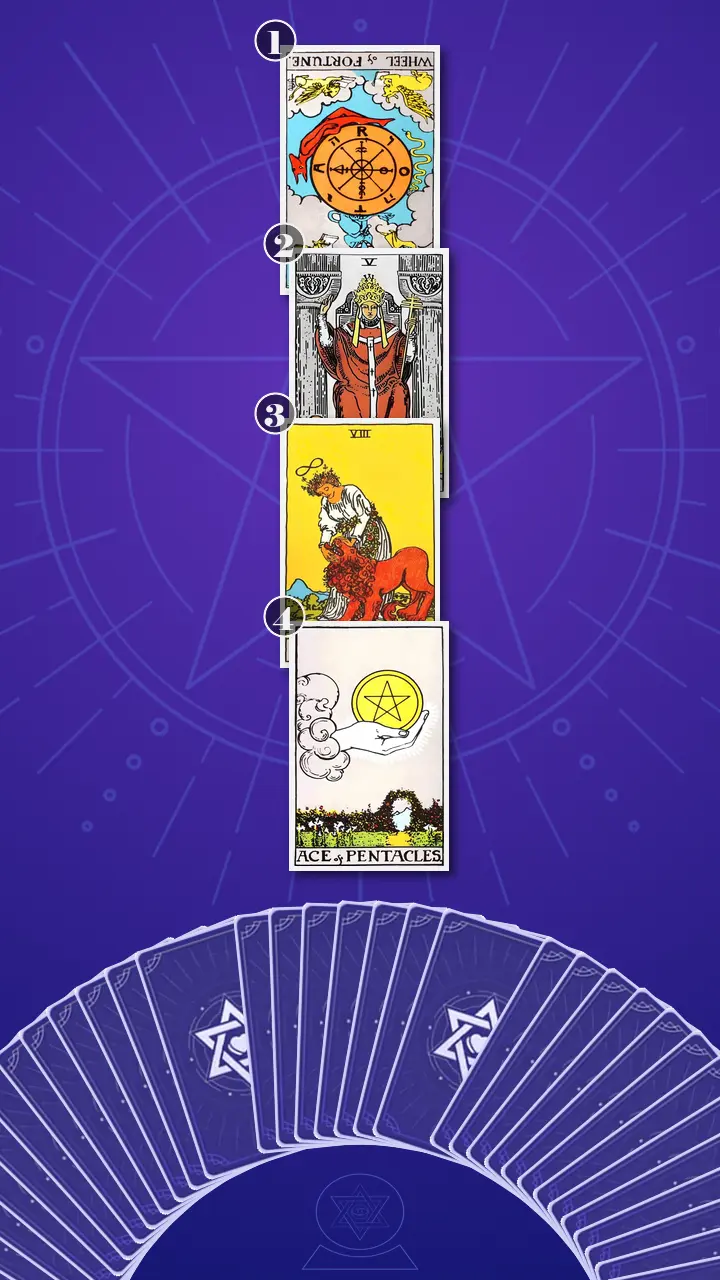
I placed the cards in a vertical line like a small ladder: Card 1 at the top (the ping), Card 2 beneath it (the deeper script), Card 3 beneath that (the turning point), and Card 4 at the bottom (the grounded step). I told her we’d pay special attention to the third card—the reframe that restores self-trust—and the last card—the one thing she could finish in a week.
Reading the Map: Card Meanings in Context
Position 1: The trigger response — what the alert activates
“Now we flip the card that represents the trigger response: what the LinkedIn anniversary alert activates in your present-day behavior and self-talk,” I said, and turned the first card over.
Wheel of Fortune, reversed.
Even before I spoke, Taylor made a sound—half laugh, half wince. It wasn’t agreement. It was the kind of reaction people have when something is too accurate and they’re annoyed it got there first.
“Okay,” she said, bitter-amused. “That’s… rude.”
I smiled a little, because I’ve been on the receiving end of that exact kind of accuracy myself. “It can feel like that. But it’s not judging you. It’s naming the loop.”
This card’s modern-life scenario could have been lifted directly from her phone: a random LinkedIn anniversary notification lands during a work break. You open the app to ‘just check,’ then your brain starts doing timeline math like it’s tax season for your self-worth. You scroll peers’ promotions and pivots, your hands get restless, and you end up micro-editing your headline and role bullets to feel temporarily ‘back on track’—even though nothing real changed in your week.
That’s Wheel of Fortune reversed as an energy state: blockage. The Wheel is motion and timing; reversed, it’s motion that doesn’t go anywhere. Not progress—spin. It’s the feeling that forces outside you are moving the story, and all you can do is keep checking the dashboard.
I pointed at the idea of the wheel itself. “The feed is the wheel,” I said. “It’s always turning. It doesn’t care if you’re tired or tender. And the moment you treat the dates as a verdict, your attention gets hijacked into scrolling and optics.”
Taylor’s fingers did a tiny refresh motion in the air—like muscle memory. Then she caught herself and tucked her hand under her thigh.
“Here’s the question this position asks,” I continued, keeping it practical. “Within the first sixty seconds after the alert hits—what do you do, and what’s the first self-judgment sentence that appears?”
She didn’t even have to think. “I check. Then I compare. Then I… fix.”
“And the sentence?”
Her eyes flicked down, as if the words were written on the table. “I should be further by now.”
“A timestamp isn’t a verdict,” I said softly, and let that sit there like a spoon on a saucer.
Position 2: The old career script — the inherited rulebook
“Now we flip the card that represents the old career script: the inherited rulebook, milestone logic, or approval system you’re still unconsciously following,” I said.
The Hierophant, upright.
Her face changed in a way I’ve seen a hundred times: not surprise—recognition. The kind that makes you feel both safer and a little trapped.
“This,” I told her, “is the part of you that wants a career that passes an invisible compliance check.”
The Hierophant in modern life looks like this: under the scroll spiral is a strict internal rulebook—your career should be linear, explainable in one clean sentence, and validated by recognizable titles or institutions. So when you feel uncertain, you don’t ask ‘What do I want to try next?’ You ask ‘What will sound correct?’ and you wait for imaginary gatekeepers to approve your pivot before you let yourself move.
Energy-wise, The Hierophant is structure. When it’s balanced, it’s mentorship, wisdom, and the ability to learn the rules of a field. But when it’s overactive, it becomes permission-seeking. It turns your own curiosity into a courtroom, and you put an invisible panel of recruiters on the jury.
I tapped the air as if pointing to the two keys in the traditional imagery. “Those keys aren’t bad,” I said. “They’re access. But you’ve been acting like you don’t get to hold them.”
“Whose approval are you trying to earn when you rewrite your headline?” I asked, keeping it simple.
She swallowed. “Recruiters. My old manager. My friends who look like they’ve already figured it out.”
Then, quieter: “Also… my younger self. Like I owe her a clean story.”
Her hands tightened into a loose fist, then opened again—one small cycle of tension and release. That was the root showing itself: not laziness, not lack of ambition—fear that a non-linear path proves the last years “didn’t count.”
Position 3: The reframe that restores self-trust — the inner stance
Before I turned the third card, the café felt suddenly quieter. Not silent—there was still the soft hiss of the espresso machine in the back—but focused, like when someone turns down the volume to hear a specific line in a song.
“This is the transformation point,” I told her. “The antidote.”
I turned the card over.
Strength, upright.
Strength is the card people misunderstand. They think it means being tougher. But the image is gentle: a steady hand on a lion. It’s nervous-system leadership, not performance.
In modern life, Strength looks exactly like the moment Taylor described: the comparison spike—tight chest, fidgety hands—and instead of escalating into a LinkedIn session, you practice staying steady. You let the feeling exist without obeying it. You choose one calm sentence and one small action based on your values, not on what would be instantly legible to recruiters or peers.
“You don’t need permission to run one small experiment,” I said, and I could feel her attention lock onto that phrase like it was a handrail.
And then I brought in one of my café metaphors—the one that has saved more people than any inspirational quote ever has: my Stress Flavor Profile.
“In coffee,” I said, “over-extraction happens when you keep pulling and pulling, trying to get more certainty out of the same grounds. The result isn’t richer. It’s bitter. Your LinkedIn spiral is over-extraction.”
“You’re trying to pull a perfect, recruiter-ready narrative out of a moment that can only give you one honest thing: a feeling. Strength is the barista move of stopping the shot at the right time. Not because you don’t care. Because you care enough to protect the flavor of your life.”
She blinked, and I watched the three-step reaction chain move through her in real time: her breath paused (a tiny freeze), her eyes unfocused like she was replaying last night’s spiral, and then a slow exhale left her chest—half relief, half grief.
Now I followed the exact arc a true aha moment needs.
Setup: I described her moment back to her: the office kitchen fluorescents buzzing, the coffee machine hissing, the “Congrats on your anniversary!” alert in her hand—chest tight, thumb ready to scroll like her worth depends on what loads next. I could feel her nod before her mind decided to.
Delivery:
Stop treating the anniversary wheel as a verdict and practice the steady hand on the lion—calm courage over milestone panic.
I let the sentence sit. A pause. The espresso machine clicked, like punctuation.
Reinforcement: Taylor’s face softened in layers. First her brow unknit, like she’d stopped bracing for a reprimand. Then her shoulders dropped, not dramatically—just enough to prove she’d been holding them up. Her eyes got bright in that almost-annoying way emotions do when they’re arriving before you’re ready. She pressed her lips together, then released them, like she was unlearning a habit.
“But if I stop—” she started, and there it was: the resistance. Anger flickered under it. “—doesn’t that mean I wasted time? Like I was wrong?”
I kept my voice calm and very human. “No,” I said. “It means you stop letting one app decide what your years mean. Your experience is real value even if the story isn’t linear.”
I leaned in a little. “Let’s do a three-minute experiment right now. No posting. No explaining. Just proof to your body.”
“Close LinkedIn,” I said, and watched her put her phone face-down. “Put one hand on your chest. Take five slower breaths. And write one sentence in your Notes app: ‘The smallest proof I can build in 7 days is ___.’ If this spikes anxiety, you can stop after the sentence—no forcing, no performance.”
She did it. I could see her fingers hesitate, then type. When she finished, she stared at the sentence like it was surprisingly simple, which is often the first sign something true has appeared.
Then I asked the question that turns insight into a lived reframe: “Now, with this new perspective—can you think of a moment last week when this would have changed how you felt?”
Her eyes went distant. “Friday,” she said. “I was rewriting my About section again. I could’ve… just drafted the portfolio outline instead. Like, actually moved.”
“That,” I told her, “is the shift: from chaotic comparison loops and milestone panic to calm inner authority—and proof-based confidence through follow-through.”
Position 4: One step — the seed action in the next 7 days
“Now we flip the card that represents one step: a single practical action you can take in the next 7 days that creates real momentum, not just optics,” I said.
Ace of Pentacles, upright.
This card is so grounding it almost changes the lighting in the room. It’s a hand offering a coin over a garden path—simple, real, schedulable.
In modern life, the Ace of Pentacles is one tangible seed step you can complete in seven days: send one informational chat request, finish one course module and capture key takeaways, or draft a one-page portfolio artifact. It’s the kind of progress that would still count even if you never updated your profile—because it creates real evidence you’re moving.
I said the line I knew she needed to hear before her brain tried to optimize it: “Optics calm you for a minute. Proof calms you for longer.”
Taylor let out a small sound—half laugh, half surrender. “Yeah. That’s… painfully true.”
“So we’re going to pick a seed,” I said. “One. Not ten. Because ten is secretly another version of the Wheel.”
She hesitated, then said, “A one-page portfolio outline. I can do that without anyone’s permission.”
“Perfect,” I said. “Small and real.”
From Timeline Panic to a One-Week Experiment
I looked at the ladder of cards as a single story. The Wheel reversed at the top was the spin: a notification becomes a courtroom, and your thumb becomes a gavel. The Hierophant underneath was the rulebook: ‘Be legible. Be approved. Don’t deviate until you can explain it perfectly.’ Strength was the turning point: the steady hand that leads the nervous system without pretending it isn’t scared. And the Ace of Pentacles was the landing: one seed you can actually plant this week.
“Here’s the blind spot,” I told her. “You keep trying to earn safety through optics. You polish the story so you don’t have to risk the step.”
And here’s the direction of the whole reading: the key shift from treating career milestones as proof of worth to treating your next week as a small experiment you can complete and learn from. Not deleting your ambition—rerouting it.
Taylor glanced at her coffee cup. It had gone lukewarm. That gave me another tool—my Cup Temperature Scan. In my café life, the speed a cup cools tells me how fast the room is stealing heat. In a reading, it’s a metaphor for how fast the internet steals your energy.
“Notice how quickly your energy cools when you’re in LinkedIn scorekeeping mode,” I said. “We’re going to protect your heat.”
She gave me an immediate, practical objection—exactly the kind that keeps people stuck. “But I can’t find time. I really can’t. My weeks are chaos.”
“Totally fair,” I said. “So we’re not asking for a life overhaul. We’re asking for a controlled, espresso-sized test.”
- The 10-Minute Wheel InterruptOne time this week, when the anniversary alert hits (or you feel the urge to check), set a 10-minute timer. Close LinkedIn. In Notes, write two sentences: “What I actually learned in that year was ___.” and “The next small proof I want to build is ___.”If it feels cringe, do it in a locked note. The point is to interrupt the loop, not to create publishable prose.
- A 25-Minute “Steady Voice” Block (No Profile Editing)Open your calendar and schedule one 25-minute block in the next 7 days titled “Steady Voice.” During that block, you work only on your seed step (Taylor’s pick: draft a 1-page portfolio outline). LinkedIn stays closed; headline edits are not allowed.Treat it like espresso machine maintenance: small, regular upkeep prevents breakdowns. If you can’t do 25, do 10—start the machine.
- “LinkedIn Is for Tasks” Rule (One Week)For seven days, you can only open LinkedIn if you can name the task out loud first (“message Jamie,” “check this company,” “reply to this comment”). When the task is done, you close the app—no scrolling to soothe yourself.You’re allowed to close the app and still be ambitious. If shame spikes anyway, move the app off your home screen for 7 days and use desktop only for specific tasks.
I added one last micro-tool from my café: a 5-Minute Coffee Meditation, because Strength isn’t only a concept—it’s a body state.
“When you feel your hands get fidgety,” I said, “grind coffee or just smell the grounds if you have them. Five slow breaths. Let your body get the message: ‘We’re safe enough to choose one small proof.’”
Taylor nodded, and this time it wasn’t a tight nod. It was a decision nod.

A Week Later: Proof That Didn’t Need Likes
Six days later, Taylor messaged me. Not a long paragraph. Not a new headline. Just: “Did the 25 minutes. Drafted the one-page outline. Sent one informational chat request. Didn’t update LinkedIn. Felt weirdly proud. Also still scared—just… quieter.”
It was the kind of progress nobody claps for online: steady, unglamorous, real. She told me she celebrated by sitting alone at a café for an hour with a notebook—no doomscrolling, no Notion board makeover—just the soft relief of having done something that couldn’t be argued with.
That’s the Journey to Clarity I trust most: not certainty, but ownership. Not a perfectly legible story, but one completed seed that makes your nervous system believe you again.
When a random anniversary ping turns your chest tight and your fingers restless, it’s not because you’re failing—it’s because part of you is terrified that a non-linear story means the last years “didn’t count.”
If you didn’t need your next move to be instantly understandable to anyone else, what’s one small, real seed you’d be curious to complete this week—just to see what it teaches you?
This story is adapted from psychological research, written so that those in a similar struggle can see their own pattern in it — and find their next step clearly.These insights are not a substitute for professional psychological, medical, legal, or financial advice.
Learn more about our Journey to Clarity.
How did this insight land for you?
🫂 This Resonates Deeplyx 1
🌀 Living This Storyx 1
✨ Now I See Clearlyx 1
🌱 Seeing New Possibilitiesx 1
🧰 Useful Frameworkx 1
🔮 The Confirmation I Needed
💪 Feeling Empowered
🚀 Ready for My Next Step
Author Profile
 AI
AI“For twenty years, I’ve listened to stories unfold over the warm aroma of coffee. I don’t believe life’s complexities always require grand theories to be solved; often, we just need a safe place to tidy up our reality. I don’t offer high-minded preaching—just grounded, heartfelt insights to help you regain your sense of control amidst the clutter of daily life.”
In this Introspection Tarot Reading :
Core Expertise
Service Features
Also specializes in :
Explore Related Patterns:
Comparison TrapTaylor opens LinkedIn for one alert and is quickly pulled into peers' glossy promotion posts, timeline math, and the sentence, "I should be further by now." The feed does not merely inform her; it reorganizes her attention around who appears ahead and what that supposedly says about her. Comparison Trap is the cognitive loop where someone else's visible milestone becomes distorted evidence about your own progress. Taylor is not comparing full lives with full lives; she is comparing her private uncertainty with other people's public career packaging, which turns incomplete information into a self-worth audit. The pattern keeps her moving sideways. Instead of asking what one useful step would create real momentum, her mind scans for ranking signals and then tries to repair the feeling through profile polish. Naming the trap helps separate useful market awareness from the kind of scorekeeping that drains agency.
Social Clock ComplianceTaylor's automatic sentence, "I should be further by now," turns a work anniversary alert into a career timestamp with moral weight. The story shows her checking dates, reading peers' promotion posts, and treating a non-linear path as something that has to be defended before it can count. That is the mechanism of Social Clock Compliance: an internalized timeline narrative starts acting like a rulebook. You do not simply wonder what move would be useful next; you measure whether your life is arriving on schedule, whether the title looks recognizable, and whether the story would satisfy an imagined panel of recruiters, old managers, friends, and your younger self. The useful audit point is that Taylor's ambition is not the problem. The pattern appears when ambition gets routed through milestone obedience, making one visible marker feel more authoritative than the real evidence of skill, curiosity, and follow-through she can build in the next seven days.
Achievement FusionTaylor says the notification makes her whole career feel like a report card, and the story later names the sharper fear underneath: that a non-linear path might mean the last years did not count. A neutral anniversary alert becomes more than information; it becomes a verdict on whether she has become enough. Achievement Fusion shows up when career evidence and self-worth get welded together. In Taylor's case, a title, a timeline, or a clean LinkedIn story starts carrying the emotional job of proving her value, so the body reacts to an app notification as if an evaluation is happening in real time. The pattern is especially costly because it makes optics feel like safety. Editing a headline can briefly quiet the shame spike, but it cannot give the deeper proof her nervous system is asking for. The shift begins when she separates worth from milestone display and lets one completed seed step become evidence of agency rather than evidence of personal adequacy.
Permission SeekingTaylor names the people whose approval seems to hover over her LinkedIn edits: recruiters, an old manager, friends who look like they have figured it out, and even her younger self. Her next career move starts to feel as if it must be understandable to them before she is allowed to try it. Permission Seeking appears here as a defense against the uncertainty of a non-linear path. If an imagined authority can approve the story first, Taylor does not have to tolerate the risk of moving before the narrative is perfectly clean. The cost is that approval becomes a gate in front of action. The one-page portfolio outline matters because it bypasses the jury entirely: it gives Taylor a small experiment she can complete without asking the feed, a recruiter, or an old version of herself whether she has the right to begin.
Compulsive CheckingTaylor's "two minutes" on LinkedIn turns into twenty minutes of checking, comparing, refreshing, and editing her headline. The behavior has a clear emotional function: when shame spikes, the app becomes a place to search for certainty and regain the feeling of being back on track. Compulsive Checking is not about curiosity in this story. It is a reassurance loop where each check promises relief but reopens the same wound, because the feed keeps providing new ranking cues and new reasons to inspect the career story again. The pattern matters because Taylor's thumb moves faster than her agency. Checking gives the nervous system a tiny hit of control, but it does not build proof. Closing the app, naming the trigger sentence, and choosing a bounded task interrupts the loop at the point where relief-seeking usually becomes more evidence-scanning.
Productive ProcrastinationTaylor keeps editing her headline, role bullets, and About section when the comparison spike hits. The work looks responsible from the outside, but the story shows that it substitutes for the more exposed action she already knows would move her forward: drafting the portfolio outline. Productive Procrastination is the pattern of doing a useful-looking task to avoid a more meaningful and vulnerable one. In Taylor's case, profile polish creates the sensation of control while delaying the real evidence-building step that cannot be instantly validated by likes or public legibility. The distinction is precise: the problem is not that profile editing is useless. The problem is that she uses it as sedation when her nervous system is asking for proof. A bounded 25-minute block on the seed step breaks the loop by moving effort from optics to evidence.
Explore Related Struggles:
Approval-Safety FusionTaylor does not rewrite her headline for no one; the imagined audience is named in the room. Recruiters, an old manager, friends who look like they have already figured it out, and even her younger self all become people she is trying to satisfy before she moves. Approval has become a safety signal. You can feel how exposed the next step becomes when it cannot be instantly defended as linear, polished, or institutionally legible. The profile edit offers a quick sense of being acceptable, while the real experiment asks you to trust movement before applause arrives. The portfolio outline changes the safety source. Instead of waiting for the invisible panel to approve the story, you build one piece of proof that your body and week can register as real.
Metric-Compass FusionLinkedIn does not merely display information in Taylor's spiral. The anniversary alert, the peer promotion post, and the profile fields become a dashboard that seems to know whether her career is on track. That is the trap of letting metrics become a compass. You start treating dates, titles, and public updates as if they can tell you what your years mean and where your attention should go next. The result is not clearer direction; it is constant checking of instruments that were never designed to hold your whole life. The interrupt in the reading gives the compass back to lived evidence: what you actually learned in that year, and what small proof you want to build next. LinkedIn can return to being a tool only after it stops being the judge of direction.
Permission ParalysisThe old rulebook in Taylor's story says to wait until the pivot can be approved, explained, and made acceptable. When uncertainty hits, she asks what will sound correct instead of what she wants to try next. That keeps action suspended between curiosity and exposure. You may know there is a step available, but taking it feels premature unless the imagined audience can already understand it. Real movement freezes while the profile keeps being adjusted. The line that unlocks the reading is simple: you do not need permission to run one small experiment. A portfolio outline is not a life sentence; it is a week-sized action that lets you move before the whole story has been certified.
Identity Verdict LockTaylor says the alert makes her whole career feel like a report card, and her body answers as if a formal evaluation has begun. The chest tightens, the hands fidget, and a simple anniversary ping starts weighing the meaning of entire years. The deeper pressure is not just wanting a better job story. You are trying to prove that the path already taken was not a mistake. When a non-linear career begins to feel like evidence that the last years did not count, every next move has to defend your identity as well as your resume. The reading loosens that verdict by separating experience from perfect narrative. Your years can hold value before they become a clean public sentence, and one small proof can move you forward without putting your entire self on trial.
Inherited Timeline LockThe LinkedIn anniversary alert lands at 11:58 p.m., and Taylor's first automatic sentence is not a plan but a deadline: 'I should be further by now.' A neutral timestamp becomes a career clock, especially once a peer's promotion post turns the feed into a comparison timeline. The old script underneath is explicit: a career should be linear, explainable in one clean sentence, and validated by recognizable titles or institutions. You are not only asking whether the next move is smart; you are measuring whether your path can still satisfy an inherited calendar. That is why the one step matters. A one-page portfolio outline interrupts the inherited schedule by creating evidence inside the next seven days, letting you test movement without forcing your whole past into a clean story first.
Explore Related Emotions:
Permission AnxietyTaylor hears the old script most clearly when she asks what will sound correct instead of what she wants to try next. Recruiters, an old manager, friends, and even her younger self become an invisible approval panel, and you can feel how the pivot has to become perfectly explainable before movement feels allowed. Permission Anxiety names the inner weather created by that panel. The career step is not blocked by a lack of capability; it is slowed by the need to be authorized, legible, and safe in other people's imagined eyes before you are allowed to build one small piece of evidence for yourself.
Timeline PanicLinkedIn pings at 11:58 p.m., and the work anniversary turns into timeline math: 'I should be further by now.' You are not simply looking at a notification; a neutral timestamp becomes a measuring stick for the whole career, and the body starts acting as if the feed has the authority to grade the past year. The check-compare-fix sequence makes the clock feel personal. You open the app to clear an alert, see someone else's promotion, and suddenly your next move is driven by urgency rather than choice. Timeline Panic fits because the pressure is not just about work progress; it is the compressed sensation that time itself is closing in and demanding proof immediately.
Timeline ShameA peer's glossy promotion post slides past, and Taylor jumps to her own profile with a tiny internal burn: edit, tap, edit, as if a cleaner headline could make the last years look acceptable. The older sentence underneath is brutal in its simplicity: a non-linear path might mean the time did not count. Timeline Shame names that private burn. You are not only worried about being behind; you are interpreting the shape of your career as a moral mark against you. The shame attaches to timing, sequence, and legibility, so the past starts asking to be defended instead of integrated.
Verdict DreadThe alert hits her body like an HR summons, and the career instantly becomes a report card. A work anniversary should be a date on a platform, but in this story it becomes a courtroom where every title, gap, pivot, and peer promotion can be used as evidence against her. Verdict Dread fits because the fear is not vague nervousness; it is the sensation of being evaluated before you have even chosen what you want to do next. You are bracing for a ruling from the feed, the recruiters, the old manager, and the imagined audience, which makes editing a headline feel like an emergency defense rather than a calm update.
Cautious Self-TrustTaylor's follow-up is small and precise: 'Felt weirdly proud. Also still scared, just quieter.' That line matters because it does not pretend confidence has arrived fully formed; it shows the first believable signal that her own follow-through can be trusted again. Cautious Self-Trust fits the emotional texture after the one-week experiment. You have not solved the whole career narrative, and you are not forcing certainty. You are letting one completed action become a quiet witness: you can move without permission, stay scared without spiraling, and let proof rebuild confidence at a human scale.
Grounded AgencySix days later, Taylor has drafted the one-page portfolio outline, sent one informational chat request, and left LinkedIn untouched. The progress is not glamorous, and that is exactly why it works: it creates evidence that does not need likes, a headline, or instant public approval to be real. Grounded Agency names the feeling of coming back into authorship through a completed seed. You are no longer trying to earn safety through optics; you are testing reality with one finishable action. The career story becomes something you can build with your hands this week, not something the feed gets to define for you.
Hard-Won ComposureTaylor puts the phone face-down, places a hand on her chest, and takes five slower breaths before writing one sentence in Notes. Nothing dramatic happens from the outside, but the action matters because she lets the spike exist without immediately handing it the steering wheel. Hard-Won Composure fits this moment because the calm is not effortless. You are still tender, still aware of the comparison trigger, and still close enough to the old loop to feel its pull. The shift is that your body gets one clear proof that you can pause, choose, and protect the next small action from the feed.
Status AnxietyThe 'Thrilled to announce' post does not stay as someone else's update; it becomes a ranking signal. Taylor's attention jumps from the peer's milestone to her own headline and role bullets, because public legibility briefly feels like the fastest route back to solid ground. Status Anxiety fits the way the platform turns visibility into pressure. You are not just comparing jobs; you are scanning for signs that your career can still be recognized as legitimate by the social scoreboard around you. That makes optics feel calming for a minute, even when they do not actually move your life forward.
Caged RestlessnessTaylor's body is trying to sprint while she is sitting still: tight chest, restless hands, thumb ready to refresh, the browser-tab feeling of endlessly reloading. Even the scene is contained, with the bedroom, the fan, the street noise, and the blue phone glow holding all that movement in a small late-night space. Caged Restlessness names the mismatch between internal speed and external stuckness. You can move the thumb, rewrite the headline, and refresh the feed, but the real step remains untouched. The body keeps producing motion because it wants escape, while the available action keeps looping inside the same small cage.
Explore Related Contexts:
Approval BottleneckTaylor names the people whose approval seems to hover over every profile edit: recruiters, an old manager, friends who look further ahead, and her younger self. The next move gets delayed because it feels as if an invisible panel has to sign off before she is allowed to test anything. That is an approval bottleneck, not a lack of capability. The external career market trains people to make every pivot sound recruiter-ready, and LinkedIn makes that audience feel present even in a private bedroom at midnight. You end up optimizing for imaginary review instead of learning from a real action. The useful move is to shrink the audience until the step can happen. A one-page portfolio outline and one informational chat request give you feedback from reality, not from a mental committee. The bottleneck loosens when proof replaces permission.
Life Script PressureThe old script appears when Taylor says her career should be linear, explainable in one clean sentence, and validated by recognizable titles or institutions. She is not only reacting to LinkedIn; she is measuring herself against a rulebook that says a non-linear path has to be justified before it can count. That rulebook creates pressure because it asks you to make your life legible before you let yourself move. Recruiters, an old manager, peers, and even a younger version of yourself become imagined reviewers of the story. The external career culture rewards clean arcs, so experimentation starts to feel like a breach of protocol. Life Script Pressure is the right frame because the pain point is not lack of effort. It is the demand to compress a real, messy development path into a socially approved storyline. Your agency returns when the next step is allowed to be useful before it is perfectly explainable.
LinkedIn Performance LoopThe alert lands at 11:58 p.m., and the two-minute check becomes twenty minutes of peer promotion posts, timeline math, and headline edits. You are not making a strategic update in that scene; you are being pulled into a professional feed that turns visibility into a live scoreboard. The loop works because LinkedIn blends career information with public proof. A work anniversary, a glossy promotion post, and a profile field all look like neutral tools, but together they reward optics faster than actual movement. Your thumb moves quickly while the real next step stays untouched. Naming this as a LinkedIn Performance Loop keeps the problem outside personal failure. The practical leverage is not to abandon ambition, but to turn the platform back into a task environment: open it for a named action, close it when the action is done, and build proof somewhere the feed cannot score.
Off-Script Career PathTaylor’s role is described as marketing/ops-adjacent, and the sentence that cuts deepest is the fear that a non-linear path means the last years did not count. The problem is not that she has no experience; it is that the experience does not fit neatly into the career story she thinks will be accepted. An off-script career path often becomes painful when the market asks for clean titles, obvious ladders, and tidy pivots. Hybrid roles, cross-functional work, and exploratory next steps can create real value while remaining hard to summarize in one line. That gap makes the past feel harder to defend than it actually is. Naming the context this way protects the value of what has already been built. The next step does not have to prove the whole story; it only has to translate one piece of experience into concrete evidence. A portfolio outline is useful because it turns a non-linear background into something visible without pretending it was linear all along.
Social Clock PressureTaylor’s first sentence after the alert is that she should be further by now, and she treats a work anniversary like a career report card. The pressure does not come from one promotion post alone; it comes from a timeline system where age, tenure, and peer milestones get converted into a verdict. That is the social clock at work in a career setting. At 29, in a role that is capable but not easily packaged, the external script says progress should be linear, visible, and easy to compare. The feed supplies the benchmarks, and your own years start looking like evidence to defend. Calling it Social Clock Pressure gives you a way to separate timing data from self-definition. You can still use milestones for reflection, but they do not get to decide whether your next week should be spent polishing a profile or building one small piece of real evidence.
Private Momentum WindowTaylor’s chosen step is small enough to finish: a one-page portfolio outline, scheduled inside a no-LinkedIn work block. Six days later, she has drafted the outline, sent one informational chat request, and left her profile untouched. That creates a private momentum window, a contained stretch where progress is measured by completion rather than applause. The structure matters: close the feed, name the task, set the time, build one piece of proof. It gives ambition a place to act without asking the public timeline to validate every move. This context is constructive but still transitional. You are not being handed a finished career answer; you are creating a short runway where evidence can accumulate. The win is that the next seven days become a testable environment instead of another round of career scorekeeping.
Personal Brand PerformanceAt the height of the spiral, Taylor jumps to her own profile and starts editing her headline and role bullets, then later remembers rewriting her About section instead of drafting the portfolio outline. The action looks productive on the surface, but it is aimed at making the story appear cleaner rather than making the next move more real. Personal Brand Performance fits because the external stage is a platform where career identity is always displayable. The pressure is not just to work; it is to package the work into a polished, instantly legible narrative for recruiters and peers. In that environment, a prettier sentence can feel like movement while the underlying career asset remains untouched. The distinction matters because you do not need to erase your public profile. You need to stop using it as the first place you go for relief. When profile edits are paused and a portfolio artifact gets built instead, visibility becomes a tool again rather than the whole arena.