Read Receipts to Question One: The Shadow Spread on Starting Alone

The Shadow Spread Behind the 7:30 p.m. Read Receipts
If you are a final-year university student who opens Canvas, messages two classmates for a focus call, and watches the read receipts before touching the first question, I suspect you will recognize the moment that brought Maya to me.
At 7:30 on a Tuesday evening, she appeared on my screen from the corner of her rented Toronto apartment. Lecture slides filled one side of her laptop; an immaculate, color-coded Notion plan occupied the other. I could hear the laptop fan humming and a kettle clicking off in the shared kitchen. She turned her phone over, then turned it back before the screen had gone dark.
“My phone is literally warm from checking it,” she said. “I know I can study once someone else is there. I don’t need help with the material. I need help crossing the first five minutes. Why do I keep needing an accountability partner to start studying?”
I watched the apprehension become physical. Her chest drew inward, her jaw held still, and her fingertips kept skittering toward the phone as if the first practice question sat on the far side of wet concrete. She had the materials, the time, and the intention, but the first action stayed suspended until someone else appeared.
“And when nobody replies?” I asked.
“I reorganize the plan, find a better playlist, maybe watch a Study With Me stream. Then it gets late and I close everything. The worst part is that my grades are fine once I start, so this feels ridiculous. Everyone else seems able to just sit down and do it.”
“It isn’t ridiculous,” I said. “You have found a form of support that reliably reduces the pressure of beginning. We’re not here to shame that support or force you into total independence. We’re here to understand why support has become the permission slip. Let’s use the cards to draw a map of that threshold.”
I also made the boundary of the reading clear. I would not use tarot to predict whether she would become more disciplined or to hand down a verdict on her character. I use it as a structured cognitive mirror: a way to separate an automatic story from observable evidence, so the person asking the question can reclaim the decisions that belong to them.

Choosing the Compass: The Shadow Spread
I asked Maya to take one slow breath and hold a single question in mind: “What happens between opening the work and making the first move?” I shuffled while she did that. The pause was not a supernatural ritual; it was a deliberate transition from reacting to the pattern toward examining it.
I chose The Shadow Spread, a five-card cross. For a question about accountability partner dependence, a larger predictive spread would have added noise. This compact layout follows the complete mechanism: visible symptom, hidden belief, protective strategy, integrating resource, and practical expression. That is how tarot works best in this kind of consultation: the card meanings gain value through context, sequence, and honest comparison with real behavior.
I placed the first card at the center to show where study intention visibly stalls. The card below would uncover the belief giving that delay its force. The opposing cards on the left and right would compare borrowed structure with an inner resource, while the final card above would turn the insight into an observable next step. The shape resembled a compass, with its lower point showing what held Maya in place and its upper point asking where she could move.
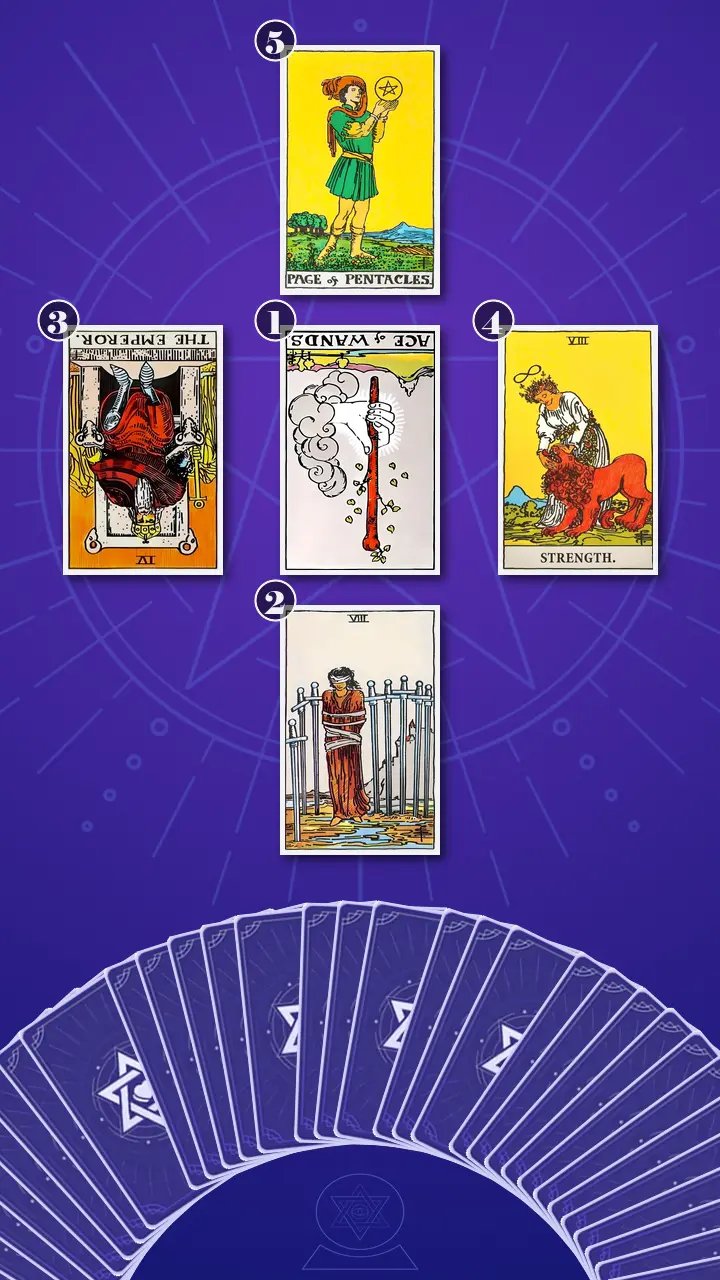
The Spark Waiting for a Notification
Position 1: The Start That Never Becomes Visible
I turned the card representing Maya’s observable start barrier: study motivation was present, but the first concrete action remained suspended until another person participated.
The Ace of Wands, reversed.
I showed her the cloud-borne hand, the living shoots on the wand, and the landscape waiting beyond it. Upright, the Ace carries Fire into a beginning. Reversed, that Fire was not absent; it was blocked at the point of conversion. Maya wanted to study, had a free hour, and had already opened the lecture slides. Yet the cursor blinked above an untouched question while she waited for a classmate’s notification to supply the spark.
In her ordinary Tuesday evening, the sprouting wand had become the message she hoped to receive. She sent two invitations before attempting any work, color-coded the plan while watching for replies, and treated silence as evidence that the session had not officially started. The energy here was a blockage of initiative, not a deficiency of interest or intelligence.
“When the laptop is open and you’re still checking whether someone will join,” I asked, “what is the first physical task you’re postponing?”
“Usually the first practice question,” she said. Then she gave a short, bitter laugh. “That’s so accurate it’s almost rude.”
I smiled, but I did not soften the distinction. “Accurate is not the same as condemning. This card is showing us where your motivation gets held. It is not saying you don’t have any.”
Her thumb stopped rubbing the side of her phone. I saw recognition arrive with a sting: she could want to study and still not have begun. Planning the start and making the first observable move were two different events.
Position 2: The Prediction Wearing a Blindfold
I turned the card representing the concealed belief beneath the delay: that a failed solo start would demonstrate a lack of personal control.
The Eight of Swords, upright.
I asked Maya to look first at the blindfold and the loosely wrapped bindings, then at the gap in the surrounding swords. The figure felt confined, but the image did not show an airtight prison. In this position, the card described contracted Air: thought had become so dominant that one predicted outcome was being treated as the full set of available facts.
Maya told me about sitting in Robarts Library at 8:47 one evening. She had opened a practice sheet, reached a question she could not answer immediately, and switched to Discord. The fluorescent lights buzzed above her; the paper felt rough beneath her wrist; her shoulders climbed toward her ears. Before ten minutes had passed, the thought arrived: “I’ll drift if nobody is here.”
I asked her to finish the deeper sentence.
She looked away from the screen. “If I start alone and it goes badly, then it means I can’t control my own effort. Like I need supervision to be a functioning adult.”
That was the hidden rule. One difficult or unfocused start did not merely mean that a study block had been imperfect. It threatened to become a verdict about who she was. Recruiting someone brought immediate relief because responsibility felt shared, but every evening abandoned in their absence removed another opportunity to gather different evidence.
I described it as a personal algorithm trained on a narrow dataset. Each time Maya predicted that solo study would fail, waited for a partner, and then postponed when nobody replied, the algorithm received the same input. It kept recommending external accountability because it had rarely been shown one bounded independent start. Like a browser warning displayed before a page loads, “I will drift” was blocking the experience it claimed to describe.
Her breath paused. Her eyes moved off the card as though she were replaying several evenings at once. Then she exhaled through her nose and lowered her shoulders by a fraction.
“I’ve repeated the belief more times than I’ve actually tested it,” she said.
“Exactly,” I replied. “The gap in the swords is not a demand to prove you can study alone for three hours. It is the option to test one small movement before treating the prediction as settled evidence.”
Position 3: The Calendar on the Empty Throne
I turned the card representing the defense that maintained the loop: assigning the accountability partner responsibility for timing, structure, and initiation.
The Emperor, reversed.
I pointed to the stone throne, armor, scepter, and orb. Upright, the Emperor organizes boundaries and makes decisions credible. Reversed, that structural energy can become too rigid, unstable, or displaced. Maya had not failed to create a calendar. She had created several. The missing piece was that she did not trust a study block to become official until someone else activated it.
On Sunday afternoons, she sometimes asked a classmate to choose the start time, open the Zoom room, and request an update after twenty-five minutes. If the classmate was busy, Maya moved the whole session to Monday. The friend’s calendar had become a throne; their availability decided whether her own planned time counted as real. Structure was present in excess around the setup but felt deficient inside the first decision.
My mind flashed back to the trading floor. A system that depended on one counterparty was not judged as weak or immoral; it was identified as carrying concentration risk. Maya’s study system had developed the same vulnerability. One changed Slack status, unanswered iMessage, or cancelled Focusmate session could take down the entire opening sequence.
I used The Wizard of Oz as a quick analogy. Companions can matter enormously, but the figure behind the curtain does not own every capacity the traveler came to find. Maya did not have to reject company. She only had to stop assigning another person the exclusive power to make her beginning real.
She pressed her lips together, then nodded once. “I’ve basically made my friends the project managers of my own evening.”
“Yes,” I said, “and that arrangement protected you from uncertainty in the short term. We can respect why it worked while noticing the cost. Accountability can be reinforcement, not permission.”
When Strength Met the Hand Reaching for the Phone
Position 4: The Resource That Does Not Need to Roar
I moved to the card representing the central transformation: a shift from borrowed control to calm, compassionate self-direction during the uncomfortable first minutes. As I reached for it, the kettle in Maya’s kitchen clicked one final time and the room became unusually quiet.
Strength, upright.
I held the card closer to the camera. The woman did not defeat the lion, remove it, or shame it for being powerful. Her hands met its jaws with steady contact. In Maya’s modern study scene, those hands became her own hand pausing above the phone. The urge to ask for reassurance could remain present while she took one breath, named the tightness in her chest, and began one manageable task.
Strength brought the missing balance. It did not offer harsher discipline to compensate for the reversed Emperor, and it did not require Maya to feel ready before acting. It showed patient self-command: the ability to stay beside discomfort without mistaking it for an instruction to postpone.
I then reached for one of my own analytical tools, Academic ROI Auditing. I normally use it to evaluate the strategic yield of a degree, major pivot, or high-investment research direction. Here, I applied the same lens to the timing of Maya’s accountability. Support added clear value after she started: companionship, momentum, and useful check-ins. When required before the start, however, it produced quick emotional relief at the cost of schedule flexibility and repeated practice. The rational move was not to eliminate the asset. It was to deploy it later.
I asked Maya to picture 7:30 again: lecture slides open, two messages sent, the phone warm beside the keyboard, and her chest tightening while the read receipts remained still. She had been treating that bodily tension as a stop order, as though wanting reassurance meant she could not issue her own first instruction.
You do not need another person to overpower your resistance; practise meeting it gently, as Strength meets the lion with steady hands rather than force.
I let the sentence rest in the quiet.
For one beat, Maya stopped breathing. Her fingers stayed suspended above the phone, and her pupils widened before her gaze slipped out of focus. I could almost see the replay: cancelled Zoom calls, untouched PDFs, beautifully rebuilt Notion pages. Her eyes reddened. Then her jaw tightened before her shoulders finally dropped, and a breath left her with a faint tremor.
“But doesn’t that mean I’ve been doing it wrong this whole time?” she asked. The words came out sharper than anything she had said earlier.
I heard the frustration beneath the question, so I did not rush past it. “No. It means you found a strategy that solved a real problem: it helped you cross the threshold. Now you can see that the same strategy has started charging too high a price when it becomes mandatory. We’re updating it, not putting your past self on trial.”
Her clenched hand opened slowly against the desk. Relief crossed her face, followed by the brief blankness that often comes when clarity returns responsibility to the person who asked for it.
“Now, with this new perspective, think back to last week,” I said. “Was there a moment when this insight could have made the experience feel different?”
She remembered reading a cancellation message on the TTC ride home. The brakes had squealed, her blue screen had reflected in the carriage window, and the entire evening had seemed structurally unavailable.
“I could still have done the first question,” she said quietly. “I still would’ve wanted someone there. But I could have started anyway.”
I distilled the crossing for her: The resistance is a feeling to regulate, not proof that you cannot direct yourself. This was not a leap from dependence to perfect independence. It was the first movement from waiting for external permission toward practising calm self-direction while connection remained available.
I also gave the insight a firm safety boundary. Before contacting anyone, she could choose one paragraph or practice question, place the phone out of reach, and set a ten-minute timer. When it ended, she remained free to stop, continue, switch tasks, or invite someone to join. If the experiment felt genuinely unhelpful, she could pause it. The point was choice, not endurance.
One Pentacle, Not the Whole Semester
Position 5: The First Move Made Tangible
I turned the final card, representing the practical expression of change: a repeatable ten-minute independent start, with accountability retained as optional reinforcement.
The Page of Pentacles, upright.
I drew Maya’s attention to the Page holding one pentacle at eye level while standing on workable ground. The Page was not carrying the entire landscape or promising a flawless harvest. The figure was learning through sustained contact with one concrete object.
In Maya’s life, the pentacle became one practice question, one paragraph, or one small flashcard set. She could choose it before opening the laptop, set a ten-minute timer, and record that an independent start occurred before deciding what the rest of the evening should contain. The Page brought balanced Earth after blocked Fire and constricted Air: modest action, repeatable evidence, and a skill developed through use.
“So I don’t have to decide whether I’m doing a three-hour solo study night?” she asked.
“Not before minute one,” I said. “The first ten minutes are practice, not a verdict. You’re measuring whether you can make one self-chosen start, not grading your character or committing the whole evening.”
She picked up a scrap of paper and wrote three words while I watched: Question before contact. A small smile appeared, but she did not pretend the urge for company had vanished.
“I’d still want to text someone,” she said.
“That’s allowed.”
“And I could begin anyway.”
That was the catalyst moving from Strength into the Page of Pentacles: “I still wanted someone there, and I began anyway.” Support after agency, rather than support as the condition for agency.
From the Borrowed Start Button to a Working System
I read the spread back to Maya as one coherent sequence. Scheduled seminars and virtual coworking had repeatedly shown her that externally fixed starts worked, while every partner-assisted beginning delivered immediate relief. Over time, the reversed Ace held her genuine motivation at the threshold. The Eight of Swords turned “this might drift” into “I cannot direct myself.” The reversed Emperor then protected her from that feared verdict by placing authority on someone else’s calendar.
Strength changed the mechanism rather than fighting its symptoms. It allowed the first-minute discomfort to exist without giving it command. The Page of Pentacles then converted that inner regulation into something measurable: one real task begun before contact. She had been waiting at the starting line for a second runner, but the cards did not ask her to run the whole course alone. They asked her to take the first step before deciding who might join.
I also pointed out the spread’s missing suit: no Cups had appeared. Maya had been managing the feeling of beginning through thought, scheduling, playlists, and social structure. Her cognitive blind spot was the assumption that better logistics could eliminate the uncomfortable sensation before action. The spread suggested a more workable direction: acknowledge the sensation, reduce the size of the task, and gather evidence without turning the experiment into surveillance.
For the actionable next steps, I adapted my Research Sunk-Cost Audit. In a stalled academic project, the audit asks whether continuing, pivoting, or requesting help makes sense based on present evidence, rather than on time already invested. For Maya, minute ten would become that decision point. The time spent perfecting the setup would no longer obligate her to rescue the entire evening, and an imperfect ten minutes would not obligate her to quit.
The Permission-Free Ten-Minute Start
- One Task Before ContactOn the next three study days, Maya would sit at the same desk at a self-chosen time, place her phone across the room, and complete one preselected task for ten minutes before opening Focusmate, Discord, or a group chat. The task could be one paragraph, one heading, or the first practice question. Afterward, she could message, “I did ten minutes on the practice set; want to join for the next block?”Tip: Leave a note on the desk reading “One task before contact.” Choose the smallest acceptable version in advance. If ten minutes feels genuinely unworkable, stop, change the task, or ask for support; the experiment protects choice.
- The One-Object Evidence CardMaya would create one paper or Apple Notes card with only three fields: start time, one study object, and what happened after the timer. At minute ten, she would use the Research Sunk-Cost Audit to choose freely among continuing, switching tasks, stopping, or inviting a partner, based on what she needed then rather than how long she had spent preparing.Tip: Record a check mark and the task name, not a score. No streak punishment, hour totals, or productivity ranking. If choosing creates friction, prepare a three-item menu for the week.
I reminded Maya that these were experiments, not commandments from the deck. Tarot had made the loop visible and helped us design a cleaner test. She would produce the evidence, interpret the result, and decide what kind of support served her next.

A Week Later: The Quiet Proof
Six days later, I received a photo from Maya. A practice sheet sat beside a paper square marked “7:34, Question 1, started before replies.” Her message underneath read: “Nobody was online. I hated minute one. By minute four I was actually answering it. I stopped at ten, made tea, and then asked someone to join.”
The evidence was deliberately small. She had not cured procrastination, transformed into a StudyTok ideal, or stopped enjoying coworking. She had simply changed the order of events. Her own action made the session real; another person’s presence became a welcome addition.
That night, she slept straight through. Her first thought the next morning was, “What if I can’t do it again?” She told me she smiled, placed the paper square beside her keyboard, and chose another question.
I saw that as the honest shape of our Journey to Clarity: not certainty, but a calmer relationship with uncertainty. The cards did not press the start button. Maya did. Tarot gave her an external map long enough to recognize the authority, patience, and practical intelligence she could already practise.
I want to leave the light where this reading placed it. If tonight your laptop is open but your hand keeps hovering over the phone, I know you may feel both the wish to begin on your own and the tight, embarrassed fear that without a witness you will lose control of the evening. Merely noticing that conflict means the old permission system is no longer invisible.
If you gave yourself one bounded ten-minute window before asking anyone to join, which single study object would you place in the Page’s hands, and what might you become curious to notice when the lion-sized feeling arrives before it?