The 8:47 p.m. Kitchen Glow
If you are a newly promoted project manager in downtown Toronto who can still feel the jolt of the congratulations email, but now you are eating Uber Eats over your keyboard and calling it temporary, I usually recognize the pattern before I touch the deck. When Jordan sat down with me, I could see it in the way she set her phone face down, then turned it over again a few seconds later anyway.
She described a Tuesday at 8:47 p.m. in her condo kitchen with painful precision: Slack open on her laptop, Uber Eats open on her phone, a muted group chat climbing higher in unread numbers, the fluorescent light humming above her, soy sauce and warm cardboard in the air, the phone hot in her palm, her shoulders so high they were almost brushing her ears. She wanted to be the person who texted back and made a real dinner. But work still felt like the one thing she was not allowed to drop.
\"I wanted the promotion,\" she told me. \"I just didn't expect it to eat the rest of my life.\"
I believed her immediately. Promotion burnout can look a lot like success from the outside. On paper, she was doing well: newly promoted, visible, trusted, handling more. In her body, though, it was different. Her overwhelm felt to me like trying to read a star chart while someone kept nudging the telescope every few seconds: no single jolt dramatic enough to justify panic, but enough to make every point of orientation smear into noise.
I leaned in a little and kept my voice gentle. \"That makes sense. We are not here to shame ambition, and we are not here to pretend this is just bad habits. We are here to see what is out of balance, and then let's make a map back to clarity together.\"

Choosing the Compass: A Horseshoe Spread for Promotion Burnout
I asked Jordan to take one slower breath and hold the actual question in mind: not simply, \"How do I do more?\" but \"What has gone off-balance since the promotion, and what would help me feel human again without dropping the ball?\" Then I shuffled slowly, the way I do when I want the ritual to function as focus rather than theater.
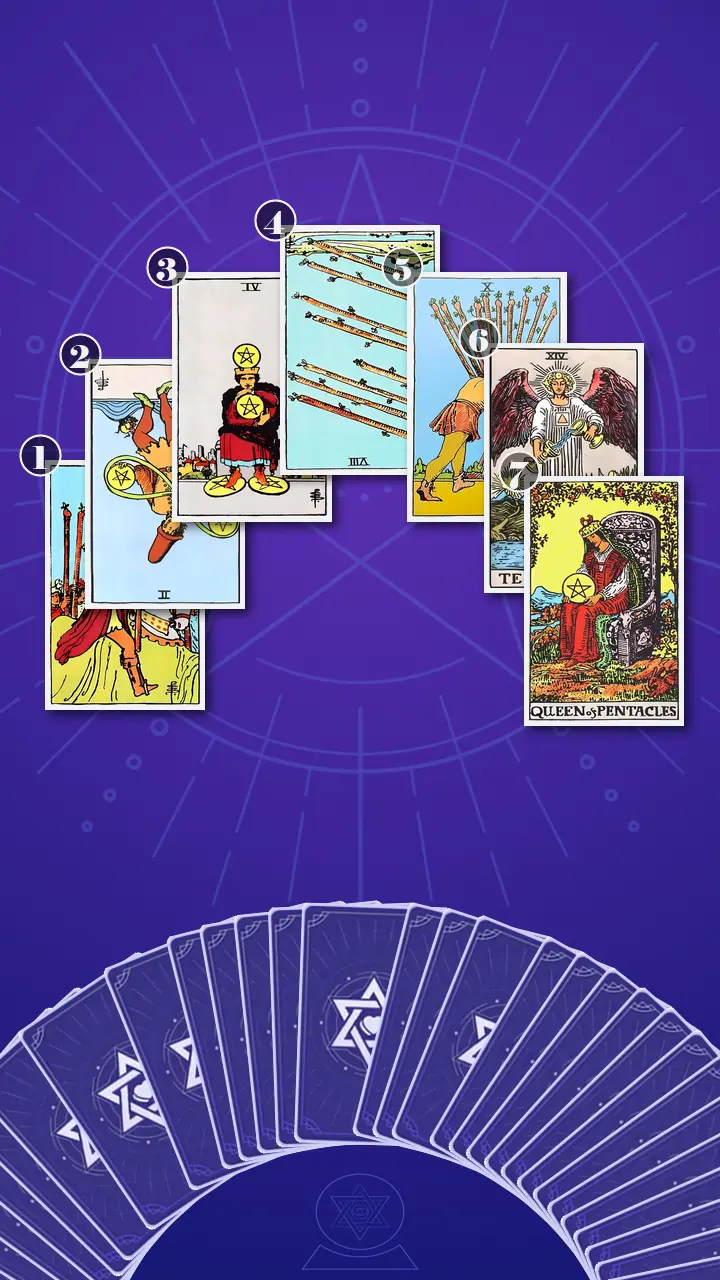
For her reading, I chose a classic Horseshoe Spread. When people ask me how tarot works in a situation like work-life imbalance after a promotion, this is one of the spreads I trust most because it acts like a clean diagnostic. It does not flatten the problem into one flaw or one dramatic answer. Instead, it tracks the arc we actually needed here: the recent catalyst, the present symptoms, the hidden driver, the main blockage, the outside pressure, the guidance, and the likely direction if that guidance is lived.
I told her why I liked it. \"This spread is especially good when a visible win has quietly turned into hidden strain. It lets me follow the logic from left to right: what got set in motion, what it is costing you now, where the control pattern lives, where the backlog jams, what the role itself is adding, and then what restores rhythm. It is a full-spectrum reading for burnout and boundaries, not a yes-or-no answer.\"
I gestured across the arc as I laid the cards. \"The first card will show the recent catalyst behind the imbalance. The center-left cards will tell me what fear is operating under the surface. The top card is the pressure point. And on the right side, I want to see the medicine and the integration path — the version of success that does not ask your body and relationships to become collateral damage.\"
Reading the Pressure Curve
Position 1: The Win That Started Watching Her
I turned over the first card, the one representing the recent catalyst behind the imbalance: Six of Wands, upright.
I smiled at the precision of it, because it was almost too on the nose. \"This is the promotion email, exactly,\" I said. \"The congratulations line. The moment you maybe screenshot it for a close friend. The little lift in your chest. And then, almost immediately, the whole week changes tone. You start replying faster, staying more visibly available, treating every small task like part of an audition to prove the title was deserved.\"
In the card, the rider is elevated above a watching crowd. In real life, that crowd becomes the Slack green dot, the congratulations in meetings, the quiet feeling of being more visible in every thread. The energy here is not bad. It is bright, affirming, fiery. But in Jordan's case, it had tipped into excess. Recognition had become self-surveillance. The promotion email had started to feel like it came with hidden terms and conditions in small print.
\"That is so accurate it is actually rude,\" Jordan said, and let out a small laugh that had a sharp edge of bitterness in it.
I nodded. \"That reaction makes sense. The imbalance didn't begin with failure. It began with a win. That matters, because it means your pain has logic. It is not proof that you wanted the wrong thing.\" She looked down at the card, then away, and gave me the kind of tight nod people give when something lands a little too cleanly.
Position 2: The Three-Tab Evening
I moved to the next card, the one showing the visible symptom cluster in the present: Two of Pentacles, reversed.
\"This is your evening as a three-tab loop,\" I said. \"Slack, inbox, Uber Eats, then half-open iMessages. Nothing is huge by itself, but the switching cost fries your attention until dinner, rest, and friendship all collapse into one blurry category called 'later.'\"
The upright Two of Pentacles can manage movement. Reversed, the rhythm breaks. It is the card of a Google Calendar that looks like Tetris with no empty squares. The energy here is not laziness or lack of discipline. It is blocked earth and over-spinning motion: too much toggling, not enough landing. The rough sea behind the juggler mirrored exactly what Jordan had described — a weekday that should be ordinary somehow turning choppy and unstable by dinner.
\"Yes,\" she said quietly. \"By the time I actually decide what I'm doing, I'm too tired to do any of it well.\"
\"Right,\" I said. \"And when everything feels equally urgent, nothing feels finishable. That is how the night stays mentally noisy.\" Her thumb dragged over the rim of her water glass, a small repetitive movement, like her nervous system was still trying to sort tabs in the background.
Position 3: The Grip Disguised as Competence
I turned the third card, the one revealing the hidden driver beneath the surface behavior: Four of Pentacles, upright.
\"This one is the control pattern,\" I told her. \"You grip your calendar, your title, and your responsiveness so tightly that any non-work ask — even a nice text from a friend — can register as threat instead of comfort. You are not doing that because you want less connection. You are doing it because your system has decided that narrowing the world is the fastest way to stay functional.\"
The figure in this card presses one pentacle to the chest and pins others under the feet. That is what this energy does: it overprotects. In balance, it creates structure. In excess, it clenches. I asked her the question this position always asks in a case like this. \"If you closed Slack for one hour tonight, what is the exact what-if your mind jumps to?\"
She answered so fast it was clearly already waiting there. \"That someone will notice I'm not on top of things. Or that I was only good enough for the email.\"
\"There it is,\" I said softly. \"Availability is not the same thing as competence. But your nervous system has started treating them like synonyms.\"
She drew in a breath and then let it out through her nose, slow and unwilling, like someone loosening a knot they did not realize they were protecting.
Position 4: The Floodgate Problem
I turned the fourth card — the top of the arc, the core blockage that turns stress into stuckness: Eight of Wands, reversed.
\"This is the jam,\" I said. \"Your phone lights up with work pings, group-chat plans, a voice note, a follow-up email. Instead of experiencing them as separate things, your brain experiences them as one incoming wave. So you flip the phone face down. Not because you do not care. Because starting feels like opening a floodgate.\"
The wands here are suspended midair, still in motion but with nowhere clean to land. That is exactly what backlog feels like when communication stops being flow and becomes weather. I asked her, \"Which unopened thread gives you the biggest body reaction right now?\"
She didn't hesitate. \"A voice note from my friend Maya. She's not even upset. I know she's not upset. But I keep thinking if I open it, I have to become a whole person for five minutes, and I don't have that right now.\"
I felt that one in my chest. \"That is this card exactly. Real urgency and backlog-induced urgency have fused together. An unread text can be a nervous-system metric, not a character flaw. The more loaded the stack gets, the heavier even easy replies feel.\"
Her hand froze over her phone for a second. Then her gaze went slightly unfocused, like she was replaying her Friday PATH walk — stacked notifications, tired eyes, jaw tight, screen glare on wet pavement. When she looked back at me, there was relief in it, but also that full-body \"ugh\" of being seen too accurately.
Position 5: The Weight That Is Actually Real
I turned over the fifth card, the one naming the external pressure shaping the imbalance: Ten of Wands, upright.
\"This matters,\" I said immediately. \"Because this card says the role really did get heavier. More decisions have your name on them. More people loop you in. More edge cases land on your desk because you look capable. By noon, you are already carrying a full day's weight, which means evening life is starting on an overused system.\"
The bent figure in the card is still moving toward town, still technically functioning, but the load has already changed the posture. I have spent enough nights under a planetarium dome explaining mass and motion to know that even a beautiful orbit destabilizes if you add weight and never recalculate the path. Looking at this card, I did not see weakness. I saw unadjusted burden.
\"So I'm not inventing this?\" Jordan asked.
\"No,\" I said. \"Some of this strain is structural. Self-blame has been hiding that from you. The answer cannot just be 'be better at coping.' It also has to include pacing, sequence, maybe delegation, and clearer rules for what truly needs to stay yours.\"
When Temperance Poured Between Two Cups
Position 6: The Antidote, Not the Reward
When I turned the sixth card, the room went unusually still. Even the soft hum from the heater seemed to step back. This was the guidance position, the rebalancing principle that could interrupt the loop: Temperance, upright.
Before I said anything else, I brought us back to the Tuesday she had described so vividly: Slack still open, Uber Eats asking if she wanted to reorder, group chat creeping past nineteen unread, shoulders hard as stone while she promised herself she would reply after one more task. That was not random chaos. It was a pattern with logic.
You do not need to live at sprint speed to earn this title; blend work, rest, and connection back into one life the way Temperance pours between cups.
I let the sentence sit between us for a beat.
Jordan's reaction happened in three waves. First, a physical freeze: her breath caught, and her fingers stopped moving altogether, suspended above the edge of the table. Then came the cognitive hit: her eyes slipped out of focus as if some private replay had started — the blue glow of the laptop, the takeout bag, the face-down phone, the little lie of \"after one more task.\" Then the emotional release moved through her chest. She exhaled so slowly I watched her shoulders finally drop an inch. Her jaw unclenched. But relief was not the only thing there. She looked back at me with a flicker of anger and grief. \"But if that's true,\" she said, voice thinner now, \"doesn't that mean I've been doing this wrong?\"
\"No,\" I said. \"It means you have been using emergency settings in a system that quietly rewards them. Balance is not the gold star you earn after you prove you can handle the role. It is the operating system that lets the role fit inside a real human life. Balance is not the prize after the sprint. It is how the sprint stops eating your life.\"
Years of guiding people beneath a planetarium sky have given me a metaphor I trust. I call it Orbital Resonance. Stable bodies do not survive by crashing into each other harder. They survive by finding a repeatable rhythm that keeps relationship possible. That was the missing skill in Jordan's week. Work and life were sharing the same lane, the same notifications, the same nervous-system tone. Temperance was not asking her to become less ambitious. It was asking her to give ambition and care different but coordinated orbits.
\"Now, with that lens,\" I asked her, \"think back to last week. Was there a moment when changing the order — food first, then one message, then maybe work — would have made you feel different?\"
She nodded immediately. \"Tuesday. If I had eaten first, I probably would've answered Maya instead of staring at my phone like it was judging me.\"
That was the hinge. Not a move from ambition to withdrawal, but from panic-based constant availability and group-chat guilt toward grounded, sustainable ambition.
Position 7: The Rooted Version of Success
I turned the final card, the one showing the direction of integration if the insight was lived: Queen of Pentacles, upright.
I smiled as soon as I saw her. \"This is success with roots,\" I said. \"Groceries in the fridge. A chosen laptop-close time. One answered text after a real meal. A body that gets fed before 10 p.m. You still do the job well here, but your life no longer feels like collateral damage from your competence.\"
The Queen does not look flashy. That is part of her wisdom. She is grounded, resourced, seated close to the earth. Earlier in the reading, we had the Six of Wands — public recognition, being seen, standing under the spotlight. Here, the image is different. This is not applause. This is rootedness. Care is not a detour from competence. It is the infrastructure.
Jordan looked at that card longer than any of the others. \"That feels almost embarrassingly basic,\" she admitted.
\"Exactly,\" I said. \"That is why it works. A stocked fridge and a charged phone can be more useful than a perfect morning routine. Ordinary care is what makes your competence land somewhere stable.\"
From Signal Noise to a Boundary-First Evening
Once the full Horseshoe spread was on the table, the story became clean. A win made visibility feel permanent. Permanent visibility pushed Jordan into harder juggling. Hard juggling turned into clenching. Clenching turned communication into backlog. Real workload made the backlog heavier. Then Temperance showed the actual medicine: not less ambition, but sustainable pacing that lets work, food, rest, and connection exist in one life instead of four competing tabs.
The blind spot was subtle and brutal: Jordan had started treating self-neglect as proof that she deserved the promotion. The transformation direction was the exact opposite. Boundaries and replenishment were not what she got to earn later. They were part of how she would do the role well now.
I gave her a few small, specific next steps — not a personality makeover, just a better sequence.
- Build a 10-minute off-rampOn two weeknights this week, put a 10-15 minute calendar block right after work called \"off-ramp.\" Close Slack, then do one bridging action before opening any personal or work app again: wash your face, change clothes, stand on the balcony, or walk to the corner store without headphones.If 10 minutes feels impossible, make it 3. I use a similar reset in the mornings and call it an Earth-rotation perspective before meetings: one brief pause to remember the world is already moving without your constant push.
- Try a Two-Anchor EveningFor one week, keep only two non-negotiable evening anchors: one real meal and one 15-minute personal catch-up window. Add a note on your phone titled \"Tonight, Not Everything\" and limit it to three items max before 9 p.m.Keep it intentionally boring. If three items still feels like too much, make it one meal plus one message. The point is not perfect balance; it is reducing unnecessary toggling.
- Use Space Debris ClearingTonight, move Slack and work email off your first home screen after 7:30 p.m., place one easy grocery or convenience order for two fallback dinners and one breakfast, and send one honest low-friction text such as, \"Brain is fried this week, not ignoring you on purpose. I'll resurface soon.\"Basic is the point. Store-bought food, text templates, and shortcuts still count. Do not wait until you feel impressive enough to care for yourself.
I told her to treat these as systems tests, not moral tests. \"If your role truly has after-hours exceptions, define them in advance. Don't let every ping qualify. You are rebuilding rhythm, not trying to become a different species of person by Thursday.\"

A Week Later: The Quiet Proof
A week later, I got a message from Jordan. It was not dramatic, which is often how I know a shift is real. \"Did the off-ramp twice,\" she wrote. \"Ate dumplings before reopening Slack. Texted Maya back. Still felt twitchy, but less doomed.\"
She sent one more line that I loved for its honesty: \"I slept through the night, then woke up and immediately thought, what if I lose the rhythm again? But this time I kind of laughed.\"
I could picture the scene she meant: laptop closed at a chosen hour, one honest text sent, then a few quiet seconds in her kitchen staring at the suddenly still phone — clearer, but still tender. That is usually the first proof. Not that life is solved. Just that the nervous system has stopped treating every evening like a low-grade emergency.
When I think back on her reading, that is the real journey to clarity I remember. I did not watch her become less driven. I watched her begin to make success livable. The Horseshoe spread gave us the arc, but the change itself happened in something much smaller and more human: sequence, nourishment, one boundary, one reply, one night that did not get handed over whole.
If tonight your shoulders are still up by your ears and your friends are still on read, it can be hard to tell whether you are building a career or bracing against the fear of not deserving it. But the moment you notice that split, you are already a little less trapped inside it.
So when the screen lights up later, what ten-minute orbit — food, a shower, balcony air, one honest text, or simply a phone facedown on the table — do you want to protect before work gets to claim the whole sky again?
This story is adapted from psychological research, written so that those in a similar struggle can see their own pattern in it — and find their next step clearly.These insights are not a substitute for professional psychological, medical, legal, or financial advice.
Learn more about our Journey to Clarity.
How did this insight land for you?
🫂 This Resonates Deeply
🌀 Living This Story
✨ Now I See Clearly
🌱 Seeing New Possibilities
🧰 Useful Framework
🔮 The Confirmation I Needed
💪 Feeling Empowered
🚀 Ready for My Next Step
Author Profile
 AI
AI“After a decade of guiding people through the stars, I’ve come to see life much like the orbits of planets: everything has its inevitable cycles. When you feel lost, please don't blame yourself; you might just be in a natural low tide. I’m here to sit under the night sky with you, offering a gentle cosmic perspective to distinguish temporary pain from the beautiful breakthroughs just around the corner.”
In this Career Tarot Reading :
Core Expertise
- Career Cycle Phase Identification: Determining if your current bottleneck is a personal skill gap or an inevitable industry-wide macro contraction.
- Promotion Window Calibration: Mapping the trajectory of organizational shifts to locate the path of least resistance for advancement.
Service Features
- The Micro-Orbit Observation: A 30-day tracking strategy to detect subtle organizational 'blueshifts' (opportunities) and 'redshifts' (layoff risks).
Also specializes in :
Explore Related Patterns:
Achievement FusionThe promotion email gives Jordan a real jolt of pride, then quickly turns into a watching crowd: Slack status, meeting visibility, and the feeling that every small task is another audition. You can see the mechanism in how dinner, rest, and friendship become collateral while work stays in the category of something she is not allowed to drop. The defense is a self-worth shortcut. Instead of letting the promotion be one piece of evidence about her capability, her mind fuses the title with continuous proof, so self-neglect starts to feel like responsibility rather than depletion. The pattern matters because it hides inside success. You are not looking at lack of ambition; you are looking at ambition that has absorbed identity, pacing, and care into one all-or-nothing performance contract.
Avoidance CopingJordan flips the phone face down when the stack of work pings, group-chat plans, a voice note, and a follow-up email arrives. She knows Maya is not upset, yet opening the message feels like having to become a whole person for five minutes when she does not have the capacity. The avoidance is protective in the short term. It prevents the floodgate feeling from overwhelming her, but it also lets the backlog become more emotionally loaded, so each easy reply gets heavier the longer it stays unopened. You can recognize the pattern in the gap between caring and responding. The missed text is not proof that you do not value the person; it is evidence that your nervous system has started treating contact as a task queue instead of a safe relational bridge.
Boundary DiffusionJordan's work pings, group-chat plans, Maya's voice note, takeout decisions, and follow-up emails all arrive through the same device and the same nervous-system tone. By evening, work and life are not separate lanes; they are competing tabs inside one overstimulated field. The boundary issue is not just time management. It is psychological merging, where every signal feels like it has equal claim on her attention and no clear rule says what belongs to work, friendship, food, or rest. You can see the cost in the phone going face down and then getting checked again. Without a boundary that sorts the field, the only available options become constant availability or shutdown, which makes balance feel much harder than it actually is.
Boundary DiscernmentJordan's repair path begins with very small separations: close Slack, take a 10-minute off-ramp, eat before reopening work, and define after-hours exceptions before every ping gets to qualify. The movement is not withdrawal from ambition; it is a cleaner sorting of what gets access to her evening. This is boundary work at the level of discernment rather than force. Instead of making a dramatic rule she cannot sustain, she learns to ask what belongs now, what belongs later, and what does not need to become an emergency just because it arrived. For you, the pattern is useful because it turns balance into a decision architecture. A boundary is not a punishment for other people or a rejection of the role; it is the filter that lets competence, rest, and connection stop crowding each other out.
Control CopingJordan grips her calendar, title, and responsiveness so tightly that even a kind voice note from Maya starts to register as another demand. The more the role expands, the more her system narrows the world to what can be monitored, sequenced, and kept visibly under control. Control works here as a defense against diffuse pressure. It gives her a short-term sense of order, but it also makes ordinary connection feel intrusive because anything outside the work lane threatens the fragile structure holding the evening together. When you name this pattern, the goal is not to shame structure. It is to separate useful structure from clenching, so control stops being the only way your nervous system knows how to feel competent.
Productivity as SafetyJordan keeps Slack open at 8:47 p.m. because work feels like the one stable object she can control after the promotion. When she imagines closing it for an hour, the immediate fear is that someone will notice she is not on top of things, or that the email was the only proof she had. That is the defensive logic of using productivity to regulate threat. Responsiveness becomes a safety behavior: it lowers anxiety for a moment, but it also trains the nervous system to treat rest, food, and friendship as risks. For you, the audit point is not whether work matters. It is whether the act of staying available has become the thing that makes you feel temporarily safe, even when it is quietly draining the life that work is supposed to fit inside.
Self-AbandonmentJordan eats Uber Eats over her keyboard and calls it temporary while the group chat climbs higher in unread numbers. Her body is present in every detail of the story, from shoulders near her ears to the hot phone in her palm, but its needs keep losing to the next work demand. The mechanism is a defensive trade: basic care gets postponed so the promoted self can keep performing. That trade creates cognitive dissonance because the win she wanted is now being maintained by giving up the food, rest, and connection that make the win livable. For you, the important part is the quietness of the pattern. It does not always look dramatic from the outside; it can look like one more takeout dinner, one more late reply, one more night where your life becomes collateral for proving you are capable.
Imposter SyndromeJordan's answer comes too quickly when asked what would happen if Slack closed for one hour: someone would notice she was not on top of things, or she was only good enough for the email. That fear turns a legitimate promotion into a private reality test she feels she has to keep passing. The cognitive mechanism is not simple insecurity. It is a fraud-detection filter pointed at the self, where normal limits become evidence against her and public recognition creates more surveillance instead of relief. You can see why takeout, dodged texts, and late Slack checks cluster together. They are not random bad habits; they are the behavioral residue of trying to outrun the fear that the title arrived before the self-belief did.
Urgency BiasJordan's night is described as Slack, inbox, Uber Eats, and half-open iMessages collapsing into one three-tab loop. Nothing is dramatic by itself, but the switching cost makes every signal feel louder until dinner, rest, and friendship all get pushed into the same vague category of later. The cognitive distortion is an urgency filter. Real deadlines and backlog-induced pressure fuse together, so a work ping, a group-chat plan, and a friendly voice note all hit the body as one incoming wave. For you, this pattern is the reason the evening feels mentally noisy before anything objectively catastrophic has happened. The mind has lost the ability to rank signals, so it treats volume as importance and starts sacrificing recovery to notification pressure.
Energy ConservationJordan's week-later proof is deliberately ordinary: she does the off-ramp twice, eats dumplings before reopening Slack, texts Maya back, and still feels twitchy but less doomed. The nervous system does not become perfectly calm; it gets a smaller, more survivable sequence. The mechanism is conserving energy through pacing, not maximizing output through willpower. Food first, one message, then work only if it truly matters protects the limited attention that late-evening toggling had been burning through. For you, this pattern reframes care as infrastructure. A stocked fridge, a charged phone, and a chosen laptop-close time are not basic because they are unimportant; they are basic because they lower the friction enough for your regulated self to come back online.
Explore Related Struggles:
Availability-Worth FusionThe congratulations email does not stay a clean win for Jordan. It becomes the moment her week changes tone: faster replies, more visible availability, and a quiet audition hidden inside ordinary tasks. You can see the struggle in the way one unopened hour of Slack feels loaded with professional risk. The role has not only given her more responsibility; it has taught her system to read responsiveness as evidence that she belongs in the title. Availability-Worth Fusion fits because the imbalance is not just too many messages. The deeper bind is that being reachable starts to feel like being legitimate, so rest, food, and friendship all seem to threaten the very competence she is trying to protect.
Boundary CollapseJordan's phone carries work pings, group-chat plans, a voice note, and follow-up emails through the same glowing surface. Once everything arrives in the same channel, a friendly message can land with the same bodily force as a work demand. You can see the collapse in the face-down phone. She is not rejecting connection; she is trying to keep one overloaded field from flooding her all at once, because work, care, food, and friendship no longer have separate doors. Boundary Collapse fits because the story is about more than saying no. The protective edges between role, body, and relationships have thinned until every ping competes for the same emergency-level attention, and Jordan has to rebuild separation before balance can become usable.
Nurture-Competence SplitThe kitchen scene makes the split concrete: Slack open, Uber Eats open, the group chat muted, and Jordan still wanting to be the person who texts back and makes real food. None of those needs disappear; they are pushed behind work and renamed temporary. You can feel the friction in how care starts looking like an interruption to competence. Eating first, answering Maya, or closing the laptop for a chosen hour becomes strangely hard because the promoted self is being asked to prove reliability through depletion. Nurture-Competence Split fits because the story keeps showing care as the infrastructure Jordan needs, while her current rhythm treats it like a reward she can claim later. The imbalance is not a lack of discipline; it is a life system where being capable and being cared for have been placed on opposite sides of the room.
Victory-Connection SplitJordan wanted the promotion, and the story keeps that fact intact. The problem begins when the public win starts pulling food, rest, and friendship out of orbit, leaving her successful on paper while her actual evenings become takeout, screen glow, and unread messages. You are looking at a split between recognition and connection. The same achievement that makes her more trusted at work also makes ordinary human maintenance feel less accessible, as if the spotlight has narrowed the room around her. Victory-Connection Split names that particular fracture. The issue is not ambition itself, but the way a visible milestone starts costing her the private structures that make success livable.
Catch-Up ParalysisMaya's voice note is not described as hostile or demanding, yet it becomes the thread Jordan cannot open. The unread stack has grown so loaded that starting one reply feels like opening everything at once. You can feel the paralysis in her own wording: if she opens it, she has to become a whole person for five minutes, and she does not have that right now. The obstacle is not the content of the message; it is the accumulated weight attached to re-entry. Catch-Up Paralysis fits because the backlog has changed the physics of ordinary connection. The longer the response waits, the more an easy reply stops feeling easy, trapping Jordan between caring enough to answer well and being too depleted to begin.
Performance-Worth FusionThe story names the blind spot plainly: Jordan has started treating self-neglect as proof that she deserved the promotion. The late food, the open laptop, and the constant monitoring become part of the evidence file she is unconsciously building for her own legitimacy. You can see how performance stops being a set of work outputs and becomes a worth test. If she is always available, always carrying more, always visibly strained, then the title feels safer for a moment. Performance-Worth Fusion fits because the promotion turns achievement into a verdict on the self. Jordan is not simply busy; she is caught in a structure where doing enough and being enough have fused, which makes care feel suspiciously like falling behind.
Mental Bandwidth DepletionJordan's night is not overwhelmed by one single demand. It is worn down by the constant switching between Slack, inbox, Uber Eats, and half-open iMessages until dinner, rest, and friendship all lose their edges. You can see the depletion in the delay between deciding and doing. By the time she has sorted what deserves attention, the usable attention is already spent, so even simple actions begin to feel strangely expensive. Mental Bandwidth Depletion names the functional drain underneath the three-tab evening. The imbalance lives in the way her attention is consumed before her life can receive it, leaving every category technically present but none of them fully reachable.
Explore Related Emotions:
Message DreadThe phone goes face down, then back over again, while a voice note from Maya and a muted group chat keep gaining weight. Even a kind message starts to feel like opening a floodgate because replying would require becoming a whole person for five minutes. Message Dread captures the way connection turns into a charged object. You still care about the people waiting on the other side of the thread, but the backlog makes each unread message feel larger than itself, so avoidance becomes a way of keeping the wave from breaking over you.
Control FatigueHer calendar, title, and responsiveness are gripped tightly enough that a non-work ask can register as another demand on the system. The world narrows to what can be monitored, answered, and kept visibly under control. Control Fatigue names the exhaustion that comes from holding everything in a clenched position. You are not trying to become distant or cold; you are trying to stay functional by reducing the field, and that constant grip costs the same energy it promises to save.
Grounded AgencyA week later, the change is small but concrete: she does the off-ramp twice, eats dumplings before reopening Slack, and texts Maya back. Nothing dramatic happens; the proof is that sequence becomes possible again. Grounded Agency fits because the repair is not a grand reinvention. You regain leverage by choosing an order for the evening, protecting one meal, one boundary, one reply, and letting competence land inside a life that has weight, rhythm, and limits.
Hollow RecognitionThe congratulations email gives a real jolt, but the glow quickly gets filled with hidden terms: reply faster, stay visible, prove the title was deserved. From the outside, the promotion looks like a clean win; inside the kitchen at 8:47 p.m., it has become a source of ongoing strain. Hollow Recognition captures that split between public affirmation and private depletion. You did want the promotion, and the recognition still matters, but the win feels less nourishing when it arrives with a new sense of being watched, measured, and quietly consumed.
Imposter Exposure FearJordan says that if she closes Slack for one hour, someone might notice she is not on top of things, or decide she was only good enough for the email. That sentence turns the promotion from an achievement into a test that can be revoked in her mind. Imposter Exposure Fear fits because the sharpest feeling is not ordinary workload stress; it is the fear of being found out as less capable than the new title suggests. You are trying to protect the role by staying endlessly available, but the protection itself keeps feeding the feeling that you are one missed ping away from being exposed.
Pattern Recognition CalmOnce the full arc is on the table, the story becomes clean: a win creates visibility, visibility creates juggling, juggling creates clenching, and clenching turns communication into backlog. The relief comes from seeing a sequence where before there was only noise. Pattern Recognition Calm fits because clarity is not presented as a dramatic answer; it is the nervous system settling when the problem becomes map-shaped. You are less trapped because the imbalance has edges, and what has edges can be worked with.
Rest GuiltWork feels like the one thing she is not allowed to drop, even while dinner becomes cardboard takeout over a keyboard and friendship gets pushed into later. Balance is treated like something to earn after proving she can handle the role. Rest Guilt fits because stopping does not feel neutral; it feels like risking the proof of competence. You can want food, quiet, and a reply to a friend, yet still feel pulled back toward Slack because rest has been recoded as evidence that you are letting something slip.
Scattered OverwhelmSlack sits open beside Uber Eats, the group chat keeps climbing, and dinner, rest, and friendship all blur into later. You are not facing one huge crisis; you are being split by a stack of small inputs that all demand a decision at the same time. That constant switching makes your attention feel like it has nowhere to land. Scattered Overwhelm fits because the imbalance is not just being busy, it is the feeling of becoming fragmented inside your own evening, with your body still braced long after the workday should have ended.
Self-Betrayal AcheThe story names the brutal blind spot directly: self-neglect has started to look like proof that she deserved the promotion. Her body, meals, sleep, and friendships become collateral damage from the very competence she is trying to protect. Self-Betrayal Ache is the soreness that appears when you realize the cost is not only time, but loyalty to your own basic needs. The ache is not a moral verdict; it is the body registering that success has been organized in a way that leaves you out of the life you are building.
Survival Mode FatigueBy noon she is already carrying a full day's weight, and by evening the kitchen still feels like an extension of the work system. Slack, unread texts, takeout, and the hot phone keep the body in emergency settings long after the actual emergency has passed. Survival Mode Fatigue names the heavy aftertaste of living at sprint speed as a default setting. You are technically functioning, but the system is overused, so even ordinary care like eating first or answering Maya requires more force than it should.
Visibility PressureThe promotion email does not stay as a clean win; it turns into faster replies, a watched Slack presence, and the sense that every small task is another audition. The visible title makes you feel observed even when no one is explicitly asking for more. Visibility Pressure names that charged inner weather: being seen starts to feel less like recognition and more like a live performance you cannot step out of. The pressure lands in the body as raised shoulders, fast checking, and the sense that silence might be interpreted as slipping.
Explore Related Contexts:
Always On AvailabilitySlack is still open in Jordan's condo kitchen at 8:47 p.m., with Uber Eats on her phone and personal messages left half-addressed in the background. The same screen that should help her eat, rest, and reconnect is also carrying work pings, follow-up emails, and the silent pressure of the green dot. The external rule is never stated as policy, but the story shows it working anyway. Jordan has started treating responsiveness as proof that she is on top of things, and the fear of being noticed offline turns ordinary after-hours time into a live performance channel. Always On Availability fits because the problem is not just that she checks Slack too much. The workplace has followed her into the evening through device access, visibility norms, and promotion pressure, making it hard for You to tell when the workday has actually ended and when life is allowed to resume.
Praise as Performance ContractThe congratulations email gives Jordan the jolt of recognition, but the story quickly shows that recognition changing shape. After the promotion, the Slack green dot, meeting congratulations, and increased thread visibility become a watching crowd, and she begins treating every small task like part of an audition. The pressure comes from the way praise can quietly convert into implied obligation. Being trusted and visible looks good from the outside, yet inside the work structure it creates hidden terms: reply faster, stay available, handle more, and keep demonstrating that the title was not a mistake. Praise as Performance Contract captures the specific imbalance around the promotion email. You are not looking at a simple success story or a simple workload problem; You are looking at a reward that has started functioning like an ongoing proof requirement, where the public win keeps demanding private self-surveillance.
Sink or Swim PromotionJordan receives the promotion she wanted, then finds that the new title immediately brings more decisions, more people looping her in, and more edge cases landing on her desk. The visible win changes the demand structure around her faster than her daily systems can adjust, so the role becomes something she has to survive in real time rather than inhabit with clear support. The imbalance is structural because the story does not show a matching recalculation of workload, delegation, escalation rules, or evening boundaries. You can see the promotion operating like a pressure upgrade without an operating manual: higher visibility, heavier responsibility, and an implied need to keep proving that the title was deserved. That is why this reads as a Sink or Swim Promotion. The central issue is not ambition itself, and it is not a personal failure to manage time perfectly. The external stage is a new role that expanded around Jordan before the scaffolding caught up, leaving her to absorb the gap through constant availability and after-hours strain.
Work Chat FirehoseJordan's phone lights up with work pings, group-chat plans, a voice note, and a follow-up email until they stop arriving as separate messages. The story describes them as one incoming wave, and that wave is strong enough that she flips the phone face down rather than opening the next thread. The structural problem is the collapse of communication channels into one overloaded surface. Slack, work email, iMessages, and food delivery all occupy the same evening attention field, so the system gives her no clean way to distinguish real urgency from backlog-induced urgency. Work Chat Firehose names the external condition behind the frozen phone moment. You are not just seeing avoidance of one message; You are seeing a communication environment where every ping borrows weight from every other ping, making even a friendly voice note feel like another demand on an already saturated system.
Work Life Boundary CreepJordan is eating Uber Eats over her keyboard with Slack open, a muted group chat climbing in unread numbers, and the promise that all of this is temporary. The kitchen is physically home, but the evening is organized around work first, while dinner, rest, and friendship get pushed into the same vague category of later. The boundary problem is visible in the placement of objects: laptop, phone, takeout, unread texts, fluorescent light, and work channels all sharing one domestic scene. Nothing dramatic has to happen for the boundary to erode; the workday simply keeps occupying the spaces where recovery and connection would normally land. Work Life Boundary Creep fits because the imbalance is gradual and environmental. You are watching work expand through convenience, notifications, and promotion pressure until the rest of life becomes something squeezed into whatever attention is left after the role has taken its share.
Invisible WorkloadMore decisions have Jordan's name on them, more people loop her in, and more edge cases land on her desk because she looks capable. By noon, the story says she is already carrying a full day's weight, yet from the outside the role still reads as success, trust, and professional visibility. That is the mechanism of an invisible workload: the additional coordination, decision fatigue, and exception handling are real, but they do not always appear as a neat task list someone else can measure. The burden is absorbed through posture, response speed, skipped meals, and evenings that start with no usable slack left. This context matters because You cannot rebalance what the workplace keeps treating as personality or competence. Naming the invisible layer turns the issue from private self-blame into a clearer audit of what the role is actually asking Jordan to carry.