Finding Clarity in the 11:45 p.m. Offer Letter Loop
You keep a “FINAL_final_v3” resignation draft in Gmail, but every time you’re about to send it, you open another tab for salary comparisons and Glassdoor reviews like you’re trying to out-research uncertainty.
Jordan showed up to our Zoom session exactly like that sentence sounds: laptop balanced on their coffee table in a shoebox NYC apartment, offer letter PDF pinned on the left side of the screen, a pros/cons Google Sheet on the right, and—because of course—Gmail open in another tab with the resignation email draft sitting there like an unsent confession.
The radiator hissed in the background. The kind of hiss that makes silence feel sharper. Their face had that laptop-glow pallor you only get at 11:45 p.m., when your eyes are dry and your thoughts are louder than the city outside the window. A Slack notification preview flashed in the corner and their shoulders jumped before they even read it. Their jaw tightened so hard I could almost feel their molars ache through the screen.
“I can’t tell if this is my next level,” they said, thumb hovering over the trackpad like it was the trigger to a very expensive trap, “or just my panic button.”
I watched them alt-tab—offer letter, pros/cons, Glassdoor, resignation draft—like they were keeping two moving escalators under each foot, refusing to put their full weight down on either one. The core contradiction was right there in the rhythm of their clicking: wanting to accept the offer as a growth move, and fearing they were only leaving to get away from discomfort—and would repeat the same pattern in a new place.
Ambivalence isn’t a vague feeling in moments like this. It’s a physical event. It’s a tight jaw and that chest-buzzing restlessness that spikes when you imagine hitting “send,” like your nervous system is bracing for impact before your mind has even made a decision.
“Okay,” I said, keeping my voice grounded and human—more guide than guru. “We’re not going to force a yes or no tonight. Let’s try something else: we’re going to map what’s actually driving the loop. Not to predict your life, but to get you to clarity—motive clarity, and the next few practical steps.”

Choosing the Compass: A Celtic Cross for a Career Crossroads
I asked Jordan to do one small thing that wasn’t mystical at all: close the extra tabs for thirty seconds, put both feet on the floor, and take three slower breaths—just slow enough to tell the body it wasn’t being chased.
While they did that, I shuffled my well-worn Rider–Waite–Smith deck. Not as a performance, but as a transition—like wiping down a lab bench before you start a careful analysis.
“For this,” I told them, “I’m using the Celtic Cross.”
To you, the reader: the Celtic Cross is perfect when someone is stuck at a career crossroads with decision fatigue, because it doesn’t treat the question like a simple fork in the road. It separates what’s happening right now (the repeating behavior), what pressure is distorting the decision (the ‘why does this feel urgent?’), what deeper strain is fueling it, and then it translates all that into environment, hopes/fears, and an integration direction. It’s a map for disentangling growth vs escape without pretending there’s a single “correct” choice floating out in the universe.
“We’ll start at the center,” I said, “with what’s happening on repeat. Then we’ll look at the crossing pressure—what’s tightening the trap. And we’ll end at the top with the integration card: the most empowering pattern-shift available if you choose with intention and boundaries.”
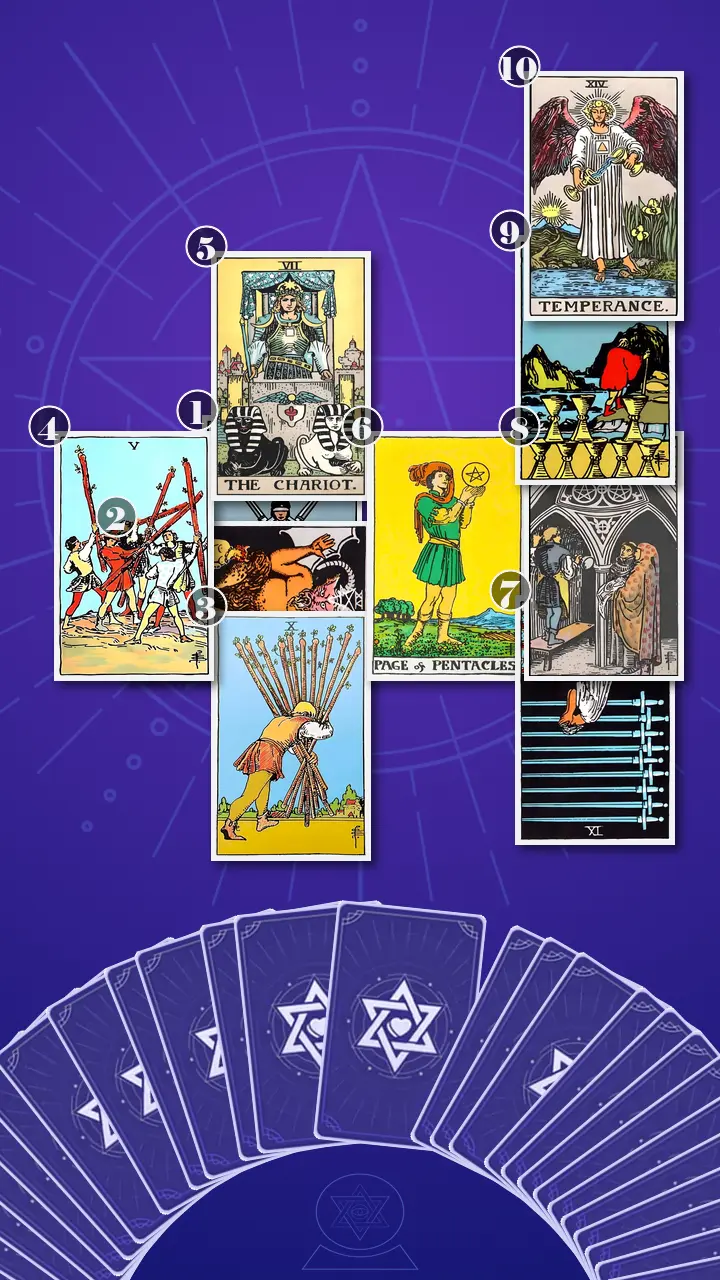
Reading the Map: Card Meanings in Context
Position 1 — The present moment of the offer-letter dilemma
“Now turning over,” I said, “is the card that represents the present moment of the offer-letter dilemma: what’s happening behaviorally and mentally right now.”
Two of Swords, upright.
In real life, this is the card of keeping two browser tabs open forever because closing either one feels like admitting you’re wrong. It’s you with the offer letter open in one tab and your current job’s calendar in another, refusing to emotionally lean either way so you can’t be blamed for choosing wrong.
Energetically, it’s not “balance.” It’s blockage. The mind is working overtime to hold a line—crossed swords, blindfold on—because if you let in your feelings and your fatigue, you might have to admit something uncomfortable.
Jordan let out a short laugh—half a joke, half a wince. “That’s… kind of brutal,” they said. “Like, yes. That is literally my screen.”
I nodded. “You’re not indecisive—you’re trying to make certainty out of a feeling.”
Position 2 — The main obstacle or pressure distorting the decision
“Now turning over,” I continued, “is the card that represents the main obstacle or pressure distorting the decision—what’s tightening the trap.”
The Devil, upright.
This is the part people misunderstand. The Devil isn’t a villain. It’s a contract you didn’t realize you signed. A free trial that quietly turns into an auto-renew subscription you forgot to cancel.
For Jordan, it looked like this: a Slack preview lighting up their screen, shoulders tightening before they even read it, and an immediate thought that masquerades as strategy—I just need more data—when the body truth is louder: I need this pressure to stop.
The Devil’s energy is attachment—a fear-based grip. Not just “I want out,” but “I need relief so badly that I’ll let relief drive the steering wheel.” That’s when a new offer becomes a panic button instead of an aligned next step.
Jordan swallowed. That quiet, immediate “oh.” Like a door in their mind had opened to a room they’d been avoiding.
“If the new job is just a different cage with nicer branding,” I asked gently, “what are the chains made of for you—status, approval, money, proving you can handle it?”
They stared down at their own hands. “Proving,” they said. “And… not wanting to feel trapped for another quarter.”
Position 3 — The deeper root feeding the urgency to leave
“Now turning over,” I said, “is the card that represents the deeper root: what ongoing strain or unmet condition is feeding the urgency.”
Ten of Wands, upright.
This card has a posture. That bent-forward, can’t-see-the-road posture. In modern life it’s carrying a team’s invisible labor like an overstuffed tote bag cutting into your shoulder—except it’s not a tote bag, it’s your nervous system.
The micro-plot is familiar: you fix the messy handoff, you answer after dinner, you’re the human patch for a broken system. The inner operating system says, If I don’t catch it, it’ll fall apart, and that’ll be on me.
The Ten of Wands energy is excess—too much responsibility held too tightly, for too long. It makes the offer letter feel like oxygen. Not because it’s perfect, but because you’re overloaded.
Jordan nodded with a tired exhale that sounded like being seen in the exact flavor of burnout they’d been minimizing. “I’m… the reliable one,” they admitted. “And I hate that I’m proud of it.”
“Reliability and resentment,” I said quietly, “are often neighbors.”
Position 4 — The recent past context that set this choice in motion
“Now turning over,” I said, “is the card that represents the recent past: what dynamics pushed this from ‘someday’ into ‘now’.”
Five of Wands, upright.
This is workplace noise as a lifestyle: cross-functional friction, shifting requirements, ‘quick pivots’ that aren’t actually quick—they’re just constant. It’s energy without alignment, effort without shared direction.
The Five of Wands energy is chaotic excess. In that environment, your nervous system starts treating “change” as the only solution. You can’t tell what you want—only what you want to stop.
Jordan’s mouth tightened again, but this time it wasn’t just tension. It was recognition. “It’s like there’s always a fight happening,” they said. “Even when no one’s yelling.”
Position 5 — The conscious aim: what you’re trying to prove
“Now turning over,” I said, “is the card that represents the conscious aim: what you’re trying to make true about yourself through this decision.”
The Chariot, upright.
This is where ambition gets interesting. The Chariot isn’t impulsive. It’s willpower. Direction. But it can also be a performance if you’re not careful—treating the decision like a public identity statement: I’m the kind of person who levels up.
I watched Jordan’s eyes flick to the LinkedIn tab they’d closed earlier, like it still existed in the air. “Yeah,” they said softly. “I want it to look… coherent.”
“Here’s the pivot,” I offered. “Old question: ‘What’s the objectively correct job?’ New question: ‘What direction am I building—and what rules keep me from burning out again?’”
The Chariot’s energy is balance through inner alignment, not speed. Two sphinxes, competing forces—ambition and relief—both in the passenger seat. The skill is steering without letting either grab the wheel.
Position 6 — The near-future practical reality of the offer
“Now turning over,” I said, “is the card that represents the near-future practical reality: what’s immediately actionable or clarifying about the offer itself.”
Page of Pentacles, upright.
This is the offer letter as an object you can inspect—terms, scope, learning curve. It’s the moment you stop reading Glassdoor like it’s a horoscope for certainty and start treating the role like a grounded experiment.
The Page’s energy is steady, constructive. It doesn’t ask you to “know for sure.” It asks you to prepare like a beginner-builder: clear expectations, clear feedback, a plan for the first 90 days.
Jordan’s expression changed—small, but visible. A little relief. Like the decision became less existential and more workable.
“Make the move like it’s a plan, not a panic button,” I said. “Highlight the start date. Open the benefits PDF. Write three questions you’d actually ask the recruiter. That’s Page of Pentacles clarity.”
Position 7 — Your inner stance: self-talk and nervous system
“Now turning over,” I said, “is the card that represents your inner stance: how your self-talk and nervous system are shaping the process.”
Nine of Swords, reversed.
This is the 2 a.m. brain turning your offer into a courtroom trial about your competence, with ‘evidence’ drawn from a sleepless night and a refreshed inbox.
Reversed, the energy isn’t “no anxiety.” It’s a loosening—a chance to interrupt the loop and separate fear-stories from factual constraints. A spreadsheet can’t tell you what your nervous system is begging for.
Jordan rubbed their forehead. “It’s always at night,” they said. “In daylight I’m… almost fine.”
“That’s not weakness,” I replied. “That’s biology. Isolation amplifies the story.”
Position 8 — External factors: the system around you
“Now turning over,” I said, “is the card that represents external factors: what the environment is asking you to notice.”
Three of Pentacles, upright.
This card is the antidote to the Ten of Wands fantasy that you can carry everything alone. It’s mentorship. Shared standards. Visible plans. It asks a very modern question: do you have a system that makes growth sustainable?
The energy here is supportive structure. It says: whether you stay or go, your growth will depend on whether expectations are explicit and feedback is real—not just whether you can grind harder.
I felt my own mind flash to a trench I supervised years ago, trowels moving carefully through layered soil. No one excavates a site alone—not if they want the story to be accurate. “In archaeology,” I told Jordan, “your best work happens when someone checks your readings, challenges your assumptions, and keeps you from mistaking noise for signal. Careers aren’t so different.”
Jordan blinked, like that metaphor landed somewhere deeper than LinkedIn ever could.
Position 9 — Hopes and fears: what leaving symbolizes
“Now turning over,” I said, “is the card that represents your hopes and fears: what leaving symbolizes emotionally, and what you’re longing for underneath.”
Eight of Cups, upright.
This is the quiet, moonlit truth: “I can do this job, but I don’t want my life to feel like this.” It’s not a public victory lap. It’s a private goodbye to an identity—the version of you who could handle anything if you just tried harder.
The Eight of Cups energy is honest longing. Not for a title. For a missing piece: mentorship, craft time, autonomy, meaning. It also carries fear—what you’ll lose by leaving, and what it might “say” about you.
Jordan’s voice got smaller. “If I leave and it’s not better,” they said, “I’ll feel so stupid.”
“That sentence,” I replied, “is the Devil’s chain trying to pass as wisdom.”
When Temperance Spoke: Not Escape—Integration
Position 10 — Integration direction: the empowering pattern-shift
When I reached for the final card, the room seemed to go unusually quiet—even through a laptop speaker. The radiator hiss faded into the background. Jordan’s hands stopped moving on the trackpad. This was the hinge of the reading.
“Now turning over,” I said, “is the card that represents the integration direction: the most empowering pattern-shift available if you choose with intention and boundaries.”
Temperance, upright.
Temperance is an angel pouring between two cups—one foot on land, one foot in water. It is moderation as intelligence. Integration as strategy. It refuses the false binary that you must choose between ambition and wellbeing as if it’s a personality test.
Setup: Jordan was stuck in the 11:45 p.m. loop—offer PDF, pros/cons sheet, resignation email in drafts—re-reading for the tenth time as if anxiety could be edited into certainty, while their body already knew they were running on fumes.
Delivery:
Not a dramatic escape, but a deliberate blend—choose the path that lets you pour your energy with intention, like Temperance mixing the cups instead of snapping the chain in a panic.
I let that sentence sit between us for a beat.
Reinforcement: Jordan’s reaction came in layers. First, a physiological freeze: their breath hitched, and their fingers hovered above the keyboard without touching it. Then, the cognitive seep: their gaze unfocused, as if replaying the last few months—late pings, quiet fixes, the endless carrying. Finally, the emotional release: a long exhale, shoulders dropping an inch, jaw unclenching like a fist opening.
“But…” they began, and there it was—an unexpected flash of resistance. Their brows knit, not in anger at me, but at the implication. “If that’s true… does it mean I was wrong? Like I’ve been doing it wrong the whole time?”
I didn’t rush to soothe them. “No,” I said, steady. “It means you were surviving inside a system that rewarded the Ten of Wands version of you. Temperance isn’t a moral judgment. It’s an upgrade.”
This is where my own work—my way of thinking—always shows up. I call it Skill Archaeology: we don’t invent a new you; we excavate what’s already there but buried under pressure. So I asked, “What’s one overlooked skill you already have—something you’ve been using to keep everyone else afloat—that could become your boundary skill instead?”
Jordan went still again, then said, almost surprised by their own answer: “I’m good at defining scope. I literally do that. But… I don’t do it for my own time.”
“Exactly,” I said. “Temperance is not telling you to pick a job. It’s telling you to stop using a job to do boundary work for you.”
I leaned in. “Now, with this new lens, look back at last week. Was there a moment—maybe a late Slack ping, maybe a last-minute pivot—where this insight could’ve changed how you felt? Not perfectly. Just differently.”
Jordan nodded slowly. “Tuesday. Takeout got cold because I answered instantly. I didn’t have to.”
And that—right there—was the step from restless indecision toward values-based clarity. Not certainty. But something steadier: the beginning of self-trust built through follow-through.
From Insight to Action: The Temperance Check and a Boundary-First Transition Plan
Here’s the story the whole spread told, in plain language: you’ve been living in Five-of-Wands noise long enough that you normalized Ten-of-Wands carrying. The Two of Swords tried to protect you by freezing—if you don’t choose, you can’t be wrong. But the Devil pressured the freeze by whispering, “Relief now,” turning the offer letter into a tempting exit hatch. The Chariot wanted to make a bold, coherent identity move. The Page of Pentacles offered a calmer reality: this can be a 90-day experiment with terms. The Three of Pentacles reminded you that system quality—mentorship, standards, feedback—matters more than heroic grinding. The Eight of Cups admitted the deeper longing. And Temperance offered the pattern shift: integrate ambition with wellbeing so you don’t carry the same burden into a new logo.
The cognitive blind spot I wanted Jordan to see was simple and sharp: they were trying to make one decision carry their entire worth. That’s why the research never ended. That’s why the resignation draft kept getting rewritten like a design deliverable. It wasn’t diligence—it was self-protection.
The transformation direction was equally clear: shift from chasing 100% certainty to making a values-based decision supported by a practical transition plan and clear boundaries. In other words: don’t use a new job to solve an old pattern.
I gave Jordan three small, specific next steps. Not a life overhaul—just enough to create traction.
- The 10-minute “Temperance Check” (Toward / Away)Open one note titled “Toward / Away.” Set an 8-minute timer. Write 3 bullets you’re moving toward (skills, mentorship, scope, craft, team norms) and 3 bullets you’re moving away from (late pings, unclear ownership, constant pivots, no feedback loop). Circle one from each list that you can influence with a boundary or a question—not with more research. Use the last 2 minutes to draft one sentence you can say out loud to a manager, recruiter, or mentor.If your chest buzzes or your jaw locks, pause. Take three slower breaths. This is not a “push through” exercise; it’s a clarity exercise.
- Relic Authentication: Verify the offer’s “provenance”Write 5 offer-clarifying questions that reveal system quality: onboarding plan, feedback cadence, workload expectations, decision-making, after-hours norms. Send only the first two to the recruiter this week. You’re not negotiating your worth—you’re authenticating the container you’ll be living inside.If your brain calls this “too simple” and tries to open 12 tabs, name it: that’s the loop. Keep it bounded.
- Megalith Transport: Move the “big stone” in two small pullsBook one 25-minute conversation (manager, mentor, or trusted lead) and ask: “What would success look like in the next 60 days, and what support exists to get there?” Then create a one-page 90-day “Beginner-Builder” doc: 3 skills you want reps in, 2 people you need feedback from, and 1 measurable definition of “good enough.”Think like an archaeologist moving a standing stone: no heroic lift. Just leverage and sequencing. Twenty-five minutes is enough to start.

A Week Later: Ownership, Not Certainty
A week later, Jordan messaged me. Not a novel—just a screenshot and one line. The screenshot was a sent email to the recruiter with two questions about after-hours norms and feedback cadence, plus a calendar invite titled “Mentor chat — 60-day success + support.”
Under it they wrote: “I slept through the night. Still woke up and thought, ‘What if I’m wrong?’—but this time I didn’t open Glassdoor. I made coffee and worked my Toward/Away note.”
That’s the quiet proof I care about. Not certainty—ownership. The beginning of a steadier confidence built through follow-through.
When you’re holding an offer letter like it’s either salvation or proof you’re a fraud, your jaw stays clenched—not because you don’t know anything, but because you’re trying to make one decision carry your entire worth.
If you didn’t need this choice to prove you’re competent, what’s one small boundary or question you’d use to make either path feel more livable this week?
This story is adapted from psychological research, written so that those in a similar struggle can see their own pattern in it — and find their next step clearly.These insights are not a substitute for professional psychological, medical, legal, or financial advice.
Learn more about our Journey to Clarity.
How did this insight land for you?
🫂 This Resonates Deeply
🌀 Living This Story
✨ Now I See Clearly
🌱 Seeing New Possibilities
🧰 Useful Framework
🔮 The Confirmation I Needed
💪 Feeling Empowered
🚀 Ready for My Next Step
Author Profile
 AI
AI“Having spent a lifetime at Cambridge and on archaeological digs, I’ve witnessed the rise and fall of countless civilizations. Please know that your current struggles are not a permanent fate, but merely a necessary fracture before rebuilding. I won't lecture you; instead, I invite you to sit with me in the ruins, using a patient, historical perspective to gently dust off the true, enduring value hidden beneath your temporary doubts.”
In this Career Tarot Reading :
Core Expertise
- Core Competency Excavation: Digging through the 'strata' of your past roles to uncover undervalued, highly transferable foundational skills.
- Career Epoch Analogies: Contextualizing your career plateau as the end of one professional era and the necessary foundation for the next.
Service Features
- The Resume Stratigraphy Review: A structured framework to rewrite your professional narrative, highlighting immutable assets over obsolete job titles.
Also specializes in :
Explore Related Patterns:
Defensive OverfunctioningJordan’s Tuesday example is small and exact: takeout got cold because they answered a Slack ping instantly, then later realized they did not have to. That moment is not just about one message; it reveals a trained reflex to become available before checking whether availability is actually required. Defensive Overfunctioning shows up when competence becomes a shield. Jordan fixes messy handoffs, catches what might fall apart, and becomes proud of being the reliable one, but the pride is tangled with resentment. The behavior protects their identity as capable while quietly teaching the workplace that their limits are negotiable. You can see why the offer letter starts to feel like oxygen. If the only boundary is leaving, then the next job has to rescue Jordan from a pattern they have not yet renamed. The deeper shift is learning to use the same scope-defining skill they already have at work for their own time, energy, and response limits.
Action ParalysisJordan’s thumb hovers over the trackpad while the resignation draft stays unsent. The image is behavioral, not abstract: the body is close enough to act, but the choice freezes at the point where intention would become consequence. Action Paralysis appears when not choosing becomes the safest available defense. By alt-tabbing between the offer, the spreadsheet, Glassdoor, and the draft, Jordan keeps both futures alive and avoids the immediate vulnerability of committing to either. The cost is that the nervous system remains suspended between two moving escalators. You can see why forcing a yes or no that night would have missed the mechanism. The useful shift is to lower the threat level around action by making the next move smaller: two recruiter questions, one mentor chat, one bounded note. Action returns when the choice stops being treated like a courtroom verdict on the self.
Analysis ParalysisJordan’s resignation draft sits open like an unsent confession while the screen keeps cycling through the offer letter, salary comparisons, Glassdoor, and a pros and cons sheet. That visible loop matters because the behavior is not simple diligence; it is the mind trying to out-research a decision that also lives in the nervous system. The more Jordan searches, the less the extra information seems to create movement. Analysis becomes a protective ritual: if one more tab might reveal the perfect answer, Jordan can postpone the exposure of choosing and being wrong. The Slack jump, the tight jaw, and the late-night timing show that the decision is being processed as threat management, not just career planning. You can recognize Analysis Paralysis here because the facts are not absent; they are being over-processed to avoid the emotional cost of action. The pattern shift is not to stop thinking, but to bound the thinking so the decision can move from endless comparison into values, constraints, and a next concrete step.
Avoidance CopingJordan’s shoulders jump at a Slack preview before they even read it, and the offer letter begins to feel like oxygen against the pressure of late pings, unclear ownership, and constant pivots. Those details show a body that has started to associate the current system with immediate threat and relief with exit. Avoidance Coping does not mean the offer is wrong. It means the motive needs to be audited because relief can grab the steering wheel before values get a vote. When the nervous system says 'I need this pressure to stop,' the mind can disguise that urgency as strategy and call the fastest exit the clearest choice. You can see the healthier distinction in the Toward/Away exercise. Moving away from pressure is valid information, but it becomes more reliable when paired with what Jordan is moving toward: mentorship, scope, craft, feedback, autonomy, and after-hours norms. That is the difference between escape as reflex and transition as choice.
Boundary DiscernmentJordan identifies the overlooked skill clearly: they are good at defining scope, but they do not do it for their own time. That single recognition turns the reading from job-choice anxiety into a practical boundary audit. Boundary Discernment is active here because the goal is not rigid refusal or heroic endurance. It is the ability to separate what belongs to Jordan from what belongs to the system, then ask concrete questions about after-hours norms, feedback cadence, workload expectations, and support before choosing a path. You can see the upright pattern in the move from panic to integration. Jordan does not need ambition and wellbeing to fight for the wheel; they need rules that let both exist. The decision becomes more livable when boundaries are treated as part of the growth plan, not as something a new job will magically provide.
Certainty SeekingJordan keeps returning to the same objects at 11:45 p.m.: the offer letter, the spreadsheet, the resignation draft, and the review sites. The repetition shows a search for a feeling more than a search for missing facts, as if enough evidence could turn a risky human choice into a guaranteed correct answer. That is the logic of Certainty Seeking. The mind tries to eliminate regret before acting, but the emotional contract underneath is impossible: no salary comparison or Glassdoor review can prove that the move is growth rather than escape. Because Jordan has made the decision carry competence, coherence, and self-worth, uncertainty starts to feel like personal failure. You can see the pattern in the way the research never reaches a natural endpoint. The useful move is not blind confidence; it is accepting that adult decisions often require bounded evidence, values-based criteria, and enough self-trust to act without total certainty.
Fresh Start FantasyJordan is asked to consider whether the new job could become a different cage with nicer branding. That line lands because the offer is carrying more than opportunity; it is carrying the hope that a new environment will automatically solve the pressure pattern that the current one exposed. Fresh Start Fantasy shows up when a change of setting is asked to do the work of a change in boundaries. The current workplace noise makes change feel like the only solution, but Jordan’s late-ping responsiveness and over-carrying could travel with them if the underlying rules stay unexamined. You can see the corrective move in the final insight: stop using a job to do boundary work for you. A fresh start becomes more real when it is paired with questions about after-hours norms, feedback cadence, workload expectations, and personal response limits, so the new logo is not mistaken for a new pattern.
Achievement FusionJordan’s eyes flick toward the closed LinkedIn tab when the conversation turns to wanting the move to look coherent. That detail anchors the deeper pressure: the job decision is not only about workload, scope, or mentorship; it is also being asked to prove a story about who Jordan is. Achievement Fusion happens when forward motion and self-worth get welded together. The new role has to signal growth, the resignation has to look polished, and the whole choice starts to function like evidence in a case about competence. That is why being wrong feels so threatening: it would not just mean a job did not work out; it would feel like the identity performance failed. You can see the pattern soften when the question changes from 'What is the objectively correct job?' to 'What direction am I building, and what rules keep me from burning out again?' That shift returns the career move to its proper size: important, but not responsible for carrying your entire worth.
Explore Related Struggles:
Binary Choice LockJordan keeps the offer letter, resignation draft, Glassdoor tabs, and pros/cons sheet alive at the same time, as if closing any one of them would make the whole decision collapse into blame. The loop is not just indecision; it is a structure where each possible choice threatens to prove something dangerous about the self. You are watching a career move become a courtroom. If the offer is growth, staying starts to look like self-abandonment; if the offer is escape, leaving starts to look like avoidance. That forced either/or keeps the body braced because neither option feels clean enough to hold. Binary Choice Lock fits because the central struggle is not whether the new job is objectively good. The deeper friction is that Jordan has turned the decision into a test where one path must be pure and the other must be wrong, leaving no room for a mixed, deliberate choice built from both ambition and relief.
Boundary CollapseJordan can define scope for projects, handoffs, and other people's work, but the same skill disappears when their own time is on the line. Tuesday's cold takeout makes the pattern concrete: a late ping arrives, and private life is interrupted before there is even a pause to choose. You can see the boundary failing at the exact point where Jordan already has the technical ability to hold one. The issue is not ignorance; it is that work pressure has been allowed to cross into dinner, sleep, and decision space until leaving starts to look like the only available boundary. Boundary Collapse fits because the offer is being asked to do boundary work that Jordan has not been able to enforce inside the current system. The deeper choice is not only stay or go; it is whether either path can include a livable edge around time, energy, and response expectations.
Burden Identity FusionJordan fixes the messy handoff, answers after dinner, and becomes the human patch for a system that keeps leaking responsibility. The line that exposes the bind is simple: they are the reliable one, and they hate that they are proud of it. You are seeing responsibility become self-definition. The burden is painful, but it also supplies evidence of competence, usefulness, and control; dropping it would not only change the workload, it would disturb the identity that formed around carrying it. Burden Identity Fusion fits because Jordan is not merely overloaded. The carrying has become fused with who they believe they are allowed to be at work, so the offer letter has to answer a heavier question: can they grow without needing to prove themselves through exhaustion?
Urgency-Compass FusionThe Slack preview lands before the message is even read, and Jordan's shoulders jump as if the work system has already entered the room. In that moment, the offer letter stops being only a professional possibility and starts to feel like immediate relief. You can see the compass getting pulled off center. The mind calls for more data, but the body is asking for the pressure to stop; the new job begins to glow because it promises distance from the late pings, unclear ownership, and constant pivots. Relief is real, but it becomes risky when it starts impersonating direction. Urgency-Compass Fusion fits because Jordan's central question is whether the move is chosen from values or from pressure. The struggle is not wanting relief; the struggle is letting urgency drive the steering wheel before the deeper direction has been named.
Analysis ParalysisJordan keeps moving through the same digital circuit: offer letter, salary comparisons, Glassdoor reviews, pros/cons sheet, resignation draft. Every click looks productive from the outside, but the motion keeps returning to the same point, with the body getting tenser instead of clearer. You can feel the trap in the way research becomes a substitute for permission. The data is not being used only to evaluate the offer; it is being asked to remove the emotional risk of choosing. Because that risk cannot be researched away, the spreadsheet and browser tabs become a holding pattern. Analysis Paralysis fits here because the problem is not a lack of information. The struggle is that information has become the place where uncertainty is stored, refreshed, and extended, making action feel premature no matter how much evidence is already on the screen.
Performance-Competence SplitJordan wants the move to look coherent, and the resignation draft gets rewritten like a deliverable that has to prove quality before it can be released. The offer letter becomes more than a job document; it becomes evidence in a private argument about whether they are competent. You can feel the pressure rising when a practical decision is made to carry self-worth. If leaving goes badly, Jordan imagines it saying something humiliating about their judgment; if staying continues to drain them, that also feels like a verdict. Competence is no longer grounded in skills, choices, and follow-through, but in the performance of making the perfect career move. Performance-Competence Split fits because Jordan's ability is real, yet their sense of being competent has been displaced onto the optics and outcome of a single decision. The work of clarity begins when the choice no longer has to prove their entire professional self.
Explore Related Emotions:
Caged RestlessnessA Slack preview flashes in the corner and Jordan's shoulders jump before they have even read it. The body is already responding to the workplace as a confined space, where late pings, quick pivots, and after-dinner replies have trained every alert to feel like another demand entering the room. Caged Restlessness captures the specific push inside this story: the urge to move because staying feels airless. The offer letter starts to feel like oxygen, but that does not automatically mean it is a growth path; it may also be the first visible door after too long in a room with no breathing space. The emotional insight is that restlessness can be intelligent without being fully clear. It tells you the current container is too tight, but it does not by itself prove the next container is better. The useful move is to inspect the new role's norms, support, and boundaries so the need for air does not choose the whole future for you.
Grounded AgencyA week later, Jordan sends the recruiter two questions, books a mentor chat, and chooses the Toward/Away note instead of reopening Glassdoor. Nothing about that screenshot claims perfect certainty; it shows a person returning to their own steering. Grounded Agency is the inner shift from looping to acting with limits. You are not waiting for the decision to feel risk-free. You are creating enough structure to test the role, name your needs, and stop outsourcing clarity to endless research. This emotion is central because it answers the original question in a practical way. Growth is not proven by the glamour of leaving, and escape is not proven by the desire for relief. Agency shows up when you can ask better questions, set clearer terms, and let your next step be owned rather than compulsive.
Integration ReliefJordan's shoulders drop and their jaw unclenches when the choice is reframed as a deliberate blend rather than a dramatic escape. The body responds because the false binary has softened: ambition and wellbeing no longer have to fight for the steering wheel. Integration Relief is the feeling that arrives when the decision stops demanding a total identity performance. You are allowed to want growth and also admit that the current pressure is unsustainable. You are allowed to inspect the offer and repair the boundary pattern at the same time. The relief is grounded, not dreamy. It comes from realizing that the old skill of defining scope can be redirected toward your own time and energy. That makes the path feel less like a leap away from discomfort and more like a choice supported by boundaries, questions, and follow-through.
Ambiguity DreadJordan keeps the offer letter, the pros/cons sheet, Glassdoor, and the resignation draft open at the same time, as if closing one tab would make the wrong version of the future suddenly real. You are watching a decision become physically suspended: one foot on growth, one foot on escape, no stable ground under either. That suspended state is the core of Ambiguity Dread. The issue is not that there is no information; it is that every piece of information can be made to support two opposite stories. The offer can look like expansion, or it can look like a pressure release valve, and the dread lives in not knowing which motive is quietly steering. The emotional weight comes from the way the choice has been inflated into a verdict. If the move works, it proves one story; if it does not, it seems to prove another. Naming Ambiguity Dread helps you separate the uncertainty of the outcome from the deeper need to understand what you are actually moving toward.
Certainty HungerJordan keeps opening salary comparisons, Glassdoor reviews, spreadsheets, and another version of the resignation draft, trying to make the next tab deliver the final answer. You can feel the mind reaching for one more data point because a complete data set seems safer than an honest internal signal. Certainty Hunger shows up when research becomes a substitute for self-trust. The information is useful up to a point, but the loop keeps asking external evidence to settle an internal question: am I choosing from alignment, or from the need to stop hurting? The hunger is not foolish; it is protective. It is trying to spare you from regret, judgment, and the pain of choosing without a guarantee. But in this story, clarity starts only when the research is bounded and the motive is named, because no amount of Glassdoor scrolling can tell you what kind of pressure your body has been carrying.
Self-Audit AnxietyJordan keeps rewriting the resignation draft like a deliverable and wants the move to look coherent, almost as if the decision will be reviewed by an invisible panel. You can feel the self turning into an object of inspection: competent enough, strategic enough, grown-up enough, consistent enough. Self-Audit Anxiety appears when the question stops being simply, is this role right for me, and becomes, what does this choice prove about me? The offer letter turns into a mirror that keeps demanding a cleaner version of the self before action is allowed. The story's turning point comes when that audit is exposed. One decision cannot carry an entire sense of worth. Once you see that, the task changes from proving yourself through the job to building conditions that let your judgment, energy, and boundaries stay intact.
Wrong Choice PanicJordan's thumb hovers over the trackpad like one click could spring a trap, and later they say that if they leave and it is not better, they will feel stupid. You can hear the choice becoming less about a job offer and more about the imagined humiliation of being wrong. Wrong Choice Panic is the inner weather that arrives when a decision is treated as irreversible proof of who you are. The panic is not only about the new role; it is about the story that might get attached to the outcome: I misread myself, I failed to grow, I escaped for nothing. This label fits because the fear keeps shrinking the available space for judgment. A workable career choice becomes a test of intelligence, maturity, and self-knowledge. Once that pressure is named, you can begin to lower the stakes enough to ask better questions instead of forcing one click to carry your whole worth.
Resentful ExhaustionJordan fixes messy handoffs, answers after dinner, and becomes the human patch for a broken system. You see the load not only in the amount of work, but in the private rule underneath it: if I do not catch it, it will fall apart, and that will be on me. Resentful Exhaustion names the emotional bruise that forms when being reliable becomes both identity and extraction. Jordan is proud of being the person who can carry it, and they hate that pride because it keeps binding them to the burden. This feeling matters to the growth-or-escape question because it explains why the offer feels so urgent. The desire to leave is not random; it is fed by a long pattern of over-carrying. Naming the resentment inside the exhaustion gives you cleaner data about what must change whether you stay, leave, or negotiate the terms of either path.
Cautious MomentumJordan still wakes up with the thought, what if I am wrong, but this time they do not open Glassdoor. They make coffee, work the Toward/Away note, and let the next step stay small enough to complete. Cautious Momentum fits because the movement is real but not inflated. You are not suddenly fearless, and the decision is not magically simple. The shift is that uncertainty no longer cancels action. That kind of momentum matters in a career crossroads because it builds self-trust through evidence. Two recruiter questions, one mentor chat, and one bounded plan are modest moves, but they begin to replace the late-night loop with a rhythm you can actually stand on.
Explore Related Contexts:
Career Transition FogJordan keeps the offer PDF, the pros and cons sheet, Glassdoor reviews, and an unsent resignation draft open at 11:45 p.m., cycling between them as if one more pass through the evidence will reveal whether the move is growth or escape. The clearest line is Jordan's own question: is this my next level, or just my panic button? That is the shape of Career Transition Fog. The external career choice is real, but the current role's pressure, late pings, constant pivots, and invisible carrying make the motive hard to separate from the need for relief. You are not just choosing between two jobs; you are trying to read a career signal through the noise of an overloaded work system. Naming the fog gives you a cleaner task. Instead of demanding total certainty, you can separate what you are moving toward from what you are moving away from, then test the offer through role scope, team norms, feedback, and support.
Responsibility Without AuthorityJordan fixes the messy handoff, answers after dinner, and becomes the human patch for a broken system. They can define scope for projects and other people's workflows, but the story shows that skill being used everywhere except to protect their own time. That is Responsibility Without Authority. The organization is extracting reliability from Jordan without giving the matching clarity, staffing, decision rights, or support structure that would make the responsibility fair. You are carrying consequences that the system has not properly owned. The practical pivot is to stop treating reliability as an unlimited resource. Whether Jordan stays or accepts the offer, the key questions are about scope, success measures, support, and who actually owns the work when priorities shift.
Strategic Exit WindowJordan has an offer letter pinned on one side of the screen and a resignation email waiting in drafts. This is no longer a vague someday fantasy about leaving; there is a real opening, a real timeline, and a real choice forming in the middle of a pressured work environment. That is a Strategic Exit Window. The exit can be made with sequence and criteria rather than drama, using recruiter questions, a mentor conversation, and a 90-day plan to turn the move into a structured transition. You are not required to stay until the pressure becomes unbearable, and you are not required to leave as a reflex. The strongest version of this window keeps agency in the process. Jordan can choose timing, boundaries, and support conditions before sending the resignation, so the new job becomes a deliberate next step rather than a container for every unresolved stress from the old one.
Values Alignment CrossroadsJordan's question changes once the offer stops being treated as the objectively correct job and starts being examined through direction, rules, and sustainability. The Toward/Away note asks for three things Jordan is moving toward, such as skills, mentorship, scope, craft, and team norms, and three things they are moving away from, such as late pings, unclear ownership, constant pivots, and no feedback loop. That makes this a Values Alignment Crossroads. The external decision is not only about salary, title, or optics on LinkedIn; it is about whether either path can support the kind of work life Jordan is trying to build. You are being asked to decide by values and operating conditions, not by the pressure to make one choice prove your competence. The useful move is to turn values into testable criteria. If growth means clearer scope, real feedback, sustainable workload, and more craft time, then the offer can be evaluated against those conditions instead of being asked to carry your whole identity.
Work Life Boundary CreepA Slack preview lights up Jordan's screen and their body reacts before they even read it. Later, they remember Tuesday, when takeout got cold because they answered instantly, even though the message did not require an immediate response. That is Work Life Boundary Creep in concrete form. Work is not staying inside its agreed container; it keeps entering dinner, late-night decision time, and the private space where Jordan is trying to think clearly. The offer starts to feel like oxygen because the current environment has made availability feel automatic. This context matters because leaving will not automatically solve the boundary problem unless the next role's norms are checked directly. Asking about after-hours expectations, workload, and feedback cadence is not being difficult; it is how you stop the same creep from following you into a new logo.
Team Culture Fit TrialJordan is told to stop reading Glassdoor like it can guarantee certainty and to inspect the offer as an object with terms, scope, learning curve, onboarding, feedback cadence, workload expectations, decision-making, and after-hours norms. The decision becomes less about whether the company looks good and more about whether the system can actually hold growth. That is a Team Culture Fit Trial. The offer is not just a new title or a cleaner escape hatch; it is a work environment that can be tested through specific questions. You are checking whether the team has the mentorship, standards, and feedback loops that would make ambition sustainable. This gives the choice a grounded next step. Before deciding, Jordan can ask the recruiter and a mentor about the conditions that made the current role so draining, then compare the answers against the values they want the next chapter to protect.