Feeling Responsible for Staffing Gaps—And Taking One Next Step

The 9:15 p.m. Career Crossroads: Guilt, Slack, and the Understaffed Team
I began with the recognition trigger I had heard in a hundred different forms: “You are the Toronto product-operations person who volunteers before anyone asks, then lets another job application deadline pass because the team is still short-staffed. That is career pivot anxiety wearing the language of loyalty.” Jordan gave me a look that was half recognition and half embarrassment.
At 9:15 p.m. on a Tuesday, I watched Jordan sit at a kitchen table with a promising product-operations role open in one browser tab and the live workload board in another. The fridge hummed against the quiet, the phone felt warm in their palm, and a new uncovered request flashed across the screen. Their shoulders tightened as they typed, “I can take this,” closed the application, and moved the deadline to Sunday.
“There is never a clean week to think about leaving,” Jordan told me. “I know staffing is not technically my responsibility, but it still feels like my problem. I want the next role, but I do not want my exit to become everyone else’s crisis.” Then they rubbed the side of their jaw and added, “I keep calling this loyalty when it is starting to look like delay.”
I could see guilt operating less like a feeling and more like a phone vibrating behind a locked door: impossible to ignore, yet never clear enough to answer. Apprehension tightened the lock, resentment gathered underneath it, and longing kept lighting up the job alert Jordan had postponed again. I told them I would not treat the delay as a character flaw or predict what they should do. “Let’s give this career decision paralysis a fair look,” I said. “We can make a map of the fog together. This is our Journey to Clarity, and you remain the person holding the compass.”

Choosing a Compass When the Week Is Never Clean
I asked Jordan to put the phone face down, take one unhurried breath, and hold the question in plain language: what is keeping the next move postponed? I shuffled slowly while the coffee between us cooled, using the moment as a practical transition from reacting to the latest Slack notification to observing the whole decision.
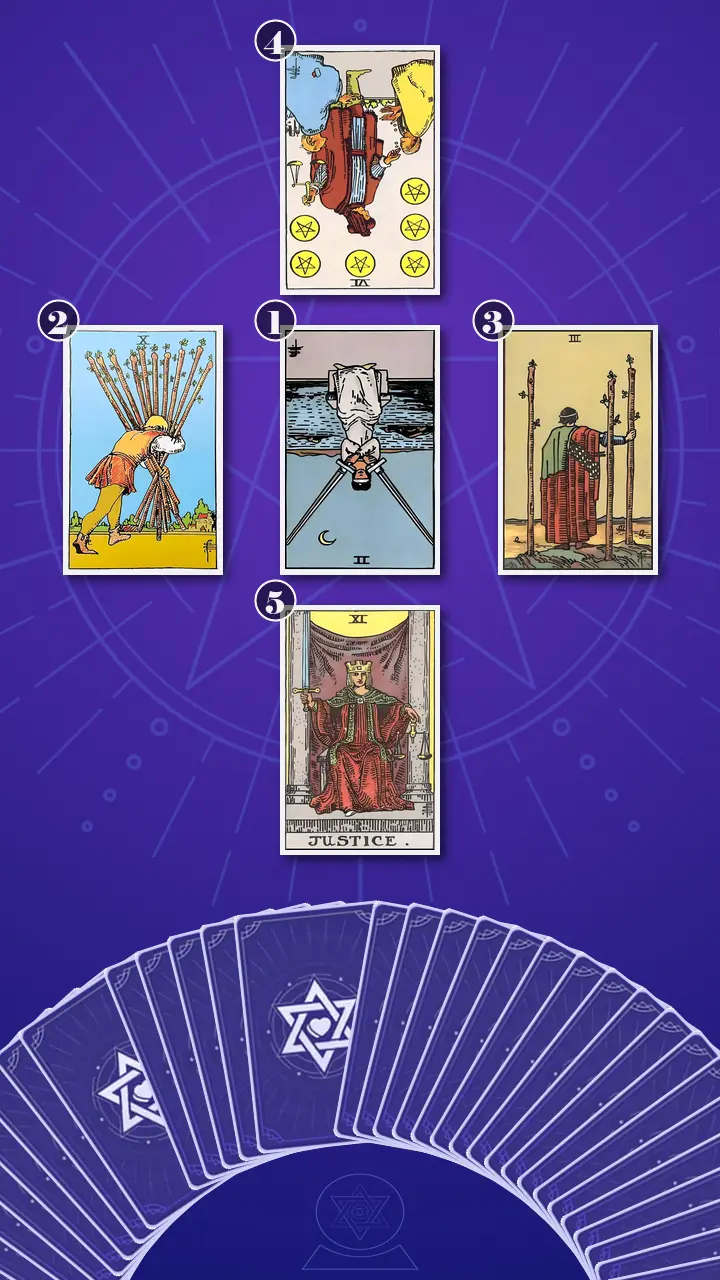
When people ask me how tarot works in a career decision, I explain that the cards are not a substitute for workplace facts, financial planning, or a conversation with a manager. They are a structured way to bring competing facts, fears, values, and habits into view. For this reading, I chose the five-card Decision Cross · Context Edition because the problem was a go-or-delay decision shaped by two equal pulls: team connection and professional vision.
A Celtic Cross would have added more layers than this question required. The five-card Decision Cross is small enough to stay concrete while still showing the observable impasse, the pull of remaining available, the wider professional horizon, the hidden responsibility contract, and the fair-decision principle that can integrate care with movement. I placed the first card at the centre, the connection pull to the left, the vision pull to the right, the hidden influence above, and the integrating guidance below.
I told Jordan that I would begin with the exact moment delay takes over, then compare what staying available protects with what the next move is asking to explore. We would also look directly at the invisible belief that a staffing gap might be a personal debt, before ending with a standard Jordan could actually use.
The Browser Tabs That Kept the Choice Frozen
The Crossed Tabs: Two of Swords, Reversed
“Now turning over the card for the current impasse, the observable pattern of postponing applications or career planning whenever understaffed-team pressure appears, I have the Two of Swords, in reversed position.”
The white blindfold and crossed swords immediately brought the modern scene into focus. After a staffing meeting, Jordan keeps a job application and the team workload board open side by side, checking the board whenever the application asks for a decision. The more staffing information they collect, the more responsible the delay appears, even though the repeated fact is simply that the team remains under-resourced.
Reversed, the card shows blocked air. The defensive neutrality that once kept two competing needs suspended has become confusion and overload. Jordan is trying to prevent either professional direction or team connection from winning, but that posture also prevents movement. More forecasts, more opinions, and another rewritten timing plan could look diligent while making the decision dependent on information that may never become conclusive.
I pointed to the crossed swords. “This is the moment when waiting stops creating calm and starts protecting you from the relational cost of choosing. The useful question is not whether one more fact exists. It is which fact is genuinely missing, and which concern you have already repeated three times.”
Jordan’s breath stopped halfway. Their eyes moved from the card to the role listing, then to the workload board, as if replaying the same Tuesday-night sequence. A small, bitter laugh escaped before they said, “That is almost too accurate. It is a little brutal.”
I let the reaction stand. “I am not asking you to agree with a verdict,” I said. “I am naming a protective pattern. Indecision is not a moral failure here. It has been giving you short-term relief from guilt, while quietly keeping your future off the calendar.” Jordan looked back at the application without closing it.
The Load That Blocks the Horizon: Ten of Wands, Upright
“Now turning over the card for the connection pull, the forces and obligations that keep you available to the current team, I have the Ten of Wands, in upright position.”
The figure bent beneath ten wands made the workload visible. In daily life, this is Jordan absorbing unclear ownership, missed deadlines, and after-hours requests because being needed brings immediate relief and praise. Each task is manageable by itself, but the bundle covers the project goal at the top of the screen. No line of sight remains for a resume, a networking message, or a thoughtful comparison of roles.
This is fire in excess. Competence has fused with obligation, so connection feels available only through carrying more. The card does not say that Jordan should stop caring or leave without a plan. It asks which burdens belong to the formal role, which were adopted to prevent discomfort, and which need redistribution rather than endurance. Being needed is not the same as being responsible for everything.
For twenty years, I have listened to people describe a manageable favour that slowly became a private contract. I have learned to listen for the moment when generosity stops being freely chosen and starts being used to prove worth. Jordan’s voice dropped when they said, “I know I am capable of handling it. That is part of the problem. Everyone knows I will.”
I watched their hand move toward the phone and stop. The praise Jordan had received from colleagues was real, and so was the fatigue and private resentment that followed it. I did not ask them to reject the trust they had built. I asked, “What would remain of the connection if your availability became proportionate instead of unlimited?”
The Wider Water: Three of Wands, Upright
“Now turning over the card for the vision pull, the opportunities and values associated with taking the alternative path, I have the Three of Wands, in upright position.”
The figure facing the horizon offered a counterpoint to the burdened posture of the Ten of Wands. In practical terms, the Three of Wands is Jordan stepping away from the live queue long enough to look at roles, conversations, and criteria beyond the current team. A fifteen-minute informational conversation, one exploratory application, or one comparison against clear role criteria can create a wider vantage point.
This fire is not a demand for a dramatic exit. It is balanced enough to become foresight. The card makes room for a reversible act of curiosity: no resignation, no announcement, no promise. I said, “You can investigate the next chapter without abandoning this one today. Exploration is not betrayal, and it is not a contract to accept the first role you find.”
Jordan let out a small breath. Their shoulders did not fully relax, but their gaze travelled toward the window instead of back to the workload board. I could almost hear the internal sentence becoming possible: “I can learn what is out there before I decide what I am willing to change.”
The Unpaid Emergency Budget: Six of Pentacles, Reversed
“Now turning over the card for the hidden responsibility contract, the fear or trade-off influencing both directions, I have the Six of Pentacles, in reversed position.”
The merchant’s scales became a workplace workload system in which Jordan’s private hours were being counted as free resources while organizational staffing decisions remained elsewhere. Reversed, the earth element is distorted. Extra labor buys short-term belonging, but the exchange leaves Jordan with less time, less energy, and more resentment. A structural staffing problem starts to feel like a personal obligation because one person’s availability is quietly subsidizing it.
I returned to the team-channel moment when an uncovered task appears before anyone formally assigns it. I asked Jordan to listen to the internal dialogue without treating it as evidence: “If I decline, they may read it as unreliable. If I accept, I can postpone my career block without having to face the guilt.” The first thought protects belonging; the second buys relief. Neither proves that unlimited availability is fair.
Jordan’s chest tightened. First, their fingers curled around the coffee cup and held it too hard. Then their eyes lost focus, as though they were replaying every time they had typed “I can take this” before anyone had asked. Finally, they released the cup and said, “I am not only helping. I am trying to earn the right to remain wanted.”
I stayed with the tenderness of that admission. “That fear makes the limit feel dangerous,” I said, “but a boundary is not proof that you care less. It is a way to test whether connection can survive fair exchange.” I wanted Jordan to see the workplace structure clearly without turning the organization or themself into a villain.
When Justice Put the Future on the Scales
The Upright Sword: Justice as a Fair-Decision Principle
The room became noticeably quieter when I turned over the card for the fair-decision principle, the concrete standard that could integrate care for the team with movement toward Jordan’s professional vision. I found Justice, in upright position.
The balanced scales and upright double-edged sword brought proportion, accountability, and direct language into the reading. In modern life, Justice is a short written standard: actual responsibility, a proportionate handover, and a date by which Jordan will review the next move. It does not force an exit. It gives both the team and Jordan’s future a fair, explainable place in the process.
At this point, I used my Analysis Paralysis Deconstruction lens. I strip away the abstract what-ifs and look only at grounded realities and immediate constraints. Toronto rent, notice periods, role fit, workload, and the team’s actual ownership structure matter. The prediction that colleagues might interpret a boundary as proof of disloyalty is a fear, not the same thing as evidence.
Then I applied my Complexity Reduction approach. I reduced the giant question, “Should I stay or leave, and what will every person think?” to a clean practical binary for this week: allow guilt to restart the debate again, or complete one reversible next-move action while remaining employed. That smaller choice preserved Jordan’s agency without pretending that the final career decision was already made.
At 9:15 p.m. in the Toronto kitchen, the promising role sat beside the workload board again. A new uncovered request appeared. I could see Jordan’s shoulders tighten, fingers type the familiar offer, and the application tab disappear. The mind called delay responsible; the body recognized the old bargain. That familiar moment was where the reading turned.
Loyalty is not an endless debt; put your needs and the team’s needs on Justice’s scales, then use the upright sword to name the boundary that lets you move.
Jordan did not nod. Their fingers froze above the phone, and their face went still as the sentence reached the place where every staffing forecast had failed to reach. Their eyes widened slightly, then drifted toward the blank space beside the workload board, as if they could see a different page there. A flush gathered at the edges of their cheeks. Their clenched hand opened one finger at a time, but the release brought a moment of dizziness rather than instant peace. They swallowed and let out a breath that shook on the way out. “But does that mean I was wrong about all of it?” they asked. I answered, “It means your care was real, and the debt story was too large. You can revise the story without condemning the person who needed it before.” I invited Jordan to use this new perspective to recall whether, the previous week, there had been a moment when the same insight might have changed the next action.
I watched the answer settle slowly. This was the first visible step from guilt-bound over-functioning and indefinite career delay toward proportionate responsibility, ethical self-trust, and grounded movement. The staffing shortage could remain real. It simply no longer had automatic authority over Jordan’s future.
Finding Clarity on a Date You Can Keep
I gathered the five cards into one story. The Two of Swords reversed showed why Jordan kept collecting information and calling the pause responsible. The Ten of Wands showed the concrete load that made the pause feel necessary. The Three of Wands revealed a professional horizon that needed exploration rather than a dramatic promise. The reversed Six of Pentacles exposed the hidden exchange: personal time was being donated to purchase belonging. Justice supplied the missing structure, separating care from self-sacrifice through a limit, a handover, and a date.
I named the cognitive blind spot plainly: Jordan had been waiting for the team to become fully staffed before allowing a career move to receive attention. That standard sounded responsible, but it made a structural problem the permanent gatekeeper of personal direction. I did not call it selfishness, and I did not call staying a failure. The transformation direction was more precise: move from asking whether the team feels perfectly ready to asking what fair responsibility requires and what small evidence can be gathered next.
For readers exploring a Five-card Decision Cross tarot spread for workplace loyalty and career direction, this is the useful chain. A card meaning becomes practical when it can answer a real question: what belongs to my role, what is a fear, what can be handed over, and what action can happen before certainty? I told Jordan that fairness needs a date, a limit, and a handover plan.
To make that principle usable, I brought out a blank sheet and described my Coffee Bean Filter Protocol, a 24-hour pragmatic sorting exercise. I asked Jordan to write every decision variable on separate scraps of paper, then physically sort them into two headings: Absolute Must-Haves and Emotional Noise. Emotional noise was not fake or shameful. It simply was not a reliable measure of responsibility. The exercise gave the clutter somewhere to go besides another browser tab.
My aim was not to manufacture certainty. It was to create enough clean space for an evidence-based career decision and one reversible step.
- Set the Justice reviewOpen Google Calendar and create a twenty-minute event within the next fourteen days titled “Justice review.” Write three observable criteria for the next role: minimum role fit, an acceptable financial or transition condition, and a reasonable handover and workload boundary. This is a review date, not a resignation date.If the date feels reckless, choose a date to review evidence rather than a date to leave. Keeping the date private is allowed.
- Use the Coffee Bean Filter and a capacity sentenceOver the next twenty-four hours, take ten minutes at the kitchen table to sort your decision variables into “Absolute Must-Haves” and “Emotional Noise.&rdquo Then, the next time an uncovered Slack or Teams request appears, wait two minutes and say, “I have capacity for X by Thursday, but I cannot also own Y this week.&rdquo Use the reclaimed thirty minutes for one resume section, one application deadline, or one career-planning note.Report facts instead of defending your character. Offer one bounded alternative only if you genuinely have the capacity for it.
- Make one reversible horizon moveBook a fifteen-minute informational conversation this week with someone outside your current team who works in a role related to your longer-term vision. Prepare three questions about scope, growth, and workload, then compare what you learn with the three Justice criteria. No resignation or announcement is attached to the conversation.If the team channel keeps pulling your attention away, put the phone in another room for the short block and reopen it afterward. Curiosity is enough for this step.
I did not tell Jordan to choose the application over the team, or the team over the application. I asked them to stop letting the loudest new request make the choice by default. The point of tarot here was not to hand down an answer. It was to make the hidden contract visible and return authorship of the next move to the person who would live with it.

The First Quiet Proof
Four days later, I received a message from Jordan. “I waited two minutes before replying,” they wrote. “I said I could own the launch notes by Thursday, but not the vendor follow-up too. Then I used the half hour to send an informational message. Nobody exploded. It still felt weird, but I did not move the message to another week.”
The team still had an uncovered responsibility, and the workload board did not become magically tidy. The difference was that the next task was discussed in a group thread instead of automatically landing in Jordan’s private hours. That was enough evidence to loosen the old equation between availability and belonging.
On Sunday, Jordan submitted one exploratory application and sat alone in a cafe while the coffee went cold. The action felt clean; the next thought was, “What if I am wrong?” They let the question remain unanswered for the afternoon and watched the streetcar lights move across the window.
I call that the first quiet proof of our Journey to Clarity: not a solved life, not a perfect team, but a decision date, a fairer exchange, and one grounded step taken while uncertainty was still present. The movement was from over-functioning toward ethical self-trust, and Jordan made it with their own judgment.
When a staffing update makes your shoulders lock and your breath go shallow, pushing your own application into another weekend can feel safer than risking the question of whether belonging survives your next step. I hope the cards offer the same recognition they offered Jordan: a fair handover and your future can occupy the same calendar.
If you imagined that a fair handover and your future could occupy the same calendar, what is the smallest next-move action you would feel curious enough to name?