The 11:34 p.m. Offer-PDF Glow (and Why “Good News” Can Feel Like Bad Stress)
If you read a new job offer at night and immediately open salary comparison threads, benefits PDFs, and LinkedIn to make sure you’re not making a mistake—welcome to offer letter anxiety.
Taylor sat across from me with their phone face-down, like it was still buzzing even when it wasn’t. They were 29, a mid-level product/marketing professional in New York, and their whole body looked like it had been asked to stay “available” for too long—jaw set, shoulders lifted, eyes doing that tired-bright thing that comes from caffeine meeting dread.
They described 11:34 p.m. in a dim NYC bedroom: the radiator clicking like a metronome, blue light smeared across the pillow, their leg bouncing on its own. “I open the offer PDF for one last look,” they said, “and then I’m in a salary comparison thread, then LinkedIn, and suddenly it’s 2 a.m. and my eyes burn but my brain won’t power down.”
The question wasn’t “Should I take it?” Not really. It was: “New job offer—why is my burnout hitting everything at once? Work, sleep, money, friends. I don’t even know why I’m tired because technically nothing has changed yet.”
I watched them swallow like their throat had gone dry. It felt—viscerally—like carrying a stack of boxes up a narrow walk-up while trying to read a text at the same time: you can do it for a minute, but your body starts negotiating with gravity.
And underneath it, I could hear the contradiction that makes this kind of burnout so sharp: they wanted to level up and prove they could handle it… and they were terrified that stepping up would expose them as someone who couldn’t—someone who would lose control over health, finances, and relationships.
“You’re not falling apart,” I told them, keeping my voice steady on purpose. “You’re running a transition in the background of your whole life. Let’s make a map of that system—so we can find clarity without asking your nervous system to pay the whole price.”

Choosing the Compass: How Tarot Works as an Energy Diagnostic Map
I invited Taylor to take one slow breath in—nothing mystical, just a clean switch from “performing competence” to “noticing reality.” I shuffled while they held the question in mind: why is this offer making everything unravel?
“Today I’m using a spread I call the Energy Diagnostic Map (7) · Context Edition,” I said.
For anyone reading along: this is exactly the kind of situation this spread is built for. When someone asks a multi-domain “why”—why burnout is hitting work, sleep, money, and friendships all at once—you don’t need a simple timeline or a yes/no. You need a system scan: surface symptoms, inner dynamics, outside amplifiers, the core blockage, then the resource, the key shift, and one grounded next step.
I pointed to the layout as I set the cards down—top row like a pressure report, center like the engine room, then a lower row that becomes the recovery path. “The first card shows what’s most obvious day-to-day. The center card names the knot that keeps the loop running. And the last card gives us something you can actually put on a calendar.”
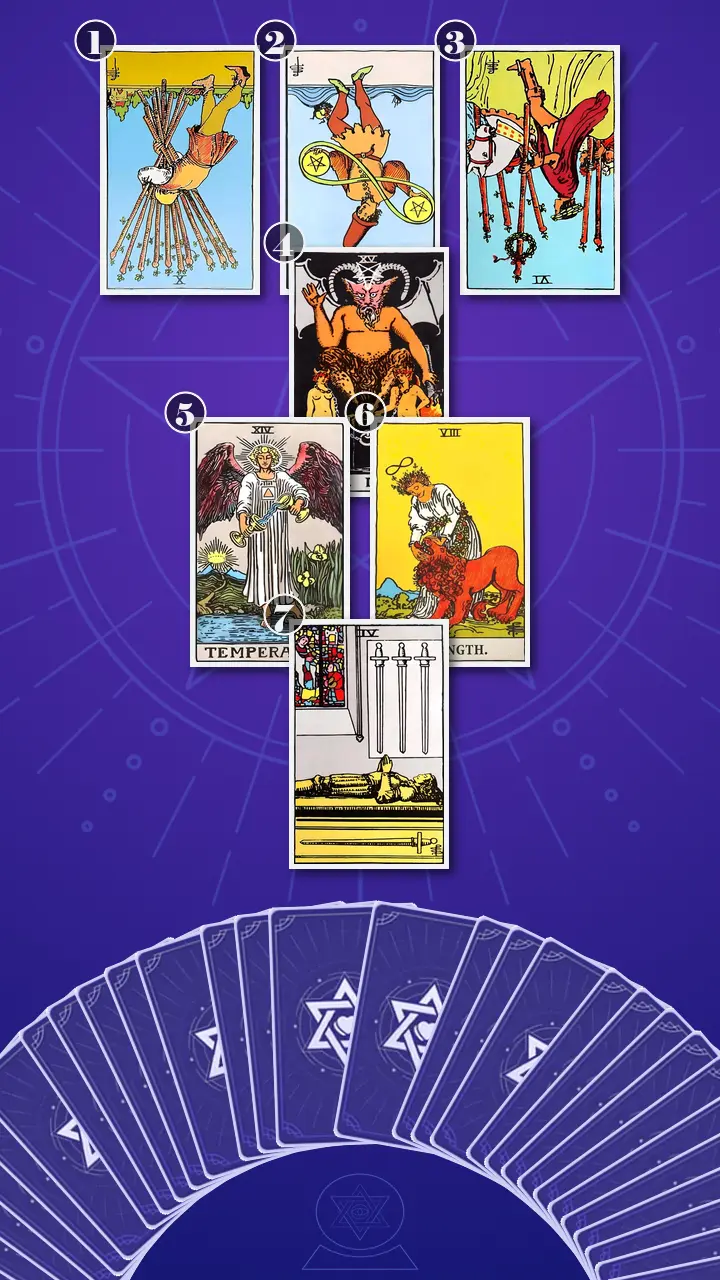
Reading the Pressure Funnel: Burnout After Getting a Job Offer
Position 1 — Surface symptom snapshot: what burnout is doing to daily functioning
“Now we turn over the card representing the surface symptom snapshot—the most visible burnout behaviors impacting your work output and daily functioning right now.”
Ten of Wands, reversed.
The first thing I noticed was the posture in the image: a figure bent forward under an oversized bundle, so overloaded they can’t see where they’re going. Reversed, it isn’t just “a lot.” It’s “a lot that’s tipping into resentment, exhaustion, and a quiet fantasy of dropping everything just to breathe.”
“This is you doing your current job like nothing’s changed,” I said, “but your brain has added a second invisible job: running the transition. Deliverables, Slack responsiveness, plus late-night offer analysis—until sleep, spending, and friendships become collateral damage.”
I kept it plain, because shame thrives on vagueness. “Some of this is work. Some of this is fear wearing a ‘responsible’ costume.”
Taylor let out a short laugh—bitter at the edges. Not a nod, not agreement. More like: called out. “That’s… yeah. That’s me,” they said. “It’s almost mean how accurate that is.”
“It’s not mean,” I answered gently. “It’s useful. The card is showing you the load—not your character.”
Position 2 — Inner tug-of-war: the juggling that destabilizes sleep and bandwidth
“Now we turn over the card representing the inner tug-of-war—where you’re overcompensating or juggling priorities in a way that destabilizes sleep and bandwidth.”
Two of Pentacles, reversed.
In the classic imagery, the infinity loop ribbon wraps around two pentacles as someone tries to keep them moving. Reversed, that infinity loop becomes a trap: constant switching that feels like management, but never becomes stability.
“This looks like your attention bouncing between work tasks, budgeting, negotiation research, and texts,” I said, “like you’re keeping plates spinning. Busy all day, but nothing ever feels resolved. Then at night, your nervous system stays in ‘on call’ mode, because you never gave it a clear ‘we’re done for today’ signal.”
I could see it land in their face—a soft frown and a tiny shake of the head, like they were watching their own browser history in their mind. “I have a Notion dashboard for this,” they admitted. “It’s… absurd. Twelve trackers. I feel productive and still completely unstable.”
Position 3 — External pressure: the visibility that turns this into a performance
“Now we turn over the card representing external pressure—what social comparison, expectations, or visibility is amplifying the burnout across money and friendships.”
Six of Wands, reversed.
Upright, this card is applause and recognition. Reversed, it’s the fear underneath applause: the sense that you’re being watched and evaluated, even when no one is explicitly judging you.
“You’re not just deciding,” I said. “You’re performing the decision. You rehearse how you’ll tell people, how you’ll negotiate, how you’ll look confident—especially after you see a ‘Thrilled to announce…’ post.”
That pressure spreads like dye in water: money becomes “I need to optimize harder,” sleep becomes “I need to rehearse every conversation,” and friends become “I need to show up as thriving—or I should vanish until I can.”
Taylor’s mouth tightened, then loosened. “Congrats texts feel like… a demand,” they said quietly. “Like: be happy correctly, right now.”
Position 4 — Core blockage: the belief-chain keeping the burnout cycle running
“Now we turn over the card representing the core blockage—the attachment or belief that keeps the burnout cycle running during the job-offer transition.”
The Devil, upright.
I’ve never read The Devil as a moral lecture. In modern life, it’s more like a subscription you can’t cancel: autopay on “prove you deserve it.” It’s the moment anxiety convinces you control is the same thing as safety.
“The imagery that matters here is the loose chains,” I told them. “Not because it’s easy to step out—because you can step out, but your system doesn’t trust it yet.”
I described the scene I could practically see: Taylor’s hand automatically reopening the offer PDF like muscle memory. The mind insisting, I’m not addicted to the PDF. I’m addicted to the feeling of certainty it promises.
“You want safety,” I said, “but you keep reaching for control because it feels faster.”
Taylor’s reaction came in a small, sharp sequence: their breath paused; their eyes unfocused like they were replaying last night at 1:32 a.m.; then a quiet exhale slipped out. “Oh,” they said. “That’s what this is.”
And I named it in the simplest words I could: “Certainty is the bedtime story your anxiety keeps asking for.”
Position 5 — Available resource: the stabilizer that’s realistic right now
“Now we turn over the card representing your available resource—the most realistic stabilizer you can use to rebalance across work, sleep, money, and friends.”
Temperance, upright.
There’s an angel calmly pouring water between two cups—no drama, no whiplash, no overnight reinvention. One foot on land, one in water: grounded and feeling, structure and softness.
“Temperance isn’t a vibe,” I said. “It’s a rhythm.”
“This is the part of you that can stop trying to fix work, sleep, money, and friendships all at once,” I explained, “and instead create one gentle, repeatable stabilizer that supports all four.”
I watched Taylor’s shoulders drop a fraction—ten percent, maybe. The urgency in their face didn’t disappear, but it stopped sprinting.
“So not a perfect routine?” they asked, almost suspicious.
“Not a new identity,” I said. “Just a 10% calmer week. One steady anchor that stops the swinging.”
When Strength Held the Lion: Finding Clarity Without Self-Abandonment
Position 6 — Key transformation: the inner skill that changes the whole system
I let my hand hover for a beat before turning this card. “We’re about to flip the turning point,” I said. “The one that changes the system, not just the offer details.”
Strength, upright.
The image is always quieter than people expect: a calm figure with a lion, not wrestling it, not dominating it—guiding it. Influence without force. Courage that looks like regulation.
“In your life,” I said, “the lion is adrenaline: the jaw clench, the doom-scroll thumb, the restless leg, the urge to check the offer at 1 a.m. Strength isn’t ‘push through.’ It’s self-leadership.”
I leaned in a little. “Strength is boundaries you can keep, even when you’re keyed up.”
And because I’m an artist who thinks in scenes, I offered Taylor the metaphor that lives in my bones: jazz.
“One of my go-to frameworks is what I call Jazz Improvisation,” I said. “Louis Armstrong didn’t play like he was trying to win a fight with the song. He listened, he paced, he left space between notes. That space wasn’t weakness—it was what made the music hold.”
“Right now, you’re treating this career crossroads like it’s a constant solo with no breathing. Strength is learning you can take a bigger role without a bigger self-abandonment.”
The Aha Moment (Setup → Delivery → Reinforcement)
For a moment, I could almost feel Taylor’s exact loop: they’re in bed in NYC at 11:30 p.m. telling themselves “one last look” at the offer PDF—then it’s spreadsheets, negotiation threads, LinkedIn, and suddenly their eyes are burning but their brain won’t power down. They’re trying to earn rest by solving the whole future tonight.
Capacity isn’t something you prove by pushing harder—it’s something you protect by leading yourself gently enough to recover and stay consistent.
I let the sentence hang in the air for a clean beat—like the room itself needed time to catch up.
Taylor’s reaction didn’t look like instant relief. It looked like a three-part unraveling: first, a physical freeze—their fingers stopped tapping their knee mid-bounce. Second, a cognitive slip—their gaze went distant, as if they were watching last week’s nights from outside their own body. Third, emotion arrived—not tears exactly, but a kind of hot-eyed recognition. Their shoulders sank, and they exhaled like they’d been holding a breath all month.
Then the unexpected pushback came, sharp and honest: “But if that’s true… doesn’t that mean I’ve been doing it wrong? Like—this whole time?”
I kept my voice calm. “It means you’ve been doing what works fast,” I said. “Control gives a quick hit of relief. But it costs you sleep, money steadiness, and closeness. Strength isn’t a verdict on your past. It’s a new skill you can practice without punishing yourself.”
“Let’s make it practical,” I added, and I guided them through a 10-minute ‘Strength check’—not a life overhaul:
1) Set a timer for 10 minutes. Sit or lie down.
2) Write two lines only:
— “The lion voice right now says: ____”
— “The self-leader voice says: ____”
3) Choose one gentle limit for tonight that you can keep without drama: “No offer/LinkedIn/budget tabs after 11:15.”
4) Put your phone to charge across the room (or at least out of arm’s reach).
“And here’s the boundary note,” I said, because this part builds trust: “If your anxiety spikes, you’re allowed to stop early—this is practice, not a test. If you break the limit, you haven’t failed. You just learned what your nervous system does under pressure.”
I watched Taylor nod—small, but real.
“Now,” I asked them softly, “use this new lens and rewind. Last week—was there a moment where the ‘one last check’ stole your sleep? What would have changed if you’d trusted the self-leader voice for ten minutes?”
Their answer came immediately. “Tuesday,” they said. “12:48 a.m. I opened the PDF. I didn’t even read it. I just… checked. And then I bought stuff I didn’t need the next day because I felt like garbage.”
“That’s the system,” I said. “And this—right here—is the first move from wired overwhelm toward steadier self-trust.”
Position 7 — Next step grounding: the calendar-able pause that turns insight into recovery
“Now we turn over the card representing your next step grounding—one concrete action that turns insight into recovery and sustainable decision-making.”
Four of Swords, upright.
This card is a deliberate pause after strain. Not quitting. Not hiding. Stepping out of mental battle mode long enough to restore your clarity.
“I want you to hear this,” I told Taylor. “This isn’t giving up; it’s stepping out of the mental fight long enough to think clearly.”
They looked skeptical—relief fighting with the belief that rest is irresponsible. And that skepticism was honest data, not a flaw.
From Insight to Action: A Boundary-First Transition You Can Actually Start
I pulled the whole story together for them, because this is what a good tarot reading does: it turns scattered symptoms into a coherent chain.
“Here’s what your cards say in plain English,” I said. “You’re overloaded (Ten of Wands reversed) and juggling in a way that never lands (Two of Pentacles reversed). LinkedIn-and-life visibility turns the offer into a performance (Six of Wands reversed). Underneath, The Devil is the belief-chain: ‘If I don’t optimize and control this perfectly, I won’t be safe.’ Temperance offers a rhythm—a single stabilizer. Strength is the real upgrade: calm self-leadership. And Four of Swords is how you prove it in real life: a protected pause.”
“Your cognitive blind spot,” I added, “is that you’re treating rest like a reward you earn after proving yourself. But your key shift—the one that changes work, sleep, money, and friendships together—is treating rest as a non-negotiable input that protects your competence.”
Then I gave Taylor next steps that were intentionally small—because small is what you can keep when you’re burned out after getting a job offer.
- The 15-Minute Decision WindowPick one time each day (same time) for 15 minutes of offer research/negotiation thoughts. Outside that window, if a thought hits at night, write it in one line and save it for tomorrow—no tabs.Expect your brain to call this “irresponsible.” That’s The Devil talking. You’re not banning thinking—you’re giving it a container so it stops taking your sleep hostage.
- The One-Person Processing Boundary (Plus an “Oscars Speech” Script)Choose one trusted person to process the decision with. Everyone else gets a two-minute, repeatable line: “I’m excited and taking my time. I’ll share when it’s final.”This is my Oscars Speech Training in real life: rehearse it once, then stop re-writing your life story in group chats. Less explaining = less performance pressure = more actual energy.
- One Low-Stim Reset Night (On the Calendar)Schedule one evening this week (e.g., Thu 7:30–10:30) labeled “Low-stim reset” like it’s a meeting. During the block: no offer PDF, no LinkedIn, no budget deep-dives. Choose one low-input activity (walk, laundry, simple show, reading).If you slip and open a tab, close it once without spiraling into self-criticism. No one gets access to you 24/7—not even your own anxiety.

Ownership, Not Certainty: The Quiet Proof a Week Later
A week later, Taylor messaged me a screenshot: a calendar block that read LOW-STIM RESET in all caps, like they were finally willing to take themselves seriously. Under it they’d written, “No offer/LinkedIn/budget tabs after 11:15.”
“I slept,” they added. “Not perfectly. I still woke up once and thought ‘what if I’m choosing wrong?’ But I didn’t check. I just… went back to sleep.”
That’s what I mean when I say this work is a Journey to Clarity. Not certainty. Not a personality transplant. Just the first real evidence of a new pattern: from compulsive control to grounded calm—one boundary kept, one nervous system protected, one life returned to them in small pieces.
When a “good” offer lands, it can feel like you’re carrying your whole future in your chest—so you keep tightening your grip at night, not because you’re lazy, but because you’re scared that letting go for one hour will prove you can’t stay in control.
If you let rest be an input (not a reward) for the next seven days, what’s one tiny boundary you’d be curious to try—just to see how your sleep and decision-making change?
This story is adapted from psychological research, written so that those in a similar struggle can see their own pattern in it — and find their next step clearly.These insights are not a substitute for professional psychological, medical, legal, or financial advice.
Learn more about our Journey to Clarity.
How did this insight land for you?
🫂 This Resonates Deeply
🌀 Living This Story
✨ Now I See Clearly
🌱 Seeing New Possibilities
🧰 Useful Framework
🔮 The Confirmation I Needed
💪 Feeling Empowered
🚀 Ready for My Next Step
Author Profile
 AI
AI“I’ve always felt our lives are films currently in production. As an artist, I know that when you feel stuck, it’s often because you’ve bravely stayed in a painful scene for just a little too long. I’m not here to coldly analyze you. I want to sit closely with you, look at those difficult moments with profound empathy, and gently hand you the pen so you have the courage to write your next beautiful act.”
In this Career Tarot Reading :
Core Expertise
- Workplace Typecasting Analysis: Identifying how your office ecosystem has boxed you into a marginalized or undervalued 'supporting role'.
- Leadership Narrative Construction: Rewriting the script of your professional identity to command authority and visibility.
Service Features
- The Protagonist Reframe Directive: A micro-behavioral script for your next cross-departmental meeting to instantly disrupt your established subordinate persona.
Also specializes in :
Explore Related Patterns:
Boundary DiscernmentTaylor's recovery starts when the offer process gets a container: no offer, LinkedIn, or budget tabs after 11:15; one trusted person for processing; one low-stim reset night on the calendar. These are not productivity hacks. They are boundary decisions that tell the nervous system where the transition is allowed to live. Boundary Discernment fits because Taylor is learning the difference between useful engagement and full-life invasion. Work, sleep, money, and friends have all been compressed by the same decision loop, so the shift is not to ignore the offer. The shift is to stop letting the offer claim every available space. The upright quality here is practical self-leadership. Taylor does not need a perfect routine or a new identity; they need one boundary they can keep while keyed up. For you, the pattern is the ability to ask, 'What needs my attention, and what needs a gate?' That distinction is what turns insight into recovery.
Certainty SeekingTaylor's late-night offer PDF ritual is not just research; it becomes a control-based attempt to make the future feel safe before they let themselves rest. The salary threads, benefits PDFs, LinkedIn checks, budget tabs, and negotiation research all promise the same thing: one more piece of certainty that might finally switch the body out of high alert. The pattern tightens because certainty is being asked to do an impossible job. A career transition always contains unknowns, but Taylor's nervous system treats each unknown as a solvable threat, so the search keeps expanding from work into sleep, money, friends, and self-worth. You can see the mechanism clearly in the line, 'If I don't optimize and control this perfectly, I won't be safe.' Certainty Seeking fits because the behavior is repetitive, soothing in the short term, and destabilizing in the long term. The more Taylor checks, the less settled they feel, which means the coping strategy starts generating the very burnout it was supposed to prevent. For you, the useful audit is not whether more information is bad; it is whether information is being used to make a decision or to postpone the feeling of not knowing.
Defensive OverfunctioningTaylor keeps performing their current job as if nothing has changed while also running an invisible second job: researching the offer, forecasting money, rehearsing conversations, managing social reactions, and trying to stay responsive. That is why the burnout hits multiple domains at once. The transition is not contained; it is being processed through the whole operating system. Defensive Overfunctioning fits because excessive management becomes a defense against the fear of being exposed as not capable enough. Instead of letting the offer introduce uncertainty, Taylor tries to outwork the uncertainty across every possible domain. The result looks competent from the outside, but internally it costs sleep, money steadiness, and closeness. The deeper mechanism is the belief that rest must be earned after competence has been proven. You can see how punishing that becomes: Taylor tries to prove capacity by spending the very capacity they need to make a clear decision. The useful shift is not doing less for its own sake; it is learning where overfunctioning has become a substitute for self-trust.
Social ComparisonTaylor does not experience the offer as a private career decision for very long; LinkedIn posts and congratulatory texts quickly turn it into something they feel watched inside. The phrase 'be happy correctly, right now' captures the social filter: other people's excitement becomes evidence that Taylor must perform certainty before they actually feel grounded. Social Comparison fits because Taylor's attention moves from what the offer means for their life to how the decision will look. They rehearse how they will tell people, how they will negotiate, and how they will appear confident, especially after seeing polished announcement posts. The comparison is not only about salary or status; it becomes a pressure to display the correct emotional script. That pressure explains why friends are affected too. Instead of friendship functioning as a stabilizing space, it becomes another stage where Taylor has to look thriving or disappear until they can. For you, the core insight is that burnout can spike when a transition becomes socially visible before it becomes internally integrated.
Anxiety SpiralTaylor's body is already telling the story before the decision is resolved: jaw set, shoulders lifted, restless leg, tired-bright eyes, caffeine meeting dread. Then the mind tries to manage that activation through another check, another tab, another comparison, another rehearsal. Anxiety Spiral fits because each coping move briefly reduces discomfort and then gives anxiety a larger territory to manage. The offer starts as a career decision, but the activated state spreads into sleep, spending, work responsiveness, and friendship availability. There is no clean 'done for today' signal, so the nervous system stays on call. The spiral is not a character flaw; it is a feedback loop. Anxiety says control will create safety, control creates more activation, and activation creates a stronger need to control. For you, the most useful intervention is to interrupt the loop earlier than your mind thinks is reasonable, before the system demands certainty from every part of your life at once.
Compulsive CheckingTaylor's 'one last look' at the offer PDF keeps turning into a chain of tabs: spreadsheets, salary threads, LinkedIn, budget checks, and negotiation research. The key detail is that Taylor admits they sometimes open the PDF without even reading it, which means the checking has shifted from useful review into a nervous-system ritual. Compulsive Checking works here because the action gives a quick hit of control without producing actual resolution. The brain learns that discomfort can be answered with another check, so the loop repeats at the exact moment the body needs a shutdown signal. By 2 a.m., the behavior is no longer helping Taylor decide; it is keeping their attention fused to the threat of choosing wrong. The next-day fallout matters. Lost sleep leads to feeling awful, and feeling awful leads to buying things they do not need, which pulls money into the same burnout system. You can treat this pattern as a behavioral audit: the question is not whether checking is rational once, but whether the repeated check is reducing uncertainty or training your anxiety to request another round.
Illusion of ControlTaylor's system treats control as if it can guarantee safety: more research, more tracking, more budgeting, more comparison, more rehearsal. The twelve Notion trackers are especially revealing because they create a strong feeling of management while Taylor still feels completely unstable. Illusion of Control fits because the tools are not inherently the problem; the psychological contract with the tools is the problem. Taylor is using structure to try to remove the emotional risk of transition, but no dashboard can make a new job offer fully predictable. The control strategy simulates clarity while keeping the body activated. That is why the burnout spreads. Once control becomes the chosen route to safety, every domain becomes something to optimize: work output, sleep timing, money choices, friendship responses, and public confidence. For you, the audit question is simple and uncomfortable: is this system helping you act, or is it helping you avoid the feeling that some part of the future cannot be controlled?
Self-SoothingTaylor's turning point is small but concrete: the urge to check appears, the anxious question 'what if I'm choosing wrong?' shows up, and they do not reopen the offer. They go back to sleep. That moment matters because it is the first evidence that their body can be led without being forced. Self-Soothing fits because the intervention is not about suppressing anxiety or pretending the offer is simple. It is about meeting adrenaline with a steadier internal voice, then choosing a limit that is realistic enough to keep. The Strength check separates the lion voice from the self-leader voice, which gives Taylor a way to regulate without escalating into more control. This is why the story frames rest as an input rather than a reward. Taylor begins protecting capacity before certainty arrives, which is the opposite of trying to earn recovery by solving the whole future tonight. For you, the practical insight is that self-trust often starts as one regulated pause, not a fully confident decision.
Explore Related Struggles:
Capacity-Identity FusionTaylor does not describe the offer as a clean win. They want to level up and prove they can handle it, but the same step forward raises the fear that a bigger role will reveal limits they have been trying hard to outrun. The offer becomes more than a career option. It starts functioning like a verdict on capacity: whether they can stay healthy, keep money steady, maintain friendships, sleep, negotiate well, and still look competent. A job decision turns into a whole-self evaluation. Capacity-Identity Fusion names that binding of performance and self-definition. You are not only asking whether the offer is good; you are carrying the heavier question of what it would mean about you if the transition exposed strain. The path back to clarity begins when capacity becomes something you protect and pace, rather than something you have to prove by staying overextended.
Certainty-Safety FusionTaylor keeps opening the offer PDF, salary threads, benefits documents, LinkedIn, budget tabs, and trackers as if the next piece of information will finally make the decision feel safe. The behavior is concrete and repetitive: one last look turns into a 2 a.m. search loop, and even the Notion dashboard with twelve trackers leaves them feeling productive but unstable. The friction is that the tools are built for information, while the pressure underneath is asking for safety. You can compare numbers, rehearse negotiation scripts, and scan other people's career updates, but those actions cannot fully answer the deeper question of whether you will still be okay after stepping into a bigger role. Certainty-Safety Fusion names the moment control starts impersonating protection. You are not simply overthinking the offer; you are trying to make uncertainty disappear before you allow yourself to sleep, spend steadily, respond to friends, or trust your own capacity. The struggle becomes visible when more checking creates less clarity, and the search for safety becomes the thing keeping your whole system on call.
Mental Bandwidth DepletionTaylor is still doing the current job, still answering Slack, still trying to compare salary data, still thinking through negotiation, still managing money fears, and still deciding how to respond to friends. Nothing has officially changed yet, but the transition has already started using real bandwidth. That is why the burnout hits several domains at once. Work, sleep, money, and friendship are not separate containers here; they are all pulling from the same limited attention system. By bedtime, the body is in a bedroom, but the mind is still at work, in a spreadsheet, in a LinkedIn feed, in a future conversation, and in the fear of choosing wrong. Mental Bandwidth Depletion names the cross-domain drain underneath the visible symptoms. You are not tired because one task is hard; you are tired because too many open loops are asking to be held at the same time, with no reliable signal that the day is allowed to end. The struggle is not a lack of discipline, but an overloaded system trying to act like it still has spare capacity.
Monitoring-Safety FusionTaylor's hand keeps going back to the offer PDF, even when they are not really reading it anymore. Salary comparisons, LinkedIn posts, benefits details, and budget tabs become a circuit they can re-enter at any hour, especially at night when the body is already asking to shut down. The loop works because it offers a quick hit of relief. For a few seconds, checking can feel like responsibility, control, or preparedness. Then the cost shows up somewhere else: sleep gets taken hostage, the next day feels unstable, money decisions get shakier, and friendship contact starts to feel like another demand on an already wired system. Monitoring-Safety Fusion names the locked version of the pattern, where watching the situation starts to feel safer than living through it. You are not failing because you want reassurance; the problem is that reassurance has been assigned a job it cannot do. The more the system monitors for certainty, the less space you have to recover enough to make the decision from a grounded place.
Performative StabilityTaylor keeps the outside structure intact: current job deliverables continue, Slack responsiveness continues, the offer research looks organized, and the decision can be explained as ambition. From the surface, the system still looks capable. Inside that same structure, the private costs are stacking up. Sleep is interrupted by late-night checking, spending gets affected after a bad night, and friendship starts to require a polished version of excitement. Even congrats texts feel less like support and more like a prompt to perform the correct emotional response. Performative Stability names the pressure to look steady while the systems that create steadiness are being drained. You are carrying the image of being fine at the exact moment you need more room to be unfinished, undecided, and human. The struggle is not that you cannot handle growth; it is that maintaining the appearance of handling it has started consuming the recovery that would actually help you handle it.
Explore Related Emotions:
Visibility PressureTaylor says congrats texts feel like a demand, as if the right emotional response has to be performed immediately. The job offer becomes public before it has become emotionally settled, and LinkedIn announcement culture turns a private decision into something that feels observed. You are trying to decide while also rehearsing how the decision will look. That doubles the load: one part of you is evaluating the offer, while another part is managing the image of someone who should already be confident, grateful, and thriving. Visibility Pressure names that watched feeling. It is the emotional strain of having your uncertainty exposed under a spotlight, especially when friends, money talk, and career optics all start asking you to appear more composed than you actually feel.
Certainty HungerTaylor reopens the offer PDF even when they are not really absorbing new information. The hand returns to the document like it might finally produce the one sentence that makes the whole future feel controlled. You are reaching for data, but the deeper reach is for a body-level guarantee that you will not choose wrong, lose stability, or disappoint people. That is why one more tab never stays as one more tab; the research is trying to create a feeling that research cannot fully deliver. Certainty Hunger captures the ache beneath the checking. It is not ordinary curiosity about compensation or benefits. It is the restless need for enough proof to let yourself sleep, breathe, and stop defending against every possible outcome.
Choice Paralysis OverwhelmTaylor is not staring at a single yes-or-no question. They are moving through salary comparisons, benefits PDFs, negotiation thoughts, friend responses, spending patterns, and sleep disruption as if every variable has to be solved before the offer can be held. You are trying to make one career decision while your mind turns it into a simulation of the whole future. Each new piece of information creates another branch, and the branches multiply faster than your body can recover. Choice Paralysis Overwhelm names the point where options stop feeling empowering and start feeling destabilizing. The question becomes so over-connected to every life domain that choosing feels less like movement and more like stepping into a system you cannot fully control.
Chronic OverwhelmTaylor opens the offer PDF at 11:34 p.m., then slides into salary threads, benefits documents, and LinkedIn until the night has been eaten by tabs. Their body is already showing the load: jaw set, shoulders lifted, leg bouncing, eyes burning while the brain refuses to power down. You are not just holding a job decision here. You are carrying work output, sleep recovery, money calculations, and friendship performance in the same mental container, with no clear place where one demand ends and another begins. Chronic Overwhelm fits because the pressure is not isolated to the offer itself. The story shows a whole system running hot, where even good news becomes another background process asking for energy your body has not had time to restore.
Contained OverwhelmTaylor’s shoulders drop when the solution becomes one repeatable stabilizer instead of a new identity. The 15-minute decision window gives the offer a place to go, so it no longer has permission to spread across the whole night. You still have pressure in your system, but it starts to become bounded. Instead of forcing yourself to resolve everything at once, you create a container where thinking can happen without taking over sleep, spending, and friendships. Contained Overwhelm fits because the emotional weather is still intense, but it is no longer completely unheld. The relief comes from structure that is small enough to keep and clear enough to protect your energy.
Grounded AgencyTaylor writes down the loud, keyed-up voice and then answers it with a steadier self-leader voice. The exercise is short, but it changes the position from being dragged by urgency to choosing a limit that can actually be kept. You are not waiting for pressure to disappear before acting. You are building agency inside the pressure by making one grounded move: a timer, a boundary, a phone placed away from reach, a reset night protected on the calendar. Grounded Agency fits because the story turns insight into ownership. The emotional power is not certainty; it is the felt proof that you can make a small, clear choice on behalf of your own recovery.
Guilt-Free RestTaylor schedules LOW-STIM RESET like a real commitment, with no offer PDF, LinkedIn, or budget deep dives after the boundary time. The pause is not framed as escape; it becomes part of how clarity is protected. You are loosening the belief that rest has to be earned by solving the entire future first. The body gets a protected interval where it does not have to prove anything, optimize anything, or perform being fine. Guilt-Free Rest fits because the story’s recovery path depends on letting rest become an input, not a prize. The emotional shift is subtle: you stop treating recovery as irresponsibility and start treating it as part of competence.
Impostor AnxietyTaylor wants to level up, but the offer also brings the fear that stepping up will reveal they cannot actually hold the next level. Nothing has changed yet, but their mind is already testing whether health, finances, sleep, and friendships will collapse under the bigger role. You are not only asking whether the job is right. You are asking whether the version of you who accepts it will be exposed as less capable than they looked from the outside. Impostor Anxiety belongs here because the pressure is tied to capacity and visibility. The offer feels like proof of competence and a threat to that competence at the same time, which makes success feel strangely unsafe to inhabit.
Quiet Self-TrustA week later, Taylor wakes once with the thought that they might be choosing wrong, but they do not check the offer. They go back to sleep, and that small moment carries more evidence than a dozen extra browser tabs. You are learning that self-trust does not have to arrive as a grand conviction. It can show up as one kept limit, one phone out of reach, one night where uncertainty is present but not in charge. Quiet Self-Trust fits because the change is understated and real. The story does not end with perfect confidence; it ends with your system discovering that you can protect rest and still remain capable.
Hypervigilant AnxietyTaylor is in bed, but the body is not off duty. The radiator clicks, blue light spills across the pillow, the leg keeps bouncing, and the offer keeps pulling attention back into a state of watchfulness. You are scanning for risk long after the workday is over. The bedroom should be a recovery space, but it has become a monitoring station where money, work, reputation, and future stability all keep flashing for review. Hypervigilant Anxiety fits because the story is full of readiness without release. Your system acts as if one missed detail could damage everything, so sleep becomes difficult not from lack of tiredness, but from the feeling that standing down is unsafe.
Explore Related Contexts:
Adulting Performance PressureTaylor wants to level up, but the offer quickly becomes a test of whether they can keep work, sleep, money, health, and friendships under control. Even the idea of being congratulated carries a script: be excited, be competent, be grateful, be ready. This pressure is bigger than the job description. You are being asked to perform adulthood as total life management, and that makes normal uncertainty feel like evidence that you are not handling the next level correctly.
Always On AvailabilityTaylor's phone sits face-down like it is still buzzing, even when it is not. The same device carries Slack responsiveness, offer documents, salary comparison, friend texts, LinkedIn visibility, and the late-night urge to check one more thing. Always-on availability turns a decision into a twenty-four-hour background process. For you, the exhaustion makes sense because the system never receives a clean stop signal; it keeps acting as if responsiveness equals safety and competence.
Career Transition FogTaylor is still doing the current job like nothing has changed, but the offer has already started running a second job in the background. Deliverables, Slack responsiveness, negotiation research, budget checks, and social explanations all compete before any formal transition has happened. That is the fog of a career move before it becomes visible on paper. You are not only choosing a role; you are trying to locate yourself between the identity you have been performing and the one this offer asks you to step into.
Compensation Comparison SpiralTaylor opens the offer and immediately reaches for salary comparison threads, benefits PDFs, negotiation research, and budget checks. Each piece of information should help, but in practice it creates another angle from which the offer might be wrong, underpaid, or poorly optimized. Money pressure spreads because compensation is not just a number here; it becomes proof that you made the right life move. When comparison replaces criteria, the research loop keeps generating more risk signals than usable clarity.
Job Offer CrossroadsTaylor opens the offer PDF at 11:34 p.m., then moves into salary comparison threads, benefits documents, LinkedIn, and budget tabs until 2 a.m. The offer is functioning less like a single yes-or-no choice and more like a temporary career junction where work output, compensation, health routines, and social presentation all demand attention at once. For you, that is why the pressure spreads. A job offer asks you to evaluate a future role while still performing the current one, so clarity has to be built through decision criteria and boundaries instead of another round of late-night checking.
LinkedIn Performance LoopTaylor sees the career-announcement script before they have even stabilized the decision: the polished 'Thrilled to announce...' post, the confident negotiation story, the public version of someone who looks certain. LinkedIn turns the offer into a stage before it has become a choice. That platform pressure explains why friends and money start carrying extra weight. You are not only asking what the job is worth; you are being pulled into how the move will look to other people who only see the edited version.
Opportunity Pile-OnTaylor receives something that should count as good news, yet the practical workload immediately multiplies. The offer brings PDFs, salary benchmarks, benefits details, negotiation research, LinkedIn comparison, budget questions, and the social labor of explaining the decision. This is opportunity arriving as another pile of tasks. You can want the upgrade and still be overloaded by the hidden administration it creates, especially when no one removes the ordinary workday obligations while the new decision lands.
Work Life Boundary CreepTaylor's bedroom becomes a work-adjacent decision room: the offer PDF is open on the pillow, LinkedIn is one tap away, and budget tabs sit beside sleep. The current job still asks for deliverables and Slack responsiveness, while the possible next job colonizes the hours that were supposed to restore capacity. The boundary problem is external and structural, not a character flaw. When work, career planning, money decisions, and social messaging all use the same devices and hours, you need stronger containers than willpower alone can provide.
Decision Criteria Black BoxTaylor builds a Notion dashboard with twelve trackers and still feels unstable. The offer PDF, benefits documents, salary threads, LinkedIn comparisons, and negotiation research provide information, but they do not define which tradeoffs actually matter most. The decision criteria are opaque, so every new data point becomes another possible standard to satisfy. You need a smaller set of explicit criteria, because unfiltered information keeps pretending to be clarity while adding more pressure.
Sleep Debt LoopTaylor tells themself it is one last look at the offer PDF, then the night turns into salary threads, LinkedIn checks, burning eyes, and a brain that will not power down. The next day, the cost shows up in steadiness around money and attention. This is a sleep loop created by decision labor after hours. You are not failing to rest because the offer is unimportant; the offer is important enough that it needs a protected daytime container, otherwise it keeps borrowing from tomorrow.
Social Performance LoopTaylor says congrats texts feel like a demand to be happy correctly right now. Instead of simply receiving support, they start rehearsing how to tell people, how to sound confident, and when to disappear until they can present as thriving. That is why the offer hits friendships. You are managing an audience while trying to make a private decision, so social contact becomes another performance surface instead of a place to recover.