After a Warm Date, the Exclusivity Text Became a Pace Conversation

The Exclusivity Text at 8:47
If you can turn an ambiguous UX brief into a clean decision tree but keep drafting an exclusivity text after every great date, a slower reply can turn ordinary uncertainty into relationship timeline anxiety.
Maya, a 28-year-old junior UX designer in Toronto, sat opposite me with her phone face-up. She had come to me carrying the aftermath of a warm date and the question she had been trying to optimize alone.
At 8:47 on Tuesday evening, she had been riding north on TTC Line 1. The brakes squealed beneath the fluorescent buzz while an engagement dinner appeared on Instagram above a kind but careful dating message. Her phone felt warm in her palm as she typed, deleted, and retyped: “Should we talk about being exclusive?”
“I keep choosing commitment before we’re equally ready,” she said. “I tell myself I want clarity, but I keep trying to create it by moving first.”
Then she rubbed her thumb into the centre of her palm and added, “I want an honest answer, but I also want the answer to be yes.” As she spoke, I watched longing press against her sternum like a train door trying to close around a trapped sleeve: tight, urgent, and impossible to ignore without pulling harder.
“You’re not wrong for wanting commitment,” I told her. “The pressure begins when your desire has to make the decision for two people.”
I also told her what I would not do. I would not use tarot to claim access to the other person’s private feelings, predict whether they would commit, or tell Maya to wait indefinitely as proof of emotional maturity. I would help her separate her readiness from shared readiness, what had been explicitly offered from what fear had supplied, and desire from the pressure to make uncertainty disappear.
“Let’s give the fog a structure,” I said. “Not so the cards can choose for you, but so you can see where your own choice begins again.”

Choosing the Compass: A Relationship Spread for Mutual Readiness
I asked Maya to place both feet on the floor, take three slow breaths, and hold one question in mind: “Why do I keep choosing commitment before we’re equally ready?” I shuffled slowly, not as a supernatural performance, but as a transition—a way to let the question stop behaving like an emergency notification for a few minutes.
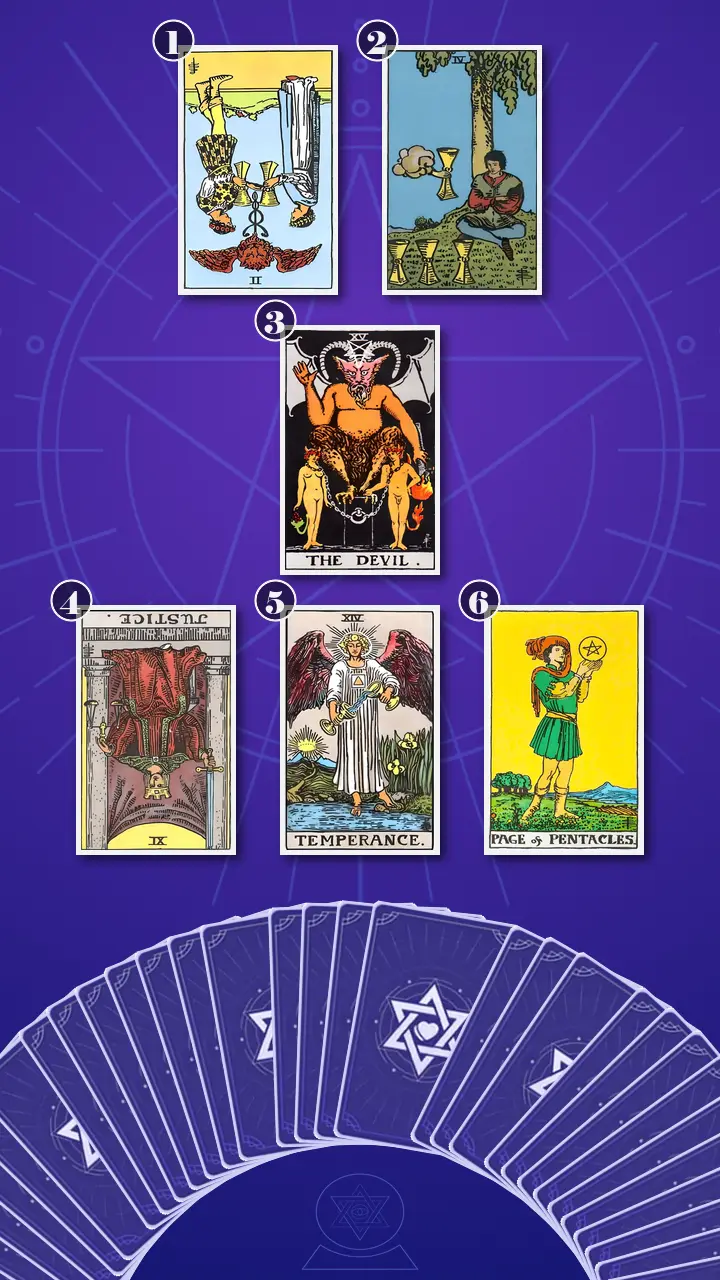
I chose the six-card Relationship Spread · Context Edition. It was the smallest structure that could hold the whole mechanism without flattening it into “commit” or “leave”: Maya’s present pattern, her interpretation of the other person’s pace, the fear beneath her urgency, the recurring imbalance, the transformation point, and one self-directed next step.
This distinction mattered. In my practice, how tarot works is straightforward: the images externalize a pattern so we can inspect it with more objectivity. The second position would not tell me what another person secretly felt. It would show how Maya was reading their visible pace. The root card would reveal what the commitment conversation had been recruited to prove. The fifth card would act as the bridge between insight and reciprocal pacing, while the final card would turn the reading into a one-week experiment rather than a permanent verdict.
I placed the first two cards across from each other like two sides of a conversation. I set the third below them as the root, then laid the final three from left to right: recurring dynamic, balancing intervention, practical action. The layout looked like a conversation descending beneath a surface mismatch and then crossing a measured bridge back into real life.
Reading the Space Between Two Cups
Position One: Two Cups, Two Timelines
The card I turned over now represented the presenting pattern: how Maya repeatedly moved toward commitment before checking whether readiness was shared.
It was the Two of Cups, reversed.
I pointed to the two figures, each holding a separate vessel. Even in a card famous for partnership, neither person holds both cups. The space between them is where reciprocity must actually occur.
“This is the Line 1 message,” I said. “You felt genuine warmth after the date, then treated that warmth as if the relationship had already reached a joint decision. You edited the exclusivity text the way you might refine a UX case study—trying to find wording honest enough to express your need, but frictionless enough to produce a secure response.”
I read the reversal as a blockage in exchange combined with an excess of initiative. Maya’s willingness was real, but it was being asked to certify the emotional transaction for both people. It was like shipping a polished UX flow before the user research had been completed by both participants. The interface might look resolved while the underlying question remained open.
“What are you ready for?” I asked. “And what has actually been agreed together?”
Maya gave one short laugh, sharp at the edges. “That’s so accurate it feels a little brutal.”
I did not rush to soften the card into something vague. “Brutal would be turning this into a character flaw,” I said. “I’m not doing that. The card is showing a strategy that gives you short-term relief and long-term confusion. A strategy can be revised. Your desire does not need to be shamed in order for your method to change.”
Her laugh faded, but her shoulders lowered slightly. The reversal was not telling her to stop asking for clarity. It was asking her to notice the precise moment when personal readiness began doing the work of a joint decision.
Position Two: The Pause That Looked Like a Closed Door
The card I turned over now represented the readiness mirror: how Maya perceived and interpreted the other person’s slower or different pace, without treating her interpretation as a fact about them.
It was the Four of Cups, upright.
I showed her the seated figure with crossed arms, the three visible cups, and the fourth cup being offered from outside the figure’s narrowed field of attention. In Maya’s life, this was the warm date followed by careful language, a vague next plan, or the familiar digital fact of “seen at 11:08.” The observable information might be a pause. Her body translated it almost instantly into a closed door.
“This card cannot tell us whether the other person is secretly afraid, deeply invested, losing interest, or simply moving slowly,” I said. “It tells us that your attention fixes on the promise that has not been offered yet. That can make a smaller present-tense truth—interest alongside hesitation, or care alongside reassessment—almost impossible to receive.”
The cup energy was contracted rather than absent. I saw a blockage in receptivity: not because Maya was incapable of receiving affection, but because affection that did not guarantee the future felt too incomplete to settle inside her.
“A pause can be information about pace without being a verdict on your worth,” I told her. “What is actually being offered now, before you turn it into a prediction about later?”
Her fingers stopped circling the rim of her water glass. She looked at the offered fourth cup for several seconds, then said, “I usually skip straight from ‘they need time’ to ‘I’m about to lose my place.’”
“That jump is the part we’re observing,” I said. “Not obeying. Not condemning. Just making visible.”
Position Three: The Passcode for Belonging
The card I turned over now represented the root attachment: the fear and value threat that made choosing commitment feel urgent, especially the fear that waiting meant lacking belonging.
It was The Devil, upright.
A notification lit Maya’s phone as I placed the card down. She turned the screen face-down, and the ordinary movement gave the loose chains in the image an almost uncomfortable relevance.
I connected the card to the Sunday kitchen scene she had described to me: the kettle had not finished boiling before an engagement announcement landed in her group chat. She had opened her dating thread, searched for the last future-oriented sentence, and begun composing another question. The label had started to function like a passcode for belonging—something she could enter to quiet the fear of being outside partnership.
“If I can make this official, I can stop wondering,” I said, repeating the sentence she had used earlier. “But when the reassurance fades, the system asks for another login: another promise, another future plan, another clarifying text.”
I read The Devil as an excess of attachment energy and a blockage of free evaluation. The desire for commitment was not the chain. The chain was the bargain hidden inside it: if the relationship became official, perhaps it could prove she was wanted enough to stay. The immediate relief made the bargain feel voluntary and rational, even while it narrowed her options.
“Sometimes the label is carrying a job it cannot do: proving that you belong,” I said. “What do you want commitment to prove about you?”
Her breathing paused. Her gaze fixed on the loose chain around one figure’s neck, then drifted away as if she were replaying several conversations at once. When the breath returned, it came from low in her chest.
“That I get to stay,” she said quietly. “That I’m not the temporary person.”
I let the room remain silent for a moment. I did not tell her that fear was irrational, and I did not promise that the current relationship would become secure. I told her the chain was loose for a reason: the pattern was powerful, but it was not an identity, diagnosis, or fate. It was a belief she could examine each time urgency tried to negotiate on her behalf.
Position Four: The Dashboard With One Hidden Metric
The card I turned over now represented the recurring dynamic: the self-reinforcing pattern in which Maya’s commitment moved faster than mutual evidence, increasing pressure and confusion.
It was Justice, reversed.
I asked her to picture the Notion page she sometimes kept beside Figma and Slack after a Wednesday stand-up: who initiated, who replied quickly, who planned the last date, who used future-oriented language. The facts were real, but she was arranging them into a case for why the relationship should advance. Her own willingness received a heavy weighting; the other person’s explicit uncertainty appeared in small print.
Seeing the reversed scales, I flashed back to my years on Wall Street. I had watched intelligent people build immaculate models around a conclusion they already wanted. A spreadsheet did not become neutral because its columns aligned, and a decision did not become objective because every selected number was technically true.
“This is the dating version of filtering a dashboard until it supports the decision already made,” I said. “The problem is not that you analyze. Your analytical skill is valuable. The problem is that urgency has changed the weighting.”
I read the reversal as an imbalance of judgment rather than a deficiency of intelligence. Maya was counting her willingness to commit as evidence that commitment should now be fair, then treating the other person’s slower pace as a usability problem she could solve. That maintained the loop: pressure produced a reassuring conversation, temporary relief obscured the readiness gap, and the gap later returned with more emotional charge.
“Your readiness is something you can name; it is not evidence you can submit on someone else’s behalf,” I said. “When you build the case, what fact are you minimizing because it complicates the conclusion you want?”
Maya’s mouth tightened, then loosened. She looked toward the edge of the spread and said, “They have told me they’re taking it slowly. I keep treating that as the opening position in a negotiation.”
“That is the catalyst in this reading,” I replied. “You can keep the facts without turning the relationship into a courtroom. The shift is from gathering more evidence to reading the available evidence more fairly.”
When Temperance Changed the Question
Position Five: Two Cups That Did Not Have to Become One
The card I turned over now represented the transformation point: the balance practice that could separate Maya’s genuine desire for commitment from the urgency to eliminate uncertainty.
Before I named it, the rain against the window softened from a restless scatter into slow, distinct taps. The room seemed to make space around the centre of the spread.
It was Temperance, upright—the key card and bridge of the reading.
I centred the image of the angel pouring between two cups. One foot stood on land and the other in water. The card did not show withdrawal, emotional detachment, or passive waiting. It showed active regulation: two different conditions held in relationship without being forced into sameness.
“In real life, this is you saying, ‘I am ready for exclusivity,’ then asking, ‘What are you ready for right now?’” I said. “The practice is allowing the answer to remain different for one conversation without immediately persuading, softening, forecasting, or negotiating it away. Equal readiness does not require identical timing. It requires both realities to be speakable.”
I returned with her to the Friday patio scene near Ossington: condensation slipping down her glass, traffic humming beyond the sticky table, and the other person saying, “I really like you. I’m just taking this slowly.” Temperance replaced the imagined single promise with two cups and a measured pour. Maya could remain honest and active without making commitment carry the full burden of reassurance.
I used what I call Asymmetric Risk-Benefit Analysis to make the structure plain. Pressing for a promise offered a small, immediate benefit: a burst of relief. Its downside was asymmetrically larger—it could hide whether the agreement was genuinely shared, increase pressure, and tie Maya’s worth to the response. A measured readiness conversation cost more in the next ten minutes because uncertainty remained visible. But its structural upside was far greater: it protected both people’s agency, produced cleaner information, revealed compatibility sooner, and could scale into trust if reciprocity was present.
“Temperance is not instructing you to accept an indefinite situation,” I said. “It is showing you the option that preserves the most truth. If the pace does not meet your needs, you remain free to set a boundary or leave. Patience is not self-abandonment.”
I asked Maya to return to the Line 1 ride: the kind message under her thumb, an engagement Story above it, and I must ask now or lose my chance tightening her chest. She still held a binary—secure the promise, or be quietly rejected by the pause.
Do not pour urgency into a promise to make uncertainty disappear; blend clear self-expression with patient, mutual pacing, as Temperance blends two cups without forcing them to become one.
For one beat, Maya stopped breathing. Her index finger stayed suspended above the table, and her pupils widened as if the Line 1 thread were replaying behind her eyes. Then her mouth tightened, and her voice came out low and edged. “But doesn’t that mean I’ve been doing it wrong this whole time?” The release did not arrive as a neat exhale; anger came first, followed by a shine at her lower lids. Her shoulders dropped a centimetre, her clasped hands opened, and a breath left her with a faint tremor. I watched relief bring its own slight vertigo: if she no longer used commitment to end uncertainty, she would have to decide whether the pace actually worked for her. I told her that my Sunk Cost Neutralization lens did not turn past texts, time, or hope into wasted assets. It simply removed them from the vote on her next choice. Past investment was information, not a debt requiring another promise. Her jaw softened; she looked back at Temperance rather than at her phone.
“Now, with this new perspective, think back,” I said. “Was there a moment last week when this insight could have made you feel different?”
She returned to the Ossington patio. “I could have heard ‘I’m taking this slowly’ as an answer about their current pace,” she said. “I still might not like the answer. But I wouldn’t have to hear it as ‘you’re not worth choosing.’ I could say what I’m ready for without making their answer prove my worth.”
I named the crossing plainly. This was not a shift from wanting commitment to wanting less. It was the beginning of an emotional transformation: from using commitment to make uncertainty disappear toward naming personal readiness, reading mutual evidence fairly, and building grounded self-trust through reciprocal pacing.
I invited her to open her Notes app for ten minutes and write three lines: “What I am ready for now,” “What has been explicitly offered,” and “What I am afraid the pause means.” I asked her not to send a message during the exercise. If her chest tightened too sharply, she could use only the first line, take a break, or stop. The exercise belonged to her; so did the decision to share any part of it.
Position Six: One Pentacle, Not the Entire Future
The card I turned over now represented the self-directed next step: one small conversation or observation practice Maya could try without deciding for the other person.
It was the Page of Pentacles, upright.
The Page held one pentacle at eye level in a green field while distant mountains remained visible. I told Maya that the pentacle was not a ring, guarantee, or final ruling. It was one tangible data point. Long-term desire could stay on the horizon without being forced into today’s message.
In her life, this meant proposing one bounded plan—a Saturday waterfront walk, brunch at a specific time, or a 20-minute check-in about how dating was feeling—and observing whether the response included clear communication, shared planning, and reasonable follow-through. She would treat the result as information about that step, not a verdict on her desirability or the entire relationship.
I read the Page as balanced, available earth energy: curiosity made practical. Instead of carrying the imagined future in both hands, Maya could focus on one observable interaction. The card did not ask her to become less discerning. It gave her a way to learn without making one question settle everything.
“What is one action you could take this week that gathers information without forcing an outcome?” I asked.
“I could ask whether they want to meet Saturday afternoon,” she said. “Just the plan. Not the plan plus ‘and what does this mean for us?’”
She paused, then frowned. “Part of me thinks that’s ridiculously small. I could still get hurt.”
“Small does not mean emotionally insignificant,” I replied. “It means the risk is bounded and the information is usable. If one modest step feels too small to soothe you, that tells us how much work you have been assigning to the final promise. You’re allowed to want more. You simply don’t have to disguise the desire for more as proof that more is already mutual.”
Then I gave her the bridge between Temperance and the Page: “Do not ask one promise to hold the whole future; let one mutual step show you what is real today.”
A Bridge That Needs Two Banks
What the Six Cards Were Actually Saying
I read the spread back to Maya as one connected mechanism. The reversed Two of Cups showed the current move: genuine closeness followed by an attempt to make personal readiness certify mutual commitment. The Four of Cups showed how a visible pause became a rejection story. The Devil revealed the hidden bargain beneath that story: commitment had been recruited to prove belonging. Reversed Justice showed how the loop maintained itself by weighting Maya’s willingness more heavily than the other person’s explicitly stated pace. Temperance restored honest difference, and the Page of Pentacles grounded that difference in one observable step.
The core metaphor was a bridge. Maya had been building rapidly from her bank of the river, hoping that enough structure would create readiness on the other side. The problem was not the quality of her materials or the sincerity of her destination. A mutual bridge cannot be completed by one person extending farther and calling the remaining gap a shared decision.
Her cognitive blind spot was not that she cared too much or wanted something unreasonable. It was that she sometimes treated her own readiness as strong evidence of shared readiness, while treating direct hesitation as a problem to solve. That made urgency look like clarity because urgency came with a plan.
The transformation direction was equally precise: uncertainty could become information rather than an emergency. Maya could name what she wanted, ask what the other person wanted now, and evaluate reciprocal behaviour without using the answer to measure her belonging. If the readiness gap remained too wide, grounded self-trust could include stepping away. Tarot was not asking her to tolerate less than she needed; it was helping her see what she was actually choosing.
I kept the actionable advice small, because insight becomes useful only when it can survive a real Tuesday night, a warm phone, and the urge to send one more clarifying message.
Three Small Tests, No Verdict Required
- The 10-Minute Name–Ask–Leave-It-Open Note Before the next relationship-defining conversation, use a ten-minute timer to complete two sentences in Notes: “I am ready for…” and “I am not asking this conversation to decide…” Keep the first specific—exclusivity, a weekly check-in, or another present-tense need. During a walk, coffee, or voice call, state your readiness and ask, “What are you ready for right now?” Leave a real pause. Wait until the next day before sending a message designed to correct, soften, or reinterpret the answer. Tip: Bring only the two sentences. If the setting feels unsafe, pressured, or emotionally flooded, use the two-minute private version and do not have the conversation. Listening never requires agreeing to a pace that does not work for you.
- The 72-Hour 3rd-Option Leverage Test At hour zero, write the apparent binary: Option A is pressing for a complete label now; Option B is waiting indefinitely without naming your needs. Then map the hidden third path: state your desire, propose one bounded seven-day experiment—such as Saturday at 2:00 or a 20-minute check-in—and observe the response without attaching a question about the entire future. For each option, note what is under your control, what gives immediate relief, and what can reveal genuine reciprocity. By hour 72, choose one action aligned with your boundary rather than the action most likely to secure a yes. Tip: The third option is not compulsory patience. If a pattern repeatedly lacks reciprocity or leaves you feeling diminished, the leverage may be a clear boundary, a pause, or stepping back.
- The One-Week No-Verdict Evidence Log After each meaningful interaction for seven days, write no more than three lines under “Explicitly offered” and “I am imagining.” Put observable words, plans, and follow-through in the first column; put predictions, comparisons, and feared meanings in the second. When a clarifying-text urge appears, record the trigger, time, and first body signal, then revisit the note after 20 minutes. At the end of the week, circle one repeated fact and one repeated interpretation without producing a score or verdict. Tip: If the log becomes another way to monitor the other person or increases agitation, switch to a brief “fact/story” voice memo or stop the exercise. Fair evidence is meant to reduce friction, not create a new reassurance ritual.

Six Days Later: The Quiet Proof
Six days later, Maya messaged me. She had asked the question, heard “not yet,” and resisted translating it into “convince me.” She chose to step back. She slept through the night; in the morning, “What if I was wrong?” still arrived—but this time she smiled and made coffee.
I did not call the other person’s answer a victory or a loss. The proof of change was the space Maya created between hearing it and sending the old corrective text. She had allowed disappointment to be disappointment without turning it into evidence that something was wrong with her.
For me, the Relationship Spread · Context Edition had done its proper work as a self-reflection tool. It had not predicted another person’s feelings or made the decision for Maya. It had shown her where longing became pressure, where analysis became argument, and where her agency returned. The cards supplied the map; Maya took the first grounded step.
That was her Journey to Clarity—not perfect certainty, but ownership. She could want commitment fully, hear a different present-tense answer clearly, and decide what she would participate in without bargaining against her own worth.
If tonight you are lying awake after a warm date, chest tight and phone face-up, it may still feel safer to choose the relationship first than to risk discovering that your willingness cannot decide the outcome for two people. I would ask you to remember Temperance’s separate cups: noticing the urge to pour for both people already means you are no longer at the beginning.
If you let your own cup hold one true sentence—“I am ready for…”—without asking it to become a promise for two, what small, honest question could you ask and remain curious enough to leave open?