Finding Clarity in the “Delivered” Check on the TTC
If you’ve ever stared at “Delivered” (or “Read”) for hours and started rewriting your apology in your Notes app like you’re doing crisis comms, you already know this loop.
Alex came to me with that exact question: “They go silent after my apology—what old shame story is running me?”
She described 8:47 p.m. on a Wednesday, riding TTC Line 1 north. Her phone was warm in her palm, screen brightness turned down like she could dim the feeling too. She kept flicking Messages → Instagram → Messages again. The station announcement crackled, the overhead lights buzzed, and every time she saw her apology sitting there—untouched by a reply—her throat tightened like it was bracing for a grade.
I’ve heard this a thousand ways, and it still lands the same: shame-driven spiraling after apologizing when someone doesn’t reply (compulsive checking, mind-reading, and overexplaining). Wanting to repair the connection, while treating the silence like proof you’re fundamentally unworthy of belonging.
It’s a particular kind of pain—like standing outside a closed door with your hands full, trying to decide whether to knock again or disappear, because both options feel humiliating. I told her, gently, “Let’s make a map of what’s happening. Not to force an outcome—but to find clarity about your next step.”

Choosing the Compass: The Four-Layer Insight Ladder Tarot Spread
I asked Alex to take one slow breath with me—not as a ritual for luck, but as a way to shift from reaction to observation. I shuffled while she held the question in mind: not “Will they reply?” but “What story does their silence wake up in me, and what would repair look like without self-erasure?”
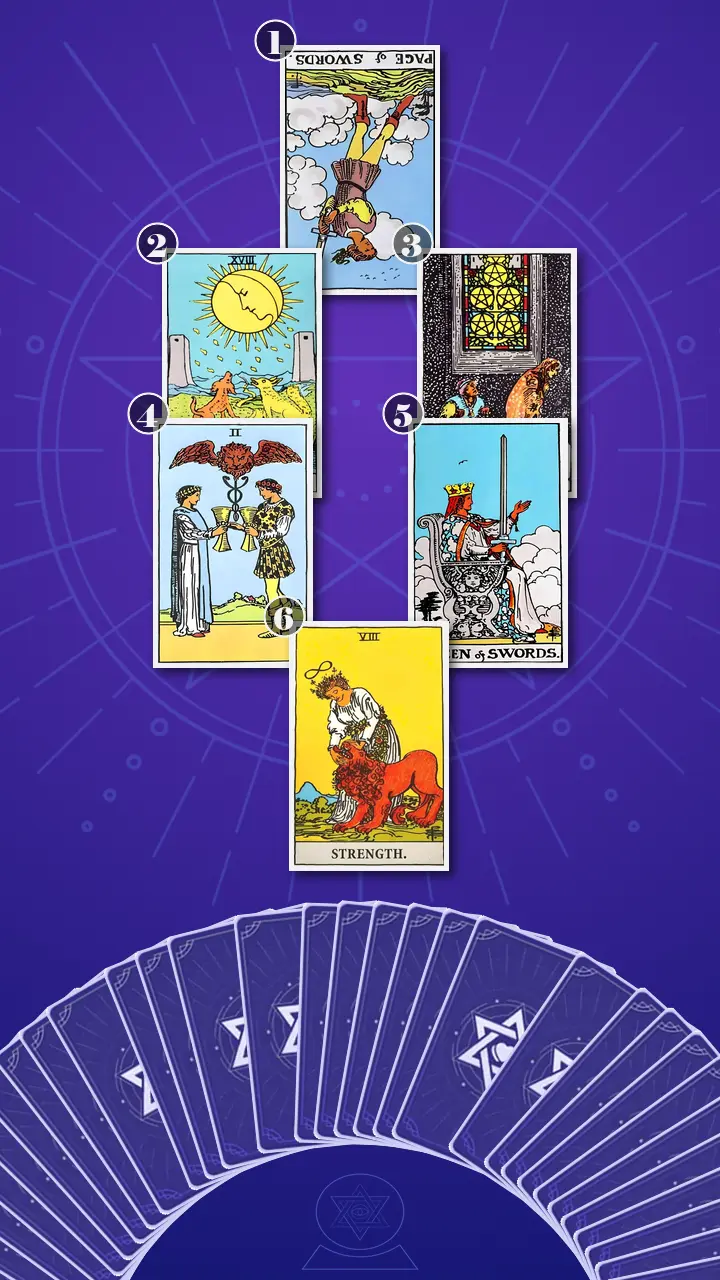
For this, I used my original method: the Four-Layer Insight Ladder · Context Edition—a Four-Layer Insight Ladder tarot spread for post-apology silence and shame spirals.
Here’s why this spread works (and how tarot works in moments like this): Alex wasn’t asking for a prediction. She was stuck inside an inner mechanics problem. A ladder structure is perfect when you need to separate: what you do on the surface, what you assume in the gap, what older wound gets touched, and what practical communication boundary can bring you back to self-trust.
I told her what we’d be looking at: the first card would show her surface pattern (what she does with her phone, her hands, her attention). Then we’d name the activated meaning (the story her mind assigns to silence). Then we’d touch the old shame root. And finally, we’d move into a clean next step and an integration practice—the part that makes change possible in the real world.
Reading the Map: When “No Reply Yet” Becomes a Whole Trial
Position 1: Surface pattern — what you do after you’ve apologized and they go silent
Now turning over is the card that represents your surface pattern: what you do (observable behaviors) after you’ve apologized and they go silent.
Page of Swords, reversed.
It landed like a screenshot of her commute: phone unlocked in her palm, refreshing the thread like it’s live news. Rereading her apology and tone-policing herself—comma by comma—then opening Notes to draft a “better” version. The Page is vigilance; reversed, it becomes surveillance. Not of them, exactly—but of yourself. Every word gets cross-examined.
Energetically, this is blockage: Air (mind, messaging, analysis) running too hot and too jittery to tell the truth from the fear. The checking feels like control. It’s actually a way to stay braced for impact.
I let it get very specific, because that’s where the spell breaks. “It’s like you’re rereading your apology like it’s a legal document,” I said, “trying to find the one line that will prove you’re a good person.”
Alex gave a short laugh—sharp and a little bitter. “That’s… awful,” she said. “Also, yeah. That’s exactly it. Like it’s rude how accurate that is.”
Position 2: Activated meaning — what their silence symbolizes to you in the moment
Now turning over is the card that represents your activated meaning: what their silence symbolizes to you in the moment.
The Moon, upright.
The Moon is what happens when there’s not enough information, and your nervous system tries to finish the story anyway. Alex sees “active 5 minutes ago” and her mind fills in the blanks: They’re ignoring me. They’re done. They’re telling someone else about how annoying I am. Her stomach drops as if she’s been rejected—despite the fact that all she actually has is ambiguity.
Energetically, this is excess: Water (emotion, intuition, imagination) overflowing into projection. The silence becomes a projector screen, and the worst-case story starts playing on loop.
I described it the way it shows up in real life—like a thriller montage: the blue glow of a screen in a dark bedroom, a thumb pulling down to refresh, rereading one line like it’s evidence. And then the inner monologue clicks in like an auto-generated script: “If they don’t reply, it means I made it worse. If it means I’m too much, then I have to fix it right now.”
I paused and gave her one of my plainest anchors: “Silence isn’t proof. It’s ambiguity—and ambiguity is where your old story gets loud.”
Her eyes dropped to the card. She stopped moving her phone in her hand, like she’d suddenly realized she’d been gripping it the whole time.
Position 3: Old shame root — the earlier belonging/worth story being replayed underneath
Now turning over is the card that represents your old shame root: the earlier belonging/worth story being replayed underneath.
Five of Pentacles, upright.
In the card, two figures move through snow while warm light shines behind stained glass. It’s not just “I’m uncomfortable.” It’s I’m outside. Support exists—but your shame says it’s not for you.
I translated it into her Toronto life: walking past a warm-lit café on Queen West, slush and salt underfoot, and thinking, “Everyone else gets warmth. I get iced out.” That same cold hits when her apology sits unanswered. The Five of Pentacles doesn’t whisper “They need time.” It shouts, “You’ve been exiled.”
Energetically, this is deficiency: Earth (belonging, stability, safety) feels scarce. So your system tries to earn warmth through labor—extra apologies, extra explaining, extra shrinking.
Alex’s mouth twisted into a smile that wasn’t happy. “It’s like… I didn’t just mess up,” she said quietly. “I got disqualified.”
I nodded. This is where my family’s way of reading always returns to the body and the seasons. In the Highlands, winter isn’t punishment—it’s the season where there’s less signal. Less warmth. Old survival instincts get louder. “Of course your nervous system calls this an emergency,” I told her. “It learned that quiet meant cold.”
Position 4: True intention — what your apology was genuinely trying to create
Now turning over is the card that represents your true intention: what your apology was genuinely trying to create or protect.
Two of Cups, upright.
This card is mutual recognition. Equal exchange. Repair as meeting in the middle.
I said, “Two of Cups is the part of you that wasn’t auditioning. You were reaching for respect. For closeness that doesn’t require you to beg.”
And then I named it clearly, because this is where a lot of people get stuck: “A clean apology is an invitation—not an audition for instant forgiveness.”
Alex inhaled like she’d been holding her breath since she hit send. “That’s what I wanted,” she said. “Not… this courtroom thing.”
Position 5: Clean next step — how to communicate with clarity and boundaries without chasing
Now turning over is the card that represents your clean next step: how to communicate (or not) with clarity and boundaries without chasing reassurance.
Queen of Swords, upright.
The Queen doesn’t perform. She speaks once, clearly, and then she stops feeding the spiral.
I framed it the way she’d actually use it: “This is you drafting one follow-up—two sentences max—no new apology, no essay, no ‘just to clarify.’ You send it or you don’t. And either way, you close the app. You stop being on-call for the response.”
Energetically, this is balance: Air matured. Precision over pleading. Truth over mind-reading.
I even gave her the line, because sometimes relief is having words you can stand behind: “Clarity is not chasing. It’s choosing one sentence you can stand behind.”
Alex nodded fast—like she was taking a mental screenshot. “I can do two sentences,” she said. “I can’t do… whatever I’ve been doing.”
When Strength Spoke: Holding the Lion Instead of Texting It
Position 6: Integration — the inner capacity to practice so you can tolerate uncertainty
The room got very still when I reached for the final card. This one isn’t about what to say. It’s about what you become while you wait.
Now turning over is the card that represents your integration: the inner capacity to practice so you can tolerate uncertainty and stay self-respecting.
Strength, upright.
Here was the setup, exactly as she’d lived it: that moment on the TTC when her apology is sitting there—delivered, maybe even read—and every time her screen lights up she feels her throat tighten like she’s about to be judged again.
Stop treating silence like a sentence—practice Strength by gently holding your inner lion until you can respond with self-respect.
I let the sentence hang there for a beat.
Alex’s reaction came in layers. First, her breathing froze—like her lungs forgot their job for half a second—and her thumb hovered over her phone without moving. Then her eyes unfocused, not on me, not on the card, but somewhere behind both of us, as if her brain was replaying every “no reply” gap it had ever mistaken for exile. Finally, she exhaled, long and shaky, and her shoulders dropped an inch like a coat sliding off.
“But… if I stop treating it like a sentence,” she said, and there was a flash of anger underneath the vulnerability, “doesn’t that mean I’ve been wrong this whole time? Like I’ve been making it all up?”
I didn’t rush to soothe her out of it. I honored it. “It means your system has been trying to protect you with an old script,” I said. “Not that you’re stupid. Not that you’re dramatic. It’s just a pattern.”
This is where I used my Relationship Pattern Recognition—not as a label, but as a lantern. “I see the recurring script,” I told her. “Apology → silence → ‘I’m unworthy’ → control attempt. The control attempt can look like overexplaining, or it can look like disappearing. Either way, it’s the same shame story running the show.”
I leaned closer to the table and softened my voice. “Strength is not ‘be chill.’ Strength is soothing intensity. The lion is that shame-panic. It’s loud, it’s physical—jaw tight, throat tight, hands restless. But it’s not a command you must obey.”
Then I asked her, exactly as I always do when the card hits home: “Now, with this new lens—can you think of one moment last week when the silence showed up, and this perspective could have changed how you felt?”
Alex swallowed. Her hand went to her chest without thinking. “Yesterday,” she said. “I saw they were active and I… I literally started drafting a fourth apology. Like—fourth. And I hated myself while doing it.”
“That’s the gap,” I said. “Not a trial. A gap. And you can practice being steady inside it.” In that moment, I could feel the emotional shift beginning: from shame-tight spiraling and reassurance-chasing to grounded self-compassion and self-respecting communication. Not perfect. But real.
The Repair-Without-Chasing Protocol: Next Steps You Can Actually Do
I pulled the whole ladder together for her, as a single story—because clarity comes from sequence, not from scattered advice.
The Page of Swords reversed showed how Alex’s hands and attention go into surveillance mode the minute uncertainty appears. The Moon showed how quickly ambiguity becomes a story factory—mind-reading the silence until it feels like proof. Five of Pentacles named the true root: an old belonging wound that translates “mistake” into “exile.” Two of Cups reminded us the apology’s real purpose was mutual respect, not self-erasure. Queen of Swords offered the practical pivot: one clean line, one calm boundary. And Strength anchored it all: soothe the inner alarm so you don’t text from panic.
The cognitive blind spot was simple and brutal: Alex had been treating response time like a verdict on her worth—like a KPI in a relationship performance review. That’s not attachment theory. That’s just modern life + an old shame story + a phone that never stops lighting up.
The transformation direction was equally simple: move from trying to earn reassurance through over-explaining to practicing self-trust through one clear repair attempt and a calm boundary.
Then I gave her a small, practical plan—nothing that required a personality transplant. Just next steps.
- The Two-Sentence QueenIf a follow-up is truly needed, write it in Notes first (not in the message thread). Two sentences max: “I meant what I said in my apology. I’m going to give you space, and I’m here to talk when you’re ready.”Expect your brain to call this “cold.” That’s the shame story shopping for certainty. Wait 10 minutes after drafting, then decide.
- The 24-Hour No-Double-Text BoundaryAfter you send the follow-up (or choose not to), close the app and set a 24-hour “no more messages” rule. Put a calendar reminder for tomorrow at the same time to reassess with a clear head.Clarity isn’t control; you’re not forcing a response, you’re protecting your side of the street.
- The Strength Reset (90 seconds)Before you check your phone again: inhale for 4, exhale for 6. Drop your shoulders. Unclench your jaw. Then name it: “This is shame-panic, not a verdict.”If 90 seconds feels impossible, do three slow exhales. This is practice, not punishment.
And because conflict repair is still about two humans, not just one nervous system, I offered one optional add-on from my own toolkit: a couple breathing sync exercise for when they do come back to talk. “If you end up having the conversation,” I said, “try two minutes of breathing together before words—four in, six out. It changes the whole temperature in the room. Not magic. Physiology.”
If you want to take it one notch further, you can even schedule the actual repair talk when you both have bandwidth—Alex laughed when I said “moon cycles,” so I translated it into what I mean in 2026: pick a night you’re not depleted, not mid-doomscroll, not between meetings. Put it on the calendar like it matters.

A Week Later: The Quiet Proof
A week later, Alex messaged me. Not a paragraph—two lines.
“I sent the two-sentence follow-up. Then I put my phone on Do Not Disturb for 24 hours. I felt like I was crawling out of my own skin for the first ten minutes… and then it got weirdly quieter.”
Her bittersweet detail mattered most: she told me she sat alone in a Queen West café afterward, hands around a hot mug, watching other people talk and laugh. She didn’t feel “cured.” Her first thought the next morning was still, What if I messed it up?—but this time she exhaled and didn’t pick up her phone.
That’s the Journey to Clarity, in real life. Not certainty on demand—ownership, steadiness, and one choice you can respect when the gap tries to swallow you.
When someone goes quiet after you’ve apologized, it can feel like you’re standing outside a closed door, holding your breath—trying to decide whether to knock again or disappear, because either way the silence feels like it’s grading your worth.
If you didn’t have to earn your way back inside, what would one self-respecting, two-sentence version of “repair” look like for you today?
This story is adapted from psychological research, written so that those in a similar struggle can see their own pattern in it — and find their next step clearly.These insights are not a substitute for professional psychological, medical, legal, or financial advice.
Learn more about our Journey to Clarity.
How did this insight land for you?
🫂 This Resonates Deeply
🌀 Living This Story
✨ Now I See Clearly
🌱 Seeing New Possibilities
🧰 Useful Framework
🔮 The Confirmation I Needed
💪 Feeling Empowered
🚀 Ready for My Next Step
Author Profile
 AI
AI“As the seventh generation of a Highland healing family, I see modern anxieties as a simple, temporary disconnection from nature's rhythm. I bring 67 years of lived seasons not to instruct you, but to hold space for you. Using tarot as a mirror, I want to gently guide you out of the chaos, helping you breathe deeply and rediscover the organic, steady heartbeat of your own life.”
In this Love Tarot Reading :
Core Expertise
Service Features
Also specializes in :
Explore Related Patterns:
Compulsive CheckingAlex's hand keeps moving from Messages to Instagram and back again, with the phone becoming the place where the whole relationship seems to be decided. The checking starts as a search for information, but the story shows it turning into a threat-monitoring ritual: read status, active status, wording, silence, repeat. Compulsive Checking fits because the behavior is not neutral curiosity. It is an attempt to regulate shame through surveillance, as if one more refresh could give her the certainty her body is craving. The more she checks, the more the gap feels loaded, and the more her attention collapses around the screen. You can see the loop break when she puts her phone on Do Not Disturb for 24 hours and feels like she is crawling out of her own skin before the system gets quieter. That detail matters because it shows the checking was functioning like a short-term anxiety release, not a real repair strategy.
Defensive OverexplainingAlex rereads her apology like a legal document, policing the tone comma by comma and drafting a better version in Notes. By the time she names the fourth apology, the behavior is no longer just careful repair; it has become an attempt to litigate her own goodness through wording. Defensive Overexplaining fits because the extra language is trying to do emotional protection work. If she can find the perfect clarification, maybe she can stop the other person from misunderstanding her, stop the shame from escalating, and prove she is not the bad person the silence seems to imply. The story gives the antidote through the two-sentence boundary: one clean line, no essay, no new apology, then closing the app. That does not make the repair colder; it makes it cleaner. You are allowed to communicate clearly without turning your self-worth into a closing argument.
Mind ReadingAlex sees that the other person was active online, and her mind immediately supplies the missing script: they are ignoring her, they are done, they are telling someone else she is annoying. The story is careful about the evidence: what she actually has is ambiguity, but the nervous system fills the blank with motive, rejection, and social judgment. Mind Reading is the right pattern because the pain comes from treating an unknown inner state as if it has already been confirmed. Silence becomes a screen for projection, and the absence of a reply starts carrying details the other person never actually gave. You do not have to shame yourself for this reflex. The pattern is a protective prediction machine trying to get ahead of humiliation, but it costs you reality testing. The practical shift is to name the difference between data and story before you respond from the story.
Rejection SensitivityAlex's body reacts to the unread or unanswered apology as if rejection has already been delivered. The active status, the silence, and the lack of immediate repair all get pulled into one conclusion: she has been iced out, disqualified, or pushed outside the door. Rejection Sensitivity fits because the trigger is ambiguous, but the response is immediate and intense. A delayed reply is processed as interpersonal danger before there is enough evidence to know what the other person means, and the old belonging wound makes the interpretation feel urgent. The key is not to argue yourself out of feeling hurt. It is to notice when your system has moved from possibility to certainty too quickly. That pause gives you room to respond from self-respect instead of trying to outrun a rejection that has not actually been confirmed.
Relationship Performance AnxietyAlex's apology stops feeling like a human repair attempt and starts feeling like a performance review. Response time becomes a score, wording becomes evidence, and the silence feels like the other person is grading whether she is acceptable. Relationship Performance Anxiety fits because the central fear is not only that the conversation went badly. It is that every relational cue is measuring her worth. The apology becomes an audition for instant forgiveness, which turns repair into pressure and makes waiting feel unbearable. The story's cleanest correction is that a clean apology is an invitation, not an audition. You can take responsibility without performing emotional perfection, and you can let the other person have time without turning that time into a verdict on who you are.
Shame BindingAlex's apology sitting unanswered does not stay a simple message gap; it turns into the feeling of being outside a warm room, with the unanswered text functioning like evidence that she has been disqualified. The clearest line is her own: she did not just feel she messed up, she felt she got disqualified. That is the mechanism of Shame Binding: a specific event gets fused with a global verdict about worth. Instead of reading silence as limited information, the old story attaches it to belonging itself, so the nervous system tries to earn its way back through more apologies, more explaining, and less self. You can see the pattern because the shame story has a full sequence: apology, silence, 'I'm unworthy,' then a control attempt. The repair work is not to pretend the silence feels fine, but to unbind the event from the identity sentence so one unanswered message no longer gets to define whether you deserve warmth, respect, or return.
Assertive CommunicationAlex's next step is deliberately small: one possible follow-up, two sentences max, no new apology, no essay, and then the app closes. That structure matters because it protects the original intention of repair without letting panic take over the conversation. Assertive Communication fits the upright side of the story because the goal is not silence, punishment, or emotional withdrawal. The goal is a clear message that respects both people: she can own her apology, give space, and stay available without chasing reassurance. You can feel the shift from self-erasure to self-respect in the 24-hour no-double-text boundary. It does not control whether the other person replies. It simply gives Alex a way to stop making her nervous system available for endless negotiation.
Self-SoothingAlex's throat tightens, her hand hovers over the phone, and her body acts like the silence is a sentence. The intervention does not begin with a better text; it begins with a breath, a dropped shoulder, an unclenched jaw, and the sentence, 'This is shame-panic, not a verdict.' Self-Soothing fits because the work is to regulate the alarm before it becomes a command. The story names the intensity directly, but it also separates intensity from instruction: the panic is loud and physical, yet it does not have to decide what she sends next. You can see the pattern taking root a week later, when her first thought is still 'What if I messed it up?' but she exhales and does not pick up the phone. That is not instant certainty. It is a practiced return to steadiness inside the gap.
Explore Related Struggles:
Earned Love BindAlex starts reaching for more labor the moment warmth feels scarce. Extra apologies, extra explaining, extra shrinking, and even a fourth draft become ways to pull reassurance out of a silent channel. Earned Love Bind captures the hidden contract inside that motion. You are trying to make yourself acceptable enough to be answered, so repair stops being a mutual meeting and becomes an audition for instant forgiveness. The story's cleanest shift is from labor to dignity. A self-respecting apology can still be sincere when it does not keep paying more of your selfhood for a reply.
Inner Tribunal LockAlex rereads her apology comma by comma, as if the message thread has turned into a legal file. Her throat tightens like she is bracing for a grade, and every sentence gets searched for the line that might prove she is still a good person. Inner Tribunal Lock names the way repair gets dragged into self-prosecution. You are not only waiting for the other person to respond; you are being made to stand inside an inner courtroom where silence feels like evidence and uncertainty sounds like a sentence. The pressure starts to loosen when the apology is allowed to be an invitation rather than a trial exhibit. One clear message can be enough even when the old judge in your head wants another explanation.
Projection-Connection SplitAlex has very little information, but the silence quickly becomes a projector screen. Active status turns into they are ignoring me, the delayed reply turns into they are done, and the gap fills with scenes no one has confirmed. Projection-Connection Split fits the moment where the wish for connection is replaced by a story about connection. You are still reaching for the other person, but the mind starts interacting with its own worst-case montage instead of the actual relational facts. The useful move is not to shame the projection. It is to name the gap as a gap, so your next communication comes from what you know rather than from the script that quiet always means cold.
Read Receipt Worth LockAlex keeps flicking Messages to Instagram to Messages while her apology sits unanswered, and the thin facts of the screen start carrying the weight of a verdict. Delivered, Read, and active status do not give her an actual answer, but her body reacts as if the relationship has already judged her. Read Receipt Worth Lock fits because the delay becomes more than a delay. You are watching response time get fused with belonging, so every minute without a reply feels like evidence that you made it worse, became too much, or lost your place with them. The reclaimable point is that the screen can show timing, not worth. Once that distinction becomes visible, repair can return to one clean attempt and one calm boundary, instead of becoming an endless audit of whether you still deserve connection.
All-or-Nothing BelongingAlex does not experience the unanswered apology as ordinary discomfort. The story keeps returning to outside images, a closed door, snow, a warm-lit cafe, and the line that support exists but shame says it is not for her. All-or-Nothing Belonging fits because a single relational gap becomes total status loss. You are not just wondering whether they need time; you are being pulled into the old equation where a mistake means exile and imperfect repair means disqualification. Seeing the equation matters because it separates the present gap from the old belonging rule. You can want repair without accepting the idea that you must earn your way back inside from zero.
Monitoring-Safety FusionAlex's hands keep returning to the phone because checking feels like the only available grip on the situation. Messages, Instagram, Messages again, brightness turned down, thread refreshed like live news, all of it gives the body a task while the relationship stays unresolved. Monitoring-Safety Fusion names the bind where surveillance starts posing as steadiness. You are not getting safety from the checking; you are staying braced for impact, training your attention to treat every status change as a signal you must manage. The 24-hour Do Not Disturb boundary matters because it proves that not checking can be a form of self-trust rather than abandonment. The phone can stop being the place where your worth is monitored minute by minute.
Explore Related Emotions:
Belonging ShameThe Five of Pentacles image lands because Alex already feels outside: snow, stained glass, warm light behind the window, and the line Everyone else gets warmth. I get iced out. Her unanswered apology touches a much older place where a mistake does not feel like a moment; it feels like being moved outside the circle. Belonging Shame fits because the pain is organized around access, warmth, and worth. You are not only wondering whether someone needs time; you are feeling the old story that support exists but may not be for you. The label keeps the focus on the story being activated, so repair does not have to become self-erasure.
Quiet Self-RespectThe Queen of Swords moment is concrete: two sentences max, no new apology, no essay, no just to clarify, and then the app closes. Alex is not asked to become indifferent; she is asked to stop making her dignity dependent on chasing a reply. Quiet Self-Respect names the steady feeling that appears when repair has a boundary. You can still care, still leave the door open, and still refuse to keep auditioning for instant forgiveness. In this story, that quiet is active: it protects the part of you that wants connection without asking you to disappear into it.
Shame SpiralAlex keeps flicking Messages → Instagram → Messages, then opens Notes to draft a better apology while the unanswered message sits there like a file under review. The behavior gives the silence more and more authority: every refresh becomes another chance to decide whether you are safe to belong, and every draft tries to reduce the feeling by making the apology more airtight. That is why Shame Spiral fits. The feeling is not only regret for possibly hurting someone; it is the body moving from repair into self-prosecution, where a gap in response time starts to sound like proof that you are too much, disqualified, or outside the room. Naming it gives you a lever: you can separate a clean apology from the old story that says your worth must be earned through constant correction.
Verdict DreadEvery time Alex sees the apology untouched, her throat tightens like she is bracing for a grade, and later the story names response time as a verdict on her worth. The silence is no longer just a pause between two people; it becomes a sentence handed down inside her body. Verdict Dread captures the way waiting starts to feel like being evaluated. You are pulled into a courtroom logic where the right comma, the right follow-up, or the right amount of remorse might decide whether you are still a good person. Seeing that logic clearly helps you step out of the trial and back into one grounded repair attempt.
Cautious Self-TrustA week later, Alex’s first thought is still What if I messed it up?, but this time she exhales and does not pick up her phone. That detail matters because the old pull is still present, yet her body makes one different choice inside it. Cautious Self-Trust fits the fragile stage after insight, when you are not fully calm but you are no longer obeying every alarm. You trust yourself in inches: one exhale, one closed app, one decision to reassess with a clearer head. It is not certainty; it is the first evidence that your own center can hold.
Clarity ReliefThe reading turns scattered pain into sequence: surface pattern, activated meaning, old worth story, clean next step, and integration. Alex stops moving the phone in her hand when the silence is named as ambiguity rather than proof. Clarity Relief fits because the relief comes from structure, not from getting the reply. You can finally see the difference between what happened, what your mind added, and what action still belongs to you. That clarity does not erase the ache, but it gives you enough shape to stop drowning in it.
Read Receipt AnxietyThe story begins with the Delivered or Read check becoming the center of the room: warm phone, dimmed screen, Messages to Instagram and back again. You are not simply waiting for a reply; you are watching a tiny status marker as if it can tell you whether repair is still possible. Read Receipt Anxiety names that specific modern pressure. The device turns ambiguity into a dashboard, so your body starts scanning for updates before your mind has any real information. When the label is precise, the problem gets smaller: the read receipt is a cue, not a court record.
Rejection ChillAlex’s body treats the silence as cold before the facts are clear: throat tight, stomach dropping, slush and salt underfoot, warm light visible but out of reach. The phrase I get iced out gives the waiting period a physical temperature. Rejection Chill fits because the hurt arrives as a sudden drop, not a completed relational fact. You can feel pushed outside before anyone has actually closed the door. The label gives that cold snap a boundary, so the body’s first weather report does not have to become the whole story.
Hard-Won ComposureWhen the Strength card lands, Alex first freezes, then exhales long and shaky, and her shoulders drop an inch. Later, the first ten minutes of Do Not Disturb feel like crawling out of her own skin before the room gets quieter. Hard-Won Composure names that earned steadiness. It does not pretend waiting feels easy; it tracks the moment your body is still loud, but you stop treating intensity as an order. The feeling is composure with fingerprints on it, built through breath, jaw unclenching, and not sending the next message from the peak of the alarm.
Relational UrgencyAlex’s inner script moves fast: If they do not reply, I made it worse; if I am too much, I have to fix it right now. That speed is visible in the fourth apology draft, the hovering thumb, and the sense of being on-call for the other person’s response. Relational Urgency is the pressure to close the gap before the gap has actually spoken. You are not only longing for contact; you are trying to outrun the discomfort of not knowing where you stand. Naming the urgency lets you slow the repair back down to something mutual: one clear message, then space.
Self-Audit AnxietyPage of Swords reversed shows Alex rereading her apology like a legal document, tone-policing herself comma by comma, and looking for the one line that will prove she is a good person. Her attention turns inward, but not in a kind way; it becomes surveillance of every word, every implication, every possible flaw. Self-Audit Anxiety names the restless feeling of being both the accused and the examiner. You are trying to make yourself safe by finding the mistake before anyone else does, but the audit has no natural endpoint. Once it is named, you can ask a better question: whether another revision would create clarity, or only feed the loop.
Explore Related Contexts:
Read Receipt PressureOn the TTC, you keep moving from Messages to Instagram and back while Delivered and Read stay unchanged. The thread stops behaving like a conversation and starts behaving like a live status board that keeps asking for another check. That is the external pressure here: the interface gives you enough signal to keep monitoring, but not enough information to move the exchange forward. When a reply is visible as a status but not yet present as a response, the screen itself becomes the place where the tension collects.
Trust Rebuilding TrialYou have already apologized, so the exchange has moved from wording into repair. The story keeps that repair in a narrow window: one clean follow-up, then space, with no extra proof demanded from the same message thread. That makes the situation a trial of whether the connection can reopen without turning into self-erasure. The boundary is not about forcing a reply; it is about holding a clear repair offer long enough for the other side to meet it or leave it unresolved on its own.