Why Do I Handle Everything Alone?

A clear look at workplace hyper-independence, the tarot cards reflecting it, and Tarot Reading Insights from this pattern.

Workplace Hyper-independence
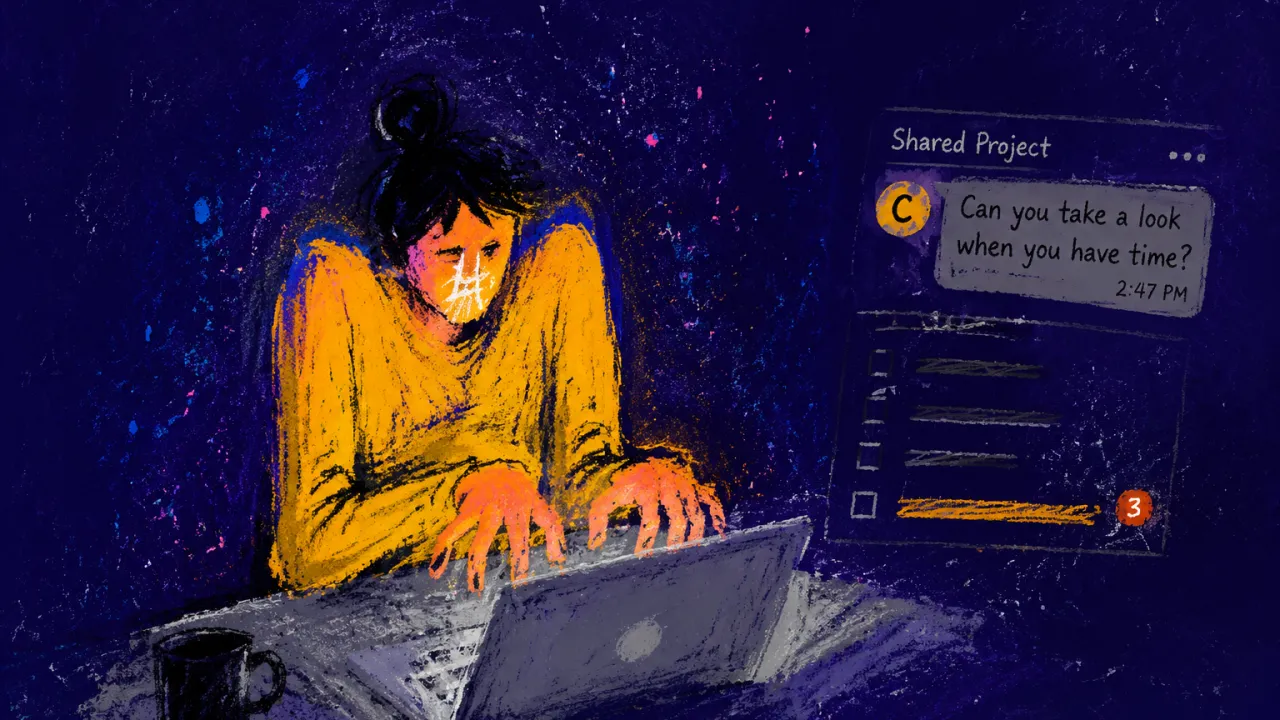
A figure with both hands over a laptop keyboard, shoulders lifted, amber light narrowing across a cool grey workspace.

What is this really?

You take on every task yourself, solve problems before asking for input, and say 'I've got it' even when your workload is already full. You are trying to protect a sense of competence and control, avoiding the cognitive dissonance of needing support while telling yourself you can handle it. Yet the same self-reliance can leave you carrying every responsibility with your view blocked by the load, like the figure in the Ten of Wands.

Why did it happen?

Earlier in your working life, being the person who handled things without asking may have kept projects predictable and spared you the uneasy feeling of being let down, corrected, or exposed. Now the subconscious loop can repeat itself: you take over, others get fewer chances to share the load, and your quiet competence leaves you mentally drained while people around you assume you still have room for more.

How does it feel?

  • When a teammate offers to take one section of a shared project, you give a quick smile, say 'I've got it,' and keep typing after the meeting ends. A few minutes later, your shoulders stay lifted and your breathing turns shallow as you scan the task list alone. You can let that response be present without deciding anything yet.
  • When a manager asks what would make a deadline workable, you nod, say 'all good,' and open another tab before the conversation is finished. Afterward, your jaw feels set and your eyes keep jumping between tabs even though the call has ended. You can notice the sensation without forcing it into an explanation.
  • You draft a Slack message asking for clarification, delete the question, replace it with a complete update, and press send. The screen stays bright while your chest feels heavy and your breath remains shallow. It is okay to pause with that feeling before deciding what it means.
  • After receiving edits on your work, you nod, write down every change, and close the document instead of asking which point matters most. In the quiet that follows, your shoulders drop but your stomach stays tight as you reopen the file. You can leave the moment unnamed while you notice it.
  • At home after the workday, you keep your laptop open, move tomorrow's tasks into tonight, and decline a coworker's offer to split the remaining work with a small 'No worries.' Once the room is quiet, your eyes feel dry and your hands keep moving even as your focus slips. Allow the pause to exist without turning it into a verdict.

Workplace Hyper-independence in Tarot Cards

Workplace hyper-independence can look like saying 'I've got it' while your shoulders stay lifted and your breathing turns shallow. Jungian archetypal theory offers a way to understand this inner pattern. The Tarot Cards below mirror its unconscious dynamics; here are the cards connected to workplace hyper-independence.

The Emperor
Reversed
The Emperor's stone throne, rigid posture, scepter, and orb create an image of order secured through centralized authority. Reversed, that structure shows how control can become inflexible, with every variable managed as though loosening the grip would threaten the whole system. At the level of identity, you may confuse being the person in charge with being the only person who can safely carry the work. The pattern can therefore turn useful self-accountability into overcontrol, limiting the cognitive upgrade from individual competence to distributed capability.
The Hermit
Upright
The Hermit raises a lantern in one hand and steadies himself with a staff while standing apart from the landscape. The image can represent reflective clarity, but it also shows how a private source of guidance becomes restrictive when no outside perspective is allowed into the process. You may trust self-generated answers because they protect you from correction and preserve the feeling of competence. Observing that preference creates psychological distance from the pattern, revealing when solitude is thoughtful and when it is functioning as avoidance of support.
The Hanged Man
Reversed
The figure hangs upside down from one leg, with his hands free and a calm halo around his head. Reversed, the image suggests resistance to the pause and perspective shift that would loosen a fixed identity built on handling everything alone. Your growth system can mistake surrendering control for losing competence, so insight stays theoretical while the same workload behavior repeats. The pattern becomes visible when reflection asks not only how much you can carry, but what belief requires you to carry it.
Four of Cups
Upright
The seated figure crosses their arms while a fourth cup enters the scene from a cloud, yet the offer receives no response. The posture mirrors the moment when support is visible but your attention remains attached to proving that you can continue alone. You may register the refusal as politeness or efficiency before noticing the underlying discomfort. The pattern uses disengagement to avoid the cognitive dissonance of needing help while seeing yourself as fully capable, leaving the emotional signal unprocessed and the workload unchanged.
Two of Pentacles
Upright
The worker keeps two pentacles moving inside an infinity loop while unpredictable waves and ships fill the background. The image captures a role that remains functional only through constant personal adjustment, with no visible place for another set of hands. You may use that adaptability to avoid disclosing that the workload is full. The cycle protects your professional image in the short term, while the workplace interprets your continued motion as available capacity and sends the next responsibility in your direction.
Reversed
The figure keeps two pentacles moving inside an infinity loop while ships rise and fall behind him. In the reversed position, the rhythm no longer looks adaptive; it shows a self-reliant system trying to stabilize too many demands without asking which task can be shared. You may call the strain flexibility because every item is still in motion. The defense protects an image of competence, yet the slipping balance makes the cost visible in missed meals, fragmented attention, and a home routine organized around work recovery.
Three of Pentacles
Reversed
The craftsman works beneath a carved structure while two people hold the plan and observe the result. Reversed, the shared design process loses alignment, showing how your private competence can interrupt the very collaboration that would distribute responsibility. You may finish a section before anyone can review it because asking early would reveal uncertainty. That defense protects your professional image in the moment, but it limits feedback, weakens team learning, and teaches the workplace to route more work back to you.
Four of Pentacles
Upright
The figure's arms, feet, and head all secure a separate coin, creating a body organized around gripping and containment. That physical closure gives form to a mental rule that control must be maintained before any support can be trusted. You may notice the rule as jaw tension, shallow breathing, or an immediate urge to say you have everything handled. The defense is not a verdict about your character; it is a learned way to prevent uncertainty, although it also keeps useful information and assistance outside your awareness.
Six of Pentacles
Reversed
The figure with the scales distributes coins toward people who must receive them. Reversed, the scene exposes an unequal exchange and the discomfort of occupying the receiving position, which can make support feel like a loss of status rather than a resource for development. You may pursue self-improvement through increasing output while avoiding the relational practice of accepting guidance or shared effort. The pattern blocks a broader definition of competence, because growth remains tied to proving that you need no one else.
Eight of Pentacles
Upright
The artisan sits at a bench, hammering one pentacle after another while the finished pieces line the wall. The concentrated craft shows how competence can become a private production system, especially when you believe quality depends on your hands alone. You may solve before consulting, absorb adjacent tasks, and interpret a request for input as a risk to your standards. The pattern rewards visible output in the short term while quietly teaching the workplace to rely on your overcapacity.
Nine of Pentacles
Upright
The solitary figure moves through a cultivated garden beside a hooded falcon, surrounded by the results of her own care. Upright, the scene honors earned self-sufficiency, but it also shows how competence can become an identity with no obvious place for interdependence. You may pursue growth by making yourself increasingly self-contained, then use each success as evidence that support is unnecessary. The developmental tension is between autonomy as a resource and autonomy as a rule that blocks collaboration, feedback, and shared responsibility.
Four of Swords
Reversed
The recumbent figure lies in a chapel with hands composed while swords remain suspended above him. Reversed, the stillness becomes an interrupted recovery state, with the body placed at rest but the mind still protecting every unresolved work obligation. You may continue checking messages or mentally rehearsing solutions because stepping away would require trusting someone else with the outcome. The career system receives more effort, but it loses the clear judgment and sustainable pace that recovery would have supported.
Nine of Wands
Upright
The bandaged figure stands behind a fence of wands, holding one upright while watching the space ahead. His body combines fatigue with readiness, showing how previous strain can keep the nervous system prepared for another demand even when immediate danger is absent. You may respond to an offer, edit, or question by tightening your control and doing more yourself. That vigilance protects against feeling let down or exposed, but it also makes exhaustion harder to distinguish from responsibility.
Ten of Wands
Upright
The carrier's face is hidden behind ten wands as he strains toward the town. The physical load directly mirrors a career structure in which you absorb every responsibility, making visible output the proof that you remain competent and in control. You keep moving before asking for input because dependence feels like exposure to correction or disappointment. The pattern converts reliability into overcapacity, so the workplace benefits from your effort while your view of role limits, advancement, and sustainability becomes increasingly obscured.
Reversed
The carrier bends beneath a bundle that blocks his face and restricts his line of sight. Reversed, the image represents the point at which a productivity identity can no longer hide the need to redistribute effort, even though releasing the burden may feel like giving up competence. You can identify the growth barrier in the gap between knowing that support would help and continuing to take over. The pattern keeps development focused on carrying more efficiently instead of examining the belief that capable work must be completed without shared responsibility.

Workplace Hyper-independence in Tarot Card Reading Insights

For anyone who keeps saying 'I've got it' and carrying the work alone, others have brought workplace hyper-independence into readings too. Below are Tarot Reading Insights from those readings.
Psychological Patterns Related to Workplace Hyper-independence