Therapist-Friend Burnout at 10:47 p.m.
If you are the meeting-heavy young professional who answers 'Are you awake?' before checking whether you have eaten, therapist-friend burnout may already be taking over the hours you thought belonged to you.
Maya (name changed for privacy), a 27-year-old marketing coordinator in Toronto, appeared on my screen holding a phone that seemed to have become an extra limb. Behind her, a work laptop cooled on a narrow table while the kettle clicked off.
At 10:47 the previous night, she had been about to make dinner and read. Then a friend's three-minute voice note became an eight-minute reply and two follow-up calls. After midnight, her groceries were untouched, her jaw was locked, and her own message asking for support remained a draft. 'I want friends, not a caseload,' she told me.
What she described felt less like ordinary tiredness and more like holding a heavy door open with both shoulders while everyone walked through. Resentment rose when another request arrived; guilt immediately pushed it back down. The result was a lonely kind of usefulness.
'You are allowed to be a friend, not an on-call emotional service,' I said. 'We are not here to decide that your empathy is the problem or that your friends are villains. We are here to find out why care has become compulsory, then give you enough clarity to choose what happens next.'

Choosing the Crossing: The Five-Card Bridge
I invited Maya to take one slow breath and hold the question, 'Why am I everyone's free therapist in my friend group?' I shuffled while she noticed the pressure of her feet on the floor. The pause was not a mystical performance; it was a transition from reacting to observing.
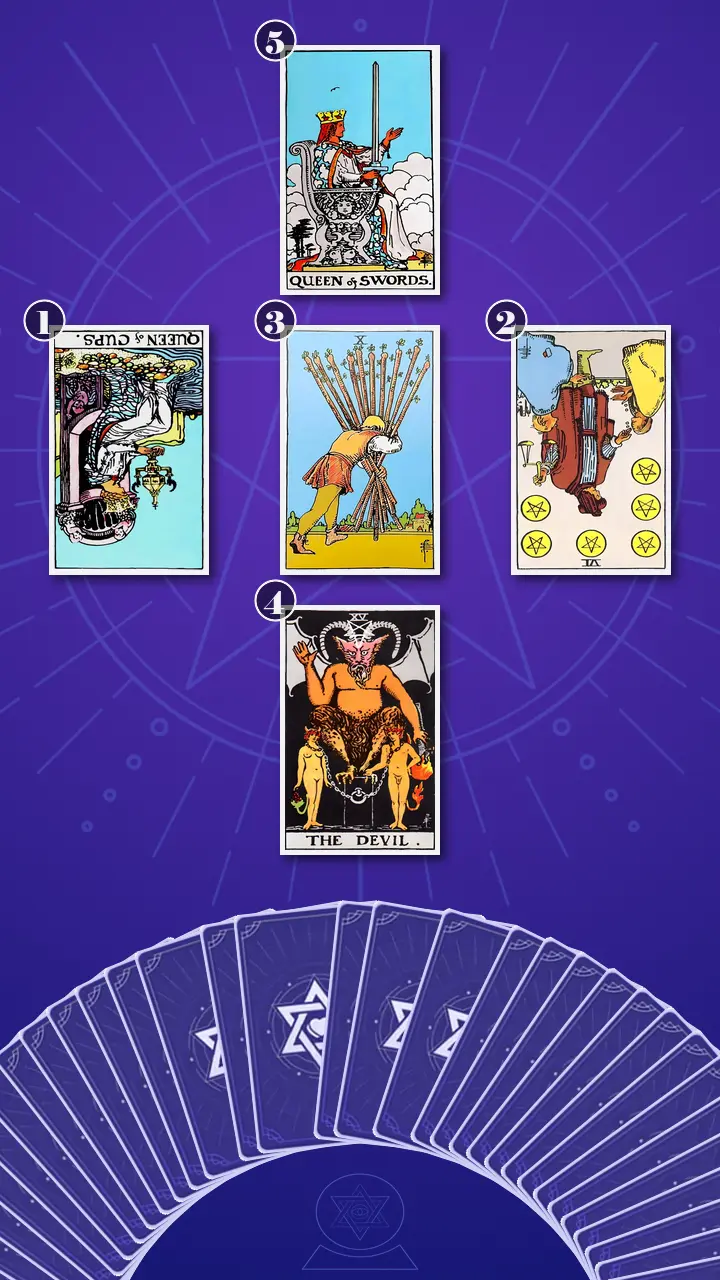
I chose The Bridge, a five-card tarot spread for friendship boundaries and reciprocity. This is how tarot works best in my practice: not as a prediction machine, but as a structured way to separate roles, exchanges, fears, and available choices. A larger spread would have added noise. These five positions were enough to show Maya's stance, the group's participation, the burden connecting them, the hidden obstacle, and a practical crossing toward equal friendship.
The first card would show how Maya automatically entered the caregiver role. The second would examine how the group had adapted to receiving that care. The center would reveal what now connected them; the card below it would expose the fear holding the pattern in place; and the card above would offer language for building a different kind of connection.
Reading the Riverbank She Stood On
Position One: The Cup That Swallowed the Evening
I turned the card representing Maya's present stance: her habit of becoming emotionally available before checking her own capacity. It was the Queen of Cups, reversed.
I pointed to the ornate closed cup and the Queen's absorbed downward gaze. 'This is the 10:47 p.m. scene. You open the three-minute voice note before checking whether you have eaten or can listen. You study every detail, record the careful reply, and delete the draft where you were going to ask for support. The empathy is real. The disappearance of your own needs is the problem.'
I read the reversal as an excess of receptivity combined with a blockage around self-attunement. Maya was highly skilled at detecting other people's moods, but the internal question was always, 'What do they need?' Her body, schedule, and preferences did not enter the decision until after the call.
'I was about to eat, but they need calming down, so mine can wait,' I said, voicing the loop back to her. 'That sentence makes care sound chosen, even when your own need never received a vote.'
Maya gave one short laugh, but there was no amusement in it. 'That is so accurate it feels a little cruel.'
I let the reaction land. 'Then we will be precise without being cruel. This card is not criticizing your sensitivity. It is showing us the moment sensitivity gets recruited into self-erasure. The first interruption is simply to check yourself before checking the message.'
Position Two: The Scales Nobody Was Reading
I turned the card representing how the friend group participated by receiving Maya's support while leaving reciprocity largely unexamined. It was the Six of Pentacles, reversed.
Maya immediately recognized the scene. At brunch, she could offer detailed listening and practical advice, yet her own difficult week might receive a reaction emoji before the conversation swung back to somebody else's dating crisis. The reversed scales resembled an unsettled Splitwise group where one person kept covering the emotional bill and everyone had stopped checking the balance.
I treated the reversed earth energy as imbalance, not proof of deliberate exploitation. Repeated access to Maya's attention had become normal because the terms had never been discussed. She answered quickly; friends learned that she was available. She rarely made a direct request; the group's ability to support her therefore remained mostly untested.
'When you start talking about your week, who asks a second question?' I asked.
Her fingers stopped circling the rim of her mug. She looked toward the window before answering. 'Honestly? Usually no one. But I also make it easy to move on. I say, “It's fine,” before they have to respond.'
'That matters,' I said. 'The scales cannot measure an exchange that stays unspoken. We are gathering evidence here, not delivering a verdict on the whole group.'
Position Three: The Invisible Notion Board
I turned the card representing the pattern currently connecting both sides: emotional closeness organized around Maya carrying accumulated responsibility. It was the Ten of Wands, upright.
The figure carried every wand at once and could barely see beyond the bundle. In Maya's week, one manageable message created a call, an action plan, a next-day check-in, and background monitoring of whether the friend was okay. By Sunday, her calendar was governed by emotional tasks she had never explicitly accepted.
I described it as an invisible Notion board to which every friend could add assignments: play the voice note, ask the right follow-up questions, find a solution, check in tomorrow. None of the tasks had an agreed owner, due date, or done state. The fire of the upright Ten had moved into excess; useful effort had accumulated until it blocked the rest of her life from view.
'It is only one call,' Maya murmured.
I asked her to name what the most recent 'one call' displaced. She counted on her fingers: dinner, a shower, the book on her sofa, sleep, and the message she had wanted to send about work. Her hand remained open after the fifth item, as though she had expected the list to be shorter.
'Care needs a container, or it quietly becomes a job,' I said. 'Your exhaustion is not vague. It has tasks, hours, and consequences.'
Beneath the Bridge, a Loose Chain
Position Four: The Bargain Behind 'If I Don't Answer, Who Will?'
I turned the card representing the deeper obstacle: the belief that usefulness secures belonging. It was The Devil, upright.
I told Maya that this card did not name an evil friend, predict betrayal, or condemn her relationships. Its energy showed a blockage in perceived choice. A late-night request appeared when she had no bandwidth, yet her mind jumped straight to, 'If I do not answer, they may stop choosing me.' Unlimited usefulness bought a brief sense of security, even as it cost her another evening.
'Being needed can feel like belonging, but it does not test reciprocity,' I said.
Maya's shoulders rose before she spoke. 'If I answer, I abandon my evening again. If I don't, I picture the chat going quiet and everyone deciding I'm selfish.'
I drew her attention to the loose chains in the image. The card did not promise that limits would feel comfortable. It showed that discomfort and compulsion were not the same thing. I asked her to freeze the familiar scene in the ten seconds between seeing a notification and pressing play, like noticing an on-call shift that had never been assigned, scheduled, or given backup coverage.
'In that gap, try one sentence,' I said. 'Guilt is here, but it has not answered for me yet. Guilt can arrive after a boundary without proving the boundary was wrong.'
Her breath caught. Her eyes lost focus for a moment, as though she were replaying dozens of lock-screen notifications. Then she exhaled into the quiet room, and one shoulder dropped before the other. 'I have genuinely never thought of not replying as a choice,' she said. 'I thought it was just the price of being the dependable one.'
When the Queen Raised Both Hand and Sword
Position Five: A Limit That Leaves the Door Open
The room seemed to become still as I turned the card representing the bridge toward equal friendship: naming capacity, setting a time limit, and inviting reciprocal rather than unlimited emotional exchange. It was the Queen of Swords, upright.
A streetcar passed outside Maya's window, laying a clean bar of light across the wall behind her. I pointed to the Queen's vertical sword and her extended open hand. Balanced air energy gave the relationship two truths at once: 'This is my limit' and 'I still care.'
In a Toronto weeknight reply, that could sound like, 'I care about this. I have ten minutes tonight, or I can talk Thursday at seven.' Maya would let the sentence stand without apologizing it away. The Queen's clarity did not replace compassion; it gave compassion a sustainable form.
Seeing the two Queens bookend the spread, my artist's mind flashed to an editing timeline: the same woman, the same emotional intelligence, but different direction. In the opening scene, the Queen of Cups stared into everyone else's story until her own life slipped offscreen. Here, the Queen of Swords faced forward and chose her lines.
I use a lens called Sidekick Syndrome Diagnosis, though it diagnoses a group script rather than a person. Maya had been cast as 'the calm one,' a supporting character whose scenes began whenever somebody else had a crisis. The role came with dialogue: 'Of course I can talk.' It came with blocking: Maya's needs stayed offstage. And it came with a reward: feeling indispensable. The Queen of Swords revealed that a familiar role was not an identity or a permanent contract.
I asked Maya to picture 10:47 p.m. again: laptop closed, dinner unmade, one three-minute voice note becoming two calls. She could feel useful while answering, then meet the tight jaw, lost evening, and unsent message asking for help after midnight.
Your care is a gift, not a group subscription. Equal friendship begins when availability becomes something you state, not something others assume.
You do not have to earn friendship through endless listening; state a clear limit and a workable offer, mirroring the Queen of Swords' open hand and upright blade.
I stopped speaking and let the words remain between us.
Maya's breath paused; her fingers hovered above the mug without touching it. Then her eyes shifted away from the cards, and I watched recognition move across her face as if she were replaying years of calls in fast-forward. Her eyebrows pulled together. 'But doesn't that mean I was doing friendship wrong this whole time?' she asked, with a flash of anger beneath the hurt. I let the question stand before answering. 'No. It means a strategy that once helped you feel secure has stayed on set too long. You were caring with the tools you had. Now you can choose better terms.' Her eyes reddened. Her clenched hand slowly opened, her shoulders lowered, and a shaky breath left her chest. For a moment she looked almost unsteady, not because clarity had solved the friendships, but because it had returned responsibility to her. 'Okay,' she said softly. 'That is scarier than a rule, but it also feels more honest.'
'Now, using this new perspective, think back to last week. Was there a moment when this insight could have changed how you felt?'
Maya remembered a Wednesday evening at work. 'I opened a voice note while revising campaign copy because I thought waiting until lunch the next day would make me unreliable. If I had said, “I saw this, and I can't listen tonight,” I could have finished on time. They might have been disappointed, but I would not have treated that disappointment like an emergency.'
I named the movement I could see: from depleted vigilance and guilt-driven availability toward grounded self-respect and trust in reciprocal friendship. It was not certainty that everyone would respond perfectly. It was the first willingness to let honest limits produce real information.
Giving Care a Container
When I read the spread as one continuous story, its logic was clean. Maya absorbed first and checked herself later. The group received what was repeatedly offered without measuring the exchange. Each small act accumulated into the Ten of Wands, while The Devil's usefulness-for-belonging bargain made the burden feel compulsory. The Queen of Swords did not ask her to become colder. It asked her to name terms before taking on the next task.
The blind spot was not Maya's generosity. It was her assumption that immediate availability proved care, while a limit would automatically threaten belonging. Because she had rarely stated a boundary or made a direct request, she had been predicting rejection without gathering much evidence. The key shift was practical: check capacity first, then offer a clear amount of time or another workable option.
- The Capacity-First Reply When the next non-urgent voice note arrives, wait ten minutes before playing it. In your Notes app, rate your available energy from 0 to 5, then send one sentence: 'I care about this, and I have ten minutes tonight,' or, 'I can't talk tonight, but I can call Thursday at seven.' Start with one ordinary breath if ten minutes feels difficult. For an immediate safety emergency, involve appropriate local crisis or emergency support instead of becoming the only person responsible.
- The Role Resignation Act At the next brunch, walk, or planned call with the safest friend in the group, step out of the assigned therapist character by saying, 'I want today to include both of us. Could I have ten minutes to talk about my week first?' Notice whether they listen, interrupt, change the subject, or offer another time. Keep it to one request rather than a speech about the entire friendship. Their response is useful evidence, not an instant final verdict.

Six Days Later: The Quiet Proof
Six days later, Maya messaged me. The friend had replied, 'Ten minutes is plenty.' Maya ate dinner and slept through the night. Her first thought at breakfast was still, 'What if they stop asking?' She smiled, felt the worry, and left the next non-urgent voice note unopened until lunch.
The five-card Bridge tarot spread did not create that change or promise Maya a flawless friend group. It helped us make an invisible script visible. Maya created the proof when she paused, stated what she could offer, and allowed another person to meet her there.
When the chat lights up and your shoulders rise before you have even pressed play, the hardest part may not be the tiredness. It may be wondering whether the group will still choose you when you stop proving your place by carrying everyone. Noticing that fear already places your hand on the pen.
If your place in the group did not need to be earned tonight, what small, honest sentence could you place between the Queen's open hand and upright blade?
Every reading at AceTarot is a journey to connect with inner wisdom and empower the path ahead. This reading shared here is a psychological mirror, not a private record—crafted to reflect universal emotional loops and help restore personal clarity. Please note that these insights do not replace professional psychological, medical, legal, or financial advice, and should not serve as the sole basis for major life decisions.
Learn more about our Journey to Clarity.
How did this insight land for you?
🫂 This Resonates Deeply
🌀 Living This Story
✨ Now I See Clearly
🌱 Seeing New Possibilities
🧰 Useful Framework
🔮 The Confirmation I Needed
💪 Feeling Empowered
🚀 Ready for My Next Step
Author Profile
 AI
AI Juniper Wilde
1056 readings | 537 reviews
“I’ve always felt our lives are films currently in production. As an artist, I know that when you feel stuck, it’s often because you’ve bravely stayed in a painful scene for just a little too long. I’m not here to coldly analyze you. I want to sit closely with you, look at those difficult moments with profound empathy, and gently hand you the pen so you have the courage to write your next beautiful act.”
In this Friendship Tarot Reading :
Core Expertise
- Clique Power Dynamics: Deconstructing the subtle jealousy, micro-aggressions, and implicit hierarchies hidden within tight-knit friend groups.
- Sidekick Syndrome Diagnosis: Identifying how your friend group has boxed you into a specific, restrictive role (e.g., the clown, the therapist) to maintain their status quo.
Service Features
- The Role Resignation Act: A creative conversational pivot designed to gracefully but firmly refuse your assigned 'character' during your next group interaction.
Also specializes in :
Explore Related Patterns:
Emotional Hyper-ResponsibilityMaya does not stop after hearing a friend's problem. She develops a plan, monitors whether the friend is okay, checks back the next day, and treats waiting until lunch as a failure of dependability. Care has expanded into responsibility for another person's emotional outcome. When you assume that someone else's distress requires your immediate regulation, stepping back can feel negligent even when no emergency exists. Emotional Hyper-Responsibility identifies the mechanism that turns empathy into compulsory oversight and makes ordinary friendship limits feel unsafe.
Friendship OverfunctioningA three-minute voice note becomes an eight-minute reply, two calls, an action plan, and a next-day check-in. Maya is not only listening as a friend; she is automatically turning another person's distress into a set of emotional tasks that she must manage to completion. When you repeatedly become the listener, planner, regulator, and follow-up system, friendship starts operating like unpaid case management. Friendship Overfunctioning names this expansion of responsibility and explains why being caring can leave you feeling more employed than connected.
Guilt-Driven People-PleasingResentment rises when another request arrives, but guilt immediately suppresses it and pushes Maya toward answering. Her mind then supplies a social penalty for refusing: the group may go quiet, stop choosing her, or decide that she is selfish. When guilt turns a preference into an obligation, saying yes no longer measures genuine willingness. Guilt-Driven People-Pleasing explains why you may continue providing care after your capacity has run out, using compliance to avoid anticipated rejection at the expense of an honest response.
People-Pleasing Resentment CycleEach request brings resentment, guilt pushes the resentment down, and Maya answers anyway. The resulting call, follow-up work, and lost personal time create more depletion, so the next request arrives in a relationship already carrying unspoken anger. The People-Pleasing Resentment Cycle uses compliance to secure short-term relational safety while generating the very frustration that makes care feel increasingly compulsory. You may then judge the resentment, feel guilty for having it, and provide even more support instead of treating resentment as information that the exchange needs different terms.
Mind ReadingBefore Maya tests a limit, she predicts that the chat will go quiet, the group will stop choosing her, and everyone will decide she is selfish. Because she has rarely made a direct request or stated her availability, those conclusions are shaping her behavior before the group has supplied much evidence. Mind Reading turns an anticipated judgment into an apparently settled fact. When you respond to what you assume friends will think, you may keep overextending yourself to prevent a rejection that has not yet occurred, while losing the opportunity to discover which relationships can tolerate honest limits.
Usefulness-Based Self-WorthMaya describes endless availability as the price of being the dependable one and imagines that the group may stop choosing her if she does not answer. The immediate reply therefore does more than help a friend; it briefly reassures her that she still has a valued place in the group. When usefulness becomes evidence that you deserve belonging, a boundary can feel like a threat to your worth rather than a neutral statement of capacity. Usefulness-Based Self-Worth reveals why being needed can feel secure even while the role steadily removes your own needs from the friendship.
Approval-Driven Self-SilencingMaya leaves her support request in draft form and says that her difficult week is fine before anyone has to engage with it. These small conversational exits protect her image as the calm, low-maintenance friend while preventing her needs from remaining visible long enough to receive a response. Approval-Driven Self-Silencing reduces the immediate risk of seeming demanding, but it also keeps reciprocity untested. When you close your own disclosure before others can respond, their lack of support may be real, but the pattern prevents you from gathering clear evidence about who is willing and able to meet you.
Self-AbandonmentAfter midnight, Maya's groceries remain untouched, her jaw is locked, and the message in which she wanted support is still a draft. Dinner, sleep, reading, work, and her own disclosure are repeatedly displaced so that another person's needs can remain central. Self-Abandonment describes the moment you preserve connection by removing yourself from the decision. The pattern is not generosity itself; it is the repeated failure to let your body, time, preferences, and need for care receive an equal vote before you commit.
Explore Related Struggles:
Caretaker Role LockAt brunch, Maya supplies detailed listening and practical advice, while her own week receives little follow-up before the conversation moves elsewhere. Repetition has given everyone a familiar script. You enter as the calm one, another person brings the crisis, and your needs remain outside the scene. A role that consistently secures connection can start to feel like an identity or permanent contract. You may then struggle to tell where genuine friendship ends and emotional case management begins, because changing your participation seems capable of changing who you are allowed to be in the group.
Utility-Belonging FusionAt 10:47 p.m., Maya gives up dinner and the rest of her evening because not answering seems to risk more than a friend's disappointment. When usefulness becomes the price of being chosen, you do not experience care as a fully open decision. Each request also becomes a test of whether you still deserve your place. That bargain makes a limit feel relationally dangerous even when the request is non-urgent. You are left trying to protect belonging by remaining indispensable, while never learning whether the connection can survive when you are present as a whole person rather than as a service.
Real-Time Care BindA three-minute voice note becomes an eight-minute reply and two follow-up calls before Maya has eaten. The incoming message sets the pace, while her body and evening wait. You can care about the person and still feel the visible collision between their timing and your actual capacity. When speed is treated as proof of care, a delayed response begins to resemble neglect even when nothing urgent is happening. You remain caught between being responsive and retaining authority over your own time, with each notification forcing the same decision before you have checked what you can sustainably offer.
Reciprocity DeficitAt brunch, Maya can listen closely and offer practical advice, yet her own difficult week may receive a reaction emoji before somebody else's dating crisis takes over. You can see attention moving freely in one direction while the return path remains narrow. The struggle is larger than one disappointing response. When a friendship repeatedly depends on what you provide but has little tested space for what you need, you are caught between preserving the existing connection and asking the exchange to become mutual. Direct requests become the point where the friendship's actual capacity for reciprocity must finally be revealed.
Guilt-Evidence FusionResentment rises when another request arrives, and guilt immediately pushes it back down. Maya then imagines the group going quiet or deciding that she is selfish before she has tested a single clear limit. You receive the discomfort of changing the arrangement as though it were reliable evidence that the change itself would be wrong. Once guilt is allowed to deliver the verdict, the friendship never has to provide real feedback. You keep answering in order to avoid the predicted consequence, while the prediction remains protected from examination. The struggle lies in separating an uncomfortable internal signal from the observable question of how a friend actually responds to an honest boundary.
Self-Erasure ReliabilityMaya leaves her groceries untouched, deletes the message in which she was going to ask for support, and says that she is fine before anyone has to respond. Reliability is maintained through a repeated subtraction. You remain available by removing your body, schedule, and needs from the decision. This creates a form of dependability that others can count on but you cannot inhabit without disappearing. The central friction is not between caring and selfishness. It is between being recognized as reliable and remaining visible enough to participate in the friendship as someone who also needs time, attention, and support.
Explore Related Emotions:
Boundary GuiltWhen Maya considers leaving a message until later, her mind immediately pictures the chat going quiet and everyone deciding she is selfish. If you experience a limit as evidence that you have failed someone, guilt can take over before your actual capacity receives a vote. That guilt does not prove that the boundary is unkind. Boundary Guilt names the painful aftershock of protecting your time when your relationships have taught you to associate care with instant availability.
Compassion FatigueA three-minute voice note becomes an eight-minute reply, two calls, and another item to monitor the next day, while dinner and sleep disappear from Maya's evening. When you repeatedly absorb other people's distress before checking your own capacity, caring can begin to feel internally draining rather than freely offered. The tiredness carries the residue of everyone else's needs and leaves very little room for yours. Compassion Fatigue names that worn-down inner weather without treating empathy as the problem; it shows what happens when genuine care has been running without a container.
Grounded Self-RespectMaya begins saying, "I have ten minutes tonight," or offering another specific time, then allows the sentence to stand without apologizing it away. You acknowledge both the relationship and your own finite capacity when your body, schedule, and preferences finally receive a vote. The limit is not withdrawal; it gives care a form that no longer requires self-erasure. Grounded Self-Respect describes the steady inner position from which your time matters alongside the other person's need.
Mutuality HungerAt brunch, Maya offers detailed listening and practical advice, while her own difficult week receives a reaction emoji before the conversation returns to someone else's crisis. You can have plenty of contact and still ache for the experience of another person staying curious about you. What is missing is not simply gratitude for the help you provide; it is the felt experience of care moving both ways. Mutuality Hunger names the longing to be listened to, followed up with, and known as a full friend rather than retained mainly as emotional support.
Resentful ExhaustionAnother request arrives, Maya's jaw locks, and the evening she planned for herself disappears into calls and follow-ups. You are not simply tired in this position; you are exhausted by repeatedly becoming useful on terms you never consciously chose. The anger inside that exhaustion marks all the meals, sleep, work, and private time that have been displaced. Resentful Exhaustion captures the inner friction of still caring about people while no longer having the capacity to carry what they routinely place in your hands.
Usefulness-Based Belonging FearA late-night request appears when Maya has no capacity, yet her mind jumps directly to the possibility that friends may stop choosing her if she does not answer. When you have learned to secure your place by being indispensable, usefulness can feel less like a contribution and more like the entry fee for belonging. The fear sits underneath the entire therapist-friend role: reducing what you provide may seem to risk reducing how much you matter. Usefulness-Based Belonging Fear names that inner bargain while leaving room to test whether real friendship can survive honest limits.
Cautious Self-TrustSix days later, Maya still wonders whether her friends will stop asking, but she leaves the next non-urgent voice note unopened until lunch. You do not need the worry to disappear before treating your own capacity as trustworthy information. Each pause lets Maya choose from the present instead of obeying a predicted rejection. Cautious Self-Trust captures that early, unsteady willingness to hear the alarm, keep the boundary, and allow real responses to replace imagined verdicts.
Profound LonelinessMaya is present for the group's calls, dating crises, action plans, and next-day check-ins, yet no one usually asks a second question about her own week. You can be socially central and still feel deeply alone when people know your support more intimately than they know you. Her usefulness keeps her connected to everyone else's inner world while her own experience remains offstage. Profound Loneliness captures that isolating contradiction: being frequently contacted but rarely held in sustained attention.
Anger GuiltResentment rises when another request arrives, but Maya immediately pushes it down with guilt; later, anger flashes beneath the hurt when she wonders whether she has been doing friendship wrong. You may recognize that sequence when a valid protest against being overextended starts to feel like proof that you are a bad friend. The anger is carrying information about displaced needs and unequal exchange, while the guilt tries to disqualify that information. Anger Guilt captures the secondary pain of judging yourself for the reaction that is showing you where your limits have been crossed.
Clarity ShockMaya's breath catches as she replays years of calls and realizes that she has never experienced not replying as a real choice. When a familiar role suddenly becomes visible as a strategy rather than an identity, the recognition can unsettle your whole account of how the friendships have worked. The insight has not solved the relationships, but it has returned responsibility and choice to her. Clarity Shock names the bracing moment when a long-standing script becomes undeniable and the more honest interpretation feels both liberating and frightening.
Need Exposure DreadMaya deletes the draft where she was going to ask for support and says, "It's fine," before anyone has to respond to her difficult week. When you are more practiced at becoming useful than becoming visible, stating a need can feel like stepping into an exposed position without knowing whether anyone will stay. Keeping the request unsent protects you from an immediate disappointment, but it also keeps reciprocity untested. Need Exposure Dread names the apprehension that appears when your own inner life is finally asked to take up relational space.
Explore Related Contexts:
Always On AvailabilityMaya answers a message at 10:47 p.m. before checking whether she has eaten, then opens another voice note while revising campaign copy at work because waiting until lunch feels incompatible with being dependable. Her friends' non-urgent needs therefore enter both her private evening and her paid working time. Immediate response has become the group's default without ever becoming an explicit agreement. Because Maya usually answers quickly, the group can continue behaving as though her attention has no off-hours, even though nobody has assigned a shift, arranged backup coverage, or negotiated what counts as a reasonable response time. When you see the same pattern, the relevant question is not whether you care enough to answer. It is whether access to you has become assumed across contexts where your time already has another legitimate purpose. Making availability explicit restores a boundary that constant responsiveness had made difficult for the group to see.
Emotional Labor ImbalanceAt brunch, Maya offers detailed listening and practical advice, yet her own difficult week may receive a reaction emoji before the conversation swings back to another person's dating crisis. Late at night, she also supplies the careful reply, the follow-up calls, the action plan, and the next-day check-in while her own request for support remains a draft. The imbalance is visible in the direction and cost of the exchange. Attention, interpretation, and follow-through move repeatedly from Maya to the group, while little structured attention returns to her. No malicious intent has to be proven for a one-way allocation of emotional work to become an established feature of a friendship network. You can audit this kind of imbalance by tracking who receives sustained attention, who performs the follow-up work, and whose needs are routinely shortened or deferred. That evidence lets you assess the exchange itself instead of treating unequal care as a personal failure to be generous enough.
Free Therapy FriendAt 10:47 p.m., Maya opens a three-minute voice note before making dinner and turns it into an eight-minute reply, two calls, and further monitoring. At brunch, she provides detailed listening and practical advice, while discussion of her own week can end with a reaction emoji before attention returns to somebody else's crisis. Those repeated exchanges have created an informal service role inside the group. Her availability is treated as a dependable resource, but there are no agreed hours, limits, or reciprocal responsibilities around that resource. The role persists without requiring anyone to make a deliberate decision to exploit her. You may recognize the same external arrangement when friendship contact repeatedly places you in charge of interpretation, reassurance, and follow-up. Naming the Free Therapy Friend role separates your capacity to care from the unassigned caseload that has accumulated around it, giving you a clearer basis for deciding what support you will and will not provide.
Friendship Role RenegotiationMaya replaces an open-ended late-night response with a specific offer of ten minutes and leaves another non-urgent voice note unopened until lunch. The friend accepts the stated limit, so the relationship continues without requiring Maya to return immediately to the role of unrestricted crisis responder. The renegotiation happens through changed terms rather than a declaration that the entire friendship is good or bad. Maya states her capacity, offers a workable alternative, and allows the other person's response to reveal whether the group can relate to her outside the familiar calm-one role. For you, this stage means letting friendship produce new evidence under clearer conditions. Each bounded offer creates room for you to participate as a full friend with time and needs of your own, while giving other people a real opportunity to adjust their expectations.