Sharing the Password to Prove Care and Holding a Fair Boundary

The 8:47 p.m. Password-Sharing Boundary Anxiety
I began with a sentence I use when a small digital boundary has started carrying far more emotional weight than it should: "If you are a Toronto renter working as a junior content producer, you know the after-work message that says, 'Can you send the streaming login again?' You reply before checking your own limit, then search 'digital boundary anxiety' instead of reopening the conversation."
I met Alex (name changed for privacy) in my studio a few days after one of those messages. As Alex described the scene, I could see it clearly: 8:47 p.m. on the TTC Line 1, the carriage lights buzzing overhead, a warm phone pressed into their palm, and one casual iMessage waiting above the tunnel map. Alex sent the password before the next stop, then turned the phone face down as if hiding the answer might undo it.
Alex told me, "It is only a password, so why does saying no feel so loaded? I want my account back, but I do not want access to become the thing that defines the relationship." I heard the contradiction plainly: Alex wanted to stop sharing the password and kept sharing it anyway. The pause before replying felt more threatening than the resentment that arrived afterward. I could see the tight chest, the restless stomach, and the hovering impulse to answer immediately before the discomfort grew teeth.
I did not treat that reaction as selfishness or a failure of will. I told Alex, "A small boundary can still touch a very old fear of being read as difficult. We do not have to make the relationship carry the whole meaning of the account. Let us make a map of the loop first, then decide what belongs to you." That was the beginning of our Journey to Clarity: not a prediction about anyone else, but a way to return the pen to the person holding the account.

Choosing a Small Map for a Big Feeling
I invited Alex to take one slower breath and focus on the exact question rather than on the imagined reaction to the answer. I shuffled slowly, treating the movement as a practical transition from automatic response to deliberate attention, not as a mysterious performance. The cards would give us images and questions; Alex would decide what those images meant in the context of their life.
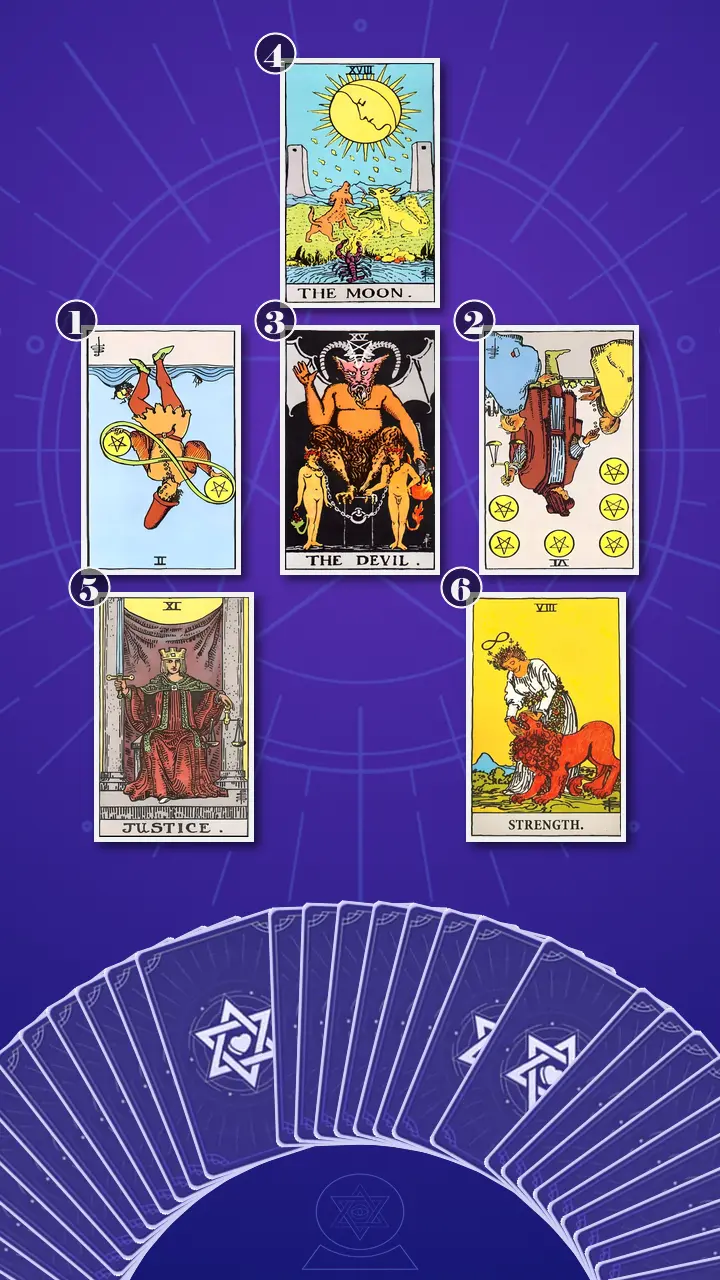
I chose the Relationship Spread · Context Edition, a compact relationship tarot spread designed for exchanges rather than forecasts. This digital boundary tarot reading needed enough space to examine Alex's behavior, perceived relational pressure, the pattern created between self and connection, the hidden emotional tension, and the next practice. A larger spread could have diluted the small but repeated interaction we were actually trying to understand.
For anyone wondering how tarot works in a situation like this, I explained that the structure acts as an objective cognitive tool. It gives a private feeling a visible sequence, so the mind can compare behavior, fear, and choice instead of letting all three collapse into one urgent yes. The first card would show Alex's present boundary stance. The second would explore the pressure Alex perceived without claiming to know the other person's secret intentions. The center would name the repeating exchange. Above it, we would look at the hidden emotional tension; below it, Justice and Strength would offer a fair rule and a way to hold it.
I laid the cards in a small bridge: the first two pressing toward the center, the middle cards revealing the knot, and the final two forming a grounded exit. I told Alex, "We are not asking whether the relationship is destined to survive a password change. We are asking what access means right now, what you have actually consented to, and what kind of response lets connection and clarity stay in the same room."
The Cards That Kept the Account Open
The Reversed Two of Pentacles and the Automatic Yes
Now I turned over the card representing Querent's present boundary stance: the observable behavior of sharing or re-confirming a streaming password despite wanting to stop, including the immediate feeling attached to that yes.
The card was Two of Pentacles, reversed position. I read the juggler's moving coins as a picture of Alex trying to keep three things in motion at once: the other person's access, the pleasant tone of the relationship, and the private wish to close the account door. The looping band around the coins looked like the notification-response-regret cycle Alex had described on the TTC.
In this reversal, I saw an excess of rapid adaptation and a deficiency of deliberate pause. Alex was not unaware of the limit. They were replying before awareness had time to become a decision. The modern scene was precise: a message asking whether the login still worked, a password sent within minutes, a reopened chat, and the delayed thought, "Why did I agree again?" An automatic yes could end the discomfort without proving the connection.
I asked, "When the next request arrives, what do you notice first in your body, and what answer might appear if you waited ten minutes?" Alex did not nod. They gave a small, bitter laugh. Their thumb froze above the phone; then their eyes lost focus as if replaying several past messages; finally, a long breath moved through their chest and their shoulders dropped a fraction.
Alex said, "That is almost painfully accurate. I send it, then feel guilty for being annoyed that I sent it." I answered, "I am reading a loop, not a character flaw. The first useful change is not a dramatic refusal. It is making enough room to hear your own answer before managing theirs."
The Reversed Six of Pentacles and the Invisible Scorecard
I moved to the card representing Perceived relational pressure: how Alex interprets the request or expectation around the streaming password, without claiming what the other person secretly intends.
The card was Six of Pentacles, reversed position. I focused on the seated giver's scale and the coins distributed downward. In an upright image, generosity can be clear and freely offered. In this reversal, I saw an excess of responsibility and a shortage of an explicit agreement. Alex had started treating the streaming login like social currency, even though no current agreement required them to keep giving it.
I connected the card to the coworking scene Alex described: a friend typed, "Can you send the login again?" while Alex was editing captions between Slack notifications and the sound of a cafe milk steamer. Alex added a laughing emoji, sent the password, and used the joke to protect the easy mood. In the quiet afterward, they mentally counted shared snacks, past favors, errands, and who had helped whom, as if access had become an invisible scorecard.
I told Alex, "Fair does not mean permanently available. The relevant question is not whether the other person is good or bad, grateful or ungrateful. It is whether you are offering access from present consent or from the fear that withdrawing it will make you look selfish." The reversed Six of Pentacles did not ask Alex to keep score or punish anyone. It asked them to notice who was carrying the tracking, the reminders, and the responsibility for keeping an old casual arrangement alive.
Alex turned the phone over and rubbed the edge of the case with one finger. I watched irritation and recognition share the same expression. I asked them to finish the sentence, "I am willing to offer access when..." Alex began writing, stopped, and said, "When I actually choose it. Not because the request makes me feel like I owe proof that we are still close."
When the Login Became a Chain
The Devil and the Contract Nobody Wrote
I turned over the card representing Pattern between self and connection: the repeating exchange in which access is offered, discomfort is postponed, and the boundary remains unclear.
The card was The Devil, upright position. I placed it in the center of the spread and looked at the two figures with Alex. The chains around their necks were visibly loose. I did not use that image to accuse Alex or the people using the account. I used it to examine how a habit can feel compulsory while still containing a choice that has not yet been consciously reclaimed.
I brought in the scene of an old friend asking for the login after months of loose account sharing. I asked Alex to complete the thought that had been running underneath the messages: "I can technically change it, but it would mean..." Alex stared at the card and said, "It would mean they know I am withdrawing. Then they might think I am difficult, distant, or not as close as they thought."
I said, "The login has become a relationship receipt. Each sign-in seems to say, 'We are still good,' even though nobody explicitly agreed that access had to carry that meaning. The Devil is naming the attachment, not issuing a moral judgment." I could see the password acting as a substitute for a conversation about closeness. Convenience protected short-term ease; resentment accumulated because the outwardly generous answer did not match the inward wish to regain control.
Alex's breathing paused. Their gaze moved from the chain to the phone, as though a series of old exchanges had suddenly become one repeated scene. Then their fingers, which had been curled tightly around the case, loosened and rested flat on the table. Alex whispered, "I have been treating access like proof that I care." I let the silence stay long enough for the insight to belong to them.
The Moon and the Full Series Finale
I turned to the card representing Hidden emotional tension: the unexamined meaning Alex attaches to stopping password sharing, including the fear of seeming selfish or losing belonging.
The card was The Moon, upright position. I traced the winding path between the two towers, the dog and wolf facing the light, and the crayfish emerging from the water. I read the image as a distinction between what was on the screen and what Alex's mind supplied around it.
I asked Alex to imagine the exact message: "Can you send the login again?" The observable fact was one short request. The internal script arrived much larger: "They will think I am selfish, then distant, then not worth keeping around." I told Alex, "The actual request is one notification. The imagined rejection is the full series finale you have already streamed in your head." The fear story was an algorithm recommending the most painful interpretation of incomplete data. The Moon asked us to check the source before treating the prediction as fact.
I asked, "If you changed the password this week, what exact reaction are you afraid of, and what evidence do you have beyond the feeling in your stomach?" Alex reread the imaginary message on their phone. Their jaw shifted; they took a slower breath; then they separated two sentences in their Notes app: "They asked for access" and "They will think I am rejecting them."
I told Alex, "The first sentence is information. The second is a possibility your nervous system is trying to solve in advance. You do not have to force certainty before making a fair decision. You can ask a clarifying question, pause, or communicate a limit without deciding what the other person must feel." The path was not suddenly bright, but it had become visible enough for one careful step.
When Justice Put the Scales Level
The Fair Rule in the Notes App
The room seemed to quiet before I touched the next card. Rain moved softly against the window, and the city noise fell behind the small white rectangle of the spread. I could feel that we had reached the card that would turn the question from an emotional referendum into a practical standard.
Now I turned over the card representing Guidance for a healthier exchange: the concrete boundary choice that aligns access with present consent, fairness, and clear communication.
The card was Justice, upright position. The sword pointed toward direct language. The balanced scales asked whether the arrangement was current, reciprocal, and genuinely chosen by Alex. I read Justice as a permission setting: visible, consistent, and based on what access was allowed now. A clear boundary was a permissions policy, not a character review.
I connected the card to the account-settings scene. Alex opened the device list, placed the phone beside the deck, and wrote one rule in a Notes app: "I share this login only when I actively choose to, and I can stop sharing when the arrangement no longer works for me." I told them that a rule could be applied consistently to a friend, partner, or housemate without inventing a new explanation for every person.
I also used my signature Narrative Fork Analysis. I asked Alex to look at two competing plotlines. In the first, the account stays accessible, the conversation remains easy for one more day, and the resentment returns with the next request. In the second, Alex pauses, names the present rule, and allows a moment of relational uncertainty without turning it into a verdict. I asked, "Which plotline genuinely serves the character growth arc you say you want: more access at any cost, or connection that can survive honest permissions?"
Then I applied my Safe-Choice Sabotage Recognition lens. Alex had been waiting for a perfect technical excuse - a new device, a password reset, a billing problem - because that would make the boundary impossible to question. I said, "Waiting for a reason that no one can argue with may look logical, but it may be the safe choice sabotaging the inciting incident. You do not need a crisis to make a present-tense decision about your own access."
Before I continued, I asked Alex to picture the original TTC ride. Their phone was warm, the carriage lights were buzzing, and the message was waiting. The following setup was small enough to be real: a casual request, a familiar automatic reply, and a private wish that the easy answer had been honest. The emotional forecast had become much larger than the boundary itself.
You do not have to keep sharing access to prove that you care or belong. The fair boundary is the one that matches your present consent, even when someone else might feel disappointed.
Stop treating an automatic yes as proof of connection; choose a fair, explicit access rule, like Justice placing the scales level and the sword upright.
Access is not affection.
Alex's breath stopped first. Their eyes widened slightly, then moved past my shoulder as if they were watching several old messages replay on an invisible screen. I saw their mouth part, close, and part again. Their shoulders had been held high for most of the reading; now they lowered by degrees. One hand unclenched, finger by finger, while the other remained pressed against the phone.
For a moment, Alex looked almost angry, not at me but at the years of meaning attached to an ordinary login. Then the anger softened into a tired recognition. They gave a shaky exhale and said, "That sounds obvious, but it also means I have been asking a password to do the work of a relationship." I let the silence hold both relief and responsibility. Clearer did not mean completely comfortable.
I suggested a ten-minute timer for the next request, with two lines in the Notes app: "What do I know?" and "What am I imagining they will feel?" Alex could stop the exercise if it became too activating. The pause was an option, not a performance, and it did not force a no. I invited them to revisit last week's message through this new lens and ask, "What might have felt different if I had paused long enough to hear my own answer?"
I named the central shift plainly: from guilt-driven automatic compliance and imagined rejection toward clear, consent-based self-trust and calm boundary communication. Justice did not promise that another person would be pleased. It gave Alex a fair basis for choosing without outsourcing the decision to an imagined reaction.
Strength and the Boundary That Stays
I turned over the card representing Integration and near-term practice: how Alex can embody a steady boundary without turning the card into a prediction about another person's response.
The card was Strength, upright position. I focused on the figure's gentle hands resting on the lion, the infinity symbol above her head, and the white roses. I read the energy as calm courage rather than force: the capacity to feel the tight chest and still let a respectful sentence remain true.
I connected Strength to the message Alex could send: "I am no longer sharing this login, and I wanted to tell you directly." The boundary could be firm without being punitive, and care could remain possible without keeping access open. I asked Alex to notice the body after sending a sentence like that, not to eliminate discomfort but to let the discomfort exist without reversing the decision automatically.
Alex placed both feet on the floor. Their shoulders were still not entirely relaxed, and I did not ask them to pretend otherwise. They nodded once and said, "I think I have been trying to make the other person comfortable before I even find out whether I am comfortable." I answered, "Strength is the practice of leaving the setting in place while their response loads. You can care about them without taking responsibility for every feeling they may have."
From Guilt-Driven Compliance to Present-Tense Consent
I gathered the cards into one story for Alex. The two Pentacles showed an overloaded attempt to keep access, ease, and discomfort moving in the same hand. The reversed Six of Pentacles showed why the favor had started to feel like an unpaid social obligation. The Devil revealed the invisible contract that made a login resemble a relationship receipt. The Moon showed how a short request became an entire rejection story. Justice supplied the clear rule, and Strength showed how to practice it without aggression.
I told Alex, "Your blind spot is not that you do not know what you want. It is that you mistake the relief of ending an immediate pause for evidence that compliance was right. You also keep waiting for a technical reason that will protect you from being misunderstood. The key shift is much smaller: pause before the request, name one fair access rule, and let your answer come from present consent rather than guilt."
I explained that changing a password is like updating a door code, not deleting a person from your contacts. The decision can affect digital access without delivering a verdict on the relationship. Alex remained the person with agency. The cards had organized the evidence, but Alex was the one who could choose the next scene.
- Use the Ten-Minute Consent CheckWhen a friend, partner, or housemate asks by iMessage, DM, or in person for the streaming login, copy the exact request into your Notes app and set a ten-minute timer before sending or confirming access. During the pause, notice your chest, jaw, and stomach without treating the discomfort as an instruction to comply.Use a two-minute version if ten minutes feels too large. The timer does not require you to say no, and you can reply later with a neutral line such as "I am checking what access I want to keep active."
- Pin the Access Is Not Affection RuleTonight, in the Notes app beside the account details, write and pin one consistent standard: "I share this login only when I actively choose to, and I can stop sharing when the arrangement no longer works for me." Apply the same rule to the next request instead of deciding from the identity of the person asking.Keep the sentence private at first. You do not need to build a case, list every favor, or explain the entire history of the arrangement before making a present-tense choice.
- Make the Protagonist Pivot within 24 hoursWithin the next 24 hours, if your access rule says the arrangement should end, open the account settings and draft or send one calm message to the person whose access you are changing: "I am no longer sharing this login, and I wanted to tell you directly." Choose the smallest action that honestly matches your present consent.I call this the Protagonist Pivot Action, a 24-hour creative mandate. A draft counts if sending would skip your pause; the point is to enter the more authentic plotline, not to force a particular reaction.
I did not ask Alex to predict whether anyone would be disappointed. I asked them to stop making another person's possible feeling the only evidence that mattered. A clear rule, a short pause, and one calm message were enough for the next scene.

A Week Later, a Little More Room
Three days later, I received a message from Alex: "I used the pause. I wrote the rule. I changed the password and sent the direct sentence to one person instead of waiting for a technical excuse." They had not solved every relationship question, and they did not claim that the message felt easy. They had simply stopped letting the first wave of guilt choose the answer.
The next morning, Alex slept a full night, then woke with the thought, "What if I got it wrong?" They smiled at the uncertainty, left the new setting in place, and made coffee. The clarity was real, but it was still becoming a habit.
For me, that was the quiet proof of the reading. Tarot had not made the decision for Alex or guaranteed a comfortable response. It had helped move the problem from automatic password sharing and imagined rejection toward present consent, clear self-trust, and calm boundary communication. Alex had taken the pen back.
When a password request lights up your phone and your chest tightens, you may still send yes to protect belonging while quietly wishing you could take your account back. But noticing that split is already a little room between the old story and your next choice.
If you let a ten-minute pause become a tiny loading screen between the request and the answer, what would you quietly notice about the kind of access that still feels chosen?