Why Does Reentry Have a Clock?

Explore reentry shaped by résumé gaps and recency filters, relevant tarot cards, and related Tarot Reading Insights.

Job Search Reentry Window
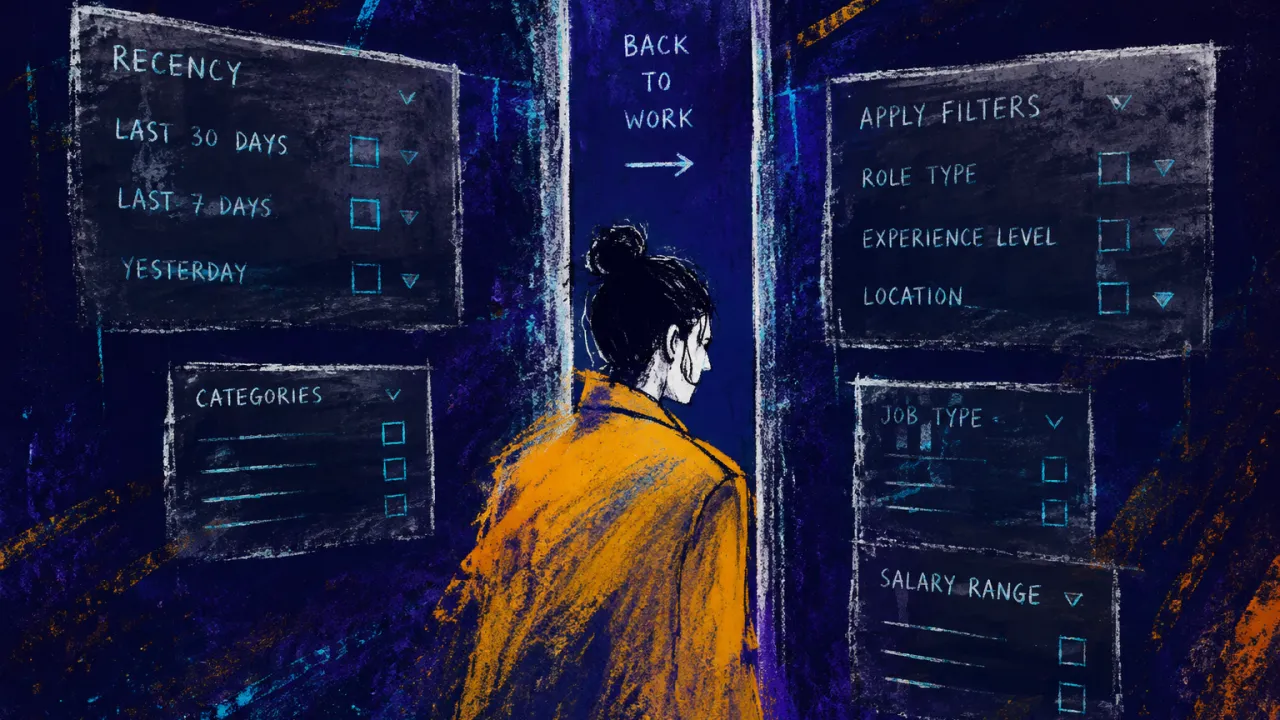
A solitary figure turns toward a narrowing doorway as oversized application fields close in beside both shoulders.

What is this situation?

Job Search Reentry Window is the stretch when you return to hiring after time away and find that the route back is treated as though a clock is already running. You open your laptop in the morning, update a profile that still leads with your last role, and reach application forms that require every month to be accounted for before they let you continue. Whether the gap followed study, caregiving, travel, a contract ending, or a needed pause, recruiters often ask about the blank dates before asking what you can do now. Roles resembling your previous work may list tools or titles that became standard while you were out; one employer reads you as overqualified for a bridge role, while another wants more recent proof for work you have already done. Applications disappear into portals, automated emails arrive without detail, advertised roles are reposted, and warm messages from former contacts can cool once you ask about an opening. If an interview comes, the employer can add another round, move the timeline, or change the brief while expecting you to remain available and polished. Meanwhile, rent, transport, and phone bills keep their own schedule, and each passing week adds another date that may need explaining. By late afternoon, your browser is crowded with job boards and tailored drafts, your shoulders are held high over the keyboard, and the day's work may leave no visible result beyond a tracker full of pending rows. The route is visible, but access remains in someone else's hands, much like the Two of Wands, where a figure holds the world and looks across open land while still standing behind a stone wall.

Why it's not you?

The obstacle is a hiring system built around uninterrupted timelines, recent titles, automated keyword matches, and employers who control the pace. Gap questions, shifting role requirements, added interview rounds, and unanswered applications are conditions imposed by that system, not proof that you failed to reenter correctly.

Job Search Reentry Window in Tarot Cards

In the Job Search Reentry Window, forms demanding recent dates and employers controlling the pace can keep your shoulders held high over the laptop long after an application is finished. This is an environmental and structural dynamic: hiring systems narrow access through recency filters, shifting requirements, and timelines you do not control. The Tarot Cards below reflect the visible contours of that threshold, waiting period, and uneven control.

The Hierophant
Reversed
The crossed keys, ranked acolytes, and enthroned institutional authority place access inside a formal system whose rules precede the individual applicant. Reversed, that arrangement exposes how a conventional employment timeline can become an unofficial entry credential, leaving a capable returner outside the approved sequence of continuous roles and recent titles. You encounter this structure when forms demand every month, automated screens privilege current keywords, and recruiters interpret the gap before examining present capability. The blockage therefore sits in institutional legibility: your experience exists, but the hiring system recognises it only after it has been translated into the chronology and language the gatekeepers accept.
Wheel of Fortune
Reversed
The rotating rim, rising and falling figures, and fixed witnesses around the Wheel organise movement into a cycle larger than any one participant. Reversed, that cycle maps the labour market's uneven cadence: vacancies open, close, and reappear while applications remain caught in systems whose pace the candidate cannot set. You may be moving quickly through tailoring, outreach, and interview preparation while the visible hiring clock turns against your material schedule. The card separates personal momentum from institutional timing, showing how recruitment cycles, budget approvals, and recency bias can make a capable return feel late even when the delay is being produced elsewhere.
Justice
Reversed
The scales, raised sword, and rigid throne present a system claiming to evaluate evidence by consistent rules. Reversed, those instruments reveal an uneven standard: blank dates and recency markers can be weighted heavily before current capability, while employers retain broad discretion to alter criteria, timelines, and role briefs. You face an assessment process that may call you overqualified for a bridge role and insufficiently recent for work you have already performed. That contradiction does not establish a defect in your experience; it makes visible how supposedly objective hiring criteria can distribute credibility unevenly when a career history does not follow the preferred chronology.
The Hanged Man
Reversed
The bound ankle, fixed beam, and inverted body turn a pause into a passage whose endpoint cannot be declared by the suspended figure. Reversed, the haloed stillness loses the quality of a bounded interval and becomes stalled transit: the candidate is ready to move, while the hiring structure keeps extending the hold. You feel this most clearly when another interview round appears, a decision date moves, or a reposted role remains open while your application stays pending. Each delay belongs to an employer-controlled timetable, yet it enlarges the gap attached to your record, revealing a timing asymmetry in which the institution can wait without carrying the same cost.
The Moon
Upright
The narrow path between two towers, the changing moon overhead, and the animals reacting at the water's edge create a route that is visible without being fully readable. That landscape closely matches applications disappearing into portals, automated messages carrying no explanation, and interview briefs changing after the process has begun. You can see the labour market and identify roles that resemble your previous work, yet essential information about selection, timing, and actual requirements remains withheld. The uncertainty is therefore produced by an opaque environment: your task is being performed in public-facing systems whose decisive activity happens behind the towers, outside your view.
Judgement
Upright
The sounding trumpet, rising figures, and opened enclosures depict reactivation after a period outside ordinary movement. Upright, the call reaches everyone in the landscape, making return possible while also placing prior history under visible review. You are not beginning without experience; you are bringing an existing body of work back into circulation and asking institutions to assess it in the present tense. The hiring friction appears when employers treat reactivation as a trial of the entire gap rather than an evaluation of current readiness, but the open scene preserves a distinction between time away and the capability now available.
Two of Pentacles
Upright
The infinity loop around two coins, the shifting stance, and the ships rising and falling behind the figure turn daily management into continuous adjustment. The scene captures application labour competing with rent, transport, phone access, domestic work, and the need to remain available for interviews that may move without warning. You can keep these systems circulating, but the balance is dynamic rather than secure, and every employer delay sends another wave through the routine. The card makes clear that job search reentry is not a single career task; it is a temporary life infrastructure sustained without the income or predictability that would normally stabilise it.
Three of Pentacles
Upright
The craftsperson on the bench, the visible plan, the two evaluators, and the institutional stonework place demonstrated skill in front of people authorised to recognise it. Upright, the work can be examined and translated into a shared standard, creating a viable route from private capability to organisational participation. You encounter the friction when employers demand recent proof for tasks already present in your portfolio or work history. The card shows why evidence matters without validating endless re-proving: the bottleneck lies in whether evaluators can connect established craft to their current tools, titles, and team requirements.
Five of Pentacles
Upright
The two figures moving through snow, their impaired pace, and the illuminated pentacles set into the institutional window depict resources that are visible but located behind a boundary. The scene closely mirrors qualified applicants seeing active roles while remaining outside the systems that distribute interviews, income, and professional belonging. You carry the material cost of that exclusion through rent, transport, phone bills, and the time required to keep applying. The lit window prevents the landscape from becoming an empty one: work and resources exist, but access is mediated by an institution whose screening practices can leave capability outside in worsening conditions.
Six of Pentacles
Reversed
The standing distributor, suspended scales, falling coins, and kneeling recipients organise access through a single party who decides when and how resources move. Reversed, the scene exposes the hiring imbalance in which employers control information, interview stages, deadlines, and offers while applicants absorb the cost of remaining available. You may respond promptly, complete another task, or attend another round without receiving equivalent clarity about the role's status. The inverted scales name this as asymmetric exchange: extensive labour and flexibility are requested before the institution commits meaningful access, feedback, or compensation.
Seven of Pentacles
Upright
The worker leaning on the tool, the accumulated pentacles in the crop, and the single pentacle near the feet show substantial labour already invested without a completed harvest. Upright, the work is real and potentially productive, but its return follows a cycle that cannot be forced into immediate completion. You see this structure in a tracker full of tailored applications, follow-ups, referrals, and pending interview stages that have not yet converted into employment. The card validates neither endless waiting nor instant abandonment; it reveals the timing question as an audit of where labour has accumulated and where employer-controlled processes have delayed the return.
Eight of Pentacles
Upright
The repeated pentacles, working tool, focused bench, and separation from the distant town depict learning through deliberate production rather than passive accumulation. During reentry, that workshop corresponds to refreshing software, rebuilding a portfolio, learning titles that became standard during the gap, or translating familiar work into a changed professional vocabulary. You are not necessarily starting the subject from zero; the study friction comes from having to make established competence look current enough for external evaluators. The open sequence of pentacles keeps the learning path usable, while the town in the distance shows that skill renewal and actual hiring access remain connected but separate stages.
Four of Swords
Reversed
The recumbent figure, three suspended swords, single horizontal sword, and enclosed resting space define a pause held apart from active public life. Reversed, that stillness becomes reactivation under pressure: the person is leaving the interval, but the labour market continues to frame them through the fact that they once stopped. You return ready to work while interviews repeatedly pull caregiving, study, travel, contract completion, or a needed break back into the foreground. The card distinguishes the legitimacy of the prior pause from the current access problem, showing how employers can keep an ended interval active as a screening concern.
Eight of Swords
Upright
The blindfold, loose bindings, surrounding swords, distant structure, and uneven open ground depict a destination that exists while usable passage has been sharply narrowed. The swords map onto gap fields, recency filters, current-title expectations, and contradictory judgements about being overqualified or not recent enough. You are not facing an empty labour market or an absence of skill; you are moving through a corridor defined by other people's criteria and incomplete information. The gaps between the blades preserve the reality that routes exist, while the bindings show why visibility alone does not create practical freedom to enter them.
Two of Wands
Upright
The figure's globe, commanding viewpoint, and open terrain establish real range, while the parapet and anchored wand keep that range behind a controlled boundary. The scene captures the difference between possessing career capacity and receiving permission to deploy it inside an employer's organisation. You may have the experience to perform the advertised work and enough market knowledge to identify the route, yet applications, recency screens, and recruiter decisions still mediate entry. The wall makes that dependency concrete: professional potential is present on your side of the process, while organisational access remains in someone else's hands.
Three of Wands
Upright
The three planted staffs, ships moving across the water, and watchful figure on the headland show work already sent beyond immediate reach. Upright, the route remains active and the horizon open, but the figure cannot pull the ships back faster by watching them. You experience this interval after applications, referrals, or interviews have entered employer systems and produced rows marked pending rather than visible outcomes. The card distinguishes active waiting from inactivity: your materials are in circulation, while response timing depends on recruiters, approvals, and processes operating beyond the shoreline.
Six of Wands
Reversed
The laurel wreath, mounted worker, and surrounding crowd make professional recognition a public allocation rather than a private possession. Reversed, the scene captures prior achievement losing signalling power when recruiters prioritise recent titles, current tools, or uninterrupted employment. You may know that you have already performed the work, yet the hiring system can withhold the visible stamp that makes this experience count in the present market. The inversion locates the friction in recognition: capability has not vanished, but its social proof is no longer travelling automatically across the gap.
Eight of Wands
Reversed
The eight staffs crossing open sky, the river below, and the settlement ahead normally form a coordinated movement toward arrival. Reversed, their shared trajectory breaks into delay, rescheduling, and messages that fail to land with a usable decision. You may be expected to answer quickly and remain interview-ready while employers add rounds, move dates, change the brief, or send automated updates without substance. The inversion makes the timing asymmetry visible: responsiveness is demanded from your side even when forward motion is not supplied from theirs.
Ten of Wands
Upright
The bent body, tightly bundled staffs, and nearby town show a person carrying every part of the workload toward a destination that is close but not yet reached. The bundle mirrors the accumulated physical administration of reentry: job boards, tailored drafts, profile updates, trackers, outreach, interview preparation, and ordinary bills. You can complete a full day of this labour without producing a visible outcome beyond more pending rows. The card makes that workload tangible and preserves the path to the town, while revealing that the hiring system has transferred extensive coordination and proof production onto the applicant before access or income is restored.

Job Search Reentry Window in Tarot Card Reading Insights

Others navigating the Job Search Reentry Window have brought the same gap questions, quiet application portals, and employer-controlled timelines into their readings. The Tarot Reading Insights below collect what came up when those hiring thresholds entered the reading.