The 10:48 p.m. Interview Replay After Recruiter Silence
If you are an early-career communications professional in Toronto who can sound composed in the interview and then spend the TTC ride home rewriting every answer, post-interview rumination may begin before the recruiter has even gone quiet.
When Alex (name changed for privacy) joined my video call at 10:48 p.m., their small apartment was dark except for the blue light of a phone and the warmer square of a laptop screen. A radiator clicked beside the bed. I watched their thumb refresh Gmail, move to an unchanged applicant portal, and return to a Notes file containing a cleaner version of an answer they had already rewritten three times.
“I know silence is not technically an answer,” Alex said, lowering the phone without putting it down, “but my brain keeps treating it like one. There has to be one moment in the interview that explains why they went quiet.”
I heard the contradiction clearly. Alex wanted reassurance that the interview had gone well, but they were also searching the silence for evidence that they had failed. The uncertainty felt like a cable running from the inbox to the centre of their chest, tightening every time Refresh returned nothing. Their restless hands kept pulling them back toward the phone, even though each check made it harder to settle into dinner, sleep, or another application.
“I am not going to use tarot to guess what the employer is thinking,” I told them. “I want us to understand why the blank space has become an imaginary performance review. Let us give this fog a map, separate what you know from what fear is supplying, and find one next step that still belongs to you.”

Choosing a Compass for the Empty Inbox
I asked Alex to place both feet on the floor, turn the phone face down, and hold the question in plain language: “Why do I replay the interview whenever they go quiet?” I shuffled slowly. I treat this preparation as a transition for attention, not as a supernatural performance. The pause helps me distinguish the question beneath the urgent checking.
I chose a four-card Shadow Spread. I use this spread when an external cue, such as a delayed hiring update, triggers an inward loop of projection, self-protection, and self-judgment. A larger Celtic Cross would have added context we did not need. Alex was not asking for a ten-part forecast; they needed a precise view of how missing information was becoming a verdict.
I want to be explicit about how tarot works in a reading like this. The cards do not reveal the hiring panel's decision, and they cannot convert recruiter silence into secret feedback. I use card meanings in context as reflective prompts. Their images externalize a mental pattern so I can examine it with the person sitting across from me, question unsupported conclusions, and identify choices that remain available.
I laid the cards in one horizontal line. The first position would show the visible shadow expression: replaying answers, checking messages, and searching for a mistake. The second would reveal the hidden projection feeding that behaviour. The third would expose the strain of holding two opposing verdicts. The fourth would show an integrated response based on clarity and agency. The arrangement moved from a tight corridor of thought toward a clean line of sight.
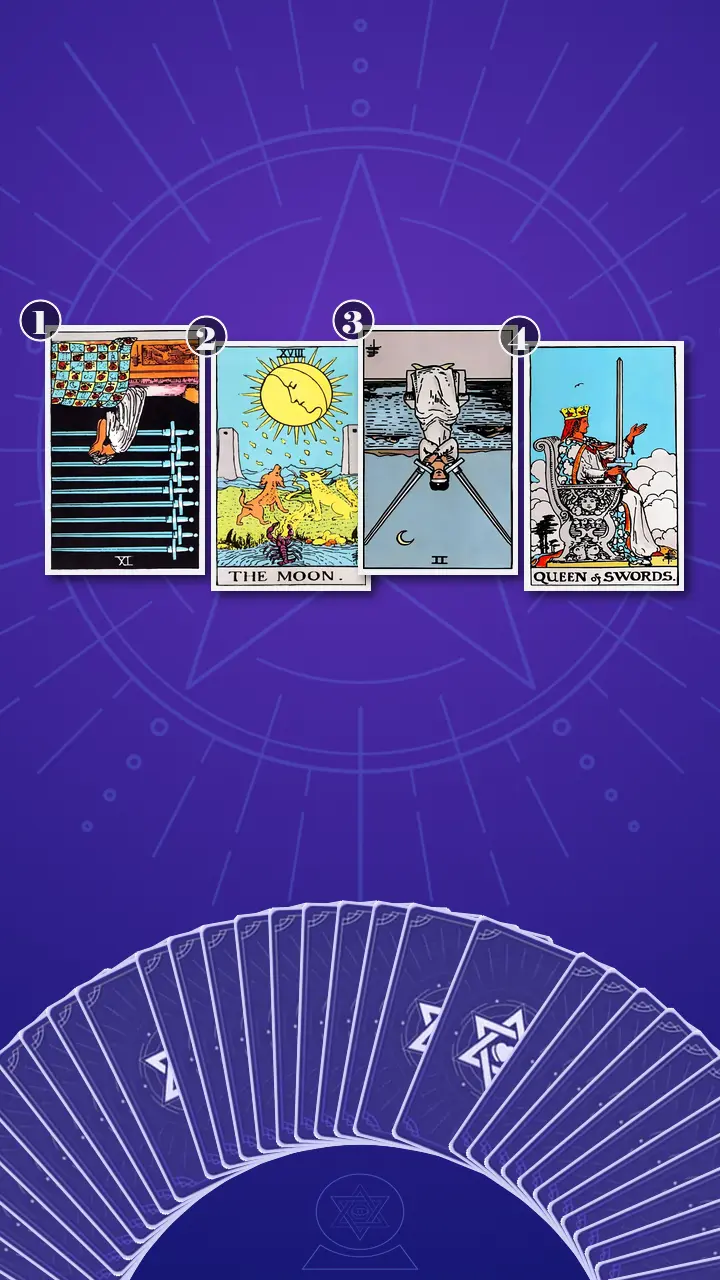
Reading the Shadow Spread Through the Fog
Position 1: The Review That Became a Cross-Examination
Now I turned the card representing the visible shadow expression, the concrete post-interview behaviour Alex could already see. It was the Nine of Swords, reversed.
I pointed to the figure sitting upright with their face covered and the fixed row of swords above the bed. I connected that image to the scene Alex had just shown me: awake with interview notes open beside Gmail, rewriting the same campaign example and checking Sent to see whether the thank-you email somehow looked wrong. The looping mental-work atmosphere reminded me of Severance, except this work problem had refused to stay at the office and followed Alex home.
I read the reversal as Blockage. The mind was producing intense analytical energy, but that energy was not moving toward usable learning or release. It had turned inward. Alex's unspoken bargain sounded like this: “If I can locate the exact sentence, then I can finally stop feeling this.” The wish to learn was understandable; the compulsion to prosecute every word was what kept mental time frozen.
“Replay offers the feeling of control, then charges interest in self-doubt,” I said. “Each improved answer gives you a few seconds of relief, but it also teaches you to distrust the answer you actually gave. Useful reflection produces a lesson. Cross-examination keeps reopening the case without receiving new evidence.”
I watched a three-part reaction move through Alex. Their breath caught first, and their thumb froze above the phone. Then their gaze slipped away from the screen, as if they were replaying several late nights at once. Finally, they let out one short, bitter laugh and placed the phone on the duvet.
“That is so accurate it is almost rude,” they said. “I call it preparation, but I am trying to make the silence explain my worth.”
“I do not hear a lack of discipline in that pattern,” I replied. “I hear a capable mind trying to solve a problem that has not supplied the necessary data. We can keep your ability to reflect without letting reflection become punishment.”
Position 2: The Moon Over an Unchanged Applicant Portal
Now I turned the card representing hidden projection and fear, the place where a missed update activates the belief that incomplete information must contain a threatening explanation. It was The Moon, upright.
The winding path between two towers became the gap between “we will update you Friday” and an empty Monday inbox. I described the dog and the wolf as two reactions to the same silence. One voice said, “The conversation felt fine.” The other said, “They saw something wrong with me.” Neither voice had received new information, but the second sounded more convincing because it matched Alex's fear of being exposed as less competent than they hoped.
At this position, I read The Moon's imaginative Water as Excess. Imagination is useful when it creates possibilities, but under career pressure it can flood the space where evidence should be. Alex had opened an unchanged portal and immediately pictured a hidden panel discussion in which one imperfect answer ended their chances. Nothing on the screen confirmed that scene.
Rain shifted against the apartment window while I spoke, and a watery reflection crossed the card. The environment seemed to underline the Moon's lesson: a moving shadow can look solid until the light changes.
“Your empty inbox has become a recommendation algorithm trained on your worst fear,” I said. “Every refresh serves a more detailed version of the same rejection story, even though the source data has not changed. Silence is missing information, not negative feedback in disguise.”
I asked, “When the promised update did not arrive, what was the first unconfirmed story you told yourself about what they must have thought?”
Alex pressed a palm against their sternum. “That they liked me until the campaign question. Then they realised I had been making my experience sound bigger than it was.”
“That fear deserves to be heard as a fear,” I said. “It does not deserve to be promoted to official feedback. The Moon describes poor visibility, not a confirmed destination. I would never read it as proof that the employer rejected you.”
Position 3: Closing Both Verdict Tabs
Now I turned the card representing integration strain, the opposing inner stories and the vulnerable feeling Alex had been avoiding by forcing certainty. It was the Two of Swords, reversed.
I centred the blindfold and the crossed swords. The image resembled two browser tabs left open all day: one titled “I definitely got it” and the other “I completely failed.” Alex had been refreshing both. They told one friend the conversation was clearly strong, asked another friend to identify every weak answer, and left a carefully edited follow-up unsent because sending and not sending both felt exposing.
I read the reversed energy as Blockage under strain. The stalemate had once protected Alex from the discomfort of saying, “I do not know.” Now maintaining two absolute stories required more energy than the unknown itself. The water behind the blindfolded figure suggested feelings kept outside the apparent decision: disappointment, shame, financial pressure, and the longing to be chosen.
“If I choose either story, at least I do not have to sit in the blank space,” Alex said quietly.
“Exactly,” I replied. “But choosing a verdict is not the only way to make a decision. You can decline both conclusions and still choose a response. You can name what is known, name what remains unknown, acknowledge the feeling, and decide whether one follow-up is proportionate.”
I asked Alex to imagine closing both verdict tabs and opening a note with only two headings: Known and Unknown. Their shoulders stayed lifted for a moment. Then I saw their fingers uncurl from the edge of the duvet, their eyes settle on the card, and a long breath leave their chest.
“That feels less dramatic,” they said, “but also more honest. I hate that it still means I have to wait.”
“Clarity does not always remove the wait,” I said. “Sometimes it removes the false job you assigned yourself during the wait. Your job is not to reverse-engineer a decision you cannot access. Your job is to choose how much attention this unknown receives.”
When the Queen's Sword Separated Signal From Noise
Position 4: The Clear Witness
Just as I reached for the final card, the radiator stopped clicking. The room became unusually quiet, and a distant streetcar bell came through the window with one clean note.
Now I turned the card representing the integrated response, the shift from replaying for certainty to separating facts from interpretations and taking one bounded, self-directed action. It was the Queen of Swords, upright.
I showed Alex the Queen's direct gaze, her upright sword, and her open hand. The sword offered a dividing line between evidence and interpretation. Her gaze stayed with what could be observed. Her open hand modelled communication that was clear without chasing, pleading, or demanding that another person regulate her uncertainty.
I read her Air as Balance. The spread did not ask Alex to become less intelligent, less prepared, or less invested in the role. It asked them to direct those strengths differently: write three facts, identify one useful learning point, label one unconfirmed story, send one concise follow-up only if the timeline warranted it, and then return attention to another choice.
At that moment, I thought of a sound-research session years earlier, when I watched several clean waveforms overlap until the combined output clipped into distortion. None of the individual tracks was morally wrong. The problem was that incompatible frequencies were competing for the same channel at full volume.
I call this diagnostic lens Mental Noise Cancellation. I did not treat Alex's internal friction as a character flaw. I separated the frequencies. The employer channel contained one verified signal: no update had arrived. The inner-critic channel insisted one answer had ruined everything. The career-pressure channel carried rent, ambition, and urgency. The LinkedIn channel amplified other people's public milestones. The Queen did not magically mute emotion or reveal the hiring outcome. Her sword removed unsupported claims from the main mix so Alex could hear the factual signal again.
I brought us back to the moment the loop took over: 10:48 p.m., the inbox empty, Notes open, the same answer being rewritten while their chest tightened. Alex knew silence was not technically an answer, but their mind had promoted it into one.
You do not need to keep replaying the interview to earn certainty; let the Queen's upright sword divide observable facts from imagined verdicts, then use her open hand to make one clear, proportionate follow-up or no further review for the day.
I let the sentence remain in the quiet room.
I watched Alex's breath stop. Their fingers hovered above the phone without touching it, and their pupils widened slightly as their gaze lost focus. I could almost see the Friday follow-up draft moving through their memory. Then their eyebrows drew together, their jaw tightened, and a flash of anger replaced the first hint of relief.
“But does that mean I have been doing all of this wrong?” they asked. “I spent hours trying to fix it. I could have used that time on another application.”
“It means the replay was trying to protect you from helplessness,” I said. “Protection can become expensive without being foolish. You do not need to shame the version of you who reached for control. You can thank that impulse for trying, update the method, and stop paying for it with tonight's attention.”
Their eyes reddened at the edges. Their shoulders lowered one at a time, and the fist resting near the laptop slowly opened. A shaky exhale became a small “Oh.” For a few seconds, I noticed the blankness that can follow release: the slight dizziness of discovering that a burden was never a duty, followed by the vulnerable recognition that the next boundary would now be theirs to choose.
I asked, “Now, with this new perspective, think back: was there a moment last week when this insight might have made you feel differently?”
“Friday at five,” Alex said. “I was hovering over Send, and I thought the panic meant I had to do something immediately. I could have written, 'What I know is that they missed the date. What I am imagining is that they rejected me because of one answer. What I choose next is to wait until Monday and send one normal email.'”
I nodded. “That is the Queen of Swords in ordinary life. Clarity asks what is known; anxiety asks for a verdict. You can learn from one answer without making it testify against your worth.”
I named the deeper crossing for Alex. This was not a leap from uncertainty to perfect confidence. It was a first movement from treating recruiter silence as a personal verdict toward holding uncertainty with discernment and self-trust. The outcome could remain unknown while Alex's competence remained outside the imaginary courtroom.
The One Review, One Message Rule
I drew the four cards together as one coherent story. Alex's preparation had begun as a real strength: the colour-coded Notion interview bank, the STAR examples, the measurable outcomes, and the thoughtful questions. Under pressure, that same strength became the reversed Nine of Swords, a film stuck on one scene. The Moon explained why the scene kept looping: recruiter silence created an empty projection screen. The reversed Two of Swords showed the inner split between “I got it” and “I failed.” The Queen of Swords recovered the spread's unused resource, Alex's capacity to edit carefully, communicate clearly, and set a boundary.
I pointed out the cognitive blind spot. Alex had been treating the intensity of their analysis as though it could substitute for access to the employer's decision data. They also assumed that if the process led nowhere, the result would reveal their underlying worth. Neither conclusion followed from the available facts.
The transformation direction was smaller and more practical than “stop caring.” I wanted Alex to keep caring while changing the container: one factual debrief instead of an evolving transcript, one proportionate follow-up instead of multi-channel monitoring, and a deliberate return to current work or another application. The goal was clarity, not forced certainty.
Because silence itself had become loaded for Alex, I used my Resonance Healing Calibration to choose a neutral sound anchor rather than asking them to sit in a perfectly quiet room. I suggested a low-volume instrumental track with a steady beat and no lyrics. It would not solve the hiring question. It would give the mind one consistent rhythm while the factual review happened.
A Bounded Clarity Debrief for the Next Eight Minutes
- Use the Frequency Reset Pause, then make a Fact-Story-Next note.On one evening this week, sit at the kitchen table, place the phone on Focus mode, and play one quiet, steady instrumental track. Breathe in for four beats and out for six beats, four times. Then set an eight-minute timer and divide one page into Fact, Story, and Next. Record three observable interview facts, one behaviour-based learning point, one story the silence triggered, and one proportionate next step.Stop when the timer rings, even if the page feels incomplete. Do not reconstruct the full interview or grade your worth. If writing restarts the loop, record one fact in a two-minute voice note and archive it. The minimum version still counts.
- Choose one follow-up date and one communication channel.Open the recruiter thread once and record the exact update date they gave. If that date has passed and Alex has not followed up, draft one email capped at four sentences: appreciation, the role reference, one status question, and a neutral close. After sending, archive or mute the thread until a named calendar check, then spend twenty minutes on one current task or another application.Ask one trusted person to check clarity, not to predict the outcome. Do not stack email, LinkedIn, and portal messages. If no message is due, the minimum action is scheduling the decision date and closing the thread for today.
“One review. One message. Then your attention comes back to you,” I said. “That boundary does not guarantee an offer, and it does not require you to pretend you are detached. It protects your ability to participate in the rest of your life while the process remains unresolved.”

Six Days Later, the Quiet Proof
Six days later, I received a message from Alex. They had used the Frequency Reset Pause at their kitchen table, then written: “Fact: I answered every question and the interviewer said my campaign example was relevant. Story: the delay means they discovered I am not ready. Next: send one concise follow-up Friday, then finish the portfolio paragraph for another role.”
They sent the follow-up when the scheduled date arrived. The employer still had not replied, but Alex did not reopen the interview transcript. They spent twenty minutes on the other application, made dinner, and watched the episode that repeated checking had displaced all week.
They had slept through the night. Their first thought at dawn was still, “What if I ruined it?” They noticed the sentence, smiled once, and made coffee before opening Gmail.
I did not read that message as proof that tarot had removed uncertainty. The cards had supplied a shared visual language, but Alex had created the change by distinguishing signal from noise and acting on what remained within their control. Their Journey to Clarity had not ended with certainty about the job. It had begun with self-trust surviving an unanswered hiring process.
If an interviewer has gone quiet and your hand is drifting back toward the phone while your chest tightens, remember what the Queen's sword revealed in Alex's apartment: the empty inbox may carry several emotional frequencies, but it still contains no verdict on what you are worth. Letting yourself notice that distinction means you are no longer at the beginning of the loop.
If you let the silence remain unknown for tonight, which one clean line would you keep on the Queen's side of the page: one observable fact about your performance, or one next choice that still belongs to you?
Every reading at AceTarot is a journey to connect with inner wisdom and empower the path ahead. This reading shared here is a psychological mirror, not a private record—crafted to reflect universal emotional loops and help restore personal clarity. Please note that these insights do not replace professional psychological, medical, legal, or financial advice, and should not serve as the sole basis for major life decisions.
Learn more about our Journey to Clarity.
How did this insight land for you?
🫂 This Resonates Deeply
🌀 Living This Story
✨ Now I See Clearly
🌱 Seeing New Possibilities
🧰 Useful Framework
🔮 The Confirmation I Needed
💪 Feeling Empowered
🚀 Ready for My Next Step
Author Profile
 AI
AI Alison Melody
996 readings | 597 reviews
“Through ten years of sound energy research, I’ve found that when we struggle, it's usually just our internal rhythm falling out of sync under pressure. I know firsthand the frustrating helplessness of wanting to move forward but feeling paralyzed. Without overwhelming theories, I want to be the soothing background track that helps you recalibrate, turning your heavy burdens back into a light, effortless, and harmonious melody.”
In this Introspection Tarot Reading :
Core Expertise
- Mental Noise Cancellation: Diagnosing severe internal friction not as a moral failing, but as a chaotic overlapping of incompatible psychological frequencies.
- Resonance Healing Calibration: Identifying the 'dissonant baseline' of your chronic anxiety and calculating the specific acoustic or rhythmic input needed to soothe it.
Service Features
- The Frequency Reset Pause: A customized rhythmic breathing or acoustic grounding technique to forcefully lower your brainwave state from a frantic beta frequency to a restorative alpha state.
Also specializes in :
Explore Related Patterns:
Certainty SeekingAlex says silence is not technically an answer while simultaneously insisting that one interview moment must explain it. The replay is organized around a bargain: find the exact sentence, obtain a verdict, and finally stop feeling exposed to the unknown. That bargain reveals certainty seeking rather than ordinary preparation. By choosing between “I definitely got it” and “I completely failed,” you can momentarily escape the blank space, but both conclusions claim access to employer information you do not possess. The pattern assigns your mind an impossible job: reverse-engineer a private decision process from an empty inbox. Because the missing data cannot be produced through analysis, the search keeps expanding while certainty remains unavailable.
Post-Event RuminationAt 10:48 p.m., Alex has Gmail, the applicant portal, and a rewritten interview answer open at the same time. The campaign example has already been edited three times, yet the mind returns to it as though one more review could uncover decisive evidence. The replay functions as an intellectualized control strategy: analyzing the past creates a temporary sense of movement when the hiring process offers no new data. When you revisit the same exchange for relief rather than a specific, bounded lesson, reflection becomes post-event rumination and teaches you to distrust the performance you are trying to evaluate. The loop persists because every improved answer briefly lowers uncertainty while implying that the original answer was unsafe. What feels like preparation is therefore reinforced as self-protection, even though it keeps the interview psychologically active long after it has ended.
Achievement-Based Self-WorthAlex recognizes that the replay is trying to make recruiter silence explain their worth. The possibility of an unsuccessful interview is therefore carrying more than a career consequence; it threatens to become evidence about who Alex fundamentally is. Achievement-based self-worth fuses an external performance outcome with internal value. When you experience a hiring decision as a verdict on competence rather than one organization's context-bound choice, every imperfect sentence becomes identity-level evidence and feels too consequential to leave alone. That fusion explains why rational reminders about recruitment delays may not stop the loop. The mind is not only waiting for an update about a role; it is waiting for permission to continue believing in itself.
Mind ReadingThe unchanged applicant portal becomes an imagined panel discussion in which the campaign answer exposed Alex as less competent than they appeared. Nothing on the screen confirms this scene, but its detail makes it feel more like recovered feedback than a fear-generated possibility. Mind reading fills an interpersonal information gap by supplying motives, judgments, and conclusions on another person's behalf. When you already fear being found out, the imagined evaluator tends to repeat your inner critic's language, so projection can masquerade as professional insight. The practical danger is not simply having a negative thought. It is allowing an internally generated account of the panel's reaction to acquire the authority of external evidence, which keeps every remembered answer open for prosecution.
Boundary DiscernmentAlex sets an eight-minute debrief, chooses one follow-up date, uses one communication channel, and archives the thread afterward. These limits define how much access the hiring process receives to the evening, even while the role still matters. Boundary discernment separates the employer's responsibilities from Alex's responsibilities. You can ask clearly for an update and reflect on one useful learning point, but you do not assume responsibility for decoding silence, producing the panel's decision, or monitoring every possible channel. The boundary is psychological as well as behavioral. It protects your attention from becoming collateral in an unresolved process and keeps another person's delay from acquiring unlimited authority over your self-assessment.
Reality TestingAlex divides the interview aftermath into Fact, Story, and Next, recording what was observed separately from what the silence triggered. The missed update remains a verified event, while the claim that one answer caused rejection is returned to its actual status as an unconfirmed interpretation. Reality testing does not require you to manufacture a positive story or dismiss the possibility of disappointment. It asks whether each conclusion is supported by available data and prevents emotional intensity from being treated as privileged evidence. This preserves Alex's analytical strength while changing its assignment. Instead of prosecuting the interview, analysis becomes a tool for separating the employer's signal from projection, identifying one useful lesson, and choosing an action that does not depend on knowing the outcome.
Uncertainty ToleranceSix days later, the employer still has not replied, but Alex sends one scheduled follow-up, works on another application, makes dinner, and sleeps through the night. The first anxious thought still appears the next morning, yet it no longer determines the first action. Uncertainty tolerance is visible here as continued agency in the absence of resolution. You do not have to feel detached or predict a good outcome; you allow the unanswered question to exist without converting it into an emergency verdict. The shift matters because it removes the false task of solving another party's inaccessible decision. The unknown remains uncomfortable, but it no longer receives unlimited control over attention, competence, or participation in the rest of your life.
Compulsive CheckingAlex's thumb moves from Gmail to an unchanged portal, then to Notes and the Sent folder, even though each location contains the same amount of new information: none. The ritual continues across late nights and begins displacing dinner, sleep, and another application. Each check offers a momentary promise that uncertainty might finally end. When the screen remains unchanged, that relief collapses and the urge returns, creating a negative reinforcement cycle in which checking both soothes and renews the discomfort. When you are caught in this pattern, the phone is not simply a source of information. It becomes a safety device used to monitor an unresolved threat, which is why an empty result can increase rather than settle the need to look again.
Explore Related Struggles:
Evidence DisconnectionAlex knows that silence is not technically an answer, yet the empty Monday inbox becomes a detailed rejection story while the source data stays unchanged. You can see the split when a missed update is treated as feedback, a portal is refreshed for meaning, and one imperfect answer is promoted above the fact that no decision is available. That leaves you trying to solve missing information with more analysis. The unknown remains inaccessible while interpretations gain the authority of evidence and pull you back to the interview. Separating what the employer has actually communicated from what the silence suggests gives your judgment a firmer place to stand without requiring you to pretend the wait is easy.
Performance-Worth FusionAfter Alex imagines that the campaign question exposed them as less competent, the delayed hiring update stops being only a process detail. The possible result begins standing in for a judgment about the person who gave the answer, so you replay the interview as if one sentence could testify about your underlying worth. When an unanswered process is made to carry that verdict, careful preparation can turn into repeated self-prosecution. You keep searching the transcript for proof that the employer's silence says something final about you, even though the interviewer said the campaign example was relevant and every question was answered. Holding performance feedback and personal worth in separate places allows you to learn from the interview without making the outcome your identity's ruling.
Rumination EntrapmentAfter the interview, you ride the TTC home rewriting the same answer, then open Gmail, the applicant portal, and Sent again. The review begins as preparation, but no new employer evidence enters the loop, so each revision sends your attention back to the same scene instead of producing a usable lesson. When the recruiter goes quiet, replay offers the promise that one exact sentence can explain the delay. That promise keeps your mental work moving in circles and turns reflection into a second shift that displaces dinner, sleep, and another application. You can keep the learning from the interview without letting the same case reopen every time the inbox stays unchanged.
Monitoring-Safety FusionAt 10:48 p.m., your thumb moves from Gmail to the unchanged applicant portal and back to Notes, while each Refresh tightens the connection between the inbox and your chest. Checking briefly appears to restore command, but the next unchanged screen sends you back for another check. Because security becomes tied to watching for an update, putting the phone down can seem like giving up the only available control. The monitoring keeps the employer's silence at the centre of dinner, sleep, and your next application even though it cannot produce a reply. A named check date and one proportionate message separate responsible follow-up from the demand to remain on watch.
Explore Related Emotions:
Identity Verdict DreadAlex says the silence has become an imaginary performance review and later admits they are trying to make it explain their worth. A delayed hiring update is therefore carrying more than career information; it has been given authority to decide what Alex's performance says about who they are. When you merge an employer's inaccessible decision with your underlying value, every unanswered message can feel like a judgment already taking shape. Identity Verdict Dread names the fear that another person's hidden conclusion could define you, while separating that fear from any observable assessment of your competence.
Impostor Exposure FearAlex identifies the campaign question as the moment when the panel might have realized their experience sounded bigger than it was. The unchanged portal supplies no evidence for that scene, yet the imagined discovery feels persuasive because it touches a vulnerable question about whether their professional presentation was legitimate. When you fear that being closely evaluated will expose a gap between how capable you appeared and how capable you feel, silence can resemble concealed confirmation. Impostor Exposure Fear describes that subjective alarm without treating it as proof that you misrepresented yourself or that the employer reached the conclusion you fear.
Reassurance CrashAlex seeks confirmation that the conversation was strong, asks another friend to identify every weak answer, and repeatedly produces improved versions of what they said. Each attempt briefly softens the uncertainty before a new possible flaw restores the need for reassurance. When you use review or other people's opinions to settle a question that still lacks external data, the comfort may disappear as soon as another interpretation appears. Reassurance Crash names that sharp return of doubt, making it easier to distinguish temporary soothing from the steadier clarity created by a bounded factual review.
Retroactive Rejection DreadAlex keeps Gmail open beside a Notes file containing a cleaner version of an answer they have already rewritten three times. With no new feedback available, the completed interview becomes a scene they can repeatedly search for the exact moment when rejection supposedly began. When you revisit the past this way, replay can feel like investigation while quietly becoming an attempt to experience rejection before anyone has communicated it. Retroactive Rejection Dread names the inner weather of expecting an old sentence to reveal a verdict, even though the available facts still support no such conclusion.
Unresolved Outcome AnxietyThe promised Friday update gives way to an empty Monday inbox, and the unanswered process begins occupying Alex's dinner, sleep, and attention to another application. The absence of information does not remain confined to the recruiter thread; it keeps Alex's body and routines waiting for a conclusion. When you cannot verify either acceptance or rejection, your attention may stay activated as though the outcome could arrive at any second. Unresolved Outcome Anxiety captures that suspended inner atmosphere, while recognizing that you can contain the wait even before the external process resolves.
Certainty HungerAlex's unspoken bargain is that finding the exact wrong sentence will finally let the replay stop. The repeated edits are not producing new interview data, but they briefly imitate the definitive explanation the empty inbox cannot provide. When you are starved of a clear outcome, analysis can begin to feel like a way to manufacture certainty from memory. Certainty Hunger names the urgent pull beneath the checking, while helping you see that a strong desire for an answer does not turn an imagined answer into evidence.
Restless Self-DoubtAlex's thumb cycles from Gmail to the unchanged portal and back to an answer already rewritten three times. Each cleaner version offers a momentary sense of correction, but it also makes the answer given in the actual interview feel less trustworthy. When you repeatedly edit a performance that can no longer be changed, uncertainty can settle into the body as agitation directed at your own judgment. Restless Self-Doubt captures the feeling that you must keep checking because your original perception, memory, or competence no longer feels reliable.
Cautious Self-TrustAlex's first thought at dawn is still that they may have ruined the interview, but they notice the sentence, make coffee, and wait before opening Gmail. The old fear remains audible without automatically becoming an instruction. When you can recognize a familiar alarm and still follow a boundary you chose, confidence no longer has to mean never doubting yourself. Cautious Self-Trust is the developing sense that you can stay on your own side while an external decision remains unanswered.
Clarity ReliefAlex imagines closing both verdict tabs and replacing them with Known and Unknown, after which their fingers uncurl and a long breath leaves their chest. Nothing about the employer's decision has changed, but the unsupported rejection story no longer has to occupy the same category as fact. When you give evidence, interpretation, and choice separate places, your mind no longer has to resolve them as one impossible question. Clarity Relief is the easing that follows accurate separation, allowing you to recover attention without pretending the unknown has disappeared.
Liberating UncertaintyThe employer still has not replied six days later, yet Alex does not reopen the interview transcript. They complete another application task, make dinner, sleep through the night, and let the unanswered process remain only one part of the evening. When you stop demanding that uncertainty become a verdict, the unknown can remain present without governing every available choice. Liberating Uncertainty describes the spaciousness of continuing your life before certainty arrives, with your attention returning to decisions that still belong to you.
Bittersweet ReleaseAlex's first hint of easing is followed by anger about the hours spent trying to fix an inaccessible decision. Their eyes redden, their shoulders lower, and a shaky exhale arrives with the realization that this burden was never a duty. When you release a costly form of control, you may feel lighter while also grieving the attention it consumed and facing the vulnerability of choosing a new boundary. Bittersweet Release holds both reactions without turning either into self-blame, leaving room to update the method while respecting why you reached for it.
Explore Related Contexts:
Post-Interview GhostingThe recruiter promises a Friday update, Monday arrives with an empty inbox, and the employer still has not replied six days after Alex sends one scheduled follow-up. The unchanged applicant portal confirms only that no information has been shared; it does not disclose a hiring decision. That communication gap creates a sharp information imbalance. The employer controls the outcome, timeline, and decision data while you are left with a completed performance and no reciprocal signal. Replaying the interview can attach itself to that blank space because reviewing your own answers is the only part of the process still accessible to you. Post-Interview Ghosting names the employer's nonresponse rather than converting it into evidence about your competence. Once the communication failure is separated from your performance, you can judge the process by observable facts, choose one proportionate follow-up, and stop treating private self-review as a substitute for feedback the employer has not provided.
Job Search LimboAlex has completed the interview, passed the recruiter's promised update date, and sent a follow-up, yet the application has moved neither forward nor out of consideration. There is no rejection to process, no next round to prepare for, and no revised timeline to organise around. This suspended status is Job Search Limbo. The hiring process has withheld the external marker that would normally close one stage and open another, so you remain socially positioned as an applicant without knowing whether the role is still active. The replay becomes attached to that stalled transition because the interview is the last completed event available for inspection. Recognising the limbo clarifies where the blockage sits. You do not have to manufacture an answer in order to keep moving; you can leave the employer's status unresolved while restoring coordinates elsewhere through another application, a portfolio task, or a defined date after which you stop monitoring the process.