Why Does Every Visit Feel Like an Audition?

Explore unspoken family tests, related tarot cards, and reading insights from others who brought this strained welcome into a session.

Partner Family Integration Trial
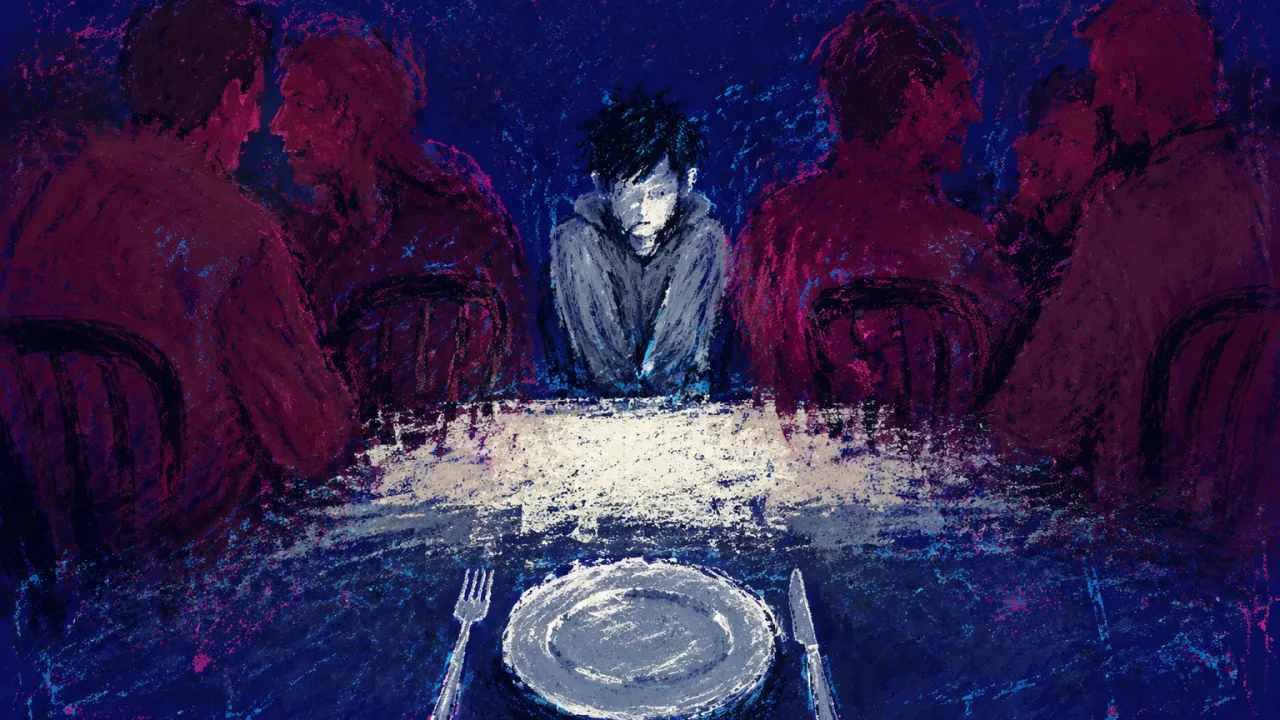
Figure with shoulders drawn inward as occupied chairs close from both sides, leaving one place setting outside the light.

What is this situation?

Partner Family Integration Trial — you arrive at your partner's family home carrying a bottle or dessert, and before your coat is off, the visit has already taken on the feel of an informal audition. At first, the questions sound ordinary: what you do, how serious the relationship is, whether you will be at the next holiday; then the rules start showing themselves through seating choices, in-jokes, side conversations, and corrections about how their family does things. You are expected to know which jokes are safe, who can interrupt whom, whether offering help is welcome, and how much affection counts as too much, though nobody tells you beforehand. One relative calls you quiet, another treats you as too familiar, and the standard shifts with whoever has the floor. When a pointed comment lands, your partner explains it later instead of interrupting it in the room, while plans keep being settled in group chats you are not part of and passed to you after decisions are made. Each invitation becomes another chance to be assessed, so your shoulders stay lifted through dinner as you watch the table for the next rule change. By the ride home, the strain comes less from any single remark than from having your place in the relationship repeatedly treated as something a family committee can approve, delay, or revoke, much like the Five of Pentacles, where two figures pass a lit window, close enough to see its warmth while remaining outside.

Why it's not you?

The problem is not that you failed to be charming, helpful, or easygoing enough. When belonging depends on shifting standards, private decisions, and approval that stays conditional, the trial is built into how the family manages access. That setup, not your adequacy as a partner, keeps your place unsettled.

Partner Family Integration Trial in Tarot Cards

In a Partner Family Integration Trial, every visit can become another informal audition under rules no one states, with your shoulders held high through dinner. This is an environmental and structural dynamic: invitations, insider access, and approval are managed around you, regardless of how carefully you participate. The Tarot Cards below reflect the visible contours of that conditional welcome without deciding what you should do next.

The High Priestess
Reversed
A pomegranate-patterned veil stretches between two contrasting pillars while a partly concealed scroll rests in the High Priestess's lap. Reversed, the threshold and hidden text become a blocked knowledge system: information exists, but access to it is partial, indirect, and controlled by those already positioned behind the veil. You are expected to know which jokes are safe, who may interrupt, and whether offering help will be welcomed, although nobody makes the code explicit. The reversed image identifies a family hidden curriculum in which insiders benefit from tacit knowledge while your predictable mistakes are treated as evidence that you do not naturally fit.
The Hierophant
Reversed
Seated between two stone pillars, the Hierophant raises one hand above two initiates while crossed keys mark controlled entry into an established order. Reversed, the teaching relationship becomes a compliance problem: customs still carry authority, but the route to legitimate membership is obstructed by rigid or selectively disclosed rules. You are corrected on how this family does things without receiving a stable explanation of those things beforehand. The reversed structure shows tradition being used as an admission test, allowing insiders to present inherited preferences as neutral standards while your relationship is treated as legitimate only when it conforms.
The Lovers
Reversed
A couple stands beneath an elevated angel with a mountain rising between their separate positions, placing intimacy under the gaze of a larger authority. Reversed, the scene exposes misalignment over whose values govern the bond and whether the couple can act as one unit when external approval carries consequences. You may receive private agreement from your partner after a pointed family comment without seeing that alignment expressed in the room. The reversed image locates the romantic friction in the gap between personal commitment and public partnership, where family approval continues to outrank the couple's shared boundary.
Justice
Reversed
Justice sits between two pillars holding level scales and an upright sword, presenting standards, evidence, and consequences as parts of one visible process. Reversed, those instruments remain present but lose procedural integrity: rules can still be enforced even when they are inconsistent, selectively applied, or changed after the fact. You can be called too quiet by one relative and too familiar by another, with no position that reliably passes. The reversed scene names the family trial as an accountability imbalance, because the committee evaluates your behaviour while its own criteria remain exempt from review.
The Hanged Man
Reversed
A suspended figure hangs by one foot from a wooden frame, with the free leg crossed and a halo surrounding the head. Reversed, suspension no longer produces a meaningful shift in perspective; it becomes a holding pattern in which time passes without changing the conditions that keep the figure pending. You may treat the next dinner or holiday as the moment family acceptance will finally stabilise, only to find the evaluation reset again. The reversed structure reveals timing without a real milestone: waiting cannot complete an integration process when the people controlling approval have not defined an endpoint.
Judgement
Reversed
An angel sounds a trumpet above a group of people who rise and turn toward the summons, creating a public moment of review, recognition, and changed status. Reversed, the summons keeps recurring without delivering a clear transition, so evaluation becomes repetition rather than resolution. You attend another dinner, answer another set of questions, and discover that previous efforts did not carry forward into secure acceptance. The reversed image captures an audition that never reaches a final decision: each invitation reopens your legitimacy while the family avoids naming what would actually end the trial.
The World
Reversed
A central figure is enclosed by a large wreath while four fixed witnesses occupy the corners, turning the image into a map of completion, recognition, and membership within a bounded whole. Reversed, the boundary remains intact while completion is delayed, creating proximity to the circle without confirmation of a settled place inside it. You can attend repeated gatherings and become familiar to every relative while still being introduced, evaluated, or consulted as a temporary addition. The reversed wreath names incomplete social integration: participation accumulates, but the family circle withholds the recognition that would convert presence into belonging.
Three of Cups
Reversed
Three figures lift their cups inside a close triangular formation, sharing a coordinated gesture that depends on mutual familiarity. Reversed, the intimate circle hardens into clique dynamics, gossip, or celebration that preserves an insider group by keeping someone else peripheral. You encounter in-jokes, side conversations, and a family group chat whose shared history gives every established member context you do not possess. The reversed circle makes soft exclusion visible: nobody needs to reject you outright when insider coordination repeatedly confirms who already belongs.
Three of Pentacles
Reversed
One craftsperson stands on a bench facing two robed figures beneath a carefully constructed arch, creating a scene of work being reviewed by an established panel. Reversed, the shared project loses reciprocal coordination and the meeting becomes an assessment whose criteria do not reliably produce recognition. You bring the bottle, offer help, attend the holiday, and still encounter a new standard from the next relative who speaks. The reversed workshop exposes a family integration process in which contribution is continually evaluated but never converted into secure standing, keeping you in the role of applicant rather than collaborator.
Five of Pentacles
Upright
Two bundled figures move through snow beneath a bright stained-glass window, placing visible warmth only a few steps away from people who remain outside. The window, winter street, and paired outsiders reproduce the physical structure of a partner's family gathering: belonging is plainly present, but access to it is controlled from inside. You may be invited into the house while still being positioned socially at its edge, learning plans late and discovering rules only after crossing them. The upright image separates material proximity from actual inclusion, making the repeated trial legible as family gatekeeping rather than a personal failure to be sufficiently agreeable.
Six of Pentacles
Reversed
A standing figure holds scales in one hand while distributing coins to two kneeling people with the other, concentrating measurement and access in the same person. Reversed, the exchange becomes conditional and asymmetrical: those controlling the resource also decide who qualifies, how much is granted, and when it can be withdrawn. You may receive an invitation, a warm comment, or access to one event without gaining equal standing in later decisions. The reversed scales clarify why approval never feels bankable: family acceptance is dispensed in small, revocable portions, leaving you dependent on standards controlled entirely by insiders.
Ten of Pentacles
Reversed
An elder, a couple, a child, and two dogs occupy a walled family setting beneath an arch filled with pentacles, layering household intimacy with lineage, continuity, and inherited status. Reversed, that legacy structure stops functioning as a secure foundation and becomes a restricted membership system whose rules protect established continuity from outside influence. You are not only meeting individual relatives; you are entering a network with old stories, fixed roles, and an internal definition of who counts as family. The reversed image reveals why ordinary behaviour receives disproportionate scrutiny: your place is being measured against an inherited family script that may treat the relationship as disruption before it treats you as a person.
Two of Swords
Upright
A blindfolded figure sits before the sea with two swords crossed tightly over the chest, holding opposing pressures in a controlled but immobile balance. The closed posture creates a stalemate in which refusing to respond is itself an active arrangement, because the conflict remains present while one person avoids taking a visible position. You face the comment in real time while your partner waits until the ride home to explain what the relative supposedly meant. The upright scene shows how partner neutrality transfers the immediate social cost to you, preserving short-term peace with the family by leaving the relationship boundary unenforced.
Seven of Swords
Upright
A lone figure carries five swords away from a cluster of tents while glancing back toward people left in the distance. The divided scene, partial removal of the swords, and backward look create an information environment shaped by side channels, selective disclosure, and action taken outside the full group's view. You learn about holiday plans after relatives have already settled them in a chat you cannot see, then arrive expected to behave as though the process included you. The upright image makes the structural issue concrete: insiders preserve coordination through private channels while your late access to information keeps your family role reactive and easier to evaluate.
Four of Wands
Reversed
Four upright wands hold a flowered garland before celebrating figures, with a substantial home visible beyond them. Reversed, the architecture of welcome remains recognisable but fails to provide secure social footing, separating the formal invitation from the experience of being received without conditions. You can cross the doorway carrying dessert and still find the family home functioning as an assessment site before your coat is off. The reversed celebration scene reveals how holidays and dinners preserve the appearance of hospitality while unstable rules prevent the visit from becoming genuine belonging.
Nine of Wands
Upright
A bandaged figure grips one wand while watching from in front of a row of eight others, with the body turned as though another challenge may arrive from outside the frame. The visible injury, guarded stance, and improvised barrier show attention organised around repeated exposure rather than a single isolated encounter. You keep your shoulders lifted through dinner, track who is speaking, and scan each joke for the next change in rules. The upright image frames that inner vigilance as information accumulated from recurring family tests, while also revealing the cost of needing to remain defended in a setting presented as ordinary hospitality.

Partner Family Integration Trial in Tarot Card Reading Insights

Others navigating a Partner Family Integration Trial have brought the shifting rules, closed group chats, and unsettled place at family gatherings into their readings. The Tarot Reading Insights below show what came up in those sessions.


Psychological Contexts Related to Partner Family Integration Trial