Three Rehearsed Stories—And the Three Seconds That Loosened the Script

The TTC Notes App and the Dinner Audition
When Jordan (name changed for privacy), a 29-year-old non-binary project coordinator in Toronto, sat across from me, I recognized the pattern: they had drafted possible dinner stories on the TTC before meeting their partner's parents, then treated every laugh or pause as feedback about whether they belonged. I hear this described as meet-the-parents anxiety, but I never reduce it to a personality flaw.
At 5:52 p.m. on the Line 1 train north, Jordan had typed three backup anecdotes into the Notes app while the brakes shrieked and wet coats pressed against their sleeve. Their phone felt warm in their palm. By 7:14 p.m. in the condo dining room, cutlery tapped porcelain, the roast smelled of rosemary, and the overhead light hummed while they glanced from the wine glasses to both parents' faces after every joke.
They told me, “I want them to meet me, not the version of me who has memorized the right answers. But I keep rehearsing, agreeing quickly, filling every quiet moment, and softening anything they might disagree with. I want to perform well for them, and I am scared that if I stop performing, they will judge the real me and I will lose my place in the relationship's wider world.”
I could see the physical cost in the way Jordan held their jaw and kept their shoulders lifted. Their social apprehension had become a tiny metronome beneath the sternum: every pause clicked, every laugh was recorded, and their restless stomach prepared for a verdict no one had announced. Beneath the polished manners, I heard both a longing to be welcomed and a quiet resentment about having to earn warmth by being easy to like.
“Nothing here proves that you are failing socially,” I said. “It tells us that an old protective pattern is working very hard in a present-day room. We do not need to guess what your partner's parents secretly think. We can map what happens inside you, separate the past from the current evidence, and find one small choice that gives you back some air. That is our Journey to Clarity today.”
Choosing a Map for Meet-the-Parents Anxiety
I asked Jordan to put their phone face down, take three unhurried breaths, and name the question without trying to make it sound reasonable. Then I shuffled slowly. For me, this is not a supernatural performance. It is a focusing ritual, a deliberate transition from replaying the last meal to observing the pattern in front of us.
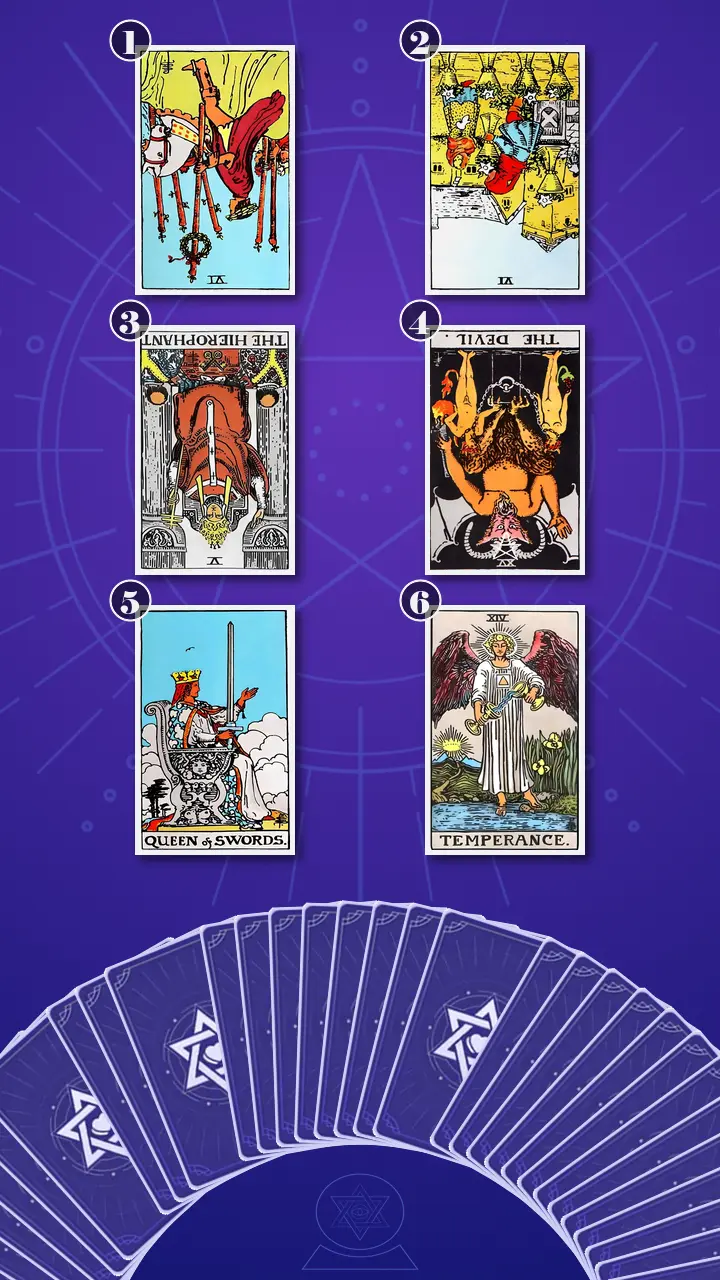
Today I used the Transformation Path Grid (6) · Context Edition. This six-position tarot spread is designed for a repeated relationship script rather than a single dinner decision. It shows how a visible behavior grows out of an older pattern, how an inherited rule starts to feel like a current requirement, where choice becomes possible, and which small action can turn insight into practice. That makes it a useful way to explore family-dinner people-pleasing and the question, “Why does dinner with my partner's parents feel like an audition?”
I explained the structure to Jordan and to anyone reading along: the first position would show the surface symptom, the second the repeated script beneath it, and the third the invisible family rule. The fourth would be the hinge, the precise choice point where compulsion could be noticed. The fifth would offer a relational experiment, and the sixth would show integration. Tarot works here through card meanings in context, not through a prediction about the parents' response. The cards could organize attention; Jordan would remain the person making every decision.
The Private Scorecard at the Table
The Rider Under Imagined Applause
Now revealed was the card for the surface symptom: the observable performance and emotional charge that appear when meeting the partner's parents. It was the Six of Wands, in reversed position.
The raised wand, laurel wreath, elevated rider, and surrounding onlookers made an ordinary dinner look like a public stage. In Jordan's condo-dinner scene, a polished work anecdote became a test. They watched both parents for the smallest sign of approval before deciding whether the story had succeeded, as if every nod, laugh, or follow-up question belonged on a private performance report.
Reversed, the Six of Wands showed an excess of outward Fire and a deficiency of settled confidence. Jordan's social energy was being spent on display and reaction-monitoring, so there was very little left for actually tasting the food, listening to the next story, or noticing what they wanted to say. The card did not suggest that Jordan should go silent or avoid family invitations. It suggested one observable experiment: share one prepared story, do not check the room for applause, and return attention to the next question.
Jordan gave a small laugh that carried no humour. “That is a little cruel,” they said. “It is exactly what I do. I call it being polite, but I am tracking every pause, laugh, and facial expression like a private scorecard.”
“I do not hear cruelty in the card,” I replied. “I hear accuracy without blame. A protective habit can be understandable and still leave you exhausted. A family dinner is not a performance review, even when your body has been preparing one.” Jordan's mouth tightened, then softened. They looked down at the card for a long moment, recognition arriving with a thin edge of irritation.
The Old Template in a New Dining Room
Now revealed was the card for the repeated script: the old relational pattern being reenacted beneath the dinner behaviour. It was the Six of Cups, in reversed position.
The children exchanging flower-filled cups and the figure walking away with a cup suggested an emotional rule carried from one household into another. When a parent asked Jordan a neutral question about work, relationships, or future plans, Jordan did not only hear the words in the current dining room. I could see them comparing the parent's tone with earlier family interactions and preparing for disappointment before any disappointment had actually appeared.
I asked Jordan to hold two images side by side. On one side was the present room: a parent asking a normal question, the dishwasher clicking in the background, a fork resting against a plate. On the other was the older emotional template being carried into that room: the rule that warmth had to be earned by being interesting, agreeable, and easy. “They only asked a normal question, so why does my body hear a test?” Jordan said quietly.
The reversed Six of Cups is not a diagnosis of the parents, and it is not proof that the past controls the present. Its blockage is that familiar emotional memory has been allowed to speak before present evidence has had a chance. I watched Jordan's fingers go still on the edge of the card. Their eyes lost focus as if replaying a conversation, then their chest rose on a shallow breath. I gave the silence time to settle before saying, “A pause is a pause, not a verdict. Let us ask what was said, and separately, what the old script added.”
The Invisible Family Handbook
Now revealed was the card for the inherited rule: the intergenerational expectation or family norm Jordan may be treating as a requirement. It was The Hierophant, in reversed position.
The raised teaching hand, crossed keys, formal throne, and two students receiving instruction translated into the invisible family handbook Jordan had been trying to master. They had asked their partner for acceptable topics, family preferences, and the right way to respond, then treated each convention as a test of character. A custom, a favourite film, or a particular way of moving through dinner had quietly been promoted into an authority that could decide who belonged.
Reversed, The Hierophant showed a blockage around tradition and conformity. Jordan was not merely choosing courtesy. They were sometimes obeying an imagined rule that said disagreement was dangerous, silence was suspicious, and a good guest should never make the table work for their presence. I was careful with the distinction: the answer was not to challenge every family custom or reject ordinary kindness. The question was which courtesy reflected Jordan's own values, and which rule was being followed only to prevent judgment.
Jordan pressed their lips together and looked toward the window. “I think I have been searching for a handbook nobody actually gave me,” they said. “And because I cannot find the full version, I keep studying everyone's face for clues.” I nodded. The tightness in their jaw had not vanished, but the source of the pressure had become more specific. That specificity was already a little more breathable.
When the Loose Chains Became a Choice
The Hinge: The Devil in Reversed Position
Now revealed was the card for the choice point: the exact moment when Jordan can recognize compulsion and separate the past script from the present dinner. It was The Devil, in reversed position.
The room seemed to grow quieter around the card. Even the traffic beyond my window felt farther away. In the Rider-Waite-Smith image, the chains around the two figures' necks are loose enough to notice. The reversed energy is not a command to stage a dramatic break. It is the beginning of conscious choice: seeing the attachment to approval before automatically obeying it.
The modern version was easy to recognize. A parent expresses a different preference, and Jordan reaches for the safest phrase, “Whatever works for everyone.” The hand tightens around a glass. The breath becomes shallow. The mind supplies an emergency: make this easy, soften the opinion, repair the mood, do not let anyone wonder whether you belong. The chain is made from repeated edits, rehearsed answers, imagined consequences, and automatic apologies. It feels binding, but it can be observed before it is followed.
After fifteen years as a perfumer, I have learned to notice boundaries through scent. I use what I call an Enmeshment & Permeability Diagnosis to ask where one person's emotional atmosphere has diffused into another person's sense of self. I was not declaring Jordan's family enmeshed, and I was not calling a neutral pause toxic. My Atmospheric Toxicity Auditing also requires restraint: passive-aggressive tension and unstated resentment need a pattern of evidence, not one quiet moment. Here, the important question was simpler. When a parent's mood entered the room, did Jordan have to let it become an instruction?
“A scent can travel through a room without belonging to every person in it,” I told them. “The same is true of a pause or a different preference. You can notice the atmosphere without absorbing responsibility for it. Your boundary is not a wall against the family. It is the point where their reaction stops deciding what your words are allowed to be.”
I asked Jordan to picture the 7:14 p.m. dinner at their partner's condo: their story landed, the cutlery kept moving, and they immediately scanned three faces for proof that they were still welcome. Their shoulders rose before anyone had actually asked them to repair the moment. The old rule had already written the emergency.
“You can notice the inherited performance script without obeying it. One unedited response is not a risk assessment or a rebellion; it is a present-day choice to participate without turning belonging into a prize you have to win.”
You do not have to keep performing to earn a place at the table; choose one honest response and let The Devil's loosened chains mark the difference between inherited compulsion and present choice.
Jordan's fingers tightened around the water glass, and their breath paused halfway in. Their eyes widened, but stayed on the loose chains. For a few seconds, their focus seemed to move through the card, replaying a carefully softened text and the familiar dinner phrase, “Whatever works for everyone.” Their jaw released by degrees. The hand around the glass loosened, their shoulders dropped, and a rough exhale moved through the quiet room. Then their eyes shone, not with a promise that approval would arrive, but with the unsettling relief of seeing a choice they had been calling impossible. “I know I am editing myself, but if I stop, what happens to the mood?” they said, almost under their breath. I let the silence stay. Within ten minutes, I asked them to write one sentence they usually softened, underline the version they could say plainly, and remember they did not have to use it at dinner. The point was to notice the space between impulse and automatic appeasing. Now, I asked, use this view to revisit last week: was there a pause you could have left uncorrected?
Jordan did not suddenly look fearless. They looked more present, which mattered more. This was the first movement in the emotional transformation from performing to earn belonging and treating pauses as verdicts toward grounded participation, honest self-trust, and connection without self-erasure. The old script could speak without getting the final edit.
The Clear Sentence in the Open Air
Now revealed was the card for the relational experiment: a small, clear behaviour that expresses authenticity without forcing a confrontation or making a decision for anyone else. It was the Queen of Swords, in upright position.
The upright sword became a clean line between what Jordan actually knew, what they were assuming about the parents' reaction, and what they could say in one clear sentence. If someone asked which restaurant, film, or weekend plan Jordan preferred, the Queen did not require three agreeable options followed by an apology. She offered direct perception, proportion, and enough independence to let other people have their own responses.
This was Air in balance rather than the sharpness of defence. The open hand and direct gaze suggested that honesty did not have to become a challenge. “You can be courteous without becoming a polished version of yourself,” I said. “A concise truthful answer respects your view and their autonomy at the same time. It does not need to persuade the table that your preference is correct.”
Jordan sat a little straighter. “So I can say I prefer one film, and I do not have to explain my entire history with cinema to make the preference acceptable?”
“Exactly,” I said. “One honest sentence is participation, not provocation.” I watched the familiar impulse cross their face, the quick calculation of how a parent might react. This time Jordan breathed before moving on. The urge was still there, but it was no longer the only voice in the conversation.
Two Cups, One Conversation
Now revealed was the card for integration: the healthier way of participating in family contact while preserving self-respect and connection. It was Temperance, in upright position.
The angel's two cups exchanging liquid, one foot on land and one in water, and the path toward distant light gave the reading its closing image. Jordan could bring a genuine opinion to dinner, listen when a parent chose differently, and allow both realities to remain in the room. Temperance did not ask them to agree quickly, withdraw completely, or turn difference into a test.
Upright, this was balanced Water and Air becoming a sustainable rhythm. Courtesy and authenticity could share a conversation. The goal was not guaranteed approval from the parents, and no card could promise that. The goal was a recognizable Jordan at the table, present enough to enjoy a side dish, ask a genuine question, tolerate a three-second pause, and let connection develop without constant approval management.
I asked, “If your preference and a parent's different preference could both remain in the room, what would a measured version of you sound like?” Jordan looked at the two cups and answered after a pause they did not rush to repair: “Probably simpler than I think. Maybe, 'I prefer this one, but I am happy to hear what you like about the other.'” That was not a perfect script. It was a usable sentence.
From Insight to Action: Courtesy Without the Costume
When I placed the six cards back into their grid, the sequence answered why the dinner kept becoming an audition. The reversed Six of Wands showed the visible performance and private scorecard. The reversed Six of Cups showed an old emotional template carried into a new dining room. The reversed Hierophant named the invisible family handbook that made conformity feel like the price of belonging. The reversed Devil exposed the attachment and, crucially, the looseness of its chains. The Queen of Swords supplied clear language, while Temperance showed how that language could become a steady relational rhythm.
The core contradiction was not a choice between being kind and being real. Jordan wanted to be courteous to their partner's parents, yet feared that stopping the performance would expose them to judgment. The cognitive blind spot was treating the parents' possible reaction as evidence about Jordan's worth, then assuming that more preparation could finally create a guarantee. No amount of rehearsing could make another person's face perfectly legible.
The transformation direction was practical: at each dinner, replace approval-monitoring with one unedited opinion and one genuine question, then let the conversation continue without repairing every pause. I remembered something perfumery taught me: when a scent is too concentrated, adding more of it does not create a clearer impression. Sometimes clarity comes from giving the air space. The same principle applied here. Jordan did not need a stronger performance. They needed a little less diffusion of other people's reactions into their own centre.
I offered three small next steps. These were experiments, not tests, and success would mean observing Jordan's own behaviour rather than producing a particular response from the parents.
- The One-Unedited-Answer ExperimentBefore the next dinner, use two minutes in the TTC Notes app or while waiting outside to write one sentence beginning with “Honestly, I prefer...” about a low-stakes film, side dish, commute, or weekend plan. Say it once to the table, then ask one genuine question or turn attention to the next speaker instead of checking both parents' faces.Use the minimum version: one preference, no supporting essay. Courtesy is still available, and if a conversation becomes disrespectful or unsafe, you can pause, change the subject, or leave.
- The Approval-Monitoring SwapAt the next dinner, choose one approval check to skip, such as scanning the parents' faces after a story. When the impulse to say “whatever works for everyone” appears, take one breath and leave one harmless pause alone for three seconds before deciding whether anything needs to be said.Define success as noticing the urge and choosing deliberately, not as making the parents respond warmly. Freedom does not require turning ordinary courtesy into a rebellion.
- The Quarantine Zone ProtocolWithin an hour after dinner, set a five-minute timer and make two short columns in Notes: “what was said” and “what the old script added.” Write one interpretation that stays open to the facts, then record one moment when you participated, listened, or enjoyed something without scoring it before closing the app.This psychological airlock prevents dinner's atmosphere from bleeding into the rest of your adult life without cutting you off from the family. When the timer ends, switch to a neutral activity and do not ask your partner to certify your worth.
I told Jordan that this was the whole point of actionable advice: a sentence, a breath, a pause, and a time-limited debrief were enough for the next dinner. The cards had not made a decision on their behalf. They had helped Jordan see the inherited rule, test its authority, and choose a response in the present.

A Week Later, the Room Stayed Ordinary
Four days later, Jordan messaged me after a Sunday roast: “I said I preferred the lemon potatoes, then let the table go quiet for three seconds.” They slept through the night. The morning question, What if I got it wrong?, returned, but they smiled and kept making coffee instead of opening a transcript of the meal.
At the next dinner, one parent chose a different side dish and the conversation moved on. Jordan did not report a cinematic breakthrough. They reported noticing the room, tasting the rosemary, and hearing their own sentence remain intact. The change was small and slightly bittersweet: the old fear had not disappeared, but it no longer had to run the entire evening.
I call that finding clarity, not because the parents' approval became certain, but because Jordan became less willing to abandon themselves in exchange for certainty. The Transformation Path Grid had offered a map. Jordan was the person walking it, and the direction belonged to them.
When you sit at a family table with your shoulders lifted and your next sentence already edited, it can feel safer to be impressive than visible, because an old rule says an unpolished version of you might lose its place. Yet the old script can speak without getting the final edit. A family dinner is not a performance review, and a pause does not have to carry the scent of a verdict.
As you consider the Transformation Path Grid (6) tarot spread for your own meet-the-parents anxiety, if one ordinary, unedited part of you could remain in the conversation without proving anything, what might you notice about the meal?