The Draft That Felt Pointless: One Question Before the Next Pass
The 9:12 Cursor: Finding Clarity in Revision Paralysis
At 9:12 on a Tuesday, I recognized the pattern before I asked a question. Casey was a 27-year-old junior communications writer in Toronto, and the moment a Google Doc filled with tracked changes, changing the title became the safest task on her list.
I watched her sit at the shared office desk with fourteen unresolved comments open beside the draft. The radiator clicked behind her, stale coffee tasted bitter on her tongue, and the cursor blinked beside the same opening paragraph while she changed the heading font, renamed the file, and glanced toward Slack. Her shoulders sank as if the document had acquired its own gravity.
She finally looked at me and said, 'Why do I keep avoiding revisions when each new draft feels pointless? I can write the first version, but the moment I have to make it better, I start looking for a new angle or a clean file.'
I heard the contradiction clearly: she wanted to improve the draft through revision, but feared that another pass would still feel flat and prove that the effort, or even her ability, was not worthwhile. Her discouragement was not a vague mood. It felt like trying to push a stalled streetcar uphill while the next stop kept moving farther away, with a tight jaw, heavy shoulders, and a restless hand reaching for another tab.
I told her, 'I am not going to use the cards to predict whether this draft succeeds. I use tarot as a structured thinking tool, a way to make a pattern visible enough for you to examine and choose differently. You remain the person steering your work. Today, we can give this revision paralysis a map and see whether one small piece of clarity is already available.'
The Shadow Spread and the Marked-Up Map
I asked Casey to place both feet on the floor, notice the chair beneath her, and take three unhurried breaths. I shuffled slowly while she held the question in mind. For me, this is a transition into focus, not a performance of mystery: we are narrowing attention so the problem can be observed without making it larger.
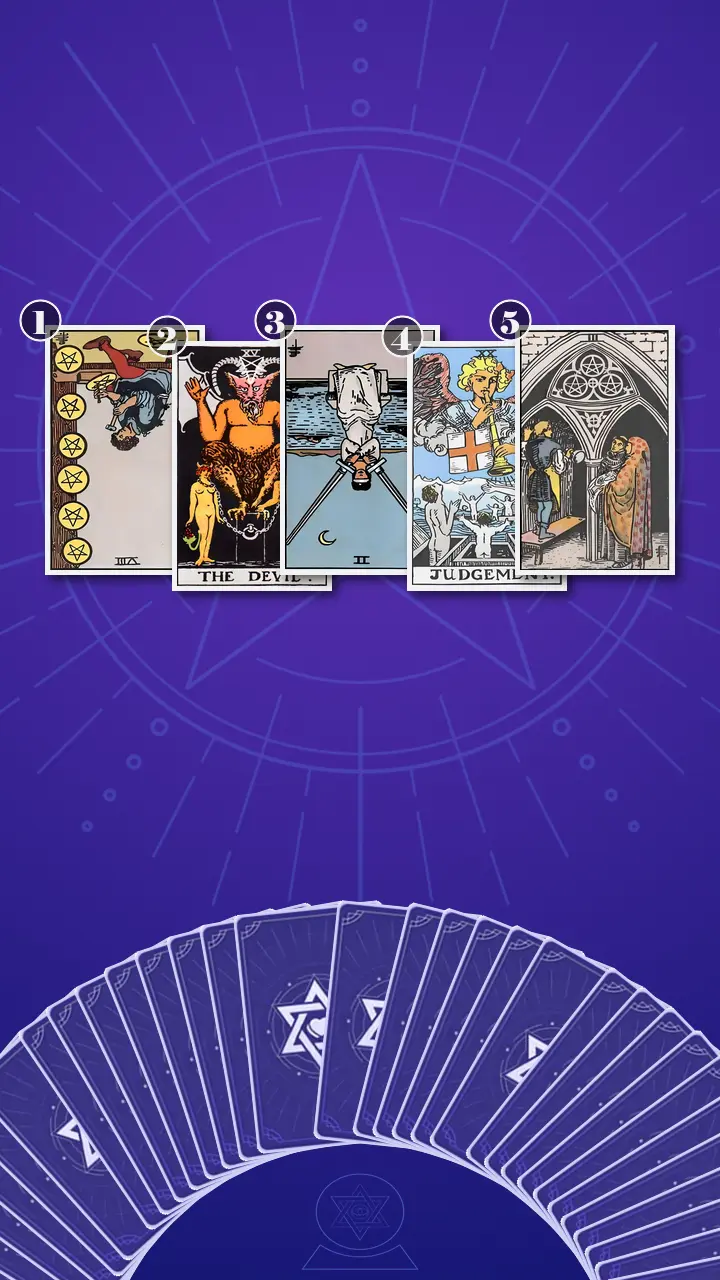
I chose a five-card layout called The Shadow Spread. Its rationale is practical: it is a compact introspective structure that moves from the behavior I can see, to the hidden attachment feeding it, to the inner stalemate, then toward an interrupting insight and a grounded practice. It is especially useful when someone asks, 'Why do I keep avoiding revising my writing?' because it explores choice and behavior without pretending to decide the outcome.
For anyone wondering how tarot works in this kind of reading, the cards give us a sequence of images and questions. They do not replace judgment or professional advice. They help us read card meanings in context. The first position shows the visible shadow pattern, the second reveals the hidden rule beneath it, and the third makes the unresolved decision visible. The fourth is the turning point, and the fifth asks what the insight can look like at an ordinary desk during an ordinary workday.
I placed five cards in a straight line, like a marked-up draft moving from a recurring margin problem toward a clear revision plan. The first three would show why the cursor kept becoming a performance review. The final two would ask what might happen if Casey stopped demanding a meaningful feeling before allowing herself to make a useful edit.
The Repetition That Looked Like Work
Position 1: The Visible Shadow Pattern, Eight of Pentacles Reversed
'Now I am turning the card that represents the visible shadow pattern currently operating in your life,' I said. 'This position shows what I could watch you do between opening the document and avoiding the substantive edit.'
The card was the Eight of Pentacles, in reversed position. In the Rider-Waite-Smith image, a solitary craftsman repeats his work at a bench, with completed pentacles lined up beside him. Reversed, the energy is not a lack of effort. It is stagnant Earth: repetition has lost its defined purpose, so activity continues without producing a result that can be recognized as evidence.
I connected it directly to the scene in front of us. At 9:12, Casey opened the existing draft, saw fourteen comments, reread the first page, changed the title style, renamed the file, and answered Slack while the central claim remained untouched. This was the modern translation of the repeated pentacles: a stack of nearly identical draft versions beginning to feel like proof that more effort would only repeat the same disappointment.
I said, 'You are not short on effort; the effort has been given no test it can pass. When the task is simply make the whole draft better, every action can feel busy and none can tell you whether it helped. The revision needs a question before it needs more motivation.'
One of my diagnostic lenses is called Cognitive Tempo Calibration. I use it to notice when the demands of a task, such as repeated decisions under uncertainty, are badly mismatched with a person's natural working rhythm. In Casey's case, each tracked comment asked for a different kind of judgment, but her attention was already flattened by deadline pressure, rent, commuting, and a full inbox. The mismatch created a restless rhythm: cosmetic edits gave her quick beats of completion, while the central argument required a slower beat with no guaranteed emotional reward.
As I described the scene, I heard the sentence she had been carrying: 'If I cannot see how this pass fixes the whole thing, doing one edit will only waste more time.' Casey did not nod. She gave a small, bitter laugh first, then her breath paused and her fingers hovered above the keyboard. Her eyes moved from the card to the fourteen comments as if replaying the morning, and finally she exhaled through her nose.
'That is painfully specific,' she said. 'I do exactly that before I close the file.'
I let the laugh stand without turning it into a confession of laziness. I told her that the visible pattern was useful precisely because it was observable. A twenty-minute pass on one paragraph could create information; a new title could only create the feeling of having postponed the real test.
The Contract Hidden in the Comment
Position 2: The Hidden Attachment, The Devil Upright
'Now I am turning the card that exposes the hidden attachment feeding the pattern,' I said. 'This position asks what private rule turns an ordinary revision note into a compulsory test of whether you are capable of producing worthwhile work.'
The Devil appeared upright. I did not present it as a threat. In the RWS image, the chains around the two figures' necks are visibly loose. The card can describe attachment, compulsion, and fear-based control, but its most useful detail here is that the bondage is maintained by a rule that can be noticed and renegotiated.
I translated the image into Casey's workday. A manager leaves a neutral comment asking her to clarify the audience takeaway. Before she changes a sentence, the note becomes an imagined performance verdict: if the reader still does not understand the paragraph, then perhaps hiring her was a mistake. The draft becomes a trap. Revising risks confirming that the work is still flat; avoiding preserves the possibility that she could have fixed it if only she had found the right angle.
'The edit became heavy when it was asked to carry your self-worth,' I said. 'This paragraph is not merely allowed to be weak. Under the hidden contract, it has to tell you whether you deserve to call yourself capable. That is a lot for one paragraph to carry.'
Casey's jaw tightened. She pressed her tongue briefly against the inside of her cheek, looked down at the loose chains in the card, and reread the sentence connecting revision with worth. Then she pulled her shoulders back as if she wanted to argue with me but had not yet found a safe argument.
I asked, 'What are you trying to prove when you demand that the next draft feel meaningful before you let it exist?'
She answered quietly, 'That I am not secretly bad at this. That I belong in the role. If the next draft still feels pointless, I will have proved that I cannot fix it.'
I said, 'The card is showing an internal contract, not an external fate. You can revise the contract. A draft can report what a reader needs without ruling on who you are.'
Two Versions, No Safe Choice
Position 3: The Inner Stalemate, Two of Swords Reversed
'Now I am turning the card that shows the inner conflict behind the avoidance,' I said. 'This is the stalemate between tolerating an imperfect revision process and protecting yourself from another discouraging result by postponing, researching, or starting over.'
The Two of Swords appeared in reversed position. The blindfold and crossed swords in the RWS image became Draft_v7 and Draft_v8 open in split screen. One comment suggested cutting context. Another asked for more explanation. Casey kept searching for the perfect editing criterion that would settle both, as if the correct choice might announce itself before she made any change.
Reversed Air showed a blockage in judgment that had begun spilling into scattered attention. It was not a lack of intelligence. It was an unresolved choice held in place so long that every option began to feel equally dangerous. She could clarify the argument, but maybe the structure was the real problem. She could revise the existing version, but perhaps a fresh draft would be cleaner. She could choose one goal, but choosing the wrong one might make the whole pass feel wasted.
I asked her to name only two possible revision aims. She wrote, 'Clarify the claim' and 'Shorten the setup.' I told her to circle one for today and place the other on a deliberately deferred list. Deferring was not abandoning it. It was giving the decision a boundary.
Casey went quiet. I watched her eyes move between the two imagined goals, then down to the blank space beneath them. Her hand tightened around the pen, released it, and wrote, 'Clarify the claim, this pass only.' The physical movement was small, but the competing choices were no longer floating through the whole document.
'I keep waiting for total certainty,' she said. 'But I think I have been using more research to avoid choosing.'
'That is the useful distinction,' I replied. 'A provisional choice is not a permanent commitment. It is one way to let the draft answer a question.'
When Judgement Asked a Better Question
Position 4: The Awareness That Interrupts the Cycle, Judgement Upright
I paused before turning the fourth card. The radiator stopped clicking for a moment, and from the street below I heard a streetcar bell travel through the glass. The room seemed to make space around the next image.
'This is the awareness that can interrupt the cycle,' I said. 'It moves you from treating each draft as a verdict to using revision as a bounded experiment that produces information.'
I turned the card. It was Judgement, in upright position.
The RWS trumpet became a feedback signal I could hear without turning it into a sentence. The gray figures rising from their coffins suggested old conclusions being revisited, not people being condemned. For Casey, the card did not mean an external authority would announce whether the writing was good. It meant she could review one passage honestly and respond to what it revealed about the reader's experience.
I also used my second diagnostic lens, Focus Disruption Auditing. I listened for the dissonant chords that kept shattering her deep-work flow: the neutral comment becoming a verdict, the two competing edit aims, the Slack badge offering a clean endpoint, and the unfinished draft demanding an emotional guarantee. Once those chords were separated, the problem was no longer one giant failure. It was a set of specific interruptions that could be answered one at a time.
At 9:12 on Tuesday, the cursor had blinked beside the same opening paragraph while fourteen comments waited in the margin. Casey had renamed the file, checked Slack, and felt her shoulders drop because she wanted a better draft but dreaded what another pass might prove. I asked her to hold that scene beside the trumpet and listen for a different question.
A draft does not have to prove its worth before you revise it. Give the next pass one question, and let the change produce evidence instead of a verdict.
You do not need to keep treating each draft as a verdict of your worth; answer Judgement's trumpet by reviewing one specific passage, naming what it teaches, and letting that evidence guide the next version.
Casey's fingers stopped above the keyboard. First, her breathing froze and her pupils widened slightly, as if the sentence had interrupted a familiar reflex. Then her gaze left the card and lost focus, moving through the memory of the manager's comment, the fresh file, and the unopened paragraph. Finally, her shoulders lowered; the fist she had made beside the trackpad loosened finger by finger. Her eyes shone, but her voice stayed steady enough to say, 'So the comment can be evidence about the reader, not evidence that I am a bad writer.' A small, shaky breath followed. The relief did not erase the deadline or make the draft suddenly brilliant. It left a brief, tender blankness where the verdict used to be, along with the responsibility of choosing what to test next.
I asked her immediately, 'Now, use this new lens to remember: was there a moment last week when this insight could have made you feel different?'
She recalled a paragraph that had been labelled unclear even though the rest of the piece was usable. She had spent an hour comparing polished campaign examples, then opened a fresh file. When we looked again, she saw that the audience did not appear until the fourth sentence. Moving that information to the first sentence would not solve the whole draft, but it would answer one question about reader orientation.
This was the first real crossing in the emotional journey from self-worth-protective avoidance and discouragement toward curious, evidence-based revision. It was not a triumphant leap. It was the moment Casey could feel discomfort after choosing one bounded edit without immediately treating that discomfort as proof that the work had no future.
The Work Becomes Visible
Position 5: The Grounded Practice, Three of Pentacles Upright
'Now I am turning the card that translates the insight into action,' I said. 'This position asks what you can practise for one week: one targeted revision, one focused feedback question, and one recorded piece of evidence.'
The Three of Pentacles appeared upright. In the RWS image, an artisan stands within an architectural structure while two observers hold a plan. The card shows skill becoming visible through specific work, useful collaboration, and a defined place for each contribution. It does not ask the artisan to build the entire cathedral alone before anyone is allowed to look.
I connected it to Casey's next move. She would share one paragraph with a trusted colleague and ask, 'After one read, what do you think this paragraph wants the audience to know?' Then she would add a boundary: 'No line edits needed. I am checking clarity only.' The colleague's response would not be a global evaluation. It would be one observation she could use to make one substantive change.
The energy had returned to grounded Earth, but it was no longer the solitary repetition of the reversed Eight of Pentacles. Judgement had introduced the fire of honest review, and the Three of Pentacles gave that awareness a plan, a witness, and a visible piece of craft. The work could be shared before it felt complete.
Casey opened a blank note and typed the feedback question. I saw her thumb hover over the send button, then move away.
'I can handle asking about the paragraph,' she said, 'but I cannot handle someone giving me feedback on the whole document.'
'Then do not ask for the whole document,' I said. 'Scope is part of the practice. You are allowed to make only one part visible.'
She nodded once, not with certainty, but with enough willingness to put the question somewhere outside her head.
A Draft as Data, Not a Verdict
When I laid the cards together, I could see the whole story. The reversed Eight of Pentacles showed effort scattered across formatting, inbox replies, research tabs, and clean new files because no pass had a defined craft question. The Devil revealed the hidden contract beneath that activity: one paragraph had been asked to prove Casey's worth. The reversed Two of Swords turned that contract into decision gridlock, keeping revision and starting over open at the same time. Judgement broke the loop by making review a way to hear information, and the Three of Pentacles grounded the change in visible, collaborative craft.
The cognitive blind spot was not simply that Casey avoided hard work. She was using emotional certainty as her progress metric. If the whole draft did not suddenly feel meaningful, she discounted a clearer sentence, a stronger audience signal, or three removed distractions as if those changes did not count. She was reading version history like a criminal record instead of lab notes.
The shift is straightforward, though not always easy: replace the demand that each new draft feel meaningful with a one-pass revision that names one change to test and one piece of evidence to review. A draft is working material. It can teach her what the next version needs without being allowed to deliver a sentence about her value.
I adapted my Syncopated Study Session for Casey's writing desk. The protocol normally breaks an overwhelming academic task into harmonious, frictionless micro-beats, and here the same rhythm fits revision: choose one beat, make one change, record one observable difference, then stop before the work turns back into a referendum. Casey did not need to force a new personality onto the process. She needed a rhythm with fewer dissonant chords.
The One-Question Revision Pass
I gave her three small next steps. Each one was optional, bounded, and designed to produce information rather than demand a feeling of total success.
- Name one testBefore the next revision session, type one question at the top of the existing document, such as 'After one read, can the reader identify the main takeaway of paragraph three?' Keep every other issue in a later-passes note.If a paragraph feels too large, test one sentence. Choosing one question is enough to begin.
- Run one rhythm beatUse the Syncopated Study Session at the desk: set an eight- to twenty-minute timer, revise only the selected paragraph for the stated purpose, save the original beside the new version, and write one factual difference underneath.Stop when the timer rings, even if you could continue. A shorter pass is still a complete experiment, and continuing is optional.
- Ask for scoped evidenceSend one paragraph to a trusted colleague in Google Docs and ask, 'After one read, what do you think this paragraph wants the audience to know?' Add, 'No line edits needed; I am checking clarity only,' then make one substantive change based on the response.If sharing feels too exposed, read the paragraph aloud and write what you understood after one pass. Keep the feedback scope narrow enough to feel usable.
When Casey looked at the twenty-minute timer again, I could see the old objection gathering in her shoulders. 'But I do not even have twenty minutes some days,' she said. 'There is Slack, the commute, and a deadline in two days.'
'Then use eight minutes,' I replied. 'The point is not to rescue the whole document. The point is to give one small piece of effort a test it can pass. You can also paste the paragraph into a temporary file if the tracked changes feel too loaded. The choice remains yours.'
I repeated the distinction once more because practical clarity benefits from plain language: revision is data, not a referendum on your ability. Give the pass one question before you ask it for meaning.
A Week Later, the Quiet Proof
Four days later, Casey sent me a message from a cafe near St. Clair West. She had completed an eight-minute evidence pass, moved the audience cue into the first sentence, and logged the change without rating the whole piece. Her message ended with, 'It still needs work, but now I know what the next question is.'
She slept through the night after the pass, then woke with the old thought, 'What if I am wrong?' She smiled at it, opened the document, and checked the one sentence she had changed. The question remained, but it no longer held the keyboard hostage.
I think of that as the first useful proof of the Journey to Clarity. The cards did not fix Casey's draft or decide her career. They helped her hear the difference between a verdict and information, then she made the choice that turned that difference into practice. Her confidence began to come from visible craft progress rather than from waiting for the page to feel meaningful.
If you also know the moment a cursor blinks and your jaw tightens because one ordinary, imperfect pass feels dangerously close to confirming that your work, and therefore you, were never worthwhile enough, I want you to know that noticing the rule has already made a little room around it.
If your next pass did not have to prove anything about you, what is the smallest question you would be curious to let one paragraph answer before the Slack tab or a fresh file takes the choice away?