At 10:47 p.m., Revision Fatigue Turned Toward One Testable Change

Finding Clarity in the 10:47 p.m. Window: Outcome-Dependent Revision Fatigue After Repeated Manuscript Feedback
If you are a Toronto PhD candidate revising after another “promising, but further changes are required” email, revision fatigue can make the third round feel less like progress and more like proof that the first two did not count. I want to begin there, before a single card is turned.
I met Jordan (name changed for privacy) at 10:47 p.m. in the shared Toronto apartment they had described in their message. I saw Word Track Changes open beside three earlier PDFs on a chipped kitchen table. The refrigerator hummed, the coffee had gone cold and metallic, and the laptop fan warmed their wrists as they changed Heading 2 to 11-point type, highlighted a repeated phrase, and left the comment about rebuilding the central argument untouched.
When I asked what had brought them to the reading, Jordan said, “Why do I stop believing revisions matter after each resubmission? By the third round, every comment feels like proof that the last round was pointless.” I could see the contradiction in the way their shoulders held themselves: they wanted each resubmission to make the manuscript meaningfully stronger, yet another request for change already seemed to prove that substantive effort could not alter the response. The discouragement was not an abstract mood. It was like a heavy wool coat fastened around the ribs, making the document feel heavier each time the cursor blinked.
I did not lecture them or promise that the next decision would be different. I said, “We can look at what happens between the feedback and the next edit. We are not here to force optimism. We are here to separate the work you can inspect from the answer you cannot control, and to draw a map through the fog.”

Choosing the Four-Layer Insight Ladder
I asked Jordan to place both feet on the floor, take three unhurried breaths, and hold the latest comment in mind without solving it. I shuffled slowly. For me, this is a focusing transition, not a supernatural test. It gives the mind a clean edge between receiving a problem and examining it.
I chose the Four-Layer Insight Ladder, a four-card RWS spread within the F5 Inner Excavation framework. This question is not really about predicting an acceptance, choosing between external options, or discovering a fixed fate. It is about the internal belief loop that turns repeated review into evidence of futility and diminished control. The ladder lets me examine the visible revision stall, the belief beneath it, the perspective that can interrupt it, and the practical craft that can carry the insight forward.
For the reader following this consultation, the logic is deliberately straightforward. The first position reveals the observable revision stall. The second reveals the underlying equation between an unchanged response, lack of control, and the fear that previous effort had no value. The third is the transformation layer, where review can become a conscious call rather than a verdict. The fourth translates that shift into shared criteria, early calibration, and visible evidence of improvement. A Celtic Cross would add contextual and prospective positions that this focused question does not need, while a three-card line would risk collapsing either the root belief or the practical integration.
How tarot works here is not that the cards decide whether Jordan should continue. The cards give form to patterns that are usually scattered across browser tabs, body tension, old comments, and half-finished edits. They make the hidden argument available for inspection.
The Ladder Out of the Review Loop
Position One: The Vine with No Visible Harvest
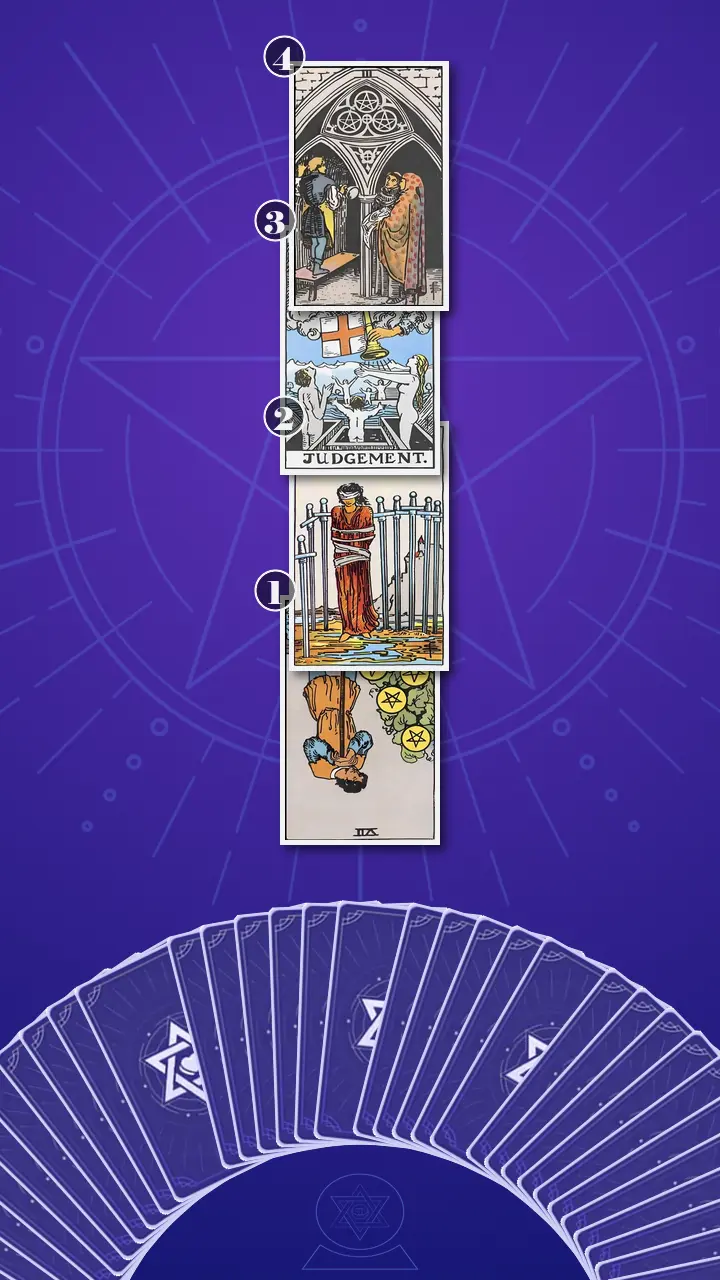
Now turning over is the card that reveals the observable revision stall: Jordan’s diminishing effort, cosmetic editing, and loss of belief after another resubmission. It is the Seven of Pentacles, in reversed position.
In the RWS image, a worker leans heavily on a staff and looks down at a vine crowded with pentacles. I saw Jordan in that downward gaze. At 10:47 p.m., they opened four versions of the manuscript and counted the revision rounds before reading the newest substantive concern. Because no acceptance had arrived to serve as the harvest, they treated the previous changes as though they had produced no return. Headings, references, and repeated phrases offered immediate completion, while the central argument remained untouched.
The reversed energy was a blockage in the relationship between effort and evidence. Delayed results had created an excess of scorekeeping and a deficiency of trust in observable craft. Jordan was not lazy, and the card did not accuse them of lacking discipline. I saw a protective strategy: if a consequential change could receive an uncertain response, a low-risk formatting edit could at least provide a small, guaranteed sensation of completion. The difficulty was that this protection also made the manuscript less responsive to the feedback, which made another similar comment more likely.
I asked, “When you last opened the returned manuscript, which task did you do first, and which comment was still untouched when you closed the file?” I returned to the kitchen-table scene: the cold coffee, the refrigerator hum, the heading menu open, and the cursor resting beside the central comment. The inner sentence sounded almost practical: “I can make it cleaner, but I cannot make myself believe cleaner will change anything.”
Jordan gave a short laugh with a bitter edge. “I do the heading styles and references first too. That is almost rude.” I let the dry recognition stay in the room. Then I said, “The card is naming exhausted scorekeeping, not a character flaw. You are trying to find the receipt for your effort in the only place that feels official, the decision letter.” Jordan’s fingers stopped moving over the trackpad, and their mouth tightened before their shoulders lowered by a fraction.
Position Two: The Fence with a Gap
Now turning over is the card that reveals the underlying equation between an unchanged external response, lack of control, and the fear that previous effort had no value. It is the Eight of Swords, in upright position.
The blindfold and incomplete fence in the RWS image gave me the exact shape of the blockage. I asked Jordan to remember 7:36 a.m. on the TTC, between Bloor-Yonge and St George, when they opened a decision email while holding a pole with one hand. The carriage brakes squealed, wet coats smelled faintly of rain, and the phone vibrated against their palm. At the words “further clarification is needed,” their stomach dropped before they had read the specific request.
I heard the two browser tabs their mind had opened: “accepted” and “all previous work was pointless.” In that frame, a sharper claim, a more traceable method, clearer limitations, or easier navigation could not count as evidence because the external answer had not changed. The Eight of Swords did not say that Jordan secretly wanted to be trapped. It showed that the equation had become restrictive, while the gap in the fence suggested that the equation was incomplete rather than absolute.
I said, “An uncertain outcome is not the same as having no available move.” I watched the reaction travel through three small stages. First, Jordan’s breath paused and their thumb froze above the phone, as if the sentence had interrupted an automatic command. Then their eyes went unfocused; I could see them replaying the decision email and the previous revision sessions, searching for the moment when uncertainty had become a verdict. Finally, their fingers loosened around the edge of the chair, though the chest remained guarded.
They said, “If I cannot guarantee the answer will change, then I cannot prove the last round mattered.” I repeated the structure back without arguing with it. “That is the hidden sentence. It protects you from another disappointing investment, but it also makes every craft-level improvement invisible until someone else grants it a stamp.” Jordan looked again at the card, especially at the gap between the swords, and saved the distinction in their phone. The relief was brief and uncomfortable. I was not trying to turn it into certainty.
When Judgement’s Trumpet Changed the Question
The radiator clicked once. Outside, a streetcar bell sounded and faded, leaving the room unusually quiet. We had reached the card that would not offer a guarantee, but might change the question Jordan could act on.
Position Three: The Call That Is Not a Sentence
Now turning over is the card that identifies the cognitive and emotional shift capable of separating useful review from a verdict on worth and restoring Jordan’s capacity to respond. It is Judgement, in upright position, the catalyst in this reading.
In the RWS image, an angel sounds a golden trumpet while figures rise with open arms. I read the trumpet as a call that can be heard, interpreted, and answered, not as a courtroom sentence. I brought the decision-email notification back into the room and placed it beside the image. The signal could be received as a public rating, or it could be opened as a specific request: What can the reader still not see? What does the latest round reveal now that the earlier draft did not make visible?
This is where I used my signature lens, Academic Stratigraphy. At Cambridge and on archaeological digs, I learned not to confuse the newest exposed layer with the whole site. In a manuscript, I separate the foundation claim, the recent reviewer request, and the debris of verdict-shaped thoughts that has accumulated around them. A repeated comment is an exposed layer that needs a clearer connection, not proof that the foundation never existed.
I also named what I call Research Bottleneck Analysis. A creative or intellectual block is not automatically a personal failure. Sometimes it signals that the next layer of understanding has not been excavated yet. Jordan’s hesitation around the central comment was telling me where the argument needed a more precise question, not proving that they had no capacity to answer it.
At 10:47 p.m., the tracked-comments file was open beside three earlier drafts. Jordan had adjusted a heading, reread an old note, and waited for proof that the previous round counted before risking the central revision again. The question had narrowed to two tabs: accepted, or wasted.
Repeated review is not proof that your effort was wasted; choose a conscious response to what is newly visible, and let Judgement’s trumpet become a call to revise rather than a sentence on your worth.
For a moment, Jordan’s breath stopped halfway in. Their fingers tightened around the edge of the paper, and the screen’s blue light caught the slight widening of their eyes. Then their gaze lost focus; I could see them replaying the last decision email, the hours of edits, and the repeated phrase that had seemed to erase both. Their jaw worked once. “But does that mean I was wrong before?” they asked, with anger arriving before relief. I waited rather than correcting the feeling. “No,” I said. “It means the decision letter was never a complete instrument for measuring your work.” Their hand opened. Their shoulders dropped. A long breath left them with a slight tremor, and their eyes grew wet without spilling over. The release brought a moment of dizziness, not triumph, as if a room had been cleared and they now had to decide what to place in it.
I added, “A response can stay unchanged while the work changes. A revision matters when it makes one thing more precise, not only when it earns the answer you wanted.” Then I asked, “Now, use this new perspective to recall last week. Was there a moment when separating the response from the change could have made the next move feel different?”
I named the shift plainly. This was the first movement from outcome-dependent discouragement and protective withdrawal toward grounded agency through observable learning. Judgement did not promise acceptance, renewed motivation, or an easy next round. It gave Jordan a way to recognise that an external response could remain uncertain while a conscious response was still available.
Position Four: The Workshop Above the Ruins
Now turning over is the card that translates renewed agency into a bounded revision practice based on shared criteria, early calibration, and observable evidence of improvement. It is the Three of Pentacles, in upright position.
The RWS craftsperson standing on a raised bench, with two collaborators consulting plans beneath an arch, changed the emotional architecture of the reading. The manuscript no longer had to be a private site where Jordan excavated every ambiguity alone. The upright Earth energy was stable and practical: skill develops through plans, workmanship, feedback, and inspection before the whole structure is declared complete.
I translated the image into a fifteen-minute supervisor check. Jordan could turn one repeated comment into a row labelled Comment, My interpretation, Proposed change, and Evidence in draft. They could bring one before-and-after paragraph rather than a flawless manuscript. The question would not be, “Does this whole paper look better?” It would be, “Would adding this comparison at the end of the section address the scope concern, or am I solving the wrong problem?”
Jordan opened the notes app before I had finished speaking. I watched them type the four headings, then pause over the blank row. The hesitation remained, but the task had become smaller and more inspectable. “I do not need them to approve the whole draft,” they said slowly. “I need to know whether this proposed change addresses this comment.” I saw the first practical evidence of the Three of Pentacles: isolated prediction had begun to make room for shared calibration.
The One-Change Evidence Loop
I laid the four cards in a narrow vertical line and told Jordan the story I saw. The Seven of Pentacles reversed showed accumulated labour being judged only by a delayed harvest. The Eight of Swords showed that disappointment hardening into an accepted-or-wasted belief. Judgement interrupted that private verdict and asked for a conscious response to what was newly visible. The Three of Pentacles returned the energy to Earth, where one defined change could be examined with another person.
I used the image of Sisyphus only to name the old interpretation: one person pushing the same manuscript uphill while the outcome rolled back down. I did not want to romanticise that exhaustion. The Three of Pentacles offered a different structure, a workshop with plans, witnesses, and criteria. Repetition can produce skill when the process includes learning and calibration. It becomes demoralising when every return is treated as a referendum on whether the previous return counted.
The cognitive blind spot was allowing the decision email to act as the only analytics dashboard. It reported the external outcome while hiding whether the claim had become clearer, whether the method was easier to trace, whether the scope was more honest, or whether another reader could follow the structure with less effort. The transformation direction was therefore specific: move from measuring a revision by whether it secures the hoped-for response to defining one observable improvement, recording its evidence, and evaluating that improvement on its own terms.
I said, “Stop making the decision letter do all the measuring.” The point was not to ignore reviewers, dismiss repeated feedback, or pretend that craft-level improvement guarantees publication. It was to give feedback its proper role as information that can be interpreted and answered, rather than allowing it to become a total judgement on Jordan’s value or control.
Rebuilding the Draft Without Rebuilding Your Worth
I introduced my Thesis Stratigraphy Framework, a structural methodology I use to rebuild an essay outline when the core argument has become buried beneath intellectual clutter. I asked Jordan to work in layers: first identify the foundation claim, then place the literal reviewer request above it, then write the proposed structural change, and finally record the visible evidence that would show the connection is now clearer. One row was enough. The framework was not a demand to rebuild the whole manuscript. It was a way to let the core argument pierce through the debris one inspectable layer at a time.
I gave Jordan three small options. Each one was designed as a test of the new relationship between effort, evidence, and uncertainty, not as a test of their worth.
- Start the eight-minute before-request-after noteDuring one revision block this week, open the current Word document and a blank note, paste one substantive comment, and set an eight-minute timer. Write: “Before, the draft did...” “The comment is asking for...” and “After this change, a reader should be able to see...” Stop when the timer ends, without predicting the publication decision.If eight minutes feels too loaded after a research-assistant shift, copy the comment and finish only the sentence “What is newly visible here is...” Stopping is part of the boundary.
- Separate the fact from the verdictAfter the next decision email, divide one page into two columns labelled “What the message literally says” and “What I am treating it as a verdict on.” Add no more than three bullets to each side before choosing any edit. Use the exercise at the moment your shoulders, jaw, or stomach reacts to the feedback.If the split starts to feel like another form of overanalysis, write only one factual sentence and one verdict-shaped thought. The aim is distance, not a complete psychological explanation.
- Use the Thesis Stratigraphy Framework with one collaboratorBefore rewriting an entire section, make one row with Comment, My interpretation, Proposed change, and Evidence in draft. Send that row and one before-and-after paragraph to a supervisor, trusted peer, writing-centre adviser, or other appropriate reader, and ask for a fifteen-minute calibration check.You do not need to share the whole manuscript or make the section flawless first. Ask whether the proposed change addresses the quoted concern. If the right person is unavailable, draft the message without sending it and compare the row with previously agreed criteria.
I reminded Jordan that the minimum version of this practice could be one copied comment and one named difference. The goal was not to manufacture confidence before acting. It was to let confidence emerge, cautiously, from evidence that the draft had become more precise and that another person could inspect the reasoning with them.
A Week Later: The Quiet Proof
Five days later, I received a message from Jordan while I was sorting notes from an archaeological site report. It read, “I did the eight-minute note. The comment was asking for a mechanism, not a total rewrite. I sent one paragraph to my supervisor and asked whether the comparison answered it. I still hate the uncertainty, but I can see what I changed.”
The plan was clear but fragile: Jordan slept a full night, woke with the thought “What if I’m wrong?” and opened the one-comment note anyway. This time, the question did not close the document.
I did not read that message as proof that the next response would change. I read it as the first small piece of evidence that the response was no longer carrying the entire weight of measurement. The Journey to Clarity had not solved the manuscript or removed the possibility of another revision. It had returned authorship of the next bounded move to Jordan.
When the same file lands back in your inbox and your shoulders feel heavy before you reach the first comment, it can feel safer to change the margins than to risk discovering that even your best effort cannot control the answer. That protective move makes sense, but it need not be the only move.
If the next response did not have to validate the entire round, which one small change would you be curious to make visible to yourself or one trusted reader?